


INTRODUCTION
It is commonly accepted that an assemblage of heterospecific co-existing parasites (i.e. parasite community) is fragmented amongst (a) host individuals (=infracommunities); (b) host species within a locality (=component communities) and (c) localities (=compound communities) (Combes, Reference Combes2001). However, parasite communities can also be fragmented across different areas of the body of an individual host, so that a particular body area is characterized by a particular assemblage of parasites. Indeed, spatial segregation of parasites on host bodies have been reported for ecto- and endoparasites of fish, bird and mammal hosts (Lotz and Font, Reference Lotz and Font1985; Bush and Holmes, Reference Bush and Holmes1986; Cohen et al. Reference Cohen, Greenwood and Fowler1991; Ellis et al. Reference Ellis, Pung and Richardson1999). In ecological studies of arthropod ectoparasites of terrestrial hosts, this hierarchical level of parasite communities (we propose to call this assemblage of parasites a subinfracommunity) has largely been neglected. This may be due to: (a) the necessity of killing a host to investigate the distribution of parasites on its body; (b) technical difficulties in processing a host; and (c) the fact that total parasite counts per body area are time consuming. Nevertheless, a subinfracommunity can be a real entity especially for ectoparasites that attach once and/or do not move across the host body (e.g. ixodid ticks, ischnocerid lice and trombiculid mites). One of the ways to understand whether these subinfracommunities are indeed real entities is to test whether they are randomly assembled or structured.
Characterization of the structure (i.e. non-randomness) in species assemblages is an important aspect of community ecology and several approaches to detect the rules governing community structure have been proposed (e.g. Gotelli, Reference Gotelli2000; Gotelli and McCabe, Reference Gotelli and McCabe2002). The question shared by most, if not all, assembly principles is whether the observed frequency of co-occurrence of different species in a community differs from random. If non-randomness is recorded and the frequency of co-occurrence is higher than expected by chance, then the assemblage is aggregatively structured due to, for example, similar resource preferences; whereas if species co-occur less frequently than expected by chance, then the assemblage is segregatively structured due to, for example, competitive interactions (Krasnov et al. Reference Krasnov, Stanko, Khokhlova, Mošanský, Hawlena and Morand2006a , Reference Krasnov, Stanko and Morand b , Reference Krasnov, Matthee, Lareschi, Korallo-Vinarskaya and Vinarskie2010, Reference Krasnov, Khokhlova and Sherbrot2011; Tello et al. Reference Tello, Stevens and Dick2008; Pilosof et al. Reference Pilosof, Lareshi and Krasnov2012). However, as yet the structure of ectoparasite subinfracommunities has rarely been studied from this perspective. Kharadov and Chirov (Reference Kharadov and Chirov2007) provide a narrative of the distribution of chiggers on selected body areas of various rodent species, while a recent study by Pilosof et al. (Reference Pilosof, Lareshi and Krasnov2012) explored the structure of parasite subinfracommunities on rodent hosts but found that garmasid mite and flea species were not segregated across the body parts of a host (Pilosof et al. Reference Pilosof, Lareshi and Krasnov2012). However, both gamasids and fleas are highly mobile and easily move across the host's body, whereas the patterns in ectoparasites that attach to a host for a long time and do no move could be different.
Here we studied the structure of subinfracommunities of several trombiculid species (Acariformes: Trombiculidae) on a rodent host, Rhabdomys pumilio, in the Western Cape province, South Africa. Trombiculid mites are a highly diverse group of temporary ectoparasites of which only the larval stage (also referred to as a chigger) is parasitic, whereas the rest of the active stages (nymph and adult) are free-living. Chiggers are host generalists and exploit a wide variety of vertebrate and invertebrate hosts (Goff, Reference Goff1979; Dietsch, Reference Dietsch2008; Krantz and Walter, Reference Krantz and Walter2009). It is also not uncommon for a single chigger species to parasitize multiple co-occurring host species (Whitaker and Loomis, Reference Whitaker and Loomis1978; Goff, Reference Goff1979, Reference Goff1982). Furthermore, a single host individual is frequently parasitized by multiple chigger species (Daniel, Reference Daniel1961; Goff, Reference Goff1979, Reference Goff1982; Dong et al. Reference Dong, Guo, Qain and Wu2008) and in high numbers (Mohr, Reference Mohr1956). An individual chigger generally attaches once to a single host, and thus horizontal transmission does not usually occur (Krantz and Walter, Reference Krantz and Walter2009). The period of attachment to the host varies between species and can range between a few weeks and several months (Daniel, Reference Daniel1961).
The host, R. pumilio, is a locally abundant and regionally widespread rodent. Earlier studies have recorded a high diversity and abundance of ectoparasites, including chiggers, associated with this species (Matthee et al. Reference Matthee, Horak, Beaucournu, Durden, Ueckermann and Mc Geoch2007). The specific aims of this study were to determine whether (a) different chigger species differ in preferences for certain body areas of a host and (b) chigger assemblages among body areas of the same host individual, are structured and if so, whether the structure of these assemblages is aggregative or segregative.
MATERIALS AND METHODS
Sampling localities
A total of 108 R. pumilio, of all age cohorts, were trapped at two sampling localities in the Western Cape Province, South Africa, during the dry and hot austral summer (February) in 2013. Seventy-three of the animals were captured at Kanu (33° 88′ 94·53″ S, 18° 81′ 89·8″ E) and the remaining 35 were trapped at Mooiplaas (33° 92′ 10·62″ S, 18° 74′ 59·8″E). Both localities represent remnant fragments of natural lowland fynbos vegetation within an agricultural matrix. However, they differ with regard to landscape features. The habitat fragment at Kanu is smaller (14 ha) and more protected (within a shallow valley) compared to Mooiplaas (60 ha) which is more exposed and has a steep incline.
Sampling of rodents and removal of ectoparasites
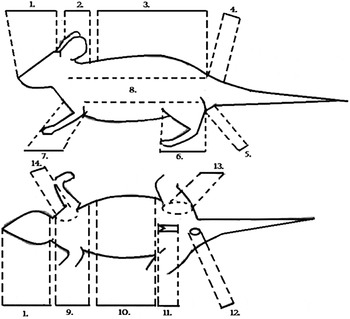
At each locality, rodents were sampled using 100 Sherman-type live traps during ten consecutive nights. Traps were placed in 3–4 line transects with 10 m spacing between traps, baited with peanut butter and oats and checked and closed in the morning at 9:00 and set again in the afternoon at 15:00. To prevent the exposure to extreme high temperatures, the traps were closed during the day and operated at night, dusk and dawn. Captured animals were taken to the laboratory where they were euthanized with intraperitoneal injection of sodium pentobarbital (200 mg kg−1), placed in pre-marked plastic bags and immediately frozen at −80 °C. Then, animals were thawed and carefully examined under a stereomicroscope. For each animal, we recorded sex, reproductive state (males: scrotal or non-scrotal testes; females: non-perforated or perforated vagina and pregnancy) and measured its body mass and length. The body of an animal was visually divided into 13 areas, namely head, ear, back, tail area, anal area, hind legs, front legs, sides, chest, belly, genital area, folds of hind legs and folds of front legs (Fig. 1). Chiggers were removed using scalpel and forceps and stored in plastic tubes containing 70% ethanol until mounting commenced. We recorded the body area from which each individual mite was removed. Chiggers were mounted on microscope slides with Hoyer's medium. Mounted specimens were initially divided into morpho-species groups. Thereafter, mites were identified to the genus level using taxonomic keys (Lawrence, Reference Lawrence1949; Zumpt, Reference Zumpt1961) and with the help of expert taxonomists Professors Lee Goff (University of Hawaii, Manoa) and Eddie Ueckermann (Agricultural Research Council, South Africa).
Divisions of the rodent body into 13 areas (sketch A is the side profile and sketch B is the ventral view of the rodent body) 1: Head, 2: Ear, 3: Back, 4: Tail area, 5 & 12: Anal area, 6: On hind leg, 7: On front leg, 8: Sides, 9: Chest, 10: Belly, 11: Genital area, 13: Fold of hind leg, 14: Fold of front leg.

Data analyses
Identification of preferred attachment sites
Data on chigger numbers found on each body area contained excessive counts of zero, as is the case with many parasite count data (Pilosof et al. Reference Pilosof, Lareshi and Krasnov2012). To account for the large number of zeros, we applied zero-inflated models (Zuur et al. Reference Zuur, Leno, Walker, Saveliev and Smith2009) to test for the effect of a body area on chigger count. Separate datasets were generated for each of the three most common chigger species (Leptotrombidium sp. nr. muridium, Schoutedenichia sp. and Neoschoengastia sp. A; see the ‘Results’). For each species we ran two models with mite count as a dependent variable and a body area as an independent variable. One model (M1) implemented negative binomial distribution of count component, whereas another model (M2) implemented Poisson distribution of count component. Because we thoroughly examined the whole body of each animal, both models assumed that false zeroes had the same probability (i.e. the probability to record a chigger was not related to the body area that was examined). Selection of the best model was done using Akaike information criterion (AIC). The significance of the estimated coefficients was tested against a reference level which was preselected as the body area with the highest mean count of chiggers, whereas the significance of the reference level (intercept of the model) was tested against zero (Pilosof et al. Reference Pilosof, Lareshi and Krasnov2012). A body area with the highest estimated count of a chigger species was assumed to be the preferred site for this parasite (Pilosof et al. Reference Pilosof, Lareshi and Krasnov2012).
Co-occurrence of chigger species within an individual host
Null model analyses of chigger co-occurrences were carried out using the software EcoSim Professional (Entsminger, Reference Entsminger2012). Only host individuals harbouring at least two of the three most common chigger species (see above) were included in the analyses. This resulted in a dataset of 95 host individuals. The parasite data for each host individual (i.e. infracommunity) were arranged in a presence/absence matrix in which rows represented chigger species and the columns represented body areas. We used the C-score (the average number of checkerboard units that are found for each pair of species; Stone and Roberts, Reference Stone and Roberts1991; Gotelli, Reference Gotelli2000) to quantify the co-occurrence of different species in each body area. An observed C-score was calculated for each presence/absence matrix (O, observed index) and compared with the C-scores calculated for 5000 randomly assembled null matrices (E, expected value). The simulated matrices were produced using fixed-equiprobable algorithm. This algorithm assumes that different body areas have equal probability to support a certain number of chigger species. We considered uninfested body areas as exploitable by chiggers, but non-colonized by chance (Gotelli and Rohde, Reference Gotelli and Rohde2002; Krasnov et al. Reference Krasnov, Stanko and Morand2006b ). An observed C-score larger than expected by chance (O > E) indicates a negative co-occurrence in a body area (i.e. species are segregated), while an observed C-score smaller than expected by chance (O < E) indicates that there is a positive co-occurrence and thus species are aggregated in certain body areas (Gotelli, Reference Gotelli2000). To further explore patterns of co-occurrence results across host individuals, we calculated the standardized effect size (SES) for each matrix. SES measures the number of s.d. that the observed index is above or below the mean index of simulated matrices (see details in Gotelli and McCabe, Reference Gotelli and McCabe2002) and is calculated by standardizing the difference between the simulated and observed index.
 $${\rm SES} = \displaystyle{{I_{{\rm observed}} -I_{{\rm simulated}}} \over {\acute{o} \,\,{\rm simulated}}}$$
To test the null hypothesis that the average SES across host individuals was zero we used one-sample t-tests. Assuming a normal distribution of deviations, approximately 95% of the observed SES values are expected to fall between −2·0 and 2·0.
RESULTS
Chigger species
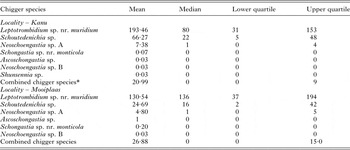
A total of 15 553 chiggers were recorded from 108 R. pumilio individuals. Seven chigger species (Ascoschongastia sp., Leptotrombidium sp. nr. muridium, Neoschoengastia sp. A, Neoschoengastia sp. B, Schoutedenichia sp., Schongastia sp. nr. monticola and Shunsennia sp.) were recorded of which all were recorded at Kanu and six of them except (Shunsennia sp.) were recorded at Mooiplaas (Table 1). Leptotrombidium sp. nr. muridium was the most abundant chigger species at both localities followed by Schoutedenichia sp. and Neoschoengastia sp. A (Table 1).
Mean and median chigger count (with lower and upper quartiles) recorded from R. pumilio trapped at two localities (Kanu and Mooiplaas) within the Cape Floristic Region, WCP, South Africa

* Data for all chigger species recorded at the specific locality combined.
Preferred attachment sites
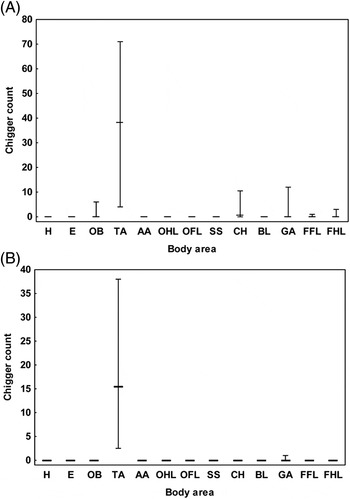
The model that implemented a negative binomial distribution of the count component (M1) was the best model for each of the three most abundant chigger species. AIC weights for M1 were 100% for all three species, whereas AIC weights for M2 (Poisson distribution of the count component) were zero. In two species (L. sp. nr. muridium and Schoutedenichia sp.) the counts on the tail area differed significantly from zero and from counts on the remaining body parts (Table 2, Fig. 2). The counts of Neoschongastia sp. A were the highest on the tail area, but the values did not differ significantly from zero and there was no significant trend for preferred body area (Table 2).
Median counts of Leptotrombidium sp. nr. muridium (A) and Schoutedenichia sp. (B) recorded in different body areas of R. pumilio. H, head, E, ears, OB, back, TA, tail area, AA, anal area, OHL, hind legs, OFL, front legs, SS, sides, CH, chest, BL, belly, GA, genital area, FFL, folds of front legs, FHL, folds of hind legs. Wiskers are lower and upper quartiles.

Zero-inflated model coefficients of chigger count on the tail area as compared to intercept for three chigger species

Establishing the level of co-occurrence between chigger species on the same body areas
Among the 95 chigger infracommunities on R. pumilio the observed C-score of chigger co-occurrence across body areas was never higher than expected by chance. More specifically, the observed C-score in 55 of the 95 infracommunities was significantly lower (P < 0·05) than expected by chance, in 15 infracommunities this difference was marginally significant (P < 0·09) and in the remaining 25 infracommunities the difference between the observed and simulated metric was non-significant (P > 0·05). The average SES value for the C-score values was −2·51 ± 0·09 and differed significantly from zero (t = −26·48, P < 0·001) and from −2 (critical value of SES) (t = −5·41, P < 0·001).
DISCUSSION
The results of the present study revealed that chiggers have a non-random distribution across the host body with an apparent preference by multiple species for the tail area. Furthermore, the frequency of co-occurrence between chigger species was in most cases higher than expected by chance. These results indicate that the aggregative structure of ectoparasites may not only be manifested at the scale of the entire host body (Bush and Holmes, Reference Bush and Holmes1986; Krasnov et al. Reference Krasnov, Stanko and Morand2006b , Reference Krasnov, Matthee, Lareschi, Korallo-Vinarskaya and Vinarskie2010, Reference Krasnov, Khokhlova and Sherbrot2011; Tello et al. Reference Tello, Stevens and Dick2008) but also at the level of a certain area of a body as well. Below, we discuss various mechanisms that can drive similar site selection pattern in different trombiculid species and thus their positive co-occurrences in subinfracommunities.
Over evolutionary time parasites have become adapted to maximize the benefit that they obtain from the resources extracted from a host (Marshall, Reference Marshall1981; Poulin, Reference Poulin1999; Morand et al. Reference Morand, Krasnov and Poulin2006). Different areas of the host's body differ in terms of skin thickness, hair type, level of exposure (to external climatic conditions) and microclimatic conditions (Marshall, Reference Marshall1981 Ma, Reference Ma1983; Pilosof et al. Reference Pilosof, Lareshi and Krasnov2012; Krasnov et al. Reference Krasnov, Shenbrot, Khokhlova, Stanko, Morand and Mouillot2014). Resource-type (e.g. food and shelter) and morphological adaptation of a parasite (e.g. feeding and attachment structures) determine its distribution across the host's body (Furman, Reference Furman1959; Murray et al. Reference Murray, Smith and Soucek1965; Marshall, Reference Marshall1981; Roubal and Quartararo, Reference Roubal and Quartararo1992). Chiggers attach to the skin of the host using minute cheliceral blades (examples of average cheliceral blade lengths are Radfordiana nudoseta 78 µm and Guntheria scrobiculata 34 µm) and thus might prefer to attach to areas where the skin is the thinnest (Dong et al. Reference Dong, Guo, Qain and Wu2008). Various studies have found that chiggers of rodents and insectivores readily exploit the ear, intranasal and anal areas (Nadchatram, Reference Nadchatram1970; Goff, Reference Goff1979, Reference Goff1982; Kharadov and Chirov, 2007; Dong et al. Reference Dong, Guo, Qain and Wu2008; Mariana et al. Reference Mariana, Mohd Kulaimi, Halimaton, Suhaili, Shahrul-Anuar and Nor Zalipah2011). A similar preference has also been observed in chiggers on lizards (occur in mite pockets) (Goldberg and Holshuh, Reference Goldberg and Holshuh1992) and bats (occur on wing membrane) (Spears et al. Reference Spears, Durden and Hagan1999; Morand et al. Reference Morand, Krasnov and Poulin2006). The present study, however, does not support a preference for thinner skin areas as chiggers were mainly recorded from the base of the tail.
A possible alternative explanation may be variation in microclimatic conditions provided by different body areas of the host. Host hair length and density varies across the body (Kuhn et al. Reference Kuhn, Ansorge, Godynicki and Meyer2010), which can influence the temperature and moisture levels close to the skin (Murray, Reference Murray1957; Marshall, Reference Marshall1981). Ectoparasites, and particularly larval stages of mites and ticks, are susceptible to desiccation (Benoit et al. Reference Benoit, Yoder, Lopez-Martinez, Elnitsky, Lee and Denlinger2006). In addition, the latter study suggested that moisture loss was significantly reduced when larvae clustered together. The type of hair of R. pumilio differ across the body and include long course hair covering the lateral and dorsal sides on the body (excluding the head), short fine hair covering the ventral parts and course hair in addition to a thick under coat of finer hair around the tail area (Matthee S., personal observation). It is thus possible that the thicker under coat around the tail area may provide a higher degree of thermal insulation to parasites that are attached to the skin compared to areas where the under coat might be absent (Marshall, Reference Marshall1981). It was also noted that the chiggers on R. pumilio often occurred in dense clusters (comprising multiple individuals and multiple species) which suggests that the microclimatic conditions on the host body is important for their survival.
In addition, hair composition can also influence the normal grooming behaviour and subsequent success of parasite removal (Mooring and Samuel, Reference Mooring and Samuel1998). In the latter study, it was found that grooming activities were significantly reduced in bison, which the authors attribute to a denser hair coat when compared to moose, elk and deer. Host-induced parasite mortality will also be influenced by accessibility of a body area to the host's grooming apparatus (Murray, Reference Murray1987). It is possible that the tail area of the rodent body is less accessible to grooming and that chiggers, or at least some species, may select the least groomed body areas. Unlike fleas and anoplurid lice that are capable of avoiding host defences (grooming) by moving around the host's body, chiggers are fixed in one place once attached (Marshall, Reference Marshall1981; Cohen et al. Reference Cohen, Greenwood and Fowler1991; Pilosof et al. Reference Pilosof, Lareshi and Krasnov2012). Therefore, it may be likely that these chiggers select the tail area of the host body for attachment as it provides a protective shelter in terms of thermal insulation and lower host-induced mortality risk.
A relatively unexplored hypothesis is the role of skin immune response in shaping the distribution of ectoparasites across the host body. The skin of mammals comprise of several layers (epidermis and dermis) that differ in thickness across the host body (McGrath and Uitto, Reference McGrath, Uitto, Burns, Breathnach, Cox and Griffiths2010). The outer layer (epidermis) itself comprise of four or five layers, depending of the body area, of which stratum spinosum contains Langerhans cells that are associated with immune response (Teunissen et al. Reference Teunissen, Kapsenberg, Bos and Bos1997). These cells respond to antigens, such as those injected by parasites into the host during attachment, and present them to epidermal T cells, thus stimulating a rapid and effective immune response (Tizard, Reference Tizard2013). Several studies on humans and rodents have indicated that the density of Langerhans and T cells varies across the body (Bergstresser et al, Reference Bergstresser, Fletcher and Streilein1980; Foster and Elbe, Reference Foster, Elbe and Bos1997). In rodents in particular the epidermal T cells are less abundant in the footpad and tail relative to ear skin (Foster and Elbe, Reference Foster, Elbe and Bos1997). Similarly Bergstresser et al. (Reference Bergstresser, Fletcher and Streilein1980) recorded significantly fewer Langerhans cells in the tail tissue of mice compared to back, ear, buccal mucosa or foot pad tissue. Based on this it is possible that the skin immune response to parasites will vary between body areas which may influence the selection of attachment sites by parasites. Although logical, this hypothesis is as yet speculative and remains to be tested.
In conclusion, different chigger species display similar preferences for attachment to certain body areas of a host. This results in their aggregative distribution across different areas of the host body. Little evidence exists for interspecific interactions and this therefore suggests that the distribution of chiggers across the host body is most probably driven by the similar microclimatic preferences and strategies to avoid host defences.
ACKNOWLEDGEMENTS
We wish to thank Cape Nature for granting a research permit for trapping the small mammals (No. 0035-AAA007-00423). Private landowners are thanked for allowing us to trap on their properties. We are grateful to Luther van der Mescht and Gert Malan for field and technical assistance. The project was approved by the University Animal Ethics Committee [Reference code: SU-ACUM11-00004(P)]. This is publication number 879 of the Mitrani Department of Desert Ecology.
FINANCIAL SUPPORT
The project was funded by the National Research Foundation (NRF) [for running costs (grant no. 74463) and a fellowship to KM] and the University of Stellenbosch. The Grant holder acknowledges that opinions, findings and conclusions or recommendations expressed in any publication generated by the NRF-supported research are those of the authors, and that the NRF accepts no liability whatsoever in this regard.