INTRODUCTION
Blue runner Caranx crysos (Mitchill, 1815), is a one of the most important commercial carangids in Tunisian waters, and is also an important component of the marine ecosystem in the coastal waters of the Gulf of Gabès. Annual catches of this species are included in one statistical category that combines both the genera Caranx and Trachurus.
This coastal pelagic carangid is found in the western Atlantic from Nova Scotia to Brazil (McKenney et al., Reference McKenney, Alexander and Voss1958) and throughout the eastern Atlantic and Mediterranean Sea, and may be found as far north as the British Isles (Swaby et al., Reference Swaby, Potts and Lees1996). This medium-sized fish, commonly attaining 400 mm fork length (Cervign et al., Reference Cervigon, Cipriani, Fisher, Garibaldi, Hendrickx, Lemus, Marquez, Poutiers, Robaina and Rodriguez1993), is generally found in large schools, and can be the dominant species in the fish assemblage in some areas (e.g. Sonnier et al., Reference Sonnier, Teerling and Hoese1976; Stanley & Wilson, Reference Stanley and Wilson1997, Reference Stanley and Wilson2000).
There have been comparatively few studies on the biology of Caranx crysos (e.g. Goodwin & Finucane, Reference Goodwin and Finucane1985; Goodwin & Johnson, Reference Goodwin and Johnson1986). Several studies have discussed the feeding habits of larval and juvenile blue runner (McKenney et al., Reference McKenney, Alexander and Voss1958; Schekter, Reference Scheckter1972, Christmas et al., Reference Christmas, Perry and Waller1974), whilst accounts of the adult feeding habits are mostly anecdotal (Randall, Reference Randall1967; Keenan & Benfield, 2003). The purpose of the present study was to investigate the feeding habits of C. crysos in the Gulf of Gabès (Tunisia), and examine the effects of sex, predator size and season on the stomach contents.
MATERIALS AND METHODS
The Gulf of Gabès spreads along 750 km of the southern Tunisian coasts, from 35°N to the Libyan border. This region is characterized by a broad continental shelf, a rare feature of the Mediterranean (Ben Othmen, Reference Ben Othmen1973).
Samples of C. crysos were taken from commercial catches from purse seine and gill-net operating from June 2004 to May 2006. The stomach contents of 1668 C. crysos were examined, ranging in size from 85–358 mm fork length (FL) and 8–880 g wet bodyweight (BW).
Most fish were examined fresh, shortly after landing. The weight of each specimen was measured with a digital balance to the nearest 0.1 g. Fork length and total length were measured to the nearest millimetre. Sex and time of capture were also recorded for each fish.
In the laboratory, the stomach contents were removed, and the prey identified to the lowest taxon practical (Fischer et al., Reference Fischer, Bauchot and Schneider1987a, Reference Fischer, Bauchot and Schneiderb).
The number of prey found in each stomach was recorded to determine the feeding pattern of C. crysos. Each prey item was weighed in wet condition to the nearest 0.001 g.
No single method of analysis of stomach contents completely describes the diet of a predator (Hyslop, Reference Hyslop1980); hence, the index of vacuity (%VI) was calculated to describe the trophic behaviour of this species. We evaluated the importance of the different prey types by calculating the frequency of occurrence (%F), abundance by both number (%N) and weight (%W). These indices were used to calculate the index of relative importance (IRI) (Pinkas et al., Reference Pinkas, Oliphant and Iverson1971; Hacunda, Reference Hacunda1981; Cortés, Reference Cortés1997) for each taxonomic category, using mass instead of volume. This index facilitates comparisons to other studies, provides a single measure of the diet, and is less biased than weight, frequency or number alone (Cortés, Reference Cortés1997).
In the present study, the following formulae of these indices were used:
(1) vacuity index (%VI) = number of empty stomachs/total number of examined stomachs* 100;
(2) frequency of occurrence (%F) = number of stomachs in which a food item was found/the total number of full stomachs * 100.
* Percentage of numerical abundance (%N) = total number of each prey item/the total number of all prey in all stomachs * 100.
* Percentage biomass (%W) = total wet weight of each prey item/the total weight of stomach contents* 100.
* The main food items were determined using the IRI:

Morato-Gomes et al. (Reference Morato-Gomes, Sola, Gros, Menezes and Pinho1998) proposed a classification according to the following subdivision:
Main prey: IRI ≥ 30 × (0.15 × ∑ F%)
Secondary prey: 10 × (0.05 × ∑ F%) 〈 IRI 〈 30 × (0.15 × ∑ F%)
Occasional prey: IRI ≤ 10 × (0.05 × ∑ F%).
The index was expressed in percentage as follows: % IRI = (IRI/∑ IRI) *100
Prey species were sorted in decreasing order according to IRI and the cumulative %IRI was calculated and recorded for the major prey taxa (Hyslop, Reference Hyslop1980) and compared between different size-groups, seasons and sex. This index was examined for three size-groups that corresponded roughly to juveniles (≤18 cm FL), medium size fish (18.1 ≤ FL ≤ 26 cm) and adults (>26 cm FL).
Statistical differences (P < 0.05) in diet composition with respect to length-class and season were assessed by Chi-square test (χ2) of the frequency of a given prey (Sokal & Rohlf, Reference Sokal and Rohlf1981). The variation in the index of vacuity (%VI) was also tested using the χ2-test over a contingency table of number of empty stomachs.
RESULTS
Feeding intensity
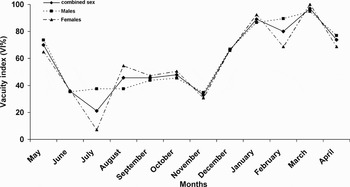
Of the 1668 specimens examined, 979 (58.7%) had empty stomachs and 689 specimens (41.3%) had stomachs containing food. The proportion of empty stomachs did not differ significantly between the sexes (χ2 = 0.84, P > 0.05), and the %VI of females and males were 57.5% and 59.7%, respectively. The index of vacuity varied significantly over the year (χ2 = 306.19, P < 0.05). The highest number of empty stomachs was found in March (97%) and January (89%), and was lowest from June to August (21.1–45.6%) (Figure 2).
Map of the Gulf of Gabès (Tunisian coasts).

Variation in percentage of the vacuity index (VI%) among sex throughout the year of Caranx crysos from the Gulf of Gabès.

The proportion of empty stomachs was also significantly different among size-classes (χ2 = 37.02, P < 0.05), with the %VI of juveniles (≤18 cm FL), medium-size fish and adults 55.5%, 64.3% and 27.6%, respectively.
Diet composition
The diet of C. crysos consisted of 3721 different prey items across 14 identified prey taxa with an average of 5.4 prey items per stomach for fish containing food.
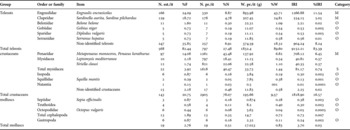
The observed prey were either teleosts, crustaceans or molluscs (Table 1), with teleosts and crustaceans the main groups, as indicated by %IRI for these groups (83.4 and 16.6%, respectively). Molluscs were only found occasionally (%IRI < 0.1), and were omitted from subsequent analyses and figures.
Prey categories of Caranx crysos from the Gulf of Gabès (Tunisia), with the proportion of the diet by frequency of occurrence (%F), number (%N), biomass (%W), IRI and %IRI. Prey taxa also classified as main prey species (M), secondary prey species (S) and occasional prey (O), according to the classification of Morato-Gomes et al. (Reference Morato-Gomes, Sola, Gros, Menezes and Pinho1998).

N. est./it, number of stomachs containing prey i; N. pr./it, number of prey item i; W. pr./it (g), wet weight of prey item i; M, main prey (IRIi ≥ 476.8); S, secondary prey (53 < IRIi < 476.8); O, occasional prey (IRIi ≤ 53 ).
Although fish were most important in terms of weight (89.6%) and frequency of occurrence (82.4%), crustaceans were the most numerous group (78.07%), due to mysids and penaeid shrimps occurring in large numbers.
At the family level, engraulids (Engraulis encrasicolus) were the most important prey in terms of weight (43.7%), whereas penaeids (Metapenaeus monoceros and Penaeus kerathurus) and mysids (Leptomysis mediterranea and Siriella clausi) were numerically the most important prey, accounting, respectively, for 43.5% and 40.5% of the diet (%N).
According to the classification of Morato (1998), the main prey (IRI ≥ 476.8) were engraulids (IRI = 1266.9; %IRI = 11.6), penaeids (IRI = 708.1; %IRI = 6.5) and clupeids (Sardinella aurita and Sardina pilchardus) (IRI = 554.2; %IRI = 5.1) (Table 1). Mysids were of secondary importance (IRI = 81.2 and %IRI = 0.7) and other taxa only taken occasionally (IRI ≤ 53).
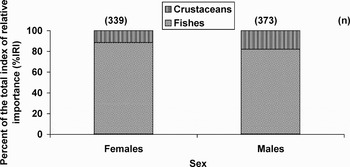
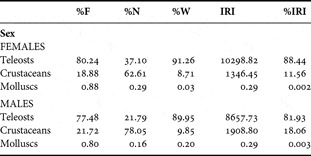
The %IRI of teleosts and crustaceans in female blue runner (88.4% and 11.5%, respectively) were similar to that observed in males (81.9% and 18%, respectively).
Based on the %F of each major food group, the differences in the diet composition between sexes were not significantly different (teleosts: χ2 = 0.8, P > 0.05; crustaceans: χ2 = 0.9, P > 0.05) (Table 2; Figure 3).
Diet composition of Caranx crysos among sex based on the percentage index of relative importance values of the majors preys groups. n, number of full stomachs analysis in each sex.

Diet composition of Caranx crysos from the Gulf of Gabès (Tunisia) among sex, with the proportion of the diet by frequency of occurrence (%F), number (%N), biomass (%W), IRI and %IRI.

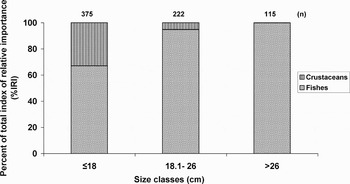
Ontogenetic differences in the diet were apparent, and the frequency of crustaceans decreased significantly with increasing predator size (χ2 = 38.3, P < 0.05), and the frequency of teleosts increased significantly (χ2 = 35.2, P < 0.05).
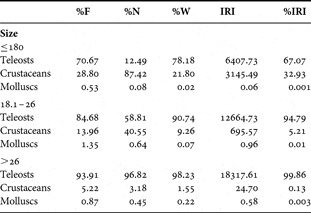
In fish <180 mm FL, teleosts and crustaceans accounted for 67% and 33% IRI, respectively, whilst the diet of the two larger size-classes (18.1–26 cm and >26 cm FL) consisted almost exclusively of fish (%IRI = 95–99.8), and crustaceans were of lesser importance (%IRI = 5–0.13) (Table 3; Figure 4).
Diet composition of Caranx crysos among size-classes, based in the percentage index of relative importance values of the major preys groups. n, number of full-stomachs analysed in each size.

Diet composition of Caranx crysos from the Gulf of Gabès (Tunisia) among size-classes, with the proportion of the diet by frequency of occurrence (%F), number (%N), biomass (%W), IRI and % IRI.

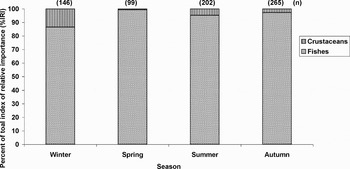
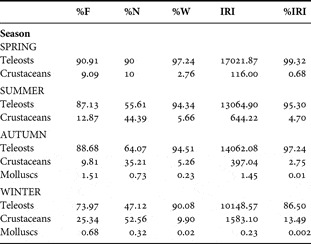
Significant differences in the diet between seasons was also observed, both for teleosts (χ2 = 8.7, P < 0.05) and crustaceans (χ2 = 20.4, P < 0.05). Fish were the main prey group, especially in the spring (%IRI = 99%), and although crustaceans were present in the stomachs throughout the year, there was a peak value recorded in winter (%IRI = 13.5). Molluscs were only found in winter and autumn (Table 4; Figure 5).
Diet composition of Caranx crysos throughout the year, based in the percentage index of relative importance values of the major preys groups. n, number of full-stomachs analysed in each season.

Diet composition of Caranx crysos from the Gulf of Gabès (Tunisia) throughout the year, with the proportion of the diet by frequency of occurrence (%F), number (%N), biomass (%W), IRI and % IRI.

DISCUSSION
In this study, the diet composition of blue runner Caranx crysos in the Gulf of Gabès was found to be broadly similar to those of related species in the family (Overko, Reference Overko1978; Maigret & Ly, Reference Maigret and Ly1986; Chavance et al., Reference Chavance, Ba and Krivospitchenko1991; Marchal, Reference Marchal1991), indicating that this species is piscivorous, and predates mostly on small, pelagic fish (Engraulidae: Clupeidae), with some crustaceans (e.g. Penaeidae: Mysidacea) and cephalopods also consumed. Overall, comparatively few species accounted for most of the prey consumed, indicating that this species is a relatively specialist predator. Teleosts were the most important prey for C. crysos. Although, numerically, crustaceans were the most abundant prey group. Other taxa (e.g. molluscs) were of minor importance and may be considered occasional prey. Keenan & Benfield (Reference Keenan and Benfield2003) reported that the blue runner C. crysos, common around offshore petroleum platforms in the northern Gulf of Mexico, was a zooplanktivorous fish, with larval decapods and stomatopods, hyperiid amphipods, and larval and juvenile fish all common components of its diet. In the West Indies, adult blue runner is considered to be primarily piscivorous (Randall, Reference Randall1967; Christmas et al., Reference Christmas, Perry and Waller1974).
Comparable studies about the food habits of other members of the family Carangidae have been carried out in the same region. The results from the present study suggest that the diet of C. crysos most closely resembles that of false scad, Caranx rhonchus (Sley et al., Reference Sley, Jarboui, Ghorbel and Bouain2008), with both species feeding primarily on teleosts. However, studies on the diets of horse mackerel, Trachurus trachurus from the Tunisian coasts (Fezzani, Reference Fezzani2006) and in the central Adriatic Sea (Santic et al., Reference Santic, Jardas and Pallaoro2004), and pilotfish, Naucrates ductor in Sicilian waters indicated that these species fed mainly on zooplanktonic crustaceans, whilst teleosts were of minor importance.
According to the classification of Morato (1998), the most important prey of blue runner in the Gulf of Gabès were anchovy Engraulis encrasicolus, which accounted for the greatest proportion of the diet by biomass (%W = 44%), penaeids (Metapenaeus monoceros and Penaeus kerathurus) and clupeids (Sardinella aurita and Sardina pilchardus), with mysids (Leptomysis mediterranea and Siriella clausi) of secondary importance.
Nearly all the fish prey observed were pelagic (E. encrasicolus, S. aurita, S. pilchardus and Belone belone). These prey items, which were only found in the stomachs of fish caught at shallow depths, are common in Tunisian waters (Gaamour, Reference Gaamour1999), especially in the Gulf of Gabès. Demersal fish (Gobiidae: Sparidae: Serranidae) were only observed occasionally in the stomachs of blue runner. The present study, as with many others (e.g. McCormick, Reference McCormick1998; Piet, Reference Piet1998; Jennings et al., Reference Jennings, Pinnegar, Polunin and Boon2001; Hanson & Chouinard, Reference Hanson and Chouinard2002; Nakamura et al., Reference Nakamura, Horimonchi, Nakai and Sano2003) indicates what are important ontogenetic changes in the diet, with the role of fish in the diet increasing with predator size. Stomachs of small-sized fish contained mainly smaller prey than the stomachs of larger-sized fish. The smallest fish (≤18 cm) fed on small crustaceans (mysids and larval fish). As the fish grew (medium size-class; 18.1–26 cm FL, and the large size-class (adults); >26 cm FL), there was an increased preference for fish, mainly E. encrasicolus and a declining proportion of crustaceans.
Some data exist on the feeding habits of larval and juvenile blue runner, while accounts of adult feeding habits have been more anecdotal. McKenney et al. (Reference McKenney, Alexander and Voss1958) and Schekter (1972) stated that blue runner less than 160 mm standard length (SL) were carnivorous planktivores that consumed primarily calanoid and cyclopoid copepods. The size-range of prey in the diets of larger juveniles increased to include zooplankton such as hyperiid amphipods, decapod and stomatopod larvae, and ichthyoplankton (McKenney et al., Reference McKenney, Alexander and Voss1958). Randall (Reference Randall1967) quantified the stomach contents of 17 mature blue runners (190–520 mm FL) from reef habitats in the West Indies; two of these had small silvery fish in their stomachs, while two fish (222 and 250 mm FL) contained 40% planktonic organisms and the remaining contents were fish.
Zooplankton comprised an important part of the diets of mature blue runner in proximity to petroleum platforms in the Gulf of Mexico. Blue runner up to 350 mm FL appeared to consume large numbers (50% by weight) of holoplanktonic and meroplanktonic, mesozooplankton and macrozooplankton. This is contrary to existing literature that characterized mature individuals of this species (>270 mm) as primarily piscivorous (Randall, Reference Randall1967; Goodwin & Finucane, Reference Goodwin and Finucane1985).
The stomachs of two adult male blue runners (365 and 370 mm SL), collected in Mississippi coastal waters, contained anchovies and two mantis shrimp (Squilla empusa) of unstated developmental stage (Christmas et al., Reference Christmas, Perry and Waller1974).
In our study, the food content of C. crysos showed little seasonal variations, as teleosts were the main prey in all seasons, particularly in spring, autumn and summer. Crustaceans constituted a significant part only in winter. Feeding intensity decreased during winter months, as can be deduced from the high number of empty stomachs (>85%). This can be explained either by the unavailability of the prey or by the temperature-dependent physiological process.
The need for larger C. crysos to take in enough energy has probably resulted in an increase in their feeding intensities, and this may also explain the decrease in the IV% of larger fish. The spawning season of C. crysos has been reported to be from June to August. In the current study, the greater feeding intensity of C. crysos coincides with the same time period, which may reflect that the fish require more energy during spawning than in other periods.