INTRODUCTION
The diversity and distribution of marine mammals around oceanic islands in Oceania including, in particular, the New Caledonian archipelago, remain poorly known (Reeves et al., Reference Reeves, Leatherwood, Stone and Eldredge1999; Wells & Scott, Reference Wells, Scott, Perrin, Würsig and Thewissen2002; Wang & Yang, Reference Wang, Yang, Perrin, Würsig and Thewissen2009). This is true, in particular, for bottlenose dolphins (Tursiops spp.) (Wang & Yang, Reference Wang, Yang, Perrin, Würsig and Thewissen2009). Bottlenose dolphins have a world-wide distribution, and show morphotypic variation among regions (Hoelzel et al., Reference Hoelzel, Potter and Best1998; Rice, Reference Rice1998; Wells & Scott, Reference Wells, Scott, Perrin, Würsig and Thewissen2002). Distinctions between coastal and pelagic populations have been documented worldwide.
Two main morphological types of bottlenose dolphins based on tooth count and cranial morphology (Perrin et al., Reference Perrin, Robertson, Bree and Mead2007), referred to as distinct nominal species, are currently considered: T. truncatus (Montagu, Reference Montagu1821) (the common bottlenose dolphin) and T. aduncus (Ehrenberg, Reference Ehrenberg, Hemprich and Ehrenberg1833) (the Indo-Pacific bottlenose dolphin) (Rice, Reference Rice1998). Useful characters for distinguishing T. aduncus from T. truncatus by external appearance are rostrum length, ratios of rostrum length to body length and to snout-to-eye length, body size, and pigmentation patterns (Hale et al., Reference Hale, Barreto and Ross2000; Wang et al., Reference Wang, Chou and White2000; Wang & Yang, Reference Wang, Yang, Perrin, Würsig and Thewissen2009). Tursiops aduncus and T. truncatus co-occur in the tropical Indo-Pacific, where habitat segregation has been documented, T. aduncus occupying inshore waters and T. truncatus tending to occur offshore (Ross, Reference Ross1977; Gao et al., Reference Gao, Zhou and Wang1995; Hale et al., Reference Hale, Barreto and Ross2000; Möller & Beheregaray, Reference Möller and Beheregaray2001; Wells & Scott, Reference Wells, Scott, Perrin, Würsig and Thewissen2002; Wang & Yang, Reference Wang, Yang, Perrin, Würsig and Thewissen2009). However, currently there is not enough evidence to know whether the different ecotypes or ecomorphs of bottlenose dolphin are consistently the same species in all parts of the Indo-Pacific where they are recorded (Wang & Yang, Reference Wang, Yang, Perrin, Würsig and Thewissen2009). Pending further osteological and genetic evidence, it is wise to provisionally refer to the generic name ‘Tursiops spp.’ in presently poorly surveyed regions of the world, such as New Caledonia.
Partly based on stranded specimens, both T. aduncus and T. truncatus bottlenose dolphins have been mentioned in a list of marine mammals from New Caledonia (Borsa, Reference Borsa2006), but information on their relative abundance, group size, period of occurrence, and habitat segregation in New Caledonian waters are still lacking. The aim of the present report is to contribute to filling that gap by summarizing and discussing recent sightings of bottlenose dolphins from New Caledonian waters.
MATERIALS AND METHODS
‘New Caledonian waters’ are here defined as the area adjacent to the island of New Caledonia, eastern Coral Sea (south-west Pacific), extending seaward from the mean low water mark to the boundary of the exclusive economic zone. Opportunistic sightings of bottlenose dolphins, Tursiops spp. in New Caledonian waters were recorded from mid-1994 to mid-1995 and from 2002 to mid-2009. Observations were made either from research vessels, diving boats, or sailboats, or from the shore. Position, pod size, the eventual presence of newborns, and behaviour were systematically recorded. Pigmentation patterns were noted when visual conditions were favourable. During the same period, additional observations were obtained by P.B. from fellow SCUBA divers and naturalists. Depth was obtained from echo sounders, or a posteriori from nautical charts.
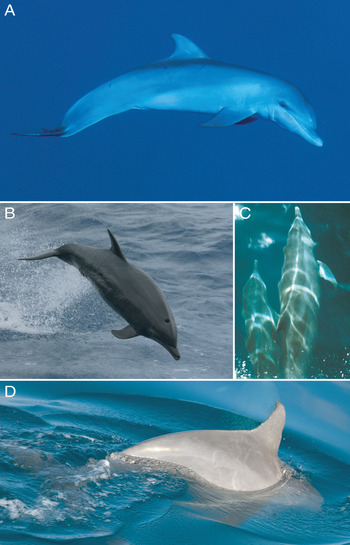
Here, two morphotypes of bottlenose dolphin, coined A and B, could be distinguished at sea from the pigmentation patterns of their back (Figure 1A–D). Morphotype-B individuals exhibited a distinctive, extensive pale-grey blaze that indents the darker-grey dorsal cape towards the basis of the dorsal fin (Figure 1C) and which was absent or unconspicuous in morphotype-A bottlenose dolphins (Figure 1A, D). The body build of morphotype-B bottlenose dolphins also appeared stockier than that of morphotype-A bottlenose dolphins (Figure 1A, B).
Morphological variation among Tursiops spp. individuals in the Coral Sea. (A) Morphotype-A bottlenose dolphin photographed in the south-western lagoon of New Caledonia (200 m north of Redika Islet, 22°30′S 166°36′E; 15 December 2008; S.A.); we interpret the series of evenly spaced marks on the flank as scars of a superficial bite from a large shark; (B) morphotype-B bottlenose dolphin (Grand Passage, 18°47′S 163°16′E; 24 October 2008; P.B.); (C) bow-riding morphotype-B bottlenose dolphins exhibiting paler-grey blaze below dorsal fin (north-east of Morinda Shoals, Great Barrier Reef lagoon, 19°05′S 147°35′E; 25 April 1991; P.B.); (D) posterior part of an adult morphotype-A individual exhibiting sparse, tiny darker spots, and de-pigmented patterns on flank determined by us as the healed scars of a wound inflicted by a tiger shark, Galeocerdo cuvier (east of Redika Islet, 22°27′S 166°42′E, 21 June 2008; M.J.).

Many of the observations of Tursiops spp. that have been compiled by us, mainly from the south-western lagoon of New Caledonia, lacked sufficiently precise information on pigmentation patterns and therefore were not included in the present report. Also excluded were two strandings of Tursiops sp. reported by Borsa (Reference Borsa2006) and a sighting of a single individual Tursiops sp. in the Chesterfield lagoon (19°53′S 158°27′E; Borsa, Reference Borsa2008).
RESULTS
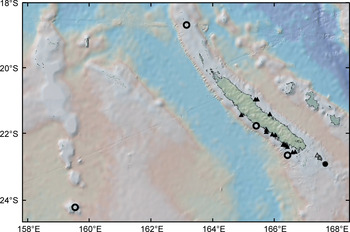
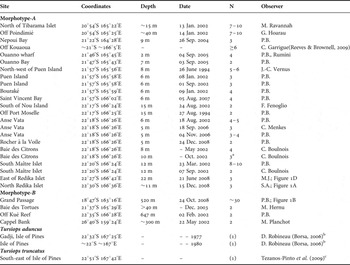
Table 1 reports all observations of Tursiops spp. where the morphotype (A or B) of the individuals sighted could be determined, during the survey period. Four observations from the literature were also included, including two skulls of individuals stranded on Isle of Pines in 1977 and 1980, and identified to species (as T. aduncus) by D. Robineau (personal communication). The distribution of sightings is summarized in Figure 2. All sightings of morphotype-A bottlenose dolphins (22 sightings, totalling ≥87 individuals) occurred inshore around New Caledonia's main island, within the lagoon delimitated by the barrier reef, and at depths less than ~40 m. All sightings of morphotype-B bottlenose dolphins (4 sightings, totalling ~36 individuals), as well as that of a live-biopsied T. truncatus (Table 1), were made off the barrier reef, at depths >40 m. There is no barrier reef in Baie des Tortues, where morphotype-B individuals were sighted closest to shore (Table 1; Figure 2). Morphotype-A bottlenose dolphins occurred in small groups, from two to ten individuals, whereas morphotype-B bottlenose dolphins occurred in groups of two up to ~30 individuals.
Distribution of bottlenose dolphin, Tursiops spp., sightings in New Caledonian waters. ▴, morphotype A; Δ, T. aduncus, identified from skull morphology and tooth count; ○, morphotype B; •, T. truncatus, identified from mitochondrial-DNA haplotype. Additional details in Table 1. Topographic map from GEOMAPAPP (http://www.geomapapp.org; Ryan et al., Reference Ryan, Carbotte, Coplan, O'Hara, Melkonian, Arko, Weissel, Ferrini, Goodwillie, Nitsche, Bonczkowski and Zemsky2009).

Opportunistic sightings of bottlenose dolphin, Tursiops spp., by morphotype (A and B), and additional strandings and observation of T. aduncus and T. truncatus, in New Caledonian waters. Depth was obtained from echo sounders, or a posteriori from nautical charts.

N, pod size (except for numbers in parentheses); a, includes a newborn; b, stranded specimen; c, biopsied specimen, identified to species from mtDNA sequence.
A proportion of morphotype-A individuals wore scars attributable to large sharks (Figure 1A, D). Other morphotype-A individuals had a damaged dorsal fin, seemingly a consequence of strikes from boat propellers: in one individual, the dorsal fin was separated in two by a deep and straight vertical gash in its middle (22°18′S 166°26′E; August 2002) and in another individual, the dorsal fin was obliquely cut clean through (21°57′S 166°02′E; August 2007).
We observed small pods of morphotype-A individuals chasing torpedo scads, Megalaspis cordyla (22°18′S 166°26′E; August 2002), barracudas, Sphyraena sp. (22°20′S 166°24′E; 07 September 2002) and mullet, Mugilidae sp. (22°18′S 166°26′E; May 2002) in shallow water close to shore. We also observed a pod of morphotype-A individuals foraging for more than two hours at night in very shallow water (<3 m) under the spotlights of a built-on-piles restaurant at Anse Vata, Nouméa (November 2006). The spotlights were turned towards the sea, to attract fish and squid and entertain the customers. The same behaviour was observed by P.B. on two consecutive nights in the harbour of Sorong (West Papua) in July 2010, where a pod of three morphotype-A bottlenose dolphins was preying on squid and fish attracted by the lights of an anchored vessel. Morphotype-B bottlenose dolphins were observed chasing flying fish, Exocoetidae sp., in the open sea (off Grand Récif Kué, 22°35′S 166°28′E; February 2002).
DISCUSSION
The similarities in pigmentation patterns and habitat characteristics of morphotype-A and morphotype-B bottlenose dolphins from New Caledonia (present report), to, respectively, Tursiops aduncus and T. truncatus from southern Queensland (Hale et al., Reference Hale, Barreto and Ross2000) and from elsewhere in the Indo-Pacific (Wang & Yang, Reference Wang, Yang, Perrin, Würsig and Thewissen2009) are strong enough to suggest that morphotype-A corresponds to T. aduncus under its current definition (Rice, Reference Rice1998) and morphotype-B, to T. truncatus. However, pending more genetic evidence, in the following we will refer to ‘T. aduncus-like’ and ‘T. truncatus-like’ bottlenose dolphins in New Caledonian waters. Also, adult T. aduncus generally exhibit dark spots on the posterior ventral half of the body (Hale et al., Reference Hale, Barreto and Ross2000), but T. aduncus populations from New South Wales and south-eastern Australia are ‘apparently more or less unspotted’ (Ross & Cockroft, Reference Ross, Cockcroft, Leatherwood and Reeves1990; Wang & Yang, Reference Wang, Yang, Perrin, Würsig and Thewissen2009). When present, only light spotting on the posterior part of the body was noticed by us on some New Caledonian morphotype-A individuals (Figure 1D). The presence or absence of a pale-grey blaze below the dorsal fin remained the easiest way to distinguish between the two forms in the field.
The present results thus confirm that both T. aduncus-like and T. truncatus-like bottlenose dolphins are present in New Caledonian waters, where they seem to occur year-round, thereby providing new details on their distribution in the south-western tropical Pacific relative to previous work (Reeves et al., Reference Reeves, Leatherwood, Stone and Eldredge1999; Borsa, Reference Borsa2006; Wang & Yang, Reference Wang, Yang, Perrin, Würsig and Thewissen2009). Tursiops aduncus-like bottlenose dolphins apparently mainly, if not exclusively, occur inside the coral-reef lagoon that surrounds New Caledonia's Grande Terre whereas T. truncatus-like individuals have so far been sighted exclusively off the barrier reef.
Although the density of the human population in New Caledonia is low (~245,000 inhabitants for a territory totalling ~19,000 km2), the coral-reef lagoon of New Caledonia is under serious threat of degradation from the deforestation, land erosion and pollution caused by developing open-pit mining projects and associated ore-processing plants (Richer de Forges & Pascal, 2008). Overfishing has been reported for some areas of the New Caledonian lagoon and further fishing pressure on fish stocks is expected in relation to the industrial development of once sparsely populated littoral regions (Guillemot et al., Reference Guillemot, Léopold, Cuif and Chabanet2009). Both habitat degradation and overfishing may affect the availability of fish prey to T. aduncus-like bottlenose dolphins in at least some areas of the New Caledonian lagoon. Another threat to T. aduncus-like bottlenose dolphin populations in New Caledonia is the increased disturbance and risk of boat strike related to the rapidly increasing leisure boat traffic: approximately 25,000 leisure boats, many of them being motorized speedboats, are currently registered in New Caledonia. That number is steadily increasing by ~1000 new boats every year (Service de la marine marchande et des pêches maritimes, Nouméa, personal communication). Collision with boats or ships has been documented for several marine mammal species in New Caledonian waters: these include the dwarf and pygmy sperm whales, the humpback whale and, mostly, the dugong (Borsa, Reference Borsa2006). The characteristics of some of the wounds exhibited by T. aduncus-like bottlenose dolphins suggest they resulted from boat propeller strikes. Monitoring the abundance and distribution of T. aduncus-like bottlenose dolphins should be considered in assessing the ecological impact of developing human activities in the New Caledonian lagoon.
ACKNOWLEDGEMENTS
We are grateful to D. Robineau (Muséum National d'Histoire Naturelle, Paris) for excellent information and to C.D. MacLeod for helpful suggestions.