The subprime lending catastrophe and the Great Recession that it triggered have cast a pall over the postindustrial city of Flint, Michigan, and its increasingly bleak suburbs. Arriving after many years of General Motors (GM) factory shutdowns, gnawing population losses, and an earlier episode of predatory lending that very few people even remember today, the most recent rash of home foreclosures has shaken this already ailing metropolis in a relentless, decade-long aftershock. According to most local observers, the Vehicle City’s latest meltdown commenced shortly after the dawn of the new millennium, when thousands of area homeowners—many of them financially overstretched by a combination of unemployment and high-interest subprime loans—began defaulting on their mortgages and property taxes. Between 2002 and 2009, officials from the Genesee County Land Bank, a public receiver for abandoned and tax-foreclosed properties, quietly repossessed nine thousand homes, businesses, and lots just within Flint, a figure that accounted for 14 percent of the city’s overall surface area.Footnote 1 Meanwhile, in the private lending market, mortgage foreclosures were surging to Depression-era levels, routinely exceeding a thousand homes per month. Just during September 2010, for instance, nearly 1 percent of the region’s two hundred thousand housing units slipped into foreclosure.Footnote 2 By decade’s end, the toxic trio of deindustrialization, tax delinquency, and predatory lending had pummeled the local housing market into a state of near collapse, with average sale prices for homes in Flint reduced to just $17,000—significantly cheaper than the Buick sedans that GM workers once assembled on the city’s North End.Footnote 3
The human dimensions of Flint’s current housing crisis and the broader national economic crash are simply staggering. Already, the subprime calamity has caused more forced relocations of local residents than any other single event in the region’s history.Footnote 4 All across the nation, in fact, the dual menaces of economic recession and usurious lending have ravaged local tax bases and denuded once-thriving communities of human life and wealth. Just between 2007 and 2010, more than nine million properties in the United States fell into foreclosure. By 2012, that number stood near the twelve-million mark.Footnote 5 According to George Packer, a journalist from New Yorker magazine who toured some of Florida’s hardest-hit neighborhoods in 2008 and 2009, the crash has transformed huge swaths of suburbia, including untold numbers of middle-class communities once known as “boomburgs,” into eerily apocalyptic “ghost subdivisions.”Footnote 6 The effects of the tailspin have been so severe that many policy observers have taken to employing the language of singularity to describe the bursting of the real estate bubble.Footnote 7
In reality, though, predacious banking and mass foreclosure are deeply rooted in American history. During the Great Depression of the 1930s, and yet again in the 1970s, credit crises, economic slumps, and old-fashioned usury converged to trigger similar episodes of mass property repossession.Footnote 8 Although scholars have written very little about the latter of these downturns, it was during the 1970s when the seeds of the current subprime debacle began to germinate in communities such as Flint and its nearby suburb of Beecher, rising out of the ashes of an obscure federal housing policy known as Section 235.Footnote 9 Implemented under the terms of the Housing and Urban Development (HUD) Act of 1968, Section 235 was a novel government finance program for low-income home purchasers. It came into being just a few months after President Lyndon Johnson signed the landmark Fair Housing Act of 1968, which outlawed racial discrimination in most real estate transactions. Together, these two federal laws helped to stimulate the nation’s flagging real estate industry while opening up many sectors of the private housing market to African Americans, the poor, and others with limited access to credit.Footnote 10 Between 1968 and 1973, when President Richard Nixon ordered a moratorium on all “subsidized” residential developments, Section 235 funds supported the sale of 465,972 new and used homes nationwide.Footnote 11 In Flint and the surrounding communities of Genesee County, nearly fifteen hundred poor and working-class families enthusiastically participated in the program.Footnote 12
Popular support for the policy eroded quickly, however, as purchasers began discovering major flaws in their homes. Beyond these individual complaints, decisions regarding the locations of the units provoked a torrent of discontent among homeowners and politicians, many of whom blamed Section 235 for creating ghettoes on Flint’s North End. By the close of the 1960s, the battles over race and housing had spilled over Flint’s northern border into the inner-ring suburb of Beecher—an integrated, working-class community that received far more than its share of low-cost homes. There, Section 235 hardened the color line, stimulated property abandonment and foreclosure, and inflamed racial tensions. For a brief period during the early 1970s, the strife over Section 235 turned Beecher into a national focal point in the debate over suburban desegregation. As part of that dialogue, local residents grappled with the implications of predatory lending and mass foreclosure in ways that foreshadowed the current outcry over subprime mortgages and “reverse redlining.”
The story of Beecher’s transformation from a working-class white bedroom community into an impoverished, majority-black suburb sheds new light on the deep roots of the subprime scandal. Since 2007, scholars and pundits have written extensively on the nature of the collapse. According to the prevailing consensus, predatory mortgage lending originated in the 1980s with the elimination of federal usury controls on home loans, which allowed lenders to charge higher interest to “risky” borrowers ineligible for “prime” mortgages. In response, the argument continues, lenders jettisoned the “redlining” practices that had historically kept mortgages out of the hands of racial minorities and the poor in favor of a new but equally egregious menu of high-interest, adjustable-rate, and partially amortized “subprime” loans marketed disproportionately to borrowers with scarred credit and people of color. Fueling this shift, many believe, was a complex process called securitization, whereby brokers bundled loans into bonds and then sold them on the secondary mortgage market to investors. The popularity of these “mortgage backed securities” led to a massive increase in subprime lending as financial institutions rushed to create newer and riskier investment products. Intoxicated by the turn-of-the-century real estate boom that lifted property values to historic new heights, very few Americans took notice of these developments except to echo President George W. Bush’s claim that subprime loans were creating a bold new “ownership society” marked by unprecedented gains in black and Latino homeownership and a long-awaited revival of inner city communities.Footnote 13 Tragically, though, the bubble burst when a rash of subprime delinquencies triggered a drop in both real estate values and the broader securities market, which in turn spawned a sharp decline in international stock prices and a severe economic recession.
By now, the broad outlines of this dominant narrative are probably quite familiar to most housing policy observers, particularly regarding the chronology of the crash. In fact, virtually all accounts of the crisis hinge on the 1980s and 1990s as the temporal pivot between the dark days of mortgage redlining and the equally exploitative era of predatory subprime lending.Footnote 14 In truth, though, the periodization of this shift is much more complex.
As the Beecher case confirms, the roots of federalized reverse redlining stretch back to 1968 and the creation of Section 235. Although the terms of the mortgages insured under the program were unlike those of subprime loans, the implementation of Section 235 marked a paradigmatic change in the racial politics and practices of corporate lenders and federal housing officials. Prior to the late 1960s, most bankers and government underwriters practiced racial discrimination by denying credit to nonwhite buyers and those seeking to purchase real estate in integrated communities.Footnote 15 In the wake of Section 235 and the Fair Housing Act, however, African Americans, Latinos, and other underserved groups gained increased access to federally insured mortgage funds. Quickly, though, hundreds of thousands of these new borrowers discovered that federal mortgage “subsidies” could be just as discriminatory as redlining. Because there were large numbers of usurious lenders already operating in communities of color long before the birth of the Section 235 program, the HUD Act did not create the predatory lending market ex novo.Footnote 16 Nevertheless, the racialized predatory lending markets that predated the HUD Act were primarily local in nature, and they existed without any significant monetary support from government agencies. With the passage of the HUD Act, though, the federal government emerged to fund, reinforce, and, indeed, nationalize the previously localized practices of reverse redlining.
After 1968, the terms of marketplace racism shifted decisively as banks across the nation began issuing large numbers of loans to people of color and poor whites, many of whom purchased homes in previously redlined areas. Powering this new credit stream was a complex process of securitization, first developed in conjunction with the 235 program in 1970, in which investors profited handsomely from the dubious lending practices of banks.Footnote 17 As with subprime loans, Section 235 mortgages often contained hidden charges that banks levied against borrowers. Yet in what appeared to be a bold and progressive new approach, the federal government moved beyond simply insuring mortgages and began issuing direct subsidies to developers and lenders in order to make 235 loans more affordable. In some ways, then, the financial terms of Section 235 loans were far more equitable than their subprime counterparts were. Nevertheless, local administrators of the 235 program in Flint and numerous other communities allowed builders to concentrate most of the region’s affordable housing units in either all-black or racially transitional areas. At the same time, the poor quality of the new and refurbished homes sold under the Section 235 program created insurmountable debt burdens for many borrowers, which eventually led to a flurry of bankruptcies and foreclosures. As Beecher’s story illustrates, the harsh outcomes of the HUD Act were the results of both the policy design choices of federal legislators and implementation decisions made at the local level.Footnote 18
The history of the Section 235 experiment highlights the need for a new interpretation of “subsidized” housing. During its short existence, this controversial program acted decisively in the service of both capital and the color line by simultaneously funding the unscrupulous practices of lenders and builders and enforcing racial and class segregation. More broadly, though, the passage of the HUD Act marked the emergence of a new type of housing subsidy—one in which federal policies decisively favored the supply side of the real estate industry over borrowers. This is not to suggest, however, that federal support for the supply side of the housing industry originated in the 1960s. As historians Dolores Hayden, David Freund, Louis Hyman, and others have shown, the “selective credit” mortgage insurance programs of the Federal Housing Administration (FHA) and the Veteran’s Administration (VA)—created in 1934 and 1944, respectively—helped to increase not only homeownership rates but also the corporate profits of banks, builders, and real estate firms.Footnote 19 Consequently, the supply-side subsidies of the 1960s had clear precedents in the 1930s and the postwar period.
Still, Section 235 helped to shift the balance of power between the supply and demand sides of the market conclusively in favor of industry. Unlike the predominantly white, federally insured mortgage borrowers of the postwar era, who, at a minimum, could expect to purchase structurally sound homes at reasonably low interest rates in the segregated suburban neighborhoods of their choosing, Section 235 buyers faced the prospects of severely circumscribed geographic options, substandard housing units, and widespread, unregulated profiteering. Stated differently, for millions of Americans who bought homes following World War II, a selective credit loan backed by the FHA or VA was a means of wealth creation. Among recipients of 235 loans, by contrast, credit was a major cause of wealth depletion.
Nevertheless, the abuses that occurred as a result of Section 235 did not spawn a sea change in the public’s perception of credit. To the contrary, most Americans continued to think of government backed mortgages as subsidies to homeowners rather than a boon to banks, developers, and bondholders. Yet looking back over at least the past forty years of mortgage lending, it now seems clear that the long-standing consensus that home loans are special subsidies for borrowers rests on the false assumptions that credit is always beneficial to its recipients and that real estate always accrues in value.Footnote 20 As evidenced by the interlocking histories of subprime lending and its predecessor, the Section 235 program, however, credit can also be a lever for discrimination, exploitation, and impoverishment.Footnote 21
Discriminatory building and lending practices fundamentally transformed Beecher during the 1960s and 1970s. By the time that President Nixon halted the Section 235 program in 1973, this tiny working-class district had come to resemble the predominantly black, deindustrialized neighborhoods of Flint’s inner city more than the all-white, middle-class communities of the suburban cliché. But Beecher did not experience this fate alone. From the major urban centers of the east and west coasts to the small towns and hamlets dotting the nation’s metropolitan hinterlands, the HUD Act helped to refashion racial, economic, and spatial inequalities in scores of American communities, proving along the way that suburbs (and rural areas, too) were not immune to the structural and social changes occurring in big cities. Indeed, the developments that unfolded in the Beecher district were part of a much broader series of political, economic, and demographic shifts taking place in suburban and exurban America after World War II. Woven into Beecher’s saga of predatory lending, then, is an equally important story about the growing diversity of suburbia—one that severely undermines dichotomies between cities and suburbs. Today, Beecher is neither a “crabgrass frontier” nor an urban ghetto, but rather an impoverished suburb with a black majority; and it came to be that way because of government policies that subsidized the financial exploitation and spatial isolation of African Americans and the poor.Footnote 22
Working-Class Suburb
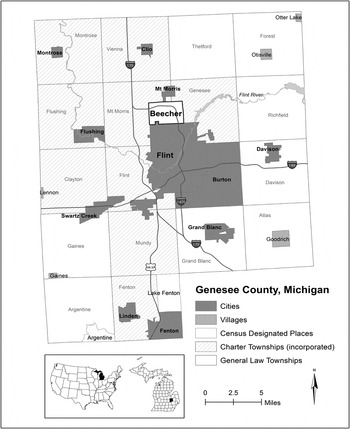
The so-called Beecher Metropolitan District occupies five square miles of land immediately north of the Flint city limits. Bounded by Carpenter Road, Dort Highway, Stanley Road, and Clio Road, this unincorporated utilities and school district is an urbanized suburb superimposed on portions of Mt. Morris and Genesee Townships (Map 1). Because of Beecher’s proximity to Flint, the two areas have often shared a similar historical trajectory. White migrants first began settling in Beecher in the 1830s, soon after Jacob Smith established a fur trading post on the Flint River. By the time that Flint became an incorporated city in 1855, Beecher had already attracted a small group of permanent residents, many of whom practiced subsistence agriculture. Although the growth of the region’s lumber and carriage manufacturing industries brought thousands of workers to Genesee County following the Civil War, Beecher remained primarily rural until the turn of the century, when the arrival of the “horseless carriage” inaugurated a new epoch in the community’s history.Footnote 23
The birth of the automobile industry helped to transform Beecher from a sleepy farming village into a modern working-class suburb. The shift began shortly after German engineers unveiled the first generation of gasoline-powered cars in the 1880s, at which point area investors began recruiting automobile companies to the Flint region. Civic boosters achieved a major victory in 1904, when one of the area’s leading industrialists, James H. Whiting, acquired the Buick Motor Company and relocated its manufacturing operations to Flint’s North End. Four years later, a Flint-based carriage maker named William Crapo Durant founded the General Motors Corporation. Eager to build his empire, Durant promptly acquired the Buick, Olds, Cadillac, and Oakland automobile companies. On the strength of these investments, GM quickly became a major automobile producer. By 1919, Durant’s company had produced its first million cars and was well on its way to becoming the world’s largest industrial firm. As GM’s birthplace and manufacturing headquarters, Flint grew rapidly in size and prominence during this freewheeling era of corporate expansion.Footnote 24
It took very little time for Flint’s growth to spill over into the fledgling suburb of Beecher. During the economic boom of the 1920s, Beecher became a popular destination for migrant workers seeking jobs at GM. In order to accommodate these new residents, real estate developers acquired several large farms north of the city and transformed them into subdivisions. Shortly thereafter, wood-framed “workman’s cottages” and grassy lawns began replacing barns and fields as Beecher made its transition into a primarily residential enclave. By 1930, the opening of two new streetcar lines connecting the neighborhoods of Beecher to the factories and shops of Flint had cemented the district’s new suburban status.Footnote 25
Overview map of Genesee County, Michigan.
Source: Michigan Center for Geographic Information, Michigan Geographic Framework: Genesee County(Lansing: Michigan Center for Geographic Information, 2009).

Workers settled in Beecher for a variety of reasons. Many of them preferred Beecher to the city because it seemed to combine the best elements of urban and country living. Homeowners there could plant large gardens, raise chickens, and breathe moderately clean air while still commuting to their jobs in Flint in a matter of minutes. Moreover, because land in Beecher was cheaper than in the city, families could buy lots and erect new homes without exhausting their savings. The district’s lenient building code even allowed cash-conscious residents to construct their own dwellings if they preferred.Footnote 26 Consequently, self-building was a common practice, with owner-built homes comprising over half of Beecher’s housing stock as late as 1960.Footnote 27 Upon purchasing their lots, self-builders typically erected their houses in stages, working in the evenings, on weekends, and during the annual summer layoff from GM. Because owner-builders often took years to complete their residences, many migrant families inhabited garages, tarpaper huts, and other temporary structures while their homes were under construction, which gave rise to Beecher’s reputation as a “Little Missouri” and a “rural slum.”Footnote 28
Nevertheless, thousands of migrants continued to seek out homes in Beecher during and after World War II. By 1948, seventy-five-hundred people lived in the district, but that number grew quickly as officials built new roads and schools and established modern utilities. Administrators from the FHA and VA responded to those investments in public infrastructure by insuring a number of home mortgages in Beecher during the 1950s, which brought additional growth to the area. The fact that government officials and lenders collaborated to exclude most black buyers from participating in these federal mortgage programs only enhanced Beecher’s desirability among most prospective white migrants.Footnote 29 Even a major tornado strike that devastated a large section of the community in 1953 could not halt Beecher’s postwar boom. Executives from GM did their part to fuel the district’s rise by erecting a massive new parts plant on Coldwater Road in 1953. Overnight, GM’s new facility—operated by the Ternstedt Division—helped to triple the community’s tax base. The new plant also helped to push Beecher’s population to nearly fifteen thousand.Footnote 30
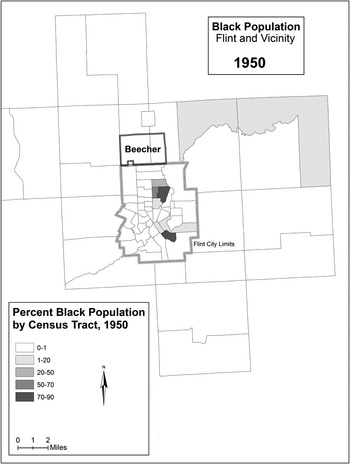
Black population, Flint and vicinity, 1950.
Source: Minnesota Population Center, National Historical Geographic Information System: Version 2.0(Minneapolis, MN: University of Minnesota, 2011).

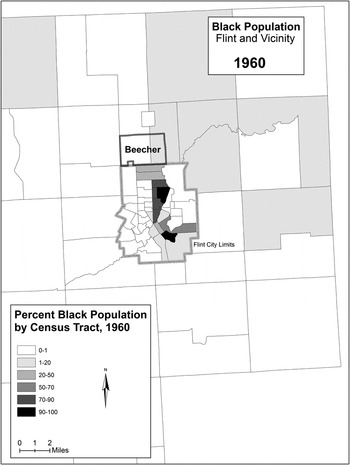
Black population, Flint and vicinity, 1960.
Source: Minnesota Population Center, National Historical Geographic Information System: Version 2.0(Minneapolis, MN: University of Minnesota, 2011).

A combination of restrictive housing policies and grassroots racism helped to keep Beecher virtually all-white prior to the 1950s (Map 2). However, an influx of black migrants during the late 1950s helped to make it one of the only racially integrated communities in suburban Flint. By 1960, 10 percent of Beecher’s residents were African American and the area began to shed its image as a segregated Little Missouri (Map 3). Even though racial violence flared in the district periodically when black families moved in, many African Americans seeking to leave Flint’s overcrowded North End ghetto still looked to Beecher as a prime destination.Footnote 31 Much like their white counterparts in the district, African Americans selected Beecher because of its proximity to Flint and its well-deserved reputation for affordable housing. Equally important, Beecher was one of the only communities outside Flint where realtors and rental agents—some of them acting as blockbusters—willingly showed homes to African Americans.Footnote 32 This combination of forces helped to drive Beecher’s black population to new heights in the years preceding the implementation of Section 235. Out of the twenty-five-thousand mostly working-class residents who lived there in 1968, one-third were African American.
Virtually indistinguishable from the Flint neighborhoods that formed its southern border, Beecher was a suburb that looked much like the city. In the words of Flint Journal reporter Gene Merzejewski, it was “a chunk of transplanted city” in the otherwise lily-white suburbs of Genesee County.Footnote 33 Unlike its urban neighbor, though, the Beecher of the postwar decades seemed to be an unlikely breeding ground for social unrest. It withstood the “long hot summers” of the mid-1960s without experiencing any major racial conflagrations. Furthermore, Beecher appeared to be a stably integrated community—or at least a place where whites and blacks could coexist without violence. Beneath that veneer of tranquility, however, a crisis brewed as Beecher’s racial demography shifted. The first clear signs of that crisis emerged as part of a bitter revolt against low-income housing triggered by the passage of the HUD Act of 1968.
Suburban Ghetto
One of the signal accomplishments of the HUD Act was the creation of the Section 235 program, which supported the rehabilitation of existing homes and the construction of new housing units for low-income buyers. The HUD law also provided funds for developers of affordable rental properties through an initiative known as Section 236. Under Section 235, members of Congress authorized the expenditure of $5.3 billion to enable the sales of nearly two million new and refurbished housing units to poor families. Specifically, Section 235 offered federal mortgage insurance to private lenders and developers who either rehabilitated existing units or constructed new low-cost homes to sell to poor buyers. The coverage offered through Section 235 was virtually identical to that provided through the selective credit mortgage insurance programs operated by the FHA and the VA.Footnote 34 Unlike the recipients of FHA and VA loans, however, Section 235 borrowers received special assistance from the federal government to pay off their mortgages. But this support came not in the form of cash grants and other demand-side subsidies to buyers. Instead, the federal government provided mortgage principal and interest payments directly to lenders and developers who backed and built low-cost housing. The funds for these corporate subsidies came from the revenues of the Government National Mortgage Association, popularly known as Ginnie Mae, a new public corporation created under the terms of the HUD Act. As part of its mission to expand the nation’s affordable housing supply, Ginnie Mae purchased Section 235 mortgages from local lenders, reassembled them as mortgage backed securities, and then sold them on the secondary mortgage market. By doing so, federal officials hoped to offset the cost of HUD’s mortgage principal and interest payments (and jump-start the nation’s real estate market) with an infusion of global capital.
Beyond members of the real estate industry and global investors, who stood to benefit immensely from the flow of new funds, the program targeted low-income Americans—primarily those earning between $5,000 and $7,000 per year—who were ineligible for both public housing and the selective credit loans backed by the FHA and VA. Under the stipulations of Section 235, buyers whose incomes did not exceed 135 percent of the admission limit for public housing could obtain a new or used home with a thirty- or forty-year mortgage of up to $21,000 (or $24,000 in the case of large families) for a down payment of $200 and fixed interest rates as low as 1 percent.Footnote 35 In real terms, this meant that a Section 235 buyer could purchase a $15,000 home for just $200 down and $48 per month, significantly less than the monthly payment of $97 required for a conventional mortgage of identical value. The architects of the HUD Act—a bipartisan group that included members of President Lyndon Johnson’s cabinet, Republican Senator Charles H. Percy of Illinois, and a number of representatives from the banking and building industries—hoped to use supply-side subsidies to revive the real estate market, reduce unemployment, and bring racial and spatial equity to federally sponsored housing initiatives. They intended to accomplish these ambitious goals by supporting the construction of affordable homes and apartments for African Americans and the poor in both cities and suburbs.Footnote 36
Local lenders, developers, and policymakers had their own aims in mind, however. For them, Sections 235 and 236 arrived at an especially opportune moment when rising interest rates and tightening mortgage markets had combined to depress new home construction and sales throughout the nation.Footnote 37 Eager to acquire any new business they could in a sluggish real estate market, lenders and builders across the nation began aggressively advertising the new program soon after its passage, often through widely publicized real estate “seminars.”Footnote 38 In Genesee County, Citizens Bank, Deventeen Investors Company, Quality Construction, Whittier Building Company, D&B Golden, A&E Building Company, and other local firms began taking advantage of the new federal funds almost immediately, especially those offered under Section 235.Footnote 39 In the years leading up to Nixon’s 1973 moratorium, developers erected approximately fifteen hundred Section 235 homes in metropolitan Flint—all but a few of them of new construction.Footnote 40 Nationwide, the HUD Act helped to fund the sales of nearly half a million housing units with a total mortgage value of $8.3 billion.Footnote 41 The new policy was so popular among builders that the phrase “Stay Alive with 235” became something of a mantra during the housing slump of 1969–70.Footnote 42
With urban renewal initiatives destroying thousands of inner-city homes at around the same time, municipal officials and representatives of the Flint Housing Commission (FHC) also welcomed the addition of new and refurbished low-cost dwellings. Members of the FHC hoped that Section 235 would provide a path to home ownership for poor renters and, in the process, reduce long waiting lists for public housing. Although the FHC did not maintain a comprehensive record of move-outs, evidence suggests that many public housing tenants did in fact take advantage of Section 235. Just during 1971, for instance, seventy-two families moved out of the Atherton East public housing complex on Flint’s southeast side into new Section 235 homes. Countywide, according to a 1974 study, one in four occupants of Section 235 housing had lived in public housing prior to acquiring their new homes.Footnote 43 Many of these former tenants initially supported the 235 program, believing that it would provide an opportunity for a fresh start in a new, trouble-free home.
In reality, though, quite the opposite occurred. The framers of Section 235 intended for the program to foster the “geographic dispersion” of affordable housing throughout metropolitan areas. In support of that aim, officials from the FHA and HUD adopted an “informal guideline” to secure “widespread geographical distribution of subsidized housing units.”Footnote 44 However, weak federal regulations on site locations and lax oversight from FHA and HUD administrators allowed local builders and policymakers in Flint, Beecher, and other areas to concentrate 235 homes in racially integrated neighborhoods.Footnote 45 One of these powerful local actors was a man named Thomas Hutchinson, a Flint-based representative of the FHA who managed site requests for builders and lenders seeking to participate in the Section 235 program. Despite the government’s guidelines on geographic dispersal, Hutchinson and his colleagues at the FHA’s local office made almost no attempt to shift building activity toward all-white suburbs. Instead of pursuing the HUD strategy of dispersion, they endorsed builders’ requests to construct well over a thousand Section 235 homes in Flint and Beecher. According to a 1974 study conducted by the Genesee County Metropolitan Planning Commission, 875 of the 1,387 Section 235 units in the region were located in Flint. Within the city, Section 235 homes were heavily concentrated in the racially transitional neighborhoods of the northwest and southeast sides. The remaining 512 structures were all located in suburban Genesee County, but they too were concentrated in small geographic clusters. Of these suburban residences, 67 percent were located in Beecher.Footnote 46 For the nearly all-white suburb of Swartz Creek, by comparison, Hutchinson approved only six units of affordable housing. In the nearby Flushing and Clayton Township areas, also entirely white, Hutchinson authorized no low-income housing at all. Despite containing only 5 percent of the county’s overall population, Beecher received 25 percent of the units that Hutchinson approved in the metropolitan region, more than all other Flint suburbs combined.Footnote 47 This extraordinary concentration of Section 235 homes triggered blockbusting campaigns, widespread white panic selling, and angry conflicts that tore at Beecher’s delicate social fabric.
Disagreements over the geographic distribution of units were at the crux of the disputes over Sections 235 and 236. From the start, members of the Flint Urban League as well as other opponents of the two programs argued that the concentration of poor people and government-assisted housing would contribute to neighborhood blight, social conflict, and, in time, racial succession.Footnote 48 The case of West Beecher seemed to bear out such critiques. Of the more than seven hundred 235 and 236 units that Hutchinson initially authorized for Beecher, 564 were located within the western half of the district. Overall, only fifty-five of the Section 235 homes were located on “scattered” sites.Footnote 49 In several cases, builders simply carved out new dirt roads, along which they erected dozens of architecturally indistinguishable homes. On Afaf Street, for instance, one developer constructed thirty similar Section 235 homes, while West Genesee Street received a dozen virtually identical structures.Footnote 50 Likewise, of the three Section 236 apartment complexes built in Beecher, all were located within a three-block radius.Footnote 51 According to one survey, the “monotonous design” and “homogeneous occupancy” of Section 235 units in Beecher was creating “block ghettos” and a “pattern of development equivalent to traditional public housing projects.”Footnote 52 Mt. Morris Township supervisor Donald J. Krapohl agreed, noting, “It’s what I call federally-aided ghetto creation.”Footnote 53
Beyond fielding criticism over the concentration of architecturally monotonous units in West Beecher, local and federal officials also received a large number of complaints regarding the abysmal quality of Section 235 homes. “Many of the complaints,” a 1971 report revealed, “involved the lack of storm doors, screens, lawns, and in some instances, paved streets and roads.”Footnote 54 Because federal rules imposed a strict price ceiling on 235 homes—ultimately capped at $21,000 for three-bedroom units and $24,000 for four-bedroom houses—builders often failed to install eaves troughing and driveways, left lawns unseeded, and ignored major construction flaws in order to maximize profits. Even proponents of the 235 initiative such as Thomas H. Jean, an official with the Genesee Community Development Conference (GCDC), acknowledged that builders had erected “some very questionable housing under this program.” “We had some units built, for instance, that crowded a four-bedroom home into well less than 1,000 square feet. We had some units put up with inadequate driveways, no sodding, and things that this community should not be very proud of.”Footnote 55 “In short,” a 1970 GCDC report admitted, “much of the criticism of the [235] program is valid as it refers to quality of construction.”Footnote 56 Although Krapohl and other district and township officials loudly decried the condition of the new units, Beecher’s weak zoning and building codes—which local policymakers had stripped down even further in the wake of the 1953 tornado to help spur new residential construction—allowed rogue developers to work with virtual impunity.Footnote 57
Beecher’s experience with Section 235 and 236 housing was not at all unique. In fact, by the early 1970s, complaints about the government’s low-income housing ventures had surfaced across the country. In the towns of Elmwood, Missouri, and Everett, Washington, for instance, congressional investigators discovered that builders were creating “instant slums” with Section 235 funds.Footnote 58 Likewise, developers on the outskirts of Columbia, South Carolina, employed Section 235 appropriations to erect what one New York Times reporter referred to as “shantytowns.”Footnote 59 Although these sorts of substandard developments sprang up in scores of communities from coast to coast, the worst abuses occurred in the metropolitan areas of Chicago, Philadelphia, Newark, Detroit, and Flint.Footnote 60 Just across Beecher’s southern boundary, in the Vehicle City, federal officials and developers came under similar fire for their failure to adhere to building codes, zoning regulations, and architectural standards. In March 1970, Flint city commissioners Floyd McCree and Fred Tucker, both African American, discovered that builders were erecting 235 homes on lots smaller than the city-mandated minimum of five thousand square feet.Footnote 61 Other critics charged that construction firms were failing to adhere to the architectural guidelines mandated by the Section 235 program. Even though the legislation required developers to construct homes of varying styles, many Flint builders adopted the Beecher approach and constructed long rows of identical homes on single streets.Footnote 62 In the words of New York Times reporter John Herbers, the projects looked like “a development out of a company town or a Mississippi plantation.”Footnote 63 Irrespective of the community in question, developers’ refusals to comply with regulations provoked widespread anger among municipal legislators and citizens, many of whom charged that the 235 program openly violated the law.
Without question, the largest number of complaints about the Section 235 program came from those who occupied the new homes, their neighbors, and local lawmakers. As in other places, virtually all of the purchasers of Section 235 housing in Genesee County found flaws, many of them major, in their new homes. In May 1970, Flint city commissioner Robert Karbowski inveighed against a large group of newly constructed 235 units in the racially transitional Evergreen Valley neighborhood. Claiming that developers there were constructing “$6,000 homes and charging $19,000 for them,” Karbowski challenged federal policymakers to visit his ward in southeastern Flint “to see what type of junk is being built.”Footnote 64 Two months later, city commissioners received numerous complaints about a 235 unit at 2006 Whittlesey Street, also in Evergreen Valley. The home had many flaws, including insufficient egress routes, poor windows, faulty wiring, and two major leaks. The construction was so shoddy, Karbowski claimed, that “an eight-year old child could knock out the sanitary pipes in the bathroom.”Footnote 65 On July 23, Flint Urban League member Willie Wheaton delivered a lengthy complaint to the city commission regarding leaks and faulty driveways at fourteen newly constructed 235 homes on Chambers Street near Evergreen Valley. Hoping to take advantage of the one-year warranties that covered all Section 235 homes, residents presented their grievances to the builder, but to no avail. Part of the problem, Wheaton reported, was that Citizens Bank and other local lenders that issued mortgages on 235 homes did not require inspections prior to the occupancy of newly built units.Footnote 66 Their presumption was that new homes did not need inspections. As critics joked, however, the Section 235 program got its name because the jerrybuilt units, new or not, were worth only $235.Footnote 67 According to a scathing report issued by the Banking and Currency Committee of the U.S. House of Representatives, the homes insured under the program were “of such poor quality that there is little or no possibility they can survive the life of the mortgage.”Footnote 68
Like their counterparts in Flint and other places, residents of Beecher protested vehemently about the defective new units. “We were promised quality homes for low-income people, but all we received was an overpriced home of inferior quality,” complained Mrs. Vernon Dean, a resident of a 235 unit on Afaf Street.Footnote 69 Although the HUD Act required inspections of all properties prior to occupancy, at least one survey noted, “The FHA Service Office in Flint has not considered it their responsibility to exercise quality control through project review, appraisal/valuation, or additional inspections when dealing with low and moderate income housing programs.”Footnote 70 Instead, FHA representatives conducted only cursory “walk-through” and “windshield” tours of new and even used structures and seldom required builders to repair flawed or unfinished dwellings.Footnote 71 Moreover, as in Flint, lenders in Beecher typically skipped inspections altogether under the assumption that newly built or rehabilitated units would be structurally sound.
Reality, however, painted a much darker portrait. Following a September 1972 visit to Beecher, Donald Riegle, the district’s congressional representative, informed local reporters that Flint’s FHA office had received three hundred complaints regarding substandard 235 units. “All 300,” Riegle declared, “received little or no action by the Flint [FHA] office.”Footnote 72 Unable to afford the repairs to their units, many residents defaulted on their house payments and forfeited their properties within months of occupancy. Nationwide, over a quarter of 235 homeowners had defaulted on their payments by the summer of 1972.Footnote 73 As homeowners abandoned their units, home foreclosure and vacancy rates skyrocketed in communities such as Beecher. According to a 1971 report on federally assisted housing in Genesee County, delinquencies and foreclosures on Section 235 mortgages “were running three to four times” the average rates in the Flint metropolitan area.Footnote 74 By October 1971, there were two hundred abandoned homes in Beecher, a quarter of which were less than a year old.Footnote 75
Regardless of the city, investigators had little trouble confirming the claims made by critics of the Section 235 and 236 programs. In June 1971, members of the United States Commission on Civil Rights took the rare step of denouncing another government agency in a report that stated, “This agency [the FHA], traditionally attuned to serving the needs of white, middle-class families, has . . . done little to develop affirmative procedures and mechanisms to assure that the lower-income buyers are treated fairly.”Footnote 76 Shortly after that, HUD officials released the results of a national audit of Section 235 units. Based upon a detailed survey of homes in fifty-two cities, the study revealed that 25 percent of newly built Section 235 units and 34.5 percent of existing structures covered under the program suffered from faulty construction. To the great dismay of HUD Secretary George Romney and other proponents of the program, surveyors discovered overhead lights without switches, cracked walls, inoperable heating units, roof leaks, sagging ceilings, and a host of additional problems—some minor, others severe—in Section 235 homes. “We concluded,” the auditors wrote, “that many of these [Section 235] houses contained easily observable but unreported deficiencies that seriously affected safety, health, and/or livability.”Footnote 77 Equally troubling was their finding that Eugene A. Gulledge and other HUD and FHA leaders in Washington had specifically ordered local policy implementers to “relax the inspection requirements” for low-cost units in order to boost construction figures.Footnote 78 Just a few weeks later, federal officials published another damning report, this one on the Section 236 program. According to that audit, around a third of the nation’s Section 236 projects had “undesirable site characteristics,” including locations near polluting industries, subsidence problems, and severe racial and economic “impaction.”Footnote 79
A 1974 survey of affordable housing sponsored by the Genesee County Metropolitan Planning Commission (GCMPC) painted a similarly bleak portrait of the Section 235 program. According to this report, 91 percent of the Section 235 borrowers in Genesee County complained of problems with their homes. Of the 133 homeowners surveyed for the study, 83 percent reported construction-related defects, while two-thirds of the respondents cited plumbing problems. In spite of the complaints, however, auditors from the GCMPC found that builders had repaired the homes of only 19 percent of the owners surveyed. Forced to absorb the repair costs themselves, many owners of Section 235 units succumbed to bankruptcy and lost their homes to foreclosure during the economic contractions of the 1970s.Footnote 80 Between 1969 and 1973, foreclosure rates in the county increased by 184 percent, due in large part to the rash of mortgage defaults from Section 235 homeowners. By March 1974, more than one in four of the Section 235 homeowners in Genesee County had ceased making payments on their homes.Footnote 81 Because the HUD Act required the federal government to pay off the balance of the loan in all Section 235 foreclosure cases, local bankers and holders of mortgage-backed securities continued to profit financially, even when homeowners defaulted on their payments. Consequently, mortgage holders and other investors remained largely silent in the face of the nation’s growing foreclosure crisis.
On their own, the numerous reports documenting the shoddy construction and geographic concentration of the nation’s newest low-cost housing units would have been sufficient to mar the image of the HUD Act. However, buried deep within many of these documents were charges of profiteering, usury, and cost inflation that threatened to delegitimize the entire foundation of HUD’s affordable housing program. At the root of the problem was the government’s laissez fare approach to regulation. In their quest to “cut the red tape to pink ribbons,” Gulledge and other federal administrators eviscerated the regulatory structures that might have protected citizens from unscrupulous developers, turning a blind eye to all but the worst abuses.Footnote 82 Businesses participating in the Section 235 program thus committed acts of economic exploitation without fear of punishment.Footnote 83 Builders, of course, routinely cut corners in order to turn a profit on newly constructed and remodeled units. But the fleecing of poor buyers occurred at virtually every stage of the process. One of the most common schemes involved a practice known as “flipping,” in which investors—many of them seeking tax shelters—acquired ramshackle properties, completed only minor cosmetic repairs, and then resold them at inflated costs to unsuspecting 235 buyers. Fueling this process were legions of dishonest appraisers who were willing to approve thousands of substandard units for sale in exchange for a steady stream of new customers.Footnote 84 Along with builders and appraisers, lenders and realtors also acted as economic predators in the affordable housing market. Realtors routinely inflated their commissions in Section 235 transactions, in some instances pocketing up to 13 percent of a home’s selling price. For their part, lenders often required Section 235 buyers to pay exorbitant “mortgage placement fees” as part of the purchase price of a home. According to HUD’s 1971 audit, placement fees in some cities frequently reached as high as 16 percent of a mortgage’s overall value.Footnote 85 Although the campaign against predatory lending in the United States would take many more years to reach fruition, the 1970s boom in real estate profiteering that occurred under the auspices of the HUD Act clearly marked the beginning of a new era of nationalized reverse redlining in which federally insured debt served as a means of maintaining inequality.
Direct participants in the Section 235 experiment were largely responsible for the surfeit of social and economic problems that took root in Beecher during the 1970s. Nonetheless, other community members also played a major part in shaping Beecher’s downward trajectory. During his 1972 tour of the district, Congressman Riegle met with Mt. Morris Township officials, members of an anti-235 group called the Citizen’s Consumer Council, and dozens of angry white residents who resented the encroachment of substandard housing and poor people. On Spring Valley Drive, Riegle viewed an attractive, conventionally financed home that had depreciated in value from $36,000 to $23,000, in part because of neighboring 235 units. Many homeowners throughout Beecher and Mt. Morris Township blamed low-cost housing and the influx of impoverished residents for declining property values, “white flight,” and the district’s severely overburdened schools. To illustrate their point, critics asserted that Section 235 families were poorer, paid less in property taxes, and had more children than most other households in the community. Moreover, local records showed that approximately 50 percent of the purchasers of Section 235 homes in Beecher received public assistance, a figure that more than quadrupled national averages.Footnote 86
Detractors also pointed out that the new housing generated large and costly enrollment increases in the district’s schools. According to a 1971 survey, the families that purchased Section 235 housing in Beecher had, on average, 3.6 children per family, far more than the district average of two children per household. During the three years preceding the implementation of Sections 235 and 236, the overall enrollment in the Beecher Public Schools had remained stable at approximately sixty-five-hundred pupils. In 1970, however, the enrollment jumped to 6,879, an increase that stemmed primarily from the construction of low-cost units.Footnote 87 By 1971, Beecher’s school superintendent Randall Coates was reporting an increase of more than a thousand pupils, a large majority of whom were high school students residing in the new dwellings.Footnote 88 Of the new pupils moving into the Beecher district, 70 percent were from families that received public assistance.Footnote 89 For instance, at Zink Elementary School, which served a large number of children living in low-cost housing, the proportion of poor students rose from 8 percent to 28 percent just between 1969 and 1971.Footnote 90 As a result of the increased enrollments, Zink’s principal opened up three new classrooms in the basement of the school, while other administrators in the district contemplated implementing a system of pupil “attendance shifts” to free up more space.Footnote 91
Integration and Disintegration
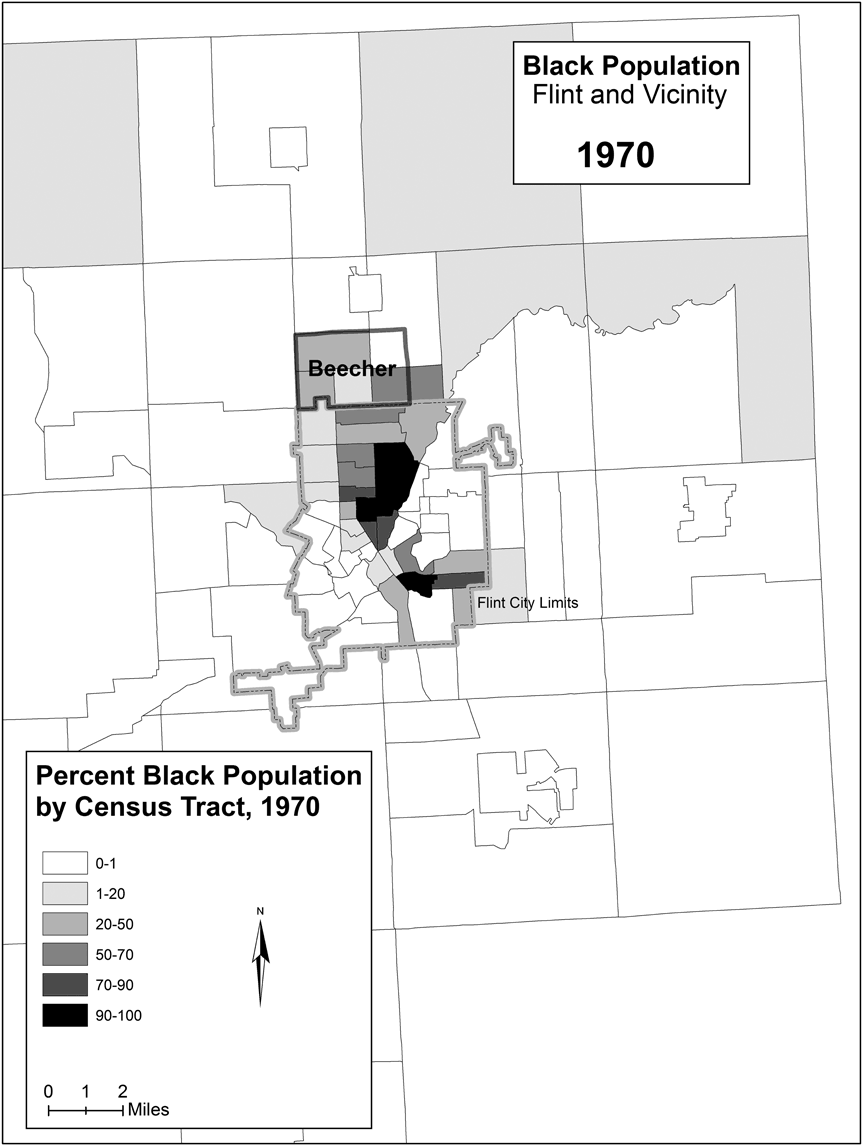
Critics of Sections 235 and 236 tended to frame their opposition to low-cost housing in economic terms, and the ample evidence of shoddy construction only seemed to fuel such sentiments. Nevertheless, racial fear played an equally prominent role in driving the resistance. Approximately 50 percent of the occupants of 235 and 236 housing in Beecher were African American. However, the concentration of units there caused several schools and neighborhoods to “tip” toward black majorities. At Zink, for example, the percentage of black pupils rose from 42 percent to 55 percent between 1969 and 1971.Footnote 92 During the four years preceding the passage of the HUD Act, the Beecher schools had maintained a stable racial mix of pupils: 70 percent white and 30 percent black. By the early 1970s, however, the combination of black in-migration and white departures had pushed several schools and neighborhoods past the racial tipping point (Map 4). “We had one of the model integrated school systems in Michigan,” Superintendent Coates complained, “and now it is being ruined.”Footnote 93
As the federally financed homes and apartments went up and hundreds of new African American families began arriving in Beecher, racial conflicts flared in schools and neighborhoods. The construction of 235 and 236 units also fueled widespread blockbusting and white panic selling across wide swaths of Flint, Beecher, and Mt. Morris Township.Footnote 94 In describing the situation in Flint Park, a neighborhood just south of Beecher, white homeowner Ben Wisniewski blamed the 235 homes for intensifying panic selling: “They [Section 235 homes] were junk. . . . Within a very short time, the properties fell into disrepair. . . . If you lived next door to that you moved out.” “I don’t think it was totally a black-white thing,” added Bill Haley, another white resident of Flint Park. “For some people, sure. But a lot of people were just worried about their investment.”Footnote 95 As elsewhere, homeowners in Flint Park and Beecher responded to plans for 235 housing by fighting to protect their investments. When that failed, they simply moved away. Others, however, turned to violence. To cite just one example, in July 1971, Clarence Hall, an African American who resided at G-1139 West Genesee Avenue in Beecher, reported that Ku Klux Klan members had burned a cross in front of his home. In a note left behind, the cross burners warned, “Niggers get out while you still can.”Footnote 96
Racially charged disputes also began erupting in the Beecher schools during this period.Footnote 97 According to Anthony Bell, a black student at Beecher High School, African American pupils faced “constant provocation” from their white peers. The first major racial conflicts in the Beecher schools exploded in the spring of 1969. During the week of April 13—shortly after the one-year anniversary of Martin Luther King’s assassination—several brawls between white and black pupils broke out at Beecher High School. On April 16, school administrators had to summon officers from the Genesee County Sheriff’s Department and the Mt. Morris Township Police Department to quell a “major confrontation” between white and black students.Footnote 98
Black population, Flint and vicinity, 1970.
Source: Minnesota Population Center, National Historical Geographic Information System: Version 2.0(Minneapolis, MN: University of Minnesota, 2011).

The fighting that occurred at Beecher High School was an extension of the battles over race, class, and real estate that were unfolding simultaneously in the district’s neighborhoods. Just prior to the April disturbances, the Mt. Morris Township board had moved to block the construction of additional low-cost housing units in Beecher. On April 4, at a meeting attended by more than a hundred angry residents, board members approved a one-year moratorium on all residential building.Footnote 99 Just over a week later, as the racial tension mounted at the high school, the board reaffirmed its position in front of a packed audience of two hundred predominantly white homeowners. After accusing builders of “consolidating the [subsidized] homes in one specific area,” one supporter of the ban urged developers “to spread them out” evenly across the county.Footnote 100 The April moratorium gained support from Superintendent Coates and other school officials, who complained that nearly a thousand new low-income students had inundated the district. Beyond contributing to classroom overcrowding, Coates argued, the 235 and 236 programs were fueling white flight and the transition from “integration to disintegration” in the district’s schools.Footnote 101
By the summer of 1969, the debates over affordable housing and integration had shifted from the legislative arena to the courts. Shortly after the township board’s vote, lawyers representing the A&E Building Company and Deventeen Investors, firms that had contracted to build a Section 236 apartment complex in the township, filed suit to end the building ban. On July 13, Genesee County Circuit Judge Phillip C. Elliott enraged many homeowners by overturning the moratorium. In his ruling, Elliott argued that the ban unfairly restricted private enterprise and that members of the township board did not have the authority to suspend building because of fears over white flight, high school taxes, and classroom shortages.Footnote 102 By allowing the construction to continue, Elliott’s decision set the stage for a series of confrontations that would ultimately thrust Beecher into the national spotlight.
In the aftermath of Elliott’s July ruling, Beecher school officials hurriedly began preparations for the new academic year. To accommodate the approximately one thousand new students they expected to enroll in the fall, school board members and Superintendent Coates devised a plan for half-day sessions and sought out new classroom space in church basements.Footnote 103 Hoping to quell the racial disturbances that had flared the previous spring, the board also hired Paul Cabell, the first black administrator in the district, to serve as assistant principal at Beecher High School. Principal Robert Towns assigned Cabell the difficult task of handling student discipline and managing race relations. Cabell’s hiring was part of a larger strategy devised by Beecher and Mt. Morris Township officials to restore calm while simultaneously working to curtail affordable housing and white flight. Ultimately, the challenge of maintaining the peace at Beecher High School would push Cabell past his emotional breaking point.
As Beecher school officials searched for ways to accommodate the new pupils and maintain order, members of the Mt. Morris Township board continued their quest to halt the construction of additional low-cost units. For their part, Township supervisor Krapohl and school superintendent Coates implored HUD and FHA administrators to conduct an investigation into the concentration of affordable housing in Beecher. In February 1971, after receiving numerous complaints emanating from Genesee County, HUD suspended its 235 and 236 programs in the Beecher area pending the results of a complete investigation.Footnote 104 Upon learning of the situation that had developed in suburban Flint, HUD’s Eugene Gulledge demanded to know why local policymakers had not adhered to the federal government’s “informal” goal of dispersing affordable housing.Footnote 105 Released in May 1971, the results of the HUD investigation did not include an answer to Gulledge’s question. However, the HUD audit did confirm Krapohl’s and Coates’s complaints that builders had saturated Beecher with more than its fair share of the contested units. The report’s authors acknowledged, moreover, that many of the 235 and 236 units in the district were poorly constructed and architecturally monotonous and that the government’s efforts were creating newly resegregated “suburban black ghettos” in Beecher.Footnote 106 According to this candid report, many other areas of the county could have received affordable housing units, “but HUD did not attempt to direct locations of building activities.” Instead, Gulledge and his colleagues in Washington gave “100 percent responsibility” over the program to FHA district officers in Flint and other cities.Footnote 107 Beyond accepting limited responsibility for the poor oversight in Genesee County, HUD officials blamed Thomas Hutchinson and the FHA’s Flint office for the “concentration” of units in Beecher.Footnote 108 “There was apparently very little, if any, discussion between the Flint [FHA] service office supervisory staff and builders and community interests regarding fund allocations, site allocations and community problems,” the authors of the report charged. Even after receiving numerous complaints from Beecher residents, the Flint FHA office neglected to address problems with the program.Footnote 109
In a May 25, 1971, letter to Superintendent Coates, Secretary Romney of HUD admitted that poor federal oversight had contributed to the turmoil unfolding in Beecher and other towns. Romney also informed Coates that William C. Whitbeck, the director of HUD’s regional office in Detroit, had “already put a stop on additional funding of Section 235/236 units in the Beecher District.”Footnote 110 While Romney’s decision to cancel the 235 and 236 programs in Beecher was welcome news to many frustrated homeowners and policymakers, it did not end the racial conflagrations. Instead, blockbusting, property abandonment, and racial confrontations continued unabated. At Beecher High School, racial tensions erupted yet again during the 1971–72 academic year. By February 1972, as one journalist wrote, “Something akin to anarchy prevailed at Beecher High. . . . Fires were set, windows were broken, youngsters were beaten and hundreds of students refused to attend class choosing instead to loiter in the hallways.” Ultimately, it took two dozen police officers in full riot gear to end the February disturbances.Footnote 111
Hired to curb the interracial acrimony that had plagued Beecher High School dating back to the late 1960s, Paul Cabell tried to serve as an intermediary between white and black students. Yet while performing in that capacity, he drew harsh criticism from both sides of the color line. Militant black students referred to Cabell as an “Uncle Tom,” maintaining that he favored whites and was insensitive to the grievances of Beecher’s growing black minority. But Cabell suffered the wrath of many white pupils, too, who believed that he was partial to black students. Cabell, Life magazine journalist Loudon Wainwright wrote, was “the man in the middle,” squeezed on all sides by racial hatred. “The black students called him ‘Tom’ and the white students called him ‘nigger,’” noted black pupil Donnie Odom. “No one was on his side.”Footnote 112
Cabell was a steadfast integrationist. As such, he initially embraced his appointment at Beecher High School as an opportunity to improve race relations. But the seemingly ceaseless racial turmoil in the community and at the school quickly destroyed his optimism. Depressed by his inability to pacify the student body, Cabell sat down in his Flint home to write two notes—one for his wife Carlitta, and another “For Beecher.” In the messages, written on the morning of February 24, 1972, Cabell admitted defeat in his quest to remedy the “unsolvable problem” of racism. He also declared that the experience in Beecher had driven him to despair, forcing him “to totter precariously on the fine line between two cultures.” “For what do I isolate myself in the middle, never right, always wrong?” he asked. In a direct appeal to racists and “hotheads” on both sides of the color line, Cabell insisted, “It is for you that I die.”Footnote 113 After finishing the notes, Cabell fired a shotgun shell into his brain.
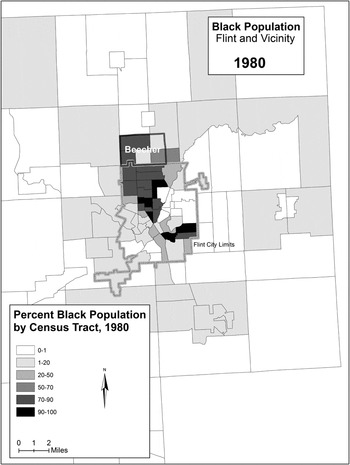
In the weeks following Cabell’s shocking suicide, calm prevailed at Beecher High School, leading many to assert that the young educator had not died in vain. Yet Cabell’s death did little to stabilize the community and stem the outward flow of whites from the Beecher district. Between 1972 and 1977, the proportion of black students at Beecher High School doubled, rising to 70 percent.Footnote 114 By the early 1980s, blacks held a clear majority in both the schools and neighborhoods of Beecher (Map 5). Meanwhile, the district’s housing stock—hit hard by property abandonment, declining government services, and a new federalized system of predatory lending—emerged as one of the most dilapidated in the county.Footnote 115
Black population, Flint and vicinity, 1980.
Source: Minnesota Population Center, National Historical Geographic Information System: Version 2.0(Minneapolis, MN: University of Minnesota, 2011).

Throughout the crisis in north suburban Flint, local and national observers speculated as to why Beecher, and not other area communities, had received so many units of “government housing.” For most defenders of the 235 and 236 programs, the market was the key factor driving location decisions. In support of his choice to approve so many units in Beecher, Hutchinson told a journalist from the Washington Post, “Our deal, as far as I can see, is this: is there a market?”Footnote 116 Clearly, there was a market for affordable housing in Beecher; and in light of that demand, Hutchinson and his FHA colleagues gave builders the freedom to select appropriate sites for 235 and 236 units. Moreover, Hutchinson allowed builders to self-regulate architectural and construction standards. In their defense, builders pointed out that the legal requirement that all federally financed homes have access to public utilities influenced their decisions to construct 235 and 236 units in Beecher.Footnote 117 Although unincorporated, Beecher met two of the federal government’s key financing requirements by providing residents with public water and sewer service.Footnote 118 “If someone can tell me where I can get financing,” offered James Walker, a developer of 235 units in Beecher, “I’d be happy to build elsewhere.”Footnote 119 Undoubtedly, the government’s guidelines regarding utilities placed clear limits on the potential locations for 235 and 236 housing projects. Yet Beecher was not the only suburban area that had access to such public services. During the 1950s and 1960s, predominantly white suburbs such as Flushing, Swartz Creek, Grand Blanc, and Linden, which received few or no low-cost units, also built modern sewer and water systems.Footnote 120 How, then, could local officials account for the discrepancies? Hutchinson and other policymakers greeted those sorts of questions with a wall of silence.
Although builders and government administrators rarely addressed the racial, economic, and political factors that drove site decisions for 235 and 236 dwellings, they clearly played a major role in determining which suburbs received units. According to at least one investigation, builders concentrated their efforts in Beecher because “the area was already integrated, a water and sewer system existed, and vacant lots were relatively inexpensive.” Furthermore, developers of affordable housing preferred Beecher to other areas of the county because Mt. Morris Township had only minimal building and home-inspection regulations, which helped to keep construction costs below federally mandated price ceilings.Footnote 121 During a 1972 speech to county planners, township supervisor Krapohl admitted that Beecher had a “very inadequate” zoning ordinance and no controls whatsoever on subdivision development. “Many lots were plotted in the 1920s with the 40’ and 60’ frontage, unpaved streets and very few sidewalks,” he revealed. “With this situation existing, the builders with commitments from the local HUD office had a field day.”Footnote 122
Because Beecher was already integrated, provided public utilities, had weak construction and zoning standards, and was affordable, builders effectively colonized the area with hundreds of substandard housing units. In their quest to stabilize the nation’s real estate industry by continuing the flow of supply-side subsidies, federal officials ignored even the most egregious local practices. In the words of the Flint Urban League’s Willie Wheaton, “The fact is that the FHA was running the program for the benefit of builders at the expense of the community.” “This district has been the victim of what I call neo-colonialism,” added Ira Rutherford, a black official in the Beecher school district.Footnote 123 Just as realtors had done for decades, builders and FHA administrators identified northwest Flint and Beecher as black expansion zones. By funneling poor and African American residents into Beecher and other such zones, participants in the Section 235 and 236 programs helped to spread the city’s growing urban crisis into suburban Genesee County.Footnote 124 But through the exclusion of affordable housing from most of the county’s remaining jurisdictions, those same actors ensured that the color line would only spread so far.
Conclusion
The federal government’s ambitious experiment with securitized home loans for low-income borrowers generated windfall profits for builders, lenders, and realtors throughout the nation. Across the country, real estate investors collected hundreds of millions of dollars in federal payments as a result of the HUD Act.Footnote 125 However, the initiative had the opposite effect on tens of thousands of poor families. In Beecher and Flint, the Section 235 and 236 programs triggered intense social conflict and waves of disinvestment that severely undermined local property values, tax bases, and community stability. Among the recipients of 235 loans in the United States, foreclosure rates were approximately 20 percent.Footnote 126 In the Flint area, however, nearly half of the Section 235 mortgage holders succumbed to foreclosure during the economic shocks of the 1970s. After exhausting their meager savings, many of the homeowners simply abandoned their properties and returned to the public housing complexes they had only recently left, carrying with them severely blemished credit histories that would make them attractive targets for local loan sharks and, later, subprime lenders.Footnote 127
Under heavy criticism from municipal officials and aggrieved homeowners from across the nation, HUD ultimately suspended the controversial program in 1973.Footnote 128 Although President Nixon’s moratorium on “subsidized” housing drastically reduced the flow of mortgage credit to low-income Americans, the private sector soon emerged to fill the void. During the 1980s and 1990s, a wave of deregulation in the financial services industry triggered a massive resurgence in predatory lending that ultimately led to the subprime crash and Great Recession. Just as in the 1960s, the predatory lenders of the late twentieth and early twenty-first centuries tended to target African Americans, members of the working class, and other “high-risk” borrowers.Footnote 129 But by the turn of the century, the terms of victimization had clearly shifted. In the late 1960s and early 1970s, participants in the Section 235 program experienced both financial exploitation and spatial segregation—even though they had also benefited from low-interest rates and federal grants. During the era of subprime lending, by contrast, high-risk borrowers suffered from financial abuse while retaining a measure of geographic freedom. In both periods, however, credit served as a vehicle for exploitation.
In Beecher and numerous other communities, bitterness over Section 235 lingered long after its demise. For many, the 235 debacle served as a reminder that the federal government had still not committed itself to providing adequate housing for African Americans and the poor. In addition, Beecher’s painful saga highlighted the fact that federal housing programs continued to enforce racial segregation and, indeed, economic exploitation, even in the wake of the major civil rights legislation passed in the 1960s.Footnote 130 Unlike the 1940s and 1950s, however, when federal policies excluded many African Americans and other classes of buyers from the home loan market, the passage of the HUD Act signaled the emergence of a new, federalized system of real estate racism rooted in standardized forms of predatory mortgage lending. Even though the terms of 235 loans differed from most subprime mortgages—and though minority and low-income home buyers in the 2000s had more and better geographic choices than their forerunners in the 1970s did—each of these systems of financing real estate transactions relied upon credit as a tool for racial and economic exploitation.
The story of Beecher’s transformation during the 1970s underscores the need for new chronological and topical frameworks for narrating the history of government-supported housing discrimination. With few exceptions, histories of the residential color line in modern America tend to begin in the mid-1930s, usually with the establishment of the Federal Housing Administration in 1934, and end at some point in the 1960s or 1970s, often with the passage of the 1968 Civil Rights Act, the 1974 Equal Credit Opportunity Act, or the 1977 Community Reinvestment Act.Footnote 131 Although these temporal bookends provide a useful lens for viewing the rise and fall of redlining and other exclusionary real estate policies, the cases of Beecher, Flint, and other communities affected by the Section 235 and 236 programs demonstrate that government-aided discrimination outlasted—and, indeed, negated—many of the landmark civil rights reforms of the 1960s.Footnote 132 As a result, the HUD Act, despite its relative obscurity, ought to be considered alongside the Fair Housing Act of 1968 as one of the most significant civil rights–related statutes of the twentieth century.Footnote 133 By 1968, a combination of federal, state, and local laws clearly prohibited redlining and other traditional forms of housing discrimination in Flint and other places. Despite such formal legal protections, however, the Fair Housing Act and other similar pieces of legislation at the state and local levels contained very weak enforcement provisions. Moreover, the HUD and Justice Department officials charged with enforcing fair housing tended to focus their efforts on increasing the flow of credit into minority and low-income communities rather than combating predatory lending. In the absence of a strong, comprehensive federal approach to fair housing enforcement, the HUD Act unleashed an avalanche of predatory lending that simultaneously impoverished and resegregated the recipients of 235 mortgages.Footnote 134 Consequently, the passage of the Civil Rights Act of 1968 marked not the end of government-backed housing discrimination, but rather a pivot point between the age of redlining and an era of nationalized predatory lending. During both periods, government housing policies caused racial discrimination and financial victimization. Indeed, through their implementation of the 235 and 236 programs, policymakers and real estate entrepreneurs brought new forms of segregation to cities, suburbs, and rural areas while pioneering novel methods of exploiting the poor. Places such as Beecher, of course, would never be the same.
America’s long history of acquisitive mortgage lending begs for a new discourse on the roots of the subprime crisis and, more broadly, the nature of credit, debt, and subsidization in capitalist societies. For decades, most scholars of American history have assumed that credit—especially when it comes with a federal seal of approval—is a form of “subsidy” for the borrower.Footnote 135 Yet the intertwined histories of the Section 235 program and the ongoing subprime disaster illustrate that debt often serves as an impediment to racial and economic fairness. Furthermore, these two intimately related calamities point to the fact that the primary beneficiaries of so-called federal housing subsidies have often been lenders, developers, and investors more than ordinary debtors. For that reason, it is now time to replace the language of homeowner subsidies that has suffused the scholarly literature on postwar metropolitan development with a more nuanced appraisal of the benefits and burdens of debt. Doing so will require an unraveling of the web of ties that connects the subprime implosion of the 2000s with the gale of predacious lending that swept across the nation during the 1970s. In that emergent story, the Section 235 program and communities such as Beecher must sit front and center.