Reports of “empty villages” or “hollow villages” (kongxin cun 空心村) in China's vast countryside have become the de facto narrative corollary to China's rapid urbanization and seemingly ever-expanding migrant labour force. If the cities are teeming with labourers born in the countryside building and servicing China's modern future, then the villages must be hollowed out of life, full of abandoned houses where the elderly are left to tend children whose care would limit the labour power of China's economic backbone. What once was the mythic heartland of Mao's China has been re-imagined in the era of its capitalist boom as a place of abject poverty, little opportunity and general misery. Whoever can leave does, it is assumed, joining the largest industrial migration in human history. It is estimated that 200,000,000 people have abandoned the countryside through both official and unofficial migration to seek employment in China's cities.Footnote 1
While this image of abandonment may be true in certain locations in China, it does not accurately describe the conditions of every village. Nor does it give any logic for migration other than the mysticism of capital, as if at the moment “the market” arrives somewhere, pre-existing historical, social, economic and familial conditions and constraints disappear. This article investigates the case of a rural village in north-east China that defies the stereotype of empty villages, while also being subject to the same forces blamed for the hollowing out of China's countryside. Previous national surveys have found that the majority of migrants are young and unmarried.Footnote 2 While this provides significant demographic knowledge of how labour and mobility in China are changing, it is unable to enquire into the specific reasons behind such migration for this age group beyond macro-economic and policy structures, and what other effects labour mobility at this critical juncture in the lifecycle has on the person and their families.
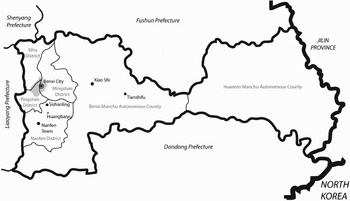
Based on longitudinal ethnographic and statistical research,Footnote 3 this article finds that much labour migration in this region of north-east Liaoning (see Figure 1) is not driven by a specific desire to abandon the countryside, but rather is a gendered strategy through which parents seek to weave a web of social security through extended family relationships while remaining in the countryside. Constrained by national land and social benefits policies that disadvantage rural residents, rural parents seek to use the marriage of sons to ensure their basic care into old age, and the marriage of daughters to build bridges to legally sanctioned urban privilege. Lifecycle labour migration is integral to both strategies. This cross-boundary movement to maximize overall family opportunities by exploiting different niches over a long time-horizon, akin to what Aihwa Ong has termed “flexible citizenship” in other contexts, does not come without risk.Footnote 4 There is only so far one can bend before breaking. In Huangbaiyu 黄柏峪, deploying a strategy of marriage migration in order to gain family stability and security may in fact be undermining it.Footnote 5
Benxi 本溪 Prefecture, Liaoning 辽宁 Province

Like other rural areas in China, conditions in Huangbaiyu are affected by “surplus labour” in agriculture, increased labour demand for both the construction of China's cities and services to its citizens, and low quality primary education provided to rural children. Labour migration out of Huangbaiyu is significant, but only amongst unmarried youth. Permanent outmigration is counteracted by intergenerational claims on filiality and family economic survival that bring young men back to the village, which in turn bring young women back to become these men's wives. Rather than being seen primarily as an economic strategy, labour migration is discussed and enacted as an intergenerational family management strategy with the goal of a successful marriage. Contrary to the models of dependency and modernization, or labour allocation and spatial equilibrium, these men and women are not only migrating to earn a higher income but also to secure a “better” marriage. It is the long-term effects of marriage on the prospects of an extended family that is the basis of a rational economic decision to migrate, not the short-term income.
Huangbaiyu village has babies, toddlers, children, recently married couples, middle-aged men and women, and the elderly. What it lacks demographically are teenagers, or youth. A pressing sociological problem is not of grandparents raising grandchildren, but of the difficulty of arranging “proper” marriages for young men and women set up by the structural mechanisms of China's development and parents’ strategies for intergenerational family security. In short, while teenage boys are sent to the city to work and save to contribute to paying bridewealth, and then return to the village to marry, teenage girls are sent to work and earn money to spend on themselves in order to “get cute” (cheng ke'ai le 成可爱了) and “citified” (chengshihua de 城市化的) in the hope that they will secure a marriage to a non-farming family with residence in the city.
When this strategy for a girl's and her family's future fails, the young woman who has worked in the city for some two to four years is re-integrated into rural life through marriage to a rural young man. Re-integration of “citified” young women into rural households is fraught with conflict in Huangbaiyu, having led to run-away wives, abortion, divorce and new strategies through which potential in-laws manage returnee wives for their sons. The long-term insurance strategy of the rural mother influences the desires of the rural daughter, which in turn creates greater anxiety and household burdens for the rural mother-in-law.
This article analyses the following questions. What are the structural conditions that have established lifecycle migration as critical to a successful marriage of rural youth? How does labour migration affect rural young men and women differently? What effect are China's development strategies having on the subjectivity of young women, and in turn on the rural households from which they come or into which they marry?
Raising these questions highlights the importance of the timing and duration of labour migration on its economic and sociological effects. The article also connects the political economy of development policy directly with intergenerational family strategies and the formation of personal desire. While both young men and women are affected, the return to a rural household puts a greater psychological burden on women than men. Anyone who returns to live in a rural village after working in a city faces a stark change in labour opportunities, consumption practices and service infrastructure, but it is women who are doubly subordinated and who feel the burden of rural life more.Footnote 6 City life may have made both men and women internalize a labour hierarchy that privileges disciplined, waged labour over agricultural self-employment. However, upon returning to marriage in a rural village it is only women who are subjugated to both devalued market labour and to the burden of domestic labour. Unlike in the city, where service infrastructure delivers gas to the room for heating or cooking, and water for drinking and cleaning, in Huangbaiyu village the primary burden of daily subsistence infrastructure provision rests on women.
Once free to work and spend money on themselves in the city, returnee young women enter into households where they are required to do the labour that was denigrated as the epitome of rural “backwardness” during their years in the city: starting and maintaining fires, hauling water, sweeping dirt and mopping muddy floors, tending vegetable gardens, feeding geese and pigs. After their inheritance from the bridewealth exchanged at their betrothal is spent, they no longer have access to money of their own, as the majority of their labour remains unpaid.Footnote 7 For some returnee young women, such as Jiao, the conflicts between a young woman's newfound expectations and those put on a rural wife are too painful to bear.
Jiao had been married to Mingliang for five months and pregnant for three months when she came to talk to me about her marriage in May 2006.
When I became pregnant the doctors had said that it was important that I remain calm, and not be angry because that would affect the baby. But I am angry. Nothing here is mine. Everything is work. Everyone yells at me. Dad [father-in-law] yells at me. Wake-up, make the fire, boil water, cook food, fold blankets, sweep and mop, wash clothes. There is so much washing and mopping. I won't do it. What's the point? There is so much mud. How can there be so much mud? Look at my pants. Damn dog. Dirty dogs. The bitterness would go to the baby. I was so angry, and in so much pain. How could I be calm? So I got rid of [aborted] it (dazuo le 打嘬了). I didn't want it. I thought about it, and I had already decided to leave him. We fought since a couple of days after the wedding, you know. He [Mingliang] won't move to the city. He's stupid. We could make more money there. He deceives people. He deceives you; he deceived me. He won't let me go to the city. He says I'll be corrupted by bad examples. That is what he was yelling about last night. I can't stay here. I can't. The conditions aren't good. How can you stay? I'm leaving. I have to go. I have to.
Jiao did leave that morning, and within another four months her marriage to Mingliang would formally end. While Jiao's decision to abort her and her husband's child and run away was extreme, young brides who ran away with or without their children, or who were sent away because of their inability to work in the rural household, were common enough in Huangbaiyu and throughout the township's villages amongst marriages that included a returnee young woman. In response to these possibilities, mothers-in-law have developed strategies for vetting and taming those brides who might destroy the “insurance” they had bought for their own future through their son's marriage.
By highlighting how China's land and education policies work together to push young rural men and women into the city as migrant labour, and back out to the countryside to provide for their parents(-in-law) and reproduce, this article seeks both to trouble the celebration of labour mobility in China as an unproblematic harbinger of personal freedom, and emphasize the importance of long-term extended family management and marriage strategy as a determinant in rural labour migration. Other scholars have written extensively about the structural mechanisms of labour mobility in China,Footnote 8 the experiences of rural migrants in the citiesFootnote 9 and the economic contributions of “successful” returnees to villages.Footnote 10 Scholars who have focused on the nexus of labour mobility and gender have tended to concentrate on the experiences of rural women in the city as labourers.Footnote 11 Where focus has turned to rural women's subjectivity as “modern subjects in the space outside the culture of modernity,” the implication remains that it is the draw of the city that is irresistible to those trapped in an “inert and meaningless” life in the country.Footnote 12 But how is this “meaningless” life structured? This article argues that it is given its context by both the failure of rural education to provide equitable opportunities for rural children to improve their lives economically and socially, and by parents’ strategies to secure such improvement through marriage.
Unlike many contemporary studies, Lin Tan and Susan Short encourage a focus on marriage and family as a component of women's labour migration, and chronicle the difficulty of the marriages of “double outsiders,” rural migrant women who marry into a county-level city.Footnote 13 They recount how those women who are successful in achieving their dreams of marrying into the city often end up isolated in their new homes. In contrast to their approach, this article looks at how the dream of marriage to a city boy is shaped in the minds of rural mothers and daughters, how this fits into overall family marriage strategy affecting both men and women, and the conflicts that emerge when these young women are brought back to the countryside for a rural marriage.
As long as rural households are left to rely on the “insurance” of land allocated to them through the Household Responsibility System – which they cannot sell for market prices – and returns on education investment remain poor, they will pull sons (and wives for them) back to the countryside, and try to marry daughters to urban households to expand their network of security. A dramatic conflict is set up: young men are encouraged to return to the countryside, while young women are pushed to marry elsewhere. If the experiences of families in Huangbaiyu and the women married here is not an anomaly but signals a broader trend, how will a generation of returnee young women frustrated and angry in rural marriages, or their abandoned ex-husbands and parents-in-law without future labour “insurance,” influence the future of China's development?
Filling Empty Time with Migratory Labour: Effects of Poor Education
I stopped going to school in the eighth grade. It was a burden. It was pointless. I was never going to pass the exam, and we couldn't afford high school anyway. Better to stay at home. Why pay for something without use? (20-year-old Mingzhu, male)
I never went to Sishanling 思山岭 [township where middle school is located]. What would have been the point? (19-year-old Ye, female)
I didn't go after sixth grade. Not many did. On the TV now I hear people talk of education as an investment. For whom? Here it's like burning money, but it's for the living [not the dead], so why burn it? (24-year-old Mingliang, male)
Why keep sending them on [to school]? She can talk and socialize. She'll be better off getting married (mother of 13-year-old girl who stopped attending sixth grade in 2004)
From 2005 to 2009, the drop-out rate in middle school for children from Huangbaiyu was between 60 and 80 per cent, and only 5 per cent of children in Huangbaiyu continued on to secondary school. If increases in education are highly correlated with increases in future income,Footnote 14 why is it that parents and children perceive continued education as pointless and akin to burning money? Are parents’ and children's decisions to not pursue educational attainment a sign that they are indeed “backward, feudal peasants” who cannot be trusted to make decisions that will improve their own lives? With economists predicting that greater inequality in educational attainment will exacerbate the growing urban–rural income gap in China,Footnote 15 how is it that in Huangbaiyu education is seen as “without use” and families’ strategies for being “better off” tend to focus on marriage? Is this mountainside village in a “feudal” time warp where some mythic tradition pulls children from school, or could there be a rational reason for such choices, perhaps even one informed by expectations of future family economy?
In short, the answer is that there is little education at Huangbaiyu Primary School. Students are set up for failure both in comparison to other village students at the township middle school and in comparison to urban students, who all compete for entry to secondary school on the same exam.Footnote 16
Days at the village primary school
While the blackboard in the staff room lists the school day as lasting from 7.30 a.m. to 4.20 p.m., there are in fact only five hours of instruction on Monday, Tuesday, Thursday and Friday, and two hours on Wednesday. The day is cut short by a ten-minute break between each class and one-and-a-half hours for lunch. Class rarely starts on time. Even these hours were often further shortened since the long lunch break regularly led to group drinking amongst the staff. After my first attendance at one of these semi-regular lunches,Footnote 17 I asked how everyone would teach in the afternoon. The fifth-grade teacher turned to me and exclaimed “self-study” (zixue 自学) as he hit his glass against mine and another glass of grain alcohol was drunk. While these drinking sessions could happen any time of the year, they were more common in the winter months, from November to March, when drinking grain alcohol was one of the main ways to feel warm.
In the winter of 2005–06, there were 12 days in which snow and ice prevented the first, fifth and sixth-grade teachers who lived outside the village from attending school. But once these outside teachers were at school, they did remain on campus. The kindergarten and second-grade teachers would regularly leave for hours at a time to attend to their households, commonly dealing with wood fuel needs or feeding trout in aquaculture ponds. Being “local” (minban 民办) hires rather than assigned through Ministry of Education channels, neither was guaranteed work year-on-year nor entitled to a pension, so for both continuing their agricultural businesses was a household priority.
Despite the location of the primary school within the centre of the village, it was still an hour-and-a-half walk from the furthest hamlets in its northern and southern forks. In the winter, this distance would sometimes prevent children from coming to school, particularly for lower primary students. Unsurprisingly, those few students who drop-out before finishing primary school have consistently been students living in these furthermost hamlets.
Huangbaiyu Primary regularly tests in the bottom 20 per cent of Nanfen district, which itself regularly tests as the bottom district in the prefecture-level city of Benxi. It is the district with the most rural schools. The tests that determine students’ and schools’ standing are selected and distributed across the entire municipality to ensure that all students are measured against the same standard. Unfortunately, all students are not provided with the same education. With an unlikely chance of passing the middle school exams and being offered a seat in secondary school, many families decide that continued investment in a child's education is indeed a waste of money. Until the summer of 2006,Footnote 18 sending one child to primary school cost a family in Huangbaiyu 7 per cent of the median household income; to attend middle school, it cost 22 per cent of the median household income, not including the cost of lunch or transport, which adds another 16 per cent. Spending 38 per cent of median household income per annum for a 5 per cent likelihood of the “investment” paying off proved irrational to the parents of the 60–80 per cent of children who did not complete middle school in 2005–09.
Once children leave middle school the pursuit of placement in a suitable work environment begins. Despite aggressive “reclaiming of wasteland” (kaiken 开垦) that has expanded agricultural landholdings by 465 per cent above official government records of allocations through the Household Responsibility System, except during the periods of planting and harvesting which conveniently fall during the national holidays for Labour Day and National Day, children's work is unnecessary. Teenagers effectively become part of what is now regularly termed “surplus labour” in China: bodies of potential labour not being effectively put to use. In Sishanling Manchu autonomous township, which includes Huangbaiyu village, the government estimates that there will be 1,970 surplus labourers by 2011, out of a total population of 11,000 people.Footnote 19 Without work on the farms, and without non-farm work readily available in the countryside, these rural surplus labourers become part of the inexpensive and disposable labour pool fueling China's economic boom. By the age of 15 for boys and 17 for girls, parents are actively securing placements for them to work in nearby towns and cities.
Finding Firewood in the City: Sending Sons So That They Can Return
“I was a good student, one of the best in the village,” Xiwu told me. His mother chimed in: “He was a better student than He [his younger sister], always at the top of his class. He read well, good at numbers. But we had no money.” In 1992 at 15, he started working at a bakery in Benxi city, the prefecture-level city, earning 150 yuan per month.Footnote 20 He worked there for nine years. By 2001 he was earning 600 yuan per month.Footnote 21 He could not start his own bakery, which had been his dream, because he used all of the money he had saved and borrowed more from relatives against his future earnings to build his parents a house in 1999. Building the house cost 15,000 yuan.Footnote 22 Before that, his parents lived in a small one-room structure. One wall had partially collapsed and the roof leaked. It was built like all the other houses that remained from the 1960s and 1970s: stone and mud walls, thatched roof and windows of paper. But in the 1990s, the houses in Huangbaiyu were being transformed into brick, tile and glass, and with that transformation marriage prospects were also transformed. Xiwu's mother told me: “We couldn't build it [a house]. So he couldn't marry. He was 22. The time to marry had arrived. No one would look at us. Even then, we are so poor it took another six years to find a bride. We've been talking to get this one for four years.”
The weight on Xiwu was particularly heavy due to his family's abject poverty. The burden to ensure the future of the family household fell completely on his shoulders: providing both the house and bridewealth (caili 彩礼). As the cost of providing housing and bridewealth has risen since Reform – at the same time that education and health care costs have risen and rural means of earning cash have remained limited – it has become virtually impossible for parents of sons to save enough money both to build sons their own stoves and kangs 炕, the sign of a new nuclear family, and pay the bridewealth. When I asked Fuxiang, father to both Mingliang and Mingzhu, why his two sons were working at auto shops in the city, he said: “I have built the kang. They must get their own firewood.” Building the kang, or raised earthen stove-heated sleeping and activity platform, and remodelling the family home to make it ready to pass the inspection of a potential bride's family (kanwu 看屋) cost his and his wife's life savings of 42,000 yuan in 2000.Footnote 23 Now in 2005, the payment to finalize the engagement negotiations for the bride (dinghun 订婚)Footnote 24 and set the wedding date would cost the family bridewealth of 36,000 yuan.Footnote 25 While Fuxiang borrowed 13,000 yuan from family and friends, his son Mingliang contributed the other 23,000 yuan from his savings as an apprentice auto electrician in the city for seven years. All parents interviewed both through the 10 per cent village household survey and extended, longitudinal interviews expected that their sons would pay the majority of the bridewealth, while they provided the new rooms in the house. The average bridewealth paid in 2004–07 was 33,500 yuan,Footnote 26 with the groom having laboured outside the village for an average of 7.5 years to earn his contribution.
Implicit in Fuxiang's thinking about his sons’ need to earn their own “firewood” is that they will return to the village to marry. Their labour in the city is a temporary act intended only to secure the money that will make it possible to secure a wife, and the possibility of new generation. While the focus on the new generation is made explicit through wedding rituals that portend the quick birth of a clever son or a beautiful daughter and decoration of the newlyweds’ room with posters of babies hung over the kang, for the older generation the importance of the wedding and childbirth is less for the creation of a new nuclear family and more for personification and solidification of their own old-age insurance plan. All the households in Huangbaiyu with sons expected that at minimum their oldest son would return to live in the family house as a stem family; second sons were given greater allowance for pursuing other opportunities, if they arose, although joint families were still the dominant expectation. For 97.5 per cent of households the expectation of a stem family proved true, with at least one son returning to the village as a permanent home, along with wife and children. The other 2.5 per cent are parents of the unusual few whose sons made it into secondary school and onward to college, and now live in cities working in white-collar jobs.
The importance of the strategy of using sons as an old-age insurance policy is made explicit in representative responses two mothers of sons gave to me when I asked them why their sons must return to the village to marry and live. Mother-of-Tiebao made an explicit comparison between the receipt of pensions and the use of sons as future labour as equal strategies for old-age survival:
You know we ruralfolk don't get pensions. That's how our country is bad to us. We work, and work, and when we're old, you work or die. Or you have a son who works so you don't die. The earth doesn't give you food for looking at it. Cityfolk! They just work a little bit. Retire at 45 and then there's a cheque that comes while you sit.
In addition to relying on sons’ labour in old age for food and income, their labour, and that of a younger generation, is necessary to make daily survival in a rural area of China possible. As Mother-of-Yangsheng said, “Maybe he'd make more money in the city, maybe he wouldn't. But who'll haul the water? Who'll cut the firewood?” Unlike in the cities where pipes bring the necessities of basic survival to the buildings people live in, in rural areas – particularly in China's frigid north-east – significant labour hours are spent just in order to subsist (weichi shenghuo 维持生活), before any work can be devoted to surplus earnings.Footnote 27
However, if sons are pushed into the towns and cities to work to save for marriage and return to the village as their parents’ old-age insurance, what is expected of daughters?
Getting Cute: Sending Daughters So That They Remain
As in various other rural areas in China,Footnote 28 endogamous marriages were dominant in Huangbaiyu in the previous two generationsFootnote 29 and marriages to mates in other administrative villages within the township common, but in the current generation both such types are now rare. Brides primarily come from Benxi prefecture's two Manchu autonomous counties – a full day's ride by several buses – or from the counties of two of Liaoning's other prefecture-level cities, Shenyang and Dandong; and Huangbaiyu's daughters rarely marry within the village. Why are parents in Huangbaiyu no longer seeking to strengthen their resource networks through village-based affinal ties?
In the current generation of parents and grandparents, affinal ties are strong supports of agnatic lineages. Within Huangbaiyu's Dry Riverbed hamlet, the endogamous marriages of Fuxiangs’ two sisters and his own marriage to a Nanfen district family that had relocated to Dry Riverbed as a result of the marriage of two of its daughters thereFootnote 30 provided him, who was 48 in 2006, with “uniting bridges” (lianqiao 联桥)Footnote 31 to three other agnatic lines. He was thus connected to 94 per cent of all households in Dry Riverbed either through blood or bridges. While marriages within Dry Riverbed were common, as they were in two of Huangbaiyu's other 12 hamlets, another two hamlets had a long-standing tradition of daughter exchange. Endogamy as a household management strategy meant that despite the tradition of virilocal marriage, daughters were not as much permanently transferred from their mother's house to their mother-in-law's as they were transferred with an unequal custody agreement. While there were still certain days that the wife could not visit her natal family according to tradition, it was expected that the men within the wife's new married family would now be the “uniting bridges” between the two families, creating a much larger security network within the same generation, and through to their progeny. It was also expected that the daughter would frequently visit her mother's house and help in times of need. When there are limited resources and high vulnerability, a larger network from which to borrow labour, money and goods strengthens a family's viability.
This strategy only works effectively as a social security measure as long as what the family needs can be secured through stronger local networks. Growing disparity – and villagers’ awareness of that disparity – between the services available to and income earned by urban residents versus rural residents as well as increased demand for temporary urban labour has shifted parents’ strategies for daughters’ marriage in Huangbaiyu. It is not more bridges within the countryside that they are looking to build, but bridges into the other world of the city, a world that they cannot fully participate in as equals because of the legal discriminations established by the hukou 户口, or Household Registration System.Footnote 32 Greater access to capital and health services, facilitation of government interactions, and comfortable care when elderly are all advantages of urban living that mothers in Huangbaiyu seek to gain through marrying a daughter to a city boy.
When talking about their plans for the future, the weddings of daughters were key steps in ensuring the household's future security. Far from seeing the marriages of their daughters as a rupture of the natal family, mothers saw them as integral to their own household's economy. After having described her dream of apartment living where more land is saved for planting and water comes magically up pipes and there are no outhouses, Changxiang confided to me: “If Li can marry a city boy, her husband will make more money than if he was rural. Sure they'll spend more money, but there's more money. There's more money to ask for.” With loans from family and friends in times of lifecycle events or sudden medical needs a critical survival bridge in Huangbaiyu, creating access to greater loan amounts is a constant work of household strategy.
Zouli 走礼, or “walking ritual,” as the practice of the gift economy is known in Huangbaiyu, dominates the household's social schedule and economic obligations,Footnote 33 and is the system through which large amounts of money are accessed in a family's times of need. While money is given, it is the person to whom it is given with whom a relationship is developed, allowing one to “have people” at one's disposal (youren 有人). Not all people are equal in one's network of “having,” as those who already have more, and so have potentially more to give, are worth more than those who do not. Gaining the ability to “have people” in the city opens up a world of possible access that does not exist within countryside-only networks.
While talking about the prospects for her daughter's marriage, literally “finding a mother-in-law” (zhao pojia 找婆家), Mother-of-Ye explained why a city boy would be an ideal mate for Ye:
It's hard to have people in the countryside. The people you have don't have people. Having people gets you things. Having people means you'll get in the big building [government buildings]. Having people gets you into the hospital. Gets you the loan. Country people don't have anything, unless you have people first.
Some mothers even framed access to city living and services in terms of survival. As Mother-of-Shuang told me about her plans for her 13-year-old daughter and of sending her to work in the city in future years as a means of finding a husband, she concluded:
When I'm very old, I don't want to live here anymore. It's cold. It'll be hard to light the fires. The grass spirits (caoqi 草气) will give me headaches, and then I'll die of a cerebral haemorrhage.Footnote 34 With a daughter in the city, she'll have room to have a bed for me.
Marriage of a daughter into an urban household allows the daughter, and thus the whole family, to bridge the chasm of opportunity between city and countryside cut by the hukou and its associated policies.Footnote 35
Consequently, dreams of such marriages are held by mothers and fostered in daughters. Mothers know that such marriages will remain only elusive fairytales if no action is taken to get her daughter noticed by a city boy. Without existing family networks within cities, families cannot employ the same customary channels for marriage negotiation between families used for most rural weddings. They also recognize that marrying a rural girl is likely to be viewed as a poor match by a city boy's family. In order to will their wish into reality, daughters are sent to nearby towns and cities to work in popular urban hotspots, most frequently as waitresses, in order to find their beloved or lover (zhao duixaing 找对象). While this process is spoken of as one of seeking, mothers also openly speak about the process as a lure in which the daughter is supposed to transform her outward appearance to secure a marriage partner. It is also not unexpected that the lure only successfully catches a marriage partner once the daughter is pregnant.
While working positions for boys are sought in Nanfen district or Benxi city by the age of 16, parents wait to send girls until they are 17 or 18. The delay in arranging labour for girls is influenced by China's marriage law, the use to which her earnings are to be put and fears of girls being ruined (huaile 坏了) in the city. While boys are expected to save money for many years in order to be able to pay future bridewealth, girls are expected to spend their entire earnings on themselves. Not a single parent of a daughter working in the district or city expected or received any remittances. The point of having the daughter work in the city was to catch an urban husband, and that required that she spend the money on her own transformation: hair dye, make-up, jewellery and clothes. Since no savings were expected, the only time necessary was that needed for the girl's transformation itself, and for a suitable boy to recognize her. With marriageable age for women set at 20, the consensus amongst parents in Huangbaiyu was that two years was plenty of time; more could be dangerous.
Despite mothers looking to the city as a place of opportunity for their daughter and their household, this is seen as short-lived. The city is an ambivalent place, one where in the short term dreams can be made, but in the long term daughters can be ruined. After four years of sitting at home, Li, now 18, was finally to be sent to the city to work as a waitress. Her mother explained the timing to me:
Two years is enough. Before she was too young. If she starts at 16, I'd worry about the boys she meets. It is too long. You can't marry that young. She'll learn bad habits. We're sending her now because it is enough time. She'll get cute, and meet someone. She'll be 20 soon enough.
It became clear through further conversations with Changxiang and other mothers that the “bad habit” they were most worried about was sex. Sex itself was not an issue, since this was seen as a way of luring a city boy's family into marriage, but if sex itself became a habit, then the daughter would become, in her parents’ eyes, unmarriageable. Changxiang succinctly captured this ambivalence in a later conversation: “If she's not pregnant, will his family agree? It is just easier that way. But if she becomes ruined, well, then who will take her?” In the short term, sex was seen as something the daughter should use judiciously, as a tool to secure a city husband; but if she remained in the city for too long without marrying, she might allow sex to become something she sought for her own pleasure. Mothers feared that daughters who engaged in sex with too many people over too long a period – or were perceived to have done so due to the opportunity to have done so – would not only have their reputations ruined but would themselves forget that sex was only “proper” when deployed strategically.
Li earned 600 yuan per month in 2006 working as a waitress in a noodle bar in Benxi city, which was typical of employment sought by parents of young girls and, also typically, her position was arranged before she was allowed to move to the city. Li confirmed that she spent all her earnings on “citifying” herself, which was clear during her visits back home during holidays. Her hair was highlighted, she wore the colourful, sparkly jewellery of urban youth, had an immaculate pedicure and wore white trousers. Her intentions no longer to work the land were clearly signalled.Footnote 36 Looking at her daughter across the kang, her mother said aloud:
Girls these days aren't meant to live in villages. Look at my own daughter. When I was her age we were in the fields every day. Work! Work! Everything ached. And still we'd work and there'd be little food. I'd go up into the mountains. When all the wild greens were gone in spring or hazelnuts and mushrooms in autumn, I'd grab the bugs. I'd boil the bark. Can you imagine her doing that? She doesn't even know the difference between what's edible and what's poison. She'd kill us all! Snakes! There are snakes up there! She can't go into the mountains. She's has no boldness.
Li, her daughter, who had been sitting on the other side of the kang watching television as we talked, added without turning her head, “I'd die.” There was a certain pride in Changxiang's description of her daughter's failure at being a rural woman, her lack of useful knowledge and “boldness,” for everything that she lacked is what her mother, and other mothers, thought would make her more appealing to and fitting for an urban husband.
When There is No Fairytale: Citified Daughters Return to (Another's) Village Life
Jiao had left school after the sixth grade, and left her village in Benxi county at 18 to work as a hairdresser in Tianshifu 田师付, a county town in Benxi Manchu autonomous county. She worked in two different hairdressing shops for four years. She had tried twice to find a placement in Benxi city but failed, always returning to the county-level town. After four years and no marriage prospects, her mother began to seek a mother-in-law's house for Jiao. I asked her why she felt that Jiao needed to marry at that time. “People here already say things about her,” she said. “She's been in the city too long. She needed to marry. She was already beyond the marriageable age. I don't think she's old, but people say so. I think she's too young for this marriage.” At the time, I did not understand what Jiao's mother meant by her daughter being too young for “this marriage,” even though she had hoped that Jiao would have already been married to a boy in town by then. Only after speaking with and observing several mothers-in-law of “citified” brides did I realize that calling these women “young” did not actually refer to their physical age but to their preparedness to be a rural wife and mother. The qualities that rural mothers of daughters sought to foster in their daughters in Huangbaiyu in the hope of attaining a city marriage hindered the development of their abilities to succeed as a woman in a rural household.
Jiao was not the first “citified” bride married into Huangbaiyu, although she was the first one married into a household where the mother of the groom was dead. As various family members and neighbours said after the spectacular divorce between Jiao and Mingliang was finalized and her abortion well-known, without a mother-in-law in the house, Jiao could not be prepared for a proper rural marriage. “She needed to be reformed through labour,” Mingliang's third maternal aunt, Changxiang – who was also Li's mother – said. Mothers-in-law in Huangbaiyu had devised strategies to re-educate their daughters-in-law upon their return from the city. However, before addressing these measures it is important to understand the significant shifts in attitude towards work and consumption that citified daughters bring back with them to the countryside.
Ruhua had worked in Xiaoshi 小市, the county seat in Benxi Manchu autonomous county, as a sales girl for five years before being married to Gang in one of Huangbaiyu's most remote hamlets at the fork between the south and east ravines. She had completed middle school but did not score highly enough to gain access to an elite secondary school, and so her parents thought it better that she prepare to work. She had enjoyed working in the city, but her parents negotiated her marriage. “They said if I couldn't find one myself, I'd left them no option but to use a matchmaker. I didn't want to marry here. I had my own boyfriend. But his parents wouldn't allow it. I still wanted to wait, but there was so much pressure.” While working in Xiaoshi, Ruhua had chosen her own English name – Ruvemda – and asked that all her friends use it, even though no one spoke English.Footnote 37 She never liked living in Huangbaiyu. She was the only person in the village who had given herself an English name, and the only person the entire time I lived there who ever tried to speak a few words of English to me – including the teachers at the school, who supposedly taught English. In her mother-in-law's house, Ruvemda did not cook, saying that her food was bad. She did not work in the mountains tending the silk worms, saying that she had no time. When her daughter was little, she stayed at home and taught her to read and sing, and as soon as she could go to kindergarten, told her family that she was moving to the municipal city to care for the education of her daughter. When she was home at weekends and her husband was drunk, which was rather frequent, she would call him an ass (shenglian 牲脸) to his face, and make fun of his dark skin and wide-set eyes. “He's such a peasant (nongmin 农民),Footnote 38” she said disapprovingly, seemingly never thinking that technically the same category officially described herself.
Jing, who was to marry into Huangbaiyu in some months’ time, loved watching a show that her future mother-in-law found incomprehensible: “Supermarket star: happy housewife” (Chaoshi dayingjia: kuaile zhufu 超市大赢家:快乐主妇). Contestants are given lists of types of things to find in the supermarket (round, made of wood, used by the hand and so on) and are judged both by how quickly they navigate the store and in some sessions by how they predict other people's navigation. One night over New Year 2007 I watched an episode of “Supermarket star: happy housewife” taped in Guangdong with Jing and her soon-to-be mother-in-law. The finale was a contest to fill up two trolleys with the most expensive items in the store, with the winner the one with the highest bill at the checkout. The winner's total was 6,287.41 yuan. Jing was enthralled, and then started telling me about the differences between the various supermarkets in Benxi city and where she'd most like to shop. Her mother-in-law walked out of the room to relight the kang. Her annual household income supporting five people was 9,100 yuan. She called for Jing, yelling that she must get more firewood from the courtyard.
Even though Jing was not yet married, she had already been living in the household of Tiebao's parents for a month. Her husband-to-be, however, was still working in the district town of Nanfen. This period in which a prospective daughter-in-law is brought into the groom's house after discussions have been held and conditions of houses compared, but before a date is set for the wedding, is often locally referred to as “the period of breaking in the machines” (moheqi 磨合期). The groom may or may not be living in the house during this time. While some people in the village joke that this is when the young lovers are trying each other out for “fit,” mothers-in-law are direct about who is being fitted to whom. As Tiebao's mother told me:
I'm seeing if after all those years in the city if she can really live in the countryside. What can she cook? Can she even make dumplings herself? She won't know how to make chazi 楂子or doujiang 豆酱.Footnote 39 She'll throw sanitary pads in the outhouse. I'm seeing how she behaves before I agree.
Before the engagement is finalized and the wedding takes place, Jing calls her “aunt” (shumu 叔母), and her possible future father-in-law “uncle” (shushu 叔叔). Since 2004, this practice of “breaking in” has become common in Huangbaiyu, and the leading strategy mothers-in-law deploy to prevent young brides from running away from their rural marriages. If the girl is deemed unfitting, then the engagement is not formally set and no bridewealth paid; the woman is sent home from her sojourn with her “uncle's family.” In 2005–06, two women who were still “too young” were sent home after not being able to be “broken in.”
Ruvemda had thought about leaving Gang before she realized she was pregnant with her daughter, Baole. The month she was planning on leaving to find her boyfriend back in the county-level town, her husband's paternal cousin's wife left, taking their young son with her. The next week, she realized she was pregnant:
I couldn't leave then. The entire family was a mess. I didn't hate them. I just didn't love him. So I couldn't leave when it would tear them all apart. He might have killed himself then. When things were better, I was showing. It was too late. So I stayed married to him. But I've never loved him.
Jiao, on the other hand, had loved Mingliang, but she hated the village and all the domestic labour that was required to live there. Since Mingliang had also worked in a city prior to being married, she thought that he'd eventually change his mind and want to live there after they were married. She had little patience to wait, however, and within weeks was screaming at him nightly, and within six months had run away twice, aborted their baby and filed for divorce. Mingliang contested the divorce, and with Jiao unable to prove any physical mistreatment, the judge in the Nanfen district court sent her back home with her husband, advising him to bring home flowers for her more often and her to be patient when he stays out late drinking in bars. The judge's advice drove Jiao further into desperate anger: in front of the judge and official witnesses she methodically tore their marriage licence into tiny squares and let them fall to the floor.
What the judge had said had driven her convictions about village life even deeper into her heart. “Where do you buy flowers in a village? He can't even be good husband,” she said to me two weeks later from a changed mobile phone number, calling from somewhere where no one in Mingliang's family had been able to find her. It was not that she could not forgive Mingliang for staying out partying with friends, drinking away their income and never giving her flowers. It was that these grievances that she was being admonished to forgive by the city-living judge were not even possible for her rural husband to commit, as long as they lived in the village.
Unlike the returning women in Rachel Murphy's early work on migrant labour in Jiangxi province, the young women marrying into Huangbaiyu do not always see “the domestic realm … as their rightful place,” and so find their return to village life doubly painful.Footnote 40 They are returned to the life that living in the city has taught them is “backward,” where they are effectively denied the ability to work for their own income and are expected to labour in both field and home without direct remuneration. While men also suffer from this fall in esteem in the labour hierarchy, women who for years had money and were encouraged to spend it on themselves, and who could buy ready-made food, use inside toilets and had radiators for heat, suddenly not only suffer the same fall in labour esteem but also now must live without the disposable income to which they have become accustomed, and without public infrastructure and modern conveniences. For some women this proves unbearable. Others bear it, but for how long?
In August 2009, now nine years into her marriage, Ruvemda's mother-in-law has died, and she has been forced to return permanently from Benxi city to Huangbaiyu with their daughter. She did not want to talk to me in Huangbaiyu. We took the daily bus into the city while her daughter was in school and her husband and father-in-law up the mountain, and went to a bubble tea shop. She told me that she is again thinking about leaving Gang. She has a lover in the city; he is married but she does not care. I ask her about her daughter; she says that Baole loves her grandfather. She'll leave her in the village with him. She must have read surprise on my face that I was unable to cover. “Xidie [Shannon], when do I get to live?” she asked.
As much as my heart hurts for Ruvemda, Jiao and the other women for whom lifecycle migration had become more of a curse than the start of a happy ending, the future misery of the men they leave cannot be ignored. It has been almost four years now since Jiao left Mingliang, and he remains unmarried. With the total cost of his wedding – not including earlier house renovation and room additions – coming to 49,000 yuan, neither he nor his father has money to negotiate for a new wife. The money his father is saving now is not even for him but for his younger brother Mingzhu, who must be provided with a wedding before Mingliang's situation can be revisited again.
Mingliang's two paternal aunts do not hold out much hope for Mingliang ever marrying again. Meilin told me:
He's damaged now. It's not his fault, but few would marry him now. It's too much to bear. No girl from a good household will come here now. He'll only be able to marry someone else who's broken. A widow. Or someone with a child. I don't think he'll be willing to for years yet, and then, even those won't have him.
Almost 30 and with an eight-year-old daughter, Gang's chances for a family life look even bleaker. The misery that is likely to continue in their lives will also be felt by their fathers: with no daughter-in-law to bear the burden of domestic labour, the “social security” they had planned through the marriage of their sons has been lost and their own old-age care put into jeopardy. A lifetime of planning and savings is lost in the moment that young women, with eyes widened by experiences in the city, leave their marriages and the countryside behind.
Of the nine young couples I followed, eight of the women had been encouraged to and pursued lifecycle migration in the hope of marrying into the city. Only one succeeded. Li met her future husband chatting on QQ. The chats continued for a year before they met. They met, and were married six months later when she was four months pregnant in 2009. He lives in the district town of Nanfen and carries the desired non-farm hukou. Changxiang, her mother, is elated. The security of the match is made even stronger by the groom's family history: while the groom's father was urban, his mother grew up in the countryside and had a farm hukou. The groom's mother, now a widow, met Li's maternal uncle, who lived in Li's same hamlet, at the wedding. Within a week, the groom's mother moved into Li's maternal uncle's house. Even though follow-up interviews with neighbours in her hamlet and others within Huangbaiyu reveal that Li's marriage is the only one in anyone's memory that delivered a “uniting bridge” to urban privilege – and one made more likely to succeed by it being a second-generation, fairytale match, and solidified by a modified, multi-generation form of daughter exchange (huanqin 换亲) – village residents spoke of Li's case as proof that a daughter's lifecycle labour migration was a sure way to secure family well-being, rather than a path likely to lead to sorrow for most of their sons and daughters.
Conclusion: Broken Dreams and Broken Homes
In Huangbaiyu and other villages in the countryside of Benxi prefecture, children's labour mobility has been deployed as an active strategy by parents, and embraced by youth as a means to a better future. Here, the reasoning behind labour migration is not for direct remittances but for long-term investment in the continuation of the multiple-generation family through marriage. Structural constraints on education and income earning in the countryside combine with the chasm in rights and services cut by the hukou system to encourage different strategies for managing sons’ and daughters’ futures, and their role in the future security of the larger household.
Unfortunately, the strategy of mothers to marry daughters into the city as a means of securing a “uniting bridge” to the services and lifestyle of urban residents in the form of a son-in-law with a non-farm hukou lays the foundation for emotional and financial tragedy. When a daughter working in the city cannot find her own urban match, her parents negotiate her marriage through the networks that they have – rural networks – lest the daughter's reputation, rural knowledge and subjectivity be “ruined” by too many years in the city. With the experiences and dreams of an urban life having altered her own views of herself and of living in the countryside,Footnote 41 these brides, although years beyond legal marriageable age, return to the countryside “too young” – too unprepared – for lives as rural wives. Mothers of sons are left to “break-in” these citified brides, often unsuccessfully. Women who do accept their rural marriages often do so at great cost to their own self-esteem. And with eyes already opened to what another world may yet hold for them, some of them abandon their families with a view to living their own lives.
What does the future hold for rural Chinese families where investment in middle and secondary school education is akin to burning money, there is less work to be had than hands to put to use, and national policies frame the maintenance of a stem family as paramount to elders’ survival in old age? While the household management strategies of parents of daughters in Huangbaiyu may seem to be destined for tragedy, what other options do they have? For households without a son, a link to the privileges and services of the city is the only strategy for elder care that seems available. For households with sons, retaining one son at home on the farm and sending a second son to the city or marrying a daughter there follows a centuries-old Chinese practice of “managerialism” where children are the sources of families’ “diversification scheme” to improve the welfare of the household.Footnote 42
In Huangbaiyu, parents are facing a particular time in which they (again) have little option but to attempt to secure their own insurance programmes out of the lives and livelihoods of their own children. In contrast to generations past, the very strategy that parents are deploying – using their daughters to cross a developmental chasm – provides daughters with experiences that make them less willing to be managed according to previous generations’ custom. While previous eras of industrialization and rapid economic transition between generations have long been noted to cause deep psychological pain and disorientation in individuals, if the trend of failed marriages, abandoned husbands and children continues and is not an isolated one, a generation of citified, divorced rural women and abandoned rural men will change China in heretofore unexpected ways.