Introduction
Junglefowl belong to family Phasianidae and genus Gallus. Gallus includes agriculturally important poultry viz. chickens, quail, turkey and Guinea fowl. Junglefowl consists of four living species recognised as red (Gallus gallus), grey (Gallus sonneratii), Ceylon (Gallus lafayetii) and green (Gallus varius) junglefowls. Particularly, the cocks of the four species differ markedly in plumage colour, feather pattern and comb and wattle types. Junglefowl are closer to chickens than other Galliformes such as turkey, grouse, New World quail, Old World quail, ptarmigan, partridge, pheasant and Cracidae. Consequently, the red junglefowl hen genome sequence has been used as a reference for genomic studies in chickens (International Chicken Genome Sequencing Consortium, 2004). Junglefowl share a number of morphological features among themselves (Darwin, Reference DARWIN1868; Morejohn, Reference MOREJOHN1968a; Crawford, Reference CRAWFORD1990) including single comb, sexual dimorphism and dichromatism, good maternal instincts and foraging, fear-related and explorative behaviours.
Speciation of junglefowl may have been occurred at different evolutionary time points, which can be reflected in the remarkable morphological divergence of green junglefowl (Darwin, Reference DARWIN1868; Morejohn, Reference MOREJOHN1968a; Crawford, Reference CRAWFORD1990; Sawai et al., Reference SAWAI, KIM, KUNO, SUZUKI, GOTOH, TAKADA, TAKAHATA, SATTA and AKISHINONOMIYA2010) and its poor reproductive compatibility with non-green junglefowl (Kanginakudru et al., Reference KANGINAKUDRU, METTA, JAKATI and NAGARAJU2008). Moreover, the green junglefowl's comb is non-serrated, it has a single median wattle and sixteen tail feathers (Crawford, Reference CRAWFORD1990). However, hybrid of green junglefowl and Gallus gallus bankiva ‘Bekisar’ (Ulfah et al., Reference ULFAH, PERWITASARI, JAKARIA, MULADNO and FARAJALLAH2017) and crosses that have been raised for colour and plumage traits (Darwin, Reference DARWIN1868) are known to exist. Experimental and unintended crossings of red (Darwin, Reference DARWIN1868) and grey junglefowl (Danforth, Reference DANFORTH1958; Morejohn, Reference MOREJOHN1968b) with chicken produced fertile hybrids (called ‘Bengals’ for grey junglefowl crosses). Mitochondrial DNA sequence analysis has supported interbreeding of grey junglefowl with both red and Ceylon junglefowl and chicken (Nishibori et al., Reference NISHIBORI, SHIMOGIRI, HAYASHI and YASUE2005). Nevertheless, it has been noted that, except for hybrids of red junglefowl and chicken, interbreeding between non-red junglefowl and chickens invariably produced infertile hybrids (Darwin, Reference DARWIN1868).
Usually, junglefowl species inhabit different home ranges. The continental junglefowl include red junglefowl and grey junglefowl. However, Ceylon junglefowl, the least studied green junglefowl and a subspecies of the red junglefowl (G. g. bankiva) represent an island sub-species. Red junglefowl is the most abundant, widely distributed and with diverse subspecies and consists of continental (G. g. gallus, G. g. jabouillei, G. g. murghi and G. g. spadiceus) and island (G. g. bankiva) sub-species. Similarly, Darwin (Reference DARWIN1868) reported contrasting morphological features of Malayan and Indian red junglefowl. Chickens and their feral descendants (chickens that have returned back to a wild state) are recognised as sub-species of the red junglefowl. However, no sub-species have been reported for the monotypic grey, Ceylon or green junglefowl (Al-Nasser et al., Reference AL-NASSER, AL-KHALAIFA, AL-SAFFAR, KHALIL, ALBAHOUH, RAGHEB, AL-HADDAD and MASHALY2007).
The junglefowl population appears to be declining due to habitat degradation, predation, recreational hunting and poaching (Collias and Saichuae, Reference COLLIAS and SAICHUAE1967). For example, the Thai red junglefowl has been classified as endangered due to loss of habitat (Akaboot et al., Reference AKABOOT, DUANGJINDA, PHASUK, KAENECHAN and CHINCHIYANOND2012). Habitat degradation may be due to climate change and creates a hostile environment for the birds. However, a wide range of ecological adaptation may have made junglefowl resilient to adverse effect of habitat loss. Hybridisation with free ranging, escaped or feral chickens may have threatened the genetic legacy of junglefowl (Callaway, Reference CALLAWAY2016). Mixing with domestic flock is likely introduce diseases to junglefowl. A number of studies have been conducted on the behavioural ecology of junglefowl. Therefore, collating and synthesising existing information can enhance the current state of knowledge. The following review discusses the similarities and differences in phenotypic characteristics of junglefowl and domestic chickens.
Home range and habitat preference
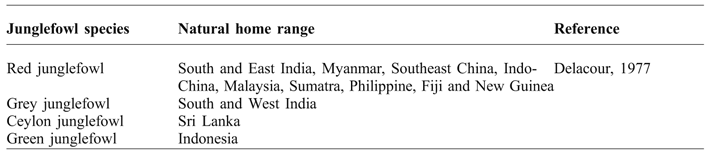
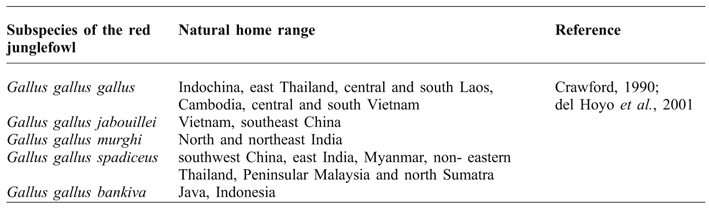
The natural habitats of the four wild species of the junglefowl and five sub-species of the red junglefowl are presented in Table 1 and Table 2, respectively. Although junglefowl have been adapted to a wide range of habitats, they frequent secondary forests (Collias and Collias, Reference COLLIAS and COLLIAS1967; Crawford, Reference CRAWFORD1990; Javed and Rahmani, Reference JAVED and RAHMANI2000) and commercial plantations (Syahar et al., Reference SYAHAR, ZAKARIA, ZUKI, LOKMAN and MAZLINA2014). Sparse vegetation may ease under-canopy movement (Collias and Collias, Reference COLLIAS and COLLIAS1967) while providing security against aerial predators. However, besides these habitats, green junglefowl prefers coastlines (Crawford, Reference CRAWFORD1990). Habitat preference and multiple uses of junglefowl for ritual, religious and leisure practices may have pre-adapted them to domestication (Collias and Collias, Reference COLLIAS and COLLIAS1967; Collias and Saichuae, Reference COLLIAS and SAICHUAE1967). Even though, junglefowl species have been known to occupy different habitats, as there is an overlapping home range for Indian red and grey junglefowl (Javed and Rahmani, Reference JAVED and RAHMANI2000) and presumably for Gallus gallus bankiva and Gallus varius. Habitats of Ceylon and red junglefowl are non-overlapping but are similar, which may have resulted in the similarity of plumage colours (Collias and Collias, Reference COLLIAS and COLLIAS1967).
In regions where the red junglefowl is abundant, the average size of home range is around one hectare per adult bird (Collias and Collias, Reference COLLIAS and COLLIAS1967). Wide species range may be associated with availability of resources and physiological demands. Daily and monthly home ranges are wider for cocks (Arshad and Zakaria, Reference ARSHAD and ZAKARIA2011). Inter-sex variation in the size of home range may be associated with territoriality and polygynous nature of cocks and social grouping of hens. The home range is wide for a solitary cock, which may be associated with breeding demand. In junglefowl, size of home range varies between seasons (Arshad and Zakaria, Reference ARSHAD and ZAKARIA2011) and they are more frequently sighted during the summer (Javed and Rahmani, Reference JAVED and RAHMANI2000). Spatiotemporal variation in the range may be linked with varying energy demands and seasonally altered behavioural cues. Ecological disruption induced by habitat loss, fragmentation or modification and predators may also alter the size of the home range (Arshad and Zakaria, Reference ARSHAD and ZAKARIA2011).
The natural home range of the four wild species of the junglefowl.

The natural home range of five wild subspecies of the red junglefowl.

Flock structure
Usually, flocks of junglefowl are dominated by a single cock (Collias and Saichuae, Reference COLLIAS and SAICHUAE1967). Consequently, most of the subordinate cocks have limited access to mates which reduces the effective number of breeding males (Collias and Collias, Reference COLLIAS and COLLIAS1967). Likewise, sighting of a solitary bird is common, which may represent a subordinate cock that has been chased away by a dominant male (Collias and Collias, Reference COLLIAS and COLLIAS1967). Flock size is small in the less gregarious grey and Ceylon junglefowl (Collias and Collias, Reference COLLIAS and COLLIAS1967; Selvan and Sridharan, Reference SELVAN and SRIDHARAN2012). Usually, red junglefowl cocks accompany more hens than grey and Ceylon cocks (Collias and Collias, Reference COLLIAS and COLLIAS1967). Usually, hens outnumber cocks (Collias and Saichuae, Reference COLLIAS and SAICHUAE1967; Javed and Rahmani, Reference JAVED and RAHMANI2000). This unbalanced sex ratio might be associated with the polygynous and aggressive nature of cocks (Collias and Saichuae, Reference COLLIAS and SAICHUAE1967). Moreover, high progesterone levels during meiosis may lead to a female-biased population. Selective pressure against cocks, owing to their territoriality and aggressive behaviour, may reduce their number (Correa et al., Reference CORREA, ADKINS-REGAN and JOHNSON2005). Moreover, males are bigger than females, and, consequently, parents may invest more on the less demanding sex i.e. females (Sze´kely et al., Reference SZE´KELY, LIKER, FRECKLETON, FICHTEL and KAPPELER2014). The number of junglefowl varies among seasons (Javed and Rahmani, Reference JAVED and RAHMANI2000), which might be partly linked with seasonal variation in detectability (Ramesh et al., Reference RAMESH, SATHYANARAYANA and LLOYD2011). Distribution density may vary depending on availability of resources and sighting might be more frequent in sparsely vegetated areas (Collias and Collias, Reference COLLIAS and COLLIAS1967).
Impact of domestication
Chicken are considered to have been domesticated earlier than other poultry. Artificial selection has made phenotypic characters more likely to disappear (e.g. eclipse plumage) or to be modified (legs, combs or calls) and most of the changes are associated with secondary sexual characteristics of cocks (Peterson and Brisbin, Reference PETERSON and BRISBIN1998). Domestication has modified morphological appearance, production traits, physiology, behaviour and genetic structure (Al-Nasser et al., Reference AL-NASSER, AL-KHALAIFA, AL-SAFFAR, KHALIL, ALBAHOUH, RAGHEB, AL-HADDAD and MASHALY2007). This might have arisen from the impact of artificial and natural selection following world-wide dispersal of chicken breeds and adaptation to a vast array of environments, breeding and management regimes. Since junglefowl have been cared for by ancient man, they have experienced phenotypic radiation that might otherwise, in some instances, have been maladaptive in their natural environment. Maladaptive characters can include conspicuous plumage colour, reduced aggressive behaviour and large size, which are encoded by domestication genes. Phenotypic modifications may have been derived from a shift in allocation of resources. The small size of junglefowl may have helped them to escape from predators and respond rapidly to environmental changes due to a high metabolic rate. However, a number of traits are shared between junglefowl and (particularly) native chickens, which are more closely genetically related to junglefowl than production breeds (Desta, Reference DESTA2015). Selection for production trait may adversely affect the phenotypic landscape of negatively correlated traits. Limited feather colour may be associated with strong natural selection pressure for wild plumage of junglefowl (Jacobsson, Reference JACOBSSON2005) and antipredator adaptation (Favati et al., Reference FAVATI, ZIDAR, THORPE, JENSEN and LØVLIE2015). Relaxed natural selection may have created vast arrays of plumage colours in chicken (Jacobsson, Reference JACOBSSON2005).
Morphological similarities and differences
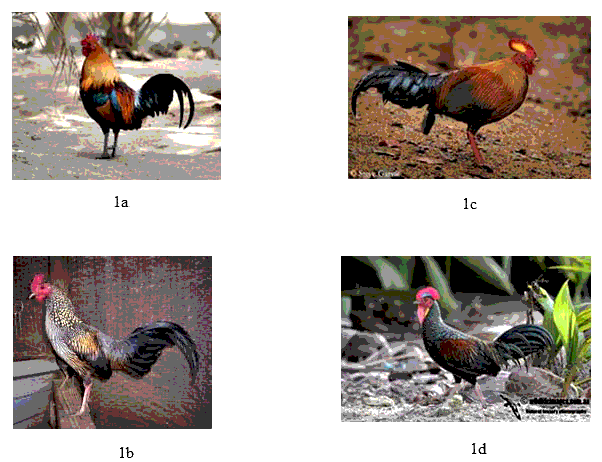
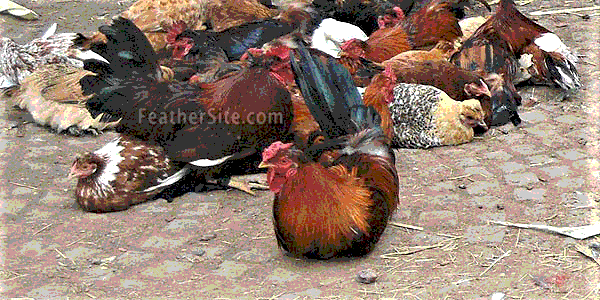
Commonly, chickens are morphologically more diverse than junglefowl. Consequently, a number of attributes that are displayed by junglefowl have been captured by chicken. For example, Ceylon junglefowl has black skin, bone and wattles (Darwin, Reference DARWIN1868), and black-bone and skin chickens exist in Asia. Earlobe colour is red in Malayan and white in Indian red junglefowl (Darwin, Reference DARWIN1868), therefore, chickens of the Mediterranean region may have been descended from Indian red junglefowl, whilst the majority of chickens with red earlobes may have originated from Malayan and other junglefowl. The spotted comb colour of Kenyan chickens (Kingori et al., Reference KINGORI, WACHIRA and TUITOEK2010) may be linked with the multi-coloured comb of Ceylon and green junglefowl. Chickens exhibit variants of comb shapes (Desta et al., Reference DESTA, DESSIE, BETTRIDGE, LYNCH, MELESE, COLLINS, CHRISTLEY, WIGLEY, KAISER, TERFA, MWACHARO and HANOTTE2013; Desta, Reference DESTA2015); however, only a single comb variant is known to exist in junglefowl. Pencilled feathers on the back and rump regions of G. varius hens resembles those seen in the dark Cornish breed, which may indicate introgression of this allele (Morejohn, Reference MOREJOHN1968a). Eriksson et al. (Reference ERIKSSON, LARSON, GUNNARSSON, BED'HOM, TIXIER-BOICHARD, STROMSTEDT, WRIGHT, JUNGERIUS, VEREIJKEN, RANDI, JENSEN and ANDERSSON2008) worked on introgression of yellow colour gene from Gallus sonneratii, a sort of yellow leg has been noted in Malayan red junglefowl (Darwin, Reference DARWIN1868) and yellow to reddish yellow leg reported in Ceylon junglefowl (Collias and Collias, Reference COLLIAS and COLLIAS1967). Amongst junglefowl, Lafayette's junglefowl morphologically resembles red junglefowl (Darwin, Reference DARWIN1868; Sawai et al., Reference SAWAI, KIM, KUNO, SUZUKI, GOTOH, TAKADA, TAKAHATA, SATTA and AKISHINONOMIYA2010), whereas, with respect to plumage colour and pattern, grey and green junglefowl cocks are more distantly related (Morejohn, Reference MOREJOHN1968a). Figures 1, 2 and 3 show the similarities and differences among junglefowl cocks and hens and morphological diversity of chickens.
Cocks of the four junglefowl species. In figure 1, 1a, 1b, 1c and 1d represent red, grey, Ceylon and green junglefowl cock, respectively.

Hens of the four junglefowl species. In figure 2, 2a, 2b, 2c and 2d represent red, grey, Ceylon and green junglefowl hen, respectively.

Village chickens on sale on street market in Ethiopia (Courtesy of Diana Marek).

sexual dimorphism and dichromatism
All species of Gallus display inter-sex variation in structure (dimorphism) and pigmentation (dichromatism) (Morejohn, Reference MOREJOHN1968a; Syahar et al., Reference SYAHAR, ZAKARIA, ZUKI, LOKMAN and MAZLINA2014). Dimorphism and dichromatism are thought to be a consequence of sexual selection and might provide an adaptive advantage. Junglefowl hens are smaller than males (Pheasantry and Pradesh, Reference PHEASANTRY and PRADESH2004; Syahar et al., Reference SYAHAR, ZAKARIA, ZUKI, LOKMAN and MAZLINA2014). Sexual dimorphism in size throughout post-hatching ontogeny is markedly pronounced in junglefowl and amongst chickens, the cockfighting varieties are the most dimorphic ones (Remeš and Székely, Reference REMEŠ and SZÉKELY2010). In junglefowl, high male to male competition may have induced cocks to increase their size, which would enhance their mating advantage. At an intra-sex level, junglefowl show little variation (seemingly monomorphic) in plumage colour and this may be due to intrasexual selection pressure on those traits increasing fitness. Junglefowl cocks possess ornamental plumage and vivid morphologies (although juvenile males are less vivid) in a bid to present themselves to females. Moreover, ornamental traits like comb, wattles and spurs are more conspicuous in cocks (Pheasantry and Pradesh, Reference PHEASANTRY and PRADESH2004; Syahar et al., Reference SYAHAR, ZAKARIA, ZUKI, LOKMAN and MAZLINA2014). On the other side, hens are simpler in appearance, with dull plumage which enables them to blend with their surroundings and to avoid predators. Besides allosomes, sexual dimorphism might be considerably affected by upregulation and downregulation of differentially expressed autosomal genes (Mank et al., Reference MANK, NAM, BRUNSTRÖM and ELLEGREN2010), male-limited or completely dominant sex-limited modifiers and sex hormones (Coyne et al., Reference COYNE, KAY and PRUETT-JONES2007).
eclipse plumage
Eclipse (dull plumage) refers to the moulting of bright feather during the post-breeding period. Naturally, eclipse plumage is observed in red, grey and Ceylon junglefowl (Collias and Collias, Reference COLLIAS and COLLIAS1967; Peterson and Brisbin, Reference PETERSON and BRISBIN1998; Pheasantry and Pradesh, Reference PHEASANTRY and PRADESH2004). Eclipse moults within three months (Pheasantry and Pradesh, Reference PHEASANTRY and PRADESH2004) and its presence is a reliable indicator of genetic purity (Syahar et al., Reference SYAHAR, ZAKARIA, ZUKI, LOKMAN and MAZLINA2014). Eclipse reduces vigour, fertility and aggression, interrupts crowing, leads to bleaching of bright legs and reduces the size of comb and wattle (Morejohn, Reference MOREJOHN1968a). Similarly, moulting in laying hens reduces feed intake and body weight and suspends reproduction whilst enhancing the bird's productive lifetime (Himeno and Tanabe, Reference HIMENO and TANABE1957; Yousaf and Chaudhry, Reference YOUSAF and CHAUDHRY2008). Eclipse plumage exhibits a dominant inheritance pattern (Morejohn, Reference MOREJOHN1968a), whereby heterozygotes look like homozygotes and can be misleadingly identified as genetically pure. Therefore, additional morphological markers should be used to assess the genetic integrity of junglefowl.
Behavioural characteristics
Basic behavioural characteristics of red junglefowl are similar to chickens (Collias, Reference COLLIAS1987). Junglefowl are terrestrial and sedentary. However, unlike chickens, junglefowl are aggressive and can take off for short-ranged flights. The most noticeable difference is the suspicious behaviour of junglefowl (Collias and Collias, Reference COLLIAS and COLLIAS1967; Collias and Saichuae, Reference COLLIAS and SAICHUAE1967; Arshad and Zakaria, Reference ARSHAD and ZAKARIA2011). Consequently, there has been difficulties in captive management (Darwin, Reference DARWIN1868). This behaviour is vital to escape from hunters (Arshad et al., Reference ARSHAD, ZAKARIA, SAJAP and ISMAIL2000) and to avoid predators. Junglefowl are aggressive (Agnvall et al., Reference AGNVALL, ALI, OLBY and JENSEN2014); however, there is a trade-off between aggression and exposure to predators (Kim and Zuk, Reference KIM and ZUK2000). Behavioural ecologies of junglefowl are presented in the following sections.
social organisation
Like cocks, hens may form a pecking order (Collias and Collias, Reference COLLIAS and COLLIAS1967; Mench and Keeling, Reference MENCH and KEELING2001). Pecking order is used to compete for food, mates etc. (Banks, Reference BANKS1956; Collias and Collias, Reference COLLIAS and COLLIAS1967), and the alpha individual dominates. Production breeds have less tendency towards formation of a pecking order, because a given flock has uniform age and size and resources are adequately provided. Aggressive behaviour that triggers a pecking order is considerably diminished in production breeds selected for tameness. Junglefowl's behavioural cues might have lost their adaptive importance in production breeds or might be modified due to correlated selection response (Väisänen and Jensen, Reference VÄISÄNEN and JENSEN2004). Dominance and hierarchy are mainly determined by social experience and aggression (Kim and Zuk, Reference KIM and ZUK2000). Despite variation in degree, social signals like aggression, courtship, dominance hierarchy, pecking order, flocking and foraging behaviour of junglefowl have been maintained in village chickens that have developed under high impact of natural selection.
breeding ecology
The local dry season (March to June) is the main breeding season of junglefowl (Collias and Collias, Reference COLLIAS and COLLIAS1967; Collias, Reference COLLIAS1987). Swedish bantam (Schütz and Jensen, Reference SCHÜTZ and JENSEN2001), feral chickens (Callaway, Reference CALLAWAY2016) and junglefowl are seasonal breeders (Jacobsson, Reference JACOBSSON2005). However, in some areas, junglefowl experience non-seasonal breeding although this varies among seasons (Arshad and Zakaria, Reference ARSHAD and ZAKARIA1999). Seasonal breeding may help to mobilise minerals for skeletal development (Callaway, Reference CALLAWAY2016), divert resources from growth and reproduction to adaptive traits and maximise survival of chicks by synchronizing chick brooding with the appropriate season. Moreover, courtship, mate competition and parental care make breeding season costly and tedious (Zuk and Johnsen, Reference ZUK and JOHNSEN1998), which requires resting period. Egg production is affected by photoperiod can be markedly different between seasons (Yousaf and Chaudhry, Reference YOUSAF and CHAUDHRY2008).
Polygyny in junglefowl may be associated with seasonal availability of feed (Stokes, Reference STOKES1971). Mating behaviour is similar in junglefowl and chicken (Collias and Collias, Reference COLLIAS and COLLIAS1967), although chickens mature earlier (Schütz et al., Reference SCHÜTZ, KERJE, CARLBORG, JACOBSSON, ANDERSSON and JENSEN2002; Worley et al., Reference WORLEY, COLLET, SPURGIN, CORNWALLIS, PIZZARI and RICHARDSON2010). Junglefowl lay a few numbers of eggs, e.g. 4 to 7 eggs per clutch (del Hoyo et al., Reference DEL HOYO, ELLIOTT and SARGATAL2001) and 10 to 15 eggs annually (Romanov and Weigend, Reference ROMANOV and WEIGEND2001); production breeds lay bigger eggs more frequently (Schütz et al., Reference SCHÜTZ, KERJE, CARLBORG, JACOBSSON, ANDERSSON and JENSEN2002). Eggs are incubated for 18 to 20 days (del Hoyo et al., Reference DEL HOYO, ELLIOTT and SARGATAL2001). Hens incubate eggs and brood chicks without any assistance from the cock (Collias and Collias, Reference COLLIAS and COLLIAS1967). Junglefowl chicks fledge within two (Arshad and Zakaria, Reference ARSHAD and ZAKARIA2009) to three months (Favati et al., Reference FAVATI, ZIDAR, THORPE, JENSEN and LØVLIE2015). Compared to junglefowl, sperm from production breeds is inferior both in volume and concentration (Pizzari et al., Reference PIZZARI, JENSEN and CORNWALLIS2004; Malik et al., Reference MALIK, HARON, YUSOFF, NESA, BUKAR and KASIM2013).
cockfighting
Cock fighting is practiced with both red junglefowl and chickens (Collias and Collias, Reference COLLIAS and COLLIAS1967). Fighting game strains are closely related to red junglefowl (Darwin, Reference DARWIN1868), and have longer necks, smaller wing and stronger muscle, but are poor fliers (Crawford, Reference CRAWFORD1990). Junglefowl cocks have better access to resources, are cared for individually and fighting does not lead to the point of death. Religious ceremonies and cockfighting for rituals might be the main causes for domestication of junglefowl (Crawford, Reference CRAWFORD1990; Kerje et al., Reference KERJE, CARLBORG, JACOBSSON, SCHÜTZ, HARTMANN, JENSEN and ANDERSSON2003; Jacobsson, Reference JACOBSSON2005; Akaboot et al., Reference AKABOOT, DUANGJINDA, PHASUK, KAENECHAN and CHINCHIYANOND2012). In some countries chickens have been specifically raised for cockfighting e.g. in Thailand (Akaboot et al., Reference AKABOOT, DUANGJINDA, PHASUK, KAENECHAN and CHINCHIYANOND2012).
roosting and nesting
Roosting is instinctive behaviour and makes junglefowl feel safe and protected. Usually, roosting sites are sparsely located (Collias and Collias, Reference COLLIAS and COLLIAS1967; Collias and Saichuae, Reference COLLIAS and SAICHUAE1967) and the group size of roosting flocks is small (Collias and Collias, Reference COLLIAS and COLLIAS1967; Collias and Saichuae, Reference COLLIAS and SAICHUAE1967). In the absence of disturbance, a roosting tree is used consistently (Collias and Collias, Reference COLLIAS and COLLIAS1967). Usually, cocks and hens roost at about the same height (Johnson, Reference JOHNSON1963; Arshad and Zakaria, Reference ARSHAD and ZAKARIA2009), although a hen with chicks will roost lower. The roost is left before sunrise and is returned to before sunset. Hens roost earlier in order to train their chicks, and leave later (Arshad and Zakaria, Reference ARSHAD and ZAKARIA2009); therefore, hens spend more time at the roosting site. Junglefowl usually nest high off the ground. Nests are used for incubating and hatching of eggs. Sticks, feathers, grass and leaves are used as nesting materials. Nesting territory is subjected to continuous surveillance in order to avoid predators and intruders.
crowing and call
Crowing is used to locate roosting sites of junglefowl (Collias and Saichuae, Reference COLLIAS and SAICHUAE1967) and advertises territoriality and dominance. Crowing is most frequent early in May (Collias and Collias, Reference COLLIAS and COLLIAS1967) and may be associated with the peak of the breeding season. The sustained pitch of the red junglefowl call resembles those of domestic cocks (Collias and Joos, Reference COLLIAS and JOOS1953 as cited in Collias and Collias, Reference COLLIAS and COLLIAS1967). However, crowing by domestic cocks is dragged and has clear-cut harmonics compared to the abruptly ended crowing by red junglefowl cock. Regardless of this, vocalisations are similar in red junglefowl and chicken (Collias and Collias, Reference COLLIAS and COLLIAS1967; Collias, Reference COLLIAS1987). The calls of red and grey junglefowl have four notes, while the Ceylon junglefowl has three and green junglefowl has two notes (Collias, Reference COLLIAS1987). Time of crowing in junglefowl is dictated by the Circadian clock (Shimmura and Yoshimura, Reference SHIMMURA and YOSHIMURA2013). Food calls, clucking, alarm calls, nesting calls, maternal calls, threat calls and post-oviposition cackle calls are commonly practiced in junglefowl to respond to internal and external stimuli, to communicate and to perform activities (Collias, Reference COLLIAS1987).
feeds and feeding
Watering and feeding are typically performed early in the morning and late in the afternoon (Collias and Collias, Reference COLLIAS and COLLIAS1967). Morning feeding may help to build up food reserves lost by overnight activities and late afternoon feeding may help to build up reserve for the upcoming night. These timings may be used to avoid predators that are active around noon. Unlike village chickens, that are mainly fed on fallen grains and household leftovers (Desta and Wakeyo, Reference DESTA and WAKEYO2012; Reference DESTA and WAKEYO2013), red, grey and Ceylon junglefowl subsist on succulent fruits, seeds and invertebrates (Collias and Collias, Reference COLLIAS and COLLIAS1967) and spend a lot of energy while scavenging (Ganabadi et al., Reference GANABADI, MUTUVIREN, HILMI, BABJEE, YAAKUB and FAKURAZI2009). Junglefowl obtain most of their water from succulent feeds (Collias and Collias, Reference COLLIAS and COLLIAS1967; Arshad et al., Reference ARSHAD, ZAKARIA, SAJAP and ISMAIL2000). Junglefowl are excellent foragers, opportunistic omnivores and generalist feeders and show seasonal preference in feed types (Collias and Collias, Reference COLLIAS and COLLIAS1967; Collias and Saichuae, Reference COLLIAS and SAICHUAE1967). A large variety of feed is consumed, which may have contributed to the ease of domestication of junglefowl (Collias and Collias, Reference COLLIAS and COLLIAS1967; Collias and Saichuae, Reference COLLIAS and SAICHUAE1967). Based on crop content analysis, the largest proportion of feed is based on plant material. The amount and type of feed varies among seasons (Collias and Collias, Reference COLLIAS and COLLIAS1967). Hens consume higher amount of animal origin feed, which may be associated with high nutrient demand to support egg production (Arshad et al., Reference ARSHAD, ZAKARIA, SAJAP and ISMAIL2000).
growth and feed conversion efficiency
Junglefowl grow slowly (Kadhim et al., Reference KADHIM, ZUKI, NOORDIN, BABJEE and ZAMRI-SAAD2011) and exhibit low feed conversation efficiency (Zulkifli et al., Reference ZULKIFLI, RAHAYU, ALIMON, VIDYADARAN and BABJEE2001), whereas production breeds gain more, have higher body weight and consume larger amounts of feed (Schütz et al., Reference SCHÜTZ, KERJE, CARLBORG, JACOBSSON, ANDERSSON and JENSEN2002). Junglefowl have highest proportions of bone and lower fat and muscle. High bone weight can be linked with consumption of larger amounts of calcium (Ganabadi et al., Reference GANABADI, MUTUVIREN, HILMI, BABJEE, YAAKUB and FAKURAZI2009). Dressing percentage and weights of whole breast, thigh and drumstick are higher in junglefowl (Rahayu et al., Reference RAHAYU, ZULKIFLI, VIDYADARAN, ALIMON and BABJEE2008), which may be associated with smaller visceral content. Interestingly, breast, thigh and drumstick command a premium price. Junglefowl can produce leaner carcasses and tastier eggs, e.g. in red junglefowl, fat and cholesterol contents of breast and leg muscles are low whereas protein content is high (Rahayu et al., Reference RAHAYU, ZULKIFLI, VIDYADARAN, ALIMON and BABJEE2008). This provides a benefit for consuming junglefowl meat from the perspective of human health. Junglefowl occupies a hostile environment, competes for scarce resources and is prone to predators. To maximize fitness, it mobilises resources towards bone and leg development and is lean and fitter than its domesticated relatives (Rahayu et al., Reference RAHAYU, ZULKIFLI, VIDYADARAN, ALIMON and BABJEE2008). Collagen content, pH, cooking loss and shear force values are high in junglefowl and native chicken. Small muscle fibre diameter and low glycogen reserve contribute to this higher pH. However, commercial broiler meat is more tender than native chicken and junglefowl (Lokman et al., Reference LOKMAN, GOH, SAZILI, NOORDIN and ZUKI2015), due to breeding selection and lower activity.
Immune system of junglefowl
Junglefowl experience similar parasites and diseases compared to chicken (Collias and Saichuae, Reference COLLIAS and SAICHUAE1967; Kellogg et al., Reference KELLOGG, DOSTER and JOHNSON1971). Junglefowl have more heterophils and a lower percentage of lymphocytes (Adnan and Babjee, Reference ADNAN and BABJEE1985) and have higher average haemolytic complement activities, which represent non-specific immune defence mechanisms and high variability in natural immunity (Mekchay et al., Reference MEKCHAY, TRAKOOLJUL, PONSUKSILI, WIMMERS, SCHELLANDER, TER MEULEN and VEARASILP1999). Balanced selection of junglefowl enables it to accumulate high intra-population genetic variation and the subsequent heterozygotes advantages could have made them more resilient to diseases. Moreover, extensive exposure of junglefowl to several infections in the absence of medication has enabled them to develop adaptive immunity and to accrue advantageous alleles. Junglefowl exhibit a high degree of excitability and trapping and caging them in captivity has a significant stress effect, which probably results in higher counts of heterophils. However, total plasma protein concentration in junglefowl is similar to chicken (Adnan and Babjee, Reference ADNAN and BABJEE1985).
Threats
Junglefowl have contributed the development of commercial chicken and that provides the bulk of animal origin protein for humans worldwide. As such, junglefowl have been used as reference populations to study the evolutionary history of the chicken, whereby they are used as a standard wild type in comparative genetic studies. They have been used in other scientific studies and socio-cultural events and provide ecosystem services, for example, in seed dispersal, by making being part of pray and predator food web. However, hunting has made junglefowl distance themselves from villages (Collias and Saichuae, Reference COLLIAS and SAICHUAE1967) as they are vulnerable to fire (Javed and Rahmani, Reference JAVED and RAHMANI2000), threatened by genetic introgression from domestic flocks and habitat loss.
genetic introgression
Eclipse plumage in cocks in non-green junglefowl cocks, the absence of combs in hens and horizontally carried tail-feather in the red junglefowl cocks are reliable indicators of genetic purity (Darwin, Reference DARWIN1868; Pheasantry and Pradesh, Reference PHEASANTRY and PRADESH2004). Although junglefowl have been classified as being less of a concern for extinction, interbreeding with free roaming, escaped or feral chickens has threatened their genetic integrity (Peterson and Brisbin, Reference PETERSON and BRISBIN1998). However, to date, the population size of junglefowl has not been quantified. Outcomes of experimental crossbreeding showed that gallus and sonneratii hybrid hens resembled lafayetii, which may indicate the intermediate position of lafayetii in gallus and sonneratii lineages. Gallus gallus and G. varius hybrid cocks commonly show the same plumage pattern of gallus which may indicate the dominant nature of gallus specific alleles; however, gallus-varius hybrid hens resembled neither of the parents (Morejohn, Reference MOREJOHN1968a).
wildfire
Wildfire destroys nests and kills chicks. However, burning leaf litter before the breeding season minimises chick mortality (Javed and Rahmani, Reference JAVED and RAHMANI2000). Burning low vegetation appears to be less frequent in the range of grey and Ceylon species, which is substantiated by the absence of black breast plumages. Burning eases the movement of junglefowl, encourages growth of bamboo cover (Collias and Saichuae, Reference COLLIAS and SAICHUAE1967) and makes the soil suitable for dustbathing (Arshad and Zakaria, Reference ARSHAD and ZAKARIA2011); however, it leads to scarcity of feed (Collias and Saichuae, Reference COLLIAS and SAICHUAE1967).
predation and hunting
Little is known about predation, however evidence show that hawks, eagles, cats, crows, Palm Civet, Shikra Goshawks and owls may pray on junglefowl and snakes and monitor lizards may feed on eggs (Collias and Collias, Reference COLLIAS and COLLIAS1967; Collias and Saichuae, Reference COLLIAS and SAICHUAE1967). In junglefowl, predator avoidance is enhanced by synchronising activities and forming social groups (Eklund and Jensen, Reference EKLUND and JENSEN2011). After receiving refuge with prehistoric man (Schütz and Jensen, Reference SCHÜTZ and JENSEN2001) chickens may have lost their predator fear and avoidance behaviours. Roosting may enhance junglefowl predators spotting ability (Arshad and Zakaria, Reference ARSHAD and ZAKARIA2009). However, hunting might be the most serious threat to junglefowl (Johnson, Reference JOHNSON1963; Collias and Collias, Reference COLLIAS and COLLIAS1967).
Conclusions
There are a number of similarities and differences in phenotypic characteristics between junglefowl and chickens. Similarities among junglefowl species may be associated with sharing recent common ancestors, and chickens were descended from junglefowl. Native chickens have retained a considerable number of phenotypic characters from junglefowl due to the low impact of anthropogenic effects in the course of their breeding history. Differences between junglefowl and chickens may be caused by evolutionary divergence triggered by domestication and differences in breeding and management histories. Variation among junglefowl may be associated with reproductive isolation which can be more highly pronounced in island species and subspecies. However, inconsistencies are frequently seen for reproductive compatibility between non-red junglefowl and chicken which demands more extensive study. Such work would require large number of representative samples and cover a wide geographic range.
Acknowledgements
I would like to acknowledge those individuals who made available the photographs presented in Figure 1 and 2 online.