I. ENGLISH AS THE LINGUA FRANCA OF ASIA
This article will focus on the effect on the law in civil law jurisdictions of young (and older) academics adopting English, the language of the common law, as a second language – or as their first foreign languageFootnote 1 – rather than a civil law language, either a Continental European language (French, German, Spanish, Dutch, etc), or another Asian civil law language (Japanese, Chinese, Indonesian, etc). The article will also focus on the effect of civil law jurists pursuing their graduate studies not only in English but also in common law jurisdictions, instead of doing so in civil law jurisdictions and returning home to become academics or practising lawyers in civil law jurisdictions.
The English language has become, de facto, the most commonly used language in most international contexts.Footnote 2 As a mother tongue, English (371 million) is not the language most spoken: that position is held by Mandarin (897 million) and Spanish (436 million) is next, but there are 611 million people who speak English as a second language, many more than any other language.Footnote 3 It is therefore the de facto common language of professionals involved in international transactions, and also of international academic exchanges.
This is certainly also the case in Asia. Although Mandarin is spoken by more Asians than is the case for English, English has greater international reach and is spoken among Asian professionals and people involved in international transactions and exchanges. This is true in legal academia in Asia as well. For example, the Asian Law Institute (ASLI) (founded in 2003) chose English as its working language. The annual conference of ASLI is held entirely in English and is, as far as we can see, the most well attended annual conference on Asian law in the world.
That English has become the lingua franca for Asian legal academics in international fora is undeniable – it is a sociological fact that some may like or dislike, but it is a fact.Footnote 4 It is also a fact that more and more young jurists from civil law jurisdictions are pursuing graduate studies abroad, and doing so in common law jurisdictions, hopefully in large part because they want to learn about the common law, which is good, but also because they do not speak a civil law language other than their own and cannot therefore study in, for example, France, Germany, the Netherlands, Japan, or South Korea.Footnote 5
English is the language of the common law, and therefore common law academics have no difficulty discussing their law in English and have, what I would call, an unfair advantage – they need not translate their law into a foreign language that has no terminology for the common law. Also, they happen to be fluent in English.
The problem is that, in Asia, the civil law is not practised in English, except in the Philippines and Sri Lanka – though they both have a mixed legal system of Spanish civil law and American common law, and Roman-Dutch civil law and English common law, respectively.Footnote 6 Asian civil law academics do not have a common civil law language – no Asian language fits the bill, and the European languages from which the civil law was adopted or imposed, even if they were widely spoken by Asian academics (which they are not), are themselves varied (for example German, French, Dutch, Spanish, Portuguese, and Russian). Latin ceased to be the common language of civil law jurists centuries ago.
In this article, I will argue that the fact that we discuss the civil law in English and the fact that civil law jurists increasingly study the common law rather than the civil law during their graduate studies, have both positive and negative effects which pose new challenges for us civil law jurists. In this introduction, let me start by mentioning some of the positive and negative effects to be discussed in more detail below.
Among the positive effects is the fact that we, civil law jurists, now talk to one another within Asia. In the past, most academic contacts were between an Asian country and the European country from which the civil law tradition was borrowed. Japanese scholars often studied in Germany and kept contact with German scholars; public law professors from Thailand studied in France and kept contact with French academics; Indonesians, with the Netherlands; Vietnamese with France and later Russia etc. Through the English language, Asian scholars have now established contacts among themselves, even though English, unfortunately, is not a civil law language.
Another positive effect is the fact that more civil law jurists, having done their graduate studies in a common law country, are now familiar with the common law. This is good for the study of comparative law in Asia. This is a great advantage for us civil law jurists, as common law jurists in Asia are often incapable of learning about the civil law as they do not speak any civil law language.Footnote 7
But there are also possible negative effects. As a greater proportion of civil law academics and lawyers are trained at the graduate level in the common law rather than in the civil law, we must wonder whether there will be enough academics trained in the civil law up to the doctorate level for the civil law tradition to remain strong. In most civil law jurisdictions in Asia this is not yet a serious issue, as there are still plenty of colleagues who write about the civil law in national languages and many also speak the European language of their legal tradition. But in some countries, this may soon (or already) no longer be so.
The second negative effect is that we lack the common terminology to speak and write about the civil law in English. We should try to learn such terminology to the extent that it exists (and it will not be learned in graduate programmes at common law law schools), and participate in efforts to build it where it does not yet exist.
After this introduction (Part I), I will first address the strength of the civil law tradition in Asia – it is not equally strong in all civil law jurisdictions (Part II). I will then provide some evidence showing that civil law colleagues often pursue their graduate studies in English in common law jurisdictions, and that common law colleagues do not pursue their graduate studies in civil law jurisdictions (Part III). I will then look at the potential negative effects of using the English language and doing graduate studies in common law law schools: will we have enough well-trained civil law academics and lawyers to keep the civil law tradition alive (Part IV)? I will then show that our use of English as the lingua franca of the civil law in Asia poses some terminological challenges (Part V). I will then look at the main positive effect: that many civil law lawyers are now familiar with the common law (Part VI).
II. HOW STRONG IS THE CIVIL LAW IN ASIA?
Before considering whether the fact that Asian civil law scholars pursue their graduate studies in common law jurisdictions constitutes a threat to the strength of the civil law tradition in Asia, we have to determine how strong or weak the civil law tradition presently is in Asia. If the tradition is strong and well established, the risk is minimal.
Unfortunately, probably no one has sufficiently detailed knowledge of the state of the civil law tradition in multiple Asian jurisdictions to evaluate how strong the civil law tradition is in each and every Asian country. However, it is possible to see that the civil law tradition is much stronger and much better supported by solid doctrine and jurisprudence in some countries than in others, and this can be explained in part.
The civil law came to Asia in two different ways: colonization, as was the case in most of Southeast Asia; or through so-called ‘modernization’ of the law (in fact a Westernization of the law) sometimes as a way to avoid colonization or to avoid the unfair extra-territorial application of Western law in sovereign Asian countries (in China and Thailand for example). Although both processes of Westernization of the law took place to a large extent as a result of Western imperialism (or the threat thereof), the effect of the two processes, I submit, can be quite different.
When the law was imposed through outright colonization, Western law was often perceived as foreign, was in a foreign language, and was sometimes not even applicable to the colonized but only to the colonizers. This was the case in Indonesia for example where Dutch law, for the most part, only applied to Europeans and adat law or Islamic law applied to locals. The law was not adapted to the local realities as it was not intended in the first place to be applied to locals. To this day, the Indonesian Civil Code is still only in Dutch and no Indonesian version has ever been adopted (although many unofficial translations do exist). It should be no wonder that European civil law did not take very deep root in the local population. Today probably more than 95 per cent of lawyers and judges cannot read the Civil Code in the language in which it is officially in force. Indonesia is the most extreme example of non-adaptation of foreign law, but similar, though less radical, situations can be found elsewhere in Asia,Footnote 8 even where the law is in local languages.Footnote 9 Because of this history, the civil law is weak in many civil law jurisdictions in Asia.
This situation is very different in Japan, where the Civil Code was adopted in Japanese by the Japanese themselves. Though inspired by German (and sometimes French) law, there was a conscious decision to adopt that law for the Japanese. Japanese scholars studied the law and decided how to adapt it, to some extent, to the Japanese languageFootnote 10 and to Japanese culture.Footnote 11 It became their law and they created a body of doctrine to adapt it to the local realities, including the challenging process of finding words to speak of the civil law in Japanese. For example, the first Civil Code (the old Civil Code of 1890), which was quickly abandoned in favour of the present code, was criticized in the following terms:
The criticism was primarily concentrated on the family law part. For example, the [old] Code provided that the father exercised parental rights. If the father died, the mother was to take over those rights. This arrangement was criticised for being against Japanese tradition, because in such cases traditionally a guardian was always appointed. … After a long and fierce debate, the Imperial Diet decided in 1892 to postpone the implementation of the Code …Footnote 12
A completely new code was adopted in 1898.Footnote 13 In my view, this act of ‘making it one's own’ – or at least in part one's own (with many other factors including the academic culture, and the resources available to academics) – has made a significant difference in the scholarship on the civil law. Japan has had a long tradition of Japanese scholars studying German and studying law in Germany, but also a long tradition of civil law scholarship in Japanese, so much so that I am told (as I do not read Japanese) that there is a rich civil law culture in Japan.
In Indonesia, however, members of the older generation of scholars (colleagues like Satrio, Gautama, and Subekti) are or were fluent in Dutch and in civil law, but considerably fewer younger colleagues have the same fluency in Dutch or in the civil law. Unfortunately, civil law scholarship is not very developed in Indonesia when compared to Japan, the Netherlands, or France.Footnote 14 Today, there seems to be a greater proportion of legal scholars in Japan, Korea, and Taiwan, for example, who speak German and know German law than there are Indonesian scholars who speak Dutch and know Dutch law. One might have thought that colonization would have left a larger imprint on the legal scholarship than ‘modernization’ would have without colonization, but it is certainly not the case in Indonesia. From anecdotal observations, this also applies to many other Southeast Asian countries – Philippine legal scholars no longer speak Spanish; Vietnamese scholars no longer speak French or Russian etc. What we did not see, at least in private law, until recently, is truly pan-Asian scholarship in civil law – scholarship on contract law, for example, that would look at Japan, Indonesia, and Vietnam as examples.
I do not have enough knowledge about the state of civil law scholarship in each and every civil law jurisdiction in Asia, but it seems to me that links between the European civil law scholarly tradition and local indigenous civil law scholarship are weaker in some jurisdictions than in others, and that this varies enormously from jurisdiction to jurisdiction.
I say all this because the dangers arising from civil law scholars studying the common law abroad, and from discussing the civil law in English, depend in large part on the strength of the local civil law scholarship and its link to the broader civil law tradition. A young academic well trained in the civil law would be better able to see the differences between the civil law he or she knows and the common law he or she is learning, whereas a young scholar trained in a jurisdiction where scholarship is weaker would not be able to do so.
III. THE EXTENT TO WHICH FACULTY MEMBERS IN CIVIL LAW JURISDICTIONS HAVE PURSUED THEIR GRADUATE STUDIES IN ENGLISH IN COMMON LAW JURISDICTIONS
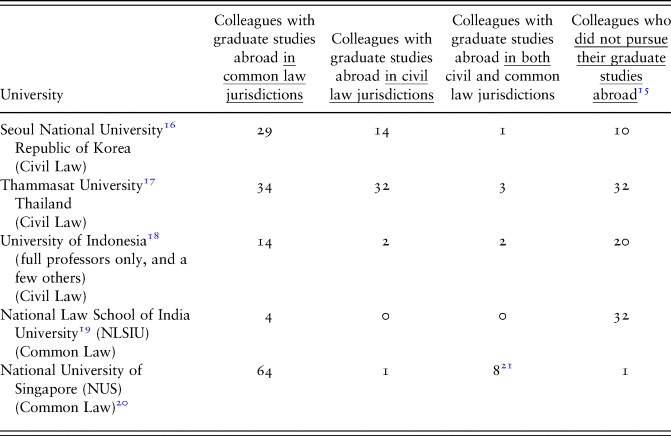
Before discussing the negative and positive consequences of colleagues from civil law jurisdictions doing their graduate studies in common law jurisdictions, and colleagues from common law jurisdictions not doing their graduate studies in civil law jurisdictions, we should look at the extent of this phenomenon. Here are some statistics based on data from the websites of a few representative institutions.
Table 1 confirms that a large number of colleagues at the three civil law universities above (Seoul National University, Thammasat University, and the University of Indonesia) have pursued graduate studies in common law jurisdictions in English. It does not mean that they have studied the common law – they may have studied international law, for example – but it is likely that the vast majority of them have experienced considerable exposure to the common law. In fact, in all three schools, a majority of those who have studied abroad have studied in common law jurisdictions.Footnote 22 It should also be noted that these three universities rarely employ foreigners (only one or two at most) and therefore, it is locals (Thais, Indonesians, Koreans) that have pursued degrees in common law jurisdictions in English.
Studying Law in the Other Tradition

Articles 1359–1361 of the Indonesian Civil Code

Table 1 also confirms that very few colleagues from the two common law law schools ever study the civil law. Not a single colleague from the National Law School of India University has pursued graduate studies in a civil law jurisdiction. The National University of Singapore (NUS) may look slightly better with nine colleagues (12 per cent) having pursued a degree in a civil law jurisdiction, but in fact the majority of these colleagues are foreigners, not locals, hired by NUS in part probably because of their civil law expertise. Of the locals who have pursued a graduate degree in a civil law jurisdiction, only one has studied the civil law in a civil law language as opposed to two others who studied international law in English.
It is clear that these three civil law law schools are better equipped to teach comparative law and the common law than the two common law law schools are equipped to teach comparative law and the civil law, and this is very positive. The issue however is whether the civil law law schools have enough colleagues trained in the civil law at graduate levels and in a civil law language other than their own to contribute significantly to scholarship on the civil law both domestically and internationally. Seoul National and Thammasat still have a core of colleagues with advanced degrees from foreign civil law jurisdictions who can interact academically in other civil law languages, but the University of Indonesia does not. It seems that the younger the colleagues, the less likely they are to study in a civil law jurisdiction.
We should be careful not to extrapolate too much from the data from these five schools – the vast majority of civil law law schools will not have as many colleagues trained in the common law as Seoul National does, for example – but nevertheless this trend where colleagues from civil law jurisdictions pursue graduate studies in common law jurisdictions and colleagues from common law jurisdictions do not pursue graduate studies in civil law jurisdictions – is clear for all to see, especially in Asia.
IV. IS THE CIVIL LAW ENDANGERED BY SO MANY SCHOLARS AND LAWYERS BEING TRAINED IN THE COMMON LAW?
From the outset, I should state that I am completely in favour of civil law jurists learning about the common law and, when relevant and useful, borrowing common law concepts and institutions, provided such borrowings are well-studied and properly adapted to the civil law and the circumstances of the host jurisdiction. This article is not against voluntary borrowings and transplants; I do not believe in the purity of the civil law or of any law – no law is ‘pure’ – and even if a law could be pure, I would not be in favour of keeping it that way for the sake of purity. However, transplants should be studied carefully and made consciously – that is, they should not creep in, in an amateurish and sometimes even unconscious fashion.
Ideally one should know one's own laws very well before borrowing the law of another country. If that is not the case, the danger I see is that some jurists could use their knowledge of the common law to reinterpret the civil law in a mistaken way because they do not understand the civil law well. This is already happening.
In some civil law jurisdictions in Asia, in Indonesia in particular, in private law (contract law is my own field), indigenous doctrine and jurisprudence on the civil law is not very rich. As mentioned above, the link to the source of the law (the Netherlands and by extension the original French Civil Code) has been lost because the vast majority of jurists do not read Dutch (and even fewer read French from which the old Dutch private law was derived) and there is a lack of solid continued elaboration of civil law doctrine and lack of civil law debate within Indonesia. I cannot speak for all fields of private law, but in contract law at least, there is a paucity of doctrinal writing – there are many short books summarizing the law of contract for students or lawyers, but very few theoretical books elaborating the doctrine with respect to contract law. Therefore, young scholars are not, in my view, as well trained as they could be in civil law, and, not being fluent in Dutch (French, German, Japanese, or Chinese could also be helpful), they cannot go to the sources of the law and read the debates about that law in the jurisdictions where there is more written on the civil law.
In a recently published chapter, this situation is described as follows:
Unfortunately, generally, … the production of local doctrine is not what it should be in Indonesia. Short of the treatises written by SatrioFootnote 23 and some articles and a short book written by GautamaFootnote 24 there are only a few books on contract and commercial law, most of them 200- or 300-page long, meant only as introductions. There are very few specialized books for example on the law of sale, of lease etc. And there are very few debates about where the law should go and what reforms should be envisaged – the doctrine is mainly descriptive. [There are also very few law review articles and dissertations on the subject.]
The main reason for this situation in my view is that the codes are still in Dutch, all pre-independence jurisprudence and doctrine are also in Dutch and the best source of non-binding comparison until recently was Dutch law. The two academics I mentioned above as having greatly contributed to the doctrine have had the advantage of being fluent in Dutch. The young academics, who are most of the time fluent in English but almost never speak any Dutch, choose to specialize in other fields where the law is in Indonesian and if foreign law is useful in those other fields it is likely to be largely available in English.Footnote 25
I have acted as an arbitrator in disputes where Indonesian law is the governing law. I am also often consulted on Indonesian contract law by both foreign and Indonesian practitioners. There are many instances in which I have personally witnessed the shortcomings of Indonesian doctrine on many aspects of contract law. The fact that there is so little doctrine being written makes it impossible for lawyers who do not read Dutch or French to find doctrine relevant to many commercial contract matters. Let me give you a few examples.
In one instance, a party had entered into a contract and paid the price it had agreed to pay. Before the other side performed its own obligations, the contract was found defective and invalid. The company therefore wanted its money back. The Indonesian lawyers for the defendant rightly stated that there was no general doctrine of unjust enrichment in Indonesian law which could be used to recover the money. The Indonesian lawyers for the claimant agreed but argued that there was a lack of good faith. I was consulted and I stated that it is indeed true that Indonesia's jurisprudence and doctrine have not introduced a general doctrine of unjust enrichment the way French jurisprudence and doctrine has, notwithstanding the silence of the French Civil Code – Indonesia thus follows Dutch law as it stood before the new Dutch Civil Code. Nevertheless, the Indonesian lawyers had not referred to Articles 1359 to 1361 of the Civil Code:Footnote 26
These are the basic provisions of the Indonesian Civil Code on what is called in French law the répétition de l'indu (the return of what is not due). The Indonesian lawyers, trained in the common law, or instructed on the common law by foreign counsel, were looking for the equivalent of ‘unjust enrichment’ which has no equivalent as a general category in Indonesia. There is indeed no general principle of unjust enrichment in the Indonesian Civil Code, but there are very specific provisions on the return of a thing that is not due. Part of the problem is that there is almost no mention of these Articles in Indonesian doctrine or jurisprudence. I found these Indonesian Articles by looking for references to Articles 1235, 1376, and 1377 of the original French Civil Code – these references are indicated at the bottom of the Indonesian Articles quoted above as ‘Civ. 1235’, ‘Civ. 1376’ and ‘Civ. 1377’. Many publications of the Civil Code in Indonesia still refer, for each Article, to the similar and often identical Articles of the Dutch Civil Code (BW) and French Civil Code (Civ.). With these references, it is very easy to find abundant doctrine and jurisprudence in Dutch or French. However, most Indonesian academics and lawyers do not read Dutch or French, and unfortunately there is very little written on these Articles in Indonesian doctrine.
A few years ago, I was asked by an excellent Indonesian law firm whether I had any source they could use from French civil law on contracts for the settlement of disputes out of court. They could not find anything in Indonesian law. I referred them back to the chapter of the Indonesian Civil Code on settlement out of courts (French: des transactions, Dutch: van dading, Indonesian: tentang perdamaian).Footnote 27 It is quite understandable that they could not find the provisions of the Code as these Articles are almost never mentioned in Indonesian doctrine and jurisprudence. There are a few books on the law of contract generally but books on special contracts – sale, lease, loan, settlements out of courts – are rare or inexistent (except for partnership and other corporate law related contracts). I was however able to find doctrine and jurisprudence in French on settlements out of court.
This lack of sound grounding in civil law is understandable as it is due to a lack of doctrine and academic scholarship on the civil law. This sometimes leads to the common law. First, many international contracts involving Indonesian parties are governed by civil or common law from jurisdictions other than Indonesia as the parties seek to avoid any uncertainty in Indonesian law. Second, the common law often creeps into the interpretation of the civil law – foreign lawyers, not knowing where the Indonesian civil law stands on an issue, often use the common law they know. There are a few examples, in the works published in English on Indonesian contract law, of the confusion of civil law concepts with quite different common law ones.
This is in part because the translations in English of the Dutch text of the Indonesian Civil Code are not always accurate. In any event the Dutch text was itself, for the most part, a translation (though in that case, an official one and one that is in force) of the French Civil Code. We often say that sometimes things get lost in translation, but it is exponentially so when one translates from French to Dutch, and then to Indonesian, and finally to English.
Also, almost all the translations into English do not take into account excellent translations into English of the French Civil Code (which until recently was similar to the Indonesian Civil Code, often the same word-for-word), or of other Civil Codes that have an English version (Quebec, Louisiana) and have elaborated a civil law vocabulary in English.
Some of the available translations of the Indonesian Civil Code into English, although generally quite helpful, unfortunately sometimes provide many examples of how having a good knowledge of English and of the common law may not necessarily lead to a good understanding of the civil law or of how to express the civil law in English. For example, the translation by Rany MangunsongFootnote 28 has some such shortcomings where common law concepts seem to replace or influence civil law ones.
For example, one of its most egregious mistakes is the translation of the concept of verbindtenissen in DutchFootnote 29 to the concept of agreements in English, probably in part because the concept of ‘law of obligations’ is rarely used in common law, where one speaks of contracts, torts, or unjust enrichment. The original French concept is les obligations,Footnote 30 which is correctly translated in Indonesian by Subekti as Perikatan. Book Three of the code translated as ‘Agreements’ almost makes no sense. The book is supposed to be on obligations, which include contractual obligations (ie agreements), delictual obligations (ie torts), and quasi-contractual obligations (eg the return of the thing not due). The latter two (delicts and quasi-contracts) do not stem from agreements and it makes no sense to include them in a book on agreements – the common link is the fact that they are obligations. This basic and fundamental mistake runs through the book on obligations, but is particularly egregious in the translation of Article 1233. That Article of the Indonesian Civil Code states: ‘Alle verbindtenissen ontstaan of uit overeenkomst, of uit de wet’. An appropriate translation in English would be ‘All obligations arise either from agreements or from the law.’ Unfortunately, the author translated it as follows: ‘every agreement is established either by consent or by the law’. How can an agreement be created by law?
There are other instances where the translation in English seems to adopt, or be influenced by, common law concepts. For example, whereas in the civil law, a penalty clause can exceed an estimation of the actual damages suffered (ie it can be a penalty), in the common law penalty clauses are not allowed and only liquidated damages are. A proper translation of the first paragraph of Article 1307Footnote 31 on penalty clauses should read: ‘A penalty stipulation shall be invoked in lieu of compensation of costs, damages and interest, for the creditor's loss resulting from the failure of the debtor to comply with the principal obligation.’ However, the translator translated this paragraph as follows: ‘The purpose of the penalty clause is to replace the loss that the creditor suffers for [sic] because of the unfulfilling of the main agreement…’
This translation is not only inaccurate in that it suggests that the goal of the penalty clause is to replace damages (ie be equivalent to damages), but it reads as a definition of liquidated damages in the common law by saying that the purpose of the clause is purely compensatory, which is not at all what the Article says and is contrary to civil law doctrine and jurisprudence on penalty clauses. The common law has sneaked in.
Some other translations of the Civil Code into English do a better job. One such translation was produced by two Indonesian lawyers, both of whom did study in the United States and were fluent in English.Footnote 32 The first, Antonius Mickey Rahmanata, studied in the Netherlands (fluent in Dutch) before studying at Columbia University in New York. The other, Andjar Pachta Wirana, after a first degree from the University of Indonesia, went to the University of Washington, a popular destination for Indonesian lawyers – in part because of the presence of Daniel Lev, a famous scholar of Indonesian law who was there for decades.
Probably because one of them was familiar with Dutch law and the Dutch language, the book on the law of obligations is entitled ‘On Obligations’, as it should be. Also, Article 1307 is translated as follows: ‘Penalizations stands instead of a compensation of costs, losses and interest, suffered by the creditor resulting from the non-performance of the main contract…’
This is a good translation that does not suggest that the purpose of a penalty clause is to compensate (as liquidated damages do in the common law), but simply says that it takes the place of damages – it is not damages.
In practice, in the arbitration cases I have heard, there is also great confusion of common law and civil law concepts when arguing Indonesian civil law in English. Inconsistencies in the civil law vocabulary used in English are very common. For example, one of the four requirements for a valid contract in French, old Dutch, and Indonesian law is that the contract must have ‘Un objet certain qui forme la matière de l'engagement’,Footnote 33 or in the Dutch version of the Indonesian Civil Code at Article 1320: ‘een bepaald onderwerp’.Footnote 34 The French talk of the object of the contract, but the Dutch of its ‘onderwerp’, which could be translated as ‘object’, ‘topic’, or even ‘subject’. In Indonesian, this Dutch word in this Article is usually translated into the word ‘pokok’ which is very poly-connotational and could mean topic, basis, reason, subject-matter, or even the object (the matter). Unfortunately, the word chosen in English by the translators of the code is ‘subject’.Footnote 35 The reason this is unfortunate is that the French concept of ‘objet’ is, in almost all other civil law jurisdictions, translated in English as ‘object’ and therefore those familiar with the requirement of an object in the French civil law tradition will wonder what is meant by ‘subject’ in the Indonesian Civil Code. That ‘subject’ actually means the same as ‘object’ is not self-evident to an English speaker. Only some knowledge of the wider context of the French civil law tradition in English could have avoided this confusion. In English, one may indeed speak of the ‘subject matter of the contract’, and that may explain the use of the word ‘subject’, but this only causes confusion when compared to the original French and how the civil law in English has usually translated ‘objet’ as ‘object’.
The growing influence of the common law in Indonesia may seem like an exception due to the lack of indigenous jurisprudence and doctrine, and lack of access to foreign jurisprudence and doctrine, but Indonesia is not alone.
Philippine contract law is supposed to be mainly governed by the civil law as contained in the Civil Code of the Philippines of 1949 (1949 Civil Code), which is largely inspired by the 1889 Spanish Civil Code which used to be in force in the Philippines. However, the 1949 Civil Code (which went into force in 1950) was adopted in English rather than Spanish, and this led to a creeping in of American common law concepts. In addition, new Articles were added, sometimes introducing common law concepts onto a civil law background. Articles of the new code that are simple translations of the old Spanish Code or which are inspired by the old code indicate at the end of the Article the corresponding Article number of the old code from which the provisions are drawn. For example: ‘Art. 4. Laws shall have no retroactive effect, unless the contrary is provided. (3).’ In this article the ‘(3)’ refers to Article 3 of the 1889 Spanish Civil Code, the translation of which becomes Article 4 of the new code.
However, when an Article is new it is followed by ‘(n)’. For example: ‘Art. 8. Judicial decisions applying or interpreting the laws or the Constitution shall form a part of the legal system of the Philippines. (n)’ This Article 8 is new and obviously adopts the common law doctrine of precedent of the United States – the status of judicial decisions described in this Article is that of American case law, not of civil law jurisprudence.Footnote 36 The Philippines had been part of the United States’ legal system for 49 years and the courts had in practice effectively adopted the common law doctrines of precedent and of stare decisis by the time the new code was adopted. This is an example of the explicit codification of the common law into what is otherwise a Civil Code in the civil law tradition.
There was also the creeping in of the common law because the Philippine jurist has lost the ability to access Spanish sources and turned instead to American law for inspiration. For example, the French civil law concept of cause (causa in Latin) in contract law is adopted in pure civil law terms in the Philippines Civil Code:
Art. 1318. There is no contract unless the following requisites concur:
(1) Consent of the contracting parties;
(2) Object certain which is the subject matter of the contract;
(3) Cause of the obligation which is established. (1261)
…
Art. 1350. In onerous contracts the cause is understood to be, for each contracting party, the prestation or promise of a thing or service by the other; in remuneratory ones, the service or benefit which is remunerated; and in contracts of pure beneficence, the mere liberality of the benefactor. (1274)
Art. 1351. The particular motives of the parties in entering into a contract are different from the cause thereof. (n)
Art. 1352. Contracts without cause, or with unlawful cause, produce no effect whatever. The cause is unlawful if it is contrary to law, morals, good customs, public order or public policy. (1275a)
Art. 1353. The statement of a false cause in contracts shall render them void, if it should not be proved that they were founded upon another cause which is true and lawful. (1276)
Art. 1354. Although the cause is not stated in the contract, it is presumed that it exists and is lawful, unless the debtor proves the contrary. (1277)
Art. 1355. Except in cases specified by law, lesion or inadequacy of cause shall not invalidate a contract, unless there has been fraud, mistake or undue influence. (n)
Even Articles 1351 and 1355, which are additions to the code of 1889 (and are therefore followed by ‘(n)’, ie new), are fully consistent with the classical French theory of cause.Footnote 37
However, when it comes to the revocation of an offer, the 1949 Civil Code introduces the common law concept of consideration, which is foreign to the civil law:
Art. 1324. When the offerer has allowed the offeree a certain period to accept, the offer may be withdrawn at any time before acceptance by communicating such withdrawal, except when the option is founded upon a consideration, as something paid or promised. (n)
This Article is a clear rejection of the French/Spanish civil law position, which is that an offer with a period of time for acceptance cannot be revoked during that period of time – the civil law does not have a concept of offers being binding only if they were made for proper consideration. This Article probably codifies the creeping in of the American common law position through case law before codification, and is inconsistent with the fact that consideration is not required for the formation of a contract (see Article 1318 above which mentions cause but not consideration). The practice of the civil law in English under American occupation (1898–1946) and the application of that law by judges trained and influenced by the common law, eventually led to the explicit introduction in the code of the concept of consideration with respect to offers.
More insidiously, the concept of consideration has made its way even into the formation of contract, and the civil law concept of ‘cause’ is now often confused with the common law concept of consideration in the formation of the contract itself. As early as 1921, in a book review criticising the adaptation of an American book on business law for an audience in the Philippines, the author of the review talks of ‘the gradual introduction of our common law doctrines into the civil law of those islands’ and criticizes the author of the book for confusing civil law and common law notions:
For example, in stating the doctrine of ‘consideration’ the rules given are now the rules of Anglo-American law, now [sic; ‘not’?] those quite different provisions of the Spanish law relating to causa, the latter term being translated as ‘consideration’. Such a throwing together of the principles of the common law with those of the civil law without any explanation whatever as to their origin or application, makes the discussion of this subject wholly unintelligible. The book would have been of far greater service if a clearer demarcation had been made between the rule of the native law and the provisions which have been introduced since the American occupation.Footnote 38
There is no time to review, in this short article, the influence of the common law on each and every civil law country in Asia, but the Philippines gives us a clear example of what can happen when English becomes the lingua franca and most jurists do their graduate studies in a common law jurisdiction (in the United States in the case of the Philippines) – the common law slowly creeps in.
Even though the common law may have penetrated the civil law of Japan and Korea to a lesser extent than in the Philippines, there is no doubt that the common law, and especially American common law, is increasingly influential – some have even talked of ‘The Americanization of Japanese Law’.Footnote 39 Some have mentioned ‘the extent to which institutions of the common law, especially as it has developed in the United States, are being inserted into a system of law [Japan's] which is basically continental’.Footnote 40 Perhaps because so many Japanese and Korean academics have studied in the United States, their countries have even changed their legal education system to require the study of law – at least for the purposes of admission to practice – as a graduate degree like it is in the United States.Footnote 41 The American common law influence on Korea and Japan cannot be denied. Some influence of the common law can probably be found in every Asian civil law jurisdiction, although the extent of that influence will vary from jurisdiction to jurisdiction.
The common law influence is also sometimes indirect: most international treaties for the harmonization of laws are compromises between the civil law and the common law, and therefore when countries in East Asia adopt such instruments, they become influenced by the common law indirectly. For example, the United Nations Convention on Contracts for the International Sale of Goods (1980) (CISG) introduces many rules inspired by the common law. Thus, when China, Japan, and Korea became parties to the CISG they introduced some common law into their legal system. In fact, China went further and used the CISG as a model for its own domestic contract law.Footnote 42
All this is to say that the common law is increasingly influential in Asian civil law jurisdictions and this is, no doubt, due in part to the fact that English is now widely spoken by civil law jurists in Asia and that many law academics have studied in common law jurisdictions.
The attractions of English and of learning the common law are so great that there is no point in lamenting this attraction – in fact it is great that young lawyers from civil law jurisdictions are learning the common law. How can comparative law academics be against that? I just wish that more young lawyers would learn the civil law in more depth, in their own languages, or in Dutch, German, French, Chinese, Japanese etc. Some do, of course, but others seem content to learn the common law without gaining sufficient mastery of their own law first. In jurisdictions where indigenous civil law doctrine and jurisprudence are weaker, it would be particularly important to train some young scholars in the civil law rigourously so that they can develop the doctrine necessary for the proper functioning of the civil law. We need good jurists with excellent knowledge of both the civil law and the common law.
Sometimes civil law jurists trained in both civil and common law may confuse the two traditions, but at least these jurists have basic knowledge of both traditions, which is more than can be said for the overwhelming majority of common law jurists – who do not study the civil law.
V. ENGLISH AS THE LINGUA FRANCA OF THE CIVIL LAW IN ASIA – FINDING OR CREATING THE CIVIL LAW TERMINOLOGY WE NEED
We have established the importance of solid training in civil law, whether in local or foreign civil law languages, for the preservation and evolution of the civil law tradition in Asia. Let me now address another challenge: the need for civil law jurists in Asia, once they have a good grasp of the civil law and of English, to adapt the English language – their new and only lingua franca – to the civil law.
Civil law jurists in Asia need to be able to explain the civil law in English to international traders and investors, as well as to arbitrators, who often come from common law jurisdictions. It is therefore good that people are learning the common law in English and that the civil law is increasingly taught, and written about, in English in our region. An increasing number of law faculties in Asia now teach their civil law programmes in English and must therefore develop teaching materials in English.Footnote 43
Writing about, and teaching, the civil law in English however is not simple and raises quite a few challenges. First, we cannot rely on LL.M. degrees or doctorates in common law jurisdictions to give us the vocabulary and translations of civil law concepts into English. We need to learn and develop a standardized civil law terminology in English. Europeans have made some great contributions in standardizing the vocabulary of the civil law in English, and we should look at their achievements and build on them. In some mixed jurisdictions, the civil law is practised in English: for example in the Philippines, Sri Lanka, Quebec, Louisiana, Scotland, and South Africa. Some lexicons already exist for the civil law in EnglishFootnote 44 and we could also use the vocabulary found in some Civil Codes that have an official version in English.
I suggest that we start sharing with each other the materials that we use to teach the civil law in English in Asia and start working on a standardized terminology with multilingual lexicons in key Asian languages. For example, we could have an entry on good faith and define the concept and its different connotations in civil law jurisdictions (it would be a long entry) with examples from jurisprudence and doctrine from different Asian jurisdictions. Following that would be different words used in Asian languages to translate the concept of good faith. Each language could have its own lexicon listing the different terms in the local language (like in a dictionary) and for each word there would be a cross-reference to the translation and definition of the term in English. This would be the kind of publication that would be perfect for an electronic or internet format with hyperlinks. This project could become the work of reference for the civil law in English in Asia. This is a project that could be undertaken by ASLI.Footnote 45
In another project, we could think of offering graduate studies, including a Ph.D. programme, on the civil law in English to train the next generation of civil law scholars. As noted, most young civil law jurists do not speak civil law languages other than their own, but if some of our law schools offered high quality civil law graduate degrees in English, it could be the start of a great new project. We could start modestly with the teaching of a graduate civil law degree cooperatively among the law schools that teach the civil law in English.
We might also be able to more quickly build the materials in English for an LL.M. by coursework – our colleagues in Indonesia and Thailand have developed such materials for their undergraduate law degrees taught in English. It would however be a different story for a Ph.D. or LL.M. by research where a library full of materials in English would be required. This lack of materials will make it difficult to offer a Ph.D. in civil law in English.
This is of course a chicken-and-egg situation: although offering a graduate research degree in the civil law in English would lead to graduates publishing more in English, in order to be able to offer such a degree, we need lots of scholarship published in English to support the research. I teach a course on Indonesian law at the National University of Singapore and used to ask the students to write a research paper. Because the students do not read Bahasa Indonesia, it was extremely difficult for them to write such papers, and in fact it was next to impossible if the students chose private law (civil law) as their topic – there are some limited materials available in English on constitutional law, human rights, etc, but very little in English on contract law or delictual liability.
It might therefore be necessary to embark on a translation exercise on a massive scale. Louisiana should be our inspiration. It is a jurisdiction that practises the civil law (French civil law with some Spanish influences), but where the Civil Code is now official only in English and where the lawyers and academics (with very few exceptions) do not read French. It therefore undertook a massive translation project to publish the Louisiana Translation Series – thus making classical French doctrine available to the world in English and the Louisiana laws are cross-referenced in these translations.Footnote 46 This translation project has translated classical French treatises such as Planiol's Traité élémentaire de droit civil,Footnote 47 Gény's Méthode d'interprétation et sources en droit privé positif,Footnote 48 Aubry and Rau's Droit civil françaisFootnote 49 and excerpts from the works of Carbonnier and Baudry-Lacantinerie and Tissier,Footnote 50 to name only the most important ones. These translations and many others have been very influential in Louisiana and elsewhere.Footnote 51 They have contributed to a revival of the civil law tradition in Louisiana.Footnote 52
First, our libraries should obtain copies of these translations or obtain access to them electronically. Second, we should have a translation project of our own – we should list the books that are not yet translated into English and which would be very useful in our local contexts, and find the resources to translate them into English. This would of course be a massive project in need of resources, but a worthy one which we should consider undertaking. This would give us the materials for teaching and researching the civil law in English. And in the process of translation, we would be developing the English civil law terminology we need. This will eventually allow civil law jurists to pursue graduate studies on the civil law in English in Asia.
VI. CIVIL LAW JURISTS SPEAKING ENGLISH AND KNOWING THE COMMON LAW – THE GREAT FUTURE OF COMPARATIVE LAW IN ASIA
I am very enthused by the present direction of legal scholarship in Asia. I have seen tremendous progress in quantity and quality of what is being published in English on the civil law since the founding of ASLI in 2003,Footnote 53 and there are absolutely no reasons to be pessimistic about the future – the future is bright.
There are many reasons for the improvement of the scholarship in English. Younger scholars are more fluent in English. Many of them have participated as students in international moots and other competitions, and in international fora that gave them confidence in English. They are also often under pressure, by their government or their school, to publish internationally which often means publishing in English. In any event, they are interested in international academic exchanges of views and are willing and happy participants in international conferences and workshops.
Many of them have found an interest in comparing their civil law to that of other Asian civil law jurisdictions, something that was not common at all twenty years ago – the main comparisons then were still mainly with Europe. The fact that so many of them have studied the common law also bodes extremely well for the future of comparative law in Asia.
VII. CONCLUSION
There is no reason to fear the fact that increasingly civil law scholars in Asia write in English and that increasingly they also study the common law. This is good not only for the future of comparative law in Asia but also for the future of the civil law in Asia.
By writing in English, we can strengthen the civil law by increasing our collaboration among civil law scholars throughout Asia rather than relying exclusively on European scholarship. This kind of pan-Asian civil law scholarship did not exist before and will strengthen the civil law in Asia. If civil law doctrine is not sufficiently developed in some countries in Asia, the fact that there is an increasing pool of materials in English about the civil law in Asia can only be useful.
By learning the common law, we are reminded of our own tradition and therefore comparisons between civil and common law should not be feared. There is a saying that one can fully appreciate one's own language only once one has learned another. The same is true for laws. It is hoped that the better knowledge of English and of the common law will lead to better knowledge of the civil law in Asia.
We must remain vigilant to ensure that the civil law tradition remains lively and continues to grow in Asia, and this means ensuring a sufficient number of our young scholars study the civil law at the graduate level. I remain, however, very confident and take the view that the internationalization of civil law scholarship in Asia, even in English, will strengthen it rather than weaken it.