Beginning in the early 1960s, life for the Hmong living in the mountains in northern Thailand—especially near the border with Laos, and in Tak province adjacent to the border with Burma—changed dramatically after the Communist Party of Thailand (CPT) gained influence and started sending agents to recruit in Hmong villages. Hmong teenagers, both males and females, were offered opportunities ‘to study’, and as a result, many hundreds, or possibly more, travelled to the border between Laos and China, where they received basic political and military training at a rustic camp known as A-30. Many Hmong also learnt how to speak, read and write Central Thai at A-30.
After basic training, some of the most promising students were sent to study in Vietnam (military) and China (medical and political). Others returned to their villages and other communities in Thailand to recruit more people to the movement. While armed resistance was envisioned, the initial goal was to develop political support quietly, and because many Hmong had grievances with the Thai State, and lived near borders in remote areas, they became targets for political work.
The CPT's recruiters emphasised the inequalities between upland ethnic minorities and lowland Thais, and that was certainly a key reason for many Hmong men to join up. However, in this article we reveal how Hmong women who became allied with the Party felt that its policies addressing gender inequalities were much more important than those directed at ethnic disparities in Thailand.
Essentially, our argument is that the CPT introduced ideas, policies and practices that were transformative to Hmong society, in particular with regards to gender relations and women's rights, and that adopting a feminist geography approach requires that we compare these changes with the pre-CPT period. Furthermore, we contend that gender issues were much more important for Hmong women than for ethnically Thai women, due to the strongly patriarchal structure of Hmong society, whereas lowland Thai society was somewhat more empowering for women due to its matrilineal family structure. While some practices introduced during the 1960s and 1970s are still being applied today, others that Hmong women criticise have been revived. Crucially, we do not intend to elevate the CPT politically, or deny the role of violence in their approach. Rather, this article is rooted in the views articulated by Hmong women during our field research. Thus, we also consider the findings in relation to social memory theory.
We devote the next section to explaining our research approach and methodology. We then provide a brief history of Hmong involvement with the CPT. This is followed by a short section devoted to Hmong women's rights and the CPT, and then an explanation of the feminist geography and social memory theoretical framing that we adopt. We then consider six particularly important issues that relate to CPT policy and practices and Hmong women: education for women and girls, bride capture, polygyny, mediated relations, work opportunities, and bride price. Next, we present Hmong women's life stories as retold to us, to provide a sense of how these issues played out for individual women. Finally, we reflect on the legacy of the CPT period on present-day Hmong Thai society.
Methodology
This research did not initially have a gender or women's focus. The first author intended to study the history of Hmong involvement in the CPT between the early 1960s and the early 1980s. The approach was to consider different perspectives, including among the Hmong themselves, but also from the points of view of Thais who worked with the Hmong during the CPT period. He has also studied those Hmong who sided with the Thai government, and considered the perspective of political and military leaders. However, that research is not presented here.
The first author adopted mixed methods and in particular conducted 150 semi-structured interviews in Central Thai, the language used by the CPT, to obtain oral histories, mainly from Hmong living in rural villages. He also accessed some relevant documentation, both published and grey literature, in Thai and English.
Initially, the first author decided to focus on Hmong men, largely because he is a man, and expected that accessing Hmong women research subjects might be difficult due to gender norms. It is generally culturally inappropriate for men to interact closely with Hmong women without male oversight. However, somewhat unintentionally, while seeking Hmong men to interview, he came across strong-willed, well-spoken, and relatively independent Hmong women who were eager to tell their stories. Therefore, he conducted 20 interviews related to Hmong women in the CPT in Chiang Rai, Phayao, Nan, Phitsanulok and Tak provinces, a dozen of which were conducted with Hmong women. Some informants were interviewed on multiple occasions.
One particular case illustrates how this research came about. In early 2017, the first author visited Phopphra district in Tak province to conduct interviews with Hmong previously with the CPT, both in Tak itself, but also in Phetchabun province to the east. Eventually, he was introduced to a Hmong man who was previously a CPT party member and radio operator in Tak. They sat down to talk, and after explaining the purpose of the research, questions were asked about the history of the Hmong and the CPT in Tak. The Hmong man was soft-spoken and friendly. Soon, however, the first author started to hear responses to his questions coming from behind him. He turned and saw an older Hmong woman talking in good Central Thai. She did not just answer one question, but soon she was answering most of them. She was the wife of the man being interviewed, and like him, had spent years in the forest with the CPT in Tak. She clearly wanted to participate in the discussion, and so after finishing the interview with her husband, the first author asked if he could specifically interview her. Before long, the woman was providing a detailed account of her years as a teenager and young woman.Footnote 1 What this encounter and many others since then have indicated is that those Hmong women who were with the CPT when they were younger are confident linguistically (in Thai) and intellectually. Moreover, these women were eager to tell their stories, despite the fact that the first author is a middle-aged white male, albeit one who speaks Thai and Lao well. Thus, while continuing a broader project regarding the role of the Hmong in the CPT, he also branched off on a sub-project, the focus here.
Although it was easier than expected to interview older Hmong women previously involved with the CPT, the first author did not feel sufficiently confident—considering his positionality—to write about this topic. Therefore, in 2018 he engaged a Hmong Thai woman and scholar, the second author, to conduct additional interviews in Hmong with women who were allied with the Party. She was an appropriate person to do this; she is not from a communist background but had conducted her Masters research at Chiang Mai University studying Hmong CPT memorialisation in the Phu Chi Fa area in eastern Chiang Rai province. The second author spent the month of October 2018 conducting 20 interviews with Hmong women in Thoeng district, Chiang Rai province, about their experiences with the CPT, and then wrote a Thai language report about those interviews. Later, the first and second authors discussed the research in person in both Thailand in mid-2019, and then in Madison, Wisconsin, in October 2019. Her findings largely coincided with those of the first author, although with some nuanced differences; thus, they decided to collaborate on this article.
The Communist Party of Thailand (CPT)
Prior to the early 1960s, the CPT was largely centred in urban areas, particularly in Bangkok.Footnote 2 However, all that changed when in 1961 the CPT adopted a new policy to focus on rural areas, with the plan to eventually—after proper preparation—engage in revolutionary armed struggle, largely modelled on Mao Zedong's revolution in China. While the Hmong who became involved with the CPT knew little about Marxism when they first joined the Party, over time some came to embrace its politics.Footnote 3
Between the mid-1950s and mid-1960s, the Sino–Soviet split resulted in communist ideology being divided into two large and diverse camps,Footnote 4 with the CPT siding strongly with the People's Republic of China (PRC). However, in the 1960s and much of the 1970s, the CPT variously collaborated and cooperated with pro-Soviet communists in Laos and Vietnam,Footnote 5 until the relationship between the PRC and Vietnam became particularly hostile in 1979, leading to a short border war and the subsequently broader Third Indochina War.Footnote 6
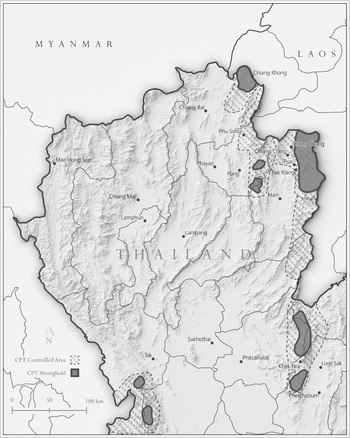
In August 1965, a low-intensity armed struggle in rural areas began in Thailand, initially emerging in the northeast.Footnote 7 However, the situation was still peaceful in Hmong areas in northern Thailand. The first armed incident between the Thai government and the Hmong occurred on 8 May 1967 in Chompu village, Thoeng district, Chiang Rai province.Footnote 8 From there, conflict spread south along the mountain range. On 11 February 1968, armed conflict broke out in Boklua district, Nan province, and by November 1968, fighting had spread to the Hmong village of Huai Sai Neua, in Nakorn Thai district, Phitsanulok province (see fig. 1).Footnote 9 The Thai military hit back hard, attacking many Hmong villages, regardless of whether they were in contact with the CPT or not. In this way, many Hmong were pushed into joining the CPT and its military wing, the People's Liberation Army of Thailand (PLAT), once the Thai military attacked and burnt down their houses. Some in the armed forces warned that indiscriminately attacking Hmong villages was not going to be effective in quelling communism,Footnote 10 but the army implemented a much more aggressive policy known to many in the CPT and their political supporters as ‘kill all, burn all, loot all’.Footnote 11 The Voice of the People of Thailand,Footnote 12 the CPT's clandestine radio station based in Kunming, China, urged, on 30 August 1969, that Hmong all over the country rise up to fight against state tyranny in Thailand. However, by that time many Hmong living near Thailand's borders with Laos and Burma had already joined the CPT. The military moved most of the ethnic Iu-Mien living in the mountains along the Lao border down to the lowlands, to keep them from being infiltrated by the CPT. This strategy was much less successful with the Hmong, many of whom refused to come down and instead joined the CPT.
Northern Thailand showing CPT-controlled areas and strongholds

Unlike other parts of the country, the mountainous geography of northern Thailand facilitated Hmong involvement with the CPT, and allowed the CPT to establish a number of strongholds (than thi man in Thai), ‘red’ areas totally under its control, and inaccessible at all times to the Thai military. These included Khet 8 in Chiang Rai province,Footnote 13 Khet 7 and 9 in present-day Phayao province,Footnote 14 Khet 1–6 in Nan province,Footnote 15 Khet 10 and 15 in Phetchabun, Phitsanulok and Loei provinces,Footnote 16 and Khet Tak Tai and Tak Neua in Tak province, along the border with Burma (see fig. 1). Between 1967 and 1969, many of the Hmong in the eastern part of northern Thailand had joined the CPT, and they were the main ethnic group living in the above-mentioned strongholds. Non-Hmong were only in the majority in four of the strongholds in Nan province (Khet 2–5), where ethnic Lua (T'in) and Upland Muang people were more numerous. The Hmong numerically dominated all the other areas, although the top leaders were mainly Chinese Thais. No Hmong were ever admitted into the CPT's Central Committee or Politburo.Footnote 17 The CPT was also strong in other parts of the country, particularly in the northeast and south. However, there are no high mountains in those regions, and it was only possible to establish ‘pink’ areas, places that were contested by both the CPT and the Thai government. Most of the Hmong in Chiang Mai and Phrae provinces did not join the CPT. As already mentioned, some Hmong in CPT-dominated areas also chose not to join the Communists and were resettled to lowland areas where the military could ‘protect’ them and keep the CPT from infiltrating the villages.
After the 14 October 1973 student protests in Bangkok,Footnote 18 and especially following the 6 October 1976 student massacre at Thammasat University in Bangkok,Footnote 19 large numbers of ethnic Thai and Chinese-Thai students, known as Octoberists, fled to the forest.Footnote 20 The Voice of the People of Thailand radio encouraged disaffected students and other Thais to join the CPT.Footnote 21 Many joined Hmong and other revolutionaries in the CPT's strongholds in northern Thailand. By the late 1970s, the CPT was at its strongest.Footnote 22
Most Hmong in northern Thailand stayed in the Communist strongholds in the mountains until the early 1980s. Internal ideological divisions; a lack of support from Laos and Vietnam after the Sino–Vietnamese split in 1979, when the CPT sided firmly with China; and government amnesties (66/23 and 66/25) all contributed to the Party's downfall.Footnote 23 In addition, when Thailand provided the PRC with access to the Khmer Rouge on the Thai–Cambodia border, it led to an end of Chinese aid to the CPT. The Party's rapid decline was certainly beyond the control of its Hmong members. In any case, by the early 1980s, most of the CPT Hmong had taken advantage of the government amnesties.Footnote 24 In November 1981, it was reported that the CPT headquarters had been moved out of Nan province,Footnote 25 and the CPT was forced to abandon its strongholds in northern Thailand in 1982.Footnote 26 However, some Hmong in Nan held out until 1990,Footnote 27 and some CPT collaborated with the Burmese Communist Party, and started settling along the border with Burma in the 1980s.Footnote 28 Around 1994, the last CPT based in forests in Prachuap Kiri Khan and Phetburi provinces, near the border with Burma, stopped operating. Those who had been in the forest mainly quietly reintegrated into Thai society.Footnote 29
CPT policy on women's rights
As mentioned, Hmong men, in engaging with the CPT, were especially interested in improving their rights in relation to lowland Thais and stopping the ethnic discrimination they faced. While Hmong women had similar concerns, they were especially interested in gaining equal rights within a patriarchal Hmong society.Footnote 30 The CPT itself recognised the importance of granting women equal rights, as a way to gain more societal support, and prevented men from pushing back against this policy. Not surprisingly, Hmong girls and women were particularly receptive to this message. The Party's commitment to gender equality was evident in the following 1969 CPT policy:
Women shall enjoy equal rights to men in the political, economic, cultural, educational and vocational fields; bring the role of women into full play in the revolutionary movement and production; promote fully welfare work among women and children, ensure education and work to the youth.Footnote 31
In addition, the CPT explicitly included women's rights in its ‘Ten Point Plan’, stating around 1969 that
Women and men are entitled to enjoy equal rights in political, economic, cultural, educational and working opportunities. Enhance the role of women in carrying out the revolution and production; guarantee the welfare of women and children.Footnote 32
The Party emphasised women's rights when recruiting new supporters, especially women. For example, one of the many announcements on the Voice of the People of Thailand in 1974 reported that, ‘[In] base areas [strongholds], the people are enjoying a new life which has never before existed in history; all men and women have equal rights in the political and other fields.’Footnote 33
Women were not, however, elevated to high-level political positions within the CPT. In fact, there were probably never any women in its Central Committee or Politburo. Even at the provincial level, women were not appointed to high-level positions. However, this does not mean that the CPT was not interested in gender issues; they certainly were. The changes they wanted to effect have to be considered in relation to male domination in Hmong society, a point we will elaborate on later.
Feminist geography and social memory theory
In this article, we apply a feminist geography framework. Feminist geographers investigate the effects of place and space on power imbalances in society, especially in relation to women, but also taking into account ethnicity, race, class, status, and other social formations.Footnote 34 There is a strong interest in intersectionality, an important analytic for considering how a combination of factors influences people's lives,Footnote 35 especially in generating gender and other inequalities in relation to space and place.Footnote 36 A feminist geography framing here is also appropriate, not only because our emphasis is on Hmong women, but because it looks at wider inequalities in Hmong Thai society, and thus intersectionality. Further, this research considers these power relations in particular spaces in Thailand, a perspective reflecting the core of feminist geography.Footnote 37
This research also presents a grounded account of the social experiences of marginalised groups,Footnote 38 and feminist geographers tend to recognise that the meanings derived from certain circumstances and experiences need to be considered in relation to other lived experiences. This has made relational approaches increasingly important in feminist geography,Footnote 39 and fits well with what is presented here, as Hmong women found the equal rights they enjoyed during their CPT years particularly inspiring, coming as they did from a highly patriarchal society.
Finally, because this study is mainly based on Hmong women's oral histories of the CPT period, it is useful to consider social memory theory. In particular, social memory theory recognises that understanding how people remember the past, and what aspects of the past they emphasise, is often important for understanding their views and positionality at present.Footnote 40
Education for women and girls
Although each movement needs to be contextualised, women have reported feeling empowered through various communist revolutions around the world. Focusing just on Asia, female empowerment has been associated with communism in China,Footnote 41 Vietnam,Footnote 42 the Philippines,Footnote 43 and elsewhere. For example, in Laos, the Pathet Lao offered ethnic minority teenagers, both male and female, opportunities to study when they recruited them.Footnote 44 Thomas Marks’ recent investigation of women's experiences with Nepal's Maoist People's Army, in a similar vein to our research, found that women were particularly inspired by the movement: ‘Most women were obviously empowered personally by their experiences and their Marxist-Leninist education, especially officers. Experiences allowed the breaking of societal structures and the growth that went with command and achievement under the most severe circumstances.’Footnote 45
In Thailand, in the 1950s, prior to the CPT period, Hmong girls were hardly ever able to study in regular Thai primary schools, which were all located in the lowlands where the ethnic Thai people mainly lived. Even boys, who are typically favoured over girls in Hmong society,Footnote 46 rarely had the opportunity to go to school. However, CPT recruiters, both Hmong and non-Hmong, emphasised that they were offering teenagers educational opportunities. This was appealing to Hmong boys, but maybe even more so for Hmong girls, who hardly imagined at first that they could go to school like their male siblings. The CPT explicitly promoted education for girls and boys. Indeed, soon the CPT was telling Hmong men that girls should go to school and study, which was not a traditional view in Hmong society.Footnote 47
The CPT enabled most Hmong girls in Thailand to study from the early 1960s, first secretly in the villages, and from 1967–68 in the mountain strongholds. They first learnt Central Thai at the childrens' schools, known as Red Youth Schools (rong rian anuchon daeng in Thai). Despite the CPT's support, some girls in these areas were still not easily able to study at the rong rian anuchon daeng, as old habits die hard, and their parents wanted them to assist with the housework, childcare, and farming instead.Footnote 48
Still, these school experiences were nationalistic in the sense that the Thai nation was frequently emphasised and promoted, and all instruction was conducted in Central Thai. The Thai-centric nature of this education is illustrated by the fact that the Thai teachers often gave their Hmong students Thai names.Footnote 49 Many younger Hmong do have Thai names at present, but the difference is that they are now choosing their own names, whereas Thai teachers during the CPT period simply gave the Hmong students names without consulting the children or their parents.
Many Hmong girls—often as young as 14 or 15—were sent to A-30 in northern Laos for basic political and military training. Sometimes they fled their homes without telling their parents, who were opposed to them studying. In other cases, parents or other relatives allowed or even encouraged them to go. Basic training typically took three months to complete. Later, some were sent to further their studies in Vietnam or China. Sometimes those who did not speak Thai well received six months of language training before completing the basic level. Some were sent to China more than once; many became nurses and doctors; some studied politics; a few were trained to be radio announcers.
Bride capture
Before the CPT period, if a Hmong man wanted to marry, or obtain a second wife, but was unable to gain traction with the woman personally, he could abduct her and force her into marriage. While not all bride capture (zij poj niam in Hmong) was forced, with some brides cooperating with grooms so that they would be ‘grabbed’,Footnote 50 there is no doubt that some bride capture was coerced or forced. Such experiences often greatly affected the lives of Hmong women, and represented a traumatic event. Of course, women wanted to be able to choose their own husbands, on their own terms, and from our research, it is clear that Hmong women generally do not approve of bride capture.
If a man abducted and kept a woman for three days in his family house without her escaping, Hmong society would recognise the couple as married, regardless of whether the woman wanted to marry the man or not. Once she was in the groom's home, and the bride purification ceremony (lwm qaib) had been conducted to accept her into his family's spiritual domain, her family could not allow her back, and she had no choice but to begrudgingly accept the marriage or become an outcast.Footnote 51
Bride capture was still common in Hmong CPT areas up until the mid-1960s. Most Hmong women strongly approved when the CPT banned bride capture. The ban gave Hmong women more power to choose their own husbands than ever before, and many found this dramatic change advantageous and empowering.Footnote 52 Some Hmong women fled to the CPT areas to avoid having to marry men whom they did not love. Where young women had often been fearful of walking around alone, especially at night, for fear of being grabbed, they felt freer during the CPT period.
Polygyny
The Hmong have a long history of polygyny (polygamy), especially for high status Hmong men, who could marry two or more wives, depending on their social status and wealth. For example, General Vang Pao, the former leader of Military Region 2, in northeastern Laos, had seven official wives, who came from different clans. These marriages were partially political, with the intention of linking different clans.Footnote 53
However, the CPT banned polygyny, and Hmong women largely supported this policy. The CPT did not force polygamous families to separate, but they did not allow new polygamous marriages. The only exception was if a couple married and remained childless, the husband was sometimes allowed to take a second wife.Footnote 54 The ban on polygyny was popular with women, as they were never permitted to have more than one husband, just the other way around. Polygyny tended to disempower women, and Hmong women were generally pleased when the CPT prohibited it. Moreover, the Party gave women the right to lodge complaints against their husbands if they did not like what they were doing,Footnote 55 including attempting to take a minor wife. This is where feminist geography's emphasis on relational theory is useful—although women were still assumed to be the cause of childless marriages, the greater leeway for women represented a big step forward in comparison to previous practices.
Mediated relations
During the CPT period, relations between men and women were closely mediated and controlled, but there were differences between those who were working full time with the CPT and regular villagers (known as muan chon in Thai). A male soldier or official who was interested in having a romantic relationship with a woman had to do this through the unit leader, who would mediate communications. Men would write notes to women and pass them through these intermediaries. A woman could choose to reject these overtures if she did not like the man courting her, without being pressured or even having to face the man. A woman could end contact by simply informing her unit leader that she was not interested. A woman, in the same way, could initiate a relationship with a man. It was crucial that these sorts of communications be fully transmitted, and at the time, if a person wanted to establish relations with another, the one initiating the relationship, generally the man, needed to be confident that he really loved the other person, even if the two had hardly spoken. The potential couple had to be prepared to never divorce, and the man to agree to have only one wife. Men were expected to observe women carefully before making official contact.
If a man and a woman agreed to pursue a relationship, a time would be set up for a private meeting, within view of minders, to ensure that the man behaved appropriately.Footnote 56 If the two decided to marry, a pig was allocated for a celebration feast with the whole unit. The head of the unit would preside over a simple marriage ceremony. Later, if the wife became pregnant, she would be transferred to do lighter work. There was separate accommodation for single women and single men, and for families. While what has been described might seem rigid to many, it often felt liberating for Hmong women compared to the prior male-dominated norms.
Ordinary Hmong villagers living in CPT strongholds courted in more traditional ways. The CPT did not officially allow traditional flirting at night, as they did not want people lurking around in the dark, due to security concerns. Yet, night flirtation did sometimes take place nonetheless, and this was criticised by some ethnic Thai Octoberists.Footnote 57 However, a man would often ask a woman directly if she wanted to accompany him and get married, to avoid problems with later accusations of bride capture. Upon her agreement, the man would take the bride-to-be to his family home for three days. Then the couple would be considered married, with the woman entering her husband's clan, since the Hmong generally do not allow people of the same clan to marry. Women felt empowered through this system, and not surprisingly, as it allowed them more freedom to choose the men they wished to have a relationship with, and it allowed them to seek men who would not dominate them.Footnote 58
Work opportunities for women
As mentioned, prior to the CPT period, the Hmong lived in remote mountainous areas and survived through swidden cultivation, hunting, fishing and collecting non-timber forest products, much as they had been doing for generations.Footnote 59 Later, when the Hmong started interacting with lowlanders in the 1950s and 1960s, they had no opportunities for non-farm employment, due to their lack of formal education and Thai language.
The CPT encouraged and enabled women to enter all types of occupations. They could become soldiers, nurses, doctors, teachers and even potentially political leaders; this was previously unimaginable in Hmong society, although this is not to say that Thai society was transformed because of the CPT. But at the time what the Party was offering was significant. These new possibilities particularly attracted many young Hmong women to join up, even if men continued to get the senior positions.
Bride price
Bride price (dowry) has long been part of Hmong culture. Traditionally, a Hmong groom pays a bride price to the bride's family. Daughters were often taught to see themselves as property to be sold to other families through marriage while grooms’ families would sometimes claim ownership and power over wives.Footnote 60 They would say things such as, ‘We have already paid for you. Therefore we own you’, and other similar statements, which demoralised and demeaned Hmong women.
Prior to the CPT period, the bride price was paid in silver bars, and amounted to 8–10 bars,Footnote 61 or even up to 15 bars at times.Footnote 62 However, the CPT reduced the price to four bars in most of their strongholds, and under the leadership of Damri Ruangsutham (Comrade Dang), who was a CPT politburo member,Footnote 63 the practice of bride price was abandoned entirely in CPT strongholds in Phetchabun, Phitsanulok and Loei provinces (Khet 10 and 15). Comrade Dang directly oversaw this area, and was considered an ideological hardliner. He wanted to implement Party policy more strongly than other politburo members. Therefore, in the areas under his direct command, the bride price was banned.Footnote 64 When asked why people in this area initially did not have to pay a bride price, Lia Sae Her, from Nakorn Thai district, Phitsanulok province, said, ‘The people in the “three provinces” [Phetchabun, Phitsanulok and Loei provinces] loved the CPT the most.’ In her case, when she married a Hmong CPT soldier in 1979, no bride price was paid, but after the end of the CPT period, her parents asked her husband's family for four bars of silver.Footnote 65 Bride price was often not collected when two CPT soldiers married, but once they returned to their village, the husband would often be asked to pay four silver bars. They dared not ask for bride price when the couple was working with the CPT for a collective cause. In other Communist-run areas, however, four silver bars of bride price was collected for Hmong marriages, except for marriages involving soldiers or officials.
Reducing or eliminating the bride price was a popular move among Hmong women, as it meant that they were at less of a social disadvantage in their new marriages, in relation to their husbands and in-laws, and they tended to have more rights as a result. Prior to this, the high bride price often left couples heavily indebted. Even though the groom's parents were supposed to bear the cost of the bride price, we heard of a number of cases in which the couple became responsible for repaying the groom's parents for part or all of the bride price.
Women's life stories
The following are a series of Hmong women's life stories that variously relate to the above six topics, although in nuanced and intersectional ways appropriate for social memory-informed feminist geography. We identified these themes based on the interviews conducted with Hmong women, as they were frequently referred to, either directly or indirectly. However, these issues played out in varying ways for each woman due to a range of factors.
Comrade Supha
The first author met Comrade Supha, age 66, in Rom Klao 1 village, Mae Jarim district, Nan province in 2017. Originally, from Nam Phang Noi village in Mae Jarim district, as a child, she initially had no chance to study. However, she started to learn how to read and write Thai a bit when CPT operatives came to her village in the 1960s. She was impressed, because these operatives said that girls could study like boys. She felt that if she stayed on the government side, she would never have a chance to study. Therefore, she went to study at A-30 in Laos. After completing her basic training, she returned to Mae Jarim (Khet 6) to do community political education work (muan chon in Thai) for about a year. Then in 1969, she was chosen to study a second time, this time to become a doctor.Footnote 66
Nobody asked Comrade Supha what she wanted to study. She was just assigned to medical training. She walked to A-30 again and then continued on to Yunnan province in China. She studied to be a surgeon at a military hospital outside of Kunming. Thirteen unmarried women were sent to study together with her: eight were Hmong, three were Thai, and two were ethnic Lua (T'in). Their lessons were in Chinese, translated into Thai. They did not study Chinese, because the plan was for them to complete their studies as quickly as possible so that they could return to help on the frontline in Thailand. They studied hard and reviewed their lessons every evening. It was not always easy, and Supha admitted that sometimes she became frustrated and cried. The students also studied military tactics and politics one day a week, and rested on Sunday if there were not a lot of incoming patients. She also studied traditional Chinese medicine and acupuncture, which she still practices in her village today. Once she returned to Thailand for the second time, she performed surgery in various places. Finally, in 1973, she married a Hmong man from China who was sent to Thailand in 1969 to support the CPT. They are still married today. Her husband paid four silver bars as bride price like others.Footnote 67 Comrade Supha commented about women's rights during the CPT period:
Women's rights were important [during the CPT period]. Before then women could not refuse to marry. Young women were afraid to leave their houses, for fear of being forced to marry someone [bride capture]. However, the CPT prohibited wife grabbing. The women were happy.Footnote 68
She clearly had a relational perspective when thinking about the rights of women during the CPT period.
Ruang Sae Yang
Ruang Sae Yang, from Thoeng district, Chiang Rai province, like many others, had to be persistent to go to study with the CPT. She explained,
Actually, my parents did not want me to study; they wanted me to help them with work. However, I saw boys and girls studying, so I insisted on studying with them.Footnote 69
Later, they were more supportive:
When I was chosen to go to study in China, my parents allowed me to go, because at that time the Party and the people were close, like fish and water. I was just 13 years old when I went to China.Footnote 70
When Ruang joined the CPT in Khet 8, she had no idea that she would be sent away to study to be an announcer for the Voice of the People of Thailand radio until she arrived in China to begin her studies, as most women were sent to be trained as nurses or doctors. First, Ruang learnt Thai until she could read, write and translate well. Then she studied to be a radio announcer. After she graduated, she did not go back to Thailand. Instead, she worked for the Hmong language section of the Voice of the People of Thailand radio station in Kunming. Seven Hmong worked there, three of whom were women. They would receive Thai news, translate it, and announce it in White Hmong language. The group also worked together to make up Hmong language songs to encourage people to join the revolution. She worked at the station for a period before returning to Thailand after the Chinese government ordered the station to close in 1979.Footnote 71
Xae Sae Lee
Xae Sae Lee, from Thoeng district, Chiang Rai province, was one of the many Hmong young women from Khet 8 who was sent for medical training. When she was 15, she only knew two short Thai phrases, ‘eat rice’ (kin khao) and ‘drink water’ (kin nam). Later, she learnt to speak, read and write in Thai. It took three months for her group to walk to Vietnam. Some of her fellow students were Thai. They immediately started on political and military studies, but many of the Hmong students had to spend the first six months studying Thai. There were no days off and they studied hard. Within six months, most Hmong were competent in Thai.Footnote 72
Xae also learnt about Thai history and the Thai government, and about justice and the rights that people should have in Thailand. She was sent to China, where she spent her first three months learning about the roles of different governmental bodies. She was then sent to a new Chinese medical school near the border with Laos. As for the others, nobody bothered to ask her what she wanted to study, but just decided what was appropriate for her. She studied there for six months and then spent one month helping to take care of Lao patients at a hospital. She then returned to Thailand for three months before she was chosen to further her medical studies in China in 1970; she remained there for two years. When she returned from China, she was posted to work in Phayao province for two years, and then for another two years in Nan province.Footnote 73 After her Nan posting, Xae returned to her village in Thoeng district for three months before being sent to study medicine in China again. It was a difficult journey by foot, carrying clothes, medicines and a gun. As she put it,
When I first went to China, it was so difficult. I promised myself that I would not go again, even if they ordered me. I finished studying the first time and came back to be a nurse. I did not know much. However, the villagers immediately had faith in me and already referred to me as a ‘doctor’ [even though I was only a nurse]. At that time, the Thai students who had gone to study to be doctors had not yet returned, so whether I knew a lot or a little, the villagers urged me to treat sick people. Some even came to beg me to help. They cried, and I cried with them. I did not know what to do. I was scared, as I had not finished studying. These experiences made me want to learn more. I told myself that if I had the chance to go study again, I would ask the teacher questions until all the answers were clear.
She did indeed get that chance to study further in China, and after two more years of instruction, she returned to Thailand. She got married and had one child before finally surrendering with most of the other CPT members in the early 1980s. Since then, she has stopped practising medicine and returned to being a farmer in the mountains.Footnote 74
Comrade Luang
Comrade Luang, from the Xiong clan, was 60 years old when the first author interviewed her in 2018. From a regular swidden-cultivating Hmong family, she did not have the opportunity to study after she became an orphan when her parents died of illness. Thereafter, she joined the CPT in the forest in Mae Jarim district in Nan province (Khet 6) when she was just 10 years old. She was sent to study at A-30 at the age of 13, as part of a group of 25 travelling together. There were more men than women, with about half being ethnic Lua. There were also a number of Hmong. She did not speak much Thai at the time. Some parts of her lessons were translated into Hmong, but she was young and able to learn Thai quickly. Like the others, she emphasised how important gender issues were to her:
Hmong society was very uneven. Democracy [with the CPT] was good. Men could not have multiple wives, or chase women when they were in the forest. There was democracy then. Women could complain if their rights were violated. We thought about gender issues then. Ethnic differences are not as important as gender differences.Footnote 75
The relation between the present and the past was clearly important for determining the views of Hmong women regarding CPT policies. Comrade Luang pondered the situation since leaving the forest in 1982:
When I was in the forest [with the CPT], I did not realise how different gender issues were treated in the forest as compared to in the village. I only learned about that after I left the forest. Then I saw a big difference. There is no democracy.
She then became melancholy, reflecting on the past:
It's been a long time since I was in the forest, but I haven't forgotten much. It was an important experience in my life. In the forest they didn't agree for someone to have two wives, unless the first one didn't have any children.
However, she did not deny the bride price tradition, saying that she herself had paid three silver bars for her son to get married. ‘It's a tradition. You cannot deny it. There are more advantages than disadvantages to it.’Footnote 76
We were shocked, however, when Comrade Luang explained that many years after she left the forest, where she had married a Hmong man who had also been in the forest with the CPT, she had beaten her husband to death in a fit of rage. She became very upset when he told her that he was planning to take a minor wife. He had also previously physically abused her. ‘I never thought to kill him,’ she explained. ‘I loved him a lot and I never thought to divorce. However, I do not deny what I did. I was in jail for two years and five months. Now I am on my own with nobody to help me.’Footnote 77
Comrade Cheusee
Comrade Cheusee, or Gia Sae Vang, was 62 years old when the first author interviewed her in 2018. Originally from the Pha Ji area in Phayao province, she went into the forest in Mae Jarim district, Nan province (Khet 6). She became the head of the CPT youth wing (yuwachon in Thai) in the village, which guaranteed that she would become a Party member, although she claimed that she was not confident of her abilities, and did not want to become one, but was forced to anyway. In any case, she became a village soldier, but unlike many others, she did not travel to A-30 to study. Instead, she did political work in the local communities, and she sometimes even shot at military airplanes that flew over, although she never hit any. She never shot at any Thai soldiers. She did learn to read and write in Thai at the CPT village school, where she would study at night between 7 pm and midnight twice a month. She eventually married a Hmong man from the Xiong clan:
I loved it in the forest because everyone loved each other. I would only have stayed with the Party if there was equality. When I was in the youth wing, we were like older and younger brothers and sisters, not like girlfriends and boyfriends. Flirting in the forest was not allowed, unless you were old enough and really loved each other. Life in the forest was not easy. There were less things to eat. But there was more equality.Footnote 78
Comrade Cheusee reflected on the question of bride price, as she was married during the CPT period, and the standard four silver bars was paid to her parents as a bride price:
Why did my parents raise me and then sell me? I do not like bride price. I have four sons and two daughters, and I did not want to collect bride price for my children, but my husband and relatives said that it is a Hmong tradition, so we should take it.Footnote 79
Comrade Cheusee also commented on polygyny in Hmong society today:
Hmong women don't like polygyny, but their husbands say that if the first wife is not good, they need to take a second one. The wives have no choice but to accept. If women divorce, they can go back to their parents, but they cannot join any rituals. In addition, if they get sick they have to leave the house. This makes it difficult. That is why many become Christian.Footnote 80
Then tears entered Comrade Cheusee's eyes, as she confided that she was concerned that her husband might try to get a minor wife soon. ‘Hmong society is not fair. My husband goes out every night. If I say anything, he will hit me. I haven't forgotten the way it was in the forest, although I sometimes wish I could forget,’ she commented.Footnote 81
Comrade Nang Jai
Comrade Nang Jai Sae Vang was 62 years old when she was interviewed in 2018. She was born in Bo Klua district, Nan province (Khet 1), and she went into the forest with the CPT when she was just 12–13 years old. Her mother was already dead when she joined the CPT, and her father was very poor. There was not enough to eat. Her father did not approve of her joining, as she was the eldest and he wanted her to look after her siblings. However, she did not listen. She heard later that her father cried when she left. She thought it was the right thing to do at the time. Later he too joined the CPT. When she was 15 years old, she stayed with CPT soldiers, and spent a year at A-30. She was there longer than most, as once she graduated from basic training, she helped newly arrived Hmong girls who could not speak Thai.
When she returned to Thailand, she worked in Khet 1 and Khet 4, in Nan province, farming and cooking for the leaders and people assigned to carry weapons and other supplies from Laos. She was a member of the yuwachon, but she never became a Party member. She ended up marrying a Thai Muang man, just a year before surrendering. She told her unit leader that she liked him, and he did the same. Then they were married in a simple way. However, he was not a good man and eight or nine months after their marriage, during the CPT period, he raped a 14 or 15 year old girl. He was imprisoned, but soon after the father of the girl he raped shot and killed him while he was in jail. After she left the forest, she married a Hmong man from the Xiong clan.Footnote 82
Nang Jai commented on present-day Hmong women's rights, ‘When women get divorced, they should be allowed to return to their parents’ clan. However, now they cannot, and that is why so many become Christians. There are no equal rights. It is not fair.’Footnote 83 Indeed, whereas in the past women sometimes looked for refuge with the CPT, now they are more likely to become Christians, for better or worse.
Nang Jai also expressed her opposition to polygyny, and objected to the custom of bride price, stating that ‘It is like selling women.’ However, she explained that she had to accept a bride price for her daughter, due to social pressure from relatives:
Women have no rights now. When they were in the forest, they had rights. It was better for women then. It was correct then. I am glad I learnt about that, but now we cannot prohibit the men. I have forgotten some of the things I learnt, but I still love the Party. I remember about equality the most. There was no hitting or forcing women at that time.Footnote 84
Again, we can see how a relational approach is useful for understanding how Hmong women viewed their time with the CPT, as they tended to evaluate their present experiences in relation to the past, and vice versa.
Comrade Tawan
The story of Comrade Tawan or Noo Sae Vang illustrates the legacy of the CPT in some Hmong villages in northern Thailand. In particular, many older women like Comrade Tawan, Comrade Nang Jai above, and many others we met, are nostalgic about the CPT period, due to the resurgence of some Hmong practices that most women are opposed to.
Originally from Santisuk village, in Pong district, Phayao province, Comrade Tawan was brought up in the Pha Chang Mountains, which was established as a CPT stronghold (Khet 7). She became a CPT nurse at the age of 14, and after a year in that position, she was sent to study at A-30 in northern Laos. She then spent over a year in Yunnan, studying modern medicine, traditional Chinese medicine and acupuncture. She became a Party member at the age of 16. In 1978–79, she returned to Thailand. She did everything from amputating legs and treating bullet wounds to delivering babies. Sometimes when there was a shortage of anaesthetic for surgery, she used acupuncture instead. In her area, almost half the Party members at that time were women.Footnote 85
When the first author met Comrade Tawan, she quickly expressed her nostalgia for her time with the CPT. As she put it, ‘I continue to reflect on lessons I learnt when I was with the CPT. Women liked the CPT more than men.’Footnote 86 She fondly remembers her time with the CPT especially because of what happened to her after she surrendered in 1982. She became pregnant; the father was a Hmong man from another province who had also been with the CPT. However, when her parents found out, they chased the father of her unborn child away, and forced her to give birth by herself outside the family house on a bamboo bed. She was given just enough food to survive, and sometimes she was not given anything to eat until after lunchtime. Her child almost died and ended up disabled. She has become a Christian because she is not allowed to participate in her clan's rituals, and lives alone. She continues to generate some income in the village by practising acupuncture. She commented, ‘Sometimes I wish that I was not born Hmong.’Footnote 87
The present
It has been about forty years since most Hmong with the CPT gave up arms and took advantage of the Thai government's 1980 and 1982 amnesties. So, how have things changed since the end of the CPT period, particularly in Hmong communities where most people had joined the CPT?
It is not possible here to describe all the changes that have occurred, but there is no doubt that Hmong girls and women now have opportunities for education and employment that were not available to the previous generations. In many cases, their grandmothers could have hardly imagined the changes that have occurred. While Hmong society still frequently privileges male children over females, and this affects their social memories, the gender gap has narrowed, and almost all Hmong girls now go to school. In addition, Hmong women with the appropriate qualifications are no longer structurally prevented from taking on all kinds of professions. However, Hmong women still frequently need financial support from family members to study.
Bride capture has not reemerged amongst the Hmong in Thailand since it was banned during the CPT period, although it is still practised by some Hmong in Vietnam. It seems unlikely that bride capture will return to northern Thailand, as there are apparently few advocates for the practice today.
As described in the interviews recounted above, some Hmong cultural practices that women do not favour have made a comeback, and at least in some areas, this has increased Hmong women's nostalgia for the CPT period. For example, polygyny is increasing in many former CPT communities, even amongst former Party members who continue to be proud of their previous involvement. This reemergence may be partly occurring because in the past only wealthy Hmong men had the opportunity to take more than one wife.Footnote 88 Now, however, there are more wealthy people in Hmong communities, and this means that more men have the financial resources to seek a second wife. Indeed, even older men who had leadership positions in the CPT have taken minor wives in recent years, much to the dismay of many Hmong women.
In 1987, Hmong in Chiang Rai, Phayao, Nan and Phrae provinces came together and agreed that everyone, both former CPT and non-CPT, would pay the same bride price of four silver bars. In reality, however, the practice varies considerably, depending on the views of the individuals involved and their circumstances. Some do not ask for any bride price when their children marry.Footnote 89 Others ask for only half. People have different justifications for their views. Some do not ask for a bride price as they think it will disempower their daughters. Still others wish to remain close to their daughters after marriage, and fear that a bride price will make this more difficult. Some believe that if they do not collect a bride price, their in-laws would not respect their daughters, since they got her ‘for free’. They also believe it is easy for husbands to leave their wives if they have not paid a bride price. Just as feminist geography encourages us to be attentive to the diversity of perspectives within a community, these different responses to the custom of bride price underline the need to avoid seeing all Hmong as having the same views. Former communists have tended to pay the same amount as during the CPT period, four silver bars. This includes Phetchabun, Phitsanulok, and Loei provinces (Khet 10 and 15), where bride price was abolished altogether during the CPT period.Footnote 90
Notably, there have recently been efforts—mainly in areas which had never been under the CPT—to reform the Hmong clan system, so that divorced women can return to their families.Footnote 91 With the support of the ‘Taking Daughters Back Home’ project, the Hmong Women's Network of Thailand, and Hmong and Thai academics, the Moua clan, in particular, has invented a ritual to enable this since 2013. Other clans, such as the Yang clan, have been receptive, but are watching the situation and considering doing the same themselves in the future. However, there has been some pushback from clan leaders against allowing divorced women to return to their parents’ house without being considered outcasts.Footnote 92 Debate is continuing in Hmong society in Thailand. However, this project is not as well known in the former CPT areas near the Lao border as it is in Chiang Mai province, although the movement seems to be gaining momentum.
Reading the Hmong women's accounts of the past in relation to feminist geography and memory studies is useful because it allows us to focus on the inequalities between Hmong women and men, and intersectional factors such as ethnicity and race. Moreover, combined with social memory theory, a feminist geography framing has allowed us to see how Hmong women's accounts of the past are affected by relational factors. Indeed, our female informants have been greatly affected by the present context of losing some ground since the CPT period, and this has contributed to them frequently viewing the past with nostalgia.
Conclusion
Women's experiences with the CPT—especially for the Hmong—were quite different from those of Hmong men, and also, we believe, from the experiences of ethnic Thai women, who were not subject to the same degree of patriarchal control as Hmong women prior to joining the CPT. Thus, this article is intended to stimulate more consideration of the ways that different groups remember their time with the CPT. Applying a feminist geography and social memory framing to this study makes sense, as gender inequalities and differences are crucial to this work, as are intersectional differences related to ethnicity and race. Hmong women's present-day circumstances have certainly affected the ways that they view the past. We have tried to consider the perspectives and memories of Hmong women, to help readers get a better sense of their life stories, including how their past experiences have shaped their present views.
Our interviews indicate that the CPT-mandated changes were largely seen by Hmong women as an important reason for joining and supporting the CPT. Moreover, many of these women remain supportive of equal rights with men as understood during the CPT period. This is not to say that all of the CPT's gender policies were appropriate. For example, women were never elevated to the highest echelons. And at the local level, polygyny was still tolerated, as it was assumed that if a new couple did not have children, it was always the fault of the woman, not the man. Relative to previous Hmong customs, however, the CPT definitely provided important opportunities for girls and women to advance themselves through education, take on an array of occupations, and have much more power to determine their own destinies, particularly being able to choose their own husbands.
Many older Hmong women who were with the CPT are nostalgic about the period because of the rights that they gained, in the face of their more recent setbacks. Some of the positive changes related to women's rights continue in former CPT Hmong communities. For example, bride capture no longer occurs, and bride price generally remains at the rate of four silver bars. However, some rights have actually eroded and polygyny appears to be on the rise. The efforts under way to support new measures to empower Hmong women, such as lobbying clan leaders to allow divorced women to return to their clans and village communities as equals, requires more research. We also need to continue to consider all these changes relationally, which is one of the key findings of this study.
Equitable policies for women clearly increased female support for the CPT between the 1960s and early 1980s, especially among younger Hmong women, whereas Hmong men or older folk tended to consider ethnic discrimination by lowlanders as the key issue. Finally, older Hmong women continue to see the CPT's social policies as having been more advantageous to Hmong girls and women than present-day circumstances.