


%20--%3e%3c!DOCTYPE%20svg%20PUBLIC%20'-//W3C//DTD%20SVG%201.0//EN'%20'http://www.w3.org/TR/2001/REC-SVG-20010904/DTD/svg10.dtd'%3e%3csvg%20version='1.0'%20id='Layer_1'%20xmlns='http://www.w3.org/2000/svg'%20xmlns:xlink='http://www.w3.org/1999/xlink'%20x='0px'%20y='0px'%20width='64px'%20height='64px'%20viewBox='5.5%20-3.5%2064%2064'%20enable-background='new%205.5%20-3.5%2064%2064'%20xml:space='preserve'%3e%3cg%3e%3ccircle%20fill='%23FFFFFF'%20fill-opacity='0'%20cx='37.785'%20cy='28.501'%20r='28.836'/%3e%3cpath%20fill='%23595959'%20d='M37.441-3.5c8.951,0,16.572,3.125,22.857,9.372c3.008,3.009,5.295,6.448,6.857,10.314%20c1.561,3.867,2.344,7.971,2.344,12.314c0,4.381-0.773,8.486-2.314,12.313c-1.543,3.828-3.82,7.21-6.828,10.143%20c-3.123,3.085-6.666,5.448-10.629,7.086c-3.961,1.638-8.057,2.457-12.285,2.457s-8.276-0.808-12.143-2.429%20c-3.866-1.618-7.333-3.961-10.4-7.027c-3.067-3.066-5.4-6.524-7-10.372S5.5,32.767,5.5,28.5c0-4.229,0.809-8.295,2.428-12.2%20c1.619-3.905,3.972-7.4,7.057-10.486C21.08-0.394,28.565-3.5,37.441-3.5z%20M37.557,2.272c-7.314,0-13.467,2.553-18.458,7.657%20c-2.515,2.553-4.448,5.419-5.8,8.6c-1.354,3.181-2.029,6.505-2.029,9.972c0,3.429,0.675,6.734,2.029,9.913%20c1.353,3.183,3.285,6.021,5.8,8.516c2.514,2.496,5.351,4.399,8.515,5.715c3.161,1.314,6.476,1.971,9.943,1.971%20c3.428,0,6.75-0.665,9.973-1.999c3.219-1.335,6.121-3.257,8.713-5.771c4.99-4.876,7.484-10.99,7.484-18.344%20c0-3.543-0.648-6.895-1.943-10.057c-1.293-3.162-3.18-5.98-5.654-8.458C50.984,4.844,44.795,2.272,37.557,2.272z%20M37.156,23.187%20l-4.287,2.229c-0.458-0.951-1.019-1.619-1.685-2c-0.667-0.38-1.286-0.571-1.858-0.571c-2.856,0-4.286,1.885-4.286,5.657%20c0,1.714,0.362,3.084,1.085,4.113c0.724,1.029,1.791,1.544,3.201,1.544c1.867,0,3.181-0.915,3.944-2.743l3.942,2%20c-0.838,1.563-2,2.791-3.486,3.686c-1.484,0.896-3.123,1.343-4.914,1.343c-2.857,0-5.163-0.875-6.915-2.629%20c-1.752-1.752-2.628-4.19-2.628-7.313c0-3.048,0.886-5.466,2.657-7.257c1.771-1.79,4.009-2.686,6.715-2.686%20C32.604,18.558,35.441,20.101,37.156,23.187z%20M55.613,23.187l-4.229,2.229c-0.457-0.951-1.02-1.619-1.686-2%20c-0.668-0.38-1.307-0.571-1.914-0.571c-2.857,0-4.287,1.885-4.287,5.657c0,1.714,0.363,3.084,1.086,4.113%20c0.723,1.029,1.789,1.544,3.201,1.544c1.865,0,3.18-0.915,3.941-2.743l4,2c-0.875,1.563-2.057,2.791-3.541,3.686%20c-1.486,0.896-3.105,1.343-4.857,1.343c-2.896,0-5.209-0.875-6.941-2.629c-1.736-1.752-2.602-4.19-2.602-7.313%20c0-3.048,0.885-5.466,2.658-7.257c1.77-1.79,4.008-2.686,6.713-2.686C51.117,18.558,53.938,20.101,55.613,23.187z'/%3e%3c/g%3e%3c/svg%3e)
%20--%3e%3c!DOCTYPE%20svg%20PUBLIC%20'-//W3C//DTD%20SVG%201.0//EN'%20'http://www.w3.org/TR/2001/REC-SVG-20010904/DTD/svg10.dtd'%3e%3csvg%20version='1.0'%20id='Layer_1'%20xmlns='http://www.w3.org/2000/svg'%20xmlns:xlink='http://www.w3.org/1999/xlink'%20x='0px'%20y='0px'%20width='64px'%20height='64px'%20viewBox='5.5%20-3.5%2064%2064'%20enable-background='new%205.5%20-3.5%2064%2064'%20xml:space='preserve'%3e%3cg%3e%3ccircle%20fill='%23FFFFFF'%20fill-opacity='0'%20cx='37.637'%20cy='28.806'%20r='28.276'/%3e%3cg%3e%3cpath%20fill='%23595959'%20d='M37.443-3.5c8.988,0,16.57,3.085,22.742,9.257C66.393,11.967,69.5,19.548,69.5,28.5c0,8.991-3.049,16.476-9.145,22.456%20C53.879,57.319,46.242,60.5,37.443,60.5c-8.649,0-16.153-3.144-22.514-9.43C8.644,44.784,5.5,37.262,5.5,28.5%20c0-8.761,3.144-16.342,9.429-22.742C21.101-0.415,28.604-3.5,37.443-3.5z%20M37.557,2.272c-7.276,0-13.428,2.553-18.457,7.657%20c-5.22,5.334-7.829,11.525-7.829,18.572c0,7.086,2.59,13.22,7.77,18.398c5.181,5.182,11.352,7.771,18.514,7.771%20c7.123,0,13.334-2.607,18.629-7.828c5.029-4.838,7.543-10.952,7.543-18.343c0-7.276-2.553-13.465-7.656-18.571%20C50.967,4.824,44.795,2.272,37.557,2.272z%20M46.129,20.557v13.085h-3.656v15.542h-9.944V33.643h-3.656V20.557%20c0-0.572,0.2-1.057,0.599-1.457c0.401-0.399,0.887-0.6,1.457-0.6h13.144c0.533,0,1.01,0.2,1.428,0.6%20C45.918,19.5,46.129,19.986,46.129,20.557z%20M33.042,12.329c0-3.008,1.485-4.514,4.458-4.514s4.457,1.504,4.457,4.514%20c0,2.971-1.486,4.457-4.457,4.457S33.042,15.3,33.042,12.329z'/%3e%3c/g%3e%3c/g%3e%3c/svg%3e)
Introduction
Vancomycin is among the most commonly used antibiotics for hospitalized children across the United States. Reference Brogan, Thurm and Hersh1–Reference Chiotos, Blumenthal and Boguniewicz3 It is most often initiated for empiric or definitive treatment of methicillin-resistant Staphylococcus aureus (MRSA), as well as for coverage for lower-virulence pathogens such as coagulase-negative Staphylococcus species and Enterococcus species. National guidelines inform the use of vancomycin, including those written for the management of sepsis, pneumonia, and central line associated bloodstream infection. Reference Weiss, Peters and Oczkowski4–Reference Liu, Bayer and Cosgrove8 In each of these guidelines, selective use of vancomycin in addition to a broad-spectrum beta-lactam antibiotic is recommended for empiric therapy, with local MRSA prevalence, risk factors for MRSA, comorbid medical conditions, and suspected source of infection cited as key considerations for empiric vancomycin use.
Several studies have demonstrated that vancomycin use is inappropriate up to 65% of the time, most often due to vancomycin being prescribed for prolonged durations without evidence of MRSA or other organisms that would require vancomycin therapy. Reference Tribble, Lee and Flett2,Reference Kim, Koo and Choe9,Reference Choe, Koo and Yoon10 A less well-characterized form of overuse occurs at the point of vancomycin initiation, where empiric vancomycin is started in clinical scenarios where MRSA is unlikely. Reference Weiner-Lastinger, Abner and Benin11–Reference Chiotos, Newland and Starnes14 In prior work, we demonstrated that empiric vancomycin was administered to approximately 60% of children evaluated for a serious bacterial infection in two of the five pediatric intensive care units (PICUs) surveyed in the present study, whereas just 2% had a culture-proven infection due to MRSA. Reference Chiotos, Newland and Starnes14 This low rate of MRSA infection relative to the number of individuals empirically treated with vancomycin is consistent with reports from adult cohorts, which demonstrate that MRSA occurs in <10% of patients treated empirically with vancomycin. Reference Waters and Caraccio12,Reference Rhee, Kadri and Dekker13 Further, vancomycin is associated with substantial toxicities, including acute kidney injury in up to approximately 25% of children, Reference Feiten, Okumura and Martinbiancho15,Reference Williams, Hankinson, McWilliam and Oni16 infusion reactions, Reference Myers, Gaedigk, Dai, James, Jones and Neville17 extravasation leading to skin or tissue necrosis, Reference Hoelen, Tjan, van Vugt, van der Meer and van Zanten18 and increased risk of vancomycin-resistant Enterococcus, Reference Flokas, Karageorgos, Detsis, Alevizakos and Mylonakis19 highlighting the risks of unnecessary utilization.
Given availability of national guidelines supporting selective use of vancomycin for many common conditions encountered in the PICU, evidence of significant vancomycin overtreatment, and risk of preventable harm from vancomycin toxicities, there is a need to develop stewardship interventions to improve vancomycin use in the PICU context. Characterizing the beliefs and behaviors surrounding empiric vancomycin use in the PICU from the perspective of clinicians across contexts can help target interventions toward determinants of overuse. Reference Lorencatto, Charani, Sevdalis, Tarrant and Davey20 The objective of this study was to characterize the knowledge, attitudes, and practice of PICU clinicians toward empiric vancomycin use.
Methods
Study design, sample, and recruitment
We conducted a cross-sectional survey of PICU clinicians in five tertiary care PICUs in the US, including Children’s Hospital of Philadelphia (CHOP) (75 beds), St. Louis Children’s Hospital (SLCH) (40 beds), Children’s Healthcare Atlanta (CHOA)—Egleston Campus (EG) (40 beds), CHOA—Scottish Rite (SR) Campus (56 beds), and The Johns Hopkins Hospital (45 beds). The survey was conducted during the preimplementation formative evaluation phase of a vancomycin stewardship intervention at CHOP, CHOA-EG, CHOA-SR, and SLCH. All attendings, fellows, general pediatrics trained PICU hospitalists, and advanced practice providers (nurse practitioners and physician assistants) practicing in one of the five PICUs were eligible for inclusion.
The survey was administered using REDCap electronic data capture tools hosted at Penn between August and September of 2023. Reference Harris, Taylor, Thielke, Payne, Gonzalez and Conde21 Prior to distribution, the survey was piloted among the study team at all participating sites, as well as with four clinicians unfamiliar with the vancomycin stewardship intervention. The survey instrument was iteratively revised for clarity following receipt of feedback. Respondents were recruited at each site by email using established institutional listservs in August and September 2023. Up to three reminder emails were sent. The survey was voluntary, anonymous, and no incentive was offered to respondents for completion. Informed consent consisted of an informational landing page that explained the study and submitting the survey indicated consent for participation. The study was reviewed and approved by the Institutional Review Board at CHOP.
Survey instrument
Questions aimed at eliciting clinician knowledge about empiric vancomycin use, their attitudes toward stewardship interventions aimed at reducing vancomycin overuse, and their practices surrounding vancomycin prescribing for common clinical scenarios found in the PICU were included. “Empiric” was defined as the initiation of an antibiotic prior to having the results of bacterial cultures and within 48–72 hours after the initiation of treatment. Survey items and clinical scenarios were based on 1) published literature related to clinician perceptions of antibiotic use and stewardship in the intensive care unit setting as well as hospital-based antimicrobial stewardship Reference Szymczak, Kitt and Hayes22–Reference Cressman, MacFadden, Verma, Razak and Daneman25 and 2) expert opinions of a team of pediatric antimicrobial stewardship program team members and critical care specialists. The specific scenarios included in the survey were: (1) a previously healthy child with no central line or other indwelling hardware who presents with community onset septic shock requiring a vasopressor infusion; (2) a medically complex adolescent with a central venous catheter hospitalized for several weeks who developed a fever without hemodynamic change; (3) a child with spina bifida and recurrent urinary tract infections who presents with fever, tachycardia, delayed capillary refill, and a urinalysis with pyuria and bacteria; and (4) an infant with RSV and a questionable right middle lobe infiltrate versus atelectasis who was admitted to the PICU on high flow nasal canula with 30% FiO2. Survey items included Likert scale (1–5), ranking, and multiple-choice responses (Supplemental Figure 1). Clinicians were stratified into high versus low vancomycin users based on their responses to four clinical scenarios. Low users reported they would order vancomycin in 0 or 1 scenario. High users reported they would order vancomycin in 2 or more scenarios.
Data analysis
Quantitative data were analyzed using descriptive statistics (frequencies, proportions, means, and standard deviations). Differences in categorical variables were evaluated using chi-squared tests or Fisher Exact tests when expected cell counts were <5. P-values of <.05 were considered significant. Agree/Strongly Agree and Disagree/Strongly Disagree were collapsed to Agree and Disagree for analysis. Data were analyzed using descriptive statistics using Stata version 18 (StataCorp), College Station, TX).
Results
Respondents
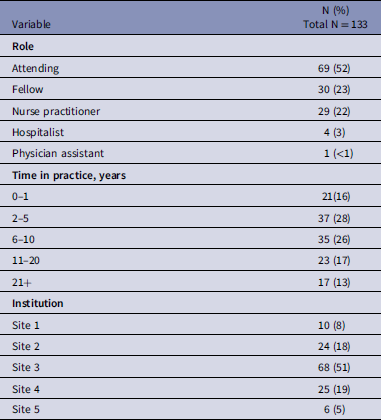
A total of 133 of 297 eligible clinicians (45%) answered the survey, including 69 critical care attendings (52%), 30 critical care fellows (23%), 29 nurse practitioners (22%), 4 hospitalists (3%), and 1 physician assistant (<1%). Clinicians from five PICUs were included in the survey, including 10 of 43 clinicians surveyed from Site 1 (8% of total responses, response rate 23%), 24 of 55 clinicians surveyed from Site 2 (18% of total responses, response rate 44%), 68 of 145 clinicians surveyed from Site 3 (51% of total, response rate 47%), 25 of 46 clinicians surveyed from Site 4 (19% of total, response rate 54%), and 6 of 8 clinicians surveyed from Site 5 (4% of total, response rate of 75%) (Table 1).
Characteristics of survey respondents

Table 1. Long description
A table summarizing the characteristics of survey respondents. The table has 133 total respondents and includes columns for variable, N, and percent. Variables include role, time in practice, and institution. Roles are attending (69, 52 percent), fellow (30, 23 percent), nurse practitioner (29, 22 percent), hospitalist (4, 3 percent), and physician assistant (1, less than 1 percent). Time in practice is categorized into 0-1 years (21, 16 percent), 2-5 years (37, 28 percent), 6-10 years (35, 26 percent), 11-20 years (23, 17 percent), and 21+ years (17, 13 percent). Institutions include Site 1 (10, 8 percent), Site 2 (24, 18 percent), Site 3 (68, 51 percent), Site 4 (25, 19 percent), and Site 5 (6, 5 percent).
Knowledge about vancomycin
Respondents were asked a series of questions to assess their understanding of vancomycin’s spectrum of antibiotic activity as well as local MRSA epidemiology. Of 116 respondents, 15 (13%) correctly identified the organisms reliably treated only by vancomycin in a hypothetical patient with sepsis receiving vancomycin and cefepime. Clinicians also varied widely in their assessment of what proportion of Staphylococcus aureus isolates locally were MRSA versus methicillin-susceptible Staphylococcus aureus, with a substantial proportion of respondents both over and under-estimating actual prevalence across sites (range: 0% to 79%). Actual prevalence of MRSA among S. aureus isolates ranged from 20 to 29% at Site 1–3 and between 30% and 39% at Site 4 and 5 (Supplemental Figure 2).
Attitudes about vancomycin use
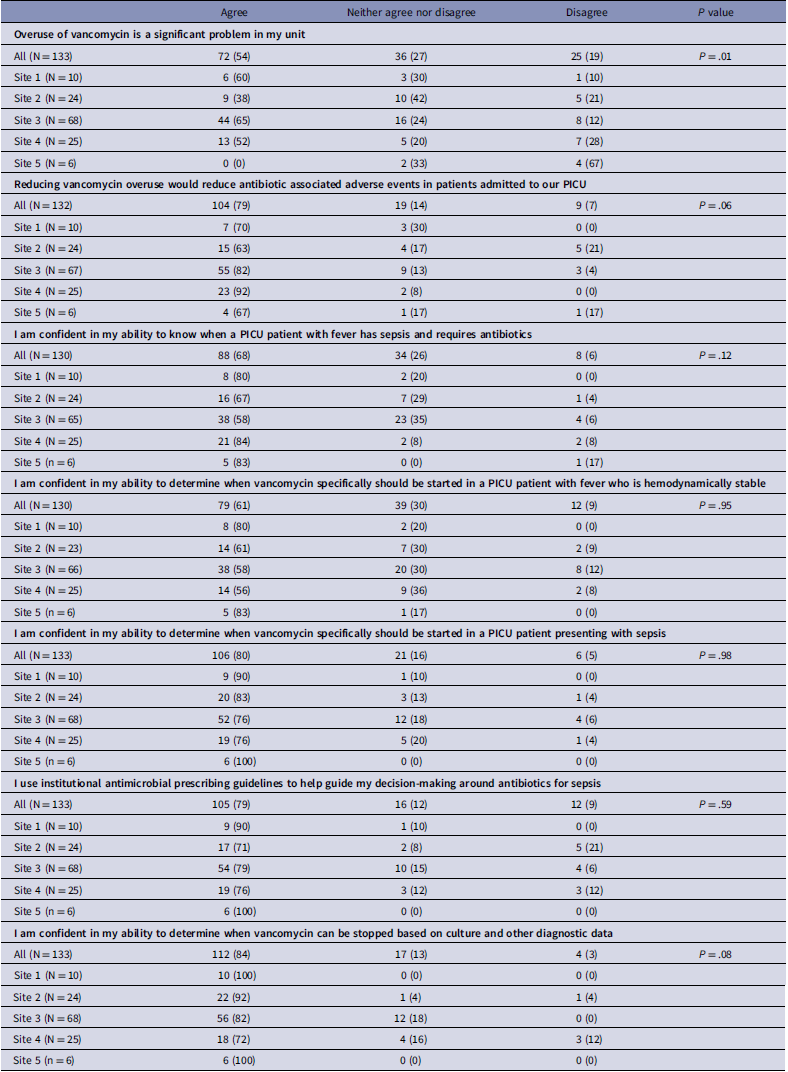
More than half of respondents agreed that vancomycin overuse was a significant problem in their unit (n = 72/133, 54%). This differed across the five sites with 0% of respondents agreeing with this statement at Site 5 and 65% of clinicians agreeing with this statement at Site 3 (P = .01). Across sites, the majority of clinicians (n = 104/132, 79%) agreed that reducing vancomycin overuse would reduce antibiotic adverse events, including nephrotoxicity and phlebitis, though the proportions of respondents agreeing with this statement was numerically lower at Site 2 and Site 5 than the other units (63% and 67%, respectively, vs 79% for the overall cohort, P = .06).
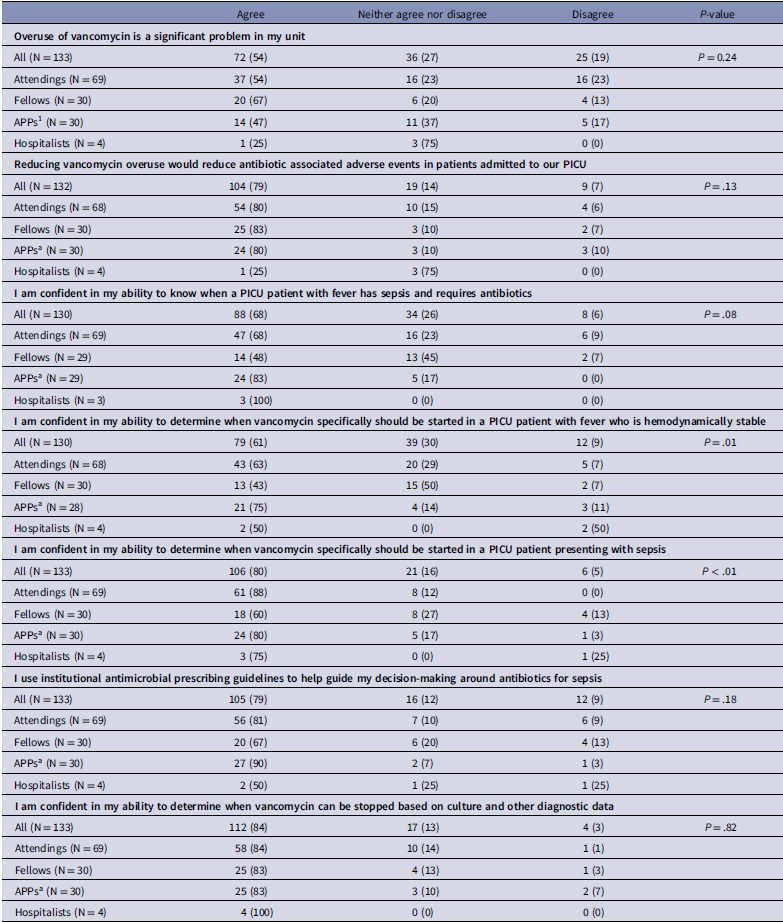
Approximately two-thirds of clinicians across all sites felt confident in their ability to discern when a child with fever had sepsis and required antibiotics, with no difference across sites (P = .12). When questioned about vancomycin use specifically, clinicians were generally confident in their ability to determine whether vancomycin should be initiated in a child with sepsis (80%) and when vancomycin could be stopped (84%), but were less often confident in their ability to determine whether vancomycin should be initiated in hemodynamically stable children (61%), a finding that did not differ across institutions (P = .95) (Table 2). Across occupational roles, 60% of PICU fellows (18/30) felt confident in their decision making around whether vancomycin should be started in children with sepsis, whereas 88% of attendings (61/69) and 80% (24/30) of AAPs felt confident with this decision making (P< .01). In hemodynamically stable patients, 43% of fellows (13/30) felt confident in their decision making around starting vancomycin, in contrast to 63% of attendings (43/68) and 75% of APPs (21/28) (P = .01) (Table 3).
Vancomycin use practices
To understand decision making around choice of empiric antibiotics, clinicians were asked what the minimum proportion of potentially causative organisms they would expect an empiric antibiotic regimen to adequately cover when administered as empiric therapy in two hypothetical clinical scenarios. For a hypothetical patient with sepsis without shock, this proportion was 80% (IQR 70%–87%) and for a patient with septic shock, this proportion was 90% (IQR 85%–95%).
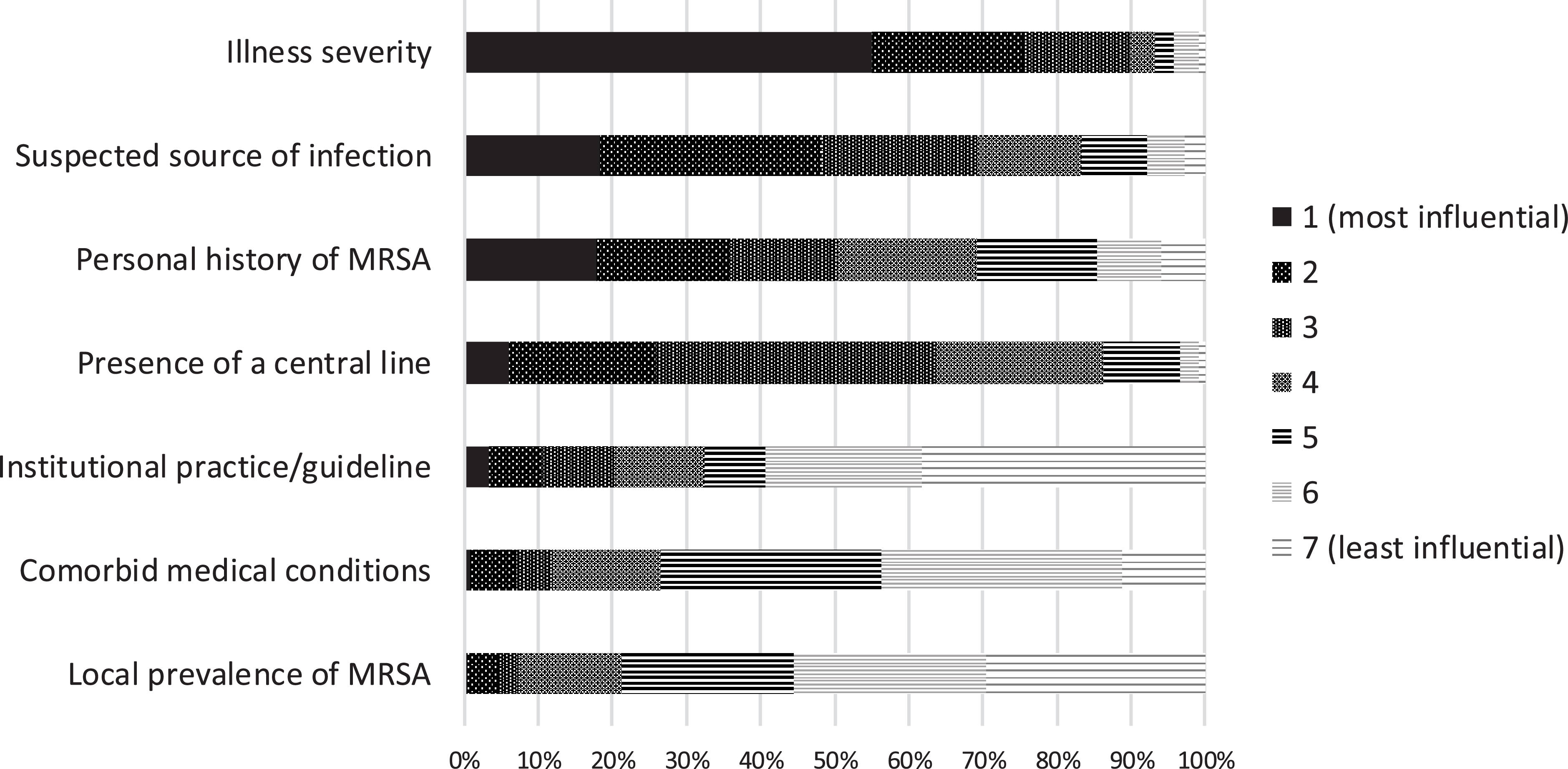
To understand factors driving a decision to order empiric vancomycin in day-to-day practice, survey respondents were asked to rank various factors from most to least influential. The most important factor influencing a decision to order vancomycin use was illness severity, followed by suspected source of infection, presence or absence of a central line, personal history of MRSA, institutional guidelines, comorbid medical conditions, and local prevalence of MRSA (Figure 1).
Factors influencing vancomycin prescribing. Survey respondents ranked each of the seven factors as most to least influential in determining whether or not to use vancomycin.

To both understand how these factors may be operationalized in clinical practice and understand variability in individual decision making, clinicians were presented with four scenarios commonly encountered in the PICU and asked to indicate whether they would prescribe empiric vancomycin. In scenario 1 (previously healthy child with community onset septic shock), 79% of respondents would prescribe vancomycin, without statistical difference across institutions (range: 63%–88%, P = .11) or occupational role (range: 67%–85%, P = .57). Illness severity was the factor influencing the decision to administer or not administer vancomycin cited most often by respondents (74%), followed by suspected source of infection (10%). In scenario 2 (hospitalized medically complex adolescent with a fever in the setting of a central venous catheter), 56% of respondents would prescribe vancomycin, with no statistical difference across institutions (range: 50%–75%, P = .73) or occupational role (range: 47%–67%, P = .74). Presence of a central line was the factor rated highest (38%), followed by illness severity (24%). In scenario 3 (child with spina bifida with suspected urosepsis), 19% of respondents endorsed that they would prescribe vancomycin, with no statistical difference across institutions (range: 13%–29%, P = .68) or occupational role (range: 0%–21%, P = 1.00). Most respondents cited the suspected source of infection as the primary factor influencing the decision to administer vancomycin or not administer vancomycin (75%), followed by illness severity (11%). Finally, in scenario 4 (infant with RSV and a questionable right middle lobe infiltrate requiring high flow nasal canula), 2% of respondents said they would administer vancomycin, with the most influential factor in making this decision being the suspected source of infection for 72% of respondents, followed by illness severity (20%) (Figure 2). Based on these scenarios, 63 respondents were classified as high vancomycin utilizers (53%) and the remaining 56 (47%) were classified as low utilizers. There were no statistical differences in knowledge or attitudes around vancomycin use between high and low utilizers of vancomycin, nor were there differences in the prevalence of high versus low utilizers across institutions or occupational roles.
Discussion
This multicenter survey of PICU clinician knowledge, attitudes, and practices regarding empiric vancomycin use was part of a formative evaluation to design a stewardship intervention focused on reducing vancomycin overutilization. Our survey revealed several potential determinants of vancomycin overuse that can inform these stewardship efforts. Clinician knowledge of the spectrum of activity of vancomycin was low, and perceptions of whether clinicians perceived vancomycin overuse to be a significant problem varied across institutions. Most clinicians agreed that reducing vancomycin use would reduce antibiotic-associated adverse events. Importantly, although clinicians were confident in their ability to determine when vancomycin should be started in children with sepsis and when it can be safely discontinued, fewer clinicians felt confident about whether vancomycin should be started in a hemodynamically stable child. These findings provide new insights into the factors that shape empiric vancomycin use in the PICU setting and offer several insights for stewardship intervention development.
Knowledge gaps around antibiotic spectrum, as well as limited familiarity with local epidemiology of multidrug-resistant organisms, have been reported in prior studies. Reference Kim, Szymczak and Schnellinger24,Reference Salsgiver, Bernstein and Simon26 In our study, just 13% of clinicians correctly identified organisms uniquely covered by vancomycin, beyond those covered by β-lactam antibiotics typically used in combination with vancomycin for suspected sepsis in the PICU, a common indication in this setting. Clinicians also endorsed an empiric coverage threshold of 80% of potential pathogens, an estimate consistent with other published literature, Reference Cressman, MacFadden, Verma, Razak and Daneman25 despite the prevalence of MRSA infection among patients being evaluated for serious infections or sepsis reported consistently as <10%. Reference Waters and Caraccio12–Reference Chiotos, Newland and Starnes14 Clinicians therefore may be selecting empiric antibiotic regimens inclusive of vancomycin based on both an overestimation of vancomycin’s spectrum of activity as well as an underappreciation of the incremental gain in coverage afforded by routinely including vancomycin in empiric antibiotic therapy.
Despite misperceptions around the utility of empiric vancomycin, half of clinicians acknowledged that vancomycin overuse was a problem in their unit and nearly 80% agreed that reductions in vancomycin use would reduce antibiotic-associated adverse events. Nevertheless, vancomycin remains one of the most commonly utilized antibiotics in hospitalized children, including those in the PICU. Reference Brogan, Thurm and Hersh1,Reference Chiotos, Blumenthal and Boguniewicz3 Although not addressed in the present study, fear of missing a potentially treatable infection has also been demonstrated to influence antibiotic decision making among ICU clinicians in prior work. Reference Pandolfo, Horne and Jani23,Reference Wunderink, Srinivasan and Barie27–Reference Chiotos, Marshall and Kellom29 These fears may be amplified in the time-pressured PICU environment in which early antibiotic administration is emphasized, whereas the clinical consequences of over-treatment are both less immediate and less salient than those of potential undertreatment. Reference Paul, Niedner and Riggs30–Reference Levy, Gesten and Phillips32
Clinicians most often rated illness severity as a primary driver of their decision making around whether or not to administer empiric vancomycin, a theme reflected in other work focused on ICU-based stewardship interventions. Reference Pandolfo, Horne and Jani23,Reference Wunderink, Srinivasan and Barie27 Although there are undoubtedly severely ill children who do not benefit from vancomycin, focusing stewardship efforts on children who are not severely ill may hold most immediate promise in reducing vancomycin overuse. Prior work suggests that clinicians may broaden or start empiric antibiotics “just in case” in these lower-risk patients. Reference Woods-Hill, Koontz and King28,Reference Chiotos, Marshall and Kellom29 In our study, nearly 40% of clinicians did not feel confident in determining whether vancomycin was necessary in a hemodynamically stable patient. Institutionally endorsed practice guidelines, clinical decision support tools, and feedback to clinicians on local MRSA epidemiology may reduce uncertainty and support more consistent decision making in these scenarios. For example, implementation of a computerized order entry prompts providing guidance about MDRO risk has been associated with reduced use of extended-spectrum antibiotics for common infections in adults hospitalized in non-ICU settings, including pneumonia and skin and soft tissue infections. Reference Gohil, Septimus and Kleinman33,Reference Gohil, Septimus and Kleinman34
A Delphi Consensus study aimed at establishing priority pediatric antimicrobial stewardship interventions in the US flagged the ICU setting as one of two high-priority clinical contexts caring for children. Reference Obeng, Tetteh and Malone35 Implementing stewardship in the ICU is challenging because critically ill children frequently present with nonspecific signs of infection, rapid clinical deterioration, and a high risk of morbidity and mortality, prompting early empiric broad spectrum antibiotic use. Diagnostic uncertainty, the heterogeneity of ICU patients, fear of undertreating sepsis, and the need to make urgent decisions about aspects of treatment such that modifications to antibiotic therapy are forgotten complicate efforts to improve antibiotic decision-making in this context. Reference Pandolfo, Horne and Jani23,Reference Wunderink, Srinivasan and Barie27,Reference Janssen, Oerlemans and Bos36 Our study provides insights into the multilevel drivers of vancomycin overuse in the PICU that suggest different implementation strategies including prospective audit and feedback, development of local clinical practice guidelines, educational outreach, multidisciplinary stewardship rounds, audit and feedback of performance, and use of clinical champions will be needed to improve prescribing. Reference Chorafa, Komatsiouli, Iosifidis, Kourti, Sdougka and Roilides37–Reference Liberati, Brigadoi, Barbieri, Giaquinto and Donà39
Our study is subject to several limitations. First, our survey relied on stated practices rather than actual practice regarding use of vancomycin. It is likely that some respondents were aware of the goals for the study and therefore may have been biased toward providing desirable answers. We attempted to mitigate this both by making the survey anonymous and by circulating the survey prior to any educational efforts regarding the intervention. Second, because our assessment of vancomycin knowledge was based on a limited number of questions, it is possible that we underestimated clinicians’ knowledge base that would have been captured with a more extensive assessment. Third, we sampled clinicians primarily working at academic medical centers, our results may not be generalizable to all settings. Fourth, we cannot assess response bias because we do not know the characteristics of people who did not respond to the survey. Fifth, we did not use a validated instrument but instead utilized a multistage process informed by the literature and expert consensus to ensure questions were relevant and captured key determinants of vancomycin use in the understudied PICU context. Despite these limitations, our relatively high response rate from multiple geographically diverse PICUs strengthens the generalizability of our findings.
Overall, our study describes PICU clinician beliefs and decision-making for empiric vancomycin to inform future work to optimize its use. Addressing both cognitive and behavioral drivers of vancomycin use is critical for effective and sustainable stewardship efforts in this clinical context, learnings that may be applied to use of other broad-spectrum antibiotics in the PICU setting.
Vancomycin use practices in common infections in the PICU. (a) Would you prescribe vancomycin to a previously healthy toddler with no central line or other indwelling hardware presenting with community-onset septic shock requiring an epinephrine infusion to maintain blood pressure? (b) Would you prescribe vancomycin to an adolescent with short bowel syndrome and a central venous catheter who has been hospitalized in your PICU for three weeks and develops a fever? He is hemodynamically stable and has no personal history of MRSA. (c) Would you prescribe vancomycin to a child with spina bifida and recurrent urinary tract infections who presents with fever, tachycardia, delayed capillary refill, and a urinalysis with large leukocyte esterase and bacteria? (d) Would you prescribe vancomycin to an infant with RSV and a patchy RML infiltrate versus atelectasis admitted to the PICU on high flow nasal canula and requiring 30% FiO2?

Vancomycin attitudes by institution

Table 2. Long description
The table presents data on vancomycin attitudes by institution across different sites. It has six rows and six columns. The columns are labeled Agree, Neither agree nor disagree, Disagree, and P value. The rows are labeled with different statements and sites. Row 1: Overuse of vancomycin is a significant problem in my unit. All (N 133), 72 (54); 36 (27); 25 (19); P.01. Site 1 (N 10), 6 (60); 3 (30); 1 (10). Site 2 (N 24), 9 (37); 10 (42); 5 (21). Site 3 (N 68), 45 (65); 16 (24); 8 (12). Site 4 (N 25), 13 (52); 5 (20); 7 (28). Site 5 (N 6), 0 (0); 2 (33); 4 (67). Row 2: Reducing vancomycin overuse would reduce antibiotic associated adverse events in patients admitted to our PICU. All (N 132), 104 (79); 19 (14); 9 (7); P.06. Site 1 (N 10), 7 (70); 3 (30); 0 (0). Site 2 (N 24), 15 (63); 4 (17); 5 (20). Site 3 (N 67), 45 (82); 9 (13); 3 (4). Site 4 (N 25), 23 (92); 2 (8); 0 (0). Site 5 (N 6), 4 (67); 1 (17); 1 (17). Row 3: I am confident in my ability to know when a PICU patient with fever has sepsis and requires antibiotics. All (N 130), 88 (68); 34 (26); 8 (6); P.12. Site 1 (N 10), 8 (80); 2 (20); 0 (0). Site 2 (N 24), 17 (66); 7 (29); 1 (4). Site 3 (N 65), 38 (59); 23 (35); 4 (6). Site 4 (N 25), 21 (84); 2 (8); 2 (8). Site 5 (N 6), 5 (83); 0 (0); 1 (17). Row 4: I am confident in my ability to determine when vancomycin specifically should be started in a PICU patient with fever who is hemodynamically stable. All (N 130), 79 (61); 39 (30); 12 (9); P.95. Site 1 (N 10), 8 (80); 2 (20); 0 (0). Site 2 (N 23), 14 (61); 7 (30); 2 (9). Site 3 (N 66), 38 (58); 20 (30); 8 (12). Site 4 (N 25), 14 (56); 9 (36); 2 (8). Site 5 (N 6), 5 (83); 1 (17); 0 (0). Row 5: I am confident in my ability to determine when vancomycin specifically should be started in a PICU patient presenting with sepsis. All (N 133), 106 (80); 21 (16); 6 (5); P.98. Site 1 (N 10), 9 (90); 1 (10); 0 (0). Site 2 (N 24), 20 (83); 3 (13); 1 (4). Site 3 (N 68), 52 (76); 12 (18); 4 (6). Site 4 (N 25), 19 (76); 5 (20); 1 (4). Site 5 (N 6), 6 (100); 0 (0); 0 (0). Row 6: I use institutional antimicrobial prescribing guidelines to help guide my decision-making around antibiotics for sepsis. All (N 133), 105 (79); 16 (12); 12 (9); P.59. Site 1 (N 10), 9 (90); 1 (10); 0 (0). Site 2 (N 24), 17 (71); 2 (8); 5 (21). Site 3 (N 68), 54 (79); 10 (15); 4 (6). Site 4 (N 25), 19 (74); 3 (12); 3 (12). Site 5 (N 6), 6 (100); 0 (0); 0 (0). Row 7: I am confident in my ability to determine when vancomycin can be stopped based on culture and other diagnostic data. All (N 133), 112 (84); 17 (13); 4 (3); P.08. Site 1 (N 10), 10 (100); 0 (0); 0 (0). Site 2 (N 24), 22 (92); 1 (4); 1 (4). Site 3 (N 68), 56 (82); 12 (18); 0 (0). Site 4 (N 25), 18 (72); 4 (16); 3 (12). Site 5 (N 6), 6 (100); 0 (0); 0 (0).
PICU, pediatric intensive care unit.
Vancomycin attitudes by occupational role

Table 3. Long description
The table presents data on attitudes towards vancomycin use among different occupational roles in a Pediatric Intensive Care Unit (PICU). It has six rows and five columns. The columns are labeled ‘Agree’, ‘Neither agree nor disagree’, ‘Disagree’, and ‘P-value’. The rows are labeled with different statements about vancomycin use and the occupational roles: All, Attendings, Fellows, APPs, and Hospitalists. Each cell contains the number and percentage of respondents who agree, neither agree nor disagree, or disagree with the statement. The table also includes a P-value for each statement, indicating the statistical significance of the results. The statements cover topics such as reducing vancomycin overuse, confidence in determining when to start vancomycin, use of institutional guidelines, and confidence in determining when to stop vancomycin.
APP, advance practice provider.
a APPs include nurse practitioners (N = 29) and physician assistants (N = 1).
Supplementary material
The supplementary material for this article can be found at https://doi.org/10.1017/ash.2026.10898.
Data availability statement
Data are not publicly available.
Financial support
This work was supported by the Centers for Disease Control and Prevention Epicenters Program (U54CK000610).
Competing interests
All authors report no conflicts of interest relevant to this article.



 Open access

