


Pia and Liana were killed in the summer of 2016 while hanging out in front of a bar. The street was known as a hot spot for drug sales in Porto Alegre, in the south of Brazil. Under Brazil’s Feminicídio Law, police had to determine whether the murders were feminicides or homicides, that is, whether they had “gender-based motives.” The police inquiry’s description of the arrested suspect stated: “He is part of drug-trafficking gangs. His use of violence aims at ensuring dominance over drug sales spots.” Upon this discovery, the police did not consider gendered motives. It happened near a drug sales point: not a feminicide, case closed.
During that same year, the most violent in the city’s history, Vivi was incarcerated in a juvenile detention center in Porto Alegre. She was part of the illegal drug economy that, according to the police, ruled out gender as a possible motive for the murders of Pia and Liana. Like the officers, Vivi did not perceive the drug market as gendered or particularly unsafe for women. On the contrary. A victim of sexual violence at home, she found safety in the streets: “I have slept with six men in the same bed; they all respected me, none touched me. In the street, if you show respect, you will be respected.”
This article investigates the narrative construction of the boundary between public “urban” violence and private “gendered” violence in Brazil. We analyze narratives by actors whose meaning making is central to the governance and production of violence: police officers who investigate murders of women (nine interviews and thirty-six reports) and teenage girls incarcerated in a juvenile detention center due to violence offences (twenty-two interviews). These narratives were produced in Porto Alegre, the capital of the southernmost state of Brazil, between 2015 and 2019, when the city experienced its deadliest conflict between criminalized drug organizations and state forces (Feltran et al. Reference Feltran, Lero, Cipriani, Maldonado, Rodrigues, Silva and Farias2022).
As these cases show, the conflicts blur the boundaries between state, criminal, interpersonal, and gendered violence. While violence has been called the “defining problem in contemporary Latin America” (Davis Reference Davis2006, 178), research on the topic has been historically “specialized and balkanized,” as studies on family and domestic violence remain separate from those on state and drug market violence (Auyero et al. Reference Auyero, Lara and Fernanda Berti2014, 450). This dichotomy mirrors scholarly and policy debates in other regions, where the binary approach to gender or (rarely “and”) urban violence endures (Walby et al. Reference Walby, Towers and Francis2014; Frazer and Hutchings Reference Frazer and Hutchings2020).
In Latin America, the hypervisibility of men as perpetrators and victims of urban violence has led to the overlooking of women’s and girls’ experiences in similar contexts (Hume and Wilding Reference Hume and Wilding2020). Yet research shows that women are targets at the nexus of gender, drug market, and state violence (Bourgois Reference Bourgois2003; Contreras Reference Contreras2012; Moura Reference Moura2005; Segato Reference Segato2018). How, then, do gendered dynamics go unacknowledged in conceptions of urban violence?
We investigate how different actors narratively construct some instances of violence as gendered and others as genderless. Drawing from feminist scholarship, we conceptualize gender as a social structure of domination (Connell Reference Connell2014) reproduced by practices and discourses at the individual, interactional, and institutional levels (Acker Reference Acker1990; Risman Reference Risman2004). By gendered or genderless narratives, we mean whether violence is portrayed as stemming from women’s position in the sexual division of labor (e.g., their presumed role as romantic and sexual partners and caretakers; Connell Reference Connell2014). We consider narratives gendered when they acknowledge women and girls’ caretaking roles and vulnerability to male violence. We do not argue that events narrated as genderless are empirically so. Gender structures all interactions, yet men’s violence is often perceived as universal and unmarked by gender (Connell Reference Connell2014); we examine how this erasure operates in narratives of violence. We are interested in narratives, rather than other forms of discourse, because they display a temporal, causal, and moral sequence of events; that is, “A happened because of B; therefore, C.”
We argue that social constructions of place are central to this gendering of violence. In our analysis, we found that the way violent events are narratively situated, whether depicted as occurring in the “home” or on the “street,” and not characteristics of victims or perpetrators, shapes how gender is acknowledged or ignored in accounts of violence. This narrative spatiality influences how individuals and institutions make sense of violent acts, including how police officers interpret incidents and how criminalized girls make sense of the violence they suffer and perpetrate.
Gender and spatiality scholars have long argued that gender and space are mutually constituted (Massey Reference Massey1994, 2; Spain Reference Spain2014). The separation of the home from the workplace, for example, “is a spatial manifestation of the social division of labor” (Spain Reference Spain2014, 585). We bring these insights to the scholarship of violence in Latin America, which has explored the relationship between space, violence, and class (Caldeira Reference Caldeira2001) and racialization (Alves Reference Alves2018; Vargas Reference Vargas2018), by showing the centrality of the home-street divide in structuring narratives of gender(less) violence.
We theorize the public-private divide as a gendered “symbolic structure” (Bourdieu Reference Bourdieu1989) shaping how individuals understand and navigate the social world. While not immutable, symbolic structures are embedded in and reproduced by individuals’ beliefs and institutional practices (Bourdieu Reference Bourdieu1989; Acker Reference Acker1990). We show that police officers’ and criminalized girls’ framings of violence as gendered were contingent on a symbolic separation between public and private spaces—or the “home” and the “street,” as previous studies in the region have theorized (DaMatta Reference DaMatta1997; Wilding Reference Wilding2012). We expand on these studies by showing how binary framings around emotions (emotional vs. instrumental), gender (gender vs. genderless), and violence (exceptional vs. expected) are narratively mapped onto these spaces, shaping perspectives about the causes and ideal reactions to violence.
Both accounts reproduce a common narrative about place, violence, and gender: the home as the space of gendered, exceptional, family-related, and emotional violence, and the street as the space of genderless, expected, market-related, and instrumental violence. This instrumental violence of the street is not genderless per se—rather, it is embedded in gendered dynamics—but is interpreted as such by the actors involved. In police narratives, the violence of the home (by men against women) is characterized as highly emotional and exceptional, and the violence of the street (presumably caused by drug markets) as inherent to their dangerous environments and hyperrationalized market logic. In the narratives of criminalized girls, the violence of the home (by men against women and children) is experienced as traumatic, out of place, and unjust, and the violence of the street (of “all against all” in drug markets) is expected, naturalized, and rationalized as instrumental to perpetrators’ goals (e.g., profit, safety, revenge). These narratives also frame home and street as separate spaces, obscuring how homes are also places where drug wars are fought—with people’s living rooms being spaces of drug sales and police repression—and how personal and affective relations are intermingled with the business of drug trafficking (Alves Reference Alves2018; Wilding Reference Wilding2012).
These spatialized narratives matter because they obscure and legitimize forms of state and interpersonal violence against women, especially those living in highly policed favelas. When police officers and criminalized girls employ these spatial categories to make sense of the violence they witness, suffer, and perpetrate, they shape the state’s management of violence and their communities’ abilities to confront it. In accounts of gendered, emotional family violence in the home, violence is framed as unacceptable and illegitimate, but also as a product of individual emotions and localized family dynamics, thus invisibilizing the structural character of violence against women and girls in the domestic sphere. In accounts of genderless, instrumental drug market violence in the street, violent acts are framed as unavoidable and inherent to favelas’ hyperrationalized drug markets, thus invisibilizing the gendered dynamics in these spaces and legitimating the state’s use of force against residents. Our findings reveal how the social construction of urban space as a site of danger and violence in Latin America is not only classed and racialized (Caldeira Reference Caldeira2001; Vargas Reference Vargas2018) but also grounded in gendered ways of seeing the world (Acker Reference Acker1990; Connell Reference Connell2014).
Gendering violence: Public and private boundaries in Latin America
Space is socially constructed in ways that produce gendered meanings (Massey Reference Massey1994). Nowhere is this clearer than in the long‑standing division between the private sphere, associated with femininity, family, and emotion, and the public sphere, associated with masculinity, work, and politics (Spain Reference Spain2014). Debates about these spheres and their forms of gender relations have been central to feminist theorizing, including discussions of gender and violence (Walby et al. Reference Walby, Towers and Francis2014). Yet the public-private divide endures in policy and academic debates, shaping how individuals and institutions frame gender and violence (Hearn et al. Reference Hearn, Strid, Humbert and Balkmar2022; Hume and Wilding Reference Hume and Wilding2020). Following Massey (Reference Massey1994, 3), we argue for a relational approach to the public-private boundary, emphasizing how spaces are often constructed in opposition to each other. From this perspective, the social construction of private violence cannot be understood apart from the construction of public violence, and vice versa. As we show, these spaces not only are relational but also are portrayed as inversions of each other.
The boundaries between public and private violence are also a subject of scholarly interest in Latin America. An “ideological and practical gap” remains between studies focused on gender-based violence (GBV) and urban violence (Wilding Reference Wilding2012, 10). The former has wrestled with a central puzzle: increasing GBV despite redemocratization, post–civil war pacification, and the enactment of gender-responsive policies across the region. Some scholars highlight the lingering effects of authoritarianism and civil wars, which have normalized gender and sexual violence (Hume Reference Hume2007; Carey and Torres Reference Carey and Gabriela Torres2010; Boesten and Gavillán Reference Boesten and Gavillán2023). Others highlight the ineffectiveness of anti-GBV legislation due to institutional neglect (Menjívar and Walsh Reference Menjívar and Drysdale Walsh2017), and gendered ideologies such as familism, which links the wellbeing of women to the collective well-being of the family, thus pushing GBV cases to family rather than criminal court (Menjívar and Diossa-Jiménez Reference Menjívar and Diossa-Jiménez2023). This confinement to family matters is reproduced even in cases of public violence against women. Discussing the killing of women in Ciudad Juárez, Mexico, Segato (Reference Segato2018, 204) argues that “femicides, although they take place in the midst of … para-state wars, never manage to emerge from the private realm in which they are confined in the imaginary of judges, prosecutors, the media, and public opinion in general.” Thus, while this literature has focused on the state and gendered ideologies in law and policy, it would benefit from a relational analysis of narratives around GBV vis-à-vis urban violence narratives.
On the other side of the public-private divide, urban violence has been a central concern in post-redemocratization Latin America. Similar to the puzzle that animates GBV studies, scholars’ key concern is the “explosion of violence and criminality” following neoliberal democratic transitions (Davis Reference Davis2006, 179; Albarracín and Barnes Reference Albarracín and Barnes2020). Studies have examined the continuities and innovations in state violence after democratization (Auyero and Sobering Reference Auyero and Sobering2019), and the expansion of extralegal armed groups fighting for territorial control over lucrative drug markets (Arias Reference Arias2014; Moncada Reference Moncada2016). Another central concern is the public construction of a “discourse of war” that legitimates the killing of impoverished and racialized populations living in urban enclaves across the region (Zubillaga et al. Reference Zubillaga, Llorens and Souto2019, 430). These studies would benefit from examining this “discourse of war” alongside GBV discourses.
Yet another body of literature challenges the public-private dichotomy and highlights the different connections between domestic and public forms of violence (Hume Reference Hume2009; Auyero et al. Reference Auyero, Lara and Fernanda Berti2014). Menjívar (Reference Menjívar2008, 109) urged scholars to consider how “multiple forms of violence coalesce in the everyday lives” of Latin Americans. Some studies emphasize how violence becomes “a routine way of dealing with everyday life issues inside and outside of the home” (Auyero and Berti Reference Auyero and Fernanda Berti2015, 19), revealing intersections between family and drug market dynamics. Examples include mothers battering sons to keep them from the “streets” (Auyero and Berti Reference Auyero and Fernanda Berti2015) or negotiating with armed groups for their children’s safety (Zubillaga et al. Reference Zubillaga, Llorens and Souto2019; Zubillaga and Hanson Reference Zubillaga and Hanson2024), as well as the heightened risk of femicide and incarceration (Moura Reference Moura2005; Wilding Reference Wilding2010). Auyero and Berti (Reference Auyero and Fernanda Berti2015) argue that under conditions of urban marginality, violence can be instrumental, that is, “used to address individual and collective problems” both at home (e.g., spanking a misbehaving child) and in the streets (e.g., retaliatory violence).
While this scholarship shows how gender, drug market, and state violence are interconnected, fewer studies analyze the narrative construction of the binary itself (but see Wilding Reference Wilding2012). We agree with efforts to destabilize these categories but view classification processes as sociologically significant because they are embedded in and reproduce broader social structures (Bourdieu Reference Bourdieu2014; Menjívar Reference Menjívar2023). For example, is the violence theorized as instrumental by Auyero and Berti (Reference Auyero and Fernanda Berti2015) always narrated as such? Would the battering of a wife be recounted in the same manner as a drug market execution? We trace how “home” and “street”, as relational spatial categories, shape narratives of violence and the meanings attributed to gender by incarcerated girls and police officers. In doing so, we show how individuals and institutions (re)produce the public-private divide, gendering and de-gendering violent acts and responses to them.
Theoretical framework: The home and street as symbolic structures
Rather than critiquing the separation between public and private violence, we examine how social actors use this divide to interpret, classify, and manage violence. Drawing on feminist theory, cultural sociology, and Brazilian social theory, we conceptualize the public-private divide as a symbolic structure whose categories organize beliefs, practices, and understandings of gendered violence. We follow Gal’s (Reference Gal2002, 79) argument that public-private distinctions are “ideological … tools for arguments in and about that world,” informing practices and beliefs by contrasting “virtually any kind of social fact: spaces, institutions, bodies, groups, activities, relations” (80–81). We therefore ask how this symbolic division shapes gendered power relations, particularly violence.
Much sociological scholarship in recent decades has examined how processes of classification and cognition, as well as shared discursive repertoires, shape inequality, structure social life, and affect the reproduction and meaning making around violence (Bourdieu Reference Bourdieu2014; Morgan and Orloff Reference Morgan and Shola Orloff2017) and gender (Acker Reference Acker1990; Connell Reference Connell2014). Following Acker (Reference Acker1990, 146), we investigate the gendering—the ways in which meaning and emotions are “patterned in terms of a distinction between masculine and feminine,” explicitly or implicitly—of violence in personal and state narratives. This gendering occurs through “symbols and images that express … those divisions” (Acker Reference Acker1990, 146), such as the enduring frame of the home as a “source of stability, reliability and … nostalgia” and “coded as feminine” (Massey Reference Massey1994, 180).
In Brazil, the public-private distinction has long been central to social theory. DaMatta (Reference DaMatta1997) has argued that “home” and “street” are central cultural categories through which Brazilians navigate social life. The home is understood as a highly hierarchical and informal space, defined by personal relationships, where conflict is often avoided. The street, in contrast, is a place where relationships are often impersonal and the laws of the state and the market prevail (often without regard for people’s rights or humanity), but also a space where hierarchies from the “home” can be escaped or contested. More recently, Wilding (Reference Wilding2012, 48) demonstrated how these boundaries continue to shape Brazilians’ understanding of “the street as a place of excitement and danger, and the home as a place of security and refuge,” contributing to the acceptability of gender violence in the home and its invisibility in the street.
Brazilian scholars show that classifications of home and street are racialized and classed. In Brazilian cities, the economic elites are secluded in hypersecuritized gated communities, while favela residents bear the brunt of state and drug-related violence (Caldeira Reference Caldeira2001). After centuries of economic exploitation and racist segregation, the favela became synonymous with crime and danger (Alves Reference Alves2018; Vargas Reference Vargas2018). Although sites of housing, commerce, and community, these neighborhoods are not viewed by the state, media, or nonresidents as proper homes: They are “symbolically constituted as spaces of crime, of anomalous, polluting, and dangerous qualities” (Caldeira Reference Caldeira2001, 79). Some people’s homes are other people’s streets.
Building on this work, we theorize the home-street divide as a “symbolic structure”: a set of socially-agreed-on cultural frameworks, categories, meanings and narratives that, taken up by individuals and institutions in their everyday practices, work to structure the social world (Bourdieu Reference Bourdieu1989). Symbolic structures are produced by those with symbolic power, who have “the capacity to produce, diffuse, and inculcate … cognitive categories” (Wacquant Reference Wacquant2023, 67).
The state is a key institution through which symbolic categories diffuse and become consequential (Bourdieu Reference Bourdieu2014). Symbolic meanings can obscure or legitimize relations of oppression and violence (Bourdieu Reference Bourdieu1989). In this study, police officers exercise this “performative power” to define what counts as violence, legitimizing state violence vis-à-vis other forms of harm. Yet symbolic categories are never absolute. Citizens can resist or reinterpret state categories and hegemonic cultural frameworks (e.g., Schwartzman Reference Schwartzman2009; Menjívar Reference Menjívar2023). We theorize that police officers coproduce the categories of “home” and “street,” while criminalized girls interpret their experiences of violence through these categories and adapt these categories in their narratives.
Case study: Rio Grande do Sul’s “trafficking war”
In the mid-2010s, Rio Grande do Sul was a fitting site to study the interplay of state, drug market, and gender violence. In 2016, the capital, Porto Alegre, ranked among the world’s most violent cities, recording 903 homicides, the highest number in its history (Feltran et al. Reference Feltran, Lero, Cipriani, Maldonado, Rodrigues, Silva and Farias2022). State actors and residents attribute the violence to a “trafficking war” between local drug organizations that later spread to the countryside (Cipriani Reference Cipriani2021; Barros Reference Barros2020). Between 2015 and 2017, almost 9,500 people were killed in the state (IPEA n.d.). The conflict’s front lines were occupied by youth from low-income neighborhoods, with young Black men disproportionately affected (Feltran et al. Reference Feltran, Lero, Cipriani, Maldonado, Rodrigues, Silva and Farias2022).
Women were also affected by rising lethal violence. In Rio Grande do Sul, murders of women rose from 162 in 2006 to 302 in 2016, a nearly 90 percent increase compared with 60 percent for all homicides. In that decade, 2,527 women were killed, 993 of them between the ages of fifteen and twenty-nine, and 1,384 of them by firearms (IPEA n.d.). Barros (Reference Barros2020, 124) pointed out the killing of women, either for revenge or as a “bait” to attract rivals, as a strategy by criminalized organizations to manage their territories in Porto Alegre.
This rise in violent victimization was also disproportionately endured by residents living in vilas, impoverished neighborhoods at a city’s outskirts. While the region has witnessed a decrease in homicides since 2017, vilas in the capital and across the state continue to endure periods of extreme instability (Feltran et al. Reference Feltran, Lero, Cipriani, Maldonado, Rodrigues, Silva and Farias2022). The majority of incarcerated girls interviewed for this study and of victims and suspects of homicide cases reside in vilas.
Analysis and methodology
This article combines the samples of two separate studies conducted between 2015 and 2019 in Porto Alegre, one composed of narratives by police officers who investigate women’s murders (Pamplona Reference Pamplona2024) and another of girls incarcerated for violence offences (Otto Reference Otto2020). While these groups are commonly understood to stand in opposite social locations and share divergent views, both are crucial to the management and production of violence. A comparative analysis reveals the different meanings various actors attribute to the home and the street, as well as how these categories might similarly shape narratives of violence across social locations.
We follow a Bourdieusian approach to narrative analysis (Fleetwood Reference Fleetwood2016; Sandberg and Fleetwood Reference Sandberg and Fleetwood2017), which investigates how narratives reproduce social inequalities by naturalizing social categories and invisibilizing relations of power (Bourdieu Reference Bourdieu1989). We conceive the narratives analyzed in this study as constrained by culturally available discourses to explain violence in an intelligible manner, reproducing the gendered symbolic structures of the public-private binary.
The first sample comprises thirty-six police inquiry reports that investigate and describe lethal violent acts against women between 2015 and 2019, of which nineteen were classified as feminicides. In 2018, while pursuing a master’s degree in sociology at a Brazilian university, Pamplona submitted the research proposal, cosigned by the program supervisor, to the state’s police institution responsible for coordinating police investigations. Upon approval, the author was authorized to visit police stations to scan documents and conduct interviews.
Reports of finalized investigations with a woman victim were scanned by the author in Porto Alegre police stations in 2018 and 2019. Police reports contain key documents describing the violent act as well as a summary of the evidence. The author removed personal information about alleged perpetrators and victims while scanning and did not include pages with pictures. The author also conducted nine interviews with police officers (who signed a consent form), four white women and five white men, who worked directly with homicide investigations in the city. These officers held leadership positions in various types of police stations, including homicide stations, which were typically led by men, and women’s police stations, which were usually led by women. We combined interview data with documentary analysis to understand the connections between the textual representations and categorizations provided in police records and the interpretations of police officers.
Our second sample of narratives comprises twenty-two biographical interviews with young women (between thirteen and nineteen years old) who were incarcerated in a women’s juvenile detention center in Porto Alegre in 2016. In 2015, while pursuing a master’s degree in sociology at a Brazilian university, Otto submitted a research proposal to a state agency that oversees custodial sentences for youths aged twelve to twenty-one in Rio Grande do Sul. The proposal, cosigned by the author’s academic supervisor and the graduate program chair, was reviewed by the detention center’s research office, which evaluates and approves studies conducted in its facilities. Known for its openness to academic research, the center has hosted numerous qualitative studies over the years (e.g., Barros Reference Barros2020). The project was approved by the office, and fieldwork began in 2016. An extension of this study, conducted in 2023 and 2024, utilizing the same methods, was approved by the University of Toronto’s research ethics board.
The young women at the institution held weekly meetings to share concerns with staff. During one such meeting, the author was introduced as a researcher and invited those interested to participate in a study focused on the life trajectories of criminalized young women. Participants voluntarily expressed interest to staff, who compiled a list of potential interviewees. The following month, the author visited the detention center daily, conducting interviews in private administrative rooms within the facility.
To prevent the production of documentation that connected participants to the study, consent was obtained verbally. During the reading of the consent form, the author reiterated that she had no ties to the institutions, that she would not disclose any information to staff or other youths serving sentences with them, and that they would neither be punished nor compensated for participating. She also informed them that they did not need to speak about anything that made them uncomfortable and could stop the interview at any point. Interviews were recorded with the participants’ consent, and the recordings were transcribed by the author and then deleted. To increase confidentiality, case details were altered when irrelevant to the analysis. Pseudonyms were randomly assigned to participants and do not bear any resemblance to their real names, of which there are no records.
Following the tenets of narrative analysis (Presser Reference Presser2009), interviews were conducted using open-ended probes and avoided direct interventions. The focus on adolescents, rather than criminalized adult women, allowed for a closer inspection of how violence is perceived by those most affected by recent violent developments in the region, as young people were on the front lines of the major armed conflict among the police and different drug trading factions between 2015 and 2018 (Barros Reference Barros2020).
Police narratives of lethal violence against women
Police officers’ narratives are embedded in bureaucratic and legal practices that determine punishments and rights on the basis of their classifications (Kurtz and Upton Reference Kurtz and Upton2017). Therefore, police narratives are part of the state infrastructure, dictating how people and situations are classified and their legal outcomes (Bourdieu Reference Bourdieu2014). In Brazil, this implies how legal reforms to prevent violence against women and girls are implemented.
Rates of violence among women and girls remain relatively high in Brazil compared to other countries, despite legislation such as the Maria da Penha Law (2006), which targets domestic violence and offers legal tools to protect victims. More recently, Brazilian feminists mobilized around the concept of feminicídio (feminicide), borrowing language from feminist struggles elsewhere in Latin America, and pushed for further legal changes to cope with the rise of women’s homicides (Campos Reference Campos2015). As a result, in 2015, Brazil promulgated the Feminicídio Law, which increases punishment for homicides of women committed “as a consequence of their female sex.” The new legal framework asks police officers who investigate murders to decide whether a case is a feminicide or “simply” a homicide. We found that the classification of cases into feminicides versus homicides was closely linked to notions of home or street. When investigating a woman’s murder, officers labeled violent acts differently depending on the (perceived) spatial context. Cases understood as happening in the street were framed as instrumental acts of violence connected to drug markets and classified as homicides. The label “feminicide” was reserved for murders happening in the home, which were understood as resulting from emotional grievances.
The violence of the street: Instrumental, genderless homicides
Cases of lethal violence against women framed as happening in the street were not classified as feminicides but as homicides linked to the trafficking “war.” In these cases, the investigation presumed that gendered relations were irrelevant to the murder. In an interview, a police chief stated that drug traffickers “do not have any respect or feelings; they just kill, and they do it without feelings.” Homicide inquiries did not describe the murder motivations. The rationalized, instrumental logic behind drug trafficking was taken for granted by officers, and the people involved were dehumanized through narratives that assumed they always mobilized violence in pursuit of drug market goals.
Thus, police narratives framed the street as a hyperrationalized marketplace where violence is normalized. Officers sustained the “homicide” classification even in situations where they acknowledged the salience of gendered relations. For example, in another interview, a police chief argued that “some women start trafficking to occupy their partner’s role to bring money home…. In these cases, some men can feel bothered because they think they are supposed to be the responsible ones.” Even though this quote suggests that the murder of a woman can be motivated by men’s naturalization of gender hierarchies in the drug market, this description was about homicide cases.
We found that most cases perceived to be set in the street had no room for representations of gendered vulnerability, even when the victims were young women living in vilas. In police narratives of such cases, their gender is irrelevant: “They were only drug users, the motivation is unknown” (Inquiry 24), “rumors that she used [drugs], was involved in local gangs” (Inquiry 31). The officers assumed that, in the street, drug-trafficking dynamics alone structured all social relations.
In these cases, the investigation focused more on the alleged perpetrator than the victim. The primary concern was re-creating the suspect’s past, not the victim’s. Officers classified the suspect as a gang member by bringing up previous criminal records and the suspect’s “well-known activities” in the area. Suspects were described as “violent,” “criminal,” and “regular outlaws.” An inquiry stated: “This person is part of a gang which acts in drug sales spots, and their modus operandi is to eliminate law-abiding people” (Inquiry 23). These narratives show how gendered power dynamics in instances of lethal violence against women were erased, and women’s vulnerability in the streets was ignored. State actors attributed these cases of violence against women to the internal, rational dynamics of drug gangs: “It is how it works.”
The violence of the home: Emotional, gendered feminicides
Cases in which women were murdered in the domestic space were classified as “feminicides.” Police officers framed these violent acts as stemming from an emotional and intimate relationship. Describing domestic and long-term relationships was the primary way police officers organized their narratives of violence against women in the home. In an interview, an officer pointed out that “marital life history helps to investigate the cases. The end of a relationship or the erosion of it are often the reasons.”
Officers reconstructed the victim’s past by interrogating her family, neighbors, and friends to gather information about her romantic relationships. In one case, a witness informed the officer that “in the family, there were comments [the suspect] behaved aggressively” (Inquiry 15). In another record, officers asked, “How often did the couple experience emotional fights?” (Inquiry 2). In the final report, officers described the people involved based on quotes from witnesses: “The suspect’s aggressive behavior has been confirmed by the victim’s siblings’ testimonies” (Inquiry 1). Inquiries also narrated the couple’s relationship according to witnesses’ descriptions: “The witness said the couple had normal discussions, but sometimes got very aggressive” (Inquiry 6).
After the testimonies, reports emphasized the relationship’s past events. Here, people were seen as more human but also as disconnected from larger social structures. The motivations for violence were linked to interpersonal and minor interactions: “They were having a couple’s discussion when the suspect started to attack the victim” (Inquiry 7). In this scenario, the discussion is not recognized as the outcome of unequal intimate relations but as a human experience in intimate relations. The reports often framed violence as an individual behavior: “The violent act was based on the feeling of possession that he felt for the victim and for believing that she was having extramarital relations, acting in this way to get revenge” (Inquiry 3). Again, feelings are narrated as part of intimate dynamics rather than as a structural power dynamic.
Police officers (re)constructed the suspect’s masculinity based on the characteristics of their intimate relationships, hoping to understand “the possible problems in the relationship for the man,” as an officer explained. They interpreted the violent act as emotionally motivated: “The suspect was unhappy with the end of their relationship, but he still had strong feelings for the victim” (Inquiry 9); “a loving relationship which ended because of the jealousy of the investigated person” (Inquiry 17). Institutional narratives, then, can frame violence as a product of emotional interactions, potentially obscuring broader patterns of gendered power in heterosexual relations.
Officers interpreted male violence as an emotional resource in the relationship. In some cases, they described a specific moment when the suspect surpassed previous acts: “The suspect was out of control and kept hitting the victim, taking her down to the floor” (Inquiry 3). The phrase “out of control” denotes that the officer understood the use of lethal violence as something uncommon to the suspect’s behavior. Instead of describing perpetrators as “criminals” or dangers to society, like police narratives about those presumably involved in drug trafficking, they depicted perpetrators of feminicide as if their acts of violence were atypical.
Police officers also narrated the domestic sphere as being circumscribed by moral family values. The domestic environment played a paradoxical role: Although characterized as a space of violence by witnesses asked about the couple’s relationship, it also was described by police as a space of safety, contrasting with the cruelty of the violence of the street (“the victim was inside her home, feeling safe”; Inquiry 13). Previous studies in Latin America found that conservative notions of “keeping the peace” and not breaking up the family put women in a vulnerable position (Hume and Wilding Reference Hume and Wilding2020). Here, this perspective appears to describe the violence as unacceptable. In officers’ perception, the domestic space was “supposed to be” safe, while the violence of the street was naturalized.
Police officers described domestic violence as more nuanced because feelings were involved, and officers understood these feelings as a gender resource. The emotions of the accused men mattered and were scrutinized by state agents. While masculinities studies have emphasized the suppression of men’s emotions (Connell Reference Connell2014), the investigations of domestic violence in Brazil looked at emotions to build a narrative and make sense of motivations, humanizing the alleged perpetrators. Police descriptions of feminicide mobilized feelings and relationship dynamics to make sense of violence, conceiving of the home as a space where the internal dynamics of a heterosexual couple explain violence.
In summary, in framing domestic and family violence as taking place entirely within the bounded confines of the home and attached to feelings, police narratives reproduce the notion of the home as a safe space and domestic violence as an exception, invisibilizing the structural character of domestic and family violence. These narratives also dissociated this violence from street and state violence and did not connect it with broader systems of oppression beyond these spaces.
Girls’ narratives of violence between the home and the street
A different sample of narrators can offer us another viewpoint on the gendered meanings of violence and space: young women incarcerated for violent offences in a juvenile detention center in Porto Alegre. Of the twenty-two interviewees, twelve were incarcerated for homicide, two for robbery and murder, seven for robbery, and one for kidnapping. Eight of the interviewees were classified by the detention center as Black or mixed race (preta or parda) and fourteen as white. Participants lived in marginalized communities under economic precarity and amid conflicts between the state and drug-trafficking organizations.
Like police officers investigating homicides, girls’ representations of gender and violence were structured by the symbolic divide between the home and the street. However, unlike police officers, who separate stories of violence into two categories—those that occurred in the home versus in the street—girls’ narratives pass through the private to the public space and then return to the private space. It is through the transitions between the home (where violence is framed as gendered, traumatic, and exceptional) and the street (where violence is framed as genderless, instrumental, and natural) that they make sense of the violence they suffered as victims and committed as perpetrators.
Traumatic and exceptional violence at home
In the beginning of girls’ narratives, the home was constructed as a space of rigid gendered hierarchies between men and women and adults and children. Yet, contrary to what the literature suggests (e.g., Menjívar Reference Menjívar2008; Wilding Reference Wilding2010), the violence of the home was not naturalized or accepted by the participants. Rather, these gendered hierarchies were contested, leading to open and righteous conflict.
All young women perceived violence in the home, either against their mothers or by parents against children, as the greatest injury. These traumatic events were deeply felt by the participants, who evoked profound grief and anger when recounting them. “My father abused us; he did us much harm. But now that we are grown, we hit him back,” Lu recalled. Val talked about not accepting her stepfather’s abuse of her mother: “If I could hurt him as much as he hurt my family, I would.” Ursula prophesized: “I will never be abused by a man like my mother was.” Despite the ubiquitous presence of family and sexual violence in girls’ stories, these events were always signified as exceptions, as the incomprehensible breaking of a rule: the safety of the home. Patricia, for example, was sexually victimized by her stepfather and wondered: “I just don’t understand how my mom let this happen.”
In girls’ narratives, the home was also often marked by caretaking roles. The private sphere was conceived of as a place where one proves herself as a caretaker, whether by domestic labor or active resistance to violence. Ana was an accomplice in the murder of her abusive father: “It was my mother or him, so I chose my mother.” Hortencia calmly stated: “If my stepfather lays a hand on my mom, I’ll kill him.” Violence in the home, then, was seen as completely unacceptable, except for protecting others from injustice. While these tales of the home are not explicitly gendered—in that girls do not explicitly attribute women’s victimization to their gender—they acknowledge that violence stems from power imbalances in the family, portraying women and children as the victims of men’s violent whims.
The marketplace of violence in the street
The street was the destiny of narrators who suffered traumatic encounters with violence in the rigidity of the private sphere, offering resources to escape and sometimes avenge the entrapments of the home. These resources often came from friends and intimate partners with local power in criminalized networks. Helena decided to leave home and “see the world” after witnessing her stepfather’s abuse of her mother, soon marrying an older man involved in drug trafficking. Olivia ran away from home after being sexually assaulted by her brother and married a powerful local drug trafficker. In an extreme example of this dynamic, Isabela recounted that she suffered an attempted rape by a family friend and was not believed by her rigid parents. In escapades around town, she met an older partner who helped plan and carry out the attempted murder of her family. The street is where the debts of the home are paid.
In girls’ narratives, the street offers them the tools to overcome powerlessness. It is a place of intoxicating freedom, brimming with opportunities: “I became addicted to the street,” said Miriam. “I thought life was a party.” Unlike the hierarchical home, the street is where girls can “make it on their own,” as Val reflected. “I thought I could take care of myself,” Miriam considered, “that I could have my own life, support myself, buy whatever I wanted.” The street, then, is the space where the law of the market reigns supreme, where the gendered rules of the home can be broken, especially for those who climb the ranks of criminalized organizations.
Some girls openly articulate the gender egalitarianism they experienced in drug markets, as opposed to their domestic life. According to Vivi, who was sexually abused at home: “The drug dealers kept everything organized, stable.” Gabi stressed: “We had more power than the boys.” The street is portrayed as a space where girls can escape gendered vulnerability and be acknowledged for their rationality, intelligence, and strength.
Another characteristic of the perceived egalitarianism and loose hierarchies of the street is seen in tales of intimate partner violence. If participants’ recollections of violence at home were of an unequal power dynamic between men and women or adults and children, the same is not true for their stories of male violence in the street. Violence ranging from slaps to threats at gunpoint was often framed as “fights” in which girls and their (usually much older) boyfriends were in equal standing. Comparing herself to her mother’s victimization, Miriam laughed: “He doesn’t hit me; I’m the one who hits him.”
Girls recounted taking their boyfriends’ violent and controlling behavior in stride, almost as a joke. Julie giggled when she recalled that her boyfriend pointed a gun at her for opening the door of his house in her pajamas. Octavia also laughed, recalling how her twenty-nine-year-old husband forced her to move in with him: “He said, ‘If you leave through this door, you won’t come back.’” Vera shrugged when remembering that she was forced to be on the phone with her incarcerated partner around the clock so he could monitor how men talked to her.
In their stories, the street grants girls a sense of power and autonomy that prevents them from seeing themselves as victims of male violence, like their mothers were at home. Girls tend to read violence in the home through a clear hierarchy of victims and perpetrators: women harmed by men, and children harmed by adults. In the street, however, they frame gendered violence as a conflict between equal partners, typically between girls and their boyfriends. This does not mean they were free from gendered harm in public spaces: They recounted many moments in which they were clearly at a disadvantage before older, more powerful men. Their reluctance to name these experiences as victimization does not reflect any real egalitarianism in street life. Instead, it reveals the enduring power of the social construction of the street in obscuring gendered dynamics and rendering them less visible, even to those most affected by them.
The intimate partner violence of their relationships in the street is not the only violence taken in good stride by the participants. If violence in the home was unacceptable for all girls interviewed, the violence of drug markets (disputes over territory and supply, the killing of “snitches” and debtors), as well as fights over reputation or heterosexual relationships, were perceived as a natural occurrence in the street. Fatima narrated herself as a simultaneously meek, dutiful wife and daughter at home and an efficient and daring fighter in the street, with no apparent contradiction. Narrators spoke of their violence against other women and girls in the street as calculated risks and pragmatic choices made to maintain the stability of their intimate relationships. Vivi, for example, shot her boyfriend’s ex-girlfriend point-blank. “In the end, it wasn’t even worth it,” she shrugged. Julie, who stabbed an acquaintance who was hitting on her boyfriend, seemed to justify her actions by saying, “She was no saint.”
As previously discussed, girls experienced family violence against women and children as profoundly unjust and emotionally traumatizing. On the other hand, violence that took place in the street, in the context of drug markets, was framed as natural, fair, and often emotionally neutral. This is not to say that the narrators approved of extreme and unjustified acts of violence. Their approach to violence in the street was practical: force was justified only to maintain the fragile stability of business and interpersonal relations. Girls attributed excessive cruelty to men and considered themselves responsible for keeping the business afloat without unnecessary bloodshed. Sam conversationally recounted an offer made by her peers: to kill the entire family of the girl who snitched on her, including grandmothers and babies. But she casually denied her peers’ offer: “There was no need for all that,” she reasoned. Instead, exaggerated violence was perceived as impractical, going against market rationality.
Here, we can see the framing of violence as instrumental and a form of problem-solving, similar to what Auyero and Berti (Reference Auyero and Fernanda Berti2015) described. This instrumentality, however, is explicitly articulated only in narratives of the street. One could, of course, read a patriarch’s violence against his wife and children as instrumental or interpret violence in criminalized markets as emotionally driven by envy or anger. We would be remiss to ignore, also, that the state and economic elites also deploy violence, in both legal and illegal forms, as an instrument for profit and control. Yet the spatial categories of home and street work to segregate instrumental logics to the street and emotional logics to the home. In doing so, they obscure the structural character of family violence in the home, the gendered dynamics of street violence, and the role of state and economic violence in both spaces.
In summary, girls conceived the street as a space where gendered rules change, power dynamics are inverted, and the once unacceptable violence can be rationalized according to market rules. In these stories, the street is where girls can escape the entrapments of traditional girlhood, such as vulnerability to family violence. This is the allure of the street, which “pulls us in,” as Gabi said.
The street, however, is fundamentally untrustworthy. In girls’ narratives, it always fails to deliver its promises: Boyfriends cheat, friends betray, money fades. At the end of their stories, girls find redemption in their return to the home. “I’ll leave here and rent a house for my mother and me,” Lu hoped. “I’ll take her away from the vila.” Abandoned by her friends upon her incarceration, Miriam found peace in the rigidity of the home: “Now that I’m here, I know my friends from the street were not real friends.” Similarly, Carol promised: “I’ll go home, study, stay away from friends.” Norma recalled her mother’s warning: “Friends will only lead you astray.” Motherhood, actual or potential, was frequently cited at the end of each tale. Octavia wanted to have a child and “have her own home” once she was released. Deborah found out she was pregnant during the detention center’s routine health check. The path of her motherly redemption led straight home: “I lost my mind when I went to the street … Now I won’t go out anymore.”
To make sense of their criminalization for and victimization by acts of violence, girls segmented the meanings of violence along a socially constructed public-private divide. We argue, however, that the naturalization of this divide contributes to the perpetuation of violence across social spaces. The dichotomy between public and private works to invisibilize the gendered nature of girls’ violent encounters in the street, as well as how street violence spills over into the home. The acceptance that the street is dangerous and treacherous led young women to point to their communities as the main culprits of the violence they suffered and witnessed. Their narratives overwhelmingly focused on the failures of the home and the dangers of the street, despite economic precarity and state abandonment being present in the background. Therefore, the process of framing stories of violence around the spaces in which they occur and the gendered possibilities of each space erases the work of structural forms of gender and state violence.
Discussion
Examining criminalizing authorities and criminalized girls’ narratives reveals the influence of gendered symbolic structures on representations of violence. While prior research has shown that gender roles assigned to victims and perpetrators shape narratives of gendered violence, our analysis highlights a different dimension: the narrative spatialization of violence. We show how the symbolic categories of “home” and “street” organize the ways violent acts are narrated, understood, and managed.
Building on a rich scholarship that aims to deconstruct this binary (Auyero and Berti Reference Auyero and Fernanda Berti2015; Menjívar Reference Menjívar2008; Wilding Reference Wilding2012), we argue that a more attentive focus on the narrative structuring of the public-private binary can illuminate the reasons for its endurance and stability. In doing so, we contribute to an understanding of what Menjívar and Walsh (Reference Menjívar and Drysdale Walsh2017) called “the symbolic violence embedded in cognitive frames” around gender-based violence, and we expand the focus on “the ideological potency, the temporality, and the implicit subjectivity attached to interpretations of violence” (Hume Reference Hume2007, 492).
In our analysis, we found that the public-private divide operates as a symbolic structure that segments violence into separate social spaces, outlining different rules, meanings, and expectations. In police officers’ and criminalized girls’ accounts, a common narrative about place, violence, and gender is reproduced: The street is a space of genderless, market-related, and naturalized violence, and the home is a place of gendered, emotional, and exceptional violence. These representations constrained criminalized girls and police officers to narrate violence as justified by feelings and individual family dynamics or by the instrumental, profit-driven logic of drug markets.
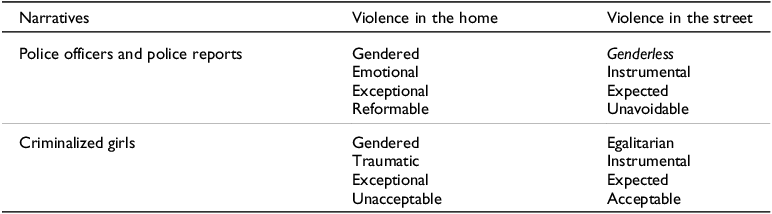
Our argument, thus, is that the public-private divide narratively frames the violence of the home as the result of emotional and individual reactions that can be resisted and reformed without addressing institutionalized violence and oppression beyond its walls, and also the violence of the street, the public, and the (drug) market as naturalized and unavoidable (Table 1). These framings were incorporated and reproduced by police officers and criminalized young women, both obscuring and legitimating forms of state and interpersonal violence.
Summary of narrative frames for violence in the home and the street

Table 1. Long description
A table with two rows and three columns. The columns are labeled Narratives, Violence in the home, and Violence in the street. The row labels are Police officers and police reports, and Criminalized girls. Under Police officers and police reports, Violence in the home includes Gendered, Emotional, Exceptional, and Reformable. Violence in the street includes Genderless, Instrumental, Expected, and Unavoidable. Under Criminalized girls, Violence in the home includes Gendered, Traumatic, Exceptional, and Unacceptable. Violence in the street includes Egalitarian, Instrumental, Expected, and Acceptable.
Our findings contribute to contemporary debates in gender‑based violence scholarship in Latin America, particularly the rise in feminicides and the persistent inefficacy of gender‑responsive policies (Carey and Torres Reference Carey and Gabriela Torres2010; Menjívar and Walsh Reference Menjívar and Drysdale Walsh2017; Menjívar and Diossa‑Jiménez Reference Menjívar and Diossa-Jiménez2023; Stephen Reference Stephen2024). Girls’ adamant refusal to accept gender violence in the home signals a generational shift in how GBV is understood. This stands in contrast to research showing the cultural acceptability of intimate‑partner and sexual violence in the region (e.g., Menjívar Reference Menjívar2008; Wilding Reference Wilding2010), shaped by patriarchal interpretations of Christianity (Beecheno Reference Beecheno2021) and legacies of civil war and authoritarianism (Boesten and Gavillán Reference Boesten and Gavillán2023).
On the one hand, our findings show the importance of attending to a new generation of young women who came of age with unprecedented access to feminist discourses that challenge women’s subordination (see Pinheiro‑Machado and Scalco Reference Pinheiro-Machado and Mury Scalco2020). On the other hand, we demonstrate how, even in contexts where violence against women has gained recognition as a social issue, the enduring home-street divide continues to sustain the framing of domestic violence as an individual rather than structural issue. The persistent construction of the home as a refuge leads both police officers and girls to interpret violence within it as exceptional, unexpected, and individualized, despite their daily encounters with its prevalence.
These framings also erase the gendered nature of violence in the street. Criminalized girls reject violence against women in the home but embrace it as a rule of the (drug market) game in the street, naturalizing their own victimization and their harming of other women and girls. Research shows that women’s experiences of intimate violence are closely linked to the dynamics of drug markets and punitive strategies of the state. Patterns in homicide data in Brazil make this connection clear: Black women have faced sharply rising rates of lethal violence, and they are disproportionately represented among women killed by firearms (Pamplona Reference Pamplona2025). These trends reflect how gendered killings intersect with broader forms of urban violence, especially in peripheral neighborhoods where Black women are overrepresented and where the war on drugs is carried out (Pamplona Reference Pamplona2025).
Yet the public-private divide blurs these connections in the narratives of both victims-perpetrators and state agents. As social spaces, the home and the street are always empirically “cross-cutting [and] intersecting” but have their symbolic boundaries defined by a “stabiliz[ing] meaning” (Massey Reference Massey1994, 4–5). The social construction of space, thus, operates a narrowing of the meaning-making possibilities in a space vis-à-vis another.
We thus argue that “cognitive frames around gender-based violence” (Menjívar and Walsh Reference Menjívar and Drysdale Walsh2017) ought to be understood in relation to frames around urban violence. That is, the symbolic construction of the instrumental, genderless violence of the street coproduces the emotional, gendered violence of the home, and vice versa. Therefore, the failure of gender-responsive policies, as well as the rise of feminicides, should not be investigated separately from the failure of “security” policies and the rise of homicides in the region.
Our findings also contribute to studies on the routinization of armed violence in Latin America (Davis Reference Davis2006, Reference Davis2018) and the production of “war discourses” that legitimize extreme state violence in criminalized territories (Arias Reference Arias2014; Zubillaga et al. Reference Zubillaga, Llorens and Souto2019). While previous scholarship has—crucially—examined the role of the racialization of urban space as a mechanism for criminalization (Alves Reference Alves2018; Vargas Reference Vargas2018), we show how this racialization is also shaped by the de-gendering of street violence. By de-gendering the street, actors and institutions frame its violence as natural and expected in marginalized neighborhoods, thus dehumanizing its residents and legitimating state intervention.
Finally, studies have documented the empirical linkages between domestic, urban, and state violence (Wilding Reference Wilding2010; Hume Reference Hume2007; Menjívar Reference Menjívar2008; Zubillaga et al. Reference Zubillaga, Llorens and Souto2019). Our study complements this scholarship by shifting attention from the co-occurrence of different violences to the narrative logics that make urban violence appear genderless, unavoidable, and instrumental, thereby serving to justify violent state responses to violence (Alves Reference Alves2018).
In conclusion, our findings contribute to research on gender and violence by examining how spatial symbolic boundaries, especially the socially constructed divide between public and private space, help maintain gendered systems of domination. We demonstrate how this division influences the understanding, management, and perpetuation of violence in both everyday interactions and institutional practices. Recognizing this dynamic is crucial not only for theoretical insight but also for activists and policymakers working to reduce gender-based violence, particularly against women in criminalized spaces.

 Open access

