In clinical genetics, consanguineous marriage (CM) refers to marriage of biologically related individuals who are second cousins or closer (Modell & Darr, Reference Modell and Darr2002). It is a major factor leading to high rates of genetic disorders and congenital malformation in addition to infant mortality (Subalakshmi & Mohan, Reference Subalakshmi and Mohan2021). In several global communities, e.g. Arab countries, Turkey, Iran, Pakistan and South India, CM is a traditional phenomenon and its rate remains high (25–55%) (Bittles & Black, Reference Bittles and Black2015; Sharkia et al., Reference Sharkia, Mahajnah, Athamny, Khatib, Sheikh-Muhammad and Zalan2016; Ben-Omran et al., Reference Ben-Omran, Al Ghanim, Yavarna, El Akoum, Samara, Chandra and Al-Dewik2020). The Arab population in Israel is currently 1.9 million, and includes 85.1% Muslims, 7.6% Druze and 7.3% Christians (Central Bureau of Statistics, 2018a, b). The Arab population in Israel has unique socio-demographic and cultural features that resemble those in other Arab societies, e.g. a high proportion of CM. Furthermore, Arab villages in Israel are relatively small, which leads to common and rare gene mutations that give rise to genetic disorders (Sharkia et al., Reference Sharkia, Mahajnah, Athamny, Khatib, Sheikh-Muhammad and Zalan2016).
The rate of CM among Arabs in Israel has decreased from 35.8% among those married before 2000, to 28.2% among those married in 2000–2004 and to 24.0% among those married in 2005–2009 (Na’amnih et al., Reference Na’amnih, Romano-Zelekha, Kabaha, Rubin, Bilenko and Jaber2015). In 2015, Sharkia and colleagues investigated the prevalence of first-cousin marriages in two generations and found the rate to be decreasing, although it was still the most predominant type of CM (Sharkia et al. Reference Sharkia, Mahajnah, Athamna, Sheikh-Muhammad and Zalan2015).
The aim of this study was to determine the rates of CM and its subtypes in 2007 and 2017 among the Arabs in Israel using a nation-wide survey. The effects of various socio-demographic factors on CM were also investigated. The Galilee Society: The Arab National Society for Health Research and Services conducts comprehensive national surveys in the Arab population of Israel tri-annually, in order to examine changes in various socioeconomic and health status variables, including health-related aspects of CM. The present study compared data from national health surveys conducted in 2007 and 2017 to detect the change and trend of the incidence of CM among the Arab population in Israel.
Arab citizens reside in various districts throughout Israel. In this study, ‘residential region’ was divided into four regions, namely: North, Haifa, Centre and South. Locality of residence was divided into urban (>15,000 population), semi-urban (between 5000 and 15,000 population) and rural (<5000 population). Regarding religion, the sample was divided into Muslim, Christian and Druze couples. The dependent variable was consanguinity, derived from survey questionnaires that asked ever-married women if they had a blood relationship to their husbands. Relationships were grouped into consanguineous and non-consanguineous marriages. Consanguineous marriages were classed as either ‘first cousin (FC) and closer’ or ‘Other’.
From a genetic point of view, mean inbreeding coefficients (α) were calculated using the formula α = ΣP i F i , where P i is the percentage of each marriage type and F i is the inbreeding coefficient of that respective marriage type. Data management and statistical analyses were conducted using SPSS. The statistical significance of associations between consanguinity and various determinants were examined using Chi-squared tests. The Kruskal-Wallis test was used to evaluate the significance of the differences observed between the two periods of time surveyed. Statistical significance was considered at p<0.05.
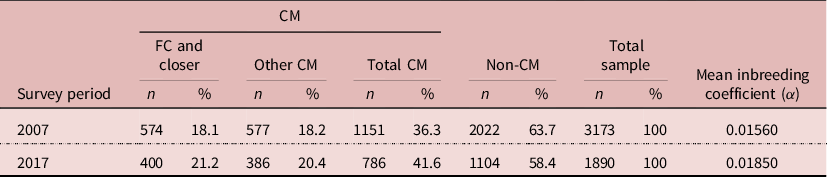
The results of the 2007 and 2017 surveys showed that the total CM prevalence among the Arab population increased significantly from 36.3% to 41.6% over the decade (Table 1). This trend is clearly reflected in an increase in the mean inbreeding coefficient (α) over time from 0.0156 to 0.0185. First-cousin and closer marriage types were found to be the most common (50% of total CMs). Furthermore, all CM types increased slightly with time.
Prevalence rates of consanguineous marriage (CM) and mean of inbreeding coefficients (α) in the Arab society of Israel, 2007 and 2017

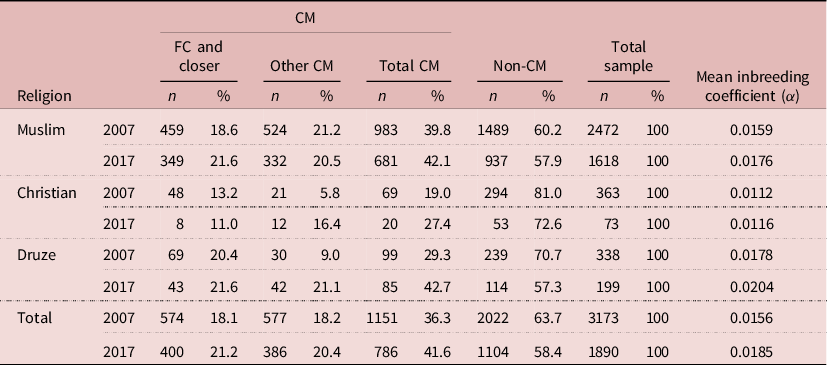
Table 2 shows the rates of the different types of marriage by the prevailing religions in the Arab population of Israel. Among Muslims, the rate of CM increased slightly, from 39.8% to 42.1%, from 2007 to 2017. Among Druze and Christians, the rate increased significantly, from 29.3% to 42.7% and from 19% to 27.6%, respectively, over the decade. The differences in consanguinity related to religion in the two periods surveyed were found to be significant (p<0.05). It was noteworthy that the prevalence rate among the Druze was highest in 2017. In FC and closer marriage types, the differences in prevalence rates between the two periods were small for all religions. In contrast, among other CM types, there was a significant increase among Christians (from 5.8% to 16.4%) and Druze (from 9% to 21.1%), while among Muslims there was a slight decrease (from 21.2% to 20.5%) from 2007 to 2017. Furthermore, the mean inbreeding coefficient (α) was found to be the highest among Druze, but slightly lower among Muslims, while the lowest was among Christians. Additionally, the mean inbreeding coefficient (α) significantly increased among Druze, while among Muslims it increased slightly, and among Christians it was near stable over the decade 2007–2017.
Prevalence rates of consanguineous marriage (CM) and mean inbreeding coefficients (α) by religion, 2007 and 2017

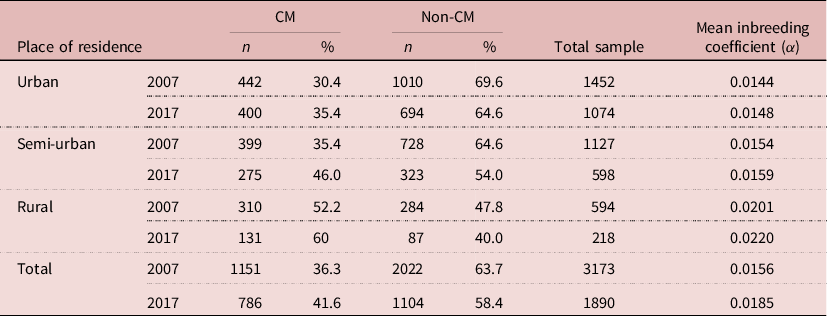
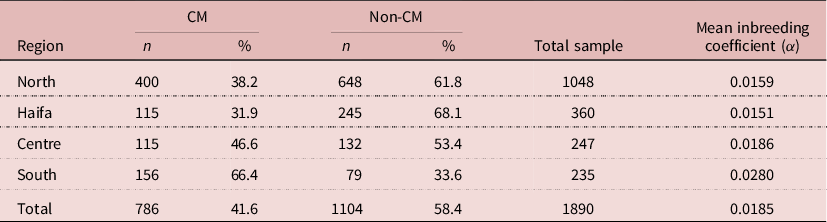
The highest rate of CM was in rural areas, followed by semi-urban areas, with the lowest prevalence in urban areas (Table 3). These differences were also observed in their mean inbreeding coefficients (α). The differences in CM increased in the three types of places in both surveys. The relationship between consanguinity and region is presented in Table 4. The South region had the highest rate of CM (66.4%), followed by the Centre region (46.6%). In the North region, the rate was 38.2%, with the lowest rate in the Haifa region (31.9%). These regional differences were also found in the mean inbreeding coefficient (α).
Prevalence rates of consanguineous marriage (CM) and mean of inbreeding coefficients (α) by place of residence, 2007 and 2017

Prevalence rates of consanguineous marriage (CM) and mean inbreeding coefficients (α) by region in most recent survey, 2017

This study indicates that there was an increase in the prevalence of CM among the Arab population of Israel over the period 2007–2017. Similar findings have been revealed in various societies where CM is common (Hamamy & Alwan, Reference Hamamy, Alwan, Kumar and Chadwick2016; Kalam et al., Reference Kalam, Sharma, Ghosh and Roy2021). However, a trend of decreasing CM has been noted in various communities (Assaf & Khawaja, Reference Assaf and Khawaja2009; Islam et al., Reference Islam, Ababneh and Khan2018). Despite declines in CM, its prevalence remains high in certain societies, owing to the common belief in the social, cultural, political and economic advantages of CM (Bhinder et al., Reference Bhinder, Sadia, Mahmood, Qasim, Hussain and Rashid2019; Islam, Reference Islam2021; Nawaz et al., Reference Nawaz, Zaman and Malik2021). The present study demonstrated that first-cousin marriages were the preferred type of CM in the Arab population of Israel. This preference prevails in most societies where CM is practised (Sharkia et al., Reference Sharkia, Mahajnah, Athamna, Sheikh-Muhammad and Zalan2015, Reference Sharkia, Mahajnah, Athamny, Khatib, Sheikh-Muhammad and Zalan2016; Bittles & Black Reference Bittles and Black2015), suggesting that FC marriage is culturally deeply rooted in Arab societies. This could be explained by the belief of FC marriage’s positive role in maintaining the stable family structure, security for woman and retaining wealth and land within the extended family. The well-known biological drawbacks of CM include increased homozygosity, health-related complications such as genetic diseases, infant mortality and congenital malformations (Sharkia et al., Reference Sharkia, Azem, Kaiyal, Zelnik and Mahajnah2010; Subalakshmi & Mohan, Reference Subalakshmi and Mohan2021). These negative effects of CM, along with its continuous high prevalence rate in a large number of societies, pose a serious challenge for health care systems.
These results document an increase in CM among Druze and Christian Arabs in Israel. The prevalence of CM among Muslims has remained high (Sharkia et al., Reference Sharkia, Mahajnah, Athamny, Khatib, Sheikh-Muhammad and Zalan2016). Druze and Christian Arabs are characterized by relatively small communities. Furthermore, the vast majority of marriages occur within the religion itself. Additionally, the populations of these two religions are geographically isolated, thus limiting the availability of potential spouses.
This study found that the highest rate of CM was in rural areas, and the lowest in urban areas, which is in concordance with studies from Tunisia (Ben Arab et al., Reference Ben Arab, Masmoudi, Beltaief, Hachicha and Ayadi2004), Pakistan (Riaz et al., Reference Riaz, Mannan and Malik2016) and India (Sharma et al., Reference Sharma, Kalam, Ghosh and Roy2021). The highest increase of CM was in the semi-urban areas. This could be attributed to the transfer of residence from rural to a semi-urban setting (due to natural population growth), while the socio-cultural life of these semi-urban areas has remained rural in nature.
The southern region of Israel, inhabited by Bedouins, has the highest rates (44.8%) of CM (Na’amnih et al., Reference Na’amnih, Romano-Zelekha, Kabaha, Rubin, Bilenko and Jaber2014), followed by the central region, with a Muslim majority of Arab inhabitants, and a considerable shift of the Bedouin population from the southern to the central region. The lowest rate of CM was in the urban Haifa region. Christian Arabs, characterized by a low rate of CM, constitute about 40% of the Arab population in the city of Haifa (Central Bureau of Statistics, 2020). On the other hand, the northern region includes Muslims, Druze and Christians in urban, semi-urban and rural settings. Thus, the north’s rate of CM is the closest to the average rate of consanguinity among the surveyed Arab population.
In conclusion, CM remains high in the Arab society of Israel, as in many Arab countries. This study revealed that religion, geographic region and socio-demographic variables are significant factors in determining the rate of CM. Attitudes towards the practice of CM, which are deeply rooted in culture and mentality, are difficult to change. Thus, it is recommended that community-based genetic counselling programmes that include genetic testing before and during marriage are implemented in the Arab population of Israel, particularly for consanguineous couples.
Funding
This work did not receive any external funding from any supporting agency. This project was supported by internal funds by the Triangle Research and Development Center (TRDC), sponsored by the Israel Ministry of Science, as well as The Galilee Society: The Arab National Society for Health Research and Services.
Conflicts of Interest
The authors declare that they have no conflicts of interest what-so-ever regarding the publication of this research work.
Ethical Approval
This study was approved by the ethical board of The Galilee Society: The Arab National Society for Health Research and Services and by the ethics committee of the Triangle Research and Development Center, Israel. Participants provided written informed consent for participation in the surveys after received detailed explanations of the survey procedures.