


The very possibility of civilized human discourse rests upon the willingness of people to consider that they may be mistaken.
Richard Hofstadter (Reference Hofstadter1968)The ignorance and misinformation that pervade the American polity are well documented and reasonably well understood (e.g., Berinsky Reference Berinsky2017; Delli-Carpini and Keeter Reference Delli-Carpini and Keeter1996; Gerber and Huber Reference Gerber and Huber2010; Hochschild and Einstein Reference Hochschild and Einstein2015; Kuklinski et al. Reference Kuklinski, Quirk, Jerit, Schweider and Rich2000; Lupia Reference Lupia2016; O’Connor and Weatherall Reference O’Connor and Weatherall2019; Southwell and Thorson Reference Southwell and Thorson2015). However, an equally conspicuous feature of the American “marketplace of realities” has attracted far less scholarship: epistemic hubris—the tendency to express greater certainty regarding policy-related factual disputes than the evidence actually warrants (Fischhoff, Slovich, and Lichtenstein Reference Fischhoff, Slovic and Lichtenstein1977; Gilovich Reference Gilovich1991; Grant Reference Grant2021; Griffin and Tversky Reference Griffin and Tversky1992).
Understanding the sources of such unwarranted factual certitude is important, for several reasons. First, and most intuitively, epistemic hubris may inhibit sound decision making by foreclosing the assimilation of new information (e.g., Grant Reference Grant2021). Second, epistemic hubris may invite both policy gridlock and extremism by impeding the willingness to compromise (e.g., Barker, Marietta, and DeTamble Reference Barker, Marietta, DeTamble, Barker and Suhay2021; Gutmann and Thompson Reference Gutmann and Thompson2012; Kavanagh and Rich Reference Kavanagh and Rich2018).Footnote 1 Third, epistemic hubris may foster social decay by breeding contempt toward people who view the world differently (Marietta and Barker Reference Marietta and Barker2019).
In this investigation, we take an initial step toward understanding the variance in epistemic hubris. We examine the explanatory purchase of what people loosely refer to as “intellectualism” and “anti-intellectualism”—nebulous concepts that have garnered less social scientific attention than their salience warrants (but see Gauchat Reference Gauchat2012; Merkley Reference Merkley2020; Motta Reference Motta2018; Oliver and Wood Reference Oliver and Wood2018; also see Baumgardner Reference Baumgardner2020; Hofstadter Reference Hofstadter1963; Rigney Reference Rigney1991; Shogan Reference Shogan2007 for good theoretical and historical accounts).
To be clear, for our purposes, intellectualism and anti-intellectualism are not opposite ends of the same scale. As we will elaborate more fully later, intellectualism is an identity trait marked by ruminative habits and learning for its own sake; its opposite is non-intellectualism.Footnote 2 By contrast, anti-intellectualism is negative affect toward intellectuals and especially the “intellectual establishment”; its opposite is pro-intellectualism.Footnote 3
Thus, despite their undeniable negative kinship, intellectualism and anti-intellectualism are not mutually exclusive: many non-intellectuals are pro-intellectual, and some intellectuals are anti-intellectual.Footnote 4 Accordingly, we gauge the explanatory power of each variable both independently and interactively, comparing (a) intellectuals who are pro-intellectual, (b) non-intellectuals who are pro-intellectual, (c) non-intellectuals who are anti-intellectual, and (d) intellectuals who are anti-intellectual (the smallest category).
We posit that intellectuals (in terms of identity) and anti-intellectuals (in terms of affect) both tend to express disproportionately high levels of epistemic hubris—out of egotism in the former case and out of ego protectiveness in the latter case. We further hypothesize that intellectual identity and affect have distinctively partisan characters—underwriting and exceeding the growing “diploma divide” between Democrats and Republicans in the United States (Harris Reference Harris2018; Kitschelt and Rehm Reference Kitschelt and Rehm2019).Footnote 5
Our observational data (gathered via the Cooperative Election Studies in 2019 and especially in 2020) are fully consistent with our hypotheses.Footnote 6 As such, by inference, we suggest that the growing intellectualism of Blue America and anti-intellectualism of Red America, respectively, may partially explain the tendency by both to view the other as some blend of dense, duped, and dishonest (e.g., Iyengar and Westwood Reference Iyengar and Westwood2015; Marietta and Barker Reference Marietta and Barker2019).Footnote 7
We intend to make three primary contributions to the scholarly literature. First, we hope to spark a new line of inquiry into an important but underanalyzed element of political psychology—epistemic hubris. Second, we seek to augment the appreciation of intellectual identity and intellectual affect as elements of political cognition and to enhance the precision with which researchers study them. Finally, we strive to heighten attention to the accelerating partisan realignment that is growing up around differences in intellectual identity and affect.
The Politics of Truth
A long litany of studies in political science documents the prevalence of American political ignorance (e.g., Althaus Reference Althaus1998; Bartels Reference Bartels1996; Delli-Carpini and Keeter Reference Delli-Carpini and Keeter1996; Gilens Reference Gilens2001; Lupia Reference Lupia2016), and an even larger body of research reveals the pervasiveness of misinformation (e.g., Bartels Reference Bartels2002; Berinsky Reference Berinsky2017; Boudreau and MacKenzie Reference Boudreau and MacKenzie2014; Bullock et al. Reference Bullock, Gerber, Hill and Huber2015; Flynn, Nyhan, and Reifler Reference Flynn, Nyhan and Reifler2017; Gerber and Huber Reference Gerber and Huber2010; Hochschild and Einstein Reference Hochschild and Einstein2015; Kuklinski et al. Reference Kuklinski, Quirk, Jerit, Schweider and Rich2000; Nyhan and Reifler Reference Nyhan and Reifler2010; Prior, Sood, and Khanna Reference Prior, Sood and Khanna2015; Redlawsk, Civettini, and Emmerson Reference Redlawsk, Andrew and Emmerson2010).
However, the American “politics of truth” includes another important feature: epistemic hubris, which we define as unwarranted factual certitude. Despite the scientific method’s admonition that knowledge is hard won and that epistemic certitude should be a relative anomaly (e.g., Darwin [1858] Reference Darwin and Barlow1958; Gould Reference Gould1993; Kuhn Reference Kuhn1962; Popper Reference Popper1935), such certitude is relatively common in the public square—even (and perhaps especially) among experts (e.g., Grant Reference Grant2021; Taleb Reference Taleb2007; Tetlock Reference Tetlock2005; Tetlock and Gardner Reference Tetlock and Gardner2015).Footnote 8
The prevalence of epistemic hubris is consistent with Western culture’s tendency to venerate characters (both real and fictional) who exude irrational confidence (e.g., Winston Churchill’s speech to the House of Commons in 1940, Babe Ruth’s called shot in the 1932 World Series, Han Solo’s navigation of asteroid fields “a long time ago”), despite the litany of examples from history and literature that caution against the folly of such hubris (e.g., Icarus re: the Sun, Custer re: the Little Big Horn, the engineers of the Titanic re: the iceberg).
Despite its pervasiveness, however, epistemic hubris has been virtually ignored as a subject of social science inquiry (but see Fischhoff, Slovich, and Lichtenstein Reference Fischhoff, Slovic and Lichtenstein1977; Gilovich Reference Gilovich1991; Griffin and Tversky Reference Griffin and Tversky1992; Marietta and Barker Reference Marietta and Barker2019 for related accounts). This investigation addresses that gap in understanding. We begin by clarifying exactly what epistemic hubris is and what it is not.
Clarifying Epistemic Hubris
People routinely exhibit all kinds of hubris, some of which can be socially useful. Indeed, many a business model depends upon irrational human audacity (those of Las Vegas, Vail, Home Depot, and Whole Foods come to mind), as do any number of amorous relationships and reproductive decisions. Overconfidence can sometimes confer democratic benefits as well. Elections require candidates, after all, and running for office requires a willingness to flout the odds in the majority of instances.
Likewise, moral hubris can yield positive as well as negative democratic consequences. Whether motivated by psychological dogmatism (e.g., Altemeyer Reference Altemeyer1981; Piereson, and Marcus Reference Sullivan, Piereson and Marcus1982; Rokeach Reference Rokeach1954; Sullivan), moral conviction (e.g., Ryan Reference Ryan2017; Skitka, Bauman, and Sargis Reference Skitka, Bauman and Sargis2005), sacred values (Graham, Haidt, and Nosek Reference Graham, Haidt and Nosek2009; Marietta Reference Marietta2012; Tetlock Reference Tetlock1986), or “closed” personality types (e.g., Gerber et al. Reference Gerber, Huber, Doherty and Dowling2011; Johnston, Lavine, and Federico Reference Johnston, Lavine and Federico2017; Jost et al. Reference Jost, Glaser, Kruglanski and Sulloway2003; Reference Jost, Napier, Thorisdottir, Gosling, Palfai and Ostafin2007), zealotry can undermine democratic deliberation but it can also mobilize political participation.Footnote 9
By contrast, epistemic hubris does not appear to have any redeeming democratic qualities (Marietta and Barker Reference Marietta and Barker2019). While epistemic efficacy (the perception that one is competent enough to distinguish facts from falsehoods) is psychologically healthy and necessary for decision making (e.g., Farman et al. Reference Farman, Riffe, Kifer and Elder2018; Pingree Reference Pingree2011; Pingree, Brossard, and McLeod Reference Pingree, Brossard and McLeod2014; Pingree, Hill, and McLeod Reference Pingree, Hill and McLeod2013), such efficacy is to epistemic hubris as confidence is to overconfidence: the former inspires achievement but the latter inspires recklessness.
To reiterate a point we made earlier, we do not consider all epistemic certitude to be hubristic (or by extension, harmful). We suggest that certitude is justified and even useful regarding epistemic disputes for which the following conditions are met:
-
o There is ample public evidence at hand, which has been produced by credentialed sources adhering to scientific norms of dispassionate inquiry.
-
o The evidence is robust across temporal and spatial dimensions, measures, methods of analysis, and interpretations.
-
o There is a consensus within the reputable expert community across fields (and subfields). Such a consensus does not demand 100% agreement among experts, but it does require broad and repeated convergence among credentialed authorities on the subject.
In such instances, democracy demands that policy discussions be grounded in those undeniable facts.
On the other hand, epistemic certitude is unwarranted, or hubristic, when high-quality evidence from reputable sources is (1) limited, (2) unreliable, (3) inconsistent (across studies, time, or methodological choices), and/or (4) subject to differences in interpretation/perspective with respect to the conclusions that experts draw from it.
As we will detail in the empirical section of this paper and in the supplementary materials online, we have identified a range of politically salient epistemic disputes that fall into at least one of these categories. They include the economic and societal effects associated with the national debt, undocumented immigration, minimum wage increases, gun control, free college, and public charter schools, as well as the relative quality of US health care and the inception of human life. To date, almost nothing is known about the factors that explain the variance in hubris regarding those epistemic disputes (and many others). In the next section, we offer one theoretical perspective.
What Explains Epistemic Hubris?
When empirical evidence is scant, unclear, unreliable, or inconsistent, how do citizens come to decide they are sure about something rather than just holding a working impression that they are willing to update? Psychologists know that most people are prone toward motivated reasoning, or the drive to see the world in ways that are consistent with one’s attitudinal predispositions (e.g., Erisen, Lodge, and Taber Reference Erisen, Lodge and Taber2014; Taber and Lodge Reference Taber and Lodge2006).Footnote 10 Some limited evidence suggests that normative orientations do indeed play an important role in structuring expressions of epistemic certitude (Marietta and Barker Reference Marietta and Barker2019), but we suspect there is much more to the story. Specifically, we posit that the intellectualism of the contemporary Democratic party and the anti-intellectualism of the contemporary Republican party both engender a more hubristic—and therefore less democratically competent—body politic.
Intellectual Identity and Anti-Intellectual Affect
As we mentioned earlier, for our purposes intellectualism and anti-intellectualism are related but distinct concepts. Intellectualism is an identity trait marked by ruminative habits and demonstrable interest in learning for its own sake—irrespective of their instrumental or commercial applications—as revealed in a person’s habits, self-image, occupation, and recreational activities (e.g., Baumgardner Reference Baumgardner2020; Hofstadter Reference Hofstadter1963). It encompasses a “need for cognition” (e.g., Jost et al. Reference Jost, Glaser, Kruglanski and Sulloway2003), but it is more than that. Although the intellectual mind is not necessarily any more intelligent than the non-intellectual mind, it is inherently more curious, more contemplative, more creative, and less conventional (Hofstadter Reference Hofstadter1963). As such, intellectuals are more likely than non-intellectuals to take interest in the arts, humanities, public affairs, and the hard sciences.Footnote 11 By extension, for those who attend college, intellectuals are more likely than non-intellectuals to pursue subjects and careers that emphasize abstract or creative thinking (e.g., as writers, editors, journalists, educators, scientists, researchers, artists, musicians, doctors, lawyers, clergy-members, and so on) as opposed to occupations that reward quick decision making and prioritize commercial reward (e.g., various business-related majors and careers).
Anti-intellectualism is not the opposite of intellectualism but rather an expression of negative affect toward intellect, intellectuals, and/or the intellectual establishment (Hofstadter Reference Hofstadter1963; Lecklider Reference Lecklider2013; Rigney Reference Rigney1991; Sowell Reference Sowell2009). It can include (1) constitutional disregard for intellect itself (stemming from either “anti-rationalism” and/or “unreflective instrumentalism”; Rigney Reference Rigney1991), (2) ideological umbrage based on a perception that professional intellectuals (educators, scientists, journalists, etc.) are liberally biased, and/or (3) populist suspicion and resentment toward intellectual “elites” (including those whom society celebrates as experts and those with high levels of intellectual achievement more generally).Footnote 12
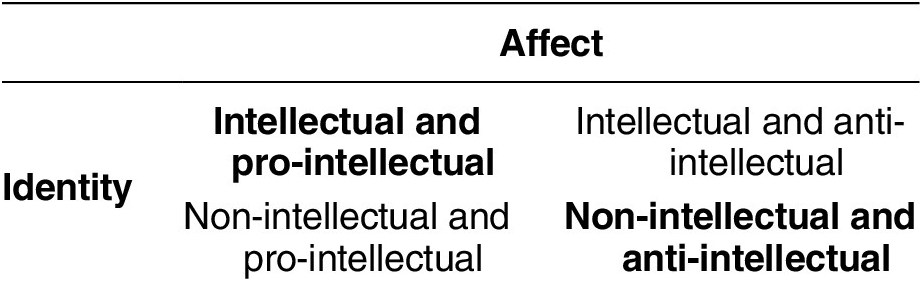
In short, intellectualism is something one is, whereas anti-intellectualism is something one feels. Though conceptually distinct, we do suspect that intellectual identity and affect are empirically related: intellectuals tend also be pro-intellectual, and anti-intellectuals tend to be non-intellectual. Table 1 depicts this expected relationship between intellectual identity and intellectual affect as a 2 × 2 table, with the reinforcing combinations in bold.Footnote 13
Intellectual Identity and Intellectual Affect

Having clarified these concepts, we now turn to describing a theory of how they may account for epistemic hubris—both independently and in concert.
Intellectual Identity, Anti-Intellectual Affect, and Epistemic Hubris
At the first glance, neither intellectual identity nor anti-intellectual affect stand out as particularly intuitive predictors of epistemic hubris. Indeed, with respect to intellectual identity, it is easy to imagine that such a contemplative disposition would actually produce lower, not higher, levels of epistemic hubris. However, other studies have shown that education actually heightens the tendency toward motivated reasoning (e.g., Marietta and Barker Reference Marietta and Barker2019) and that those with the deepest expertise in a particular area are often the least likely to self-correct when they get predictions wrong (Grant Reference Grant2021; Taleb Reference Taleb2007; Tetlock Reference Tetlock2005; Tetlock and Gardner Reference Tetlock and Gardner2015).
These findings suggest that intellectuals may sometimes fall prey to blind spots borne of vanity and smugness. It may be more difficult, after all, for someone who prides herself on being a sophisticated “thinker” to acknowledge a lack of knowledge on virtually any front. In short, William James may have had it right when he famously asserted that “the greatest empiricists among us are only empiricists on reflection; when left to their instincts, they dogmatize like infallible popes” (James Reference James1896). Or as fivethirtyeight’s Nate Silver put it recently: “one thing I’ve noticed is that once someone gets a PhD, it becomes 10 times harder to convince them that they are wrong” (Twitter, October 15, 2020).
When it comes to anti-intellectual affect, one might imagine that the cynicism toward informational authorities that characterizes the anti-intellectual mindset might lead to a sense of incredulity regarding all epistemic claims, leading perhaps to nihilism rather than to hubris. However, the essence of anti-intellectualism, in many cases, is the resentful “chip on the shoulder” that some people possess toward the intellectual establishment—the kind of defensive bullishness that goes along with feeling looked down upon by others. Anti-intellectuals tend to deride those whom they view as “eggheads” who live in “ivory towers” with their heads in the clouds, having lost their collective grip on reality. They distinguish those who are “book smart” from those who have common sense, the latter of which they view as a superior means of ascertaining truth.
In sum, the preceding discussion provides the rationale for our first two falsifiable hypotheses:
H 1 : Intellectual identity is positively associated with epistemic hubris, all else being equal.
H 2 : Anti-intellectual affect is positively associated with epistemic hubris, all else being equal.
In the next section, we discuss what we suspect is the strong partisan character of these relationships. That is, we describe the theoretical rationale behind our expectations that intellectuals and pro-intellectuals tend to call the Democratic party home, while non-intellectuals and anti-intellectuals tend to fall into the Republican camp.
Intellectual Identity, Intellectual Affect, and Party Identification
Over the course of the past generation—and especially the past few years—a partisan realignment has been taking shape in the United States (and some other advanced democracies as well) which manifests in educational differences. A huge “diploma divide” opened such that (a) college graduates favor Democrats over Republicans by more than 20 percentage points (and postgraduates by more than 30 percentage points) and (b) whites without college degrees favor Republicans by an even wider margin (e.g., Harris Reference Harris2018; Pew Research Center 2018). We suggest that such educational differences are a relatively crude indicator of a deeper partisan gulf with respect to both intellectual identity and affect.
Intellectual Identity and Party Identification
In addition to being more likely to attain college degrees (and postgraduate degrees), Democrats are more likely than Republicans to be occupied as “knowledge workers” (educators, scientists, researchers, journalists, publishers, doctors, lawyers, entertainers, artists, etcetera)—what is sometimes deemed “the creative class.” Republicans, for their part, are much more likely to be occupied in more hands-on and/or profit-centric professions such as farming (including agribusiness), entrepreneurship, corporate management, finance, sales, military, and criminal justice (e.g., Swanson Reference Swanson2015).
Such partisan differences reflect underlying ideological differences. Hofstadter (Reference Hofstadter1963) argues that intellectualism—by definition a creative and nonconformist form of intelligence—is instinctively radical. Jean Paul Sartre (Reference Sartre1976) and Michel Foucault (Reference Foucault1980) expressed similar sentiments (as recounted by Baumgardner Reference Baumgardner2020). Moreover, a large body of evidence reveals that ideological liberalism is positively correlated with several traits that are conceptually related to intellectualism, including “integrative complexity,” (Tetlock Reference Tetlock1983; Reference Tetlock1984), “need for cognition” (e.g., Jost et al. Reference Jost, Glaser, Kruglanski and Sulloway2003; Reference Jost, Napier, Thorisdottir, Gosling, Palfai and Ostafin2007), open-mindedness (e.g., Johnston, Lavine, and Federico Reference Johnston, Lavine and Federico2017), and an ironic sense of humor (Young et al. Reference Young, Bagozzi, Goldring, Poulsen and Drouin2019). Meanwhile, ideological conservatism is associated with non-intellectual characteristics such as a “need for cognitive closure” (e.g., Kruglanski Reference Kruglanski2004), belief in conspiracy theories (Van Der Linden et al. Reference Van Der Linden, Panagopoulos, Azevedo and Jost2020), and authoritarianism (e.g., Barker and Tinnick Reference Barker and Tinnick2006; Haidt Reference Haidt2012; Hetherington and Weiler Reference Hetherington and Weiler2008). In light of this literature, it is reasonable to anticipate that intellectual identity is associated with ideological liberalism/progressivism. So as the Democratic party has become much more culturally progressive in recent decades (and the Republican party more culturally conservative), it logically follows that the relationship between intellectual identity and Democratic party identification has also become stronger.
In short,
H 3 : Intellectual identity is associated with Democratic party identification (non-intellectual identity is associated with Republican party identification), all else being equal
Intellectual Affect and Party Identification
As for the partisan character of pro- versus anti-intellectual affect, it is well known that Republicans are much less likely than Democrats to (1) trust the mainstream press, the scientific community, or nonpartisan government agencies (e.g., Funk et al. Reference Funk, Hefferon, Kennedy and Johnson2019; Kennedy and Funk Reference Kennedy and Funk2019); (2) view colleges and universities as “good for America” (e.g., Parker Reference Parker2019); (3) believe that science is a better informant than one’s “gut” (Toth and Dewese Reference Toth and DeWese2020); and (4) believe that experts are well equipped to solve important societal problems (Funk et al. Reference Funk, Tyson, Kennedy and Johnson2020).Footnote 14
Republican animus toward the intellectual establishment appears to have come to a head in recent years, but it has been germinating for generations. Elite universities have long invited scorn from mainstream America for their relative receptiveness toward Marxist thought and other culturally liberal ideas (Shogan Reference Shogan2007; Sowell Reference Sowell2009), whereas anecdotal accounts suggest that Republican suspicion toward intellectuals traces at least as far back as the 1950s presidential contests between Dwight Eisenhower and Adlai Stevenson (Hofstadter Reference Hofstadter1963; Shogan Reference Shogan2007).
Such animus picked up steam in the 1960s and 1970s, when several social movements blossomed and drew disproportionate support from highly educated constituencies (Hall, Rodeghier, and Useem Reference Hall, Rodeghier and Useem1986). Dixiecrats such as George Wallace and Republicans such as Richard Nixon pushed back, charging the mainstream media with “liberal bias” in their coverage of such movements and associating the social movements themselves with elitist social engineering (e.g., Maxwell and Shields Reference Maxwell and Shields2019). It was during this time that conservative leader William F. Buckley famously stated that (despite being an intellectual elite himself), he would “rather entrust the government of the United States to the first 2,000 people listed in the Boston telephone directory than to the faculty of Harvard University” (Buckley Reference Buckley1963).
The emergence of the Religious Right in the 1980s may have deepened Republican resentment of intellectuals even further. As newly politicized evangelicals joined the Republican fold, they ushered in a new era of climate denial, creationism, and other scientific heresies among Republican activists (e.g., Green and Guth Reference Green and Guth1988; Miller and Schofield Reference Miller and Schofield2008; Mooney Reference Mooney2006; Noll Reference Noll1994; Oliver and Wood Reference Oliver and Wood2018). They fueled the political ascents of Dan Quayle, George W. Bush, and Sarah Palin—all of whom suffered under mainstream media ridicule for their (at times proud) lack of intellectual curiosity. And after some early hesitancy, evangelicals eventually converted to the candidacy of Donald Trump with characteristic zeal—spurred in part by his scientific skepticism, epistemic bravado, and confrontational exchanges with the mainstream media, whom he labeled “fake news” and “the enemies of the people (e.g., Oliver and Rahn Reference Eric and Rahn2016).
These patterns, observations, and historical trends inform our fourth hypothesis:
H 4 : Anti-intellectual affect is associated with Republican party identification (pro-intellectual affect is associated with Democratic party identification), all else being equal
To summarize this section, we suspect that differences in intellectual identity and affect have become central to the Red/Blue Culture Wars in the United States (also see Grunwald Reference Grunwald2018; Thomson Reference Thomson2010, 152).Footnote 15 In the rest of this paper, we consult the evidence for our somewhat paradoxical argument that intellectual vanity among Democrats and anti-intellectual vitriol among Republicans empower the epistemic hubris that characterizes both sides of the Red–Blue divide.
Data, Measures, and Estimation Methods
To test our hypotheses, we collected and analyzed nationally representative survey data under the auspices of the 2019 and 2020 Cooperative Election Studies (CES; formerly the Cooperative Congressional Election Studies; n = 1,000).Footnote 16 The 2019 data served as a pilot, justifying richer measurement and modeling in 2020. As such, we focus below on the 2020 analyses. (We describe the 2019 analyses in the supplementary materials online.)
Given that many of our key variables are latent psychological concepts, we measure them using multiple-item indices derived from principal components analysis (PCA). PCA uses the shared variance among multiple indicators to extract a weighted index of the latent concept in order to reduce random error in the measure relative to a simple summed or mean index (Dunteman Reference Dunteman1989; Hotelling Reference Hotelling1933).
Epistemic Hubris
We created our primary outcome variable of interest, Epistemic Hubris, in two steps. First, we created a principal component index of certitude regarding nine policy-related epistemic claims for which the best available evidence is unsettled (alpha = 0.77; eigenvalue = 3.15). The survey questionnaire randomized the order in which respondents considered the claims, each of which appears below (0–4; 0 = “certainly true”; 4 = “certainly false”; coded such that 1 = either “certainly” response; 0 = any “probably” or “don’t know” response; percentage certain [either true or false] and principal component loadings appear in parentheses):
-
1. “If unchecked, the US national debt will cause major economic damage” (35%; loading = 0.29).
-
2. “If college were free, there would be much less economic inequality” (33%; loading = 0.36).
-
3. “Gun control reduces mass shootings” (47%; loading = 0.37).
-
4. “The quality of health care is better in many ways in the US than in Canada” 34%; loading = 0.33).
-
5. “Unauthorized immigration hurts the American economy” (43%; loading = 0.35).
-
6. “Significant increases in the minimum wage reduce poverty” (37%; loading = 0.37).
-
7. “Charter schools harm regular public schools” (29%; loading = 0.34).
-
8. “Human life begins at conception” (55%; loading = 0.31).
-
9. “To achieve professional success, grit is more important than luck” (25%; loading = 0.28).
Reviews of the relevant literature pertaining to each of these claims—demonstrating their empirical inconclusiveness—are observable at ryandetamble.com.
To avoid partisan bias in the measure, we deliberately included (a) four claims that, if true, would favor Democratic policy prescriptions (#2, 3, 6, and 7), (b) four others that would clearly favor Republican policy prescriptions (#4, 5, 8, 9), and one that is not clearly more consistent with either party’s policy goals (#1).
Moreover, to be analytically prudent with respect to the degree of hubris we were setting ourselves up to observe in the sample, we deliberately worded many of the items using somewhat vague language (“much less …, “many ways …,” “significant increases …,” “major economic damage …”), making it easier for respondents to express uncertainty. If facts depend upon the meaning of particular qualifiers, it means that any expression of certitude in the presence of vague qualifiers is not warranted.
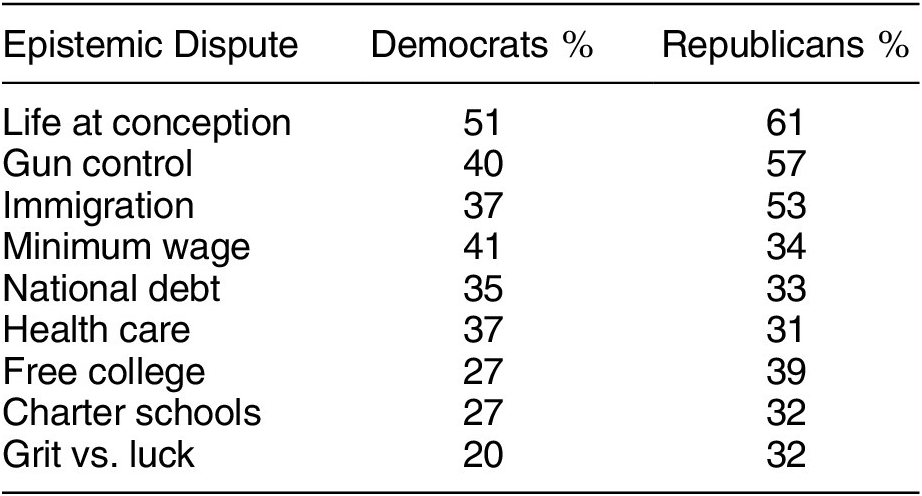
The mean of this index (rescaled to 0–1) is 0.37 (SD = 0.28). Table 2 breaks things down by issue and partisanship. We see that respondents tend to exhibit greater certitude with respect to high profile Red/Blue culture war issues such as gun control, immigration, and especially whether human life begins at conception (and thus whether abortion is the taking of a human life). Epistemic disputes that pertain to non-culture-war issues that are nevertheless polarized by party (health care, the minimum wage) also tend to inspire relatively high levels of certitude but to a lesser degree than do the disputes relating to the cultural divide.Footnote 17
Prevalence of Epistemic Hubris (2020 CES)

Note: Percentage of survey respondents who express certitude (either true or false) with respect to each claim.
Because we seek to distinguish genuine epistemic certitude from that which may be a byproduct of a Confident Personality type, we took a second step in creating our Epistemic Hubris variable for analysis. We regressed the principal component hubris index on a variable measuring the degree to which respondents agreed with the statement “I am someone who gets nervous easily” (0 = “strongly agree”; 4 = “strongly disagree”; rescaled to 0–1; mean = 0.50; SD = 0.31), saved the residuals from the equation, and operationalized their variance as our measure of Epistemic Hubris. Footnote 18 We rescaled the variable to 0–1 for analysis.
After accounting for the relatively small amount of its variance that is attributable to a confident personality in this way, the sample reveals a substantial amount of Epistemic Hubris, overall, (mean = 0.39; SD = 0.25).Footnote 19 These numbers are almost identical to what we have reported elsewhere, across multiple years, using slightly different items in the index (Barker, Marietta, and DeTamble Reference Barker, Marietta, DeTamble, Barker and Suhay2021).
It is also worth noting that the Epistemic Hubris in our sample is bipartisan, though Republicans (and Independents who lean Republican) are slightly more likely to exhibit such unwarranted certitude (mean = 0.45; SD = 0.25) than are Democrats/Democratic Leaners (mean = 0.36; SD = 0.25), a difference that is statistically distinguishable from zero (p < 0.01). These findings are consistent with earlier work indicating that conservatives/Republicans tend to exhibit greater rigidity than do liberals/Democrats, but such partisan asymmetry is not overwhelming (e.g., Tetlock Reference Tetlock1983; Reference Tetlock1984).
To account for the variance in Epistemic Hubris, we construct predictive models that include indexes of Intellectual Identity and Intellectual Affect. We turn to describing those indexes now, along with several potentially confounding variables that we include in the models.
Intellectual Identity
Measuring the variance in Intellectual Identity—with higher scores representing greater “intellectualism”—is no straightforward task. Given its multidimensional nature, we sought to identify indicators that would, collectively, capture demonstrable differences in the degree to which respondents possess (a) creative and ruminative habits of mind, (b) an interest in learning for its own sake without regard for instrumental or commercial applications, and (c) an intellectual self-image. We also sought to include items that are relatively inclusive of the population as well as those that are relatively exclusive, to create a variable with sufficient variance for analysis. We settled on the seven indicators listed below, all of which we rescaled to 0–1 for analysis. The principal component analysis extracted an eigenvalue of 1.68. Per our standard practice, we also rescaled the scored index to 0–1 for analysis (mean = 0.39; SD = 0.20). The individual component loadings appear below, along with the means and standard deviations associated with each indicator. The Measurement Appendix at the end of the article provides full descriptions of each indicator, including survey question wording.
-
o Intellectual Occupation (18% of sample; loading = 0.49)
-
o Intellectual College Major (39% of sample; loading = 0.58)
-
o Pleasure Reading (11% of sample; loading = 0.31)
-
o News Attentiveness (mean = 0.40; SD = 0.31; loading = 0.22)
-
o Artistic Interest (mean = 0.52; SD = 0.30; loading = 0.36)
-
o “Nerd” Identity (16% of sample; loading = 0.30)
-
o Self-Perceived Imaginativeness (mean = 0.70; SD = 0.31; loading = 0.24)
In isolation, none of these items fully captures the multidimensional nature of Intellectual Identity, and each of them could be used for other purposes. Collectively, though, they capture the dimensions of noninstrumental cognitive interest, creativity, ruminative habits, and intellectual self-image that we have discussed, and so we submit that their overlapping variance captures the latent concept with reasonable face validity.
Conspicuously absent from the list is educational attainment, because we want to distinguish such attainment that reflects genuine intellectualism from that which reflects some combination of ability, diligence, ambition, or social privilege.Footnote 20 We consider Intellectual Occupation to fit this bill, because a college degree (and in some cases an advanced degree) is a prerequisite for most intellectual professions but non-intellectual college graduates are less likely to pursue such occupations or to remain in them for very long.
Likewise, at least one semester of postsecondary education is required to have thought about a college major, but non-intellectuals with such requisite college experience are less likely to have pursued an Intellectual Major in the arts or sciences than other types of majors (e.g., business).
Pleasure Reading and News Attentiveness seek to capture recreational habits of reading and following public affairs, respectively, both of which are inherently intellectual activities undertaken largely “for their own sake.” Artistic Interest, Nerd Identity, and Self-Perceived Imaginativeness attempt to capture self-image—the degree to which respondents see themselves as artistic, imaginative, and “nerdy”—all of which are necessarily intellectual by the definition drawn from Hofstadter (Reference Hofstadter1963) and others.
Anti-Intellectual Affect
Operationalizing Anti-Intellectual Affect is more straightforward because it is a somewhat less complicated concept. We measure it with another principal component index that quantifies the extent to which respondents agree or disagree with the five statements that appear below (Likert-type scales: 0 = “strongly disagree”; 4 = “strongly agree”):
-
o “When it comes to figuring out the truth, it is best to just trust your eyes, heart, and gut” (mean = 2.23; SD = 1.14; loading = 0.31).
-
o “Too much education can blind you to the real truth” (mean = 1.48 SD = 1.29; loading = 0.46).
-
o “Most ‘experts’ don’t have much common sense” (mean = 1.98; SD = 1.27; loading = 0.47).
-
o “Public schools and universities fill young people’s heads with all kinds of nonsense” (mean = 1.91; SD = 1.46; loading = 0.48).
-
o “I’ll take the wisdom of ordinary people over the book-smarts of intellectuals any day” (mean = 2.06; SD = 1.23; loading = 0.49).
The first item reflects a constitutional suspicion toward intellect—favoring first-hand experience and gut-level intuition over anything that can be learned second-hand (i.e., through books). It contributes least to the index. The second, third, and fourth items are anti-intellectual establishment, and the fifth item is a populist expression of anti-intellectualism. They each contribute almost identically to the index (loadings between 0.46 and 0.49). We rescale the variable to range from zero (strongly pro-intellectual, as indicated by strong disagreement with each of the statements) to one (strong agreement with each, and therefore strong anti-intellectual affect). We rescaled the index (alpha = 0.85; eigenvalue = 3.09) to 0–1 for analysis, with “0” indicating strong pro-intellectual affect (strong disagreement with each of the statements) and “1” equaling strong anti-intellectual affect (strong agreement with each). The variable has substantial variance and is reasonably normally distributed (mean = 0.48; SD = 0.25).
Demonstrating the Distinctiveness between Intellectual Identity and Intellectual Affect
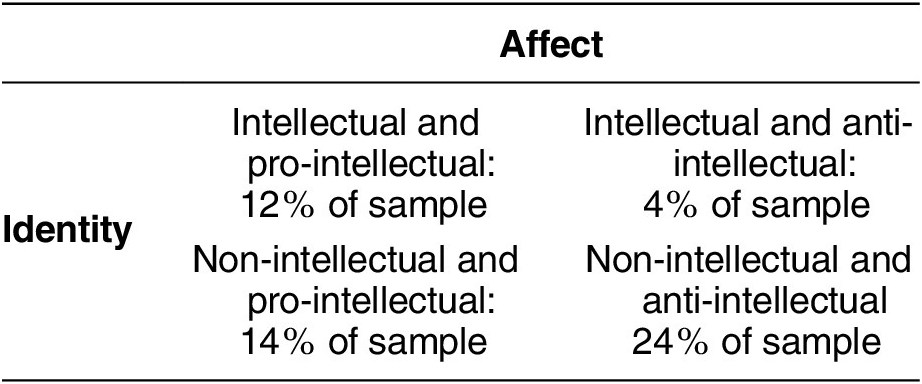
To test our hypotheses, it is necessary to demonstrate that Intellectual Identity and Anti-Intellectual Affect are not only conceptually distinct but empirically distinct as well. As we anticipated, the two are significantly correlated, but not overwhelmingly so (Pearson’s r = −.38; p < 0.01). Table 3 displays the combinations more vividly, with a comparison based on those who score above 0.6 versus those who score below 0.4 on both variables. The first row shows that those who score above 0.6 on Intellectual Identity are about three times as likely to also be relatively pro-intellectual (below 0.4 on Anti-Intellectual Affect) as to be anti-intellectual (above 0.6 on Anti-Intellectual Affect). The second row shows that those who are relatively non-intellectual (below 0.4 on Intellectual Identity) are a little more than 1.7 times as likely to also be relatively anti-intellectual (above 0.6 on Anti-Intellectual Affect) as they are to be pro-intellectual (below 0.4 on Anti-Intellectual Affect).
Intellectual Identity and Intellectual Affect: Sample Percentages

Note: Percentages of survey respondents in the top two/bottom two quintiles of Intellectual Identity and Intellectual Affect.
Overall, these patterns reveal that while Identity and Affect tend to reinforce each other, the cross-pressured categories are not unheard of.
Intellectual Identity, Anti-Intellectualism, and Epistemic Hubris
To test our first two hypotheses, we model the variance in Epistemic Hubris as a function of Intellectual Identity and Anti-Intellectual Affect, both independently and multiplicatively. Specifically, in successive equations we consider the predictive capacity of (1) Intellectual Identity without considering Anti-Intellectual Affect, (2) Anti-Intellectual Affect without considering Intellectual Identity, (3) both, without their interaction, and (4) both, with their interaction.
To simultaneously address concerns about omitted variable bias (e.g., Greene Reference Greene2018) and posttreatment bias (e.g., Acharya, Blackwell, and Sen Reference Acharya, Blackwell and Sen2016) in our models, we estimate two sets of linear regression equations. The first set of equations includes only the variables of theoretical interest and demographic controls (Race, Gender, Age, and Income).Footnote 21 The second set of equations adds several additional covariates that in theory may account for any relationships we observe between Epistemic Hubris and our measures of Intellectual Identity and/or Anti-Intellectual Affect.
Specifically, in an attempt to discriminate between the predictive capacity of intellectual identity and that associated with intellectual ability, ambition, or privilege (which are related to such identity but do not define it), we add Education (0 = < high school graduate; 5 = postgraduate degree; rescaled to 0–1; mean = 0.53; SD = 0.30) and Educational Elitism (see Measurement Appendix) to the equations.Footnote 22 Moreover, because our hypotheses pertaining to Anti-Intellectual Affect might spuriously reflect the effects of traditionalistic ideologies, we add Ideological Identification (0 = “very liberal”; 4 = “very conservative”; rescaled to 0–1; mean = 0.49; SD = 0.29), Christian Traditionalism (a three-item principal component index; see Measurement Appendix), and Generic Populism (a three-item principal component index; see Measurement Appendix) to the equations. Finally, to account for the possibility that our hypothesized relationships could spuriously reflect differences in psychological rigidity that are grounded in tribal, ideational, and/or personality-based characteristics, we add Partisan Strength (five-point Party Identification, folded and dichotomized; 1 = “strong Democrat/Republican” [43%]), Ideological Strength (five-point Ideological Identification, folded and dichotomized; 1 = “very liberal/conservative”[30%]), and (3) Authoritarianism (three-point principal component index; see Measurement Appendix) to the equations.Footnote 23
Results
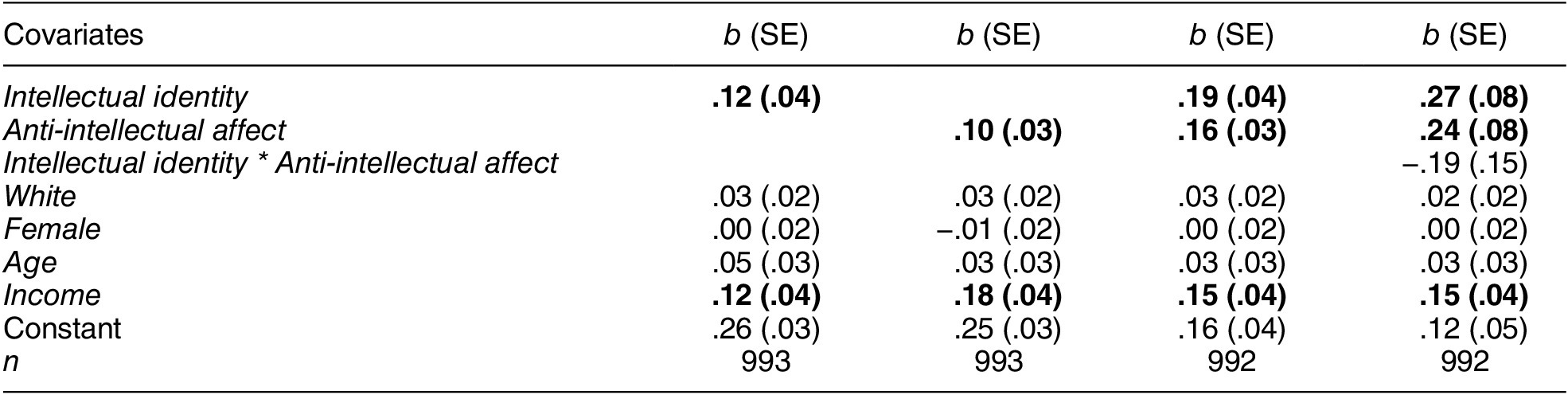
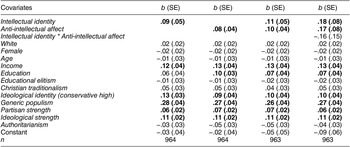
Table 4 displays the first set of results, which show consistent support for Hypotheses 1 and 2. Specifically, as Columns 1 and 3 show, a minimum-to-maximum difference in Intellectual Identity corresponds to an increase in Epistemic Hubris that ranges from 12 to 19 decimal points on the 0–1 scale (depending on whether the model also accounts for Anti-Intellectual Affect), which translates into expressions of certitude regarding one to two additional claims on the nine-item index (both relationships are statistically significant at p < 0.001). As for Anti-Intellectual Affect, as Columns 2 and 3 display, a minimum-to-maximum difference corresponds to a boost in Epistemic Hubris of between 10 and 16 decimal points on the 0–1 scale (or certitude toward one to one and a half additional claims on the nine-item scale; p < 0.001).
Intellectual Identity, Anti-Intellectual Affect, and Epistemic Hubris

Note: Ordinary least squares regression coefficients of the difference in Epistemic Hubris corresponding to minimum-to-maximum differences in each explanatory variable. Standard errors are in parentheses. Statistically significant relationships (p < 0.05; one-tailed) are in bold.
The fourth results column shows how the two variables interact. A minimum-to-maximum difference in Intellectual Identity corresponds to a 27-decimal-point increase in Epistemic Hubris on the 0–1 scale among the most pro-intellectual respondents (expressing hubris toward nearly three additional claims on the nine-item index; p < .001). The effect drops to only 0.08 among the most anti-intellectual respondents (0.27 − 0.19 = 0.08). Similarly, a minimum-to-maximum increase in Anti-Intellectual Affect is associated with a 24-decimal-point increase in Epistemic Hubris among non-intellectuals (almost three additional items on the nine-item index), but the relationship falls to 0.05 among the most intellectual respondents (0.24 − 0.19 = 0.05).Footnote 24
Table 5 displays the results after taking account of the potential confounding variables. As expected, the explanatory power of both Intellectual Identity and Anti-Intellectual Affect are somewhat weaker than in the simpler models, but the patterns remain the same.
Intellectual Identity, Anti-Intellectual Affect, and Epistemic Hubris

Note: Ordinary least squares regression coefficients of the difference in Epistemic Hubris corresponding to minimum-to-maximum differences in each explanatory variable. Standard errors are in parentheses. Statistically significant relationships (p < 0.05; one-tailed) are in bold.
To summarize our results so far, the data are clearly consistent with our hypotheses. Intellectual Identity and Anti-Intellectual Affect are both associated with Epistemic Hubris regardless of the other’s presence in the model or variations in model specification more generally. Next, we examine the partisan character of these intellectual characteristics.
Blue Intellectualism, Red Anti-Intellectualism?
To evaluate Hypotheses 3 and 4—that intellectualism is associated with Democratic partisanship and that anti-intellectualism is associated with Republican partisanship—we estimate a multinomial logistic regression equation that models the variance in Party Identification (three-point: Democrats and Independents who lean Democratic = 0 [44% of sample respondents]; Pure Independents = 1 [15%]; Republicans and Independents who lean Republican = 2 [41%]). We focus on the comparison between Democrats/Democratic Leaners and Republicans/Republican Leaners.Footnote 25 Again, we estimate four models, examining the explanatory purchase of (1) Intellectual Identity without accounting for Anti-Intellectual Affect, (2) the reverse, (3) both variables, and (4) both plus their interaction. We round out all the models with the basic demographic covariates we described earlier (Race [white vs. nonwhite], Gender [Female = 1], Age, and Gross Household Income), along with Education (which, as a crude measure of cognitive talent, could undergird Intellectual Identity to some extent) and Christian Traditionalism (which, as we have discussed, may partially account for Anti-Intellectual Affect).Footnote 26
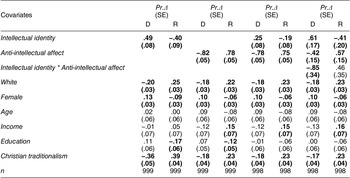
Table 6 displays the results, both with respect to the probability of identifying as a Democrat and with respect to the probability of identifying as a Republican.
Intellectual Identity, Anti-Intellectual Affect, and Party ID (Independent Leaners = Partisans)

Note: Cell entries are differences in the predicted probability of identifying as either a Democrat (D) or a Republican (R), converted from multinomial logistic regression coefficients that correspond to minimum-to-maximum differences in each explanatory variable. Standard errors are in parentheses. Statistically significant relationships (p < 0.05; one-tailed) are in bold.
Intellectual Identity, Intellectual Affect, and Party Identification

Note: Cells display (a) differences in the predicted probability of identifying as a Democrat or a Republican based on top two/bottom two quintile combinations of Intellectual Identity and Intellectual Affect. They also display the percentage of each party’s identifiers who fall into each of the four Identity/Affect categories.
The data strongly conform to our expectations. After converting the logit coefficients to differences in predicted probabilities, we see that when not accounting for Anti-Intellectual Affect, a minimum-to-maximum difference in Intellectual Identity corresponds to a 49-percentage-point increase in the estimated probability of identifying as a Democrat (p < 0.001), and a 40-percentage-point decrease in the estimated probability of identifying as a Republican (p < 0.001). Those percentage-point changes drop to 25 and 19 points, respectively, when accounting for Affect but remain statistically different from zero (p < 0.02). Notably, these effects are stronger than those for Female and they are comparable to those for White and Christian Traditionalism. Footnote 27
As for Anti-Intellectual Affect, the results are even more striking: a minimum to maximum difference is associated with an estimated 78–82-percentage-point decrease in the probability of identifying as a Democrat, and a 75–78-percentage-point increase in the probability of identifying as a Republican. We did not have theoretical priors about the relative strength of Intellectual Identity and Anti-Intellectual Affect as predictors—and indeed, the difference we observe here could be attributable to differences in measurement reliability or other factors—but this difference is nevertheless eye-opening and deserves further investigation.
Looking finally at the variables in concert (the last results column), we see that among the most pro-intellectual respondents in the sample, a full-range increase in Intellectual Identity increases the probability of identifying as a Democrat by over 61 percentage points (p < 0.001) while appearing to decrease the probability of identifying as a Republican by about 41 percentage points. Among the most anti-intellectual respondents in the sample, though, the predictive capacity of Intellectual Identity vanishes. Meanwhile, among the least intellectual respondents, a full range increase in Anti-Intellectual Affect is associated with a 57-percentage-point increase in the estimated probability of identifying as a Republican and a 42-percentage-point decrease in the estimated probability of identifying as a Democrat.Footnote 28 These relationships appear even stronger among those who also score highly on the Intellectual Identity scale, though as we discuss below, such a combination is very rare.
We can display these results in a final variant of our 2 × 2 table, which shows (a) the probability of identifying as either a Democrat or a Republican for different combinations of Intellectual Identity and Intellectual Affect (above 0.6 and below 0.4 on the 0–1 scales) and (b) the percentage of each party that is comprised of each category. We see that those who are on balance both intellectual in terms of identity and pro-intellectual in terms of affect are 67 percentage-points more likely to be Democrats than to be Republicans, and they comprise 22% of the Democratic Party versus only 2% of the Republican Party. On the other side of the coin, those who are on the less intellectual and more anti-intellectual side of the ledger are 55 percentage-points more likely to be Republicans than to be Democrats, and they comprise 39% of the Republican Party versus only 11% of the Democratic Party.
In sum, these findings provide compelling support for our hypotheses that Intellectual Identity is associated with Democratic partisanship (H3 ) and Anti-Intellectual Affect is associated with Republican partisanship (H4 ).Footnote 29 These relationships also appear to reinforce each other such that those who are both intellectual in terms of identity and pro-intellectual in terms of affect are overwhelmingly likely to be Democrats, whereas those who are the least intellectual in terms of identity and the most anti-intellectual in terms of affect are overwhelmingly likely to be Republicans.
One question that remains is how lasting or transient these relationships will prove to be. As we discussed earlier, the ideological character of intellectualism and anti-intellectualism (both in terms of identity and affect) has been evident for several decades, which translated increasingly into a partisan character this century as the parties sorted themselves more cleanly into ideological camps. Those trends then became spikes during the Trump presidency, which means they could in-theory recede when Trump no longer leads the Republican Party. However, at the time of this writing, the intellectual/anti-intellectual identity of the two parties appears to be hardening (both in the body politic and among elected officials)—leading us to speculate that a lasting partisan realignment has emerged.
Conclusion
In contemporary American culture, the three little words in shortest supply may not be “I love you,” but “I don’t know.” In this investigation, we have analyzed the correlates of epistemic hubris, an underappreciated element of the “politics of truth” (e.g., Berinsky Reference Berinsky2017; Delli-Carpini and Keeter Reference Delli-Carpini and Keeter1996; Gerber and Huber Reference Gerber and Huber2010; Hochschild and Einstein Reference Hochschild and Einstein2015; Kuklinski et al. Reference Kuklinski, Quirk, Jerit, Schweider and Rich2000; Lupia Reference Lupia2016; O’Connor and Weatherall Reference O’Connor and Weatherall2019; Southwell and Thorson Reference Southwell and Thorson2015; see Marietta and Barker Reference Marietta and Barker2019 for a recent, expansive review).
Using nationally representative data, we find that such certitude is common and bipartisan. As Samuel Johnson observed over one hundred years ago, “Credulity, or confidence of opinion too great for the evidence from which opinion is derived, we find to be a general weakness imputed by every sect and party to all others” (Johnson [1758] Reference Johnson2010; also see Fischhoff, Slovich, and Lichtenstein Reference Fischhoff, Slovic and Lichtenstein1977; Gilovich Reference Gilovich1991; Grant Reference Grant2021; Griffin and Tversky Reference Griffin and Tversky1992; Taleb Reference Taleb2007; Tetlock Reference Tetlock2005; Tetlock and Gardner Reference Tetlock and Gardner2015).
We also observe that the character of such epistemic hubris appears to differ remarkably across the political divide. Our data suggest that the growing intellectualism of “Blue” America and the spiking anti-intellectualism of “Red” America contribute to each side’s conviction that they are uniquely endowed with knowledge and truth. That is, we observe that both intellectual identity and anti-intellectual affect predict epistemic hubris and that the former is disproportionately associated with Democratic partisanship whereas the latter is disproportionately associated with Republican partisanship.
In conclusion, this investigation initiates a new line of inquiry into an important but underanalyzed element of political psychology: epistemic hubris. It not only complements the body of knowledge on the causes and consequences of political ignorance and misinformation but also advances understanding of what appears to be an accelerating partisan realignment surrounding intellectualism and its discontents (see Hofstadter Reference Hofstadter1963; Merkley Reference Merkley2020; Motta Reference Motta2018; Oliver and Wood Reference Oliver and Wood2018; Rigney Reference Rigney1991). In so doing, it refines scholarly understanding of the so-called “diploma divide,” and contributes to the broader canon on the nature of political polarization (e.g., Hetherington and Weiler Reference Hetherington and Weiler2018; Iyengar and Westwood Reference Iyengar and Westwood2015; Johnston, Lavine, and Federico Reference Johnston, Lavine and Federico2017; Klein Reference Klein2020; Mason Reference Mason2016; Smidt Reference Smidt2017).
If only intellectual identity or only anti-intellectual affect marked the path to hubris—or if such hubris were exclusive to only one of the parties—then the odds of building a more inhabitable public square in the United States might improve. Instead, the partisan realignment around intellectualism appears to further the hubris that has come to characterize both parties, hamstringing democracy’s ability to function.
Supplementary Materials
To view supplementary material for this article, please visit http://dx.doi.org/10.1017/S0003055421000988.
Data Availability Statement
Research documentation and data that support the findings of this study are openly available at the American Political Science Review Dataverse: https://doi.org/10.7910/DVN/T9AEBN.
Acknowledgments
For their helpful suggestions on earlier drafts of this manuscript, we are grateful to John Cluverius, Joshua Darr, Joshua Dyck, Matthew Graham, Silvia Kim, Mona Kleinberg, Michael Strausz, Elizabeth Suhay, Emily Thorson, and Jenifer Whitten-Woodring.
CONFLICT OF INTEREST
The authors declare no ethical issues of conflicts of interest in this research.
Ethical Standards
The authors declare the human-subjects research in this article was deemed exempt from review by American University’s Institutional Review Board.
MEASUREMENT APPENDIX
All variables rescaled to 0–1 for analysis.
I. Intellectual Identity (eigenvalue = 1.68)
Intellectual Occupation (loading = 0.49): Open ended declaration of occupation, coded as either intellectual (1) or non-intellectual (0). Intellectual careers are those that emphasize abstract or creative thinking (e.g., writers, editors, journalists, educators, scientists, engineers, researchers, artists, musicians, doctors, lawyers, clergy-members, and so on). Intellectual = 18%.
Intellectual College Major (loading = 0.58): Open ended response: “What was your college major?” Intellectual majors (coded as “1”) include those in the arts and sciences (including but not limited to the humanities, social sciences, hard sciences, communication, and education). Non-intellectual majors (“0”) include, but are not limited to, accounting, finance and other primarily business-related fields, criminal justice, agriculture, recreation, hospitality, nursing, and nutrition. Those who have not attended college are also coded as zero. Intellectual = 39%.
Pleasure Reading (loading = 0.31): “On the weekend, I like to catch up on … Reading (1) | Sleep (0) | TV (0) | Shopping (0) | Housework/yard work (0) | Socializing (0)| Other (0)” Reading = 11%.
News Attentiveness (loading = 0.22): Principal component index of three items regarding news media consumption in the past 24 hours (newspaper, TV, radio); eigenvalue = 1.24), rescaled to 0–1 (mean = 0.40; SD = 0.31). Newspaper = 35% (loading = 0.61); TV = 59% (loading = 0.50); Radio = 30% (loading = 0.61).
Artistic Interest (loading = 0.36): Strongly agree (0) to Strongly Disagree (4): “I am someone who has few artistic interests” (mean = 0.52; SD = 0.30.).
“Nerd” Identity (loading = 0.30): “In high school, people thought of me as a … Nerd (1) | Jock (0) | Partyer (0) | Loner (0) | None of these (0). Nerd = 16%.
Self-Perceived Imaginativeness (loading = 0.24): Strongly disagree (0) to Strongly Agree (4): “I am someone who has an active imagination” (mean = 0.70; SD = 0.24).
II. Additional Covariates
Educational Elitism: Open-ended response “what is the name and location of the last college or university you attended?” Institutions ranked in top 100 national universities/top 50 liberal arts colleges based on the 2020 U.S. News & World Report rankings = 4; 101–200 national universities/51–100 liberal arts colleges = 3; all other brick and mortar, nonprofit four-year universities/colleges = 2; community college, for profit, or online college/university = 1; no college/university = 0. Rescaled to 0–1; mean = 0.31; SD = 0.36).
Christian Traditionalism: principal component index of three items (eigenvalue = 1.92; mean = 0.29; SD = 0.32): (1) “Born Again Christian” identity (27%; loading = 0.6); (2) belief that the Bible is “the inerrant and authoritative word of God” (26%; loading = 0.59), (3) church attendance (0 = never; 5 = multiple times per week; mean = 0.34; SD = 0.34; loading = 0.54).
Generic Populism: principal component index of three Likert-type items (eigenvalue = 1.38; mean = 0.65; SD = 0.19): (1) “These days, it seems like everything is rigged against the people, to protect the powerful” (mean = 0.70; SD = 0.27; loading = 0.64); (2) “It would be better if regular people, not political elites, made decisions for the country” (mean = 0.67; SD = 0.24; loading = 0.68); (3) “Don’t be fooled: a secret group of elites make the important decisions around the world” (mean = 0.50; SD = 0.31; loading = 0.36).
Authoritarianism: principal component index of three items (eigenvalue = 1.63; mean = 0.50; SD = 0.29): (1) “If you had to choose, would you say it is more important for children to learn independence or respect for elders?” (respect = 53%; loading = 0.63); (2) “…self-reliance or obedience?” (obedience = 29%; loading = 0.56); (3) Likert: “a decent and just community makes sure that young people have proper respect for authority and tradition” converted to 0–1 (mean = 0.60; SD = 0.28; loading = 0.54).





Comments
No Comments have been published for this article.