Introduction
The delivery of health care often is affected adversely during times of conflict. Kashmir, located in the northwestern part of Southeast Asia, has experienced nearly two decades of conflict. At times, this unrest has involved armed violence resulting in nearly 100,000 deaths. In 2010, this conflict took a new turn, and prolonged spells of stone pelting by crowds of people were interspersed with a strictly-enforced curfew throughout the valley of Kashmir.
Access to healthcare facilities during this period became tenuous for health care professionals as well as for patients, as it was nearly impossible for private and public transportation vehicles to utilize the roads. Ambulances took on an added responsibility of trying to maintain a link between the patients, hospitals, and healthcare professionals. In addition to their routine emergency duties, the ambulances were required to ferry staff, medical equipment, and other material on a daily basis.
During this period, the ambulance drivers faced substantial difficulties including stone pelting, and frequent checks and stops enforced by the police and paramilitary personnel. Few reports have highlighted the difficulties and challenging circumstances faced by ambulance drivers during this period.Reference Erbay, Alan and Kadıoğlu 1 , Reference Singh, Mukherjee and Datta 2 The purpose of this study was to identify the problems faced by ambulance drivers in a conflict zone when public and private transportation were virtually unavailable.
Methods
This study was conducted from July to October, 2010 and involved randomly-selected ambulance drivers from four hospitals across the valley: (1) the Sheri Kashmir Institute of Medical Sciences Soura; (2) the Sheri Kashmir Institute of Medical Sciences Medical College Bemina; (3) the Government Hospital for Bone and Joint Surgery Barzullah; and (4) the Government SMHS Hospital Srinagar. These hospitals are within a circular area with a 25-kilometer diameter and have a combined 2,000 beds.
A questionnaire comprised of 30 work-related questions was developed by the authors. Drivers were interviewed individually, and their answers were recorded (Appendix 1). Any additional and interesting observations made by the drivers during their runs also were recorded. Only the relevant demographic data were collected. The data were tabulated and assessed in terms of percentages. No comparisons were made and, to the authors' knowledge, no study of this character has been done anywhere. All drivers were questioned within a period of 90 days over which none of them had been on a leave of more than three days. Permission was obtained from the institutional review boards of all the institutions involved.
Results
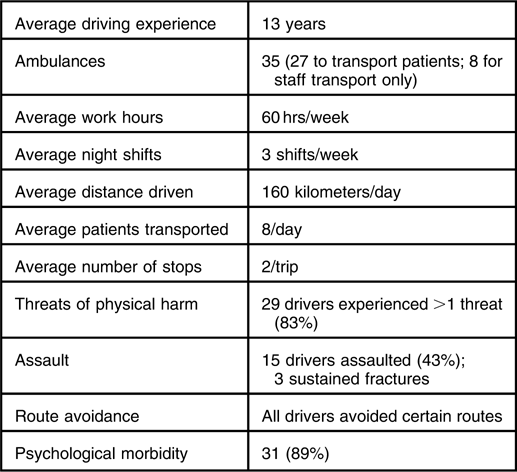
A total of 35 ambulance drivers participated in this study (60% of the total drivers working in the four main hospitals of the Srinagar city) (Table 1). The participants had been driving an ambulance from 2-30 years with an average of 13 years. The study group was from the four hospitals. Five drivers belonged to the SKIMS Hospital Soura; nine to the SKIMS MC Bemina, six to the Government Hospital for Bone and Joint Surgery, and 15 to the SMHS Hospital Srinagar. The ages of the drivers ranged from 24 to 56 years with an average age of 37 years. All of the drivers were male.
Results From Selected Questionnaire Items. Table contains both averages and totals.

Six of the drivers drove a bus to transport hospital staff (transport ambulance), 15 drove a conventional ambulance, 12 drove a minivan, and two drove a car to transport important faculty members. Only 27 of the 35 drivers (77%) transported patients, while the remaining eight ferried staff to and from the hospitals. The drivers were on duty for an average of 60 h/wk with no fixed timings while being on duty for a night shift three times a week. A night shift constituted a duty period from 4 pm to 10 am the next day. Ambulance vehicles were driven an average of 160 km/d. Transport buses carried up to 120 staff members daily; the conventional ambulances also carried up to 35 members of hospital staff daily. Buses and cars did not transport any patients. The conventional ambulances carried an average of eight patients/day, almost all of them injured in the conflict. On average, the drivers had six stops/day by the security forces; all drivers reported having been stopped occasionally by violent mobs. The security forces checked the identity of the passengers routinely, which caused significant delays in travel times. The drivers also reported that their ambulances had been denied permission to move an average of two times over the study period of three months.
Twenty-nine of the 35 drivers (83%) reported that they had been threatened with physical harm more than once over the 90-day study period. Fifteen (43%) of the drivers had been assaulted during their duties; one driver had been attacked twice. Three of the drivers sustained fractures of the hand and nasal bones and one driver was admitted for a head injury. One ambulance had been fired upon by the police while located a short distance from its hospital. All drivers reported that arguments with police and paramilitary personnel were routine, while arguments with the protesting crowds occurred occasionally. No death could be attributed to these incidents during this period.
All drivers noted that they were afraid to move out in ambulances, a fear that became accentuated during the night. Twelve of the drivers (34%) reported that they had been caught in work situations in which they felt a threat to their lives. To avoid troublesome spots and aggressive security pickets, the drivers had become adept at route avoidance, even if it meant driving an extra distance.
Sleep disturbances were reported by 30 drivers (86%) and 31 (89%) reported that they experienced increased irritability, headaches and body aches. None of the drivers was insured.
Ambulances were used to transport staff, equipment, and patients as the need arose. On many occasions, the ambulances were used for more than one purpose. An ambulance that would transport staff in the morning was used for transporting patients during the rest of the day.
Only one driver reported wanting to leave his job. All others reported that they felt that they were serving a very important and critical function, which inspired them to continue duties under such difficult circumstances.
Twenty-seven vehicles were not up to the mark in terms of servicing and repairs, but the drivers reported only one breakdown in front of a crowd of protesters. This information was volunteered by the driver whose ambulance broke down. This ambulance had to be towed away for repairs later. The servicing protocol advised by the manufacturers of the ambulances was not followed in these cases as per the records.
Discussion
Ambulances play a central role in the day-to-day functioning of hospitals all over the world. Studies involving ambulance drivers have been few, with most being about accidents and individual experiences, while some have highlighted the remedies for improving performance during normal times. 3 - Reference Elling 7 As cited in the literature, ambulance drivers relatively rarely have reported unusual occurrences during their work.Reference McCallion 8
Ambulances in Kashmir serve several functions, most related to the transport of patients from one hospital to another. However, the safe transport of doctors and staff is especially important during periods of unrest; the conditions during the conflict period may vary in intensity and may expand in scope. The recent turmoil in Kashmir began in early June 2010 and continued through the time of the collection of data for this study (July to October, 2010). This period was difficult for the ambulance drivers because of witnessed mass incidents of stone pelting, general strikes, and imposed curfews throughout Kashmir. The streets either were full of protestors or teeming with police and paramilitary forces. The conditions were such that private and public transportation were unavailable to residents, except on rare occasions.
The ambulances in Kashmir are not highly equipped, and often they are staffed by a single driver who is not well-versed in emergency medical care. The ambulances are equipped with only a stretcher, an oxygen cylinder, and an Ambu bag. For these reasons, it is vital that the ambulances reach hospitals as quickly as possible.
In general, ambulances are equipped with several active and passive signals that highlight the critical role of this vehicle. For example, the color of the vehicle and insignias, including the Star of Life, are easily recognizable. Active signals include lights, sirens, and wig wags (a device for flashing an automobile's headlights at a preset rate). These symbols are recognized universally, and are meant to facilitate the passage of ambulances on roads and byways. O'Brien et al reported a statistically significant difference in the transit times of ambulances using lights and sirens compared with those that did not use lights and sirens; the reported average difference was 230 seconds.Reference O'Brien, Price and Adams 9 Interestingly, most of the drivers in this study reported that paramilitary forces did not allow them to use either the lights or the sirens. 3 In fact, several drivers reported that they had been physically attacked by paramilitary forces for using a siren.
Health care workers are exposed to difficult work conditions during times of turmoil and conflict. More than any other health care workers, ambulance drivers are exposed to difficulties because they must work outside the relative safety of the hospital premises. This risk is magnified when the streets are the theater of the turmoil.
The findings that the ambulance drivers in this study worked an average of 60 h/wk with three night shifts, and drove an average of 160 km in their vehicle daily, underscore the point that the drivers were exposed to maximum stress for significant portions of their duty hours.
The valley of Kashmir is hamstrung by the absence of a hospital that includes all the faculties of medicine under one roof. This enhances the need for inter-hospital referrals, which adds to the time the ambulances must spend on the streets ferrying patients. The frequent checking by the police and the threat of bodily harm while transferring patients meant that the drivers were under a continuous level of stress during the period studied. The resultant psychological morbidity is reflected in the prevalence of fear, sleep disturbance, headaches, and irritability among the ambulance drivers.
In a situation where public and private transportation on the streets is nonexistent, desperate people often force ambulances to stop and transport them, against the wishes of the driver. This provides sufficient reason for the paramilitary personnel to harass drivers and frequently physically attack them. Often, inflammatory words are exchanged, increasing the possibility of a physical confrontation. These arguments impacted the transport time of patients as well as the health care staff members who needed to report to hospitals within a stipulated time in order to avoid critical shortages.
Delays during the transportation of patients were reported universally by drivers. This often resulted in the deterioration of the condition of critically injured patients, although no deaths during ambulance transportation occurred. However, it is difficult to ascertain whether any patient actually died due to these delays, as this would have required an inter-hospital collaborative investigation that was beyond the scope of this investigation.
During these periods of conflict, the hospitals are under great stress due to the surge in the inflow of critically injured patients. This results in an increased demand for supplies and emergency equipment, which can be met only by using ambulances in the role of load carriers; any other form of transportation is liable to be attacked on the roads. Consequently, the drivers face unexpected road trips on a daily basis.
Under normal circumstances, hospital staff travels to the hospitals using public or private transportation. However, during this conflict period, the ambulances had to double as transportation vehicles for the staff in order to allow continued functioning of the hospitals. Unfortunately, violence against medical personnel is common in areas of the world plagued by conflict. Even though such violence is prohibited by international law and the Geneva Conventions, such incidents continue to occur with surprising regularity.Reference Tuya-Figueroa and Mezones-Holguín 10 , 11
Most of the ambulances were serviced irregularly during the period studied. In most cases, damage to the windows, bodywork, and the windshield during stone pelting was not repaired immediately, due to the intense workload. This caused discomfort to the drivers as well as the occupants of the ambulances.
Even though all of the ambulance drivers were government employees, none of the drivers that were interviewed were insured against accidents. Obtaining insurance was an expensive proposition for them, and the administration was not helpful in obtaining the insurance for them. Despite this, none of the drivers wanted to change jobs except for the one driver who wanted to go on leave.
The experiences of the drivers of Kashmir during the period studied are informative in many respects. The critical role of these health professionals in times of conflict, especially in areas where inter-hospital transfer is the norm, often is understated. Due to the fact that the drivers bridge the lacunae in individual hospitals, and drive to and from various hospitals, they are easy targets for warring parties who control the streets.
Conclusions
Ambulance drivers in Kashmir have demonstrated a remarkable sense of duty during trying times, in spite of facing serious threats from armed forces and stone pelting from crowds. Recommendations to safeguard these professionals and ensure smooth functioning of the hospitals during these periods of conflict include:
-
(1) An information grid should be established that allows government security forces to know in advance about the likely passage of these vehicles in their areas;
-
(2) The armed forces should be sensitized regarding the importance of these vehicles, especially during periods of heightened conflict;
-
(3) In view of their work in a very risky environment, ambulance drivers should be insured;
-
(4) Ambulance vehicles should be given some kind of protection that can circumvent the damage caused by stones; and
-
(5) Evidence of psychological morbidity among ambulance drivers must be assessed regularly, and corrective measures administered.
Abbreviations
- SKIMS MC:
-
Sheri-i-Kashmir Institute of Medical Sciences Medical College
Appendix 1. Ambulance Driver Questionnaire
-
(1) How long have you been driving an ambulance?
-
(2) Which hospital at present?
-
(3) Type of vehicle?
-
(4) Working hours in a week?
-
(5) Night shifts in week?
-
(6) How many rounds do you make per day?
-
(7) How many kilometers per day?
-
(8) How many patients do you carry every day?
-
(9) How many staff?
-
(10) How many injured?
-
(11) How many injured due to current conflict?
-
(12) How often have you been stopped by security in a day?
-
(13) How often have you been stopped by violent mobs in a day?
-
(14) How often has your identity been checked?
-
(15) How often has the ambulance been refused permission to move?
-
(16) How often have you been threatened with bodily harm?
-
(17) How often have you or inmates been beaten in ambulance?
-
(18) How many times your vehicle was damaged?
-
(19) Do you have frequent arguments with security forces/mobs?
-
(20) Any deaths due to stoppages?
-
(21) Are you afraid to move out even in an ambulance?
-
(22) How often have you been caught in circumstances when you felt a threat to your life?
-
(23) Are you feeling more irritable than before?
-
(24) Do you feel increased incidence of headaches, body aches?
-
(25) Do you have any sleep problems?
-
(26) When boarding an ambulance do you feel fear?
-
(27) Do you have any insurance coverage?
-
(28) Do you wish to leave this job?
-
(29) How often has your vehicle been used for other purposes?
-
(30) How often have you not been able to move ambulance due to technical problems (servicing, fuel, damage to vehicle, etc.)?