Introduction
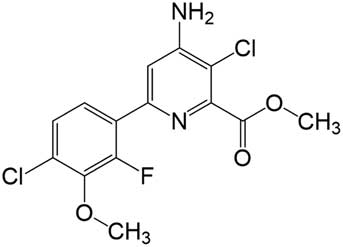
Halauxifen-methyl is the first commercialized herbicide representing a new chemical class, the arylpicolinates, within the synthetic auxin herbicide mode of action (Figure 1). This foliar-applied herbicide, with a typical field use rate of 5 g ae ha−1, provides control of several broadleaf weed species, including Sumatran fleabane [Erigeron sumatrensis (Retz.) E. Walker] and hairy fleabane (Erigeron bonariensis L.), under a range of environmental conditions (Anonymous 2017; Braz et al. Reference Braz, Oliveira, Zobiole, Rubin, Voglewede, Constantin and Takano2017; Love et al. Reference Love, Plater, Lines, Wells and Nott2016). When tank mixed with fluoroxypyr or florasulam, halauxifen-methyl provides control of many problematic broadleaf weed species, including acetolactate synthase (ALS) inhibitor–resistant common chickweed [Stellaria media (L.) Vill.] and fumitory (Fumaria officinalis L.) (Anonymous 2016a; Paterson et al. Reference Paterson, Jackson, Bardsley and Sampson2016). Given the low use rate and different preferred binding site compared with other auxin herbicides, halauxifen-methyl is an alternative Group 4 herbicide that can be incorporated into many weed management programs (Bell et al. Reference Bell, Schmitzer and Robinson2014; Schmitzer et al. Reference Schmitzer, Balko, Daeuble, Epp, Satchivi, Siddall, Weimer and Yerkes2015).
Molecular structure of halauxifen-methyl.

Horseweed (Erigeron canadensis L.) is a broadleaf weed species that has been described as “one of the most problematic, noxious, invasive, and widespread weeds in modern day agriculture” (Bajwa et al. Reference Bajwa, Sadia, Ali, Jabran, Peerzada and Chauhan2016). This weed, characterized as a summer and winter annual, is found in many cropping systems and is particularly problematic in undisturbed environments such as no-till crop production fields (Davis et al. Reference Davis, Gibson, Bauman, Weller and Johnson2009; Weaver Reference Weaver2001). Since the evolution and spread of E. canadensis resistance to glyphosate and ALS-inhibiting herbicides, control options for emerged plants have become limited (Heap Reference Heap2017; Kruger et al. Reference Kruger, Davis, Weller, Stachler, Loux and Johnson2009; VanGessel Reference VanGessel2001). The auxin herbicides 2,4-D and dicamba have been commonly used for E. canadensis control before planting corn (Zea mays L.) or soybean [Glycine max (L.) Merr.], but there are limitations to these herbicide options. Erigeron canadensis control following a preplant application of 2,4-D can be inconsistent among various E. canadensis populations (Kruger et al. Reference Kruger, Davis, Weller and Johnson2008). While dicamba can be an effective E. canadensis management tool, the precipitation-dependent preplant interval before soybean planting presents a major limitation on its use (Anonymous 2010).
Erigeron canadensis emergence is not easily predicted, as many studies have shown inconsistent response to soil temperature, air temperature, and rainfall (Main et al. Reference Main, Steckel, Hayes and Mueller2006; Shrestha et al. Reference Shrestha, Hembree and Wright2008). In addition to these environmental conditions, variable E. canadensis emergence has also been documented as a function of previous management, including fall herbicide programs (Davis et al. Reference Davis, Kruger, Young and Johnson2010). The large window of emergence presents a unique challenge for spring herbicide applications, when E. canadensis plants can range from rosettes to bolted plants more than 30 cm in height.
Commonly, an increase in plant size at application correlates with an overall reduction in final herbicide efficacy (Craigmyle et al. Reference Craigmyle, Ellis and Bradley2013; Everitt and Keeling Reference Everitt and Keeling2007). However, investigations on the influence of E. canadensis plant height on auxin herbicide efficacy have provided conflicting results. Wiese et al. (Reference Wiese, Salisbury and Bean1995) reported complete control of 30-cm-tall E. canadensis with 560 g ha−1 of 2,4-D ester, while this rate resulted in less than 50% control of plants in the rosette growth stage. In other research, plant size had a differential effect on the efficacy of dicamba and 2,4-D. There was relatively little influence of plant height on dicamba activity, but a marked reduction of control with all rates of 2,4-D (0.6, 1.1, and 2.2 kg ha−1) on E. canadensis measuring 10 to 15 cm in height compared with rosette plants (Keeling et al. Reference Keeling, Henniger and Abernathy1989). Kruger et al. (Reference Kruger, Davis, Weller and Johnson2010) reported equivalent control of E. canadensis up to 30 cm in height to foliar applications of 2,4-D ester or dicamba when applied at 560 g ha−1 and 280 g ha−1, respectively, although dicamba resulted in a higher level of control on weeds taller than 30 cm compared with 2,4-D. Given the recent commercialization of dicamba-resistant crops (e.g., soybean, cotton [Gossypium hirsutum L.]) and potential future release of 2,4-D-resistant crops (e.g., corn, soybean, cotton), an increase in the use of these auxin herbicides within preplant and in-crop applications for weed management is expected. Furthermore, the prominence of herbicide-resistant E. canadensis biotypes will result in this weed species being a major target of these auxin herbicide applications. This will likely challenge these chemistries to control weeds taller than the label recommendation of plants that are 10 cm or fewer in height (Anonymous 2016b). As E. canadensis resistant to glyphosate and ALS-inhibiting herbicides becomes more widespread, it is imperative to investigate effective herbicide programs that include synthetic auxins. This research was conducted to compare the efficacy of a new auxin herbicide, halauxifen-methyl, with current standards, dicamba and 2,4-D, on E. canadensis. Reports of inconsistent E. canadensis control following 2,4-D and dicamba applications at various heights encouraged a second objective within this study: to investigate the influence of weed height on the efficacy of halauxifen-methyl, dicamba, and 2,4-D under different environmental conditions.
Materials and Methods
Field experiments were conducted at two locations near Cortland, IN (38.98′N, 85.95′W) and Brookston, IN (40.59′N, 86.76′W) in 2015 and 2016. Both field sites were in no-till production with a dense population of glyphosate-resistant (GR) E. canadensis that ranged from 64 to 86 plants m−2. Herbicide treatments included halauxifen-methyl (Arylex™ active, Dow AgroSciences, 9330 Zionsville Road, Indianapolis, IN 46268) at 2.5, 5.0, and 10 g ae ha−1; 2,4-D (2,4-D LV4, Winfield Solutions, P.O. Box 64281, St Paul, MN 55164) at 280, 560, and 1,120 g ae ha−1; and dicamba (Clarity®, BASF, 26 Davis Drive, Research Triangle Park, NC 27709) at 140, 280, and 560 g ae ha−1. Glyphosate (Roundup PowerMax®, Monsanto, St Louis, MO 63167) was included at 870 g ae ha−1 in combination with either 2,4-D at 560 g ae ha−1, dicamba at 280 g ae ha−1, or halauxifen-methyl at 5 g ae ha−1 to represent an industry standard. Producers typically tank mix an auxin herbicide with glyphosate to ensure broad-spectrum control of grass species. Methylated seed oil (MSO Ultra®, Precision Laboratories, 1429 S. Shields Drive, Waukegan, IL 60085) at 1% v/v and liquid ammonium sulfate (N-Pak AMS Liquid®, Winfield Solutions, P.O. Box 64589, St Paul, MN 55164) at 2.5% v/v were included in all treatments, because this is the label requirement for halauxifen-methyl and permissible for the other herbicide combinations. Plots were 3 by 9 m arranged in a randomized complete block design with four replications, and a nontreated control plot was included in each replicate.
To investigate the influence of weed height on herbicide efficacy, 12 individual E. canadensis plants per plot, including the nontreated control plots, were marked before spray application. Individually marked plants ranged from 5 to 30 cm in height. Herbicides were applied on May 20, 2015, and June 8, 2016, at Cortland and on June 16, 2015, and June 13, 2016, at Brookston, when E. canadensis growth stage ranged from newly emerged cotyledons to bolted heights greater than 30 cm. A CO2-pressurized backpack sprayer with a 2-m-wide handheld boom equipped with four flat-fan XR8002 nozzles (TeeJet® Spraying Systems, P.O. Box 7900, Wheaton, IL 60189) calibrated to deliver 140 L ha−1 at 276 kPa was used for all herbicide applications. Visual estimates of overall E. canadensis control were taken at 7, 14, 21, and 28 d after treatment (DAT) on a scale of 0 (no injury symptoms) to 100 (death of all plants). For the purposes of reporting, only the 14 and 28 DAT data are shown. Individually marked plants were also visually evaluated at 7, 14, 21, and 28 DAT. At 28 DAT, marked plants were cut at the soil surface for shoot dry weight determination and calculated as percent of the nontreated control of the same height. In 2016, end-of-season inflorescent plant density was recorded using two 0.25-m2 quadrats randomly placed per plot.
Erigeron canadensis control and inflorescent plant density data were analyzed with the PROC GLIMMIX procedure in SAS (v. 9.4, SAS Institute, Cary, NC 27513), using treatment as the fixed effect and replication and site-year as random effects. Due to different treatment trends, control data from Cortland in 2016 were analyzed separately from the other three site-years, and replication was included as a random effect. Brookston 2015/2016 and Cortland 2015 were combined, because the site-year by treatment interaction was not significant in the ANOVA.
Data for individually marked plants from all site-years were analyzed using the PROC NLMIXED procedure in SAS, with site-year as a random effect. In this model, the control rating at 28 DAT for each marked plant was converted to a binary variable where less than 75% corresponds to “Not Controlled” and 75% to 100% corresponds to “Controlled.” This cutoff value was validated by visual observations in which plants given a rating of 75% or higher at 28 DAT did not produce seed. Given the slow action of auxin herbicides, particularly on larger plants, this new covariate accurately represents the fate of each marked plant. After data analysis and model evaluation, the most accurate and informative model was the logistic regression model that allows for prediction of the probability of weed control given a specific height and treatment.
 $$\log \left( {{{P\left( {{\rm Controlled}} \right)} \over {P\left( {{\rm Not \,\,Controlled}} \right)}}} \right){\equals}mx{\plus}b$$
In this two-parameter logit model (Equation 1), m and b are the slope and the y-intercept, respectively, and x represents E. canadensis height in centimeters. The model uses the odds ratio of controlling an individual plant given the height at herbicide application. A separate model was generated for each herbicide treatment, and estimates for the maximum height at which there is a 90% probability of control for an individual plant (PR90 value) were calculated.
Pearson correlation indicated a strong correlation between height and individual plant biomass that was consistent across all treatments (unpublished data). Therefore, these data were not useful for analyzing the influence of plant height on biomass reduction from herbicide efficacy, because the relationship was confounded by this correlation. Variability in the relationship between plant biomass and visual control in response to auxin herbicides was observed in this study and has been noted by previous researchers (Devkota et al. Reference Devkota, Whitford and Johnson2016; Dowler Reference Dowler1969; Roskamp et al. Reference Roskamp, Chahal and Johnson2013). Due to these concerns, individual plant biomass data, while seemingly straightforward and objective, were not further analyzed or presented. The PR90 value analysis demonstrates a novel application of the logit model and allows for direct comparison of herbicide treatments in terms of the maximum weed height controlled rather than an indirect comparison of rates needed for a 50% reduction in biomass. While a GR50 value is an important parameter to consider when investigating basic herbicide chemistry comparisons and to validate resistant versus susceptible biotypes, this approach lacks applicability to commercial field applications compared with a PR90 value. The logistic regression used in this analysis fills that void and could be a useful tool for weed scientists in field-scale experiments investigating herbicide efficacy in terms of weed height. The inflorescent plant density data represent an objective record of herbicide efficacy on all GR E. canadensis heights and provide a follow-up validation of the PR90 results.
Results and Discussion
Auxin Herbicides and Glyphosate
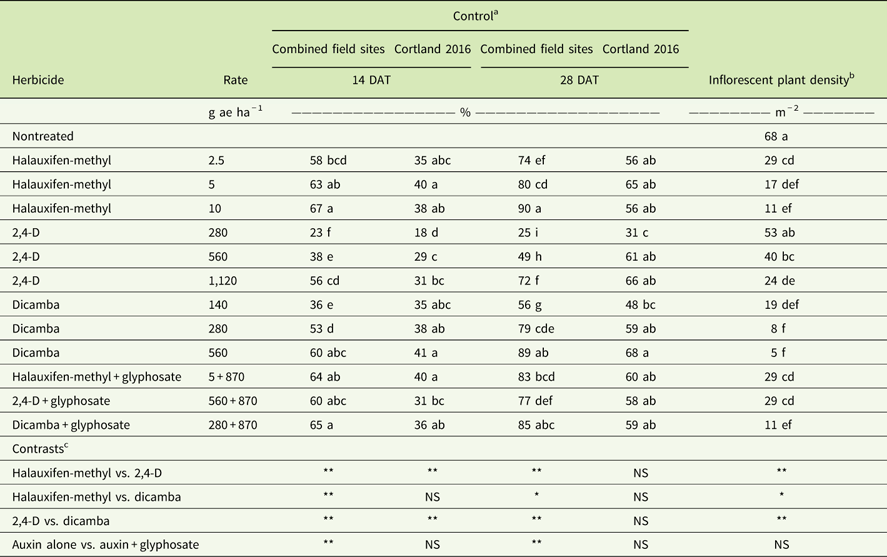
The speed of symptomology development was more rapid following halauxifen-methyl application compared with dicamba and 2,4-D. Plants treated with halauxifen-methyl exhibited stem chlorosis, epinasty, and drooping leaves within days of application. Initial injury observed following 2,4-D and dicamba application included bleached shoot apical meristems and plant stunting. Halauxifen-methyl at 2.5 g ha−1 provided 58% and 74% control at 14 and 28 DAT, respectively, at the combined field sites. This level of activity was not observed with the low rates of 2,4-D (280 g ha−1) and dicamba (140 g ha−1) that resulted in 25% and 56% control at 28 DAT, respectively, for the combined field sites (Table 1). At the field rate of 5 g ha−1, halauxifen-methyl resulted in 80% control at 28 DAT at the combined field sites, while comparable field use rates of 2,4-D and dicamba resulted in 49% and 79% control, respectively (Table 1).
Glyphosate-resistant Erigeron canadensis control ratings 14 and 28 d after treatment (DAT) and end-of-season inflorescent plant density in a field study conducted in Brookston and Cortland, IN.

a Combined field sites includes Brookston (2015 and 2016) and Cortland 2015. These data exclude Cortland 2016 as dictated by a significant treatment interaction in the ANOVA. Means within a column followed by the same letter are not significantly different at α=0.05.
b Data only collected in 2016.
c Significance is designated as: * = P < 0.05; ** = P < 0.001; NS denotes P≥0.05.
Halauxifen-methyl and dicamba comparably controlled GR E. canadensis at the medium and high rates; the significant contrast at the combined field sites likely represents the higher level of control of halauxifen-methyl at 2.5 g ha−1 compared with the lowest dicamba rate of 280 g ha−1 (Table 1). In general, halauxifen-methyl and dicamba were more efficacious than 2,4-D, with 79% or higher control achieved at 28 DAT at the combined field sites for the middle and high herbicide rates. Halauxifen-methyl at 10 g ha−1 and dicamba at 560 g ha−1 resulted in 90% and 89% control, respectively, at 28 DAT and provided the greatest reduction of end-of-season inflorescent plant density. Only 72% control was observed following the application of 2,4-D at 1,120 g ha−1. Halauxifen-methyl at 10 g ha−1 resulted in 90% GR E. canadensis control at the combined sites (Table 1). Inflorescent plant density counts were markedly decreased by the high rate of halauxifen-methyl compared with the nontreated control, from 60 to 11 m−2. Furthermore, each respective rate of halauxifen-methyl was approximately 50 to 100 times less herbicide active per hectare than dicamba and 2,4-D, respectively, and still resulted in a comparable or higher level of control. All herbicide treatments reduced the end-of-season inflorescent plant density relative to the nontreated control, except the low and middle rate of 2,4-D (Table 1). Overall, a higher level of GR E. canadensis control and separation of treatments was observed at the combined field sites compared with Cortland in 2016. This degree of variability of E. canadensis control with auxin herbicides has been reported in previous research (Byker et al. Reference Byker, Soltani, Robinson, Tardif, Lawton and Sikkema2013; Kruger et al. Reference Kruger, Davis, Weller and Johnson2010). While air temperature and soil moisture between the sites could not provide direct evidence supporting the lack of herbicide efficacy for dicamba and halauxifen-methyl at Cortland in 2016, it is likely that a combination of environmental factors contributed to this irregularity in response.
Combinations of glyphosate with 2,4-D and dicamba are commonly used for commercial weed management for control of a broad range of weed species and as a practice for mitigating weed resistance to herbicides (Leon et al. Reference Leon, Ferrell and Sellers2016; Norsworthy et al. Reference Norsworthy, Ward, Shaw, Llewellyn, Nichols, Webster, Bradley, Frisvold, Powles, Burgos, Witt and Barrett2012; Robinson et al. Reference Robinson, Simpson and Johnson2012). The addition of glyphosate to halauxifen-methyl, dicamba, and 2,4-D was included to investigate the value of the common tank mixture when the target weed population contains GR biotypes. There was no significant effect of adding glyphosate to halauxifen-methyl for control of GR E. canadensis (Table 1). The addition of glyphosate improved GR E. canadensis control with all auxin herbicides at the combined field sites, represented by a significant contrast when testing an auxin alone compared with an auxin tank mixed with glyphosate, but this observation was not consistent at Cortland in 2016 or with inflorescent plant density measures (Table 1). Adding glyphosate to 2,4-D and dicamba increased control at the combined field sites by 28% and 6% at 28 DAT, respectively (Table 1). This result is consistent with previous research that observed an increase in efficacy with tank combinations of 2,4-D or dicamba with glyphosate compared with the auxin alone to control GR weed species (Byker et al. Reference Byker, Soltani, Robinson, Tardif, Lawton and Sikkema2013; Spaunhorst and Bradley Reference Spaunhorst and Bradley2013). While an increase in efficacy was observed between dicamba tank mixed with glyphosate compared with dicamba alone, there was no difference for the end-of-season inflorescent plant density count (Table 1). This is likely due to the high level of efficacy observed with dicamba alone, which did not permit a further increase in control from the addition of glyphosate. Previous reports have shown slight variability in GR E. canadensis response to dicamba and reported no benefit of tank mixing glyphosate with dicamba (Flessner et al. Reference Flessner, McElroy, McCurdy, Toombs, Wehtje, Burmester, Price and Ducar2015).
E. canadensis Height
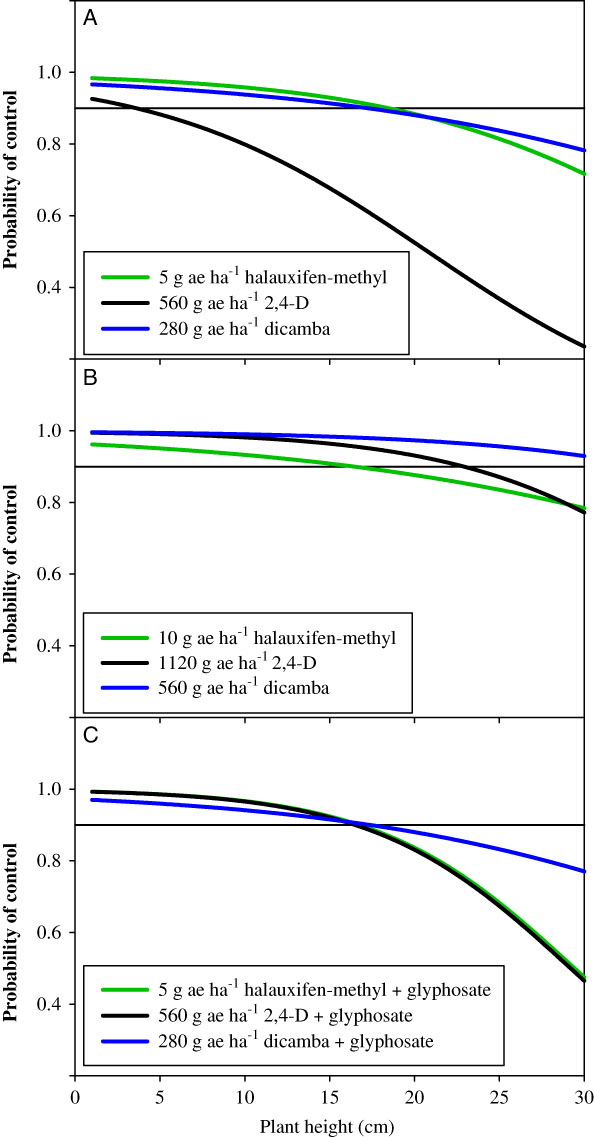
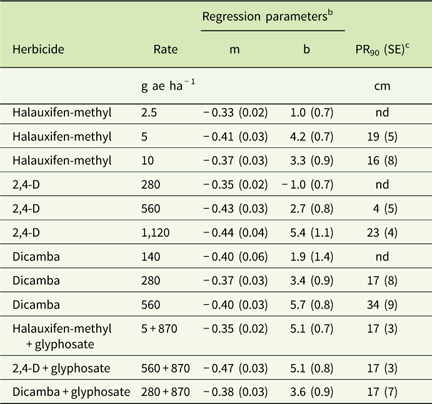
Within each plot, individually marked plants allowed for observations on the influence of weed height on herbicide efficacy. The logistic regression analysis further validates the overall plot data by providing insight into the efficacy of herbicide treatments at different weed heights. Calculated PR90 values (90% probability of control) for halauxifen-methyl at 5 and 10 g ha−1 on GR E. canadensis were 19 and 16 cm, respectively (Table 2). The relatively gradual slope of the high rate indicates a high probability of weed control at heights up to 30 cm (Figure 2B). Dicamba at 280 g ha−1 resulted in efficacy similar to halauxifen-methyl with a PR90 of 17 cm (Table 2). The calculated PR90 for dicamba at 560 g ha−1 was 34 cm; however, this is misleading, because the maximum height included in the analysis was 30 cm, and extrapolation beyond that value can be uncertain. A significant influence of rate was observed with 2,4-D, as the higher rate (1,120 g ha−1) controlled E. canadensis up to 23 cm in height, a considerable increase compared with the medium rate of 560 g ha−1 that only controlled E. canadensis up to 4 cm (Table 2).
The influence of glyphosate-resistant Erigeron canadensis height on the probability of E. canadensis control. Plots displayed represent (A) medium rate, (B) high rate, and (C) auxin plus glyphosate tank mixture. The solid horizontal line indicates the 90% probability of E. canadensis control. The plant height at which a treatment line crosses this reference line approximates the PR90 values shown in Table 2.

Logistic regression parameter estimates to predict the probability of control for two Indiana glyphosate-resistant Erigeron canadensis populations in 2015 and 2016 in response to three synthetic auxin herbicides.Footnote a

a Data were combined over locations and years.
b Logistic regression parameters in the table correspond to Equation 1. Parameters: m, slope; b, intercept.
c nd, not determined.
There was no effect on the maximum GR E. canadensis height controlled when glyphosate was tank mixed with halauxifen-methyl compared with the auxin alone (Figure 2). A similar trend was evident with dicamba, as comparison of the PR90 values indicates no difference in the maximum height controlled between the 280 g ha−1 applied alone or in combination with glyphosate. The addition of glyphosate to 2,4-D increased control of E. canadensis at all plant heights compared with the auxin herbicide alone, as indicated by a more gradual slope in Figure 2C compared with Figure 2A. When 2,4-D was applied in combination with glyphosate, E. canadensis up to 17 cm tall were controlled. Erigeron canadensis control decreased as height increased for all herbicide treatments, as indicated by the negative and nonzero slope parameter (Table 2). The PR90 values were not determined for the lowest rate for each herbicide, because the moderate level of efficacy observed for those treatments did not contribute to a meaningful analysis. This observation in plant height data is consistent with the data for overall plot control observations.
This research demonstrates that halauxifen-methyl has the potential to manage GR E. canadensis in a manner that is equivalent or better than current auxin herbicide standards. The efficacy of halauxifen-methyl at 5 g ha−1 was similar to dicamba at 280 g ha−1, including the application of each active ingredient alone and in combination with glyphosate. Additionally, halauxifen-methyl applications only require a 14-d interval before planting any soybean genetics, which is shorter than the interval required for dicamba applied before planting any soybean not containing the dicamba-resistant trait (Anonymous 2010, 2017). The low use rate of halauxifen-methyl compared with 2,4-D and dicamba is of interest, as applicators consider direct injection systems and other alternatives to expedite herbicide applications and promote more complete and timely sprayer cleanout between herbicide applications. If the use of 2,4-D and dicamba increase as expected, it is likely there will be increased incidence of resistance to these herbicides as well. Because the complete mode of action for synthetic auxin herbicides has not yet been fully characterized, we can only speculate that a weed that evolves resistance to dicamba due to increased selection pressure will likely exhibit at least some level of altered response to 2,4-D as well. Because halauxifen-methyl is a new auxin herbicide with a different binding site than dicamba and 2,4-D, target-site resistance to dicamba and 2,4-D may be overcome with halauxifen-methyl. Inconsistent weed control has been shown as a weakness of the examined auxin herbicides, particularly for preplant application efficacy on weeds like E. canadensis. Our research further supports this finding, particularly for halauxifen-methyl and dicamba at Cortland in 2016. Our analysis of the data and environmental variables was not able to identify the cause for the reduced efficacy. Future work including the comparison of these herbicides under controlled greenhouse conditions and an investigation of the synthetic auxin mechanism of action is necessary to characterize differences and similarities of these herbicide compounds. Research in these areas could provide further insight on the variability of plant response to these herbicides under different environmental conditions or the uniqueness of these auxin herbicide groups as part of best management practices for herbicide-resistant weeds.
Acknowledgments
The authors thank Hilda Ibriga and Julie Young for statistical and technical assistance in these studies. Additional acknowledgments go to the members of the Purdue Weed Science program and Dow AgroSciences for their support throughout the project. No conflicts of interest have been declared. This research received no specific grant from any funding agency or the commercial or not-for-profit sectors.