For more than a decade, the Eastern Democratic Republic of the Congo (DRC) has been the site of an ongoing, brutal conflict.1 It is estimated that as many as 45 000 civilians continue to die monthly, primarily from disease and malnutrition1 and that 1.8 million civilians are thought to have been displaced from their homes.Reference Maigua2 One of the defining features of this conflict is the use of sexual violence, which Human Rights Watch calls a weapon of war.3456Reference Wakabi78Reference Steiner, Benner, Sondorp, Schmitz, Mesmer and Rosenberger910Reference Kelly, VanRooyen, Leaning and Cragin11Reference Bartels, VanRooyen, Leaning, Scott and Kelly12Reference Bartels, Scott, Leaning, Mukwege, Lipton and VanRooyen1314Reference Bartels, Scott, Mukwege, Lipton, Vanrooyen and Leaning15Reference Johnson, Scott and Rughita16 Although sexual violence as a weapon of war is not a new phenomenon, the scale and extent of sexual violence in Eastern DRC is still not fully understood. In Eastern DRC, systematic sexual violence is intended to destroy communities as well as the personal dignity of its survivors,Reference Gingerich and Leaning17 and it is an impediment to achieving peace and stability within the region.Reference Vinck, Pham, Baldo and Shigekane18 Although the conflict officially ended in 2002, reports of sexual violence have increased again in recent years.1920
The General Referral Hospital of Panzi, in Bukavu, South Kivu Province, has a long history of serving the needs of women affected by the war in Eastern DRC. The medical center is a full-service hospital offering obstetrics and gynecology, pediatrics, internal medicine, surgery, dentistry, and nutrition services. In recent years, Panzi Hospital has become recognized for its care of sexual violence survivors. The hospital's Victims of Sexual Violence Program, which receives approximately 6 sexual assault survivors daily,21 provides free medical treatment and free psychosocial care to sexual violence survivors.
Postsexual assault medical care is recommended as soon as possible within the first 72 hours so that maximal benefit can be achieved from postexposure prophylaxis (PEP) for human immunodeficiency virus (HIV),Reference Workowski and Berman22Reference Bates and Marx23Reference Smith, Grohskopf, Bkack, JD, Veronese and Struble24 from prophylactic antibiotics against sexually transmitted infections (STIs),Reference Workowski and Berman22 and from emergency contraceptives.Reference Bates and Marx23Reference Linden25 In spite of these recommendations, lengthy delays between sexual assault and presentation to medical care have been reported in Eastern DRC.Reference Steiner, Benner, Sondorp, Schmitz, Mesmer and Rosenberger9Reference Duroch, McRae and Grais26 However, to our knowledge, time intervals between assault and presentation to care at Panzi Hospital have not previously been described.
The insecurity and logistical challenges of working in Eastern DRC have made it difficult to collect rigorous data regarding sexual violence in the region. Some of the questions that need answers are: What are the characteristics of women who experience sexual violence? Are particular women at higher risk for certain types of sexual assault? When and how do survivors seek medical care following sexual violence? To help address these questions, researchers from the Harvard Humanitarian Initiative, in collaboration with Panzi Hospital staff, performed a retrospective cohort study of sexual violence survivors presenting to Panzi Hospital between 2004 and 2008 inclusive. Specifically, this analysis aimed to (1) provide detailed demographics of sexual violence survivors presenting to Panzi Hospital; (2) examine how demographic factors might impact patterns of sexual violence; and (3) describe care-seeking behavior among sexual violence survivors.
METHODS
This retrospective registry-based study was performed at Panzi Hospital in South Kivu Province, DRC. Using a nonsystematic convenience sample, Panzi Hospital staff interviewed women and girls who presented to Panzi Hospital between 2004 and 2008. The sole recruitment criterion was either a statement from the victim that she had experienced sexual violence or a request for sexual assault services at the time of triage. Individual women were chosen for interview based on staff availability and severity of trauma. Interviews were conducted in French or in the local dialect (Kiswahili or Mashi) and were carried out in private by trained female staff. The semistructured questionnaire asked basic demographic information and then allowed the patient to describe her sexual violence experience in an open, self-reporting format. Collected data were recorded in French and then translated by the research team into English.
Between November 2007 and April 2009, study investigators reviewed a total of 4311 records, representing all interviews conducted under Panzi Hospital's Victims of Sexual Violence Program from 2004 to 2008. In the same 5-year period, an additional 4709 women accessed postsexual violence care at Panzi Hospital. However, these women did not undergo the same in-depth interview because of staffing limitations; detailed information on their sexual assaults was not captured in this analysis.
A single sexual violence experience was recorded on each questionnaire. An individual woman may have had a prior sexual violence experience, but the details of that prior experience were rarely described in the questionnaire and, even if described, were not included in this analysis. Thus, there are 4311 sexual violence experiences in this data set.
Quality assurance checks were performed by having a second investigator review the data extraction. The data were then translated from French to English and entered into an electronic spreadsheet (Microsoft Excel 2004; Version 11.5.5). Quantitative analysis was performed using STATA (Statistical Software: Release 10.0. Stata Corporation). For qualitative analysis, 2 investigators read and re-read the narratives to identify prominent and recurring themes. Representative quotations from individual woman were chosen throughout the 5 years and used to illustrate the identified themes. An individual woman was not quoted more than once. This study was approved by the institutional review board at the Harvard School of Public Health and by the medical director at Panzi Hospital.
For our study purposes, sexual violence was defined as any unwanted physical contact of a sexual nature. Sexual violence committed by 2 or more assailants was classified as gang rape, and sexual slavery was defined as being held captive for the purpose of sexual violence for more than 24 hours. Combined gang rape and sexual slavery was used to describe any assault that constituted both gang rape and sexual slavery as defined. Rape not otherwise specified (rape NOS) was taken to be sexual violence committed by a single assailant and not involving sexual slavery. It was also used to describe a sexual assault in which the survivor simply stated that she was sexually assaulted without providing any further details. Other includes sexual assault in the presence of family members, forced sexual assault between victims, anal penetration, forced oral sex, sexual harassment, forced to undress, and insertion of foreign objections into the vagina. For each type of assault in the other category, there were very few reported incidents and were therefore combined for the analysis.
RESULTS
Demographics
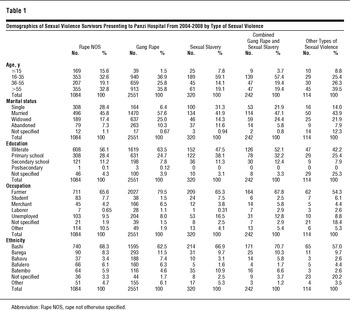
The demographics of women presenting to Panzi Hospital between 2004 and 2008 requesting postsexual violence care were disaggregated according to type of sexual violence (Table 1). Both the mean and median age was 35 years, with an age range of 3.5 to 80 years. In total, 6% of survivors were younger than 16 years of age and 10% were 65 years of age or older. Fifty-three percent of women were married, 22% were widowed, and 9% reported that their spouses had abandoned them. The mean number of children per woman was 3.6, with a median of 3. The number of children per woman ranged from 0 to 12. Also, 59% of women were illiterate, and only 9% had attended secondary or postsecondary school. The majority of women in this data set reported farming as their source of livelihood (74%), and another 10% reported that they were unemployed. The majority of women self-identified with the Bashi tribe (65%).
Demographics of Sexual Violence Survivors Presenting to Panzi Hospital From 2004-2008 by Type of Sexual Violence

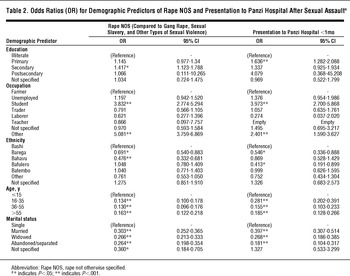
For the purpose of regression analysis, sexual assaults were divided into 2 categories: rape NOS versus all other types (including gang rape, sexual slavery, combined gang rape and sexual slavery, and other types of sexual violence). This division was based on earlier evidence that rape NOS is more likely to be perpetrated by civilians and carries attack characteristics that are distinct from both gang rape and sexual slavery.Reference Bartels, VanRooyen, Leaning, Scott and Kelly12 The complete regression analysis is shown in Table 2.
Odds Ratios (OR) for Demographic Predictors of Rape NOS and Presentation to Panzi Hospital After Sexual Assaulta

In summary, survivors who had completed secondary education were more likely to report rape NOS than other types of sexual assault in comparison to survivors who were illiterate (Odds Ratio [OR] = 1.417, 95% CI = 1.123-1.788). Survivors who were students (OR = 3.832, 95% CI = 2.774-5.294) and survivors who reported “other” occupations (OR = 5.081, 95% CI = 3.759-6.869) were more likely to report rape NOS than other types of sexual assault in comparison with survivors who reported being farmers. Furthermore, survivors who self-identified with the Barega (OR = 0.691, 95% CI = 0.540-0.882) and Bahavu (OR = 0.476, 95% CI = 0.332-0.681) tribes were less likely to report rape NOS than other types of rape in comparison to survivors who self-identified with the Bashi tribe. Survivors who were 15 years of age or younger were more likely to report rape NOS than other types of sexual assault in comparison to survivors in all other age groups (Table 2). Finally, survivors who reported being single were more likely to report rape NOS than other types of sexual assault in comparison to women who reported being married, widowed, or abandoned (Table 2).
Presentation to Panzi Hospital
Many sexual violence survivors who presented to Panzi Hospital came alone (36%). Other women were accompanied by aid workers (13%), family members (7%), or other patients traveling to Panzi Hospital (7%). Less than 1% of women were accompanied by their husbands.
In total, 73% of women reported “vehicle” as their mode of transportation to Panzi Hospital, without differentiating private vehicle, taxi, bus, ambulance, or other. Another 18% walked to the hospital to receive care. Less than 1% of women took a flight to reach Panzi Hospital, and less than 1% traveled by boat.
Most sexual violence survivors (92%) reported that they had originally accessed the services of a nongovernmental organization (NGO) or community-based organization (CBO) and were then referred to Panzi Hospital for care. For 86.29% of those women, the service rendered by the NGO/CBO was referral and transportation to Panzi Hospital. For another 13.62%, the service received was not specified, and only 4 survivors (0.09%) indicated that they had received medical care from the NGO/CBO.
A third of the records did not include the month that the sexual assault occurred. In many instances in which the month of attack was missing, the assault had occurred several years before arrival at Panzi Hospital, thus representing cases in which significant delays occurred between sexual violence and presentation to medical care. To calculate the time intervals between sexual assault and seeking medical care, the month of attack was assumed to be June for any record in which the actual month was not provided.
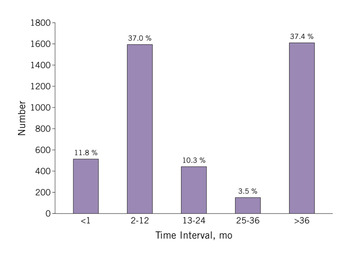
The Figure provides the time intervals between sexual assault and presentation to Panzi Hospital requesting postsexual assault services. The mean time interval was 10.4 months and the median time interval was 7 months. Only 12% of women presented within the first month following the sexual assault. Many women came within the first year following the attack or had a much-delayed presentation, not seeking help for more than 3 years following the assault.
Time Interval Between Sexual Assault and Presentation to Panzi Hospital Requesting Postsexual Assault Services.
Data labels represent percentage of total women in the data set.

Throughout the data collection period, the delay between sexual violence and time to presentation at Panzi Hospital did not shorten. For instance, the average time delay in 2005 was 9.4 months versus 13.7 months in 2008. The analysis for 2004 was difficult because so many of the sexual assault records for 2004 did not include the month of the sexual assault.
We examined whether any demographic factors predicted delay to seeking medical care after sexual assault. For the purposes of this analysis, the time interval between sexual assault and presentation to Panzi Hospital was divided into less than 1 month versus 1 month and longer, as 1 month was the shortest time interval that could be consistently identified in this retrospective analysis. The full regression analysis is provided in Table 2. Survivors who had completed primary education were more likely to present to medical care in the first month than those who were illiterate (OR = 1.636, 95% CI = 1.282-2.088). In addition, survivors who reported being students (OR = 3.973, 95% CI = 2.700-5.868) and survivors who reported other occupations (OR = 2.401, 95% CI = 1.590-3.627) were more likely to present to Panzi Hospital in the first month in comparison to survivors who reported being farmers. Survivors who self-identified with the Barega tribe (OR = 0.546, 95% CI = 0.336-0.888) and Bafulero tribe (OR = 0.413, 95% CI = 0.191-0.899) were less likely to present to Panzi Hospital in the first month as compared with survivors who self-identified with the Bashi tribe. Survivors who were 15 years of age and younger were more likely to present to medical attention in the first month in comparison to survivors in all other age groups (Table 2). Finally, survivors who reported being single were more likely to present to Panzi Hospital within a month in comparison to survivors who were married, widowed, or abandoned (Table 2).
Type of sexual violence and type of perpetrator were also predictive of delayed presentation to Panzi Hospital. Survivors who reported being assaulted by civilians were more likely to present to Panzi Hospital in the first month than were those who reported being assaulted by unidentified soldiers (OR = 5.813, 95% CI = 3.968-8.547), soldiers belonging to an identified armed group (OR = 4.739, 95% CI = 3.289-6.849), and non-specified perpetrators (OR = 3.968, 95% CI = 2.865-5.464). Survivors who experienced gang rape were less likely to present to Panzi Hospital within a month in comparison to survivors who experienced rape NOS (OR = 0.541, 95% CI = 0.422-0.695).
Qualitative Analysis
The qualitative analysis provided insight into why many sexual violence survivors delayed seeking medical attention. For some, presentation to a hospital seemed to be prompted by physical symptoms that worsened over a period of time, finally becoming severe enough that the survivor decided to seek medical care. This was the case with the following woman:
“I was in my house and I heard a noise outside. I decided to flee with my children. Just as we were arriving at the road, I fell. As a result I was caught by the soldiers…. Two men held my legs while the other raped me and then vice versa. My health has deteriorated so I decided to come for testing.”
A 41-year-old widow who presented to Panzi Hospital 8 months after sexual assault.
Other sexual violence survivors did not seek early medical attention because they did not have the means to access care, as was the case in the following instance:
“I was sitting when the soldiers came and entered my house. They began to hit everyone and to loot our belongings. Two men stayed in the house and each took a turn raping me. I didn't feel anything and I did not have the means to come to get medical care.”
A 28-year-old woman who presented to Panzi Hospital 4 months after sexual assault.
In some instances, the spouses and families of survivors were not aware of the sexual assault, and the survivors waited for an opportunity to present to medical attention privately.
“I was in the forest with my children when we met the assailants. They chased my children away and then they both raped me. After they left, I made my way home. My husband is traveling this month. . . and so I came to get tested for sexually transmitted infections and HIV.”
A 35-year-old woman who came to Panzi Hospital 10 months after sexual assault.
For some survivors of sexual slavery, delayed medical care was simply a function of having been abducted for a prolonged period of time. This was the case for the following woman:
“… we arrived in the fields and I was starting to collect cassava when suddenly the six assailants arrived. They tied up my husband, took him away and shot him. After that, the six assailants raped me and took me to the forest where I stayed for 1½ years. Eventually I had an opportunity to escape.”
A 29-year-old widow presented to Panzi Hospital 18 months after being abducted.
Finally, stigma surrounding sexual violence appears to have prevented some women from seeking prompt medical attention. This was the case for the following woman:
“I was sleeping in my house when I heard a knock on the door. When I opened the door, armed soldiers came into the house to pillage. I was intimidated by their guns and I thought they were going to shoot me. I was forced to lie down and they started to rape me. When my husband tried to intervene he was tied up. They tried to force my husband to rape our 3-year-old daughter and when he refused, he was shot and killed. They continued to rape me. . . I have been too ashamed to tell anyone but now I have finally come for help.”
A 50-year-old widow who presented to Panzi Hospital 37 months after sexual assault.
COMMENT
Demographics
Analysis of this data set, consisting of 4311 female survivors presenting to Panzi Hospital seeking postsexual violence care between 2004 and 2008, illustrates sexual violence that is pervasive in the communities of South Kivu. It affects young girls and elderly women who are single, married, divorced, and widowed. It affects the educated and the uneducated, as well as women of different occupations and ethnicities. In general, the educational status,2728 occupation,29 and ethnicity28 of women in this data set reflect the general demographics of women in South Kivu Province, implying that no one is spared. Furthermore, our finding that sexual violence is widespread in Eastern DRC, and affecting women and girls of all demographic backgrounds, is consistent with other reports.Reference Steiner, Benner, Sondorp, Schmitz, Mesmer and Rosenberger9Reference Johnson, Scott and Rughita1628Reference Peterman, Palermo and Bredenkamp30
Although sexual violence affected women from all demographic backgrounds, disaggregation of the data revealed that certain demographic factors were associated with the type of sexual violence experienced. For instance, girls younger than 15 years of age and single women were more likely to report rape NOS than other types of sexual violence. Prior work has suggested that young girls are more likely to be sexually assaulted by civilians,Reference Nelson, Collins, VanRooyen, Joyce, Mukwege and Bartels31 and that civilian perpetrators are more likely to perpetrate rape NOS.Reference Bartels, Scott, Mukwege, Lipton, Vanrooyen and Leaning15 Consistent with our earlier findings, Duroch et al reported that minors were more likely to be sexually assaulted by unarmed civilians.Reference Duroch, McRae and Grais26 Level of education and occupation also appeared to impact the type of sexual violence. Survivors who had completed secondary education, survivors who reported that they were students, and survivors who reported other occupations (including teaching, cooking, housekeeping, health care, and dressmaking) were all more likely to experience rape NOS than other types of sexual violence. It remained unclear why educated women, students, and women in other professions would have been more likely to experience rape NOS rather than gang rape, sexual slavery, or a combination of gang rape and sexual slavery. In South Kivu, urban areas tended to have a more educated population, the population tended to engage in different occupations as opposed to rural areas, and there was less military/militia presence in comparison to rural regions. Therefore, we speculated that it may have been because educated women and women in other occupations live in more urban areas and because a greater proportion of urban sexual assaults was perpetrated by civilians (due to lesser presence of armed combatants) that this trend was observed. Prior work suggested that civilian perpetrators are more likely to commit rape NOS than other types of sexual assault.Reference Bartels, Scott, Mukwege, Lipton, Vanrooyen and Leaning15
Presentation to Panzi Hospital
In this study, there were notable delays before women presented to Panzi Hospital for medical attention. Similar delays were reported by Malteser International,Reference Steiner, Benner, Sondorp, Schmitz, Mesmer and Rosenberger9 by Casey et al,Reference Casey, Gallagher, Makanda, Meyers, Vinas and Austin32 and Duroch et alReference Duroch, McRae and Grais26 at other medical facilities in DRC. In Sierra Leone, lengthy delays before presentation to medical care have also been reported (5 months on average).Reference Amowitz, Reis and Lyons33 These delays have important implications for physical, reproductive, and mental health. Many women sought medical care only when their physical symptoms persisted or became very severe. In an ideal setting, postsexual violence care is recommended within the first 72 hours such that HIV PEP,Reference Workowski and Berman22Reference Smith, Grohskopf, Bkack, JD, Veronese and Struble24 prophylactic antibiotics for STIs,Reference Workowski and Berman22 and emergency contraceptives can be given.Reference Bates and Marx23Reference Linden25 However, with a mean delay of 10.4 months from sexual assault to seeking care, most sexual violence survivors in this study presented to Panzi Hospital too late to benefit from these preventative medical therapies.
Women who reported being sexual assaulted by civilian perpetrators were more likely to present to Panzi Hospital within the first month after the assault than were women who were sexually assaulted by armed combatants or nonspecified perpetrators. This finding contradicted our hypothesis that women who experienced brutal sexual assaults perpetrated by armed militias would suffer more injuries and therefore be more likely to seek prompt medical attention. We believe that civilian-perpetrated sexual assault is more common in larger towns and cities such as Bukavu, and women in these towns and cities can more easily access care at Panzi Hospital. Therefore, this finding may simply reflect sampling bias. Women who reported being gang raped were less likely to present to Panzi Hospital in the first month after the assault; again, this may represent sampling bias, as gang rape is more likely to be perpetrated by armed combatantsReference Bartels, Scott, Mukwege, Lipton, Vanrooyen and Leaning15 in rural villages, and women living in rural villages probably have more difficulty accessing medical care in Bukavu.
Girls younger than 15 years of age and single survivors were also more likely to present to Panzi Hospital within the first month after sexual assault. In the narratives of many of these young girls, it was apparent that they were being brought for medical care by their parents after their parents were informed of the sexual assault.
Qualitative analysis identified multiple reasons why sexual violence survivors had a delayed presentation to Panzi Hospital. Some women presented late because they had been abducted and forced into sexual slavery for a prolonged period, sometimes for months or years. Since the date of the assault was entered as the day that the woman was abducted, prolonged periods of sexual slavery undoubtedly contributed to the prolonged intervals between assault and seeking care (average of 10.4 months). However, other reasons were also noted for delayed presentations. Some women specifically mentioned that they had no means to come to Panzi Hospital earlier. Although our study was not designed to examine this, we speculated that women who lived in rural villages further from Panzi Hospital had more difficulty finding the means to come to the hospital in comparison to women who lived in or close to Bukavu.
In some instances, sexual violence survivors talked about deterioration in their health or about physical symptoms becoming so severe that they finally were prompted to seek medical attention. Thus, there appeared to be a lack of awareness about the benefits of early medical attention following sexual assault, before symptoms begin, such that HIV PEP, prophylactic antibiotics, and emergency contraception can be provided. A study looking at medicolegal services for sexual violence survivors in Kenya also commented on a lack of community awareness about postsexual violence services and about how this might explain delayed care-seeking behavior (although the delays noted in the Kenya study were several days as compared to our reported 10.4 months).Reference Chaudhry, Sangani, Ojwang and Khan34
It may be possible that some symptoms prompting women to seek care were unrelated to the sexual assault. However, to have been referred to the Victims of Sexual Violence Program, these women must have mentioned the sexual assault while they were being triaged and, therefore, they were concerned that the symptoms were related to the assault. In most cases it will be impossible to know whether a symptom such as pelvic pain or vaginal discharge was actually a consequence of sexual violence or was unrelated. Regardless, we identified this as one area of intervention to reduce lengthy delays to medical care—a culturally appropriate, community educational campaign to raise awareness that HIV PEP and emergency contraceptives are most effective if given within the first 72 hours, and that beyond this period they are unlikely to be beneficial. Furthermore, survivors of sexual assault also need to be informed that prophylactic antibiotics can prevent infection with and complications of STIs. Of course, sexual violence survivors who present for early physical care could also benefit from early and culturally sensitive psychological support and mental health services. If raising community awareness improves timely access to medical services, then the availability of medical interventions needs to be ensured, particularly in light of a recent report that none of the 21 public health facilities assessed in Eastern DRC had HIV PEP or emergency contraception available.Reference Casey, Gallagher, Makanda, Meyers, Vinas and Austin32
Some women discussed stigma surrounding sexual assault and about having been too ashamed to seek care earlier. Other women reported that their spouses were not aware of the assault and to prevent their spouses from finding out, they delayed seeking medical care until their spouses were out of town. Here too, we believe that there is an opportunity for intervention to reduce lengthy delays before seeking postsexual assault care. If stigma surrounding sexual violence can be reduced, sexual violence survivors may be more likely to talk about their assaults, more likely to seek the support of family members in accessing postsexual assault services, and more likely to promptly report the sexual violence to health care providers. Addressing stigmatization will require focused sensitization and education at the community level.
The delays documented here were for the period 2004 to 2008. It is noteworthy that since that period, Panzi Hospital and several aid organizations have implemented outreach programs to educate community members about the importance of seeking medical care promptly following sexual assault. The impact of these programs is unknown, and it is possible that delays in seeking care have been reduced since our data were collected.
Limitations
This study has a number of limitations. First, the study's retrospective nature prevented the clarification of data inconsistencies as well as the completion of missing data. The retrospective design also did not allow for verification of the original information or the manner in which it was collected. Second, this study was limited by its sampling methodology. Data represent only those sexual violence survivors presenting to Panzi Hospital for postsexual assault care, thus introducing an inherent selection bias. The sampling within Panzi Hospital was also a limitation. The Victims of Sexual Violence Program was sporadically understaffed, such that an insufficient number of interviewers were available at times to interview all presenting survivors. During these times of understaffing, the available interviewers chose to interview those women whom they perceived, based on the initial triage, to have experienced the most traumatic violence.
Although the potential for selection bias existed, we did not detect any patterns in the data registry gaps. Rather the gaps were sporadic—arising from irregular staffing patterns. It is possible that the sexual violence survivors in this convenience sample have in fact experienced the most severe violence. However, we believe that it would be difficult to determine during the brief triage process which women had suffered the most severe trauma. It is also possible that the sexual violence survivors sampled are different in some way from the general population of women who have experienced sexual violence in Eastern DRC. Other recent retrospective clinic or program-based data share similar sampling biasesReference Steiner, Benner, Sondorp, Schmitz, Mesmer and Rosenberger9Reference Duroch, McRae and Grais26 and in spite of these potential biases, we believe that our large sample size and the collection of data over a 5-year period provides important insights into sexual violence in the region.
In addition, it is possible that some women included in this data set had presented to Panzi Hospital making false claims of sexual assault to access free medical care under the Victims of Sexual Violence Program. However, given the high levels of stigma surrounding sexual violence in DRC and given the potential consequences faced by survivors (for instance, abandonment by husband or family, not being able to marry), we believe that false claims of sexual assault were rare. Furthermore, before being enrolled in the Victims of Sexual Violence Program, staff routinely screens all survivors with a series of questions to verify the history of sexual assault. As a final limitation, several translations were required before the analysis of these data, thus introducing potential errors and cultural differences also have the potential to create errors in interpretation. To limit the later source of error, results were discussed with local Panzi Hospital staff who provided cultural background and context.
CONCLUSIONS
Female sexual violence survivors presenting to Panzi Hospital in 2004 to 2008 represented diverse backgrounds, implying that women of all demographics are at risk for sexual violence in the province of South Kivu. Significant delays occurred before many women presented to hospital, with most women presenting so late that routine postsexual assault care, such as contraceptives and HIV PEP, were rendered ineffective. Five reasons were identified to help explain the lengthy delays to seeking care: waiting for physical symptoms to develop or worsen before seeking medical attention, lack of means to access medical care, concerns that family would find out about the sexual assault, stigma surrounding sexual violence, and being abducted into sexual slavery for prolonged periods of time. Promoting timely access of medical care may best be facilitated by reducing stigma and by educating women, communities, and community leaders about the benefits of early medical care even in the absence of injuries or symptoms.
Acknowledgments: The staff of Panzi Hospital provided frontline care to survivors of sexual violence and have been the bedrock of the Victims of Sexual Violence Program.
Funding and Support: Supported by the Harvard Humanitarian Initiative, Cambridge, Massachusetts. Study was funded by Oxfam America. PMU InterLife (The Swedish Pentecostal Mission Relief and Development Cooperation Agency) funded the Victims of Sexual Violence Program at Panzi Hospital.