Contamination of the skin and clothing of healthcare personnel may occur during doffing of personal protective equipment (PPE).Reference Tomas, Kundrapu and Thota 1 To reduce the risk for contamination during care of patients with suspected or confirmed Ebola virus disease, the Centers for Disease Control and Prevention have recommended disinfection of gloves at multiple steps during PPE doffing. 2 Disinfection of gowns with a disinfectant wipe or spray is also recommended if visible contamination is present. 2 However, pathogen contamination often occurs without visible soiling. Moreover, the effectiveness of disinfectant wipes and sprays for removal of pathogen contamination on gowns is unclear. Here, we tested the hypothesis that an ethanol-based spray disinfectant would be effective in reducing bacteriophage MS2 contamination on cover gowns that may be used in the care of patients with confirmed or suspected Ebola virus infection. Bacteriophage MS2 is a non-pathogenic, nonenveloped RNA virus commonly used to study transmission of viral pathogens.Reference Tomas, Kundrapu and Thota 1 , Reference Casanova, Rutala, Weber and Sobsey 3 Ebola is also an RNA virus, but it is enveloped.
METHODS
Purell Healthcare Surface Disinfectant (GOJO, Akron, OH) is a 1-step cleaner and disinfectant containing 30% ethanol that has bactericidal and virucidal but not sporicidal activity. The product has received the lowest allowable Environmental Protection Agency toxicity rating (category IV) and can be safely applied as a spray. The Cleveland VA Medical Center Institutional Review Board approved the study protocol.
We examined the efficacy of the ethanol-based disinfectant for killing bacteriophage MS2 (American Type Culture Collection 15597-B1, Manassas, VA) using a modification of the American Society for Testing and Materials (ASTM) standard quantitative carrier disk test method (ASTM E-2197-02). 4 Bacteriophage MS2 was propagated in Escherichia coli 15597.Reference Tomas, Kundrapu and Thota 1 We tested 3 gowns, including a Tyvek coverall (PosiUB 3706, West Chester, Monroe, OH), a microporous film composite fabric coverall (Provent 10,000, Kappler, Guntersville, AL), and a surgical gown (Convertors SmartGown, Cardinal Health, Waukegan, IL). Each of the gowns passed both ASTM F1670 and F1671 for resistance to blood and viral penetration. 5 , 6
A volume of 10 μL 5% fetal calf serum containing bacteriophage MS2 was inoculated onto 1-cm2 sections of the gown material and onto 1-cm2 steel disks and was allowed to dry for 30 minutes. The inoculum was adjusted such that 5–6 log10 plaque-forming units (PFU) were recovered from untreated controls. A volume of 50 µL ethanol-based disinfectant or Clorox Healthcare Bleach Germicidal Cleaner (The Clorox Company, Oakland, CA) containing 0.65% sodium hypochlorite (positive control) was added with an exposure time of 30 or 60 seconds; for the steel disks, only a 30-second exposure was tested. The carriers were then submersed in 1 mL of neutralizer consisting of letheen broth (Thermo Scientific, Waltham, MA) containing 0.0125% sodium thiosulfate pentahydrate (Fischer Scientific, Fairlawn, NJ), vortexed 1 minute, and dilutions were plated on selective media and enumerated.Reference Tomas, Kundrapu and Thota 1 Following 24 hours incubation, log10 PFU reductions were calculated in comparison to untreated controls.
Additional experiments were conducted to evaluate the efficacy of the ethanol-based disinfectant for reduction of bacteriophage MS2 from Tyvek PosiUB 3706 coveralls worn by volunteers. The same size Tyvek coverall was worn by 4 taller personnel (>1.83 m [6 feet] tall) and 4 shorter and more petite personnel (~1.52 m [5 feet] tall). The coveralls were inoculated in 7 locations (wrist, elbow, shoulder, chest, waist, knee, and ankle) with 10 uL aliquots of 5% fetal calf serum containing 106 PFU of bacteriophage MS2. After air drying 30 minutes, each coverall was sprayed with the disinfectant. After a 60-second exposure, the suits were sampled using sterile swabs (BBL CultureSwab, Becton Dickinson, San Jose, CA) premoistened with neutralizer solution and processed as described previously. The personnel spraying and wearing the coveralls were blinded to the location of the bacteriophage. An equal number of experiments were conducted in which the person wearing the coverall used a cloth wipe to distribute the ethanol disinfectant evenly. Log reductions were calculated in comparison to untreated control gowns.
All experiments were performed in triplicate. One-way analysis of variance with a post hoc Tukey test was used to compare reductions for different disinfectant groups. The Student t test was used to compare reductions on gowns worn by shorter versus taller personnel and with spray versus spray and wipe methods. Data were analyzed using R version 3.1.1.
RESULTS
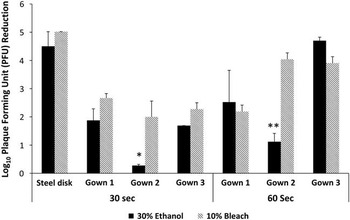
As shown in Figure 1, after a 30-second exposure, reductions for both disinfectants were significantly greater on steel disks than on gown material (P<.01). After both 30 and 60 seconds, the reduction achieved by the ethanol disinfectant on the microporous film composite fabric coverall (gown 2) was significantly less than that achieved on the Tyvek coverall (gown 1) or the surgical gown (gown 3) (P<.05). For the bleach product, there was no significant difference in the reduction achieved for the 3 gown types (P≥.20). For steel disks and gowns 1 and 3, there was no significant difference in the reduction achieved by the 2 products, whereas for the microporous film composite fabric coverall (gown 2) bleach resulted in significantly greater reductions (P<.05).
Efficacy of Purell Healthcare Surface Disinfectant (30% ethanol) and Clorox Healthcare Germicidal Bleach (10% bleach) in reducing recovery of bacteriophage MS2 from steel disk and gown material carriers. The carriers were treated for 30 or 60 seconds. The means of the data from experiments conducted in triplicate are presented. Error bars indicate standard error. Gown 1, Tyvek coverall PosiUB 3706; gown 2, a microporous film composite fabric coverall Provent 10,000; gown 3, a surgical gown Convertors SmartGown. *P<.05 versus gowns 1 and 3; **P<.05 versus Gown 3.

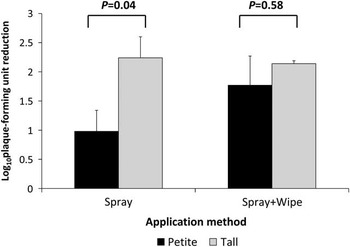
Figure 2 shows the log reductions of bacteriophage MS2 achieved by the ethanol disinfectant on Tyvek coveralls (gown 1) worn by taller or shorter personnel. The coveralls were observed to fit loosely on the shorter and more petite personnel with multiple folds, whereas they fit snugly on the taller personnel. A greater reduction occurred when the ethanol product was sprayed on the gown worn by taller versus shorter personnel (P=.04), but similar reductions were achieved with the spray and wipe method. For taller personnel, there was no significant difference in reductions achieved through spray application alone versus spray with wiping.
The efficacy of Purell Healthcare Surface Disinfectant for reduction of bacteriophage MS2 on Tyvek coveralls (PosiUB 3706) worn by volunteers. The same size coverall was worn by taller personnel (>1.83 m [6 feet]) and shorter and more petite personnel (~1.52 m [5 feet]). The coveralls were inoculated in 7 locations (wrist, elbow, shoulder, chest, waist, knee, and ankle) with 10 uL aliquots of 5% fetal calf serum containing 106 PFU of bacteriophage MS2. After air drying, the coverall was sprayed with the ethanol-based disinfectant; for some experiments the person wearing the coverall also used a wipe to distribute the disinfectant evenly.

DISCUSSION
We found that bleach and an ethanol spray disinfectant reduced bacteriophage MS2 contamination on material from gowns meeting ASTM standard 1671 for resistance to blood and viral penetration. For 2 of the 3 gowns, the ethanol disinfectant was as effective as bleach. The ethanol disinfectant was also effective in reducing recovery of bacteriophage MS2 by>2 logs on cover gowns with a snug fit. These data suggest that the ethanol disinfectant could be useful for rapid disinfection of contaminated full body coverage PPE prior to removal.
Our results suggest that the efficacy of the disinfectants may be affected by factors such as gown material and correctness of fit. The ethanol disinfectant was less effective than bleach on the microporous film composite fabric coverall (gown 2). We observed that this gown rapidly absorbed disinfectants, whereas the other gown materials did not. The gown material is composed of 3 layers; it is possible that rapid absorption of ethanol through the outer layer might result in reduced antimicrobial activity on the surface. We also found that a spray application of the ethanol product was less effective in disinfection of gowns worn by personnel when the gown fit loosely with multiple folds. Avoiding a loose fit or inclusion of a wiping step may improve disinfection.
Our study has some limitations. We did not formally assess tolerability of the spray application. However, participants did not offer concerns regarding odor or adverse effects. Although both products were effective in the presence of fetal calf serum, it is likely that efficacy would be reduced by heavy contamination with blood, vomitus, or feces. Thus, we recommend manual cleaning of visibly contaminated areas prior to application of the disinfectants. Different sampling methods were used in the carrier and gown contamination experiments; therefore, the results cannot be directly compared. Finally, ethanol may be more effective against enveloped viruses such as Ebola than against non-enveloped viruses such as bacteriophage MS2.Reference Sickbert-Bennett, Weber, Gergen-Teague, Sobsey, Samsa and Rutala 7 – Reference Casanova, Teal, Sickbert-Bennett, Anderson, Sexton, Rutala and Weber 9 Therefore, our results may underestimate the efficacy of the ethanol disinfectant against Ebola.
ACKNOWLEDGMENTS
Financial support: This study was supported by the Department of Veterans Affairs and by a grant from GOJO to C.J.D.
Potential conflicts of interest: C.J.D. has received research grants from STERIS, Clorox, Merck, and GOJO, and he has served on scientific advisory boards for 3M. All other authors report no conflicts of interest relevant to this article.