

While more than 20 theories exist within the field of career development, Holland's (Reference Holland1997) theory of personality types consistently ranks amongst the big five (Leung, Reference Leung, Athanasou and Esbroeck2008). Its popularity and application are legion. The use of the Holland types in career development is premised on a person-environment interaction that has been adopted for occupational information as well as career counselling the world over (Su & Rounds, Reference Su, Rounds and Strauser2014). The purpose of this report is to examine the extent to which rehabilitation clients utilise the Holland six vocational types in making their occupational preferences.
Holland's Theory of Vocational Types
Holland (Reference Holland1959, Reference Holland1997, Reference Holland, Savickas and Spokane1999) proposed six personality types (realistic, investigative, artistic, social, enterprising and conventional). These types are presumed to encompass a broad range of interests, abilities and values within outdoor/practical, scientific, creative, people contact, business or clerical/office work activities. Combinations of the six personality types are used to explore opportunities in which a person-environment fit presumes a higher likelihood of success or satisfaction than with non-person-environment-fit preferences (Szymanski & Van Collins, Reference Szymanski and Van Collins2003). This approach to occupational interest has found application in vocational rehabilitation in acquired injury and disability (e.g., traumatic spinal cord injury — Krause, Saunders, Staten, & Rohe, Reference Krause, Saunders, Staten and Rohe2011; mid-life disability — Tenenbaum, Byrne, & Dahling, Reference Tenenbaum, Byrne and Dahling2014).
The Holland vocational interest types have evidence for the predicting workplace behaviour (Nye, Rounds, & Drasgow, Reference Nye, Su, Rounds and Drasgow2017) and long-term occupational interests (Stoll et al., Reference Stoll, Rieger, Ludtke, Nagengast, Trautwein and Roberts2017). This study aimed to explore the utility of the Holland vocational interest types with rehabilitation clients whose disability arose from a variety of accidents. It sought to test the assumption that the implicit features of occupations based on the Holland type may influence rehabilitation clients in their career choice preferences.
Method
Research Design
An exploratory idiographic approach was preferred for this study. This approach is characterised by the study of a unique individual. It is appropriate with small case samples as in clinical rehabilitation and for the goal to analyse specific processes such as judgement and decision-making. The outcome that is achieved is a description of the lawfulness of each person's behaviour. This idiographic approach enables us to determine what features of the context are likely to be relevant to the future interests of each person (see examples of this methodology in Athanasou, Reference Athanasou1998, Reference Athanasou1999, Reference Athanasou2003).
Participants and Setting
The participants (three females; two males) ranged in age from 15 to 48 years. They were five cases from a rehabilitation practice with a disability arising from a personal injury such as a motor-vehicle accident (n = 2), medical negligence (n = 1) or work injury (n = 2). The injuries covered musculoskeletal conditions, psychological impairment as well as a traumatic brain injury. The psychosocial, educational and vocational details for each person are provided in the preamble to each case study. Informed consent was obtained and furthermore, the demographic details have been altered randomly to preserve confidentiality.
Data Collection and Procedure
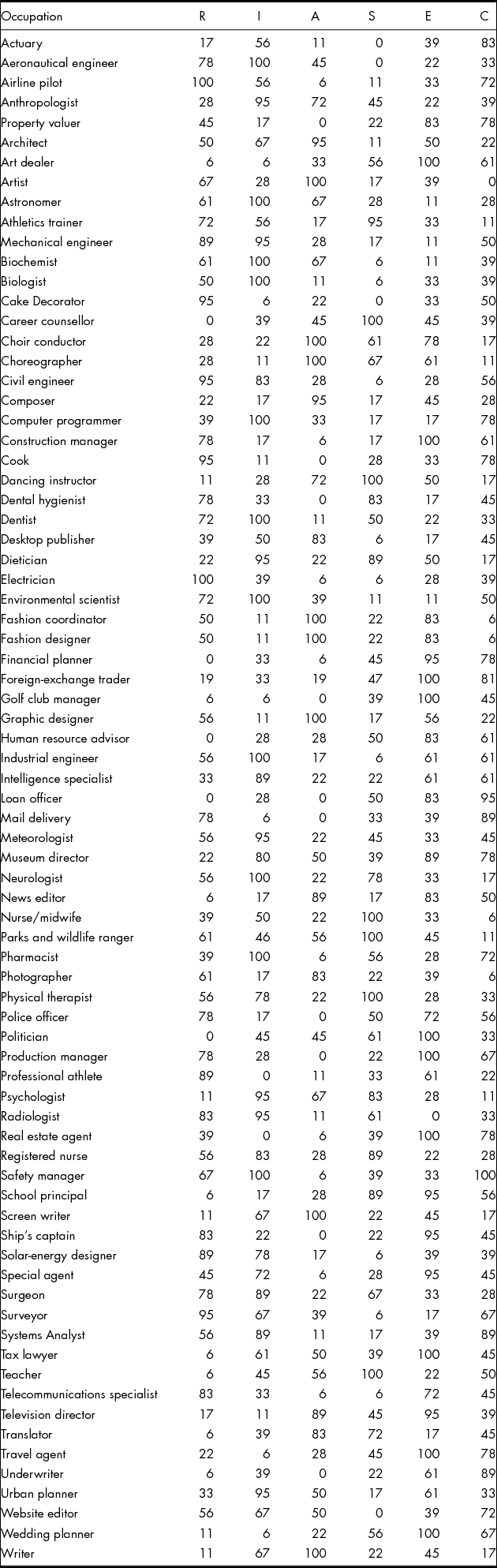
Participants were presented with 77 occupations from a community college career centre and were listed in alphabetical order. Table 1 provides a listing of these occupations together with the relevant Holland interest ratings for realistic, investigative, artistic, social, enterprising and conventional. The occupations ranged from unskilled through to intermediate skill level to professional occupations (35 required a degree; 18 required a diploma; 10 a certificate or trade; 5 some other qualification; and 9 did not require a qualification).
Listing of the occupations used in the study (n = 77) and the relevant Holland interest ratings

R = realistic, I = investigative, A = artistic, S = social, E = enterprising, C = conventional: Source: Riverside Community College, www.rcu.edu.
Procedure
Participants were shown the occupations in alphabetical order and asked to indicate which ones they might be prepared to select. Each occupation had been rated by O*NET (US Department of Labor, 2017) from 0 to 100 for the level of each interest. For instance, the occupation of desktop publisher was rated 39 realistic, 50 investigative, 83 artistic, 6 social, 17 enterprising and 45 conventional. The participant was not aware that the courses had been categorised in this way.
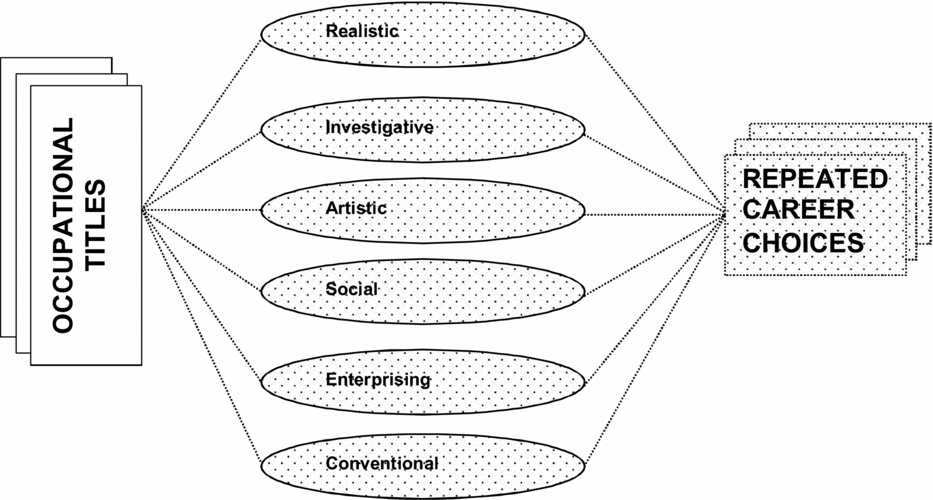
Figure 1 describes the model for investigating individual judgements as it has been applied in this study. The elipses in Figure 1 represent items of information embedded in a career title. In this study, the embedded features are the six personality types (i.e., interests) formulated by Holland. Each occupation can be classified by these six interests. As a person reacts positively or negatively to an occupation, they are implicitly responding to these cues. If we present enough choices then it is possible to describe the role (if any) of such career interests. The individual making the choices would not be aware, however, that they are responding to a series of coded implicit features. Based on this model, it is assumed that the career choices by rehabilitation clients may be influenced by their implicit decision-model which decision-making may also be idiosyncratic.
Implicit features that are present or absent in job titles.

Data Analysis
The analysis of results was undertaken for each individual. The repeated choices of these five cases were examined to determine the role of vocational interest in their occupational choices. This meant that each person formed their own study comprising a sample of 77. Therefore, they acted as their own control in terms of social, demographic and personal characteristics. This allowed for use of the logistic regression of job choice with the six vocational interest types. In this analysis, the person's choices are the dependent variables (binary variable, 1 = chosen and 0 = not chosen) and the vocational interest type is the independent variable (0–100). The analyses for each person were considered separately.
Results
In this section, the results of each case study are presented. The personal and social background of the client is described together with some assessment results to provide a more complete picture of the functioning of the person. The actual occupational choices are listed together with the results of the logistic multiple regression.
Case Study A
Person A is a 48-year-old female clerk, who was injured in a work-related accident, when aged 39 years. She had a musculoskeletal condition with a 10% whole person impairment based on the American Medical Association guidelines. Her educational background involved completion of her schooling to Year 10 level at around age 16 years. She had no post-school qualifications or training. She achieved a perfect score (i.e., not malingering) on the Lezak 15-item test (Lezak, Reference Lezak1995; Rey, Reference Rey1964) which is a memory test designed to assess malingering. Her reading level on the Wide-Range Achievement Test – 4 (Wilkinson & Robertson, Reference Wilkinson and Robertson2006) was commensurate with her schooling and around Year 10 level. Her primary interests on the Career Interest Card Sort (Athanasou & Hosking, Reference Athanasou, Hosking, McMahon and Patton2015) were for Creative and People Contact activities. She had returned to work with a different employer in a different job.
Person A chose the following six occupations from the list of 77 occupations: artist, cake decorator, cook, photographer, real estate agent and wedding planner. Both Artistic and Enterprising types of occupations featured as highly influential in these preferences. The percentage of choices accurately classified by the regression was 92.2% (there is no minimum correct classification given that most occupations are likely to be rejected). The model R-squared for Person A was 0.488 (χ2(6) = 17.7, p = .007) indicating that the overall model was a moderate predictor but only around 20% of the choices (and rejections) were explained by the model. These results are also summarised for all the participants in Table 2.
Log-linear regression coefficients for all six vocational interest types (n = 77)

1Nagelkerke R-squared.
Case Study B
Person B is a 34-year-old female. She was a welfare worker who was injured in a motor vehicle accident, when aged 31 years. Her stated disabilities related to a whiplash injury; there was no hospital admission. She has major problems of psychological adjustment and has been diagnosed by a psychiatrist with a conversion disorder. She achieved a perfect score on the memory test (not malingering). Her educational background involved completion of her schooling to Year 12 level. She had certificate level post-school qualification in welfare. Her reading level on the Wide-Range Achievement Test – 4 was around Year 12 level. On the Career Interest Card Sort her primary interests were for Health and Community activities. She attempted a returned to work but is not working.
Person B chose the following six occupations from the list of 77 occupations: aeronautical engineer, astronomer, biologist, meteorologist, physiotherapist and police officer. The Holland investigative type featured as highly influential in these preferences. The percentage of choices accurately classified by the regression was 92.2%. The model R-squared for Person B was only 0.232 (χ2(6) = 7.9, p = .245).
Case Study C
Person C is an 18-year-old male student, who was injured in a motor vehicle accident, when an infant. He had a major traumatic brain injury with a Glasgow Coma Scale of 3 at the time (coma scale scores range from 3 for very serious loss of consciousness to 15 normal) and has a rated whole person impairment of 14%. There was surgery for his injuries; there are disc problems; and major problems of psychological adjustment. He achieved a perfect score on the memory test (not malingering). His educational background involved recent completion of his schooling to Year 12 level. There are no post-school qualifications at this time. His reading level on the Wide-Range Achievement Test – 4 was around Year 7 level. This is close to average in the Australian population. On the Career Interest Card Sort his primary interests were for Health, Practical and Outdoor activities.
Person C chose the following 15 occupations from the list of 77 occupations: aeronautical engineer, airline pilot, architect, athletics trainer, mechanical engineer, construction manager, electrician, graphic designer, industrial engineer, parks and wildlife manager, photographer, physiotherapist, police officer, surveyor and urban planner. Realistic types of careers featured as highly influential in these preferences. The percentage of choices accurately classified by the regression was 80.5%. The model R-squared for Person C was 0.359 (χ2(6) = 19.6, p = .003).
Case Study D
Person D is a 15-year-old female student, who was injured in a general accident, when aged 10 years. She had surgery for a musculoskeletal injury. There were some minor problems of psychological adjustment. She achieved a perfect score on the memory test (not malingering). She is still at school. Her reading level on the Wide-Range Achievement Test – 4 was around Year 8 level. On the Career Interest Card Sort her major interests were for Health, Creative and People Contact activities.
Person D chose the following 27 occupations from the list of 77 occupations: airline pilot, anthropologist, architect, art dealer, artist, cake decorator, cook, dental hygienist, dietician, fashion coordinator, fashion designer, human resource advisor, intelligence specialist, museum director, parks and wildlife ranger, photographer, professional athlete, safety manager, school principal, ship's captain, special agent, surgeon, teacher, translator, travel agent, wedding planner. Enterprising and artistic types of careers featured as highly influential in these preferences. The percentage of choices accurately classified by the regression was 64.9%. The model R-squared for Person D was 0.128 (χ2(6) = 7.4, p = .278).
Case Study E
Person E is a 30-year-old male, who was injured in a work-related accident, when aged 24 years. He had a musculoskeletal injury requiring surgery and has a rated whole person impairment of 4%. There are no problems of psychological adjustment. He achieved a perfect score on the memory test (not malingering). His educational background involved completion of his schooling to Year 10. There are no post-school qualifications. His reading level on the Wide-Range Achievement Test – 4 was around Year 6 level. On the Career Interest Card Sort, his major interests were for Outdoor and People Contact activities. He returned to his pre-accident work on light duties but his position was terminated and he now works as a forklift operator.
Person E chose the following five occupations from the list of 77 occupations: construction manager, golf club manager, professional athlete, surgeon and surveyor. Realistic types of careers featured as highly influential in these preferences. The percentage of choices accurately classified by the regression was 93.5%. The model R-squared for Person E was 0.251 (χ2(6) = 7.7, p = .256).
Discussion and Conclusion
The results from these five case studies indicated that the combined six interest types were not especially powerful predictors of occupational choices. Only two of the model R-squared values reached statistical significance and at most accounted for only around 20% of the variation in choices or rejections.
As one might expect there were large personal differences in the judgement policies. It was as though they used only a portion of the hexagonal structure of the Holland interest types for their decision-making. Person A considered the Investigative nature of the occupation as the basis for indicating interest or disinterest; Person B relied heavily on Investigative and Realistic cues for choice or rejection; Person C relied almost exclusively on Realistic as their basis for preference or dislike; Person D reverted to Investigative and Social for their decision-making; and Person E focused almost equally on the Realistic and Artistic components.
This study was essentially quantitative but also descriptive. As such, no claim is made that generalisations to other cases can be made from these individuals. Nevertheless, there was still a large portion of the variance in occupational choice that was not mediated by interests. Their occupational choices may also be influenced by factors such as abilities, values, education and training requirements, prestige, sex-stereotyping of occupations, earnings or labour market prospects as well as any pertinent vocational limitations of persons who have an injury or disability. For instance, in the case of cystic fibrosis factors that influenced career choice were ‘illness appraisal, occupational compromise, persistence and altruism’ (Pablo, Pomeranz, & Young, Reference Pablo, Pomeranz and Young2018, p. 425). Such personal variables were not considered in this study.
Although vocational interests as a whole did not influence choices it seems likely that the participants had some underlying rationale. The judgements were not random. One of the difficulties in exploring occupational choices is that so many options are rejected at the outset. In essence, this became a study of occupational rejection rather than preference. As suggested in an earlier study of course choices, people first took ‘. . .cognisance of their dislikes but then other factors such as relevance and value intervened in making the final choices’ (Athanasou, Reference Athanasou2013, p. 30).
In short, it is suggested that further research examines the extent to which the totality of interests may be sufficient for career choices. It may simply be too much — too high a cognitive load — for someone to take into account all the six interest types. Rehabilitation clients may utilise a simpler judgemental heuristic of focusing on their prime dislike or their prime interest preference as they encounter each choice option. Gigerenzer and Goldstein (Reference Gigerenzer and Goldstein1996) described this as a fast-and-frugal approach to making judgements under conditions of complexity and uncertainty. So that, in deciding whether one likes an occupations a person uses the most important information that they have about themselves which is (a) readily available to him/her, (b) which is within the limits of their knowledge of the world and (c) which is within their computational power. At the very least, the findings suggest that rehabilitation counsellors explore choices in some depth rather than utilise a one-off omnibus interest inventory approach to vocational interest assessment. In essence, the proposition that all six vocational interest types accounted for occupational choices was not supported in this investigation and it raises questions for future research to determine which factors (e.g., physical or mental capacity, prestige, earnings) might be operating for a particular client.
Acknowledgement
The helpful comments of the editor and two anonymous referees are gratefully acknowledged.
Funding
This research received no specific grant from any funding agency in the public, commercial or not-for-profit sectors.
Conflict of Interest
None.