Introduction
A substantial increase in the number of institutionalised elders has become evident in recent years in many western countries, as a consequence of the growing elderly population and the rise in mean life expectancy (Tanner and Bercaw Reference Tanner and Bercaw2005). Elder abuse is a prominent problem in residential long-term care institutions (Baker and Heitkemper Reference Baker and Heitkemper2005; Harnett and Jönson Reference Harnett and Jönson2010). It includes physical, psychological and sexual abuse, financial exploitation, passive or active neglect, and violations of rights (Dixon et al. Reference Dixon, Manthorpe, Biggs, Mowlam, Tennant, Tinker and McCreadie2010; Joshi and Flaherty Reference Joshi and Flaherty2005; Payne and Burke-Fletcher Reference Payne and Burke-Fletcher2005). Lowenstein's (Reference Lowenstein1999) broad definition of abuse included violations of care, such as lack of privacy, de-individuation, infantilisation and disrespectful behaviours, which impair the elder residents' quality of life.
Precise data on the prevalence of abuse or neglect in long-term institutions for frail older people are lacking, because of the hidden nature of abuse in institutions (Baker and Heitkemper Reference Baker and Heitkemper2005) and inadequate procedures for its assessment and identification (Liang Reference Liang2006). Based on a multi-dimensional analysis of the situation in Israel, Lowenstein (Reference Lowenstein1999) concluded that severe forms of abuse were mainly confined to a few small, private unlicensed facilities, but a wider range of mistreatments, including disrespectful behaviours and humiliation, were much more prevalent. A study of frail older people living in the community or in nursing homes and sheltered homes in Sweden revealed that 11 per cent of the nursing aides had observed incidents of physical, psychological, financial and sexual abuse or neglect, while 2 per cent admitted committing abusive behaviours (Saveman et al. Reference Saveman, Astrom, Bucht and Norberg1999). A German study found that 79 per cent of the care staff at an 80-bed nursing home had observed cases of physical and verbal abuse or neglect during the previous year (Goergen Reference Goergen2001). In another large study, 36 per cent of 577 randomly-selected nurses and nursing-aides reported observing, and 10 per cent reported committing, physical abuse during the previous year. Eighty-one per cent had observed and 40 per cent had committed psychologically abusive acts over this period (Pillemer and Moore Reference Pillemer and Moore1989). A recent study of Norwegian nursing homes found that 91 per cent of the nursing staff reported observing at least one act of inadequate care, and 87 per cent reported committing at least one act of inadequate care (Malmedal, Ingebrigtsen and Saveman Reference Malmedal, Ingebrigtsen and Saveman2008).
The elderly residents of long-term care institutions are particularly prone to abuse and neglect as a result of their physical and mental frailties, dependency and their social isolation, which limits their ability to report maltreatment and is compounded by the fear of being punished or subjected to vengeance by the carers who perpetrate abusive behaviour (Joshi and Flaherty Reference Joshi and Flaherty2005). Abusive behaviours by nursing-home staff have been found to be related to the highly stressful nature of the work, insufficient staffing, time pressures, high burnout, low salaries and weak supervision and support, as well as residents' aggressive behaviour (Conlin Shaw Reference Conlin Shaw1998; Hawes Reference Hawes, Bonnie and Wallace2003; Pillemer and Moore Reference Pillemer and Moore1989). From previous studies and clinical experience, it is evident that the identification of abuse is extremely problematic because of its complex and uncertain nature, and that current methods induce many misidentifications: cases may be missed because they are hidden or as a result of the unawareness and poor training of professionals; false identifications occur because of confounding medical conditions, and there are spurious complaints by residents with cognitive or mental difficulties and by family members with unrealistic expectations or who are misinformed (Fulmer et al. Reference Fulmer, Paveza, Abraham and Fairchild2000; Harnett and Jönson Reference Harnett and Jönson2010; Lachs and Pillemer Reference Lachs and Pillemer2004; Lachs et al. Reference Lachs, Williams, O'Brien, Pillemer and Charlson1998). Cohen et al. (Reference Cohen, Halevi-Levin, Gagin and Friedman2007) demonstrated that three approaches to the identification of elder abuse are needed, namely direct questions about experiences of abuse, looking for signs of abuse, and evaluations of the risk of abuse.
The evaluation of the risk of abuse is an essential step toward identifying cases of abuse where the person does not or cannot complain and signs are not detectable. The risk of abuse has mental, cognitive, behavioural, interpersonal, economic and health-related components, and previous studies have shown that such indicators predict to a high degree actual cases of abuse in the community-dwelling older population (Cohen et al. Reference Cohen, Halevi-Levin, Gagin and Friedman2006, Reference Cohen, Halevi-Levin, Gagin and Friedman2007; Reis and Nahmiash Reference Reis and Nahmiash1998). The efficiency of tools for identifying risk of abuse among the residents of long-term facilities has not been assessed, however, and while many cases of abuse in nursing homes go unidentified (Liang Reference Liang2006), the hospitalisation of the residents provides an opportunity to identify those who have been abused. Hospital episodes facilitate examinations for signs of physical violence, malnourishment, excessive or insufficient administration of drugs, and poor hygiene (Shugarman et al. Reference Shugarman, Fries, Wolf and Morris2003). Blood tests give further indications of the patient's nutritional and physical status, e.g. albumin level is a reliable measure of the nutritional status of frail older people (Phaneuf Reference Phaneuf1996), and so could be an indicator of neglect and maltreatment (Cohen et al. Reference Cohen, Halevi-Levin, Gagin and Friedman2006).
Background: long-term care residential facilities for older people in Israel
In Israel in 2004, there were 369 long-term care residential facilities for older people and they accommodated 27,130 residents. They included elderly homes, sheltered homes and nursing homes or ‘nursing (long-stay) departments’ of hospitals. Twenty-three per cent of the residents were independent in the activities of daily living (ADL), 22 per cent were frail (partially limited in ADL and in mobility), 10 per cent were defined as mentally frail, and 45 per cent were dependent in all ADL (and mostly not mobile) and required full nursing care (Beer Reference Beer2004; Brodsky, Shnoor and Bewer Reference Brodsky, Shnoor and Bewer2008). The rate of institutionalisation of people aged 65 or more years in Israel in 2000 was 4.1 per cent, compared with 5.1 per cent in the United Kingdom and more than 8 per cent in The Netherlands and Sweden (Beer Reference Beer2004). The low institutionalisation rate may be partly related to the strong family ties, to the growing system of community-based services offered to frail older people in Israel, or to other policy differences (Lowenstein Reference Lowenstein1999).Footnote 1 Nearly three-quarters (72%) of the residents of long-term care facilities were aged 80 or more years, compared to 22 per cent of those aged 80 or more years living in the community. Among the residents there are three women for every man, and 18 per cent of the residents are married compared to 57 per cent of older people living in the community.
The aim of the reported study was to identify signs of abuse and to elicit disclosures of abuse among the residents of long-term care facilities. In addition, we wished to assess how far the risk indicators that have been found suitable for identifying abuse among community-dwelling older people applied in long-term residential facilities, and to assess these in relation to socio-demographic and health variables. The study used Lowenstein's (Reference Lowenstein1999) broader definition of abuse that includes physical and psychological abuse, neglect, financial exploitation, disrespectful behaviour and humiliation.
Methods
The sample was 71 patients who were hospitalised in internal medicine and orthopaedic departments in two major university hospitals in Israel, the Rambam Medical Center in Haifa, and the Hadassah Medical Center in Jerusalem. Eligible patients were those aged 70 or more years with good cognition who lived in nursing homes or sheltered-home facilities and needed assistance with two or more ADLs. The reported analysis derives from a larger study that sought to identify people at high risk of abuse among the patients hospitalised during 2005–06 (Cohen et al. Reference Cohen, Halevi-Levin, Gagin and Friedman2007). The interviews were conducted by social workers experienced in geriatric and hospital social work and trained for the study. Details of the patients' medical condition were recorded from the patients' files, with their agreement.Footnote 2
Measures
Age, gender, living arrangement and kinship ties were established for each participant. The health variables were the number of and reasons for hospitalisations during the previous year, continence/incontinence, blood levels of albumin (grams per decilitre: g/dl), creatinine (milligrams/decilitre; mg/dl) and urea nitrogen (mg/dl). The last two are indicators of renal functioning but may also indicate dehydration or malnutrition.
A 24-item questionnaire that listed maltreatment/abusive acts was designed for the study drawing from established questionnaires (cf. Kottwitz and Bowling Reference Kottwitz and Bowling2003; Wan, Tseng and Chen Reference Wan, Tseng and Chen2007). It prompted each participant to disclose if they had suffered any of a wide range of maltreatment and abusive acts committed by staff at their residence. The responses could range from ‘0’ ‘never’ to ‘3’ ‘almost all the time’. The sum of the 24 scores can range from 0 to 72. Factor analysis was conducted to examine whether the reported behaviours reflected underlying behaviour dimensions. Tests of the suitability of the data for factor analysis showed satisfactory results (the Kaiser-Meyer-Olkin test score was 0.74, exceeding the recommended cut-off of 0.60) (Kaiser Reference Kaiser1974), and Bartlett's (Reference Bartlett1954) sphericity test was statistically significant (p=0.0001). The final result showed four factors, all with Eigen values higher than 1, and in aggregate they explained 87.4 per cent of the variance. Factor 1 with seven items was labelled ‘neglect of personal basic needs’; for example, food or drink not being provided when requested, not being taken to bathe, not being cleaned when necessary, not being taken outdoors, not having bedclothes changed as needed, and requests for help not being answered. The internal consistency (α) of this subscale was 0.89.
Factor 2 of five items was labelled ‘humiliation behaviour’; for example, violation of personal privacy, flouting the requirements of personal modesty, diapering when not necessary, being ignored, and giving help impatiently. The internal consistency (α) of this subscale was 0.87. Factor 3 of five items was labelled ‘psychological abuse’; for example, insults, ridicule, shouting, swearing, and deliberately angering the respondent. The internal consistency (α) of this subscale was 0.89. Factor 4 of seven items was labelled ‘physical abuse’; for example, pushing, hitting, pinching, applying restraint, holding tightly, and threatening. The internal consistency (α) of this subscale was 0.88.
The Signs of Abuse Inventory (Cohen et al. Reference Cohen, Halevi-Levin, Gagin and Friedman2006, Reference Cohen, Halevi-Levin, Gagin and Friedman2007) assessed evident signs of physical and sexual abuse, financial exploitation and neglect, as detected by the professional staff. The instrument was assessed for validity and reliability, as previously described. Signs of psychological abuse were not assessed in the present study as they are almost impossible to detect without direct observation or personal reports. Signs of abuse were identified by the social workers and nurses on the hospital wards by means of a personal interview with the participant, a physical check-up and a detailed overall evaluation of the patient's condition at admission. The severity of abuse was scored for each item on a scale from ‘0’ ‘not at all’ to ‘4’ ‘extreme’. Details of the abuse subscales are available in Cohen et al. (Reference Cohen, Halevi-Levin, Gagin and Friedman2006, Reference Cohen, Halevi-Levin, Gagin and Friedman2007). The internal consistency (α) of the four subscales (signs of physical abuse, sexual abuse, financial exploitation and neglect) was 0.71–0.90.
Based on the Indicators of Abuse (IOA) screen described by Reis and Nahmiash (Reference Reis and Nahmiash1998), an expanded semi-structured instrument (E-IOA) was developed and extensively tested for reliability and validity, the results showing very good psychometric properties (for details seeCohen et al. Reference Cohen, Halevi-Levin, Gagin and Friedman2006, Reference Cohen, Halevi-Levin, Gagin and Friedman2007). This was administered to the participants and the internal consistency (α) of the scores was 0.82. The E-IOA includes indicators of risk regarding the older person and the care-giver. In the present study, only the older person's indicators were used. These included behaviour difficulties, emotional difficulties, family/marital conflicts, isolation, unrealistic expectations, level of understanding of one's medical condition, lack of support, poor interpersonal relationships, social isolation, emotional dependence and cognitive difficulties. Answers were given on an intensity scale (from ‘0’ ‘not at all’ to ‘4’ ‘very much’) or a frequency scale (‘0’ ‘never’ to ‘4’ ‘very often’). Unavailable information was a separate category. The mean risk score was calculated: the higher the score the greater the risk of abuse.
Statistical analyses
Factor analysis, using principal components analysis, was performed for the list of maltreatment complaints. The participants were divided into two groups: those found positive and negative for signs of abuse. Chi-squared and t-tests were performed to assess the differences between the groups with regard to socio-demographic and health attributes, self-reported abuse and risk factors. Pearson bivariate correlation coefficients and hierarchical regression analyses were conducted to assess the relationships among the study variables. Variables found significantly associated with at least one of the outcome variables were included in the regression analyses.
Results
Disclosure of maltreatment/abuse
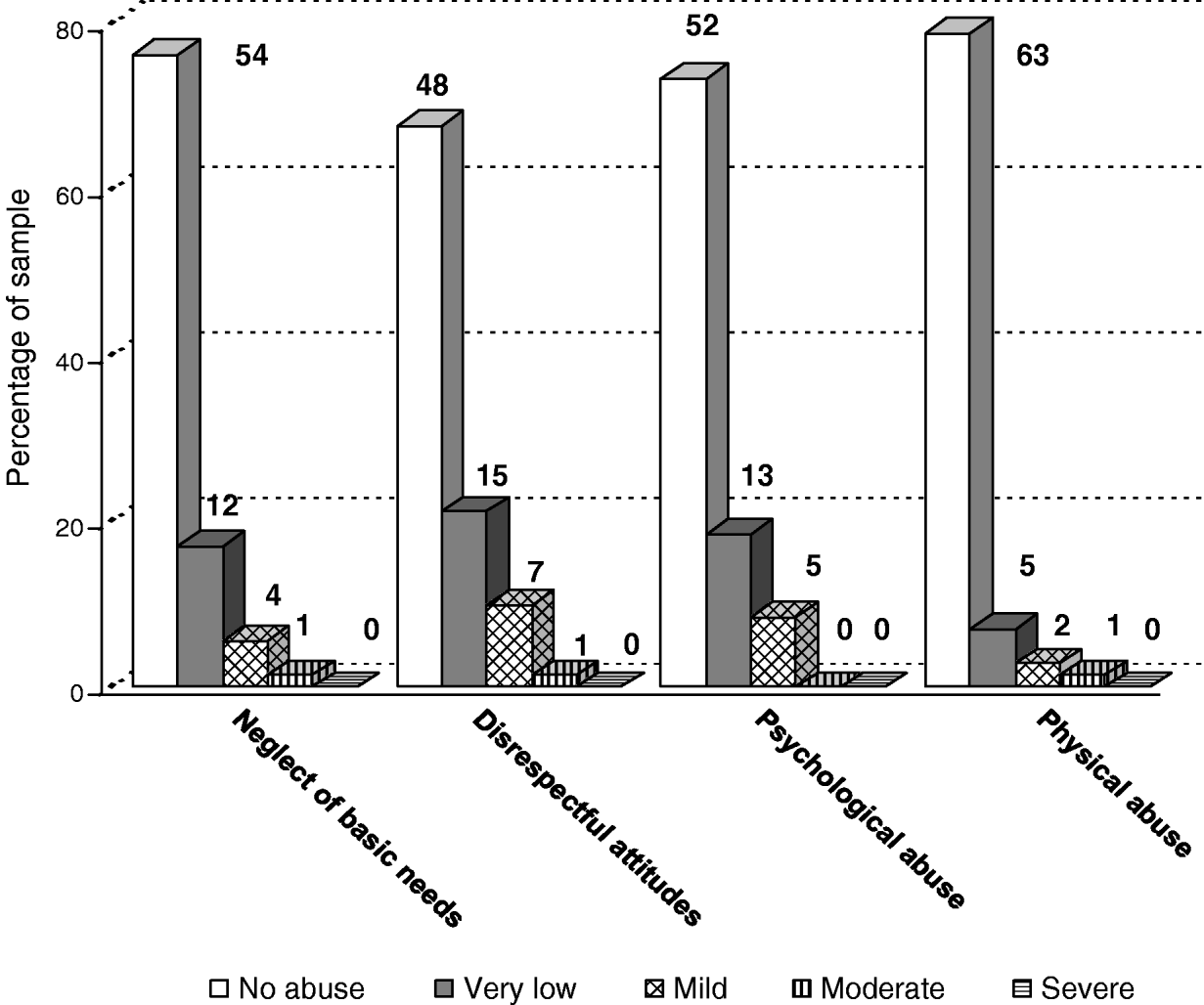
Twenty-two (31.0%) patients reported that they had experienced some maltreatment or abusive behaviour during the previous year. Eight (11.3% of entire sample) reported a very low level of maltreatment/abuse (total score 1–3), six (8.4%) reported mild maltreatment/abuse (total score 4–10), seven (9.9%) reported moderate maltreatment/abuse (total score 11–20), and one (1.4%) had a score of 51 indicative of severe maltreatment/abuse. The distribution of the four types is shown in Figure 1. Most reported complaints were forms of humiliation, followed by neglect of basic needs and psychological abuse; the lowest rate of complaints was for physical abuse. Most of the complaints were in the very low and low categories. Eight (11.3%) of those who disclosed maltreatment or abusive behaviours reported on all four categories of abuse, seven (9.9%) reported three categories, and seven (9.9%) reported one or two categories of maltreatment.
Distribution of disclosed maltreatment/abuse. Note: Numbers on the plot are frequencies.

Identified signs of abuse
Signs of neglect (score 3 or more on the neglect subscale) were identified in nine patients (12.6%). Five (7.0% of the entire sample) had a marginal score of 3, two (2.8%) had scores of 5–9, and two (2.8%) scores of 13 and 17, both indicative of severe neglect. Signs of physical abuse (3 or more on the physical abuse subscale) were identified in three (4.2%) patients, of whom two (2.8%) had a score of 3 and one (1.4%) a score of 4. Only two (2.8%) patients had scores of 3 on exploitation. No cases of sexual abuse were identified. In sum, 14 (19.8%) participants had total scores of 3 or higher indicating signs of abuse (neglect, physical abuse and exploitation). Six (8.5%) scored 3, indicative marginal severity, six (8.5%) had scores from 4 to 10, and two (2.8%) obtained scores of 13 and 17. For only one respondent (1.4%) was neglect, exploitation and physical abuse found together, but two types of abuse were identified in two others (2.8%), and in the remainder only one type of abuse was detected.
Differences between the participants identified and not identified for abuse
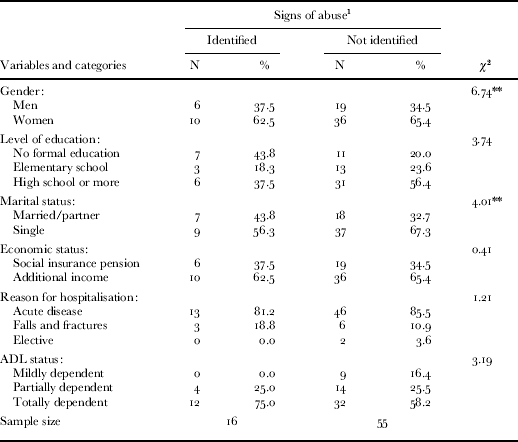
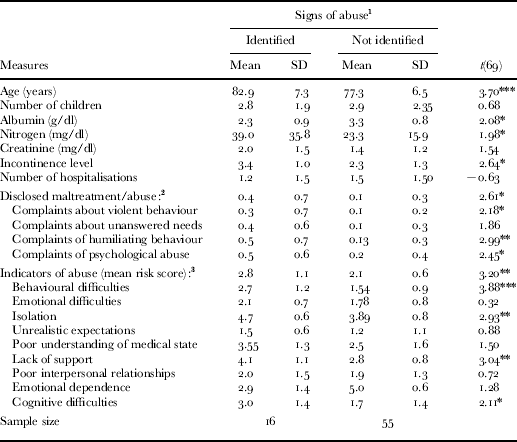
The socio-demographic and health characteristics of the participants by whether signs of abuse were identified are presented in Tables 1 and 2. The participants' ages ranged from 70 to 99 years and the mean was 81.6 (standard deviation 7.5). Both groups had more women than men, a high proportion with only basic or no education, and a majority of single people, and two-thirds of the participants had sources of income other than the basic social insurance pension. These figures are compatible with the profiles of residents in long-term facilities in Israel and of people in advanced old age in Israel (Beer Reference Beer2004; Brodsky, Shnoor and Bewer Reference Brodsky, Shnoor and Bewer2008), except for a relatively high representation of married people. Significantly more of those identified for abuse were women and single, were older, had lower levels of albumin and higher levels of nitrogen in the blood, and had more incontinence problems. Those identified and those not identified for abuse did not differ significantly in level of education, number of children, economic situation, creatinine level or ADL status. The participants identified with signs of abuse also had significantly higher disclosures of maltreatment or abuse (Table 2), and specifically reported more violent behaviour, humiliating behaviour and psychological abuse. They also scored significantly higher on indicators of abuse, specifically isolation, lack of support, behavioural difficulties and the measured cognitive difficulties.
The participants' socio-demographic and health characteristics by identified signs of abuse status

Notes: 1. Measured by the Signs of Abuse Inventory (see text and Cohen et al. Reference Cohen, Halevi-Levin, Gagin and Friedman2006, Reference Cohen, Halevi-Levin, Gagin and Friedman2007). ADL: activities of daily living.
Significance levels: * p<0.05, ** p<0.01.
Socio-demographic and health scores (continuous variables) and disclosures and risk indicators of maltreatment by identified signs-of-abuse status

Notes: 1. Measured by the Signs of Abuse Inventory. 2. Total score. Determined using a list of maltreatment/abusive acts. 3. Measured by the E-IOA. For details of the measures and units of measurement, see text and Cohen et al. (Reference Cohen, Halevi-Levin, Gagin and Friedman2006, Reference Cohen, Halevi-Levin, Gagin and Friedman2007). SD: standard deviation.
Significance levels: * p<0.05, ** p<0.01, *** p<0.001.
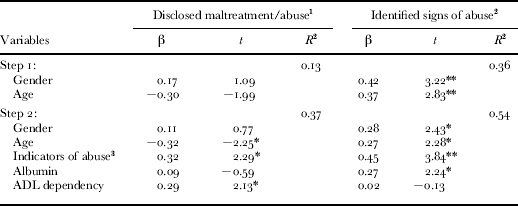
Hierarchical multivariate regression analysis was conducted to assess the predictability of abuse, namely reported maltreatment or identified signs, by means of the socio-demographic variables and abuse indicators (Table 3). In the regression model for disclosed maltreatment/abuse, the socio-demographic variables alone were not significantly associated with more disclosed maltreatment/abuse (Step 1). The risk indicators and ADL dependency score added in Step 2 significantly associated with more disclosed maltreatment/abuse. The model explained 37 per cent of the variance in disclosed maltreatment/abuse (F (5, 63)=4.08; p<0.01). Regarding the regression model for identified signs of abuse, age and gender significantly associated with more signs of abuse and explained 36 per cent of the variance at Step 1 (F (2, 63)=10.54; p<0.001). Indicators of abuse, level of albumin in the blood and degree of ADL dependency were entered at Step 2; of these, indicators of abuse and albumin level significantly associated with identified signs of abuse, and added 18 per cent to the explained variance (F (5, 61)=9.45; p<0.001).
Result of hierarchical multiple regressions of disclosed maltreatment/abuse and identified signs of abuse

Notes: 1. Determined using a list of maltreatment/abusive acts. 2. Measured by the Signs of Abuse Inventory. 3. Measured by the E-IOA. For details of the measures and units of measurement, see text and Cohen et al. (Reference Cohen, Halevi-Levin, Gagin and Friedman2006, Reference Cohen, Halevi-Levin, Gagin and Friedman2007). ADL: activities of daily living. β: beta regression coefficient.
Significance levels: * p<0.05, ** p<0.01.
Discussion
The study has several limitations. The number of participants was too few for generalisations to the wider population, and the sample may not be representative of the residents of all long-term care facilities. Larger samples are needed to conduct more sophisticated analysis. The study was cross-sectional without follow-up of the patients who reported or were identified as suffering from abuse. Another shortcoming is that signs of psychological abuse, which are major problems in nursing homes and other residential facilities, were not assessed because they are usually evaluated by outcomes such as apathy, depression and fearfulness that are congruent with the reactions of older people to loss, illness or cognitive deterioration in old age (Ansen and Breckman Reference Ansen and Breckman1988).
That said, this study has been the first to assess the prevalence and correlates of elder abuse in long-term facilities in Israel using direct questioning, by identifying signs of abuse and through the calibration of risk indicators. Consistent with the results of a previous study (Lowenstein Reference Lowenstein1999), the results have shown a low prevalence of physical abuse but much higher rates of broadly defined abuse, including psychological mistreatment, violations of privacy and other humiliating behaviours. Compared with the few existing reports in other countries of the abuse reported by nursing-home staff (Goergen Reference Goergen2001; Malmedal, Ingebrigtsen and Saveman Reference Malmedal, Ingebrigtsen and Saveman2008; Pillemer and Moore Reference Pillemer and Moore1989; Saveman et al. Reference Saveman, Astrom, Bucht and Norberg1999), the observed prevalence is notably low. Reports by staff members may yield a more accurate view of abusive behaviours than the residents themselves are ready to admit. Actual cases may well be higher than those found in the study, reflecting the participants' efforts to hide or deny abuse (Lachs and Pillemer Reference Lachs and Pillemer2004), or because of the difficulties in identifying signs of abuse (Cohen et al. Reference Cohen, Halevi-Levin, Gagin and Friedman2007). Inconsistent findings may also arise from differences among settings, or from the strict criteria for defining signs of abuse in the present study.
The study has shown that direct questioning of non-demented residents is an important tool by which to elicit the disclosure of maltreatment and abusive behaviours. Direct questions evince instances of abuse, but the responses may be influenced by emotional or cognitive states; for example, they might reflect dissatisfaction with living in a nursing home, with dependency on others, or of being torn away from home and denied privacy, and they could be related to other personal and interpersonal factors. On the other hand, residents may not be aware of all instances of abuse, such as the neglect of their medical or nutritional needs. The most prevalent indicators of abuse detected in the present study were signs of neglect, while very few signs of physical abuse were identified, which is consistent with findings for community-dwelling elders (Cohen et al. Reference Cohen, Halevi-Levin, Gagin and Friedman2006, Reference Cohen, Halevi-Levin, Gagin and Friedman2007; Lowenstein et al. Reference Lowenstein, Eisikovits, Band-Winterstein and Enosh2009). Sexual abuse was not detected, one hopes because no such instances occurred, but perhaps because most are undetectable in a physical check-up.
The efficient identification of signs of abuse, intended to reveal actual symptoms and conditions, requires highly aware and trained professional staff. They must also be alert to differences between actual signs of neglect and various symptoms of diseases, medical conditions, cognitive impairment or self-neglect (Lachs and Pillemer Reference Lachs and Pillemer2004). Indicators of abuse have previously been found to predict abuse and neglect among community-dwelling older people (Cohen Reference Cohen2008; Cohen et al. Reference Cohen, Halevi-Levin, Gagin and Friedman2006, Reference Cohen, Halevi-Levin, Gagin and Friedman2007; Reis and Nahmiash Reference Reis and Nahmiash1998), but have not been assessed in residential institutions. In the present study, some risk indicators were significantly higher in patients identified with signs of abuse, which substantiates the findings of previous studies of community dwellers (Cohen Reference Cohen2008; Cohen et al. Reference Cohen, Halevi-Levin, Gagin and Friedman2007). These were behavioural difficulties, isolation, lack of support and cognitive difficulties. Residents' behavioural difficulties and cognitive impairments often increase conflict and frustration among the carers. Conflicts between residents and staff members have been found to instigate abuse, and cognitive impairment may decrease patients' co-operation in their own care and worsen self-neglect (Pillemer and Bachman-Prehn Reference Pillemer and Bachman-Prehn1991). In the present study, isolation was defined as a low number of visits reported by the elder person. Visitors can exert control on the staff and on the quality of care, so few or none, as well as lack of support, may encourage abuse by staff members, with lower concern for the consequences (Harnett and Jönson Reference Harnett and Jönson2010). Also, residents' unrealistic expectations impede the care-taking role, and make it more frustrating and prone to more conflicts (Cohen et al. Reference Cohen, Halevi-Levin, Gagin and Friedman2006).
Physiological and medical parameters have rarely been investigated in relation to abuse situations, although many clinicians have reported that abused elderly patients, especially those suffering neglect, are in a substantially worse state of health and more vulnerable to disease and even death (Lachs et al. Reference Lachs, Williams, O'Brien, Pillemer and Charlson1998). This study is one of few to demonstrate that albumin and nitrogen levels and severity of incontinence are significantly higher in patients with signs of abuse. This relationship may be bidirectional, however, for the neglect of a resident can worsen their health, or residents with worse health status may be more liable to neglect. The present study shows that once a thorough assessment is conducted, it is possible to detect abuse or maltreatment, and that the assessment should be conducted by both direct questioning and by identifying signs of abuse and risk indicators. These results highlight the need to improve the quality of care in long-term facilities. More supervision and training programmes are needed to raise staff members' awareness of their possibly abusive behaviour (Gibbs and Mosqueda Reference Gibbs and Mosqueda2004; Pillemer and Bachman-Prehn Reference Pillemer and Bachman-Prehn1991). Clear directives as to what constitutes abuse, detection and the management of abuse are needed, for where applied they have been found efficient (Payne and Burke-Fletcher Reference Payne and Burke-Fletcher2005; Weatherall Reference Weatherall2001).