1. Introduction
Insecure property rights over land – a central theme in environmental and development economicsFootnote 1 – explain many economic outcomes in the developing world (Feder et al., Reference Feder, Chalamwong, Onchan and Hongladarom1988; Besley, Reference Besley1995; Deininger and Chamorro, Reference Deininger and Chamorro2004; Rozelle and Swinnen, Reference Rozelle and Swinnen2004; Field, Reference Field2005; Deininger et al., Reference Deininger, Ali, Holden and Zevenbergen2008; Goldstein and Udry, Reference Goldstein and Udry2008; Besley et al., Reference Besley, Burchardi and Ghatak2012; Acemoglu et al., Reference Acemoglu, Chaves, Osafo-Kwaako, Robinson, Edwards, Johnson and Weil2014; de Janvry et al., Reference De Janvry, Gonzalez-Navaro, Emerick and Sadoulet2015; Di Falco et al., Reference Di Falco, Laurent-Lucchetti, Veronesi and Kohlin2020). This paper investigates the role of enhanced land rights in reducing the negative impact of climatic factors in agriculture. To this end, we use a Ricardian model (Mendelsohn et al., Reference Mendelsohn, Nordhaus and Shaw1994) and exploit a natural experiment: the assignment of enhanced property rights via a land certification program in the highlands of Ethiopia. We find that farm revenues are responsive to both rainfall and temperature anomalies. Enhanced property rights, importantly, somewhat reduce some of the economic effects of adverse climatic conditions. The impact of rainfall anomalies is indeed reduced by 4 per cent after certification. While we cannot totally rule out the potential effect of confounders, we probe our identification via a set of robustness checks.
Understanding the potential mitigating role of enhanced property rights on climate change adaptation is very important. Climate change is a major threat to small-scale subsistence farmers in rural Africa. Changes in temperature and more erratic rainfall reduce agricultural productivity, resulting in food insecurity and less welfare (Parry et al., Reference Parry, Rosenzweig and Livermore2005; Kurukulasuriya et al., Reference Kurukulasuriya, Mendelsohn, Hassan, Benhin, Diop, Eid, Fosu, Gbetibouo, Jain, Mahamadou, El-Marsafawy, Ouda, Ouedraogo, Sène, Seo, Maddison and Dinar2006; Deressa et al., Reference Deressa, Hassan and Ringler2008; Lobell et al., Reference Lobell, Burke, Tebaldi, Mastrandrea, Falcon and Naylor2008; Di Falco and Chavas, Reference Di Falco and Chavas2009).Footnote 2 A number of climatic models predict very difficult future conditions for most of Sub-Saharan Africa (e.g., World Bank, 2008). Ethiopia is a prime area to study the differential impacts of climatic factors on agriculture. Ethiopian agriculture is the cornerstone of the national economy, corresponding to 42 per cent of GDP and 85 per cent of employment (Byerlee et al., Reference Byerlee, Spielman, Alemu and Gautam2007) yet it is often exposed to climate shocks and can lead to food insecurity (Adenew, Reference Adenew2006).
Our results contribute to the topical and growing body of empirical literature on adaptation to climate change in developing countries (e.g., Deressa et al., Reference Deressa, Hassan and Ringler2008; Seo and Mendelsohn, Reference Seo and Mendelsohn2008; Wang et al., Reference Wang, Mendelsohn, Dinar and Huang2010; Di Falco et al., Reference Di Falco, Veronesi and Yesuf2011; Fishman, Reference Fishman2012; Di Falco and Veronesi, Reference Di Falco and Veronesi2013).Footnote 3 Much of this literature focuses on the drivers of successful strategies for adaptation to climate change. However, none of these studies highlights the role of institutional factors in mitigating the impact of an adverse climatic factor. We aim to fill this important gap. This paper can also be seen as a contribution to the literature that focuses on the importance of enhanced property rights via land certification on different welfare outcomes. These include studies of the effect of land certification on: productivity and agricultural investments (Place and Migot-Adholla, Reference Place and Migot-Adholla1998; Deininger and Jin, Reference Deininger and Jin2006; Holden et al., Reference Holden, Deininger and Ghebru2009; Deininger et al., Reference Deininger, Ali and Alemu2011), education and housing (Galiani and Schargrodsky, Reference Galiani and Schargrodsky2010) and tree planting (Mekonnen, Reference Mekonnen2009). We provide evidence of the welfare-supporting role of land certification under challenging climatic conditions.
We speculate that the key mechanism behind our result is the relationship between land certification and agricultural investments. For instance, tenure security may indeed strengthen farmers’ incentive to make crucial adaptive investments to face more challenging climatic conditions (e.g., Boardman and Favis-Mortlock, Reference Boardman and Favis-Mortlock1993; Gebremedhin and Swinton, Reference Gebremedhin and Swinton2003; Kato et al., Reference Kato, Ringler, Yesuf and Bryan2009; Di Falco and Veronesi, Reference Di Falco and Veronesi2013). We find that the land certification increases the probability of undertaking land conservation activities such as conservation bunds, cut-terraces and tree planting.Footnote 4
The paper proceeds as follows. Section 2 provides the conceptual background. Section 3 offers an overview of the land certification in Ethiopia. Section 4 presents the key variables and the data. Section 5 provides the econometric strategy and section 6 presents and discusses the results. Section 7 concludes the papers by offering some final remarks.
2. Conceptual framework
The premises made in this section relate to how uncertainties stemming from tenure insecurity, coupled with environmental uncertainty, impact on agricultural investment decisions and productivity outcomes. Specifically, we hypothesize that, like any investment, uncertainty stemming from tenure insecurity discourages investment. Second, an additional form of uncertainty in the form of weather variability further discourages investment. Below we discuss these two hypotheses in some detail.
The literature on the role of secure property rights attests to their robust effects in attaining desirable economic outcomes (e.g., Besley et al., Reference Besley, Burchardi and Ghatak2012; Acemoglu et al., Reference Acemoglu, Chaves, Osafo-Kwaako, Robinson, Edwards, Johnson and Weil2014). In many instances, empirical evidence shows that moving toward better but still imperfect property rights may yield important gains in efficiency of land-related investment (e.g., Rozelle and Swinnen, Reference Rozelle and Swinnen2004; Deininger et al., Reference Deininger, Ali and Alemu2011) and productivity (e.g., Field, Reference Field2005; Fort, Reference Fort2007; Holden et al., Reference Holden, Deininger and Ghebru2009).
Added to the impact of tenure insecurity, we speculate that climate change, through altering a farm-household decision making process, could lead to the adoption of adaptation practices, which could in turn be conditioned by security associated with land ownership. In an environment where there is complete tenure security, climate change may trigger a full-scale adaptation investment. When security of land tenure is less than full, however, agricultural investment will be partially conditioned on tenure security; the resulting impact on the level of investment may also not be as clear cut. Given that different adaptation options have different levels of effectiveness in combating against the vagaries of climate change, the conditional impact of climate change on investment given a level of tenure insecurity may vary depending on the degree to which an individual adaptation option is effective.
An important consequence of climate change is the need to alter production and agricultural resource use practices to adapt to the changing profile of the natural environment. To the extent that adaptation practices bring about effective adaptation against the vagaries of climate change, improvement in the level of productivity and production stability are likely to follow (Woodfine, Reference Woodfine2009). In this respect, our added extension to the existing investment literature under tenure insecurity (e.g., Jacoby et al., Reference Jacoby, Li and Rozelle2002) is incorporating into investment consideration the likelihood of adaptation investment along with the damage from climate change.
In that respect, the paper shares several similarities with Deininger et al. (Reference Deininger, Ali and Alemu2011), which studied the effect of land tenure security on agricultural investments in the Amhara region, and found that land certification has increased adaptation-enhancing investments. However, unlike Deininger et al. (Reference Deininger, Ali and Alemu2011), our paper suggests that net agricultural revenues decrease less for households that experienced weather shocks in villages where land certification activities started first.
3. Land tenure and the land certification program in Ethiopia
A feudalistic system that combined communal ownership (Rist), private ownership (Gult) and church ownership (semon) characterized pre-1975 land tenure in Ethiopia (Nickola, Reference Nickola and Penrose1988; Kebede, Reference Kebede2008). For non-owners, land was accessible through tenancy land rental and land sales markets (Nickola, Reference Nickola and Penrose1988; Crewett et al., Reference Crewett, Bogale and Korf2008). The land reform in 1975, following the overthrow of the Imperial regime, declared all land to be the collective property of the Ethiopian people and a process of land redistribution was implemented. The provision of usufruct rights to farmers was accompanied by the prohibition of transfer of land rights through mortgages, leases or sales. The hiring of labor was also prohibited (Kebede, Reference Kebede2008). Upon replacement of the Derg regime by the Ethiopian People's Revolutionary Democratic Front in 1991, a new approach was sanctioned by article 40 of the Federal Constitution (FDRE, 1995). This article, while keeping the principle of government ownership over land, provided for stronger use rights by allowing farmers to make improvements and to bequeath, transfer and claim compensation for improvements when the use right expires. The ban on land market activity was also lifted. As a result, an active land rental market gradually emerged (Benin et al., Reference Benin, Ahmed, Pender and Ehui2005; Pender and Fafchamps, Reference Pender and Fafchamps2006). Tenure security was still, however, a major preoccupation for Ethiopian farmers. The Ethiopian certification program was, thus, initiated with the objective of reducing the level of such tenure insecurity.
The program was implemented in the Amhara region, the focus of analysis in this study, in the year 2004 (Adenew and Abdi, Reference Adenew and Abdi2005). The process began with a preparation and awareness campaign starting at the kebeleFootnote 5 level of government. After the campaign, discussions were held and election of land administration committees (LACs) took place. These committees are composed of individuals from the local community and are trained as land registrars. The LACs, along with representatives of elders from the different Kebeles, then took charge of demarcating boundaries, communal lands and public areas. Farm household members, neighbors, and LAC members participated in the process of measuring the plots and identifying their borders (Adenew and Abdi, Reference Adenew and Abdi2005).Footnote 6 After this, a document indicating the plot location, size and land quality class was filled out and registered in the land registry. The document was approved by both the LAC chairperson and the village head. Based on this procedure and information, a temporary certificate was then issued by the woreda, where the land registration office is located and which processes the paperwork from different kebeles (Palm, Reference Palm2010). There is evidence that this specific program was quite successful and implemented at a relatively low cost.Footnote 7
4. Data and variables
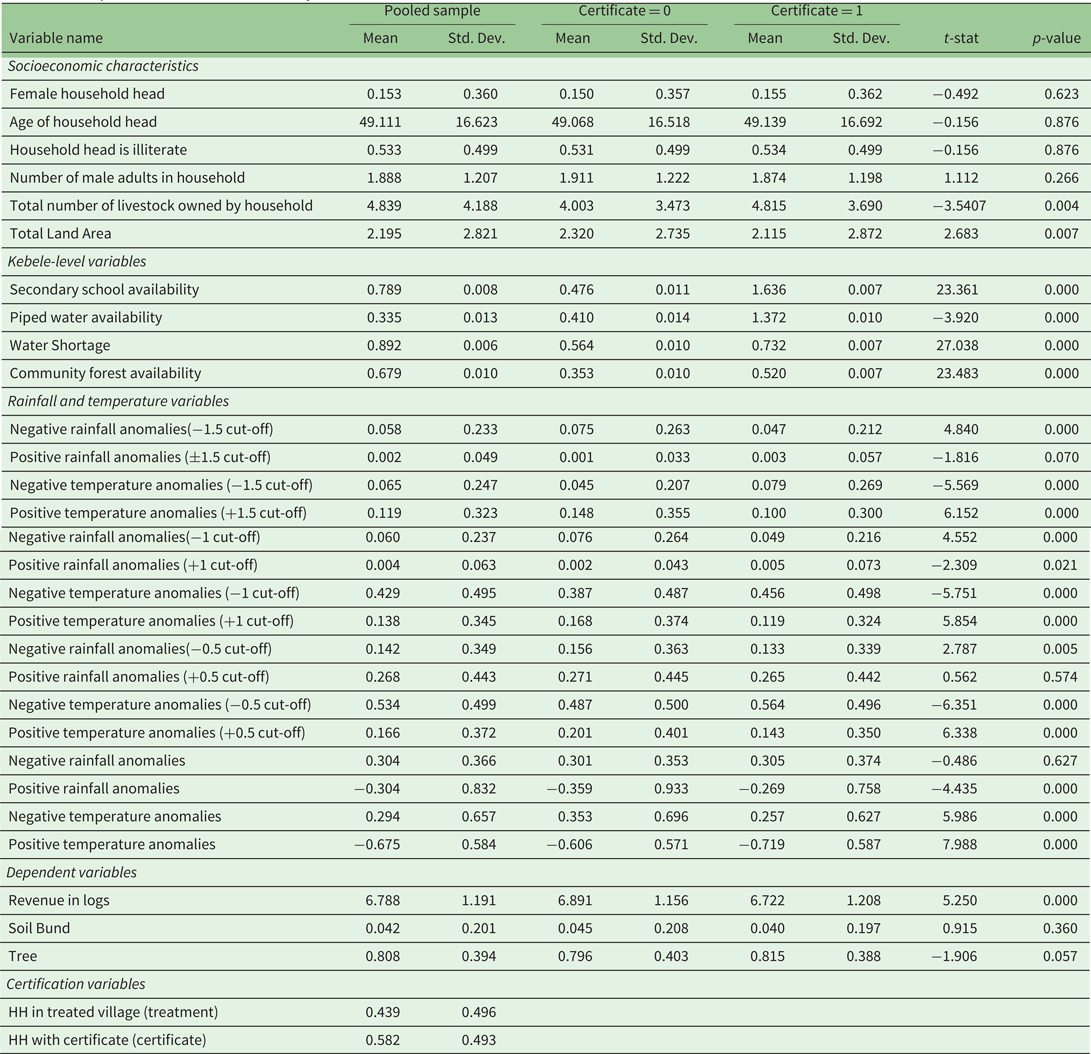
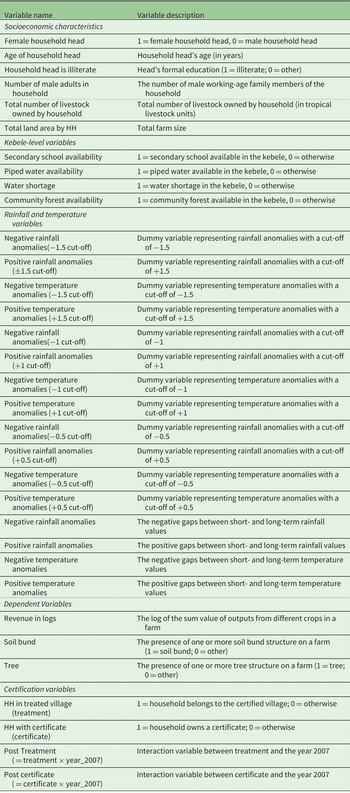
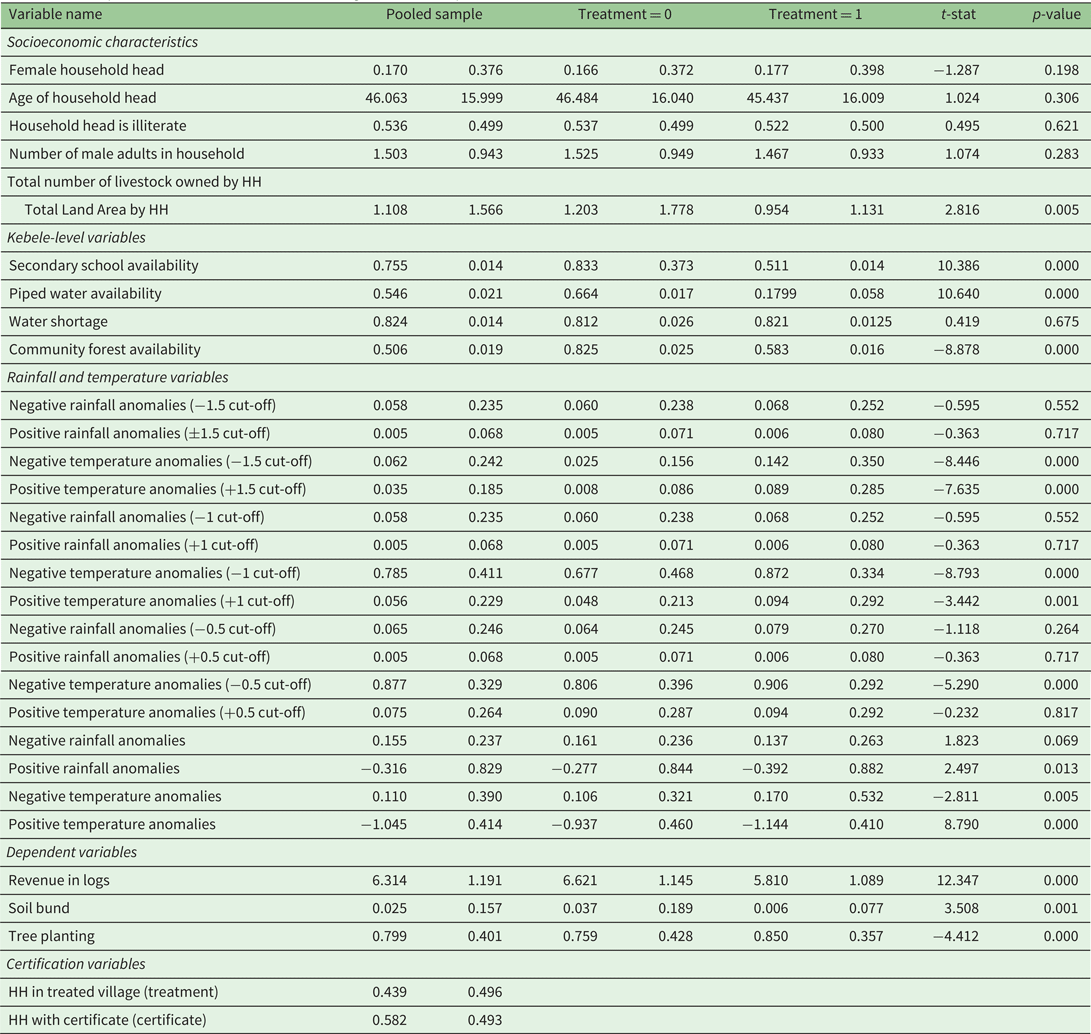
Data used for this paper's analysis was obtained from the Sustainable Land Management Survey collected in the years 2000, 2002, 2005 and 2007, in the Amhara National Regional State of Ethiopia. The survey focused on the East Gojjam and South Wollo Zones. A total of 14 villages were included in the study, seven from each Zone.Footnote 8 Using a stratified random sampling technique, a total of 1,600 households were followed in each survey year. As the setting is a multi-cropping farming system, information is collected on each crop and plot within a farm household. The dataset also includes detailed information on socioeconomic characteristics of the farm households and from the land certification program. The survey data is combined with information on rainfall and temperature. Table 1 presents descriptive statistics of variables used in the regressions, based on observations from the year 2000. The statistics are separated by treatment category. The first panel presents the descriptive statistics for the pooled sample while two panels after that are separated by treatment versus control groups, for kebele-level certification.Footnote 9 Table A1 in the appendix presents description of the variables used in the analysis. Below, we present a discussion of the dependent and explanatory variables.
Descriptive statistics of variables for the year 2000, based on household-level certification

4.1 Dependent variables
Our key dependent variable is farm net revenue, defined as the revenue from all crop typesFootnote 10 grown on a farm in a given year, net of the costs of fertilizer and manure. It is therefore an application of the Ricardian model where net revenues are used in place of land values, to capture the economic effect of climatic factors in agriculture (Deressa and Hassan, Reference Deressa and Hassan2010). The use of net revenue is particularly appropriate in this set-up as land markets are in fact not perfect.
The analysis also considers the adoption of soil and water conservation (SWC) as an additional dependent variable. Soil bund, terrace (local or modern) and tree planting are considered in the analysis. The purpose of these structures is to help collect surface runoff and increase water infiltration and prevent soil erosion. When used as a combination within a field, they help to increase the proportion of arable land by levelling steep land, reducing runoff and preventing erosion. Such measures are also said to be effective along with other sustainable land management practices, as promising adaptation strategies, especially in the high-rainfall areas (Kato et al., Reference Kato, Ringler, Yesuf and Bryan2009).
Farmers practice cut-off drains as a way of conserving moisture and preventing runoffs. In the study areas, cut-off drains are dug across a slope to intercept surface runoff and carry it safely to an outlet such as a canal or stream. They are used to protect cultivated land, compounds and roads from uncontrolled runoff, and to divert water from gully heads. Soil bunds are common types of SWC measures, but bunds are susceptible to heavy rainfalls and easily eroded by water and wind. As the bunds tend to be moisture- and nutrient-rich, some farmers destroy the soil bunds and disperse the accumulated soil over the whole field after a while. Other farmers also maintain their bunds and cultivate crops on them. The most dominant form of SWC activities in the sample is tree planting, which also both conserves moisture and prevents soil erosion.
4.2 Certification variables: kebele and household level
Implementation of the certification program was initiated simultaneously in all woredas. Although the simultaneous implementation was the initial plan, it was recognized that such action would stretch financial and manpower resources both at the kebele and the woreda levels, so a plan was set to cover all lands in the region within three years. The program reached some of the woredas within the Amhara region starting in 2004, and was eventually rolled out to the entire region by 2007 (Adenew and Abdi, Reference Adenew and Abdi2005). Furthermore, the slack agricultural seasons were chosen to initiate the program due to the availability of the famers then (as opposed to during the busy wet seasons) and the conduciveness of the dry-weather roads to carry out fieldwork by the officials. Preparation, completion and distribution of certificates were carried out by the officials during the peak agricultural season. The certification program was implemented in these villages sequentially.Footnote 11 The discontinuity created by agricultural seasonality and road conditions along with the gradual roll-out created a geographic and a time gap in the implementation in the different kebeles (Deininger et al., Reference Deininger, Ali and Alemu2011; Bezabih et al., Reference Bezabih, Holden and Mannberg2016).Footnote 12
Hence, the construction of the certification variable was such that villages and households reached by the program earlier are categorized as certified while those enrolled in the program at later stages are considered control. The last round of the survey, conducted in 2007, was designed to gather information on the features of the certification program that enable analysis of the impact of the program on different variables of interest. We use two measures of certification to identify the program impacts: a kebele- and household-level certification. A kebele is considered certified if the initial demarcation of fields in the kebele by the LAC was completed 12 months before the last round of the survey in 2007 (Deininger et al., Reference Deininger, Ali and Alemu2011). The essence of this is to ensure that sufficient time has elapsed for the effects of the program to be realized.
The exact timing of the receipt of the land certificate depends not only on the time when the land demarcation activities started but also on the time when the land certificates were issued to households.Footnote 13 Since the date of issuance of the land certificate can be arguably exogenous to household characteristics, there will be variation across households on the date of receipt of certification. This variation could be the source of identification. In other words, household-level certification enables comparison of households that have received their land certificates on time to change their agricultural decisions measured during the last round of the panel survey to their peers that had not received their certificate on time. Hence, the appropriate level of certification that will be analyzed is household (instead of kebele). As shown in table 1, 43 and 58 per cent of the observations are certified at the kebele and household levels, respectively.
4.3 Rainfall and temperature variables
The monthly rainfall and daily temperature data were obtained from the Ethiopian Meteorology Authority, in eight stations close to the study villages (kebeles) for the years 1976 to 2006. To convert the station level observations into farm-level observations, an inverse distance weighting interpolation method, which combines latitude, longitude and station-level rainfall and temperature observations, was employed to impute farm-specific information. The interpolation leads to varying observations at the household level. While a farm is typically comprised of different plots located in different places, the plots are also typically closer to the house as the house will be built in a manner that it is close to the plots. Therefore, we have taken the location of the farm to be the location of the household. While this could be a strong assumption in some instances, the GPS information is taken for the household and not for the different plots and, therefore, the interpolation is based on information on the household.Footnote 14
The interpolated observations are used to compute annual mean and standard deviations from which rainfall and temperature anomalies are computed We use the measurement of anomalies-deviations of current observations from the long-term mean (O'Loughlin et al., Reference O'Loughlin, Witmer, Linke, Laing, Gettelman and Dudhia2012). The rainfall anomaly values are then computed as the ratio of the difference between the short-term (annual) and the long-term mean rainfall to the standard deviation of the long-term rainfall. In terms of range, three cut-off points are used to construct the anomalies: −1.5 to 1.5, −1 to 1, and −0.5 to 0.5. Accordingly, for the first cut-off, the negative rainfall anomaly dummies are constructed as anomalies below −1.5 and the corresponding positive rainfall anomaly dummies are constructed as anomaly values above 1.5. These dummies represent adverse climatic conditions. The same procedure is followed for the temperature anomaly dummies. Based on anomalies, we also compute the censored continuous measures, which are constructed as 0 to positive and from 0 to negative values.
4.4 Socioeconomic variables
The key socioeconomic characteristics used in the analysis are presented in table 1. Around 17 per cent of the surveyed households have a female head. The average age of the household head is 46. The proportion of household heads that can read and write is 58 per cent. An average household has two male adults of working age. Livestock ownership, measured in tropical livestock units, is around six per household. The average farm size is 1.64 ha, slightly higher than the national average of 1.1 ha.
Table 1 also presents a mean difference test for the variables used in the analysis. The test results show that the difference between the treatment and control groups is insignificant for many of the variables. The temperature anomaly variables, however, show significant mean difference between the two groups.
5. Estimation strategy
Our major estimation strategy is a difference-in-difference (DID) approach, which is proceeded by a propensity score matching (PSM), which enables us to control for biases associated with observable characteristics.Footnote 15 We also employ common trend analysis, a post estimation method that enables us to check for the absence (or otherwise) of trend-based unobservables. We discuss these three methods in some detail below.
5.1 Generating comparable groups based on observables – PSM
The main purpose of PSM is to choose a sample of households in the treatment and control groups that are as similar as possible to each other in important, observed, aspects. More specifically, PSM balances the observed distribution of covariates across households in the two groups such that the conditional probability of participation in the program (i.e., receiving a certificate) should be equal in the treatment and control groups. The difference in this conditional probability is called the ‘propensity score’ and is the relevant summary statistics to ensure that the samples are sufficiently balanced (Rosenbaum and Rubin, Reference Rosenbaum and Rubin1983).Footnote 16 The matched sample so formed is then used in the DID analysis that is described below.
5.2 The difference-in-difference analysis
Our empirical strategy on the interplay between rainfall and land certification on farmers’ welfare relies on: (i) the gradual rollout of the land certification program to farm households at the village level, (ii) the exogenous variation in rainfall and temperature anomalies, and (iii) the panel nature of our dataset. We estimate a model where the identification of the effect of tenure security on welfare comes from comparing reported net revenues in year 2005 (before the implementation of the land certification) and in year 2007 (after the implementation of the land certification) in certified and non-certified villages and its interaction with rainfall anomalies. The measurement of anomalies of both temperature and rainfall enable us to capture non-linearities by creating dummies representing positive and negative deviations of short-term observations from the long-term temperature mean. Accordingly, the relationship between a farm level revenue, temperature and rainfall anomalies is given by:

The log of farm revenue from farm household $h\;$ in year $t\;$
 is denoted by ${y_{ht}}$
 . ${r_{ht}}\;$
 represents a vector of temperature anomaly dummies for each household h in year $t$
 . Similarly, the rainfall anomaly dummies are represented by ${w_{ht}}$
 while ${x_{ht}}$
 are the socioeconomic and physical farm characteristic variables. The treatment variable ${p_k}$
 is a dummy variable representing whether the household is in a treatment or control village. The variable ${l_t}$
 stands for the year dummy. The coefficient of the post-certification interaction variable ${p_k}{l_t}$
 thus corresponds to the effect of certification. ${\theta _{ht}}$
 is the intercept term. Incorporating the effect of interaction between the certification and the anomaly dummies extends equation (1) to:

The error term ${\varepsilon _{ht}} = {\alpha _h} + {u_{ht}}$ is composed of a normally-distributed random error term, u ht ~ N(0, σ u2uij), and an unobserved household-specific effect, ${\alpha _{ih}}$
 . Under the assumption that ${\alpha _h}$
 is orthogonal to the observable covariates, a random effects estimator can be employed (Wooldridge, Reference Wooldridge2002). However, allowing arbitrary correlation between ${\alpha _h}$
 and the regressors/observed covariates requires a fixed effect, as it takes ${\alpha _h}$
 to be a group-specific constant term and uses a transformation to remove this effect prior to estimation (Wooldridge, Reference Wooldridge2002). For a robustness check, we added a battery of controls to the estimating equation. Many important controls, however, do not change much in the period of interest. Since it may be presumed that the observed covariates are correlated with the unobserved individual effects, our estimation procedure involves the inclusion of fixed effect in the estimation following the Mundlak approach (Mundlak, Reference Mundlak1978; Wooldridge, Reference Wooldridge2002).Footnote 17 The results are very consistent and reported in column (4) of table 3.
5.3 Testing for the common trend assumption
In order to correctly identify the impact of certification, the treatment and control villages must be randomly assigned such that the change in the agricultural revenue, the outcome variable of interest, is attributed solely to the effects of the treatment. Closely related to the random choice of villages is the common trend assumption, which holds if the unobserved influences on farm level revenue, conditional on weather shocks, do not change in different ways between the control and treatment groups. We analyze the extent to which it is possible to establish that the trend in revenue, given observable variations that can be controlled for, and conditional on weather shocks, is the same for the treatment and control groups (see table 1).
As the common trend assumption is fundamentally untestable after the introduction of the program, we base the test on data prior to, and including, 2005. Accordingly, we estimate a panel data equation that consists of different intercept terms for the treatment and control villages for each year; weather shock variables; the interaction between these intercept terms and weather shocks; and a set of control variables. The coefficients from the estimation are then used as inputs in the common trend assumption test. The test investigates whether, prior to the land certification, households that have eventually received their land certificate used to be more resilient to weather shocks. Accordingly, the null hypothesis of the common trend assumption test is that the coefficients of interaction between certification and experience of weather shocks in 2000, 2002 or 2005 are not statistically different from zero. The pattern of coefficients during the pre-policy change period in the years 2000, 2002 and 2005 show no significant difference. This indicates that there is no statistical evidence of violation of the parallel trend assumption. Estimation and test results are reported in the online appendix, table B4.
6. Discussion of results
The PSM was performed for both the household- and kebele-level certification and using socioeconomic and kebele-level characteristics as major explanatory variables and using log-revenue as a dependent variable. In the interest of space and because our main goal in the matching method is to obtain matched treated and non-treated observations to use as inputs for parametric regression, the propensity score estimates are not discussed in detail here, but the key results of the matching exercise are reported in tables B1 and B2 in the online appendix. As can be seen in table B2, the PSM analysis produced a satisfying reduction in the bias between the treatment and control groups.
Below we present the results from the impact of climate anomalies on farm-level revenue, alongside a discussion of the combined role of climate anomalies and land certification. As a way of exploring the mechanisms that link the impact of certification on farm-level revenue in the presence of climatic anomalies, we analyzed the certification impacts of soil conservation investment and tree planting. These agricultural investment decisions are considered viable climate change adaptation measures.
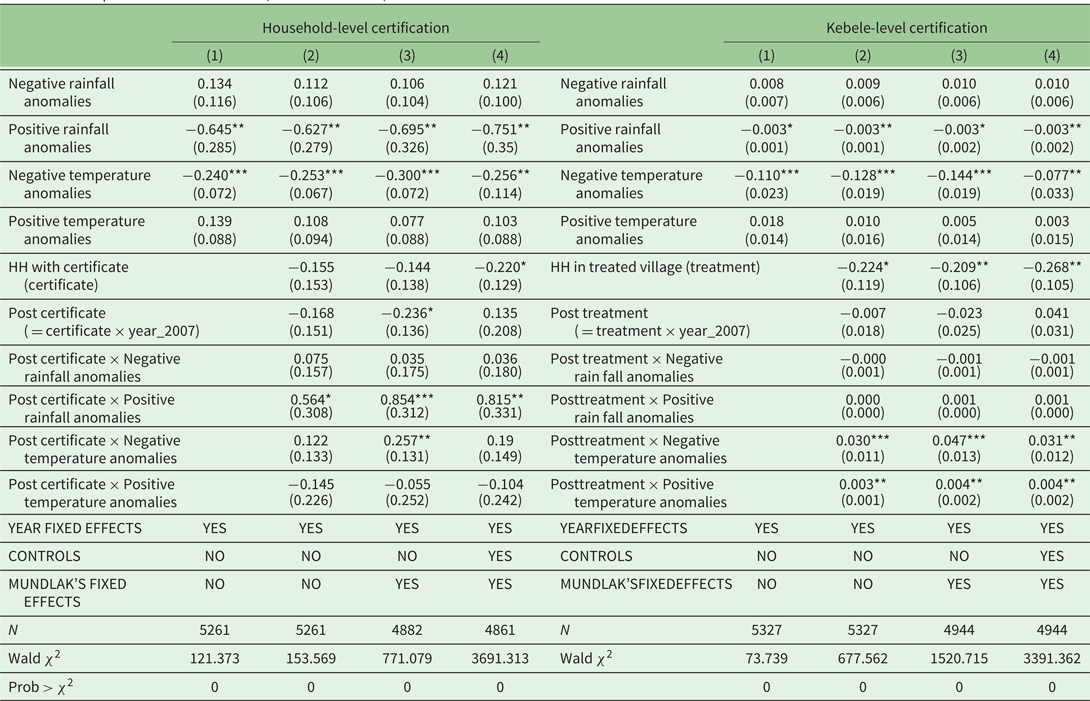
Table 2 presents the estimation results for revenues from all crops within a farm (farm-level revenue). Specifically, table 2 presents the analysis of results based on the anomalies cut-off of [−1 and +1]Footnote 18 for both temperature and rainfall based on household- and kebele-level certification. However, the discussion on the impact of certification and climate anomalies is mainly based on the results from household-level certification (see description of the certification variables in section 3 for justification of this).
The impact of climatic anomalies (cut-off of −1 to +1)and certification on farm revenue

Notes: *significant at 10%; ** significant at 5%; *** significant at 1%. Bootstrapped standard errors in parentheses. Controls: household size, literacy, age of household head, gender, land area.
Accordingly, the positive rainfall anomalies dummies have consistently negative impacts across specifications. These results are in line with expectations as extreme rains would have negative impacts on production and revenue. For temperature anomalies, the coefficient of negative deviation from the long-term temperature average is negative and significant, across specifications. This estimate suggests that temperatures considerably lower than the average lead to reduction in revenues. However, positive deviation from the average for temperature anomalies is statistically insignificant.
The coefficient on the variable post-certification reports our estimate of the average effect of issuance of land certificates on households that did not experience a climate shock. Unfortunately, the design of the study does not produce a reliable estimate of this coefficient. Indeed, as reported in table 2, the estimates of the coefficient of the variable post-certification vary depending on the control variables considered (which may suggest heterogeneity of responses depending on households characteristics). Furthermore, as reported by the size of the associated standard errors, the estimates of the coefficient of the variable post-certification are somewhat imprecise.Footnote 19
We find that the interaction between positive rainfall anomalies and certification has a positive and statistically significant impact. The coefficient is very stable across different specifications. This implies that land certification reduces the economic impact of rainfall excess, likely through enhanced tenure security, and its role in enhancing adaptation investment and actions.Footnote 20
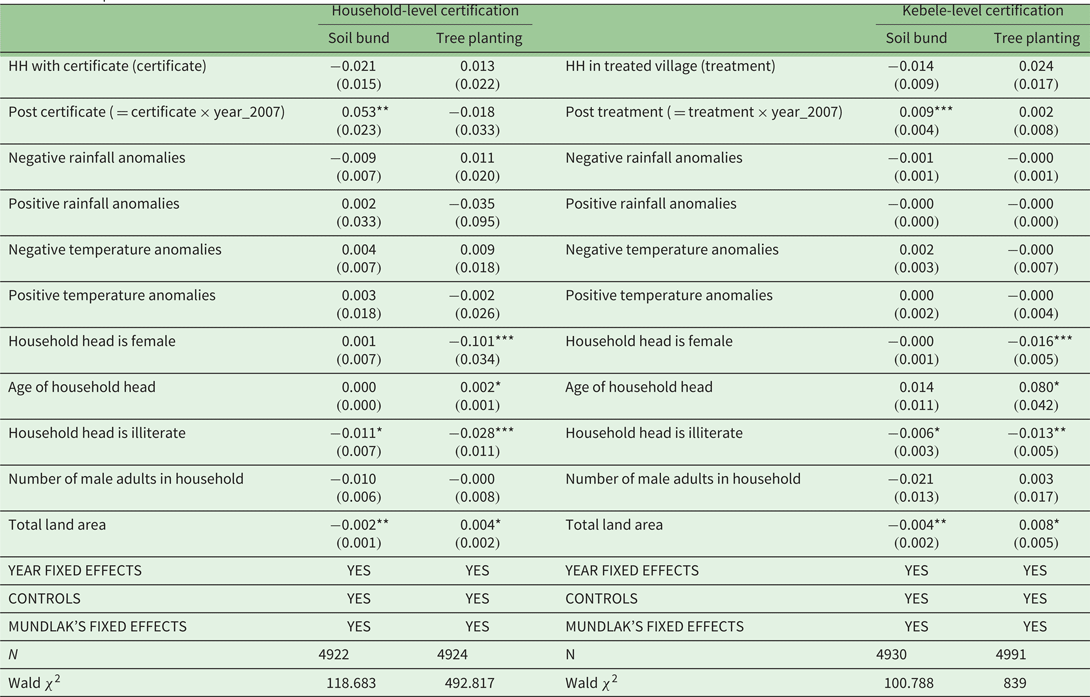
We speculate that the key mechanism driving these results is the investment-enhancing role of the land certification program. We present auxiliary regressions where we test the effect of land certification on key agricultural investments that affect crop productivity and revenues. The first and second columns in table 3 represent the results for the determinants of presence of soil bund structure and tree planting regression. The treatment dummy (the variable measuring the impact of certification) carries a positive sign in all the categories, except for the trees regression. This implies that certification enhances the likelihood of participation identified as adaptation enhancing mechanisms, partially. The results from kebele-level certification in the right panel of table 3 also carry qualitatively similar results.
The impact of certification on soil and water conservation investments

Notes: *significant at 10%; ** significant at 5%; *** significant at 1%. Bootstrapped standard errors in parentheses.
7. Conclusions
In this study, we examine the role of property rights in reducing the possible effect of climatic factors on agricultural revenue based on data from Ethiopia, a rain-fed agrarian economy with notorious fluctuations in weather and frequent droughts. The emphasis of the analysis is on the importance of combining the effects of short- and long-term climatic factors, using anomalies measures. Furthermore, the impact of enhanced tenure security on adaptation is analyzed by assessing the impact of the land certification program implemented in Ethiopia.
The major findings of the analysis can be summarized as follows. First, higher than average rainfall has a strong and negative effect on farm-level net revenue. The effect of negative temperature anomalies is positive and significant. This may indicate that excessive rainfall and low temperature are the most important threat to farmers in the highlands. Second, we find the interaction between rainfall anomalies and certification to be more significant than those of temperature anomalies-certification interactions. Third, the responsiveness of soil conservation practices to land certification, although partial, highlights the importance of property rights in the context of climate change adaptation. We therefore speculate that the mechanisms though which enhanced property rights support revenues is via the increase in investments. As the results show, there is no evidence to reject the common trend assumption and the interpretations of the coefficients remain valid.
The policy implications of this paper are potentially very large. First, the results show that the land rights certification program has contributed to resilience of the farming system. This indicates that implementing a decentralized, transparent and cost-effective process of land registration under African conditions is not only possible but, by reducing (but not eliminating) tenure insecurity, can have double dividends in the form of enhancing impacts of certification and enabling effective adaptation to climate change. This suggests that registered and certified land rights may be economically and socially beneficial through enhancing adaptation. From a national policy perspective, climate change adaptation practices are a key component of the Climate Resilient Green Economy strategy, the country's main development paradigm. The results of the study will serve as crucial inputs to the evaluation and further planning phases of the program. In sum, policies that enhance and strengthen property rights over land may, in addition to creating a precondition for development, also reduce the welfare effects of climatic anomalies by environmental shocks. The role of institutions and their improvement is important in the context of climate change adaptation. Future research, both theoretical and empirical, should be devoted to better understanding the interplay between anomalies, land investments and property rights.
Supplementary material
The supplementary material for this article can be found at https://doi.org/10.1017/S1355770X2100022X
Acknowledgements
The authors gratefully acknowledge the Environmental Economics forum for Ethiopia for access to data and financial support for the study. We would like to thank the Editors and the reviewers for their very constructive comments. The authors would also like to thank the Global Green Growth Institute and the Grantham Foundation for the Protection of the Environment for financial support. Comments from participants at the 20th Annual Conference of the European Association of Environmental and Resource Economists, 26–29 June 2013, Toulouse, France; the 6th Annual Meeting of the Environment for Development Initiative, 25–29 October 2012, La Fortuna, Costa Rica; and from Stein Holden and Jeremy Lucchetti are acknowledged and appreciated. The usual disclaimer applies.
Appendix A1. Description and statistics of variables used in the regressions
Description of variables used in the regressions

Descriptive statistics of variables used in the regressions for the year 2000, based on kebele-level certification

Appendix A2. Construction of the temperature distribution
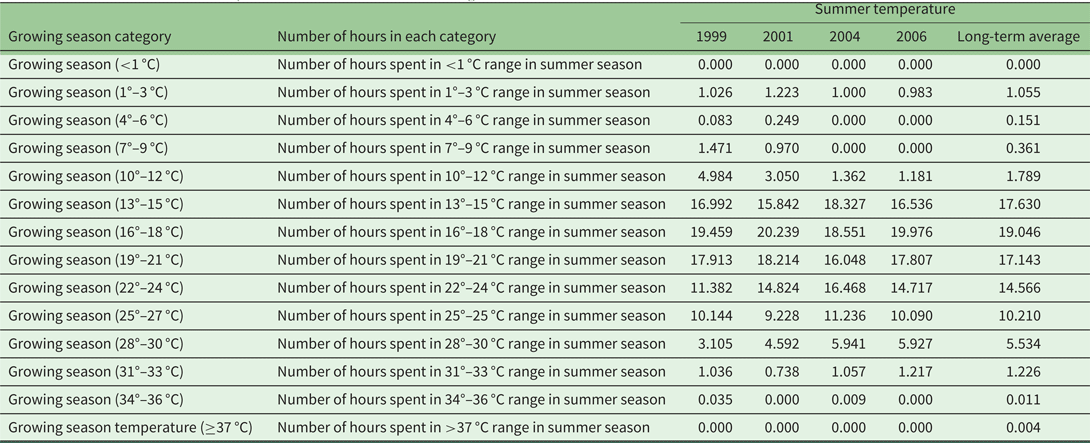
We follow Schlenker and Roberts (Reference Schlenker and Roberts2006, Reference Schlenker and Roberts2009) in constructing the distribution of the temperature values in the summer season. Accordingly, a sinusoidal curve is fitted between predicted minimum and predicted maximum temperatures. This sinusoidal interpolation gives the time spent in each 1 °C-degree temperature interval between −5 °C and +40 °C within each day. These are the lowest and highest temperature ranges experienced in the area. The time spent in each of the one-degree Celsius intervals is then converted into a more aggregate distribution by summing together the individual one-degree times into three-degree temperature intervals, known as temperature bins. The length of time spent in each three-degree Celsius temperature interval in each day (temperature bin) is then summed across all days of the month, for each farm household, to obtain 14 monthly temperature bin distributions, each consisting of a three-degree bin. The long-term summer temperature distribution is obtained by averaging the three-degree range distribution over the 30 years. The short-term temperature variables are the three range distribution temperature values for each survey year. The long-term and short-term rainfall variables are aggregated by summing the rainfall for the respective years. Table A3 shows the frequency distribution of temperature variables corresponding to the survey years over the long term. As would be expected, the pattern of temperature over the three-degree ranges follows a bell-shaped distribution, with many of the days spent in the 10–30 degree range. This holds true for both annual and long-term mean distributions. The extreme ends have different values for the short and long-term mean temperature. The long-term variables increase the possibility of extreme values being captured in the distributions.
Distribution of summer temperature values over the short and long term

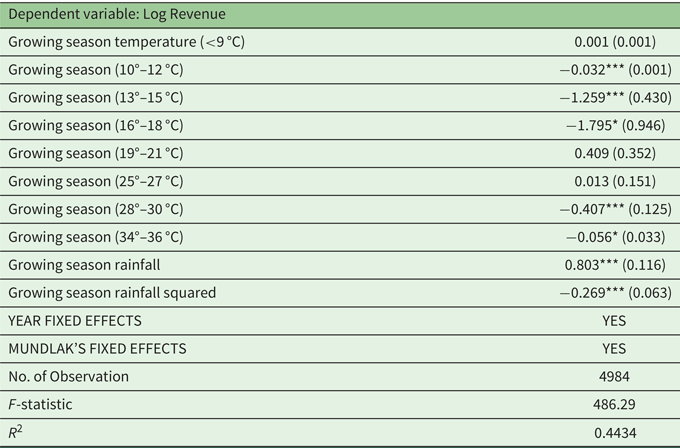
The impact of temperature on farm revenue – degree days