Introduction
Over the last few decades, diaspora studies have been a major field for the early modern socio-economic history of central and south-eastern Europe. While there has been a strong emphasis upon cross-cultural circulations ‘across the Danube’ and between the Ottoman empire and the Habsburg monarchy, except for few isolated studies, the urban impact of these circulations remains unexplored.Footnote 1 Despite the important contributions of Mediterranean historians, such as Francesca Trivellato and Sebouh D. Aslanian, to early modern trading diaspora studies, early modern central and south-eastern European history still reflects contemporary political and identity agendas, as it emphasizes the segmentation of the history of central Europe into several hermetic ethno-religious or national narratives.Footnote 2 However, in line with recent research on the citadinité of multicultural cities, like Jerusalem for example,Footnote 3 comparison and analysis of the activities of the Ottoman merchants – whatever their religion – in Vienna's port area during the eighteenth century allows us to overcome this anachronistic cultural agenda and to write an inclusive urban geo-history from the perspective of the newcomers.Footnote 4 This article outlines the geography of Ottoman traders in the port of Vienna in the second half of the eighteenth century. It explores the circulation of the merchants within the city, and the integration of the different areas of Vienna. It shifts the focus of analysis away from the diaspora to the port and argues that the increasing diversity of eighteenth-century European cities should be observed in the light of the social fabrique of the city rather than through particular identities. Research on Vienna can contribute to the urban history of early modern port cities, from a continental perspective, as much as it questions the classical perception of port areas as highly segregated zones.Footnote 5
In 1775, Vienna was the fourth largest city in Europe with 200,000 inhabitants.Footnote 6 Among the many different foreign communities who moved to the city and contributed to the ‘diaspora metropolis’,Footnote 7 Muslim, Sephar, Armenian and Christian Orthodox Ottoman subjects were particularly welcomed and were given legal protection by the peace and commercial treaties of Karlowitz (Sremski Karlovci), Passarowitz (Požarevac) and Belgrade, issued respectively in 1699, 1718 and 1739. Vienna, Trieste and many Hungarian cities such as Fiume (Rijeka), Pest, Temesvár (Timișoara) or Tokaji all benefited from the trade of Ottoman private companies.Footnote 8 In Vienna, Ottoman merchants operated mainly in the old town and in its suburb, Leopoldstadt, where the port infrastructures were located – the two districts being separated from each other by the Danube and the city walls. Several historians have examined how the Ottomans from the Greek diaspora became established in Vienna through the papers of the Hofkammer (Aulic Chamber), which had oversight of the Ottoman trade. However, their specific research agenda led them to focus solely on the Greek merchants and to exclude from their analysis the relations between those merchants and other Ottomans, who were mentioned in the same series, in the same volume and, quite frequently, on the same page, and who lived in the same districts, and sometimes in the same street, if not in the same house.Footnote 9
This article aims not only to investigate the relations between the different Ottoman religious minorities, but to cast the city of Vienna in a different historical perspective. Close attention to local Habsburg administrative and municipal sources not only broadens the focus but also allows us to explore the social integration of Ottoman merchants in the city and to view their contributions to its development and the activity of its port. This approach complements analyses of the local economic and social rivalries generated by the Habsburg state-building process which brought the Habsburg administration into opposition with the Viennese municipality. This led to the state's progressive extension of the legal capacity of Ottoman merchants in the Habsburg cities, at least in matters of trade, in order to undermine the commercial privileges of the local bourgeoisie.Footnote 10 In Vienna, a Habsburg–Ottoman political-cum-commercial milieu organized by the agents of the imperial administration emerged in the eighteenth century. It reflected an early but ultimately unsuccessful process of cross-cultural regional integration.Footnote 11
This process had a major impact on Vienna's port area and its different social spaces. In the eighteenth century, Vienna was indeed still a fortress with high and imposing ramparts, defended by a large military glacis to the south and the river Danube to the north. This impressive physical boundary separated the fortress from its suburbs, but by the eighteenth century, the city walls no longer constituted an economic or social boundary. In most Habsburg port cities, a classical mercantile policy was adopted that permitted the establishment of foreign trading communities within specific, delimited neighbourhoods or suburbs, with the intention of boosting the trade of that city. The everyday spatial practices of merchants in Vienna, however, indicate that the city was less rigidly segregated than this model would suggest.Footnote 12 Analysis of the integration of the Ottoman population in Vienna's port area shows that merchants overcame the ethno-religious divisions and the physical boundaries of the city.
Three geographical layers arise from this approach, which this article will review in turn. The first one deals with the city and stresses the participation of Ottoman merchants in the reconfiguration of Vienna's trading geography that resulted from its demographic growth. The second layer delineates the edge of the port area where Ottoman activities were essentially concentrated. The third and last layer drills down to the scale of the street, the block or even the individual building to offer a more detailed picture of how Ottoman merchants contributed to and participated in the social life of Vienna.
Across the city: Ottoman merchants in Viennese urban development
Ottoman merchants were fully involved in Vienna's urban development, as is evident from two major documents produced by the Hofkammer's Council of Trade in 1766 and 1767. The first one is a Consignation of a group of Ottoman merchants in the city centre of Vienna – the Innenstadt – divided by parish.Footnote 13 It records the number of merchants staying at a specific address and the name of the landlord. For example, it records that ‘nearby the Rotenturm’, ‘Imon, a Turk has been staying here [at Herr von Gollhofer's] for three years’ or that ‘in Fischhof’, ‘Josef Hosmator, a Turkish subject has been staying here [at Anna Hellmayr's] with his servants for four years’.Footnote 14 The second document, which is much more detailed, is the keystone of the present analysis. The Conscription of the Turks and Turkish Subjects in Vienna was compiled from data collected in multiple interviews conducted by the agents of the Habsburg administration during the first six months of 1767, through 11 enquiries under the authority of the Council of Trade.Footnote 15 It provides statements from 134 Ottoman merchants, divided into four so-called ‘national’ groups – as the administration put it – corresponding to the Ottoman legal religious categories, i.e. ‘Turks’, ‘Jewish Turks’, ‘Armenians’ and ‘Greeks’. Each merchant is first introduced by a short note giving his name, his age, his address in Vienna, the place where he came from in ‘Turkey’ and his matrimonial status. The second part of the statement includes full information on the merchant's career, the evidence proving that he was an actual Ottoman subject, when he entered the ‘Imperial and royal Erblande’ for both the first and last times, his trading activity and especially if, where and how many warehouses he rented in Vienna etc.
Although it is almost impossible to identify the exact building where the Ottomans were established, except for some cases, one can easily identify the different streets where they lived and on this basis it is possible to draw up the first comprehensive picture of their distribution across the city rather than focusing on one particular neighbourhood (Figure 1).Footnote 16 Ottoman subjects in Vienna were mostly located around the Donaukanal, a branch of the Danube bordering the Innenstadt, which separated the old medieval fortress from Vienna's northern suburb, Leopoldstadt. Lying on the western extremity of what was the inner Danube delta, the Innenstadt remained enclosed in the old city walls until the middle of the 1860s. In the eighteenth century, a second line of fortification – the Gürtel (belt) – parallel to the old city walls delimited Vienna's administrative limits. The suburbs arose between the glacis around the ramparts and the Gürtel.Footnote 17
Streets where Ottoman merchants were located in 1767

The area chosen by Ottoman merchants can be divided into three sectors: the Hoher Markt, the Fleischmarkt and the Leopoldstadt. They corresponded to the three stages of Vienna's urban development.Footnote 18 The Hoher Markt was the economic and political centre of early medieval Vienna. It was bounded by Tuchlauben in the north, the Rotenturmstrasse in the south, the Graben in the west and the Danube in the east and what had been the palace of the Babenberg family was in the square, Am Hof. According to the historical geographer Elizabeth Lichtenberger, this neighbourhood symbolized the Golden Age of the municipality and its medieval economic prosperity, which was challenged during the fourteenth century by the extension of the city commanded by the archduke of Austria. During this period, Vienna's surface area was tripled and the planning of its extension controlled by the church, which owned the land on which it was built, just like the classical models offered by the Italian medieval città.Footnote 19
The Fleischmarkt was the first extension of the city to the east in the thirteenth century. This area was dedicated to foreign merchants allowed to trade in Vienna, but outside the walls, according to the Stapelrecht (commercial privileges that a city received from the emperor to host foreign merchants and develop its trade) granted in 1221. At that time, foreign merchants remained symbolically outside the city, secluded in a specific extramural area and stigmatized as non-pure by the presence of the meat market – ‘Fleisch-Markt’. This was the first interface of Vienna's international trade. In 1450, the construction of the new wall meant that the centre of the city shifted to a new sector devoted to and controlled by the church and the nobility, who were the major owners of the land on which it was built. Consequently, the Fleischmarkt was integrated into the city and was connected to the Hoher Markt thanks to the new Rotenturmstrasse, a street built on the course of the former early medieval moat.Footnote 20
Finally, in the seventeenth century, a new suburb was set up on the northern side of the walls and the left bank of the Donaukanal after the transfer of the Jewish community from the Hoher Markt's neighbourhood in 1625. This Judenstadt – the Jewish ghetto – was abolished in 1671 and the municipality acquired most of the buildings, and it became instead the Leopoldstadt. The history of the ghetto and its forced secularization is also the history of the urban development of the port of Vienna, which entailed the reclamation of the inner Danube delta for the common benefit of the merchants and of the aristocracy.Footnote 21 The other suburbs, where Ottomans were far less numerous, were also more recently built and by the second half of the eighteenth century they contained the major part of Vienna's population.Footnote 22 Overall, the distribution of the Ottoman merchants in Vienna was concentrated in those suburbs where manufactories with imperial privileges were established, including Mariahilf and the Rossau where the porcelain manufactory was built in 1718 after the peace treaty of Passarowitz.Footnote 23 Like the French General de Guibert noticed in 1773, the porcelain manufactory especially targeted the Ottoman export market, contributing to the reshaping of the material culture of the new Ottoman elite.Footnote 24 In 1754, the population of the suburbs was more than twice as large as that of the city within the walls. Hence, the Ottoman presence between the city and the suburbs was inversely proportional to the global Viennese one. The functional geography of Vienna resolved this apparent paradox.
Analysis of Ottoman housing and warehouse addresses demonstrates that Ottoman subjects conformed with the reorganization of the trading geography of the city, that was concentrated first in the old municipal area and then spread to the suburbs. In 1537, Ferdinand I invited the Niederläger (licensed foreign wholesalers) from Innsbruck, where the court of Emperor Maximilian I had been previously established, to move to Vienna.Footnote 25 Over the next two centuries, the presence of these merchants significantly contributed to the transformation of the streets of the municipal area into a neighbourhood essentially comprised of warehouses, workshops and shops. Following its original function, the Fleischmarkt provided foreign merchants with convenient warehouses. Buildings owned by monasteries transformed their activities too. Some of them, like the Heiligenkreuzerhof (Holy Cross’ courtyard) built in 1659, were totally dedicated to merchants’ needs after 1748. They offered them housing and warehousing in the Fleischmarkt's neighbourhood. Other courtyards, like the Steyrerhof, at the corner of the Fleischmarkt and the Rotenturmstrasse, were mostly occupied by Christian orthodox merchants.Footnote 26 In the last age of mercantilism, Vienna was supplied with the production of manufactories from Bohemia or Austria owned by the emperor or by the aristocracy. For example, in 1752, the Wienerisches Diarium (the official gazette of Vienna) advertised that a warehouse had just opened in the Leopoldstadt with the sole aim of providing Ottoman merchants with Bohemian glass to be sold wholesale, and in 1767 the Bohemian Count Hartig supplied the Ottoman company of the Filzoglu brothers with glass production from his own estate.Footnote 27 Under Charles VI (1712–40), both the manufactories from aristocratic estates and those from the city centre were encouraged to move to Vienna's suburbs in order to accommodate their growth, as well as to relieve the old medieval area and its narrow streets, which by then were unsuitable for the needs of modern trade. The last stage was the transfer of the warehouses from the city to the suburbs and the setting-up of the first integrated trading complexes.Footnote 28 The on-going transfer of the trading area from the city to the suburbs that entailed the specialization and the multiplication of trade interfaces was followed by the gentrification of the Innenstadt.
Ottomans were also promoting imperial foreign trade and the emperor administratively and legally protected their economic activities against the bourgeoisie of Vienna. In 1718, except during the two yearly fair periods, the Ottoman trade was indeed restricted to the in grosso way (wholesale). However, after 1750, Ottomans regularly obtained individual privileges to trade also alla minuta (retail sale) all year long. Although the bourgeoisie repeatedly protested against these infringements of their trading monopoly, in 1774 and 1776, the Council of Trade clarified the situation by granting Ottoman merchants full liberty of trade regarding everything they could import from Turkey.Footnote 29 According to the treaty of Belgrade of 1739, Ottoman trade was taxed at the border while manufactured goods, especially Viennese porcelain, Bohemian glass and Alpine handcraft (Berchtesgadener Waaren) were exported to the Ottoman empire without payment of duty. As Ottoman trade mostly consisted of imports of textile raw materials, it underpinned the development of Habsburg proto-industry in Vienna and elsewhere, and it was supported by the Habsburg administration.Footnote 30
Across the river: the port area of Vienna
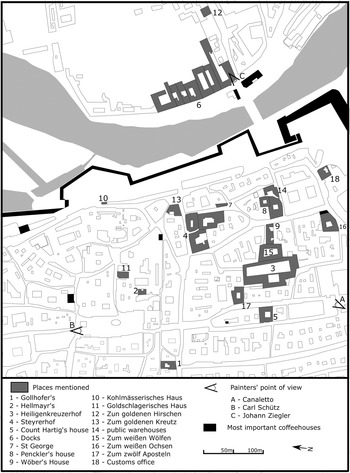
At the scale of a specific district, focusing on the Ottoman presence reveals the workings of the heart and arteries of the Viennese economy. The history of the Ottoman merchants meets that of the Danube city port of Vienna.Footnote 31 The economic activities of the Ottomans emphasize the connections between the Hoher Markt, the warehouses of the Fleischmarkt and the docks of the Leopoldstadt. They provide historians with a better understanding of the economic geography of the city (Figure 2).
Places mentioned in the present article

Three components
The Hoher Markt was the first component of Vienna's port area. The oldest market place of the city, it was thoroughly transformed in the second half of the eighteenth century. The transfer of its daily fish market to a secluded square, the Fischhof, in 1753 was simply the most important symbol of the appropriation of the square by a new category of population that accompanied the rationalization of urban space undertaken by Joseph II during the Coregency (1765–80).Footnote 32 Commercial activity became permanent and luxury shops replaced hawkers. The nobility progressively appropriated the place and mixed with rich bourgeoisie and opulent foreign merchants. Around 1790, the engraver and topographer Carl Schütz pictured the Hoher Markt as a major site of sociability for the imperial and royal Residenz.Footnote 33 In the middle of his painting he symbolically placed a group of two richly dressed Ottoman merchants surrounded by what, a couple of years before, the Berlin publisher Friedrich Nicolai called the ‘Beau Monde’ walking around on an aseptic square.Footnote 34 The only market that the Hoher Markt still allowed was reduced to fine handcrafts and food like speck provided three times a week from the countryside.Footnote 35
Topographers and artists also associated Ottoman merchants with the Fleischmarkt's neighbourhood; the second component of the port area of Vienna. In 1756, Canaletto pictured a group of them discreetly walking in the direction of Ober Bäckerstrasse (today Sonnenfelsgasse), a street parallel to the Fleischmarkt between the Jesuit church and the old university building, and where numerous inns were located such as the famous Zum zwölf Aposteln (The 12 Apostles).Footnote 36 According to the contemporary statistician Ignaz De Luca, the Fleischmarkt still kept its original function of being devoted to foreign merchants in the eighteenth century.Footnote 37 After the peace treaty of Passarowitz in 1718, Emperor Charles VI tried to settle Ottoman Greek merchants in the Steyrerhof, a courtyard located between three blocks in the corner of the Fleischmarkt and the Rotenturmstrasse. Nearby the building, in the Griechengasse (Greek lane), they were given the use of St George's chapel, even though freedom of religion was not yet granted to Habsburg Christian Orthodox subjects.Footnote 38 Like the secret churches of Amsterdam studied by Andreas Nijenhuis-Bescher, the chapel in Vienna was first located in a private flat, as was the Christian orthodox chapel of Trieste during the 1720s.Footnote 39 Moreover, while the Catholic church was the major owner of the real estate of the Fleischmarkt area, the ruling class progressively managed to became landlords of the Ottoman merchants. These newcomers included Freyherr (Baron) von Penckler and Freyherr von Wöber, who became the most important patrons of Ottoman merchants.Footnote 40 Sometime after 1736, while the Aulic Council of War was still in charge of the management of Ottoman trade, it moved into the Deutschordenshaus (Teutonic Order House) – just behind the Stephansdom (i.e. the cathedral) in the Fleischmarkt neighbourhood – a very convenient place for merchants due to its numerous available warehouses.Footnote 41
The third neighbourhood, the Leopoldstadt, was in the port area of Vienna precisely described in 1665 by the Ottoman scholar Evliyâ Çelebî during his visit of the city:
The bank of the Danube is here [in the Leopoldstadt] a single long landing dock, where all the ships and boats, barges and fishing boats and different wood rafts made from tree trunks and shingles stop before the customs and in front of hundreds of warehouses. The customs office makes four times a thousand gold coins in a year…The war shipyard and the place where the ships are made [i.e. the Arsenal] are also located in this suburb. Farther along live all the Jews there are in Vienna; they live in magnificent palaces in this suburb, while the German Infidels live in plain houses. The Jews are all very rich merchants.Footnote 42
Çelebî mentioned very clearly Vienna's docks, where merchandise was unloaded and stored. Just behind the docks, he evoked the Judenstadt, whose merchants were at that time in charge of managing the Danube trade. While the ghetto was progressively secularized and incorporated into the development of the suburb, the Leopoldstadt kept the same economic function.Footnote 43
Connections
The Ottoman merchants’ economic activity thus built on this urban configuration and connected it to the Innenstadt across the Donaukanal, through the Fishermen Gate and the walls of the old fortress. For example, in 1767, Mullah Hussein lived in Salzgries at the kohlmässerisches Haus (coal merchants’ house). He was very wealthy and rented six warehouses mostly located in the Fleischmarkt area and in the Leopoldstadt. From Istanbul, his brother provided his warehouses with ‘any kind of Turkish merchandise’. In the same year, Mullah Hassan also resided at the goldschlagerisches Haus (goldsmiths’ house) in Judengasse, near the Hoher Markt, while he had four warehouses on both sides of the Donaukanal, notably a dock – mentioned as a Mass Niederlag – in the Leopoldstadt. Dimitri Sava was established in Tuchlauben, a street leading to the Hoher Markt from the north, and also rented three warehouses in the Fleischmarkt area and one ‘in the Leopoldstadt right behind Zum goldenen Hirschen [The Golden Deer]’.Footnote 44
The statements of the Ottoman merchants highlight the workings of the Viennese port area. The docks of the Leopoldstadt provided the warehouses on the Fleischmarkt with cotton, wool, camel wool, red yarn and mousseline fabric or dry goods such as spices or coffee. All these goods were sold wholesale in these warehouses. The Hoher Markt's neighbourhood was not only the place where Ottoman merchants lived but also where they bought German fine handcrafts to be exported through the Leopoldstadt's port into the Ottoman empire, after having paid the tax at the Fleischmarkt's customs.Footnote 45
Of course, not all Ottoman merchants were able to embrace the entire trading area of Vienna. At the most basic level, a merchant stocked his merchandise in the place where he lived.Footnote 46 In 1767, comments in the register such as ‘he has no other warehouse than the place where he is staying’ related to a third of all Ottoman merchants in Vienna. For this reason, the Fleischmarkt's neighbourhood was very convenient since the merchants could be easily supplied with merchandise unloaded in the Leopoldstadt. The Fleischmarkt's imperial customs also played a significant and obvious role in the concentration of the population around the street. Only the better-off merchants were able to pay the rent for an apartment or a room and another for a warehouse. In such cases, they used to choose the Hoher Markt's neighbourhood, especially the streets of the former German Jewish neighbourhood before it was transferred to the Leopoldstadt due to the buildings’ trade facilities, like Judengasse and Salzgries.Footnote 47
The Conscription also reveals the failure of early administrative attempts to concentrate religious minorities in specific areas. After 1719, Charles VI tried to corral all the members of the Ottoman ‘Greek’ – that is Christian Orthodox – community around the Fleischmarkt, especially in the Steyrerhof. However, analysis of the geographic data extracted from administrative documents suggests that this was not successful. First, Greek Ottomans did not live only in the Steyrerhof or in the Fleischmarkt neighbourhood. Nor was the Ottoman community of the Fleischmarkt neighbourhood only made up of Greeks or restricted to them or to the Ottomans. The neighbourhood was actually dominated by German merchants, even local bourgeois, and by a minority of foreigners, according to the documentation recorded in the municipal archives and the death notices in the Wienerisches Diarium. The Fleischmarkt, the Leopoldstadt and the Hoher Markt simply made up the economic centre of the city. Ottomans were integrated into it because they were merchants first, and they strengthened its economic and social structures. As a consequence, the group of Ottoman merchants evolved in parallel with imperial urban planning.Footnote 48
This insight into the geographical distribution of the Ottoman presence in the city means that the Innenstadt and its suburbs should not be studied as separate entities: they were integrated by the commercial practices of the merchants and the walls no more than the river were physical urban boundaries. In 1780, the engraver Johann Ziegler drew Vienna from an original point of view, the Leopoldstadt's bank. He showed the flows of different sorts of merchants – including Ottomans placed in the foreground of the picture just as in Carl Schultz's image – passing through the city walls over the Schlagbrücke, which connected the old fortress to the Leopoldstadt.Footnote 49 Examining Vienna from a socio-economic point of view also complicates our understanding of relations between Germans and foreigners within the port area since the socio-professional criterion of being a merchant appears now to be the most relevant for historians to get a better understanding of the city's dynamics. Last but not the least, although Vienna's early modern economic development is usually described as the consequence of the vibrant life of the imperial court and the presence of an opulent aristocracy in the city, exploration of Ottoman trade challenges the idea of the complete economic subordination of the city to the court, and forces us to consider the interaction between foreigners and the agents of the Habsburg administration in the very municipal centre of Vienna.Footnote 50
Across the streets: a parallel city
Indeed, the Viennese administrative materials related to the management of Ottoman trade enable us to focus on the very exact scale of a building to understand the urban environment of the Ottoman merchants, and the latters’ voices lead us to reinterpret the sociability of Viennese merchants.
Some preliminary remarks on their location are necessary. First, there were only a few blocks or buildings that were entirely or mainly rented by Ottoman merchants. The kohlmässerisches Haus in Salzgries, already mentioned, is one of the only examples. According to the Ottoman statements of 1767, it housed five households of Muslim merchants and one Christian one from the Ottoman empire. The head of the latter, Johann Oskan, was actually a convert who had been raised in the Muslim faith and converted to Catholicism when he was a refugee in Italy. However, he obviously did not break cleanly with the Ottoman empire, nor with Islam, since he chose to stay in Vienna in the only building that presented a concentration of Muslim merchants. Yet, just like the Steyrerhof where the Greeks were concentrated, the kohlmässerisches Haus did not accommodate all the Ottoman Muslim merchants who were scattered across the port area. It never even aimed to.Footnote 51 The Ottoman Muslims from the kohlmässerisches Haus were from diverse origins, including Alanya in South Anatolia, Istanbul or Sarajevo. They did not, apparently, trade together nor had they specific family bonds; these were usually stressed in the Conscription. It was the urban spaces of Vienna that brought them together. All that they shared was a religious background with no official place of worship, despite all the efforts of the former general consul (Shahbender) Ömer Ağa to create one in the 1730s, ‘so that the Turks in the city could have a place of worship [just like] Christians have some in Turkey’.Footnote 52 Surprisingly, the only merchant that was identified as an ‘imam’, although he was himself from Alanya, was staying at Zum goldenen Kreutz (The Golden Cross) together with a Greek from Moscopolis (Voskopojë) in Albania, a Turkish Jew from Edirne, and another one from Vidin. The Wirthshaus (inn) Zum goldenen Kreutz similarly housed a concentration of Ottoman merchants, regardless of their respective religious and geographical backgrounds, but other merchants from the Holy Roman Empire were also staying there. Again, the socio-economic criterion – the fact that they were merchants – and the economic function of the neighbourhood explained their location more than any national or ethno-religious identity marker.Footnote 53
Examining the Viennese Höfe (courtyards) sheds light on a more complex logic of the merchants’ location. Sheilagh Ogilvie compared them to a kind of funduk, because there were absolutely no closed courtyards, where foreign merchants were cut off from the rest of the city. More recently, focusing on everyday interaction in early modern Venetian lodging houses, Rosa Salzberg has shown that ‘the study of these houses serves to enrich our understanding of the nature of everyday life in a highly mobile, multicultural metropolis, and of the cultural and labour networks that coexisted and interwined there’.Footnote 54 Although Charles VI had given the Steyrerhof in 1719 to a group of Greek laymen that administered the building until the 1780s, the brotherhood did not represent the entire Ottoman Greek community of Vienna, but only certain members. Most of the Ottoman Greeks lived outside the Hof without any connection to their fellows. The Conscription of 1767 testifies that Ottomans from other religious communities rented flats and warehouses in the Steyrerhof, even if, according to the imperial privilege confirmed by Joseph II in 1783, this was not explicitly permitted.Footnote 55 In Vienna, as in Venice or Paris, lodging houses were effectively beyond the control of the administration, and constitute a grey area of social history.Footnote 56
The brotherhood's setup in the Steyrerhof was actually the first step towards the confessionalization of the Ottoman Greeks by the Habsburg administration. The Orthodox Metropolitan bishop of Karlowitz, who claimed to have jurisdiction over all Orthodox souls in the Habsburg monarchy, regularly asked the brotherhood of St George to pay a tax that its members constantly refused. They argued that, since they were subjects of the Ottoman sultan enjoying the protection of the emperor in Vienna, they did not recognize the temporal authority of the Metropolitan. In 1776, to settle the litigation for good, Maria-Theresa granted the brotherhood a new privilege that de facto confessionalized the community giving it the right to have a proper church (and not only a chapel), a priest and to be ruled according to Christian Orthodox law as long as it did not go against the imperial one.Footnote 57 Only two years later, the Ottoman Jews – called ‘Sephar’ by the Habsburg administration regardless of their background – were granted a similar privilege, especially the right to erect a synagogue and to have a representative (approved by the Habsburg administration), two points that were systematically refused to German Jews until 1782 and Joseph II's Patent of Toleration.Footnote 58
Contrary to the confessionalization of the Ottoman Greeks, the policy towards the Ottoman Jews was not based on a particular geographical quarter and, since the Ottomans were mostly merchants, the areas of the respective religious communities in Vienna overlapped and criss-crossed each other.Footnote 59 In 1768, a report from the municipality stressed the fact that the ‘Imperial and Royal Jews’ as well as the ‘foreigners’ were sharing the same two butcheries in Salzgries. This could imply that the two Jewish groups were integrated, and like in Trieste, the legal segregation of the Jewish communities did not reflect a level of social integration.Footnote 60 The same report also mentioned – and this was the most important point for the municipality and the reason why it ordered the report – that the Jews were scattered in this area ‘sharing houses and gardens’ with Catholic subjects too. Again, the boundaries of religious community were dissolved in the city.Footnote 61 Broadly speaking, Ottoman merchants shared blocks, buildings and warehouses near the Hoher Markt, the Fleischmarkt and the Leopoldstadt docks. They not only mixed with, but they were also deeply involved in Viennese social life. There is a point at which the ethnic, religious or national boundaries between them exist more in the perception of historians than in the historical record.
Viennese places of sociability highlight the urban logic of this mixing. The most widespread were the courtyards devoted to the trade of the private houses. The Deutschordenshaus – where Mozart stayed when he was working on his piano sonata no. 11 ‘alla turca’ – and the Heiligenkreuzerhof were archetypal examples.Footnote 62 Such places were usually comprised of two parts. The first was a private court which was restricted to the landlord or the administration of the building. The landlord could be a religious order, a local corporation, an individual such as a nobleman or a rich bourgeois. The second part, which consisted of four or five floors, was larger and higher. On the ground floor, large doors barred access to the warehouses dug out under the building. Coffeehouses or inns were sometimes also included at the bottom of the courtyard. The top floors of the building were divided into apartments and rooms rented by merchants or private individuals.Footnote 63 Near the Fleischmarkt, some of these buildings even belonged to members of the imperial administration. For example, in 1766, the Wienerisches Diarium advertised the death of ‘Elisab[eth]. von Kollet ép[ouse]. Sr. Excell. Dem…Herrn, Herrn Heinrich Christoph des H. R. R. Freyherrn von Penkler’ in the latter's house on the Fleischmarkt, which confirms that the administrators responsible for Ottoman affairs actually lived with the merchants whom they protected and supported.Footnote 64 On the Fleischmarkt, Penckler shared a courtyard with the public warehouses and hosted Ottoman merchants and merchandise, while he also offered some administrative facilities to merchants that he met in Pera. He also used some of them as spies to gather information from the Ottomans in Vienna, whatever their religious background.Footnote 65
Höfe were multifunctional integrated urban buildings made up of private accommodations, lodging houses, warehouses, small manufactories, wirtshaüser and coffeehouses. They were linked to the streets by open or covered passages, and could eventually be connected to each other, as around the Heiligenkreuzerhof (Figure 3). For example, in the same building where Freyherr von Wöber had his family accommodation was a Wirtshaus called Zum weißen Wölfen (The White Wolf), a configuration totally comparable to the Höfe.Footnote 66 Located deep down a narrow street connecting the Heiligenkreuzerhof with the Fleischmarkt, Zum weißen Wölfen occupied a central position and was frequented by a mixed population as were other famous inns such as Zum weißen Ochsen (The White Goose) – that according to De Luca included a ‘very nicely furnished’Footnote 67 coffeehouse – and Zum zwölf Aposteln. According to De Luca, Wirtshäuser were ‘of two sorts: 1) in which foreigners can stop for refreshments, and where light lunches and proper dinners are served. 2) Inns where only wine is offered, and lunch and dinner are kept.’Footnote 68 This urban diversity and vibrant commercial life was strongly intensified by the agglomeration of similar Höfe around the Heiligenkreuzerhof. While passages could connect the courtyard from within, elevated bridges also crossed the streets and linked different blocks. Courtyards, passages and street bridges contributed to the organization of the trade in the city that totally challenges our present conception of the distinction between public and private spheres.
Heiligenkreuzerhof, a multifunctional complex

The socialization of Ottoman merchants in the port area was indeed fostered by Wirtshäuser and coffeehouses. As Brian Cowan, Emma Spary or Melissa Calaresu have respectively shown for London, Paris and Naples, coffeehouses’ attendance was strongly shaped by the neighbourhood where the customers lived or worked.Footnote 69 Focusing on the places attended by Ottoman merchants, therefore, can provide us with a better idea of the diversity of Vienna's port area. According to the list of coffeehouses compiled by Ignaz De Luca in 1787, the location of coffeehouses matched the geography of the Ottoman presence within the city. In the Innenstadt, trading streets like ober-Beckerstrasse, the Fleischmarkt, Salzgries or the Rothenthurmstrasse had at least one coffeehouse. During his journey to Vienna in 1781, Johann Kaspar von Riesbeck, a publicist from Mainz, described the socio-cultural mix in coffeehouses of the port area that brought together ‘the very well-paid servitors of the court, the opulent nobility and the numerous foreigners that one can find here’.Footnote 70 If coffeehouses from this neighbourhood particularly welcomed foreigners and brought together merchants, noblemen, travellers from all over Europe and the Mediterranean, they were also the place of sociability for the local aristocracy and bourgeoisie. For example, near the Graben, the famous coffeehouse Zum Kramer, where the most important Aufklärern met, ‘is visited by strangers, the military and other different persons’.Footnote 71 In the Kurrentgasse – a small alley parallel to Tuchlauben – ‘one always finds good company’.Footnote 72 However, this cosmopolitanism was not uniform. Some coffeehouses were mostly attended by linguistic, if not national, communities like the one on the Kohlmarkt where ‘one can find most of the Italians’.Footnote 73 However, the Kohlmarkt was not part of Vienna's port area but of the court relational space that was divided between Italian and German clienteles.Footnote 74
This social diversity – which characterized the European early modern metropolisFootnote 75 – was perhaps even more pronounced in the northern suburb. Nicolai noticed in 1780 that the Ottomans could be frequently seen on coffeehouse terraces at the Leopoldstadt's docks at the beginning of the Taborgasse. According to De Luca, the two coffeehouses on the Leopoldstadt's dock, located right after the bridge, were already a Viennese social institution open to everyone: ‘in both houses one serves also on the first floor. The view is very pleasant, because all the people coming from the city or from the Leopoldstadt have to walk here.’Footnote 76 The places that De Luca identified correspond to the map drawn from the Ottoman statements of 1767, and Ziegler's engraving mentioned above. Nicolai also noted the same coffeehouses:
Also, one meets in this suburb [Leopoldstadt] many Turkish and Serbian [Raizen] men. They live in the city around the Fleischmarkt, where they also have warehouses for their goods. However, they come here in part for business, and in part because the nearby bridge [Schlagbrücke] conveniently has a coffeehouse. It looks eccentric that some go half Turkish and half German dressed.Footnote 77
The agents of the Habsburg monarchy and the merchants shared a common interest in the development of Ottoman trade in Vienna and this encouraged them to visit the same social areas. Places of sociability and the mixing of social practices eroded the informal barriers between the Viennese and Ottoman people, although the latter still had a very specific legal status related to their foreignness. The urban boundaries that the Ottoman merchants crossed in Vienna were physical, religious and social.
Conclusion
Vienna is a very lively social laboratory for studying the integration of Ottoman merchants in a foreign place. This article has emphasized how local structures and social logics were more relevant than external legal categories in accounting for the localization of the Ottomans in the city and the geography of their activity. The Ottoman legal distinction made between Muslim and zhimmis as well as the German distinction made between subjects of the emperor and Ottoman subjects did not entail any particular geographical distribution. The social identity of those merchants seems more relevant to understanding their presence in the city than their supposed ethnic, religious or cultural one. In other words, the foreigners studied here were above all else merchants in Vienna. They strengthened the structures of the city and supported its development. They were not on the fringe of Viennese history, but were located deep in the city's heart. This case-study shows the necessity of keeping a certain distance between the categories encountered in the sources and those of our present world. It would be preferable to use the word ‘population’ instead of ‘community’ or ‘group’ to describe the Ottoman people in Vienna. The socio-professional level of their activity explains their integration; the academic value in studying them separately from the rest of the international merchants of the city is limited. Foreigners were fully a part of the history of the city and their presence has to be explored within the specific urban dynamics of that city: the reconfiguration of its economic sectors and social places, the tensions at play between the socio-economic groups by which a city is made, and the evolution of its urban planning.