Introduction
Cognitive control, an important component of executive function, involves online maintenance of task contexts and goals for appropriate behaviour in the face of interference (Lesh, Niendam, Minzenberg, & Carter, Reference Lesh, Niendam, Minzenberg and Carter2011; Miller & Cohen, Reference Miller and Cohen2001). It is a general ability that underlies a variety of tasks, including selective attention, response conflict adaptation, cognitive flexibility, and working memory (Amer, Campbell, & Hasher, Reference Amer, Campbell and Hasher2016; Miller & Cohen, Reference Miller and Cohen2001; Shipstead, Lindsey, Marshall, & Engleb, Reference Shipstead, Lindsey, Marshall and Engleb2014). Patients with schizophrenia have been found to be impaired in cognitive control (Lesh et al., Reference Lesh, Niendam, Minzenberg and Carter2011; Ray et al., Reference Ray, Lesh, Howell, Salo, Ragland, MacDonald and Carter2017; Ryman et al., Reference Ryman, Cavanagh, Wertz, Shaff, Dodd, Stevens and Mayer2018) and this deficit is associated with social isolation, poor interpersonal relationships (Bozikas et al., Reference Bozikas, Kosmidis, Kafantari, Gamvrula, Vasiliadou, Petrikis and Karavatos2006), poor quality of life (Addington & Addington, Reference Addington and Addington2006), and low self-esteem (C. S. Wang, Wu, Chang, & Chuang, Reference Wang, Wu, Chang and Chuang2013). Individuals with schizotypy are people who show subclinical symptoms similar to patients with schizophrenia, who are at risk of developing schizophrenia (Ettinger et al., Reference Ettinger, Mohr, Gooding, Cohen, Rapp, Haenschel and Park2015; Steffens, Meyhofer, Fassbender, Ettinger, & Kambeitz, Reference Steffens, Meyhofer, Fassbender, Ettinger and Kambeitz2018). Schizotypy is also considered to be a personality feature aside from schizophrenia and worth for study itself (Cohen, Mohr, Ettinger, Chan, & Park, Reference Cohen, Mohr, Ettinger, Chan and Park2015; Rawlings, Williams, Haslam, & Claridge, Reference Rawlings, Williams, Haslam and Claridge2008). Impaired cognitive control has also been found in these individuals (Kerns, Reference Kerns2006; Kim, Oh, Jang, Che, & Im, Reference Kim, Oh, Jang, Che and Im2012).
Recent theoretical and empirical evidence suggests that there are different mechanisms of cognitive control. For example, the Dual Mechanisms of Control (DMC) theory proposes that cognitive control can be divided into two different modes: “proactive control” and “reactive control” (Braver, Reference Braver2012; Braver, Gray, & Burgess, Reference Braver, Gray, Burgess, Conway, Jarrold, Kane, Towse and Miyake2007). Proactive control is conceptualised as a global preparatory control aimed at guiding information processing toward goal-relevant information before the onset of interference. In contrast, reactive control is a late correction mechanism, reflecting a transient form of control process which is recruited after the onset of interference. Proactive and reactive control involve different neural substrates, for example, reactive control is related to transient recruitment of the dorsolateral prefrontal cortex (DLPFC) and other brain regions involved in reactivation of task goals and interference detection, such as the anterior cingulate cortex (ACC) (Egner & Hirsch, Reference Egner and Hirsch2005; Kerns et al., Reference Kerns, Cohen, Macdonald, Johnson, Stenger, Aizenstein and Carter2005); while proactive control depends on more sustained/anticipatory engagement of the prefrontal cortex (MacDonald, Cohen, Stenger, & Carter, Reference MacDonald, Cohen, Stenger and Carter2000).
According to the DMC theory, individuals employ either the proactive or reactive control mode depending on the contextual demand (Braver et al., Reference Braver, Gray, Burgess, Conway, Jarrold, Kane, Towse and Miyake2007). Therefore, previous research usually measures proactive and reactive control by varying the context. A commonly used method is to manipulate the proportion of congruent trials in an interference task (e.g., the Stroop task, in which coloured words are presented and individuals are required to attend to the colour and ignore the word meaning, and sometimes the colour and word meaning do not match) to induce proactive and reactive control (Grandjean et al., Reference Grandjean, D’Ostilio, Phillips, Balteau, Degueldre, Luxen and Collette2012; Lesh et al., Reference Lesh, Westphal, Niendam, Yoon, Minzenberg, Ragland and Carter2013; Xiang et al., Reference Xiang, Chen, Chen, Zhang, Xu and Wang2018). Reactive control is mainly adopted in a mostly congruent (MC) context, in which frequently congruent trials render participants more dependent on word reading to respond quickly and accurately. In this context, when an infrequent incongruent trial is presented, the participant needs to engage control mechanisms quickly to avoid making an error (Botvinick, Braver, Barch, Carter, & Cohen, Reference Botvinick, Braver, Barch, Carter and Cohen2001). In contrast, proactive control is more likely to be adopted in the mostly incongruent (MI) context in which incongruent trials are encountered frequently and can be reasonably anticipated. Using this method, previous studies have found differences between proactive and reactive control (Aben et al., Reference Aben, Calderon, Van der Cruyssen, Picksak, Van den Bussche and Verguts2019; Burgess & Braver, Reference Burgess and Braver2010; Grandjean et al., Reference Grandjean, D’Ostilio, Phillips, Balteau, Degueldre, Luxen and Collette2012; Manard, François, Phillips, Salmon, & Collette, Reference Manard, François, Phillips, Salmon and Collette2017; Xiang et al., Reference Xiang, Chen, Chen, Zhang, Xu and Wang2018). For example, at the behavioural level, the interference effect, which refers to the reaction time difference between incongruent and congruent trials, is smaller for the MI context compared with the MC context (DePisapia & Braver, Reference DePisapia and Braver2006; Grandjean et al., Reference Grandjean, D’Ostilio, Phillips, Balteau, Degueldre, Luxen and Collette2012). At the neural level, in the MC context, there is transient activity at the DLPFC and the intraparietal sulcus in incongruent trials compared with congruent trials, while in the MI context, fronto-parietal areas are persistently activated in the inter-trial interval (Aben et al., Reference Aben, Calderon, Van der Cruyssen, Picksak, Van den Bussche and Verguts2019). Moreover, proactive and reactive control can be differentially impaired. For example, impulsive individuals are impaired in reactive but not proactive control (Xiang et al., Reference Xiang, Chen, Chen, Zhang, Xu and Wang2018), while older adults exhibit increased activity at the left inferior frontal areas in reactive control and decreased activity in the ACC and the right lateral orbitofrontal gyrus in proactive control compared with young adults (Manard et al., Reference Manard, François, Phillips, Salmon and Collette2017).
Event-related potential (ERP) is a powerful tool that can examine the temporal course of neural modulation of cognitive processes. Two ERP components are considered important for cognitive control: medial frontal negativity (MFN) and conflict sustained potential (SP). MFN peaks at approximately 300–500 ms after stimulus onset and the magnitude is larger for incongruent trials compared with congruent trials, representing conflict detection in an interference task (West, Reference West2003; West & Bailey, Reference West and Bailey2012). Conflict SP reflects a sustained phasic negativity, which emerges roughly 500–600 ms after stimulus onset and sustains for 200–400 ms over the lateral frontal region of the scalp (McNeely, West, Christensen, & Alain, Reference McNeely, West, Christensen and Alain2003; West, Reference West2003). Conflict SP is associated with conflict resolution supporting the selection of appropriate stimulus dimension. Both MFN and conflict SP could be modulated by the proportion of congruent and incongruent trials (West & Alain, Reference West and Alain2000), suggesting that they are sensitive to variation in the allocation of cognitive control.
Previous studies have indicated that patients with schizophrenia have absent (Markela-Lerenc et al., Reference Markela-Lerenc, Schmidt-Kraepelin, Roesch-Ely, Mundt, Weisbrod and Kaiser2009) or attenuated (McNeely et al., Reference McNeely, West, Christensen and Alain2003) MFN (also called N450) in a Stroop task, suggesting that schizophrenia patients may have impaired conflict detection. This deficit is also found in individuals with schizotypy (Kim et al., Reference Kim, Oh, Jang, Che and Im2012). Moreover, conflict SP is absent in patients with schizophrenia, which suggests impairment in cognitive conflict resolution in schizophrenia (McNeely et al., Reference McNeely, West, Christensen and Alain2003). However, these studies did not differentiate between proactive and reactive control. It is not known whether people along the schizophrenia spectrum are impaired in proactive and reactive control or not, and examining this issue could contribute to the understanding of the full picture of cognitive control in these populations.
In this study, we aimed to examine proactive and reactive cognitive control in individuals with schizotypy. These individuals not only exhibit subclinical characteristics similar to schizophrenia patients but also share similar neuroimaging (Dickey, McCarley, & Shenton, Reference Dickey, McCarley and Shenton2002), genetic (Lin et al., Reference Lin, Liu, Liu, Hung, Hwu and Chen2005), and neuropsychological (Noguchi, Hori, & Kunugi, Reference Noguchi, Hori and Kunugi2008) abnormalities. Studying this population could also avoid confounding factors such as medication exposure and hospitalisation (Vollema & Hoijtink, Reference Vollema and Hoijtink2000).
Specifically, we examined proactive and reactive control in individuals with schizotypy and their neural correlates using ERP technique. By doing this, we could know whether individuals with schizotypy would show general or selective impairment in different modes of cognitive control. These results could shed lights on our understanding of cognitive control in patients with schizophrenia spectrum. Participants were asked to perform a classic colour-word Stroop task, wherein the proportion of congruent and incongruent trials was manipulated to induce reactive or proactive control. We hypothesised that individuals with schizotypy would exhibit impairment in proactive and reactive control. However, since proactive and reactive control involve different neural mechanisms (Aben et al., Reference Aben, Calderon, Van der Cruyssen, Picksak, Van den Bussche and Verguts2019; Grandjean et al., Reference Grandjean, D’Ostilio, Phillips, Balteau, Degueldre, Luxen and Collette2012; Marini, Demeter, Roberts, Chelazzi, & Woldorff, Reference Marini, Demeter, Roberts, Chelazzi and Woldorff2016), we also hypothesised that individuals with schizotypy would exhibit different performance and neural substrates in proactive and reactive control compared with controls.
Methods
Participants
The Schizotypal Personality Questionnaire (SPQ) was used to screen participants with and without schizotypal features (Chen, Hsiao, & Lin, Reference Chen, Hsiao and Lin1997; Raine, Reference Raine1991). Five-hundred university students from Beijing were recruited and completed the SPQ. According to the manual of SPQ (Raine, Reference Raine1991), participants whose SPQ score was within the top 10% (SPQ score > 40 in this study) were regarded as individuals with schizotypy (the schizotypy group), while participants who scored below average (SPQ score < 25 in this study) were regarded as healthy controls (the HC group). The inclusion criteria were no personal and family history of neurological or psychiatric disorders, no history of alcohol/substance abuse/dependence, no colour blindness, and normal or corrected to normal vision. All these information were self-reported by participants.
A total of 58 participants were identified and attended the ERP experiment, 7 participants (3 schizotypal individuals and 4 HCs) with frequent blink artefacts or muscular artefacts were excluded from the subsequent analysis. Thus, a total of 51 participants were included in the final analysis, with 25 in the schizotypy group and 26 in the HC group. For the schizotypy group (17 females and 8 males), the mean age and duration of education were 22.04 (SD = 2.19) and 15.44 (SD = 1.76) years, respectively. For the HC group (22 females and 4 males), the mean age and duration of education were 21.73 (SD = 2.20) and 15.27 (SD = 1.93) years, respectively. The two groups did not show any significant difference in gender ratio, age, or duration of education. The two groups showed significant difference on SPQ scores (see Table 1 for descriptive and statistical data; see supplementary material part 1 for distribution information of SPQ scores).
Comparison of SPQ total score and factor scores between schizotypy and control groups [Mean (SD)]

HC, healthy control; SPQ, Schizotypal Personality Questionnaire.
This study was approved by the Ethics Committee of the Institute of Psychology, the Chinese Academy of Sciences. Written informed consent was obtained from each participant. All participants were paid after completing the study. Human data included in this manuscript were obtained in compliance with the Helsinki Declaration.
Stimulus and Task
A classic colour-word Stroop task was used. The stimuli included four colour words (red, yellow, blue, and green) that were presented in one of four colours (red, yellow, blue, and green). There were 16 different stimuli, including 12 incongruent stimuli (word and colour not matched) and 4 congruent stimuli (word and colour matched).
All participants completed the Stroop task in two contexts: the MC context and the MI context. There were 75% congruent and 25% incongruent trials in the MC context, and the proportion of congruent and incongruent trials was reversed in the MI context. Each of the two contexts included 2 blocks of 160 experimental trials (320 trials in total). Participants were arranged to complete one context first and then completed other cognitive tasks for a different project in between to minimise possible influences from the previous context. The order of the MC and MI context was counterbalanced across participants. The flow of each trial was as follows: a fixation cross was displayed for 500 ms, followed by a stimulus (displayed for 1200 ms), and then a blank screen (the duration varied randomly between 1500 and 2000 ms). Before the formal experiment, participants completed a practice session consisting of 24 trials. They went on to the formal experiment if the accuracy in the practice session was above 70%.
The task was programmed with E-Prime 2.0. The stimuli were presented in the centre of the screen on a grey background. All participants were tested individually and were asked to judge the colour of the stimuli and respond with a button press on a standard QWERTY keyboard as quickly and as correctly as possible. Participants were instructed to respond by pressing the ‘‘D” with the left middle finger if the stimuli was presented in “red” colour and the ‘‘F” with the left index finger if the stimuli was presented in “yellow” colour. In the same way, pressing the “J” or “K” key with the right index or middle finger corresponded to stimuli presented with “blue” or “green” colour, respectively. Coloured stickers were used to indicate the corresponding response keys of the keyboard. Participants sat comfortably approximately 70 cm from the computer screen in an electrically shielded room and were instructed to avoid eye/body movement and to keep their eyes fixated on the screen.
Electrophysiological Recording and Preprocessing
Using the Neuroscan system (Scan 4.5), continuous electroencephalogram (EEG) was recorded from 64 scalp electrodes mounted in an elastic cap with an online left mastoid reference. Horizontal and vertical electrooculogram (EOG) was also recorded through electrodes placed at the outer canthi of both eyes and above and below the left eye. The impedances of each electrode were kept at < 5 kΩ. Both EEG and EOG signals were recorded at a sampling rate of 1000 Hz and amplified by a 0.05–100 Hz online band-pass filter.
The EEGLAB Toolbox was used for off-line analysis. First, all EEG signals were off-line re-referenced to the average of both mastoids. Then a 0.1–30 Hz band-pass digital filtering was applied to these signals. The EEG signals of correct trials were segmented into epochs from 200 ms pre-stimulus onset to 1000 ms following stimulus onset. Each epoch was baseline-corrected by subtracting the average activity of a 200 ms period prior to stimulus onset. Trials exceeding a threshold of ±100 μV were removed. Finally, independent component analysis implemented in EEGLAB was used to exclude blink artefacts from the trials. The remaining trials from the data preprocessing described above were considered as artefact-free. Then, the average ERP waveforms of these trials were calculated separately for each congruency condition and each group for each context.
Based on visual inspection of the grand-averaged ERP waveforms and results of previous studies, two components were considered as relating to cognitive control: the MFN and the conflict SP. Three electrodes (Fz, F1, and F2) in the frontal region were selected for both MFN and conflict SP analysis based on the following reasons: first, the distribution of the MFN and conflict SP in previous studies showed that the electrodes over the midline frontal–central region and the lateral frontal region were sensitive to the MFN and conflict SP (Liotti, Woldorff, PerezIII, & Mayberg, 2000; McNeely et al., Reference McNeely, West, Christensen and Alain2003; West & Alain, Reference West and Alain2000). Second, in the current study, we found that the electrodes close to the frontal scalp were more sensitive to exhibit difference between incongruent and congruent trials in individuals with schizotypy and HCs; third, Kim et al. (Reference Kim, Oh, Jang, Che and Im2012) also used the electrodes (Fz, F3, and F4) close to the frontal scalp to analyse the difference between incongruent and congruent trials in individuals with schizotypy and HCs. The amplitudes of MFN and conflict SP were measured as the mean amplitude between 360 and 530 ms and between 600 and 1000 ms, respectively. We collapsed the data across selected electrodes by calculating the mean in order to improve the signal-to-noise ratio and simplify the statistical models (Luck & Gaspelin, Reference Luck and Gaspelin2017).
Data Analysis
Three-way mixed analyses of variance (ANOVAs) [2 (Group: schizotypy, HC) × 2 (Context: MC, MI) × 2 (Congruency: congruent, incongruent)] were conducted to examine whether the three-way interactions were significant for behavioural performance (response time and accuracy) and neural response (MFN and conflict SP amplitude). Group was a between-subject variable, whereas Congruency and Context were within-subject variables. In order to make our results more comparable with previous studies in the literature (most studies examined the group performance in each control mode separately (Lesh et al., Reference Lesh, Westphal, Niendam, Yoon, Minzenberg, Ragland and Carter2013; Xiang et al., Reference Xiang, Chen, Chen, Zhang, Xu and Wang2018)), we analysed our data by isolating the Context, 2 (Group: schizotypy, HC) × 2 (Congruency: congruent, incongruent) mixed ANOVAs were carried out in each context. For all analyses, incorrect trials were excluded and the significance level was set at .05.
Some of the data were not normally distributed (for information of data normality test and homogeneity of variance test, please see part 2 of supplementary material), and we have tried several types of transformation (e.g., square root, ln, log10, and reciprocal) but could not make all the data normally distributed. Since Harwell et al. (Reference Harwell, Rubinstein, Hayes and Olds1992) and Zinke et al. (Reference Zinke, Altgassen, Mackinlay, Rizzo, Drechsler and Kliegel2010) suggested that the results of ANOVA are robust even the assumptions are violated, we present our results of analyses on the original data in this study.
Results
Descriptive statistics for accuracy, response time, MFN, and conflict SP amplitude for schizotypy and HC groups in MI and MC context are presented in Table 2.
Descriptive information of accuracy, response time, MFN amplitude, and conflict SP amplitude for schizotypy and HC groups in each context

MI, mostly incongruent; MC, mostly congruent; HC, healthy control; MFN, medial frontal negativity; SP, sustained potential.
The three-way interaction was significant only for accuracy (F (1, 49) = 4.37, p = .042, η p 2 = .082); for response time, MFN, and conflict SP amplitude, this triple interaction was not significant (ps > .05). We then isolated Context in our subsequent data analyses, that is, conducting 2 (Group) × 2 (Congruency) ANOVAs for MC and MI context separately.
Behavioural Results
MC Context
For accuracy, we found that the main effect of Congruency was significant (F (1, 49) = 78.28, p < .001, η p 2 = .615). Accuracy was lower for incongruent trials (M = .87) than for congruent trials (M = .97), indicating a significant interference effect. The main effect of Group (F (1, 49) = 1.10, p = .299, η p 2 = .022) and the interaction (F (1, 49) = 2.25, p = .14, η p 2 = .044) were not significant.
For response time, we found that the main effect of Congruency was significant (F (1, 49) = 230.65, p < .001, η p 2 = .825). Response time was longer for incongruent trials (M = 742 ms) than for congruent trials (M = 622 ms), indicating a significant interference effect. The main effect of Group (F (1, 49) = 3.05, p = .087, η p 2 = .059) and the interaction (F (1, 49) = 1.88, p = .177, η p 2 = .037) was not significant.
MI Context
For accuracy, we found that the main effect of Congruency was significant (F (1, 49) = 44.90, p < .001, η p 2 = .478). Accuracy was lower for incongruent trials (M = .90) than for congruent trials (M = .95), indicating a significant interference effect. The main effect of Group (F (1, 49) = .02, p = .880, η p 2 < .001) and the interaction (F (1, 49) = .86, p = .36, η p 2 = .017) was not significant.
For response time, we found that the main effect of Congruency was significant (F (1, 49) = 293.17, p < .001, η p 2 = .852). Response time was longer for incongruent trials (M = 731 ms) than for congruent trials (M = 648 ms), indicating a significant interference effect. The main effect of Group (F (1, 49) = 3.13, p = .083, η p 2 = .058) and the interaction (F (1, 49) = .10, p = .754, η p 2 = .002) was not significant.
ERP Results
MC Context
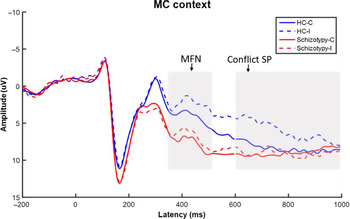
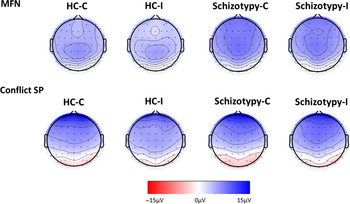
The grand-averaged ERP and topographical maps for MC context are presented in Figures 1 and 2.
Grand-averaged event-related potentials (ERPs) elicited by incongruent (I) and congruent(C) trials in the healthy control (HC) and schizotypy group for the mostly congruent (MC) context. The electrodes used in data analysis on the MFN and conflict SP were Fz, F1, and F2. The grey-shaded areas indicate the 360- to 530-ms time window and 600- to 1000-ms for the calculation of the mean value of the MFN and conflict SP components, respectively. The time point “0” indicates stimuli onset.

The topographical maps in incongruent (I) and congruent trials(C) for the MFN (360–530 ms), conflict SP (600–1000 ms) in healthy control (HC), and schizotypy group under the MC context.

MFN Amplitude
The ANOVA showed that the main effect of Congruency was significant (F(1, 49) = 17.23, p < .001, η p 2 = .26), suggesting that the MFN was more negative for incongruent trials than congruent trials. The main effect of Group was significant (F (1, 49) = 5.43, p = .024, η p 2 = .100). The interaction was also significant (F (1, 49) = 4.07, p = .049, η p 2 = .077). Simple effect analysis showed that in the HC group, the difference between incongruent and congruent trials was significant (F (1, 25) = 19.41, p < .001, η p 2 = .284), while in the schizotypy group, the effect of Congruency was not significant (F (1, 24) = 2.23, p = .142, η p 2 = .044).
Conflict SP Amplitude
The ANOVA showed that the main effect of Congruency was significant (F(1, 49) = 5.48, p = .023, η p 2 = .101), suggesting that the conflict SP was more negative for incongruent trials than congruent trials. The main effect of Group was not significant (F (1, 49) = 1.15, p = .289, η p 2 = .023). The interaction was significant (F (1, 49) = 6.08, p = .017, η p 2 = .110). Simple effect analysis showed that in the HC group, the difference between incongruent and congruent trials was significant (F (1, 49) = 11.79, p = .001, η p 2 = .194), while in the schizotypy group, the effect of Congruency was not significant (F(1, 49) = .008, p = .931, η p 2 = .000).
MI Context
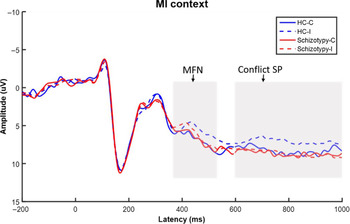
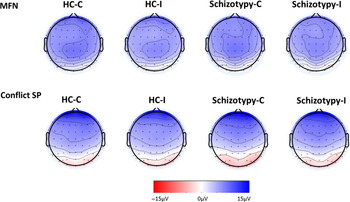
The grand-averaged ERP and topographical maps for MI context are presented in Figures 3 and 4.
Grand-averaged event-related potentials (ERPs) elicited by incongruent (I) and congruent(C) trials in the healthy control (HC) and schizotypy group for the mostly incongruent (MI) context. The electrodes used in data analysis on the MFN and conflict SP were Fz, F1, and F2. The grey-shaded areas indicate the 360- to 530-ms time window and 600- to 1000-ms for the calculation of the mean value of the MFN and conflict SP components, respectively. The time point “0” indicates stimuli onset.

The topographical maps in incongruent (I) and congruent trials(C) for the MFN (360–530 ms), conflict SP (600–1000 ms) in healthy control (HC), and schizotypy group under the MI context.

MFN Amplitude
The ANOVA showed that the main effect of Congruency (F (1, 49) = 9.62, p = .003, η p 2 = .16) was significant, suggesting that the MFN was more negative for incongruent trials than congruent trials. The main effect of Group (F (1, 49) = .002, p = .965, η p 2 = .000) and the interaction (F (1, 49) = 1.80, p = .19, η p 2 = .035) was not significant.
Conflict SP Amplitude
The ANOVA showed that the main effect of Congruency was not significant (F(1, 49) = 3.10, p = .085, η p 2 = .059). The main effect of Group (F (1, 49) = .308, p = .582, η p 2 = .006) and the interaction (F (1, 49) = 2.93, p = .094, η p 2 = .056) was not significant either.
Discussion
In this study, the schizotypy and HC groups did not differ significantly in terms of behavioural performance under both the MI and the MC contexts. However, the ERP results showed dissociation between proactive and reactive control. Specifically, individuals with schizotypy showed abnormal neural activity during a task involving reactive control but normal neural activity during a task involving proactive control compared with HC. To our knowledge, this is the first study that examines the neural correlates of proactive and reactive control in individuals with schizotypy.
Regarding reactive control (the MC context), we did not observe any significant difference between individuals with schizotypy and HC in interference effect for response time and accuracy. Although Kim et al. (Reference Kim, Oh, Jang, Che and Im2012) found that individuals with schizotypy showed significantly more errors in response to incongruent trials than HC in the Stroop task and a previous review also showed that individuals with schizotypy were associated with a reduced inhibition performance (Ettinger et al., Reference Ettinger, Mohr, Gooding, Cohen, Rapp, Haenschel and Park2015), our findings are in line with the most recent meta-analysis which demonstrated no significant association between schizotypy and inhibition performance (Steffens et al., Reference Steffens, Meyhofer, Fassbender, Ettinger and Kambeitz2018). In terms of ERP results, HC showed a significantly larger MFN amplitude in incongruent trials compared with congruent trials, but this effect was absent in individuals with schizotypy. This result is consistent with studies in patients with schizophrenia (Markela-Lerenc et al., Reference Markela-Lerenc, Schmidt-Kraepelin, Roesch-Ely, Mundt, Weisbrod and Kaiser2009; McNeely et al., Reference McNeely, West, Christensen and Alain2003) and a study in individuals with schizotypy (Kim et al., Reference Kim, Oh, Jang, Che and Im2012), all of which reported no significant difference in frontal negativity (FN)/N450 amplitude between incongruent and congruent trials. FN/N450 is similar to MFN because both ERP components are observed in frontal–central sites 300–500 ms post-stimuli, both are considered to reflect the detection of cognitive conflict (West & Alain, Reference West and Alain2000), and both share the same neural generator (i.e., ACC) (Liotti et al., Reference Liotti, Woldorff, Perez and Mayberg2000; West, Reference West2003). These findings suggest that individuals with schizotypy may have abnormal neural activation in conflict detection under contexts that require reactive control.
In addition to the attenuation of MFN, reduction in conflict SP amplitude was also observed in individuals with schizotypy. Conflict SP amplitude in incongruent trials was larger compared with congruent trials in HC, but this was not observed in individuals with schizotypy. The results are consistent with finding of diminished conflict SP in patients with schizophrenia (Markela-Lerenc et al., Reference Markela-Lerenc, Schmidt-Kraepelin, Roesch-Ely, Mundt, Weisbrod and Kaiser2009; McNeely et al., Reference McNeely, West, Christensen and Alain2003). Conflict SP modulation is related to the selection of an appropriate stimulus dimension after conflict detection on incongruent trials, reflecting the process of conflict resolution supported by the lateral frontal and posterior cortex (West, Reference West2003; West & Alain, Reference West and Alain2000). The significant changes in MFN and conflict SP amplitudes suggest that individuals with schizotypy may have abnormal neural activation in both conflict detection and conflict resolution in contexts that require reactive control. Intact conflict detection is the basis for invoking subsequent control process to resolve conflicts (C. S. Carter & Veen, Reference Carter and Veen2007). Therefore, it is possible that the reduced conflict SP may be a result of the attenuated MFN.
The MC context consisted of 75% congruent trials, and it was beneficial if participants could maintain their attention towards the word meanings of stimuli (the irrelevant dimension), which could result in a strong interference when they encountered infrequent incongruent trials (Bugg & Crump, Reference Bugg and Crump2012). At the same time, reactive control would be enacted to overcome this interference (DePisapia & Braver, Reference DePisapia and Braver2006; Kane & Engle, Reference Kane and Engle2003). Therefore, in the MC context, a stimulus-driven control (the reactive control) may be activated on an as-needed basis (Braver et al., Reference Braver, Gray, Burgess, Conway, Jarrold, Kane, Towse and Miyake2007). Taken together, these results suggest that individuals with schizotypy may have reduced ability to detect and resolve conflict interference under the reactive control mode. Similar findings that no significant behavioural impairments but anomalous ERP results have also been reported in patients with schizophrenia (McNeely et al., Reference McNeely, West, Christensen and Alain2003). There are several possible explanations for these findings: first, neurophysiological abnormalities precede the behavioural abnormalities. Second, alternative neural networks may be recruited to produce a normal behavioural response in individuals with schizotypy, as previous studies have shown that both increased and decreased functional brain connectivity were observed in individuals with schizotypy (Mohr & Claridge, Reference Mohr and Claridge2015; Y. M. Wang et al., Reference Wang, Cai, Zhang, Zhang, Zhou, Wang and Chan2020). Nevertheless, more sensitive tasks may also need to be developed to better explore this issue.
In the MI context (proactive control), the schizotypy and HC groups did not differ significantly in behavioural performance (e.g., response time or accuracy). Moreover, the amplitudes of MFN and conflict SP were also similar in these two groups. These results suggest that individuals with schizotypy may be as effective as HC in the detection and resolution of interference conflict under the MI context. These results are not consistent with our hypothesis. Indeed, a number of studies have reported that the interference effect in the MI context is smaller than in the MC context (Aben et al., Reference Aben, Calderon, Van der Cruyssen, Picksak, Van den Bussche and Verguts2019; DePisapia & Braver, Reference DePisapia and Braver2006; Grandjean et al., Reference Grandjean, D’Ostilio, Phillips, Balteau, Degueldre, Luxen and Collette2012; Xiang et al., Reference Xiang, Chen, Chen, Zhang, Xu and Wang2018). In the MI context, incongruent trials are more frequent, and as such participants may strategically use proactive (top-down) control to divert attention away from the frequently distracting dimension, which may speed up the identification of incongruent trials and decrease interference (Bugg & Crump, Reference Bugg and Crump2012; Logan & Zbrodoff, Reference Logan and Zbrodoff1979). Individuals with schizotypy appear to be normal in the process of preparing for forthcoming interference in advance to facilitate the effective resolution of subsequent conflicts.
Several previous research using the AX-Continuous Performance Task (AX-CPT) suggest that individuals with schizotypy may have deficits in proactive control (Barch et al., Reference Barch, Mitropoulou, Harvey, New, Silverman and Siever2004; Chun & Ciceron, Reference Chun and Ciceron2018; Uhlhaas, Silverstein, Phillips, & Lovell, Reference Uhlhaas, Silverstein, Phillips and Lovell2004). The AX-CPT is another commonly used task to measure proactive and reactive control, in which sequential letters are presented, forming cue–probe pairs, and participants are required respond to A–X pairs. Processing of the cues and probes represent proactive and reactive control, respectively (Chaillou, Giersch, Hoonakker, Capa, & Bonnefond, Reference Chaillou, Giersch, Hoonakker, Capa and Bonnefond2017; Qiao et al., Reference Qiao, Xu, Che, Zhang, Li, Xue and Chen2018). These results appear to contradict with our finding of intact proactive control in individuals with schizotypy. One possible explanation of this inconsistency may be due to the fact that proactive control can be divided (Marini et al., Reference Marini, Demeter, Roberts, Chelazzi and Woldorff2016) into “phasic” (Oliveira, Hickey, & McDonald, Reference Oliveira, Hickey and McDonald2014) and “tonic” proactive control (Braver, Paxton, Locke, & Barch, Reference Braver, Paxton, Locke and Barch2009; Marini, Chelazzi, & Maravita, Reference Marini, Chelazzi and Maravita2013). Phasic proactive control is implemented before an expected distraction, but not sustained across trials, while tonic proactive control can be sustained across multiple trials. The AX-CPT belongs to the cue–probe paradigm, and so in each pair of stimuli, the cue has to be actively maintained until the appearance of the probe, while the content (cue) maintained in every trial is dynamically adjusted. As a result, the proactive control implemented in the AX-CPT is a kind of “phasic” proactive control. However, in this study, proactive control is manipulated in the whole block, which could be considered as a kind of “tonic” proactive control. Individuals with schizotypy may only be impaired in “phasic” proactive control. Future studies are needed to examine this issue.
Moreover, a previous study has shown that schizophrenia patients exhibit a dissociation between sustained and transient attention, displaying impaired transient attention related to the onset of a target and intact sustained attention associated with sustained signals that persist across the entire task (J. D. Carter et al., Reference Carter, Bizzell, Kim, Bellion, Carpenter, Dichter and Belger2010). Similarly, our findings suggest that individuals with schizotypy also exhibit abnormal neural activation in reactive control and intact proactive control. Attention resources needed in reactive control is best applied sparsely and implemented dynamically (Aben et al., Reference Aben, Calderon, Van der Cruyssen, Picksak, Van den Bussche and Verguts2019; Botvinick et al., Reference Botvinick, Braver, Barch, Carter and Cohen2001; Braver et al., Reference Braver, Gray, Burgess, Conway, Jarrold, Kane, Towse and Miyake2007), that is, increasing at task-relevant moments and decreasing during task-irrelevant periods. However, attention resources in proactive control are continuously needed and constant in a longer timescale or global context. The schizophrenia spectrum may not be able to modulate cognitive resources effectively to respond to the changing demands of the task (i.e., the transient process). Importantly, we provided evidence that individuals with schizotypy showed similarities with schizophrenia on the neural abnormalities in reactive control. However, we did not compare individuals with schizotypy and schizophrenia directly, and further studies need to compare these individuals directly to get a clear picture of different modes of cognitive control in the schizophrenia spectrum.
This study has several limitations. First, schizotypy has three dimensions: positive, negative, and disorganisation (Ettinger et al., Reference Ettinger, Mohr, Gooding, Cohen, Rapp, Haenschel and Park2015; Steffens et al., Reference Steffens, Meyhofer, Fassbender, Ettinger and Kambeitz2018), but we only used the total SPQ score to screen individuals with schizotypy. Although we found that individuals with schizotypy and HC showed significant difference among all the three dimensions, it is not clear whether our results could be generalised to individuals with positive, negative, or disorganised schizotypy. Second, frequent incongruent trials or frequent congruent trials in the MI or MC contexts may result in low-level associative learning, which may confound the control process. However, we had included 16 different stimuli and the trial sequence was pseudo-randomly arranged to avoid repetition of stimuli between adjacent trial to minimise associative learning as far as possible. Adding another unbiased pair of stimuli (the proportion of incongruent and congruent trials is equal) in the MI/MC context could further eliminate this confound (Braem et al., Reference Braem, Bugg, Schmidt, Crump, Weissman, Notebaert and Egner2019; Bugg, Reference Bugg2014; Spinelli & Lupker, Reference Spinelli and Lupker2020). Third, patients with schizophrenia can be recruited to examine the generalisation of our results to clinical populations. Fourth, some of the data were not normally distributed even after transformation. Although Harwell et al. (Reference Harwell, Rubinstein, Hayes and Olds1992) and Zinke et al. (Reference Zinke, Altgassen, Mackinlay, Rizzo, Drechsler and Kliegel2010) suggested that the results of ANOVA are robust and have excellent power properties even the assumptions are violated, the present findings should be considered to provide preliminary evidence and warrant for further validation in future study. Fifth, even though the two groups showed a differential pattern of MFN and Conflict SP amplitudes between congruent and incongruent trials, the triple interaction effect of Context × Congruency × Group was not significant, so to isolate the variable (Context) might inflate the type I error, future studies should increase the sample size to achieve a greater statistical power. Finally, how might the decreased MFN and conflict SP in reactive control (but not proactive) impact on social or occupational functioning in those with schizotypy are not clear and worth further studies.
Conclusion
In this study, we demonstrated that individuals with schizotypy exhibit decreased MFN and conflict SP amplitudes in reactive cognitive control but not in proactive cognitive control. Our results provide preliminary evidence showing a dissociation of proactive and reactive cognitive control in individuals with schizotypy. The current findings help us better understand cognitive control impairments in patients with schizophrenia and suggest that the abnormal reactive control in schizophrenia patients may not be caused by medication or hospitalisation.
Supplementary Material
To view supplementary material for this article, please visit https://doi.org/10.1017/S135561772000137X
Acknowledgements
This study was supported by National Science Foundation of China (31571130, 32071062).
Conflict of Interests
The authors have no conflicts of interest to declare.