1. Introduction
1.1. Sound appropriation by sound art
Since the late 1970s, somewhere between visual arts and music, we have watched the rise of an art form that has come to be referred to as sound art. Some of the main characteristics of this repertoire are its conception and use of sound, the absence of a narrative discourse, an approach that emphasises contextual aspects, the interaction with the public, and the connection between body, space and time. Sound art is highly connected to conventional musical practices as it uses sound as its essential element. At the same time, it resonates with contemporary practice in the visual arts since it makes use of space and visual elements to project sound and create aural environments. Both music and visual arts are important to understand how sound art has claimed its own territory.
Despite the direct connection between music and visual arts, sound art established a new artistic practice that can be understood as a result of sound’s impact on the arts in the twentieth century. Sound’s role in establishing representation and signification processes is a key element in the analysis of this repertoire. To understand these processes we can start from the hypothesis that sound has followed two different paths within the arts. On the one hand, there is the musical route towards the creation of strategies and procedures to establish a self-referential grammar. This process culminates with the emphasis on sound itself as a source and foundation of musical discourse, as one can find in Pierre Schaeffer’s écoute réduite (Schaeffer Reference Schaeffer1966) or in John Cage’s transpositions of everyday sounds into music (Dyson Reference Dyson1992). On the other hand, we can observe, especially outside the musical domain, a tendency to explore the contextual and representational potentiality of sound, which is the basis of what constitutes the repertoire of today’s sound art. In the first case the idea of musicalisation of sounds emerges (Kahn Reference Kahn1999); in the second, sound material is directly connected with other aspects of culture and life.
While instrumental and electroacoustic music composition remained connected to an abstract aspiration, sound art, like the visual arts, tended to make reference to objects, concepts or ideas. Here there is a hybridisation of strategies that are present in both music and visual arts. Sound art comes closer to musique concrète by exploring timbre and the perceptive qualities of diverse sound categories. At the same time it assumes a more flexible attitude in relation to the abstraction of discourse created from the sound material. In the same way as can be observed within visual arts, sound art widely explores the use of diverse elements (not only sounds, but also all sorts of objects, light, images, space, bodies) to create direct and complex relationships to what is outside the work itself. In sound art, a concrete conception of sound is allied to a fragmented time approach and to the use of an aesthetically active space, which corroborate in a syntax that is seldom based on musical abstract structures.
Thus the possibility of a closer and more direct contact with sound on a level less mediated by symbolic representations (as is the case of music notation) has raised a concrete, almost ‘material’ conception of sound and a different relationship between the artist and the artistic object. In this case, sound can even be considered in an expanded concept of sculpture: as a sculpture material; as something plastic that can be shaped, manipulated, deformed or even restructured. While the sound discourse in traditional music tends to be more narrative and teleological, in sound art the narrativity does not occur through a temporal structuring of sounds, but through the references provoked by these sounds. There is no need for an elaborated temporal string of sound elements, as happens in music. On the contrary, sounds are frequently pointing out visual and spatial elements.
To understand how sound art uses sound material to construct its representational discourse, we will concentrate on two aspects that are the basis of this repertoire: space and time.
2. Space
One of the transformations accomplished by electroacoustic music in the mid twentieth century was the appropriation of space as a musical element. However, in this process there was a reduction in the idea of spatialisation to the concept of a projection of sounds in space. Thus, the electroacoustic project devoted considerable attention to developing strategies to create the perception of sound source localisation (front/back, left/right), sonic planes (close/distant), and virtual acoustic spaces (small/large, dry/reverberant). In this sense, the acoustic space in electroacoustic music is mainly related to sound data, and the aural perception of space is associated with source localisation and room dimensions. It constitutes an acousmatic space (Campesato and Iazzetta Reference Campesato and Iazzetta2006: 777) that does not correspond to the space where the music is diffused. Electronic devices hidden behind the curtain of loudspeakers construct this virtual space.
In sound art, part of the work is the actual space where it occurs. Multimodal sensations are activated by acoustical elements and space resonates with sound, leading to sensorial images of dimension, colour, texture, shape and movement. Also, many of the references attached to a site can be triggered by sounds and become part of the work. The idea of space is translated into the idea of site, incorporating social, psychological, perceptive, acoustic and visual characteristics of a place. Space becomes a representational element in the artwork.
One of the references that emerges in this context is a notion of place that transcends the idea of geometric space as a measure demarcated by geographical coordinates (LaBelle Reference LaBelle2006). It incorporates perceptual, social, psychological, acoustical and visual characteristics of a milieu assigned by specific circumstances and occurrences.
Thus, site-specific brings the idea in which space embraces more than geometrical properties: materials as well as the history they can elucidate, architectural contexts, and even the cultural and social conventions that regulate the place of exhibition, all become constitutive elements of the art work. This practice introduced a critique of the modes of art diffusion and led to a shift from a focus aimed at the object to a wider concern with the artistic context and environment.
In the case of music, the concert hall is such a consolidated space that it became extremely difficult to project new musical environments and new forms of music presentation. Even some more sophisticated proposals of electroacoustic multitrack diffusion did not break up the formal configuration of a concert hall in which space serves as an enclosure where the music is physically constrained and the audience is confined.
When music crosses the boundaries of the concert hall in search of alternative spaces it is usually reconfigured in new formats such as sound art, sound installation, and performance. The art gallery becomes an alternative space to host musical and sonic arts. But if the concert hall enforces its own ritual and traditions, the gallery also provides a new type of space with its own conventions. Like the concert hall, the gallery’s walls and rooms also impose a clear demarcation of what is inside and what is outside.
2.1. Space in music and sound art
The art gallery has established itself as an almost neutral and aseptic space, sealed (without windows), especially built to isolate the work of art from any external event: a white cube.
The ideal gallery subtracts from the work of art all the evidence that interfere in the fact that it is ‘art’. The work is isolated from anything that might undermine its appreciation. This provides the room with a characteristic presence of other spaces in which conventions are preserved by the repetition of a closed system of values. Some of the holiness of the church, of the formality of the court, of the mystique of the experimental laboratory is joined to a fashionable design to produce a unique chamber of aesthetics. (O’Doherty Reference O’Doherty2002: 03)
The gallery’s white walls lead to a contemplative attitude from the spectator, who, framed by social rules, keeps a relative distance from the work, establishing a relationship that is more rational than physical, corporal or sensorial. The contemplative detachment is clearly a remnant of an almost religious attitude, in which the aseptic white cube and the concert hall are part of an almost sacred conception of art.
The installation attempts to transform the ‘white cube’ into a ‘black cube’: as it weakens the idea of sacred, it brings the viewer to a closer relationship with the work, and transforms the site into an encompassing environment (Campesato Reference Campesato2007). Black cubes are inhabited by loudspeakers and screens, and the dark walls become invisible, providing the creation of a virtual space in which new perceptive modalities are stimulated. Thus, the context becomes content and the viewer becomes part of the work, emphasising the idea of immersion. Material elements and creative procedures are transformed.
The installation is configured as a new way of presenting the work of art. The listener is not confined to a fixed position in space, but is invited to create his or her own spatial relationship with the work (Campesato Reference Campesato2007). While publishing music is traditionally achieved through performance (or at least by recording), installation art configures itself as ‘the possibility of publishing [the music] without performance’ (Aldrich Reference Aldrich2003) in a way that the listener is free to establish his or her own link with the time of the work and with the space where it happens.
2.2. Three instances of space in music and sound art
Any art form that takes sound as its main material is a temporal art form since sound can only happen in time. In music and in other types of sound art, time can be associated with space forms on different levels of relevance. We can analyse some of the spatial aspects that are put into resonance by sound in music and sound art, showing how they are explored in recent works. For this purpose we will establish three categories of spatial relationship with sound and analyse their role in the art. The three categories are acoustical space, architectural space and representational space.
2.2.1. Acoustical space
Acoustical space embraces the perceptual acoustic characteristics of space, such as volume, reverberation and sound source localisation. Acoustic phenomena are used to provide psychoacoustic impressions of a space. This instance is related to what is generally called spatialisation in electroacoustic music, or stereophonic image in the process of sound recording and mixing in a studio. Basically, it is related to the localisation of sound sources and their movements in space. Also, the reverberant characteristics of a perceived sound allow the perception of some spatial aspects such as volume or shape, and can even provide some hints about the type and position of surfaces constituting that space.
In the last decades electroacoustic music has developed many systems and strategies to deal with sound spatialisation. From the first experiences with multi-channel composition in electronic music in the 1950s to the set-up of large loudspeaker orchestras, to the development of new spatialisation techniques and protocols, space found its way into the musical agenda.
In sound art, space has become the material that constitutes the essence of many works as they emphasise the acoustic effects produced by controlled projection of sound sources. Not only is sound itself perceived in relation to space, but also the acoustical and psychoacoustical characteristics of sound spatial dimensions are employed to emphasise the architectural characteristics of a particular place. In fact, many sound art works explore psychoacoustical aspects by focusing on the perceptual subtleties of sound events. They seek to stimulate the spectator to understand acoustical phenomena that are not usually taken into account, even in the processes of listening to music (Campesato Reference Campesato2007).
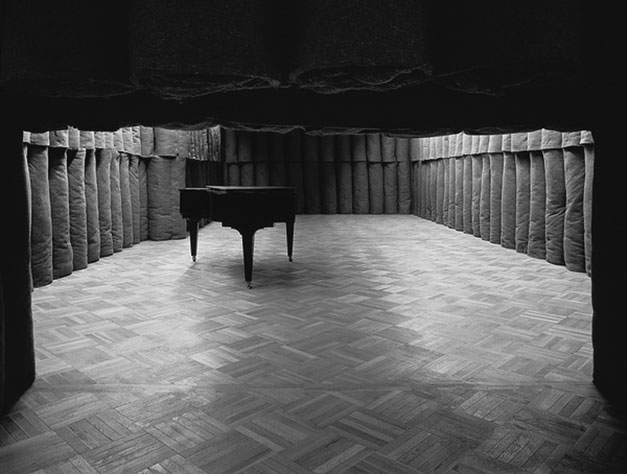
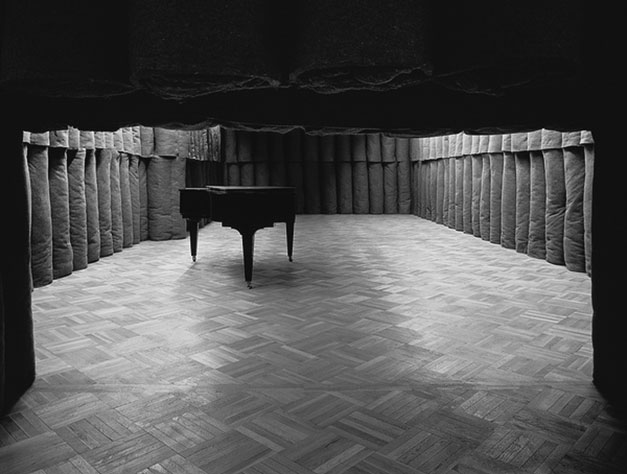
One example is the installation Plight (Anthony d’Offray Gallery 1985), created by German artist Joseph Beuys, well known for his ritualistic performances and his participation in the Fluxus Group. In this installation there is a conceptual use of the acoustic space as it uses a highly sound-absorbent material to cover all the surfaces of a room (figure 1). This material eliminates the room’s natural reverberation and creates an extreme perceptive distinction between the external and internal acoustic spaces. Inside the room the sensation is as if all the sounds in the environment have been absorbed by the covered surfaces. There is no need to play specific sounds or music to perceive the acoustical changes: environmental noises or sounds produced by the visitor are sufficient to trigger attention to the unusual acoustics. Inside the room a piano remains silent as if its sounds were also drawn by the absorbent surfaces.
Detail of Plight, by Joseph Beuys.
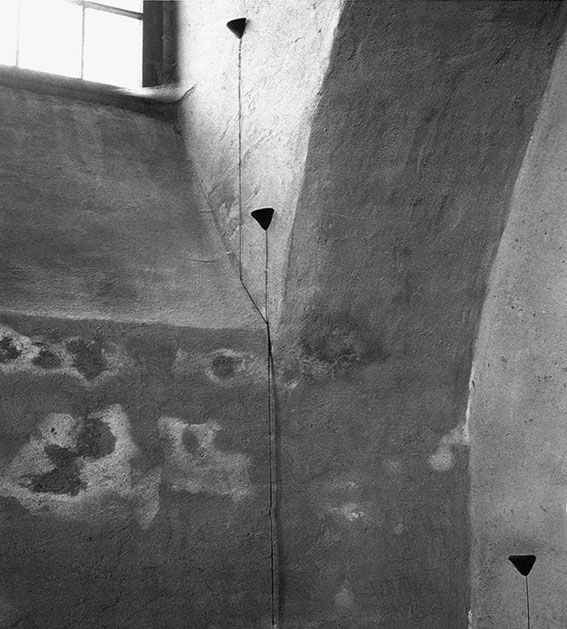
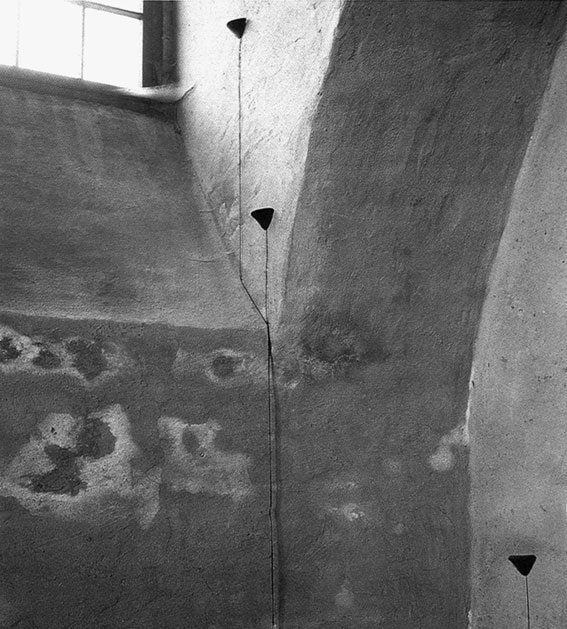
In Stationen (1992), Robin Minard creates an installation where ‘space itself becomes a musical instrument and architecture an acoustic event’ (Schulz Reference Schulz1999: 99). In this work, loudspeakers are placed around the stairwell and the bell tower of Berlin’s Parochial Church (figure 2). These loudspeakers reproduce natural and synthetic sounds that are integrated to the acoustics of the environment without disturbing it. Some of the sounds are produced and controlled by a computer and are reproduced by loudspeakers placed in positions of the building following a vertical organisation in which the register of the sounds changes gradually from low to high as one ascends the stairwell into the bell tower room. The filtering of higher frequencies and the integration of loudspeakers with the environment make it difficult to localise the sound sources, providing a very diffuse sound reproduction.
Detail of Stationen, by Robin Minard, Parochialkirche, Berlin, 1992.
In both works, space is made evident by the sounds. Also, sound materials establish a relationship of resonance with the space where it is produced. While in music the practice of spatialisation remains attached to the idea of sound-source localisation and displacement, in sound art works space tends to acquire a more effective role by establishing more direct connections between sounds and the acoustic behaviour of these sounds in a particular environment.
2.2.2. Architectural space
Architectural space relates to the conception of aural architecture developed by Blesser and Salter (Reference Blesser and Salter2007), in which sounds are able to shape a sonic space that carries specific functions and representational potentialities. This conception leads to a close relation between the place where sounds are projected and the way one listens to it, creating a listening space. In this sense it shares characteristics of both acoustical and representational spaces.
Different from a soundscape, in which sounds are important in themselves, in aural architecture, sounds illuminate space (Blesser and Salter Reference Blesser and Salter2007: 16). In electroacoustic music the idea of spatialisation focuses on sounds themselves and on their movement across a virtual space: sounds are made evident by their movement. In aural architecture, by contrast, sonic sources are placed in order to reveal space. In this context space is not only taken as a physical dimension, but also considered in its social, perceptual and experiential aspects.
According to Blesser and Salter (Reference Blesser and Salter2007: 64), one can experience space in four modes: ‘social, as an arena for community cohesion; navigational, as local objects and geometries that combine into a spatial geometry; aesthetic, as an enhanced aesthetic texture; and musical, as an artistic extension of instruments’. These modes can coexist and their relevance depends on the cognitive strategies adopted in a particular context.
Music seldom directs attention towards space in this sense, even when it incorporates spatial aspects in the compositional process, as we have already mentioned regarding electroacoustic music. Of course, when one listens to a sacred piece inside a church or to an orchestral concert in a park on a Sunday morning, the environment becomes part of the music and one can establish connections between contextual characteristics of those spaces and the music being performed, but these connections are more accidental than intentional. In this case, the relationship between music and space is more related to the particularity of a performance than to the compositional conception of the work. Thus, space usually draws attention to musical aspects.
In the field of sound art, many works may invert this balance by using sounds and music to emphasise – or, as Blesser and Salter (Reference Blesser and Salter2007) would say, to illuminate – space. Some artists may employ sound to put space into resonance and use this resonance to amplify the referential potentiality of space. Robin Minard has created works for public spaces in which the function of music is redefined in relation to noisy environments. He creates a kind of spatial composition for public spaces that receive the artwork without losing their original functionality. Consequently, Minard has ‘left the protected concert hall to deal with the actual acoustic space of the urban world’ (Schulz Reference Schulz1999: 27), shaping acoustic spaces to become works to be listened to. The use of public spaces requires the creation of strategies to guide the listener’s attention to the sounds that compose the natural and urban environment at the same time that the artist ‘deconstructs and recombines the acoustic material to create an oscillating effect’ (Schulz Reference Schulz1999: 29) in which one can establish new connections regarding the familiar sounds that inhabit a place.
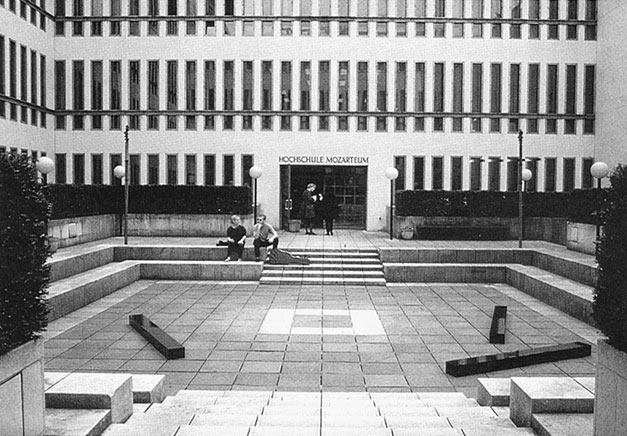
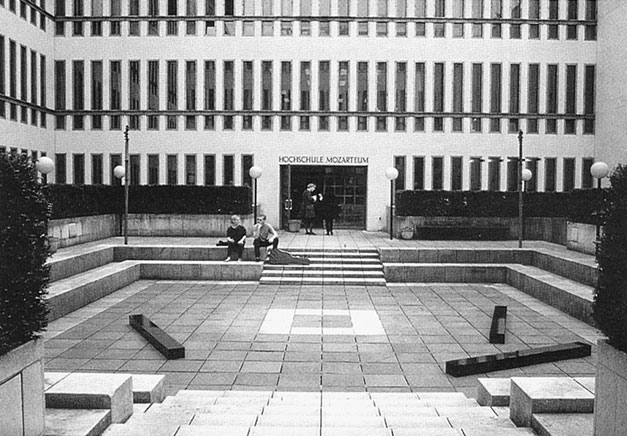
The resonance of these ideas can be noted in Brunnen (1994). This installation consists of three rectangular blue acrylic boxes asymmetrically located on the floor (figure 3). Inside the boxes are loudspeakers that transmit a mixture of natural and synthetic sounds of water. Each of the acrylic columns placed close to the speakers are tuned in intervals a quarter-tone apart, producing small frequency variations in the environment (Schulz Reference Schulz1999). It is interesting to note that the work was installed at the entrance of the Mozarteum in Salzburg, whose traditional fountain was replaced by the blue boxes, producing an intriguing integration between the current space and the memory of the previous acoustic space. Moreover, there is a strong spatial relationship created by the formal similarity between the boxes and windows of the building that surround the plant.
Brunnen, by Robin Minard, Mozarteum, Salzburg, 1994.
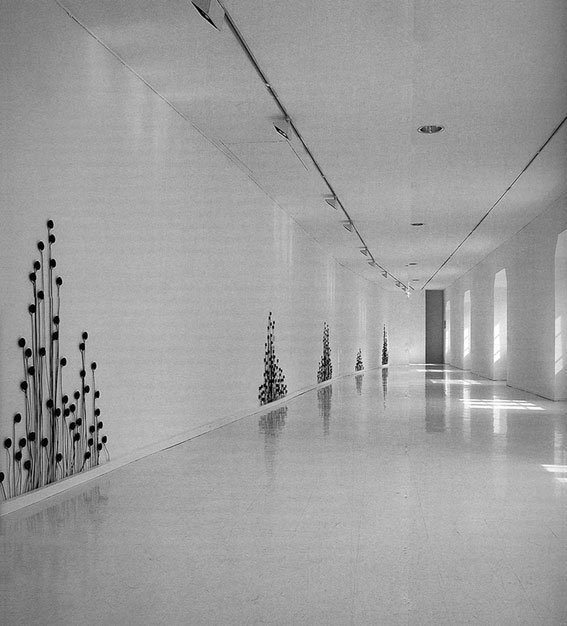
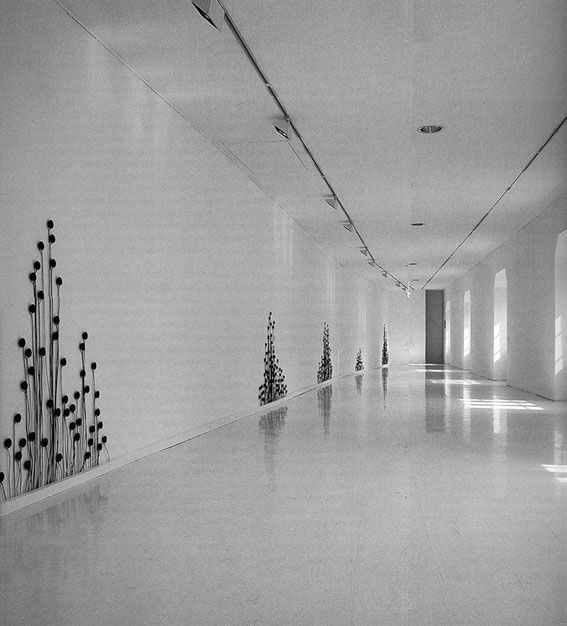
In Silent Music (1994), the artist uses about 400 piezo-electric loudspeakers fixed on walls and other surfaces (figure 4). Attached to their wires the loudspeakers assume plant-like forms that resemble bioorganic structures (Schulz Reference Schulz1999). The arrangement of the loudspeakers creates the impression that they search for the light as if they were real plants. The work is conceived for both traditional exhibition spaces and public areas such as gardens and parks. Sounds are composed by synthetic and natural sources and are specially conceived to be incorporated into the environment.
Silent Music, by Robin Minard, Stadtgalerie Saarbrücken, 1999.
Generally, in public spaces, the artist must deal with the fact that sounds and other elements of that space carry their own specific meanings, because sounds are attached to the context of their places of origin. In this type of work, Minard adds previously composed sounds to the site that lead to a perception that ‘hovers between identifying familiar phenomena and noting unexpected musical sounds’ (Schulz Reference Schulz1999: 29).
2.2.3. Representational space
Representational space refers to images, contexts and concepts that are related to a specific site and can be triggered by sounds. It focuses more on the historical and contextual elements of a place than on its geometrical delimitation and physical configuration. While instrumental and electroacoustic music maintained a discourse based on abstract sound relations that are constructed through references to the musical discourse, sound art tends to generate a representational discourse full of references that point out concepts and contexts that are external to the work itself. In music, referentiality is inserted into the temporal discourse as a basis for the musical narrative. In sound art referentiality is usually extra-musical, thus it can operate through other resources such as the physical or imaginary space where it is presented. If music tends to establish a linear discourse whose elements are deeply attached to musical grammar, by its turn sound art uses sound in a more representational way. Thus, its discourse does not need to be based on temporal structures – as is the case of music – but it can lead to other types of configurations in which conceptual ideas are referred to its sonic constructions.
For this reason time dimension in sound art is somehow condensed. Usually sound art works do not impose a linear temporal organisation of sound elements. Many of these works do not provide a specific begining or end, allowing the spectator to enter and leave the work at any time. As the use of time becomes less imposing, it is possible to adhere to a spatial discourse, typical of the visual arts. In the same way that sound became essential to twentieth-century music, space plays a central role in the repertoire of sound art.
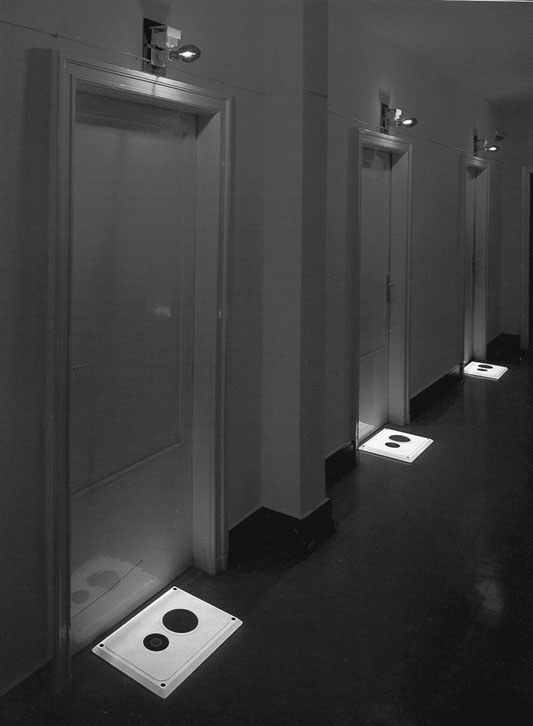
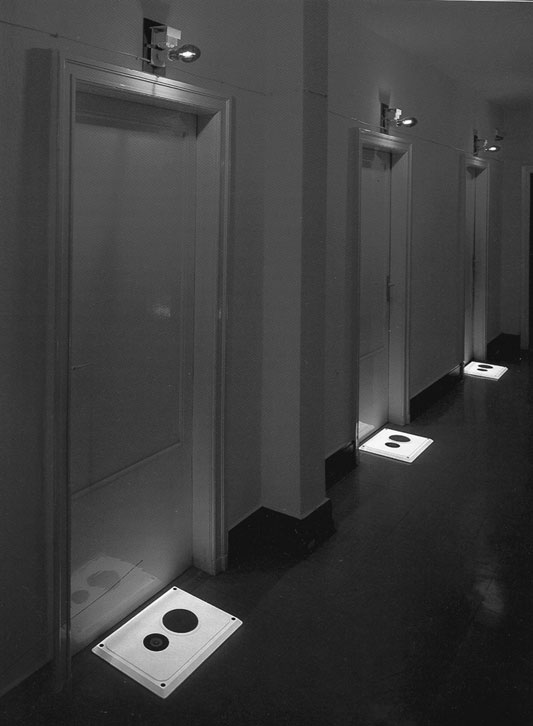
An example of a highly representational use of space is the work Zwölf Türen und zwölf Klänge (Twelve Doors and Twelve Sounds, 2000) by Christina Kubisch. It is part of a series of installations entitled ‘consecutio temporum’. Works on this series are created for rooms that have gone through different historical changes. Zwölf Türen und zwölf klänge was set on the second floor of the Opel Villa building in Rüsselsheim (Kubisch Reference Kubisch2000). The place was constructed in 1930 and since then it has assumed different purposes: it was originally used as a floor for servants, later as a hospital and, during the Second World War, for military purposes.
The installation consists of twelve white lacquered doors each with a white loudspeaker in front of it; the loudspeakers are list by lamps hanging above the doors (figure 5). This lighting reveals traces of the building’s history by illuminating some cracks and small marks. These details guide the public through the history that emerges from the architecture. It is worth noting the metaphorical use of sounds in relation to the environment. Loudspeakers are installed in the threshold of each lacquered door and each door reflects both the image and the sound of the loudspeaker. The sounds are produced by electronic devices in twelve soundtracks. Their extremely high frequencies are close to the human hearing threshold and work as a tapestry that involves the space.
Detail of Zwölf Türen und zwölf Klänge, by Christina Kubisch, Reference Kubisch2000.
Regarding Kubisch’s particular conception of an archaeological space in this work, Carsten Ahrens, curator of the exhibition comments that:
In the luminous dark, the traces of time become visible. Fissures and wounds in the structure of the room’s wall appear; our glance and our thoughts follow the patterns of their lines, tracing a journey into what is past. The history of the site becomes a history of question marks, an empty space our curiosity seeks to fill. (Ahrens Reference Ahrens2000: 58)
In these three spatial instances mentioned above – acoustic space, architectural space, and representational space – there is a progression from a more objective conception of space to an abstract, referential one. If music repertoire tends towards the first instance, sound art usually explores the potentialities of the three of them. Thus, space not only points to internal sonic structures of the work, but also creates a web of connections with ideas, contexts and stories that lie outside the work.
3. Time
Time in music is usually built by a relatively extended discourse where structural units of different durations are articulated. Thus, the constitution of a musical form is inevitably dependent upon time, which is articulated in segments such as sections, periods and phrases. From the point of view of formal composition, sound is generally used to build temporal structures (cells, phrases, motives) that create temporal arrangements of repetition, variation, development and rupture.
On the other hand, in the repertoire of sound art time frequently appears condensed or suspended. Sound structures usually lead to acoustic qualities or concepts that renounce a more extensive or elaborated temporal development. Instead of long discursive forms, as can be found in music, which demand the listener to follow each phase of the composition, from beginning to end, sound art makes use of either short elements which can condense its meaning in a brief moment, or of repetitive elements which generate a static character.
While music, especially concert music, demands a linear and successive following of discourse, be it more or less fragmented, time in sound art is the duration of recognition and fruition of the work in its environment. In general, there is no explicit demarcation of the beginning or the end of a work and its duration depends on the intention and the interest of the spectator. Thus, the sound elements are not sustained by their temporal connection but by their immediate meaning and their relationship with other non-temporal elements, such as concepts or the space itself.
3.1. Time in music and sound art
The discursive joining of sound elements in music composition enables the construction of complex and extensive narrative structures. According to Pasler (Reference Pasler1993: 5), narrativity is widely connected to memory in the domain of art. Therefore, referentiality, being internal or external to the discourse, becomes an important feature to be analysed in the artistic context.
In music, narrative mainly points out an internal memory of the discourse. A certain music excerpt frequently leads us to another musical excerpt or, at least, to another musical structure. One can think of the idea of development in the sonata form, which is a constant re-elaboration of the thematic material impinged upon the memory. In electroacoustic music, in which the sound material is a unifying element of the work, the memory of previous sounds is also recurrent.
In sound art, even in works that are based on musical structures, narrativity is related to the memory of facts that exist outside the work. In this case, the main difference of discourse organisation resides in the referentiality process. For example, in the installation Sound Cooking (1984, Stuttgart) by Rolf Julius, there is a loudspeaker suspended by a wire with the drivers facing up. On the driver there is a red powder that vibrates while the speaker reproduces low sounds of a cello (Schulz and Gercke Reference Schulz and Gercke1996: 83). The way the cello phrases are presented constitutes an essential aspect, but the memory and references they evoke are related to something that is located outside the sounds. The strongest reference is connected to the work’s title, as the central object in the installation resembles a cooking pan. In this case, the narrative is diluted as the sequential string of elements is established individually by the viewer and the temporal element becomes secondary.
Another important element to be pointed out regarding temporal construction of sound art works is the overlay of elements used in creation. While musical narrativity is built mainly through a sound discourse, in sound art temporality is made up of the interconnection of different elements such as video, sound devices, recordings, images and lights. Each one of these elements can constitute different temporalities that coexist inside the same work.
In sound art time is closely related to the processual development of works. Instead of an overemphasis on the art object itself, which is related to a teleological organisation of sound elements in time, sound art narrative appears diluted or fragmented, raising the process to the focus of the work. When the focus of a work relies on the process through which it is accomplished, its structuring of time comes to a state of rest. The work becomes an ephemeral event whose duration is determined by its processes. The idea of a culminating point is diluted, opening room for a synchronicity of times that are triggered by references that carry their own present. Thus, sound art works tend towards an aesthetics of the ephemeral, of the transitory, at the same time that they condense historically distinctive elements in the same space and time.
Perhaps the main difference between the conception of time in art forms such as painting, sculpture and even music and the one that is practised in sound art and installation art in general lies in the way the viewer experiences the work. In an installation the viewer physically enters the work, follows its elements step by step, feels it and is affected by it. Time attains a distinctive characteristic because it requires the participation of the viewer to be established. The time of a work is often the time assigned by the viewer to that particular work. This time, however, moves from a temporal structure that has been established in advance, as is the case with music, to a structure that takes place through the exchange of experiences between the viewer and the work. It goes from a work that encloses its precepts and form to an open work, in which the elements are usually constituted in an indeterminate way.
In this sense, the time of experience sets the duration of a work. In Western music, the duration of the work, although relative, is preconceived in the composition. Apart from some examples of indeterminate music, the duration of musical elements are usually pre-determined. This is valid for the relative tempo of a musical passage as well as for the more precise duration of a recorded electroacoustic piece. It doesn’t matter how much duration is defined by the composer, or even by the interpreter, music always presupposes a fundamental factor: it lasts. Even in a work that challenges the traditional music structure such as Cage’s 4′33′′, the piece is framed by its duration no matter how loosely one can consider the time indicated in its title. Its performance is shaped by musical gestures that mark its beginning and end.
By its turn, in sound art duration is seldom taken as a crucial factor. Even when the material that constitutes a work has a temporal nature (sounds, music, video) and is arranged in time, the viewer decides when to enter or leave it. Temporal construction in sound art is much more dependent upon the viewer than the creator. Even when time is chronologically established, as is the case when a recorded sound has a fixed duration, the viewer chooses his or her own course through the work and decides how much time is necessary for its fruition. This approach to time is much more determined by the fruition of work than by the creation itself.
3.2. Temporal aspects of the repertoire
Although we have approached some aspects of narrativity, discourse, memory and referentiality that constitute the concept of time in sound art, we are far from defining the diversity of modes of temporal construction that can be observed in this repertoire. Amongst this diversity, one cannot ignore the representative group of works on the borderline of performance art, or the ones based on a linear temporal discourse such as audiovisual works.
Among the temporal strategies that characterise the sound art repertoire, one can acknowledge three significant strategies: an idea of stasis or static time that is conceived by the cyclical repetition of structures or by the regular maintenance of elements; the conception of distinct temporal scales; and the use of punctual and unitary structures which synthesise the sound construction.
3.2.1. Stasis and silence
A static sound construction is usually accomplished through the constant repetition of elements or through an extremely slow variation. Many sound art works are built according to this principle of sound immobility, approaching a conception which values the process instead of the narrative directionality. This resource, also widely applied in minimal music, generates an effect of temporal suspension by the exhaustive repetition of elements or by the extremely slow variation of sound materials.
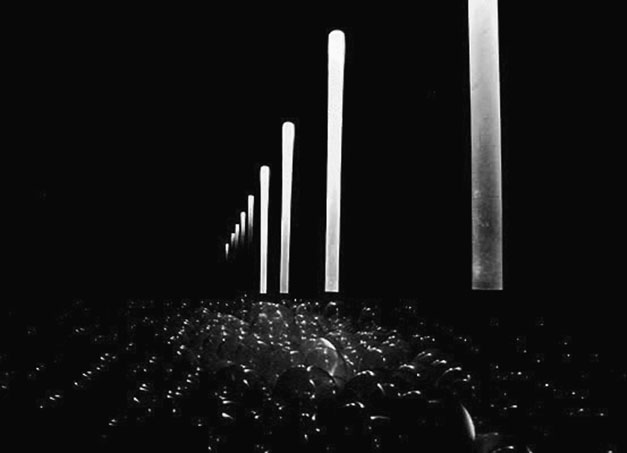
The work Infinitation (2007) by the sound artist Bernhard Gál and the architect Yumi Kori is an example of this time conception in which constant sound textures create a static character that, as time passes, brings the sensation of silence. Suspended glowing red tubes and mirrors are arranged in a dark site to create a virtual ‘infinite’ space. The idea of infinite is reinforced by continuous sound textures made of micro-tonal sequences. By combining visual and acoustic elements, this work provides a sensorial experience of ‘infinitation’. The apparent boundlessness of the environment and the static repetitive sounds create a type of silence (figure 6).
Installation ‘Infinitation’ by Bernhard Gál and Yumi Kori, 2007.

While silence in music is usually taken as a counterpart of sound, situated as a tension element in relation to sound, in sound art silence can be constituted as a fundamental element of the work. By creating a situation emptied of sound events, silence no longer establishes temporal marks, but leads to the sensation of a static time that does not flow.
3.2.2. Distinct temporal scales
In the case of using distinct temporal dimensions, it might be useful to recall Stockhausen’s ideas on musical time structuring. In his paper …how time passes…, written in 1959 (Stockhausen Reference Stockhausen1959), the composer proposes a structural and unifying approach in relation to time in music, gathering elements such as pitch, timbre, rhythm and form under a common temporal axis. Although his paper emphasises the serialist expectations of unifying the music structure around the series, due to the broader temporal conception that sets up his discourse, one can easily apply it to analyse some examples of sound art.
The idea of superposing different time scales can be found, for example, in some works by Felix Hess that turn inaudible infra-sounds into regular sounds. In Air Pressure Fluctuations (2000), Hess recorded infra-sounds – that is, air pressure variations whose frequencies are below the threshold of human perception – and reproduced them 360 times faster than the original recording (Schulz Reference Schulz2001). That means that one second of sound on the accelerated recording corresponds to six minutes of the original recording time. The whole work is 20 minutes and 38 seconds, which corresponds to 5 days, 3 hours and 49 seconds of infra-sound recording. Thus, the sharp noise heard in the frequency band around 1000 Hz refers, in fact, to sound frequencies around 2.7 Hz (1000/360). In this case, the sounds reproduced by the recorded CD correspond to vibrations that originally occurred in the band between 0.03 Hz and 56 Hz. By speeding up the original air pressure variations, disturbances coming from motor vibrations, factory gears and train engines became audible. It’s interesting to note that at every four minutes in the CD, denser textures of whistles and clicks can be heard, probably due to typical increase of activities early in the morning in a city.
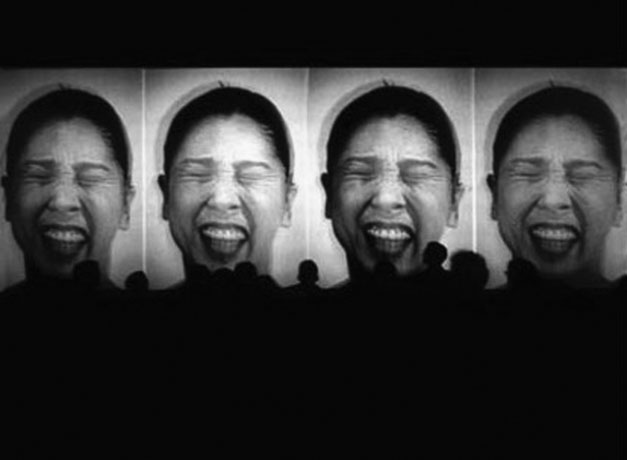
Another interesting example of the use of different temporal scales is the work of the German ensemble Granular∼Synthesis, a pair of artists who have developed collaborative works since 1991. In Modell 5 (1994–96), they incorporated the conception of sound granular synthesis in an audiovisual work. Modell 5 is a kind of video installation, an improvisation that came out from previously recorded images of a woman’s face, who produces sounds, either speaking, sneezing or shouting. In the work, both sounds and images are submitted to a similar granulation process. Although each grain carries little information in its limited duration, when showed in a fast succession they form a temporal texture in which sound and image appear to be synchronised (figure 7).
Video still from Modell 5 by Granular∼Synthesis.
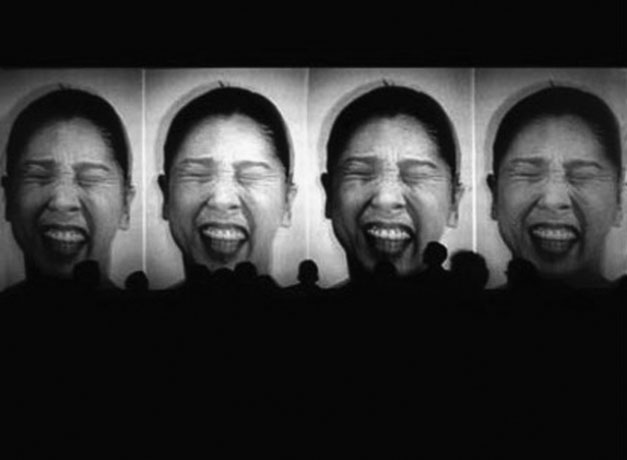
The outcome of this process is very interesting as it manages to generate many structural variations of image and sound in a highly controlled way. The perception oscillates from the scale of milliseconds (the dimension of an isolated grain) to seconds (the textures formed by the succession of grains) to minutes (the duration of the piece). In the real-time performance the artists can move from static moments, in which the viewer reaches a hypnotic immersion, to sudden changes of time.
3.2.3. Short and punctual structures
Another way to organise time found very frequently in the sound art repertoire is the use of short, unitary and punctual structures. Instead of a concatenation of distinct parts, as occurs in music or cinematic narratives, only a single element is presented, which synthesises the whole idea of the work.
The One Second Sculpture (1969), by American experimental artist Tom Marioni, illustrates this idea. The work consists of a metal tape measure taken apart, and thrown into the air. While it is falling, the metal tape flies like a spring in the air and produces a loud sound. For a moment, the tape’s trajectory creates distinctive and unpredicted shapes in space until it drops to the floor (LaBelle and Roden Reference LaBelle and Roden1999: 121).
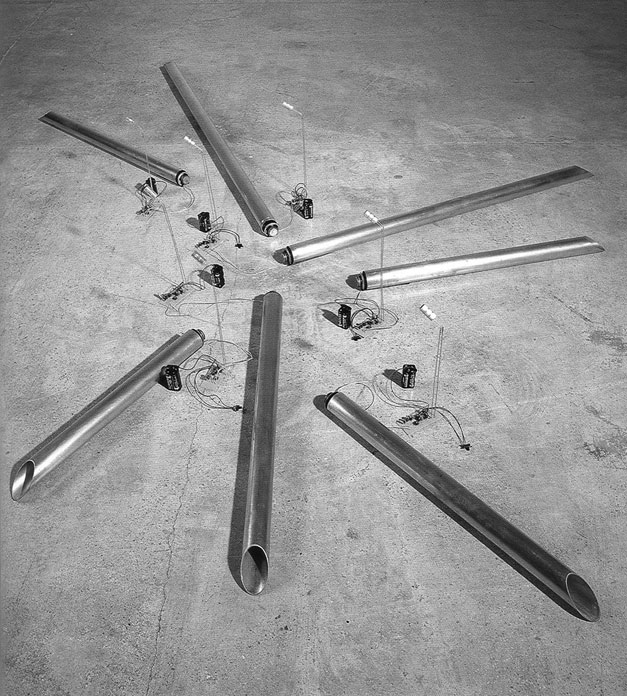
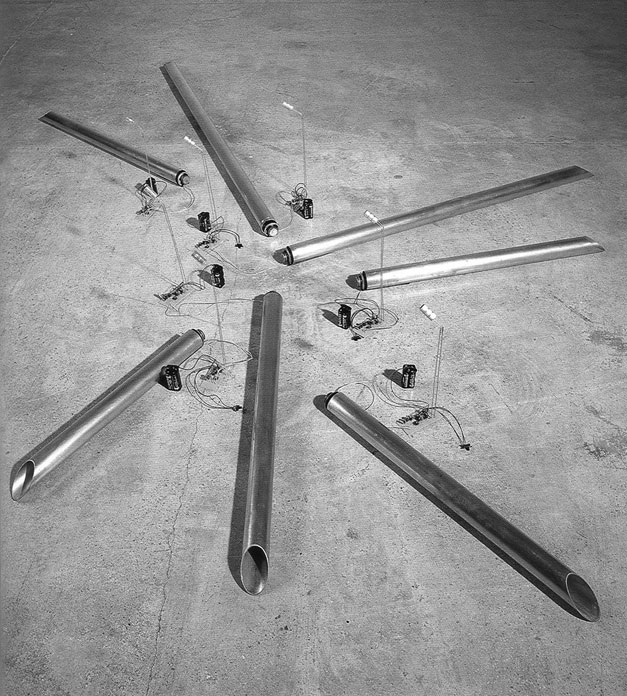
A more emblematic and developed example of this idea can be found in the work of Spanish sound artist Jose Antonio Orts (Zaplana Reference Zaplana1999) (figure 8). Most of his pieces consist of short and sometimes unique elements that synthesise the temporal conception of the work. In some of his works short sounds triggered by the audience generate static rhythmic structures, without a beginning or an end. His sound objects are, at the same time, sound sources and sculptures. The artist creates small devices that generate sounds through simple electronic circuits connected to small loudspeakers, hidden in metallic tubes of different dimensions. The resonances of the tubes are coupled with the resonances of the environment itself. Time oscillates between a musical time (since there are elements of rhythmic development) and a time of fruition established by each viewer. Even the titles of his works indicate this temporal conception: Ostinato perpetuo (1998), Território rítmico (1999), Ritmos luminosos (1999).
Detail of the sound installation Blanco ostinato, 1997 by José Antonio Orts.
4. Conclusion
The starting point of this article was the investigation of the relations of productive forces in both sound art and music. The survey of approximations and differences in their repertoires was an essential element for the development of this work. Starting from this survey it was possible to perform an analysis of artistic forms instituted by sound art, specifically in relation to its treatment of sound in space and time and the consequences of this treatment in the constitution of a particular type of discourse.
One of the first contentions raised in this work was the observation of a kind of deviation introduced by sound art in the regular path of creative use of sound material in music. On one hand, sound art repertoire develops a discursive approach which is very distinct from the one that guides music compositional structures. On the other hand, it absorbs modes of production typically found in the visual arts domain. Sound art differs from music and from other art forms in which sound plays an important role (cinema, for example) by establishing new possibilities of appreciation and listening. Its distinctive use of sound, the absence of a linear temporal discourse, the exploration of the referential potentialities brought by sound, the effective interaction between the audience, and the space and time in which the work occurs, all of these aspects collaborate to distinguish sound art as a discrete artistic modality.
If these aspects are not exclusive to this repertoire, they can be a starting point to map out its production. They raise interesting questions about processes that are essential to the formation of sound art and can be condensed into three relevant aspects.
The first relates to the role that sound plays in the creation of these works. In fact, the sound is the main element, the one that grounds other aspects of the work. The articulation of sound elements can be done in different ways. Sometimes it can be only an indirect reference to a sonic event. In other cases it occurs through the exploration of circumstantial data of the environment in which the work takes place. Frequently there is an emphasis on the metaphorical potential that a sound can raise along with the consequent chain of references it can trigger.
The second aspect to be pointed out is the relevance of the referential aspects that a work can generate. Here, sound art tends to be quite different from music. In music referentiality is generally achieved inside its own discourse. It builds its discourse through the variation, contrast and development of internal references in order to articulate a temporal narrative. In sound art, the contextual references usually point to what is outside the work. Its narrative does not need to be temporal: it can be built upon the articulation of diverse elements such as images, sound, or the site where it takes place.
Finally, the third aspect to be emphasised is the contextual element. By incorporating context as an essential aspect of the work, sound art opens new and rich possibilities of connection between sound and other ‘silent’ elements such as images, gestures or spaces. In this sense the idea of an architectural space can be seen as one of the most relevant contributions of sound art to integrate temporal and spatial elements. In sound art the space, with all references it can carry, becomes as audible as any sound it can hold.
Beginning with Modernism, there seems to be a tendency in music to conceive sound as a phenomenon unattached to any context, which does not point out its own acoustic and psychoacoustic qualities. This tendency has somehow contaminated the arts in general to the extent that Douglas Kahn (Kahn Reference Kahn1999), based on Dan Lander’s previous reflections (Lander and Lexier Reference Lander and Lexier1990), claims that sound, as an artistic element, was polarised by music and followed a discursive path according to a specific grammar that, even being experimental, maintained a teleological trajectory.
Here we return to the initial idea of this text: that sound has followed two distinct trajectories within the arts. On one hand there is the musical path, in which sound is inserted in a self-referential grammar and in a discourse that points towards a musical listening. As stated before, this is notable in Pierre Schaeffer’s and John Cage’s thoughts, for instance. On the other hand, one can detect a tendency in other arts to explore representational and contextual aspects of sound. This path takes an opposing direction in relation to a process that can be understood as the ‘musicalisation of sound’ and leads to different forms of expression and to new intentions of appreciation of sound in an aesthetic context. The consequence is that these new sound conceptions frequently found in non-traditional artistic fields, such as sound art itself, promote an interchange among distinctive discourses and contribute to enlarge the frontiers of music as well as the other art forms in which sound plays an important role. By and large, sound installations, sound sculptures and all the diverse artistic possibilities incorporated by sound art are changing the way we think of sound and what we imagine that music will become.