- AKR
‘Account of Kighley round taken Nov'r 1763’, KLSL, BK/15/1/3/1/b
- BSB
‘The Bradford society book 1792, Bradford Kirkgate (Wesleyan) chapel records’, West Yorkshire Archive Service (Bradford), 17D81/17
- KCA
‘Keighley Wesleyan Circuit Quarterly Accounts, 1748–1932’, KLSL, BK/15/1/3/a
- KLSL
Keighley Local Studies Library
- MARC
Methodist Archives and Research Centre, the John Rylands University Library, Manchester
- PCS
‘Pocklington Methodist circuit schedule book, 1787–1818’, East Riding of Yorkshire Archives and Records Service, MRP/1/7
- SRM
‘Methodist Church: Rye (formerly Sussex) circuit, register of members arranged by societies within the circuit 1774–96’, East Sussex Record Office, NMA/4/1
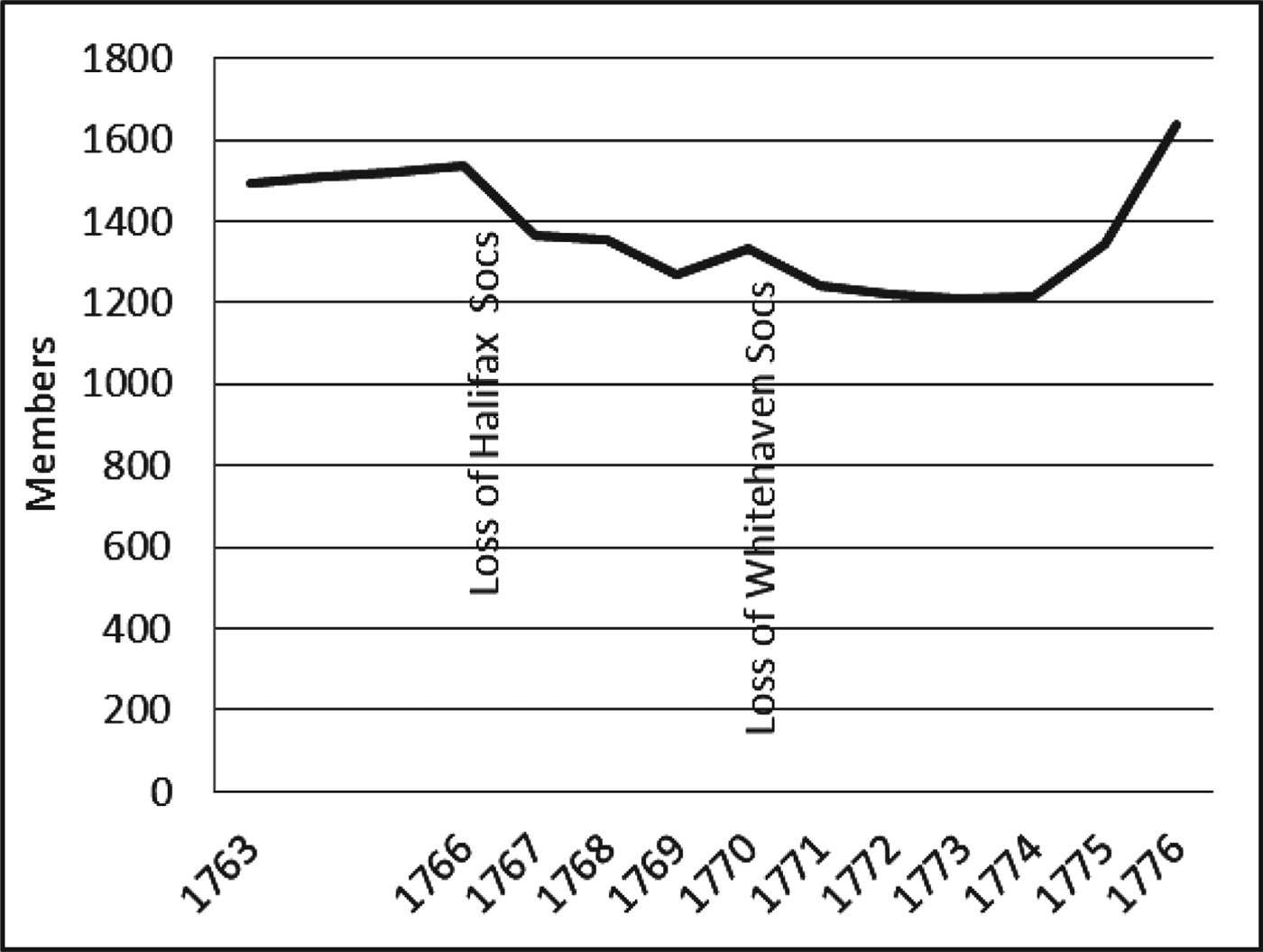
In February 1743 John Wesley visited his fledgling society in Newcastle upon Tyne and was so concerned about conduct that he dismissed sixty-four of the members for offences ranging from Sabbath-breaking to drunkenness, with the greatest number (twenty-nine) convicted for lightness and carelessness.Footnote 1 Very little is said about those whom he retained, but Wesley had made his point: waywardness would not be tolerated, and in the future he would require detailed information on the health of his societies. This article uses a high-resolution analysis of records of the Keighley circuit,Footnote 2 among others, from the mid-eighteenth century to determine the acquisition of members, their spiritual progress and retention within the movement. It will be argued that both recruitment and leakage were considerable, and that although some members underwent spiritual growth over a twelve-month period, the majority remained in the same condition. The result is a significantly more complex picture than that provided by a simple inspection of the annual returns to Conference (see Figure 1).Footnote 3 The claims of revival by successive preachers were indeed true, but any increase in membership was soon negated by significant losses both from new recruits and the established congregation.
Membership of Keighley circuit as reported to Conference, 1763–76.

The sources for much of the information used here are circuit membership schedules drawn up by Methodist preachers in which they recorded members’ names and marital status, and sometimes occupations and addresses. In addition, specific symbols – dots, question marks, letters and strokes – were written against members’ names and it will be argued that these identified their spiritual status, as they followed a path from an awakened state through justification potentially to sanctification. The awakened were those newly accepted into society who had been convicted of their sin. Seekers, already convicted, were looking for God's grace to convince them of their salvation, but were not considered to be fully justified. The justified were those who in Wesley's words were ‘pardoned, and received into God's favour, and into such a state, that if [they] continue therein, shall be finally saved’,Footnote 4 and the sanctified believed that they were ‘renewed in the image of God, in righteousness and true holiness’, a topic of much debate at Conference.Footnote 5
Wesley, as Henry Rack has demonstrated, was not only Arminian, but a child of the Enlightenment, and empiricism was a major factor in the manner in which he lived.Footnote 6 David Hempton further develops the argument that the twin strands of the Enlightenment, the theory of knowledge and the principle of association, were of immense importance in the spread of Methodism, and he traces firmly the membership rolls, financial accounts and rules to the Enlightenment's influence on the movement's ecclesiology.Footnote 7 It follows that items were not recorded without a purpose, and that any reason for their inclusion must be sought from the views of the initiator. Rack, in discussing the 1738 Aldersgate experience, narrates Wesley's slowly changing views through the following decades from teaching that conversion had not occurred unless clear and instantaneous assurance had been received from God, to an acceptance that the progress through justification might be gradual, and no such immediate revelation may have been made.Footnote 8 In the light of this, it is pertinent to question whether Wesley was using the membership lists as a means of recording instantaneous conversions, or whether in fact he already had some doubts in 1741, when he drew up his first roll, that assurance was immediate.Footnote 9
The continuing influence of the Enlightenment on Methodism is demonstrated in the desire to record the movement's history in a vast number of narratives, biographies and autobiographies, and the membership rolls have frequently been used as a quarry for information on early days.Footnote 10 At a more academic level, Frank Baker has described the various categories recorded in the schedules and placed them within the scheme of governance,Footnote 11 but very little empirical work has been carried out to build a picture of early Methodism at the congregational level. The exceptions have been the use of the data, particularly the occupational statistics in the Keighley records, to determine the social class of the membership. Three such studies have been carried out: by Charles Wallace, Jr in 1975,Footnote 12 Clive Field in 1977Footnote 13 and John Smith in 1988.Footnote 14
As would be expected, few manuscripts have survived the years. The earliest remaining membership lists were written out by Wesley himself for the societies in BristolFootnote 15 in 1741 and LondonFootnote 16 in 1742, during the troublesome times of his split with Whitefield and the Calvinists over predestination and reprobation.Footnote 17 However, worthy as they are of a separate investigation into how Wesley firmed up his ideas about polity, they are either incomplete or too inconsistent for the purposes of this paper. Consequently, the oldest record to be analysed dates from 1763; and the others from the 1770s and '80 s. Five have been selected, four from the north of England: Keighley,Footnote 18 which is the most extensive, Blackburn,Footnote 19 PocklingtonFootnote 20 and Bradford;Footnote 21 and one from the south, Sussex,Footnote 22 to give a broader national view.
On 23 February 1743, immediately following Wesley's dramatic intervention in Newcastle, he published the first pamphlet of rules to be observed by his societies.Footnote 23 Here he defined the entry requirement – ‘a desire to flee from the wrath to come’, simple enough on the surface but stiffened by a comprehensive list of expected indicators of a ‘desire for salvation’. A pattern would emerge of members being tested on their spiritual state and adherence to these conditions during the travelling preachers’ quarterly visitations to each society.Footnote 24 In the 1746 Conference minutes,Footnote 25 Wesley required each superintendentFootnote 26 to create a catalogue of his societies, and in 1749 ‘to take an exact list of each society every Easter, and transmit those lists to London some-time before Whitsuntide’.Footnote 27 The minutes state neither how comprehensive individual records were to be nor the processes for handling them. John Bennet, in his manuscript minutes of the 1748 Conference, was rather more specific.Footnote 28 To the question ‘How shall we have a more exact knowledge of the state of the societies in each division?’ the answer was given:
Let the preacher assisted by the stewards in each society take an exact list of them every Easter. 2. Let these lists be transmitted within 3 weeks after Easter to the persons appointed in each division to receive them. Let this same person at the same time diligently inform himself of the spiritual and temporal state of each society, and let him bring these lists with him to the following Conference and give an account of all.
Later, in 1766, Wesley was asked ‘how may each assistant take a regular catalogue of the societies?’Footnote 29 He answered ‘By writing the names of members as they live in house-row, without regarding the classes’; and at the same Conference, for each adult, ‘next inquire into his state, whether convinced, or unconvinced: converted or unconverted. Tell him, if need be, what conversion is. And then renew and enforce the enquiry’.Footnote 30 The catalogues were, and perhaps had always been, more part of the preacher's toolbox than a means of supplying information to London.
Despite the Conference instructions, however, in 1763 Wesley bemoaned ‘how few exact lists of societies’ he had received.Footnote 31 Indeed, from the sources used in this study, it would appear that unless great pains had been taken to copy all the names into a separate London-bound document, all that appears to have been delivered was a summary of the overall numbers in each society.Footnote 32
The oldest schedule analysed in this study is that of the Keighley (Yorks.) circuit, and dates from 1763, immediately following William Grimshaw's death.Footnote 33 Despite his great fame and energy as a preacher, Grimshaw, parish minister of Haworth and also steward of the Methodist circuit created around him, had not been notable for attention to the detail of his societies. His accounts were rather rough and ready,Footnote 34 and it is quite apparent that John Wesley left him to his own affairs, other than providing travelling preachers to assist in the work.
Three months after Grimshaw's death, Wesley at Conference appointed four preachers,Footnote 35 not only to take on the existing round, extensive as it was, but to include the far north-westFootnote 36 in an enormous circuit stretching from Elland, south of Halifax, to the Scottish border.Footnote 37 The superintendent was William Fugill, and to work with him were John Pawson, Daniel Bumstead and Paul Greenwood.Footnote 38 ‘Upon coming into the circuit we found all the people mourning the loss of that eminently faithful servant of God, the Revd W. Grimshaw, who had died in April that year’, wrote Pawson later:Footnote 39
Many, very many had, I am inclined to think, put that excellent man in God's place, and seriously thought that the prosperity of the work entirely depended on him … As the people, I am satisfied, did this, the Lord called his faithful servant away; and it was very remarkable the work prospered wonderfully, and I believe there was much more good done in the circuit in that one year than had been done in seven years before that time. In Keighley also, and the neighbourhood, there was a glorious revival of the work of God, such as no one living could remember to have seen.
Quite obviously, the circuit needed some dynamic preachers, so much so that at first glance the choice of Fugill as the superintendent appears strange,Footnote 40 since within two years he was put out of connexion for drunkenness and debauchery.Footnote 41 Whatever his shortcomings, he certainly carried out a thorough job in organising and extending Grimshaw's straggling round, vindicating Wesley's confidence in him. The quarterly meetings were put on a firmer footing, and the finances improved as the number of societies contributing to the circuit funds rose from twenty-nine in April to forty-three by December, and income from £12 to £24.Footnote 42 However, Fugill's most notable work, for the historian, was his spiritual and temporal catalogue of all members, as required by Wesley in Conference.
The book in which the data were storedFootnote 43 was headed ‘Account of Kighley Round taken Nov'r 1763. W.F.’. There were two sections. The first recorded the quarterly contributions made to the round by the societies. The second, the subject of this paper, was Fugill's catalogue of members. It would appear that he first started work on this in late 1763. He left considerable space for the income (expenditure was recorded elsewhere)Footnote 44 and the book was still in use for this purpose until 1775.
The title of the schedule reveals that Fugill's base was Keighley, not Haworth, which, probably in deference to the memory of Grimshaw, remained as the nominal centre of the round until 1776.Footnote 45 While Fugill stayed in Keighley, the other preachers had to take their turn in going to Whitehaven,Footnote 46 Colne and Otley, causing some bad feeling, though this did not prevent the completion of what is now the most comprehensive set of early membership data in existence.
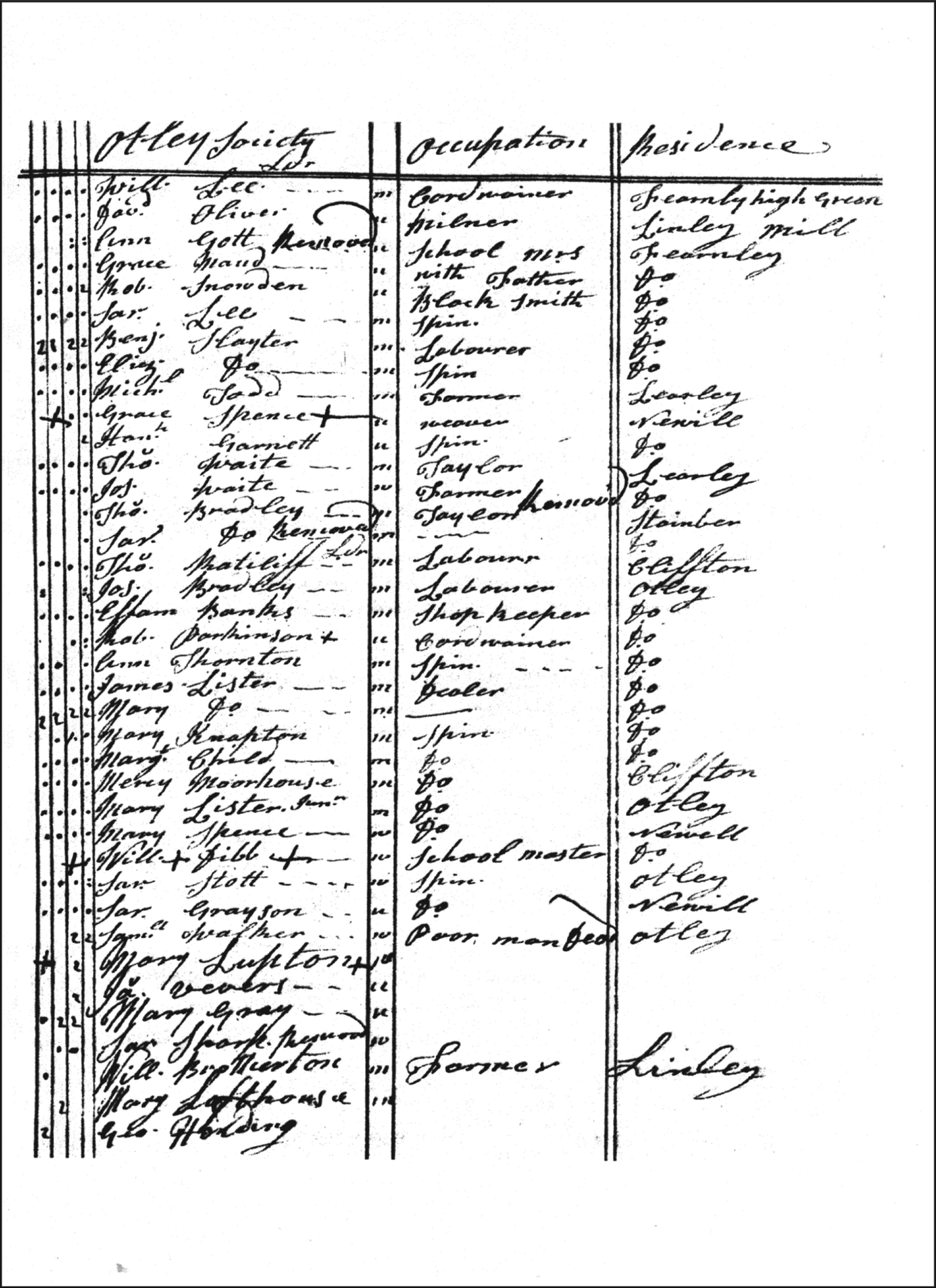
The book was arranged society by society and was entirely in Fugill's hand (see Figure 2 for an example of a page from the catalogue). The first wide column from the left gave the members’ names in each society, arranged in class order, with the leader at the head. To the right was a column registering marital status: ‘m’ (married), ‘u’ (unmarried), or ‘w’ (widowed). The third column noted the member's occupation, though in some societies this was often missing. Details were also often absent in the residence column, but sufficient was given to identify closely the locality of the smaller societies.
Page recording Otley society from Haworth round membership schedule, 1763–5. Reproduced by courtesy of Keighley Local Studies Library.
To the left of each page are up to four narrow columns, containing a series of symbols, the purpose of which was not stated. A century ago, similar symbols in Wesley's 1741 membership lists for the united societies in Bristol puzzled Henry J. Foster, who was unable to give an explanation, and did not pursue the matter further.Footnote 47 However, in 1934, an anonymous contributor to Wesley's Chapel Newsletter, who had also long been perplexed by the symbols in Wesley's 1783–6 Bristol membership lists, published the following entry from the City Road leaders’ meeting book, 1 March 1808:Footnote 48
Resolved – That the leaders do in future mark their class papers on the left hand opposite the names with marks descriptive of the spiritual state of the members – as follows (?) for questionable, (ā) scarcely awakened (a) awakened, (.) one dot for received a sense of justification, (:) two dots to denote being in a sanctified state.
(Signed) A. ClarkeAlthough the City Road minutes indicate that class leaders were expected to complete the lists, Frank Baker regarded them in passing as being recorded by the superintendent at his quarterly visitation,Footnote 49 and from the evidence to be presented below, this interpretation will be followed here.
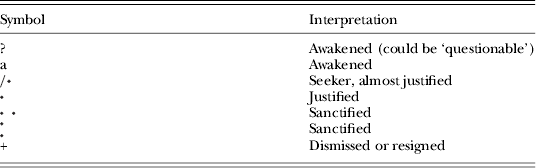
It can be deduced from the layout of the Keighley lists, with recruits at later visitations added at the bottom, that each narrow column marked a time period, with the oldest at the right. Conclusive evidence from burial records of deceased members indicates that they were taken at quarterly visitations. There was usually a progression from (a) or (?) through (/•) to (•). (For the suggested explanation, which varies slightly from the much later City Road instruction of 1808, see Table 1.) It is difficult to interpret the (/•) mark: similar occurrences can be found in the later Bradford and the Rye (Sussex) records. Following the principle of the (ā) symbol at City Road the most likely conclusion is that it was made by the superintendent to record that the person showed many characteristics of being justified, but there was some doubt, in other words, a ‘seeker’ or ‘almost justified’. The idea that there could be such categories as ‘almost justified’ or ‘almost awakened’ infers a continuum, rather than an instantaneous revelation of grace, and mirrors Wesley's eventual acceptance that the believer's awareness of justification may be a gradual process. The similar (–) mark, and also (ā), were used in the membership schedules for 1741 and 1742, indicating that even at those early dates Wesley may have had some doubts about immediate justification.
Interpretation of symbols showing spiritual condition, Haworth round, 1763–5

In the Keighley schedules there was a geographical split between (a) and (?), with (a) being used exclusively in the Cumberland area and (?) elsewhere. It is inconceivable that there were no members in the ‘awake’ state in the south of the circuit, so it is assumed that Fugill lumped together in his compilation all those he considered either ‘questionable’ or ‘awake’. Perhaps he was unconcerned about the divisibility of the spiritual state of members, until they approached justification. Consequently they have been taken here to be synonymous, meaning ‘awake’, rather than ‘questionable’, though a degree of caution is required when making comparisons between the membership lists of different circuits. Entries normally did not appear to the left of a cross symbol, which can be taken to mean that a person had left the society (resigned or been dismissed), but not through death, since this was recorded in other columns and no cross appears. In some cases members had a cross against their name in the first period but another symbol after a gap of one or two summations. This could indicate their readmission at a subsequent period.
Analysis of the other records from around the country reveals a common approach to recording spiritual condition, with many symbols, especially that denoting justification, being the same, or similar, and the Bradford record actually gives a key to their interpretation. The practice appears to have diminished over time, and some preachers, in particular the newly appointed, discontinued the process, perhaps unwilling to interview individual members too closely about their progress.
A number of conclusions can be drawn at this stage. Despite the instruction given in 1808 at the City Road meeting, the books always appear to have been the work of the superintendent and not the class leaders, the handwriting changing as each preacher was moved to a different circuit. Indeed in one later case (Hastings in 1828) the superintendent was rather taken aback by Conference posting him to a new station: ‘As I did not fully calculate upon leaving the circuit at this time, I did not write out the names at the June visitation. This is the reason why they are not here as in former years. J.J.’Footnote 50
Spiritual state appears to have been assessed at the superintendent's annual or more frequent visitations to each society. It is possible that in the Keighley circuit the more distant visitations in Cumberland were carried out by the resident preacher. Comments were few but indicate the depth to which enquiries were made regarding individual spirituality. ‘Dead to God’ appears a number of times, and superintendents were not always given to reticence: Idle ‘is the most sickly society in the circuit’ wrote Alexander Mather in the Bradford records for 1781, where only five of the thirty-three members were classed as justified, the others being ‘doubtful’.Footnote 51
Although the practice of recording spirituality by the use of symbols appears generally to have been discontinued around the time of Wesley's death, the City Road decision of 1808 to revive it would suggest some fond memories. In the 1797 Minutes, later given to new preachers as a rulebook, the final section ‘on promoting an increase of spiritual religion among the Methodists’ recorded that
we agree to revive uniformly the good old custom of keeping quarterly schedules in every circuit, each of which shall contain a correct statement, for the quarter to which it belongs, of persons admitted on trial, – new members, fully admitted into society after due probation, – Removal into other Circuits, – Deaths, – Backsliders, – Conversions, – Number in the Bands, – and total Number of Members then in society.’Footnote 52
The only requirement for delivery to Conference, though, was a summary of these headings, not the list of members, which was to be kept within circuit, and any attempt to note individual spirituality had ceased.
Investigation of the schedules does not end with the knowledge that the left-hand columns recorded spirituality and followed a practice initiated by John Wesley. It is possible to follow the progress of individual members over a number of years or quarters and use the results to carry out a review of claims of revival made by the preachers as they recalled their times in a particular circuit.Footnote 53
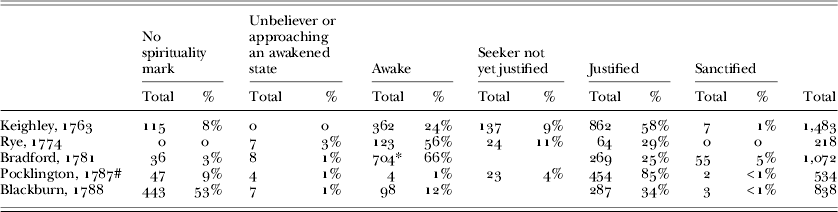
Fugill's list recorded sixty-three societies, but eighteen had only one or two completed columns for spirituality, probably because, most of them being small, they received few visitations. Unfortunately for this exercise spirituality was not recorded for Whitehaven, the second largest society, perhaps because the schedule was compiled by another preacher than Fugill.Footnote 54 Nevertheless, all the other societies in Cumberland were tabulated with at least one column. The spirituality of members in Keighley Circuit at the first enumeration is compared (see Table 2) with data from the earliest schedule in each of the other sampled circuits. The data sets are all large and represent sizeable proportions of the national membership even though it rose considerably, as recorded by Conference, from around 20,000 to 60,000 in the period between 1760 and 1790.Footnote 55
Comparison of the earliest remaining records of spiritual condition of members in five circuits, 1763–90
* Perhaps includes the seekers, not yet justified.
# Pages are missing for Pocklington society.
The first point to note is that, as time went by, the recording of spiritual condition tended to decrease.Footnote 56 Even taking this into account, there was considerable variation in the proportion classed as being justified and we should look more deeply into the numbers and try to elicit a reason for the wide swings across the country.
Keighley had a much higher percentage of justified members than Bradford and Rye.Footnote 57 The most likely reason is that Keighley had a number of well-established societies. The 1763 visitation was too close to the stationing of the new preachers to claim it as proof of revival. In fact, if this were the case, one would expect the reverse: large numbers of awakened members rather than the justified.Footnote 58 Pocklington, a late enumeration with a high percentage of justified members, may have been displaying the spirituality associated with long-established, stable, rural societies with little recent Methodist expansion. Conversely, Bradford, by the 1780s, was experiencing fast population growth, reflected in rising membership. Methodism in Sussex was late in expanding into the rural areas and had recently founded a number of small societies with few justified members.Footnote 59
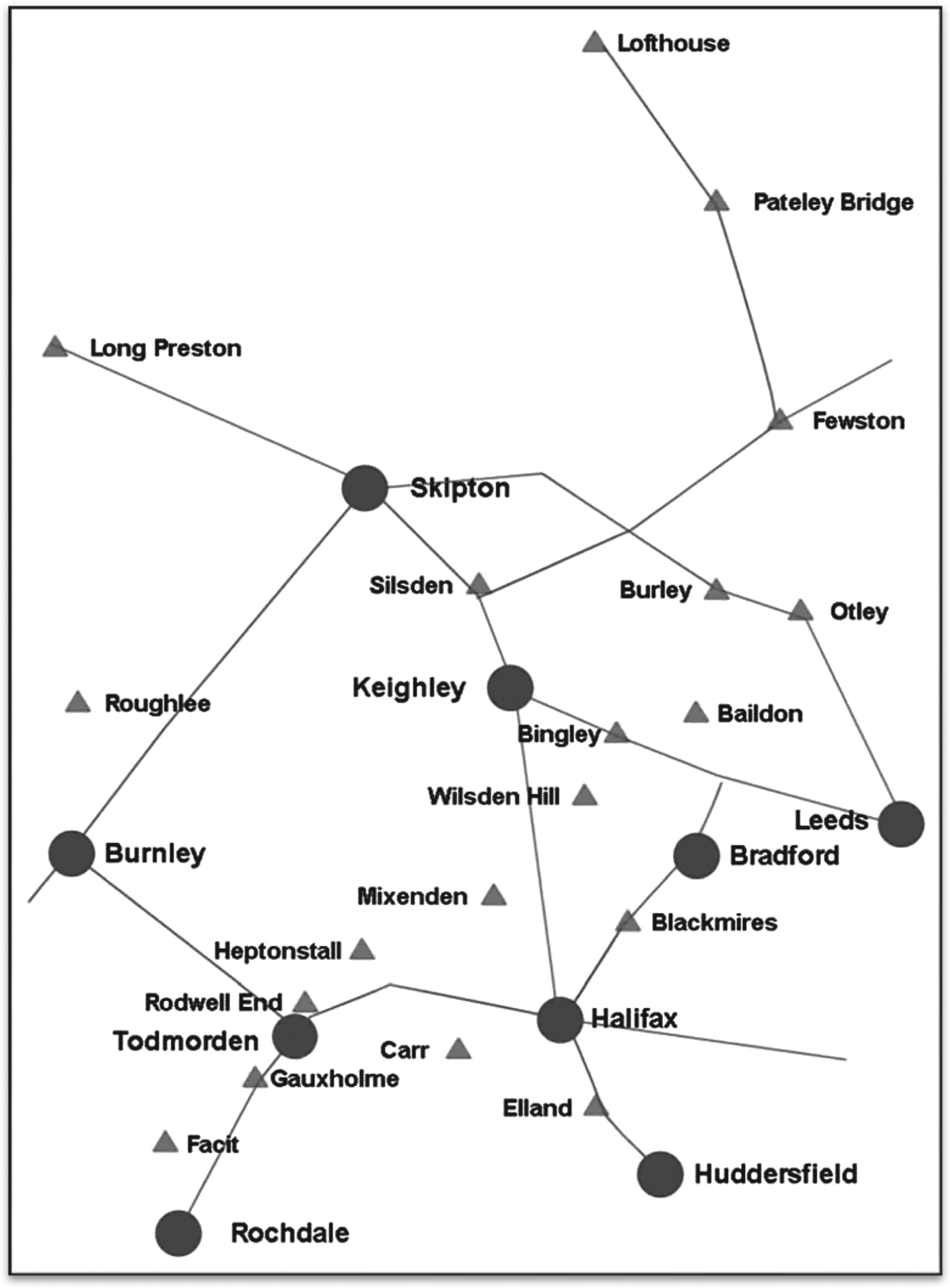
The data in Table 2 are snapshots of the membership at single points in time, and it is more enlightening to use the Keighley schedule to see what happened to the members over a cycle of four visitations, covering a period of one year. Societies with one, two or three visitations have to be discarded at this point, but nineteen (see Figure 3) received four and provide a sufficiently robust source for our analysis.Footnote 60
Societies (marked by triangles) in Keighley circuit receiving four visitations.
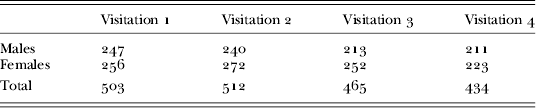
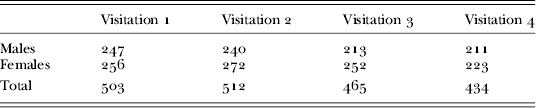
Table 3 is a simple statement of the membership of the nineteen societies receiving four visitations, and utilises the calculations of the superintendent to report numbers to Conference. The immediate conclusion is that, despite Pawson's claims that the work ‘prospered wonderfully’, membership declined considerably towards the end, with a fall over the year of nearly 15 per cent. Further, although the male membership declined steadily over the whole period, the women first increased in number before falling at a similar rate to the men. It follows that any possible revival took place before the second visitation and among women rather than men.
Membership of societies receiving four visitations: Keighley circuit, 1763–5
Raw membership figures do not, of course, reveal the whole story and by following the progress of individual members it has been possible to identify new recruits at each visitation and their spiritual progress, and whether they were dismissed or resigned, drifted away from society or, for the middle two visitations, whether they were absent to return at a following quarter.
Societies with returns for four visitations: membership at the first visitation: Keighley circuit, 1763–5

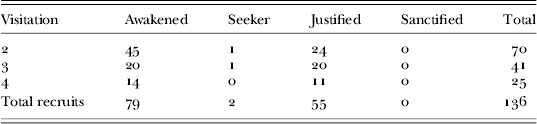
Societies with returns for four visitations: recruits at second and subsequent visitations: Keighley circuit, 1763–5
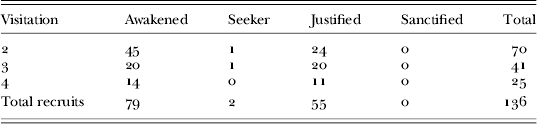
Table 4 shows the numbers in society at the first enumeration, and table 5 the subsequent recruitment which, reaching 14 per cent at the second visitation was quite significant, although it fell to 5 per cent by the last.Footnote 61 Surprisingly, a substantial number were classed as justified at only their first visitation.
Perhaps the most important statistic to emerge from this data is that the number of people classing themselves as members at some point during the year was 639, 20 per cent higher than 503, the figure which, incorporated into the total for the round (1,478),Footnote 62 was reported to Conference. Further, recalling Pawson's claims, the recruitment of seventy new members in one quarter would appear to have been a great success, yet the figure hides an underlying difficulty: that of retaining recruits once the initial fervour had worn off. Tables 6 and 7 highlight the problem, accounting for the decline in number of members, and any variation that might have existed between men and women.
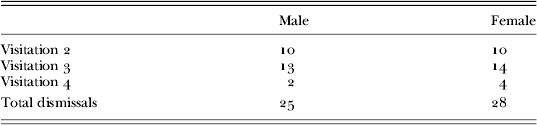
Dismissals or resignations from societies with four visitations: Keighley circuit, 1763–5
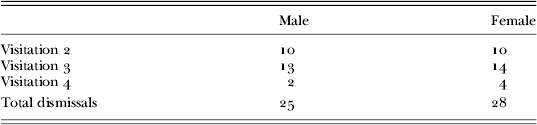
Dismissals or resignations are considered to have been members who were identified by a cross symbol in the spirituality column (see Table 1), and it would appear that there was little difference in numbers between men and women. On four occasions, members who had been marked with a cross were readmitted. These instances also confirm that the cross symbol was not used for members who had died: in fact death was usually recorded by a note (see Figure 2 for an example: Samuel Walker, the eighth record from the bottom).
Although some members who left their society made a positive break, others just drifted away and did not reappear in the lists. Table 7 shows the data for those missing for two or more consecutive visitations and not recorded as returning.
Members of societies missing for two consecutive visitations and not returning (mainly ‘drifters’): Keighley circuit, 1763–5

It is impossible to identify whether members missing for the first time at the fourth visitation were likely to reappear later, so the data range is restricted. Here, the women who disappeared from the record at the third visitation outnumbered the men by nearly 50 per cent, a statistic possibly inflated by recent converts finding the strict demands placed on them to be uncongenial. Drifters were not the only lost members. The list also included those who died (only one, though, in the nineteen societies listed here), and others who removed elsewhere (four). It is possible, of course, that those classed here as ‘drifters’ still attended as hearers, and there is no means of checking. Wesley, however, in the Conference minutes from 1769 onwards, highlighted circuits with a fall in membership, putting pressure on superintendents to report gains, and it would seem logical that they would react by attempting to persuade ‘drifters’ to return.
To complete the picture the members missing for one or occasionally two visitations and returning are recorded (see Table 8). Since the fourth visitation was the last to be recorded, the number of absentees included both ‘drifters’ and those legitimately away on business or sick, and have been excluded from the table.
Members of societies absent then returning: Keighley circuit, 1763–5

The increase in absentees over the period could have been due to a number of factors, for example a reluctance to be examined at close intervals, or a lack of enthusiasm by Fugill at second and subsequent visitations. However, by assuming that the fourth quarter experienced the same leakage as the third, the total loss over the full period is estimated to have been 106 ‘drifters’ and fifty-three resignations or dismissals. It would appear that, however hard the preachers tried, their recruitment of 136 new members could not keep pace.
To gain a better view of those who remained in society, a more complex analysis has been undertaken testing how the spirituality of individuals changed from quarter to quarter, again concentrating on the nineteen societies which had four visitations.
Changes in spirituality of members of societies during William Fugill's administration: Keighley circuit, 1763–5: societies with four visitations
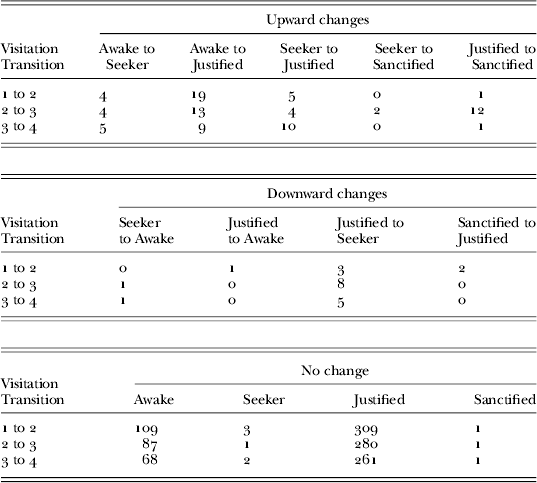
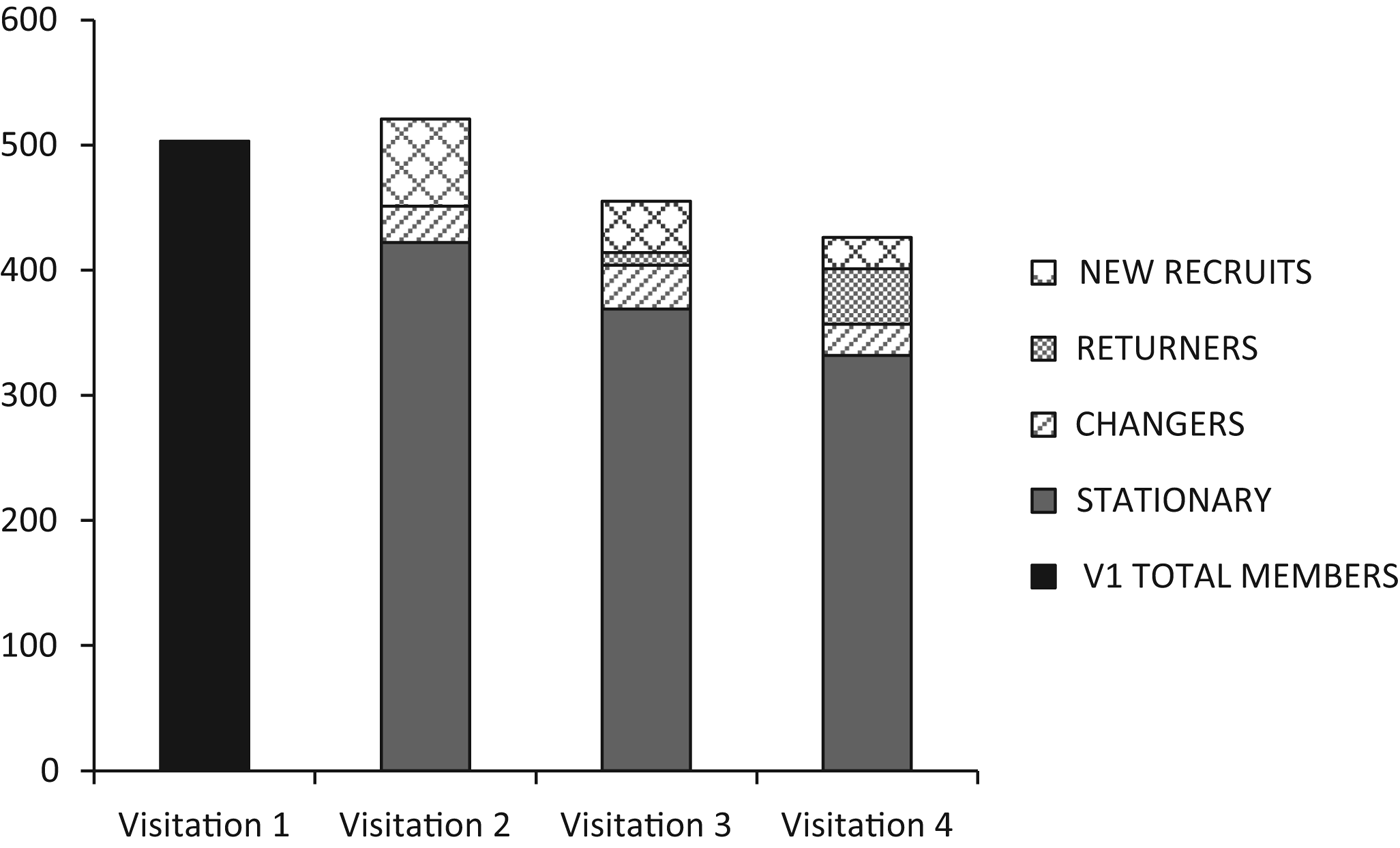
The results are shown in Table 9, and are summarised together with the recruits and returning absentees in Figure 4. Little difference was identified between men and women, and the results for both sexes have been combined. By far the greatest number maintained their current level and more members registered an upward change in spirituality (the ‘risers’) than a downward change (the ‘fallers’), but many departed.
Constituency of societies at visitations carried out during William Fugill's administration: Keighley circuit, 1763–5.
The data have proved of great value in revealing a far more complex situation than a simple spiritual progression. Coincidental with the influx of new recruits, the circuit witnessed the greatest advance of members from the awakened to the justified state, the conversions that Wesley was so concerned to record. Some moved to being seekers, the translation from this state to justified occurring by the following visitation. However, the immediate conclusion that this signified a general advance from recruit to awake to seeker and justified would be false, only five undergoing this simple transition, and all were from the membership existing at the first visitation which could have been recruited some time beforehand. The situation was rather more complex, with advance sometimes being followed by a regression.
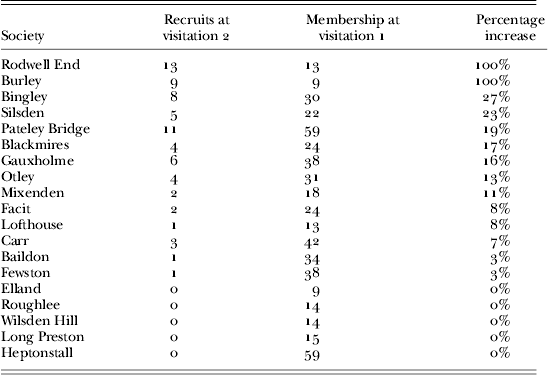
The aggregate data presented so far identify a probable revival at the second visitation, and it has been possible to determine the societies where apparently it took place. Some, notably Heptonstall, recorded no recruits in the first quarter and few later on. Others, in particular Burley-in-Wharfedale near Otley, and Rodwell End, between Todmorden and Heptonstall, doubled their membership (for ranking of the societies see Table 10). Clearly, recruitment was not uniform and there was no geographical concentration. Both Burley and Rodwell End were close to much larger societies (Otley and Heptonstall), neither of which gained many recruits, in this or succeeding quarters. Nor can the recruits be identified as members moving from adjacent societies, which Wesley had virtually forbidden.Footnote 63
Recruits to individual societies in the first quarter of William Fugill's administration, 1763–5
Note: Societies are ranked in percentage order; see Figure 3 above for location of societies.
Statistical tests to see if there was any relationship between recruitment and spiritual advancement show that there was very little, although, as will be seen, the society with the highest percentage of recruits, Rodwell End, had also the highest proportion of members with rising spirituality. However, others showed exactly the opposite trend, so no conclusions can be drawn. Similarly there was little relationship between recruitment and leakage from societies. It is suggested that losses were associated more with individual members’ spirituality and loss of enthusiasm, perhaps inspired to join by the preachers and lost by the class leaders, but there is no evidence to confirm or deny this. Wesley, certainly, was wary of the role played by class leaders and concerned that they might attempt to usurp the authority of the preachers; loss of recruits may well have been one of his concerns.Footnote 64
A factor to account for the loss of recruits may have been the presence of exclusive self-searching bands (the small and intimate spiritual groups within societies). However, only one of the nineteen, Bingley, recorded membership of bands. This particular society was ranked third for recruitment, but at fifteenth place was poor at retention and at eighteenth even more so for members rising in their spirituality. There could be a base here for an argument that the bands, composed entirely of existing members, hindered the advance of new recruits who quickly left, unable to break into the inner circle. Indeed, two years later the bands in Bingley could have been demonstrating their exclusive nature and running towards antinomianism when Wesley grieved over the society ‘with a heavy heart, finding so many of the Methodists here, as well as at Haworth, perverted by the Anabaptists’.Footnote 65
So what of the two societies which attracted most recruits? Burley was the simpler case. A new society had been formed in early 1763,Footnote 66 and at Fugill's first visitation there were five justified and three awakened members, who, apart from one who left, remained in their original spiritual state for the full year. Most of the recruits were classed as justified at the first visitation, but all had disappeared by the fourth and the revival was probably a failure. Burley shortly became a class of the Otley society.
Rodwell End was a small hilltop community near Todmorden, with a wide catchment area. The society, formed in 1759,Footnote 67 underwent a year of considerable flux. At the first visitation, all but two members were justified. At the second the leader, Will Marshall, was classed as sanctified. By the following visitation a further eleven were similarly upgraded. However, at the next count all were missing, recent recruits being the only ones to be assessed. The recruits had also seen some turmoil. Three had achieved sanctification then disappeared with the others. Four had resigned or been dismissed, and six remained, each in the justified state. The society still functioned, but at a reduced level, as witnessed by the payment of subscriptions of around 10s. a quarter to the circuit until 1775.Footnote 68 The community already had a strong Particular Baptist presence so it is possible that members may have embraced Calvinism and moved as a group to the other denomination.
Although short-term movements in and out of society would not have been apparent in the Conference returns, comparable long-term changes have been identified in other circuits where annual lists have survived. In Sussex, the Shoreham society recruited fourteen new members in 1775, half of whom had disappeared the following year.Footnote 69 Those who stayed were those who made the upward journey to justification. A similar story can be seen in the societies around Pocklington where Driffield, for instance, in 1788 recruited seven but lost six from its original twenty-eight members.Footnote 70 In both cases the returns made to Conference hid significant changes on the ground, and any statistics showing the rise in numbers of members based on the minutes will severely underestimate the population making themselves members of their local society, even if only for a short length of time.
The visitation records have proved to be a most useful tool in the analysis of short-term changes taking place in Wesleyan societies. They have revealed a situation which may have been suspected, but for which historians have lacked firm evidence when relying on the Conference statistics, such as those presented in Figure 1. The decline in the membership of the Keighley Circuit between 1763 and 1774, even allowing for the removal of societies to other circuits, could be interpreted as a period of stagnation. Yet, over the same period, revivals were regularly reported by incoming preachers, and on the surface their narratives would appear to be inconsistent.Footnote 71 However, this analysis has enabled these claims to be verified, even though revivals may well have been short-lived. What the preachers witnessed was a large, albeit patchy, influx of recruits: hearers taking on full membership very quickly as they woke to their sinfulness and need for redemption. Additionally a number of existing members grew spiritually, though most remained in the same state and a few went backwards. What was noticed less was a significant drift away from society as members perhaps failed to approach justification or became disillusioned. Since class leaders were in more direct communication with the rank and file membership than the preachers, it is tempting to lay the blame for leakage on them, especially if newcomers felt marginalised in societies with an established hierarchy unwilling to welcome new recruits fully into their brotherhood.
By 1800 the Methodist Connexion had matured, numbers were rising fast, and newly recruited preachers were becoming ever more reluctant to undertake intrusive enquiries. Despite the 1797 agreement to maintain ‘the good old custom of keeping quarterly schedules’, and the later City Road resolution, the practice of recording spirituality had been abandoned, and with it the opportunity to examine nineteenth-century circuit-wide changes in personal faith at a microscopic level.