Introduction
“Canada’s aging work force hasn’t saved enough to retire. Pension benefits are being slashed, employees are working longer, the elderly are selling their homes and going back to work.” (Globe and Mail, 2009)
The observation from the Globe and Mail in 2009 following on the heels of a world economic downturn is the latest retirement crisis identified by the economic sector, the public, and the media. Retirement, as a social institution, emerged in modern industrialized societies at the beginning of the twentieth century. Scholarship into retirement began in earnest in the late 1940s and early 1950s, but because of the rapid evolution of retirement, there is always doubt about the relevance to retirement today of research conducted in earlier times. Just when scholars have a sound grasp of retirement, the picture shifts: new economic conditions arise, followed by related policy debates and changing individual preferences that require new explanations. For example, retirement was initially developed as a reward for loyal older workers to encourage lifelong attachment to their firms as realized by the Hudson Bay Company and the Grand Trunk Railway in the 1870s. In a recession such as the one in the early 1990s, retirement was used as a mechanism to remove older workers from the labour force through early retirement programs in government and the corporate sector.Footnote 1
These variations on retirement are founded on the underlying premise that retirement, as a social institution, moves Canadians out of the labour force in an organized fashion according to age, and defined by the state through public pensions; in the workplace, defined through private pensions (Atchley, Reference Atchley1976; McDonald, Reference McDonald1997; McDonald, Donahue, & Marshall, Reference McDonald, Donahue, Marshall, Denton, Fretz and Spencer2000; McDonald & Wanner, Reference McDonald and Wanner1990; Myles, Reference Myles1984). Since the economy and society are always in flux, so too is retirement, a circumstance that currently contributes to the supposed retirement crisis in Canada today.
Twenty years following the publication of Retirement in Canada (McDonald & Wanner, Reference McDonald and Wanner1990), there is little question that the societal foundations of retirement have been transformed in profound ways (Ekerdt, Reference Ekerdt and Uhlenberg2009b). First, non-standard work has been on the rise since the 1990s in Canada. In 2001, it was estimated that 38 per cent of the Canadian working population was employed in non-standard work (Kapsalis & Tourigny, Reference Kapsalis and Tourigny2004; Townson, Reference Townson2006; Vosko, Zukewich, & Cranford, Reference Vosko, Zukewich and Cranford2003). Moreover, that number is growing (Vosko & Clark, Reference Vosko and Clark2009). In fact, in some quarters, non-standard work is now referred to as “precarious employment” to emphasize the possible negative consequences non-standard work can create through employment insecurity, lower earnings, and limited or no access to employer benefits such as pension plans (Townson, Reference Townson2006; Vosko, MacDonald, & Campbell, Reference Vosko, MacDonald and Campbell2009). Furthermore, those in non-standard work may not be able to retire at all because they will lack access to employer-sponsored pensions or pensions from the Canada Pension Plan, a situation that will become even more problematic as the size of this group continues to expand.
A second way in which retirement has been transformed is that the nature of work has changed in the past decade as a result of a continuous increase in mentally stressful job demands. These are evidenced in the form of higher requirements for mental concentration as well as time pressures and work volume, all of which can add to the unattractiveness of work (Diestel & Schmidt, Reference Diestel and Schmidt2009; Eschuk, Reference Eschuk2003; Johnson, Reference Johnson2004; Sonnetag & Frese, Reference Sonnetag, Frese, Borman, Ilgen and Klimoski2003; Turcotte & Schellenberg, Reference Turcotte and Schellenberg2005). Conversely, it also can be argued that because jobs have become less physically demanding, work may be more attractive, increasing attachment to the labour force (Johnson, Mermin, & Resseger, Reference Mermin, Johnson and Murphy2007).
In a third change to retirement, the ranks of mature workers have burgeoned with the flood of women into the labour force that began in the late 1960s. In 1954, only 12.9 per cent of women aged 55 to 64 were in the labour force compared to 48.7 per cent in 2006 (Statistics Canada, 2007). Looked at another way, 54 per cent of the first wave of baby boom women aged 16 to 25 were in the labour force in 1971. Ten years later, 70 per cent of the second wave of baby boom women, also aged 16 to 25, were in the labour force (Galarneau, Reference Galarneau1994). The effect of this development is that the majority of boomer women will constitute the first female cohort whose labour force participation will span most of their adult lives. They will qualify for their own retirement pensions (Brown & Warner, Reference Brown and Warner2008; McDonald, Reference McDonald and Stone2006; Wong & Hardy, Reference Wong and Hardy2009), they will be challenged to coordinate their retirement with family and partners (Schellenberg, Turcotte, & Ram, Reference Schellenberg, Turcotte, Ram and Stone2006; Szinovacz, Reference Szinovacz and Stone2006), and they are likely to have some immediate impact on the overall structure of retirement that will reflect the complexity of their lives – for example, caring for children and for their parents (McDonald, Reference McDonald and Stone2006).
Lastly, the fiscal implications of an aging society have finally infiltrated public and corporate consciousness. The specter of the retirement of the baby boomers, the largest population cohorts in Canadian history, who are now part of the 45-to-64-year-old age group and who, as of July 2009, accounted for 40.4 per cent of the nation’s working-age population, has struck a chord of uneasiness in Canada (Abbott, Beach, Boadway, & MacKinnon, Reference Abbott, Beach, Boadway and MacKinnon2009; Globe and Mail, 2009; Marshall & Ferrao, Reference Marshall and Ferrao2007; Robson, Reference Robson2009; The Daily, 2009, July 1; The Economist, 2009, June 25). It is estimated by the C.D. Howe Institute that the impact of the boomers on public monies threatens to push the aggregate cost of Canada’s government age-sensitive programs for health, education, seniors, and families in 2009 from 15.0 to 19.4 per cent of GDP over the next half-century (Robson, Reference Robson2009). The fact that people are expected to spend more time in retirement is not helpful, either, because of the longer dependence on financial support (Denton & Spencer, Reference Denton and Spencer2010). Canadians spend on average 21.9 years in retirement compared to the French who are expected to spend 25.8 years in retirement and to the Americans who spend 19.4 years in retirement (OECD, 2010).
All of these major transformations coincide with the worst worldwide economic downturn since World War II. The 2008 meltdown of financial markets resulted in the recent loss of over CAN$200 billion of household wealth in Canada (Abbott et al., Reference Abbott, Beach, Boadway and MacKinnon2009). The trickle of companies retreating from their pension obligations accelerated after the global recession and led some companies into bankruptcies (e.g., Nortel, January 2009). In the process, the recession exposed the underfunding of many pension plans (e.g., Air Canada), with estimates suggesting a CAN$50 billion deficit in corporate pension funds (Globe and Mail, 2009). Although the absolute number of members in employment pension plans – usually referred to as Registered Pension Plans (RPPs) or Employment Pension Plans (EPPs) – continued to grow from the addition of women (Moussaly, Reference Moussaly2010; The Daily, 2010, May 25), in relation to the size of the employed workforce, RPP membership has been declining since the late 1970s and has fallen from 46.1 per cent of paid workers in 1977 to 38.3 per cent in 2007 (Baldwin, Reference Baldwin2009; Mintz, Reference Mintz2009; The Daily, 2010, May 25).Footnote 2 However, private pension plans grew from 23 per cent in 1992 to 32 per cent in 2006 as a proportion of the average retirement income of Canadians 65 and older (Gougeon, Reference Gougeon2009), underscoring their growing contribution to retirement income.
At the same time, the form of private pension coverage began to shift from defined-benefit to defined-contribution plans, a transition witnessed in a number of countries (Baldwin & Fitzgerald, Reference Baldwin and Fitzgerald2010).Footnote 3 Although membership in defined-benefit plans still accounts for a majority of RPP plan members, the trend to a declining portion of RPP members in a defined-benefit plan is occurring in both the public and private sectors (Baldwin, Reference Baldwin2009). Without detailing the minutiae of the various plans, it is noteworthy that fluctuations in the world economic situation can affect income from private pension plans, depending on their characteristics. With the prevailing situation in Canada, having begun in 2008, the financial circumstances of current and future retirees could become riskier, depending on the type of plan and investment as with, for instance, defined-contribution plans (Beck, Reference Beck1992; Giddens, Reference Giddens1990). We would add that with the increase in defined-contribution plans, the responsibility for investment is now passed on to the individual and to his or her financial analyst or banker – just when the June 2009 Federal Task Force on Financial Literacy (2010) had proclaimed in their first report that “many Canadians lack some or all of the skills, knowledge and confidence necessary to be financially literate” (p. 4). There is also a conflict of interest on the literacy front because the financial industry may not be ready to provide the kind of information that people need, as opposed to the kind that sells products at high prices (Ambachtsheer, Reference Ambachtsheer2008). In terms of retirement, the 2009 Canadian Financial Capability Survey found that an astonishingly low 45.6 per cent of those aged 25 to 64 had a good idea of the savings required to maintain their standard of living in retirement (Schellenberg & Ostrovsky, Reference Schellenberg and Ostrovsky2010).
The immediate upshot of these major transitions – other than the worldwide recession – is the re-galvanization of the pension debate, albeit in fairly narrow terms. At the end of the 1980s, the Great Pension Debate (1976–1984), which focused on the expansion of the earnings-related Canada Pension Plan, had been shelved, but by 1989, the “clawback” of Old Age Security benefits was securely in place. The 1990s in Canada saw the retrenchment of the welfare state with an ambitious effort to scale back Old Age Security benefits in the mid-1990s, an effort ultimately abandoned (Battle, Reference Battle1997; Béland & Myles, Reference Béland and Myles2008; Little, Reference Little2008; McDonald, Reference McDonald1997; Weaver, Reference Weaver2004). The only feasible possibility for change at the time was the Canada Pension Plan (Little, Reference Little2008), which underwent fairly significant adjustments such as increased contribution rates, de-indexation of the payroll tax exemption level, the reduction of disability benefits, and the creation of an investment board for a hybrid pay-as-you-go scheme (Béland & Myles, Reference Béland, Myles, Bonoli and Shinkawa2005; Hicks, Halliwell, Hébert, & Lenjosek, Reference Hicks, Halliwell, Hébert and Lenjosek2008).
By 2010, the debate became fixated on reform of the private pension system (Registered Pension Plans [RPPs] or registered retirement savings plans [RRSPs]) with chiefly economists and financial analysts at loggerheads over defined-benefit and defined-contribution plans (Baldwin, Reference Baldwin2008; Baldwin & Fitzgerald, Reference Baldwin and Fitzgerald2010; Bonnar, Reference Bonnar2008, Reference Bonnar, Abbott, Beach, Boadway and MacKinnon2009; Brown, Reference Brown2010; Canadian Institute of Actuaries, 2009; Jametti, Reference Jametti2008; McLellan, Reference McLellan, Abbott, Beach, Boadway and MacKinnon2009; Mintz, Reference Mintz2009; Pesando, Reference Pesando2008). The two factions were those who saw this debate as an “unhelpful preoccupation with two familiar but flawed models” (Robson, Reference Robson2010, p. 1) and those who would like to see a reformed model (Ambachtsheer, Reference Ambachtsheer2008; Baldwin, Reference Baldwin2009; Hicks et al., Reference Hicks, Halliwell, Hébert and Lenjosek2008; Robson, Reference Robson2010).Footnote 4
In this article, we raise the question as to whether retirement is lost, as we currently know it in Canada. There is a certain crisis mentality circulating in the public sphere when it comes to the effect of the economic downturn on retirement, seemingly the only significant issues being the coverage and adequacy of private pensions with some criticism of the solvency of the Canada Quebec Pension Plan (CPP/QPP).Footnote 5
Here, we take a broader approach and look at the retirement research according to the scope of traditional retirement and the “new” retirement, recognizing that most retirement research still is plagued by definitional and measurement issues. We explore the developments in theory related to the use of longitudinal data and revisit the issues important to Canadians, such as the risks involved in planning for retirement, the timing of retirement, the different routes into retirement, and family contingencies. Additionally, the function of pensions in driving forward retirement policy is considered, as is the possibility of poverty for some Canadians. On the basis of this selected review, we propose that retirement is undergoing modifications on the basis of several trends that commenced before the 2008 economic crash. We ask the retirement modification question, knowing that the timing of the answer will be skewed by the economy’s present instability. For certain, those nearer retirement are more likely than the already retired to be negatively affected because they are still in a labour market distinguished by a “jobless recovery”, and they have little time for an economic resurgence in order to regain lost ground in their private pensions and investments (OECD, 2009; Sass, Monk, & Haverstick, Reference Sass, Monk and Haverstick2010, February).
The Scope of Retirement
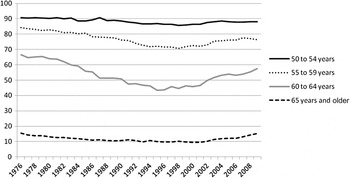
It is well-known that earlier retirements are slowing in a number of countries such as the United States, and policy strategies to raise the age of retirement continue to be proposed to curb early retirement as recently witnessed in France and Canada (Hering & Klassen, Reference Hering and Klassen2010). Figure 1 indicates that in 1976, 90.7 per cent of men aged 50 to 59 years were in the labour force compared to 88.2 per cent in 2009, higher than the low rate of 85.6 per cent in 1998. In the next age group, 55 to 59, 84.2 per cent of men were in the labour force in 1976 compared to 76.4 per cent in 2009 with a low of 70.6 per cent in 1998. For those men 60 to 64 years of age, 66.5 per cent were in the labour force in 1976 compared to 57.4 per cent in 2009, having bottomed out at 43.4 per cent in 1995.
Labour Force Participation Rates, 1976–2009, Men
Note: The participation rate is the number of labour force participants expressed as a percentage of the population aged 15 and older. The participation rate for a particular group (age, sex, marital status) is the number of labour force participants in that group expressed as a percentage of the population for that group. Estimates are percentages, rounded to the nearest tenth.
Source: Statistics Canada. Table 282-0002 – Labour force survey estimates (LFS), by sex and detailed age group, annual (persons unless otherwise noted) (table), CANSIM (database).
http://cansim2.statcan.gc.ca/cgi-win/cnsmcgi.exe?Lang=E&CNSM-Fi=CII/CII_1-eng.htm (accessed: November 2, 2010)

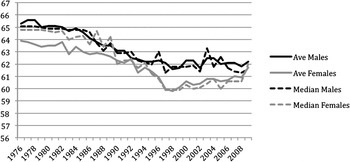
The trends for those in the labour force age 65 and older began at 15 per cent in 1976, plunged downward to as low as 9.4 per cent in 2001, and then back up to 15 per cent in 2009. In all scenarios for the past 33 years, the labour participation rate has first dropped as increasingly more men exit the labour force earlier, but then the rate began a slow upward climb in the mid-1990s (Marshall & Ferrao, Reference Marshall and Ferrao2007). The slowing of earlier retirement is nowhere as pronounced as in the United States, but there is some suggestion in these Canadian data that the first wave of the baby boomers, aged 63 in 2010, may strengthen their labour force participation rate in the next few years. Although the trend started before the 2008 economic downturn, it may be strengthened by a weak economy (Copeland, Reference Copeland2007; Marshall & Ferrao, Reference Marshall and Ferrao2007; Martel, Caron-Malenfant, Vézina, & Bélanger, Reference Martel, Caron-Malenfant, Vézina and Bélanger2007; Wannell, Reference Wannell2007a). Changes in the self-reported average and median ages of retirement for men have not been quite as dramatic but have also showed a beginning upward trend, as Figure 3 shows.
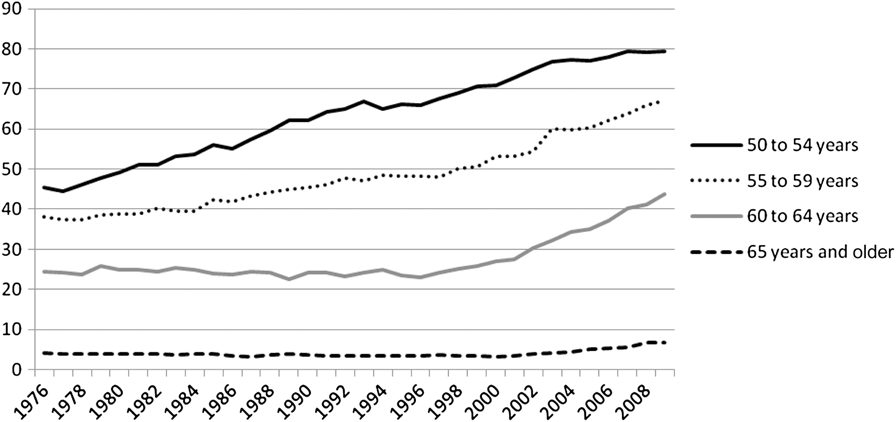
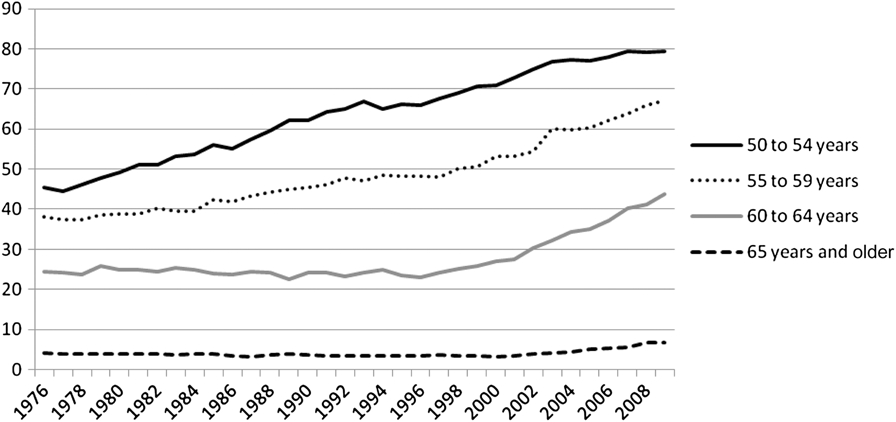
Figure 2 shows that there has been a constant increase in women’s labour force participation rates beginning in the 1960s, jumping from 38.2 per cent in 1976 to 67.1 per cent in 2009 for those aged 55 to 59 years and from 24.2 to 43.8 per cent for those aged 60 to 64 years. The percentage of women working and aged 65 years and over has never been as high for women as it was in 2008 and 2009 at 6.8 and 6.7 per cent respectively. An examination of women’s average and median age of retirement in Figure 3 indicates a slight upward trend beginning at the end of the 1990s when it averaged 59.8 years in 1998 and 61.7 years in 2009; the median age is very similar. Whether short-term or long-term, changes are definitely afoot in the direction of a later retirement.
Labour Force Participation Rates, 1976–2009, Women
Note: The participation rate is the number of labour force participants expressed as a percentage of the population aged 15 and older. The participation rate for a particular group (age, sex, marital status) is the number of labour force participants in that group expressed as a percentage of the population for that group. Estimates are percentages, rounded to the nearest tenth.
Source: Statistics Canada. Table 282-0002 – Labour force survey estimates (LFS), by sex and detailed age group, annual (persons unless otherwise noted) (table), CANSIM (database).
Source: http://cansim2.statcan.gc.ca/cgi-win/cnsmcgi.exe?Lang=E&CNSM-Fi=CII/CII_1-eng.htm (accessed: November 2, 2010)
Mean and Median Retirement Age 1976–2009 for Both Sexes
Note: The labour force survey asks people – who are not working and who have left their last job within the year prior to being surveyed – why they left this job. One of the response categories is “retired”. The average or median retirement age is calculated from this variable.
Source: Statistics Canada. Table 282-0051 – Labour force survey estimates (LFS), retirement age by class of worker and sex, annual (years) (table), CANSIM (database).
http://cansim2.statcan.gc.ca/cgi-win/cnsmcgi.exe?Lang=E&CNSM-Fi=CII/CII_1-eng.htm (accessed: November 2, 2010).

Analytic Model of Retirement
The intentions of Canadians are consistent with these trends. Drawing on data from three different surveys in 1991 (Survey on Aging and Independence), 2002 (General Social Survey), and 2007 (General Social Survey), it appears that Canadians in their late forties and early fifties intend to push back their retirement plans and are not planning on retiring as early, a development reported prior to the economic downturn. For example, between 1991 and 2007, the proportion of near-retirees aged 45 to 49 planning on retiring before age 60 decreased by about 4 percentage points, while those planning on retiring at age 65 or older increased by about 7 percentage points (Schellenberg & Ostrovsky, Reference Schellenberg and Ostrovsky2008a). About 39 per cent of near-retirees are uncertain about the timing of their retirement: 14 per cent do not know at all when they will retire, 14 per cent are not at all certain of the timing, and 11 per cent do not intend to retire at all, which is higher than in 2002 (Schellenberg & Ostrovsky, Reference Schellenberg and Ostrovsky2008a).
A random survey, taken after the economic downturn, of pre-retiree and retired Canadians aged 45 and older found that 42 per cent of pre-retirees were not prepared for retirement, while 64 per cent of pre-retirees said the economic downturn had not affected their retirement plans very much or at all, although they had concerns. About 41 per cent of pre-retirees did not believe they would be able to maintain the same standard of living in retirement; 62 per cent were concerned about being able to pay for adequate health care, and 62 per cent were concerned about depleting their savings. The pre-retirees reported they were more than twice as likely as retirees to work during their retirement (Canadian Institute of Actuaries, 2010). Their strategies to prepare for retirement were more likely to focus on investing in stocks or mutual funds than were retirees (57 per cent vs. 49 per cent) and were much more likely to try to save as much money as they could to protect themselves financially (83 per cent vs. 69 per cent). In both groups, 54 per cent have or planned to move their assets to more conservative investments while the pre-retirees were more likely to buy a guaranteed income product or employer plan option. About 50 per cent of pre-retirees already were working or planned to work longer while only nine per cent of retirees had already done so or planned to do so (Canadian Institute of Actuaries, 2010).
Many arguments have arisen as to what constitutes a “new” retirement, and as would be expected, it is difficult to pin down what is new about the new retirement (McDonald, Reference McDonald and Stone2006). Some scholars argue that the new retirement is longer and fuzzier (Kohli & Rein, Reference Kohli, Rein, Kohli, Rein, Guillemard and van Gunsteren1991), is more asynchronous (Han & Moen, Reference Han and Moen1999; O’Rand, Reference O’Rand, Mortimer and Shannon2003; O’Rand & Farkas, Reference O’Rand and Farkas2002; O’Rand & Henretta, Reference O’Rand and Henretta1999; Settersten, Reference Settersten, Binstock and George2006), and that public pensions no longer regulate early retirement entries (Guillemard, Reference Guillemard2000). The length of the time frames in the life course have shifted between education, work, and retirement, thereby blurring the boundaries. For example, it has been suggested that there are extensions in education at the front end of the life course, shorter periods of gainful employment at midlife, and increased longevity at the end of the life course (Ekerdt, Reference Ekerdt and Uhlenberg2009b; Settersten, Reference Settersten, Binstock and George2006). Other scholars have suggested that the life course is still uniform but becoming more variable in timing (Henretta, Reference Henretta1992), whereas Gardyn (Reference Gardyn2000) proposed that retirement is being reinvented to include not only second careers but also continuing education and volunteerism (Butrica, Johnson, & Zedlewski, Reference Butrica, Johnson and Zedlewski2009). McDonald (Reference McDonald and Stone2006) has provided evidence as to the “new routes into retirement” that involve unexpected early retirement, caregiving for family, disability, poor health, and unemployment (McDonald, Reference McDonald and Stone2006; McDonald & Donahue, Reference McDonald and Donahue2000; McDonald et al., Reference McDonald, Donahue, Marshall, Denton, Fretz and Spencer2000; McDonald, Sussman, & Donahue, Reference McDonald, Sussman and Donahue2002, October).
‘What Is Retirement’ Is Still the Question
Barely do researchers describe the nature of the new retirement and dramatic drops in labour force participation when the kaleidoscope rotates again and labour force participation begins to increase, implying a later retirement on the horizon. The one constant in the evolution of retirement is that retirement has little meaning outside of the paid labour force, no matter how the concept is defined. When retirement research was on the ascendancy in the 1960s, retirement was defined as “the creation of an economically non-productive role in modern societies which are capable of supporting large numbers of persons whose labor is not essential to the economic order” (Donahue, Orbach, & Pollak, Reference Donahue, Orbach, Pollak and Tibbitts1960, p. 331). In 2007, on behalf of Statistics Canada, Bowlby (Reference Bowlby2007) offered the agency’s standard definition: “‘retired’ refers to a person who is aged 55 and older, is not in the labour force, and receives 50% or more of his or her total income from retirement-like sources” (p. 17).
Ever since scholarship began on retirement, researchers have recognized the many problems attendant on defining retirement and so have used many definitions over time (cf. Denton & Spencer, Reference Denton and Spencer2009; Ekerdt & DeViney, Reference Ekerdt and DeViney1990; Gower, Reference Gower1997; Lazear, Reference Lazear, Ashenfelter and Layard1986; Palmore, Burchett, Fillenbaum, George, & Wallman, Reference Palmore, Burchett, Fillenbaum, George and Wallman1985; Streib & Schneider, Reference Streib and Schneider1971). The challenges are numerous: conceptually, retirement has been seen as a social institution at the structural level; a social role, a process, or a phase of life at the individual level; and analytically as a dependent, independent, or intervening variable and has been operationalized in dozens of ways. Most researchers would agree that retirement relates to withdrawal from the paid labour force and that the rest of the definition would be contested.
As recently as 2009, Denton and Spencer were still asking the same question. These scholars reviewed and assessed the many concepts and measures of retirement and provided an overview of the ways used to conceive retirement: non-participation or reduced participation in the labour force, receipt of pension income, end-of-career employment, self-reported retirement, or combinations of those characteristics (Denton & Spencer, Reference Denton and Spencer2009). In light of their exhaustive analyses, several factors are self-evident. Almost all retirement research in Canada has been based on secondary data analyses of large data files except in two instances, the Retirement and Pre-retirement Survey 1975 and in 1991, The Survey of Ageing and Independence, both cross-sectional and both carried out by the Canadian government. There are two data sets both longitudinal and new to the retirement scene, but neither was developed to study retirement, which is the primary problem with secondary data analysis. The limited number of longitudinal files in Canada and their relatively recent appearance is highlighted when compared with the United States where longitudinal studies of retirement were possible with the National Longitudinal Surveys of Labor Market Experience (NLS), especially the Young Men and Older Men Survey begun in 1966, the Retirement History Longitudinal Survey (RHLS), taken over the period 1969–1979, and the highly utilized Health and Retirement Study (RHS) started in 1992.
The two most significant surveys in Canada are the Longitudinal Administrative Database (LAD) (Grafstrom, Nordberg, & Winblad, Reference Grafstrom, Nordberg and Winblad1993; cf. Halliwell, Reference Halliwell, Abbott, Beach, Boadway and MacKinnon2009; Tompa, Reference Tompa1999), which links individual tax returns and the Survey of Labour and Income Dynamics (SLID) (cf. Compton, Reference Compton2001; Deschênes & Stone, Reference Deschênes, Stone and Stone2006; Pyper & Giles, Reference Pyper and Giles2002). The LAD is rich in sources of income but short on labour force variables; it is valuable, however, because of its length of 26 years (extending up to the 2007 tax year). SLID, started in 1992, has both income sources and labour force variables, but not enough people retire in any given year for viable longitudinal analysis (Denton & Spencer, Reference Denton and Spencer2005). An additional problem is that even within these data files, researchers create different definitions of retirement that limits national and international comparability (e.g., Denton, Finnie, & Spencer, Reference Denton, Finnie and Spencer2009; Halliwell, Reference Halliwell, Abbott, Beach, Boadway and MacKinnon2009). One new longitudinal file coming on line will be the Canadian Longitudinal Study on Aging (CLSA), a large, national, long-term study that will follow approximately 50,000 Canadian men and women between the ages of 45 and 85 for at least 20 years. The study will collect information on the changing biological, medical, psychological, social, and economic characteristics of Canadians and has a module on retirement. Many of those researchers reading this article are not likely to exploit the longitudinal findings from this study since they will have a long wait, which is always a drawback in collecting longitudinal data.
As we said 20 years ago, definitions are important because they determine who is retired and who isn’t, they determine whose view matters, and why contradictory answers to the same research questions co-exist. The implications of the “definition” problem have serious ramifications for the formulation of public policy, for determining the size and age composition of the labour force, and for the security of older adults in retirement. Nevertheless, there is still no general consensus on how to define retirement: the definition is mainly determined by what data sets are available in Canada, and these are still firmly tethered to income and labour force participation.
Moreover, misspecified models of retirement that are far removed from Canadian citizens are all too likely to result from the inability of the current longitudinal data files – including the cross-sectional ones like the Canadian Census, The General Social Surveys, or the Canadian Labour Force Surveys – to consider objective and subjective factors (Gustman & Steinmeier, Reference Gustman and Steinmeier2001), and from the impact of structural influences like state or global policies (Phillipson, Reference Phillipson, Bauld, Clark and Maltby2006).Footnote 6 The data also lag behind contemporary circumstances, providing limited information about family dynamics and retirement (e.g., dual-career couples, raising grandchildren), data about the unpaid labour of older women, especially immigrant women (McDonald, Reference McDonald and Stone2006),Footnote 7 and most recently, of course, the social psychological turmoil of the economic meltdown.
The Theory and Retirement: Edging Forward
Theories explicitly designed to explain retirement are scarce and are little more than revisited theories or models found in any discipline whose researchers are interested in retirement (e.g., economics, sociology, psychology, anthropology, and professions like nursing, social work, and business administration); see Wang and Schultz (Reference Wang and Shultz2010) for a recent review. If any theories are in evidence, most are either focused on the micro-level of individual behaviour (e.g., activity theory, or human capital) or on the macrolevel of structure and policy (critical theory or political economy) in explaining retirement (Cooke, Reference Cooke2006; Estes & Associates, Reference Estes2001) with the majority focusing on the individual (Pushkar et al., Reference Pushkar, Chaikelson, Conway, Etezadi, Giannopoulus and Li2010). Those theories that attempt to link both micro- and macroperspectives are extremely rare (Stone & Nouroz, Reference Stone, Nouroz and Stone2006). Twenty years later, however, we find more attempts to apply longitudinal approaches to retirement research such as the life course perspective from sociology, life span development in psychology, and life cycle theories in economics, all of which recognize that retirement is the accumulation of many factors over a lifetime (Bulanda & Zhang, Reference Bulanda and Zhang2009; Denton et al., Reference Denton, Finnie and Spencer2009; Kubicek, Korunka, Hoonakker, & Raymo, Reference Kubicek, Korunka, Hoonakker and Raymo2010; McDonald & Valenzuela, Reference McDonald and Valenzuela2009; Pleau, Reference Pleau2010). For example, using the LAD to examine pathways to the Guaranteed Income Supplement (GIS), Uppal, Wannell, and Imbeau (Reference Uppal, Wannell and Imbeau2009) provided evidence that job or personal difficulties in middle age – such as going on unemployment, using social assistance, or developing a disability – increase the probability of receiving GIS benefits in retirement.
In examining the longitudinal features of the National Population Health Survey, Park (Reference Park2010) found that men retired earlier if they had assessed their health as poor 10 years earlier. A longitudinal approach has become so important to retirement research that pseudo-cohorts and trend studies are also the norm (Baker & Benjamin, Reference Baker and Benjamin1999; Gougeon, Reference Gougeon2009; Uppal, Reference Uppal2010). With six five-year waves of the Canadian Census from 1981 to 2006, Uppal (Reference Uppal2010) showed how the labour force activity of men over age 65 has increased over time. A longitudinal view, while a step forward, is nonetheless not synonymous with theory. In addition, most studies are still focused on the individual level of analysis or the societal level but not the connections between the two. The links between the micro, meso, and macro levels that simultaneously influence retirement are overlooked, as are their possible intersections. As a result, retirement research often suffers from a certain type of reductionism or a sense of “false necessity” (Block, Reference Block1990) that market realities are the only factors driving retirement research (Phillipson, Reference Phillipson, Bauld, Clark and Maltby2006; Vincent, Reference Vincent, Baars, Dannefer, Phillipson and Walker2006). For example, the narrow debate on the pros and cons of defined benefit and contribution plans that has become louder in the face of the market crash is really only about a change that favoured private-sector employers long before the economic crisis and which was initiated by employers to diminish their pension risks and pass them on to the individual (Gougeon, Reference Gougeon2009). This flurry of research on defined-benefit and defined-contribution plans is misplaced and overlooks other important factors that influence retirement (Robson, Reference Robson2010).
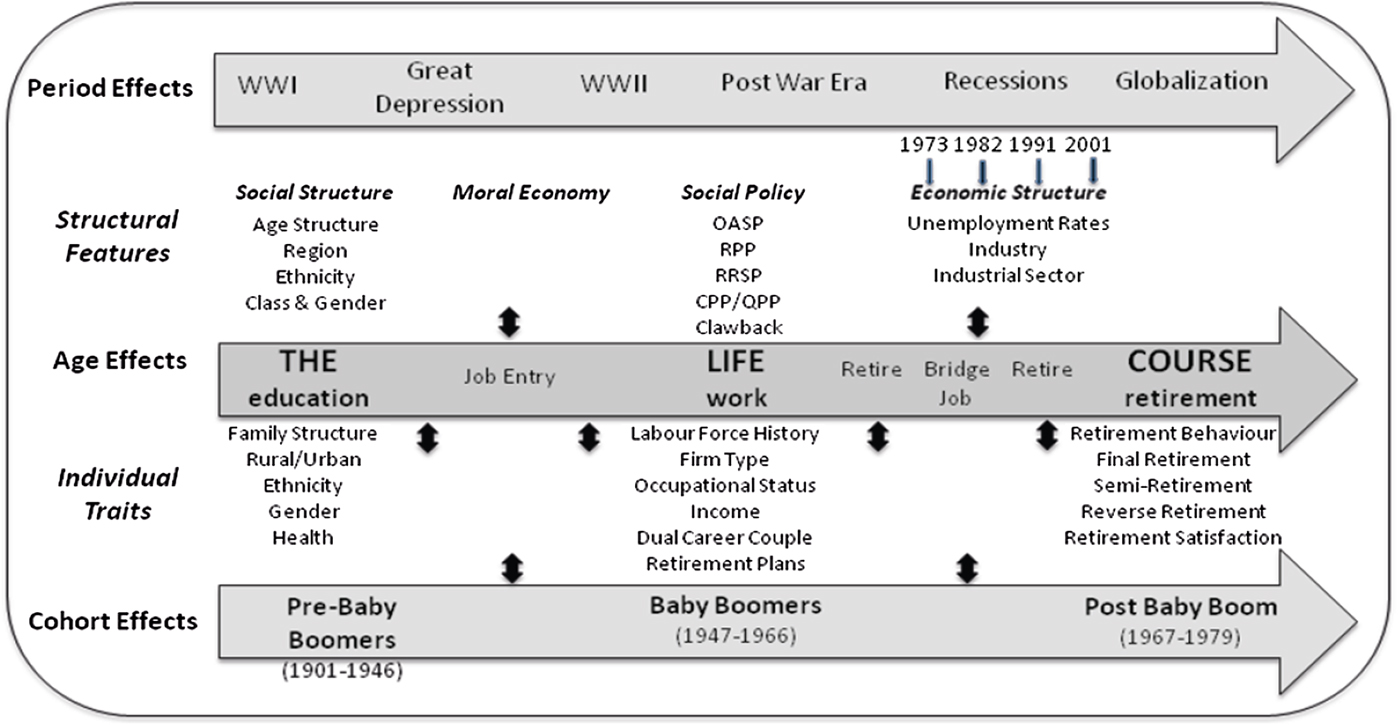
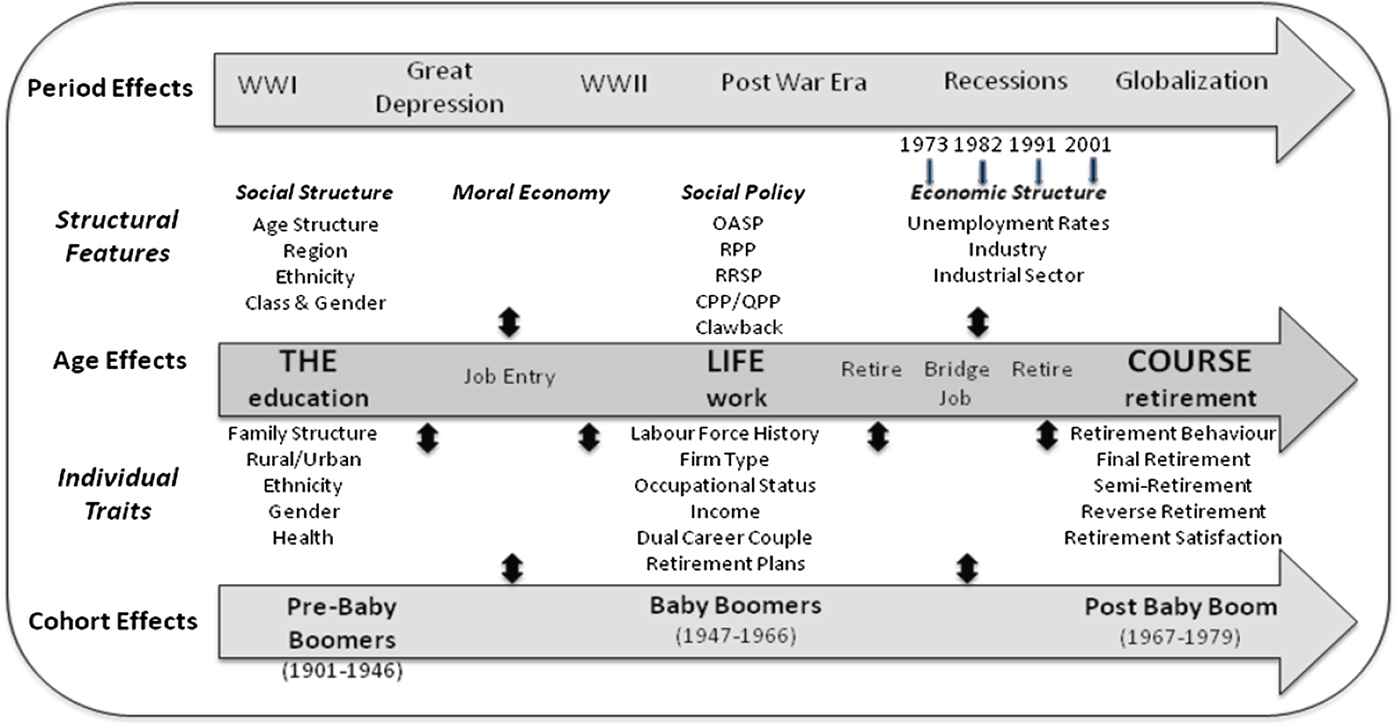
One of the more interesting aspects of the life course framework is that it is not a genuine theory but rather a perspective or framework within which theories can be nested (Ferraro, Shippee, & Schafer, Reference Ferraro, Shippee, Schafer, Bengston, Silverstein, Putney and Gans2009) or from which principles can be drawn and incorporated into other theories (Flippen & Tienda, Reference Flippen and Tienda2000) depending on what is being studied and the proclivities of the researcher (Ferraro et al., Reference Ferraro, Shippee, Schafer, Bengston, Silverstein, Putney and Gans2009). Figure 4 provides a “life course” skeleton of the basics of retirement and the possible areas for study that include age, period, and cohort effects and the ways they intersect.
Historical events influence the social structure, the economy, and social policy. As an example, it is hard to ignore one of the main themes of globalization: that private provision is inherently superior to that provided by the public sector (Stiglitz, Reference Stiglitz2003; Walker & Deacon, Reference Walker and Deacon2003). It is equally hard to ignore, first, how this neoliberal ideology has been spread by supranational bodies such as the Organisation for Economic Co-operation and Development (OECD), the World Trade Organization, the World Bank, and the International Monetary Fund as well as by pharmaceutical and other supranational corporations (Phillipson, Reference Phillipson, Bauld, Clark and Maltby2006; Polterovich & Popov, Reference Polterovich and Popov2006), or, second, to ignore how the global recession has further fanned the flames of privatization of the welfare state. How these bodies influence pensions and retirement in Canada could be better understood before the retirement system is lost to international policies Canadians may not value (Monk, Reference Monk2010; Orenstein, Reference Orenstein2008). In turn, social structure, social policies, and differences across the economy shape the life course to which the individual brings his or her own capabilities. At the same time, the individual belongs to a specific age group, a cohort such as the baby boomers, which can influence experiences and views of retirement over time. Interestingly, a recent study that examined changes in work values over generations from the boomers to Generation Me (GenMe; those born in the period 1982 to 1999) showed an increasing value of leisure and a decline in the centrality of work.
A major suggestion was that boomers may not be the generation so eager to retire but rather the GenMe generation that basically “works to live” (Twenge, Campbell, Hoffman, & Lance, Reference Twenge, Campbell, Hoffman and Lance2010). In addition, dual-economy theory could be used to study rates of retirement in different economic sectors (e.g., the well-protected public versus private sector retirement)Footnote 8 as could the cumulative disadvantage/advantage hypothesis in which the inequalities created by work histories prior to retirement are perpetuated after retirement and become amplified by cumulative effects over time (Chappell, McDonald, & Stones, Reference Chappell, McDonald and Stones2008). A recent study of a life course approach to retirement using Dutch longitudinal data clearly showed that retirement is a matter of personal agency within structure over time and that income and wealth are significant variables but they are not the only significant or most important explanatory variables when it comes to explaining retirement. Further, experiences in midlife set the stage for retirement in later life (Damman, Henkens, & Kalmijn, Reference Damman, Henkens and Kalmijn2010).
The life course approach has limitations, mainly related to a singular interest in the individual that reduces the likelihood that research will mirror Canadian retirement; the other obvious problem is that the perspective is representative of life in western industrialized nations, a condition that does not apply to all people in Canada (Dannefer, Reference Dannefer2003). The life course perspective is not new as far as research is concerned; it is just used more frequently by retirement researchers (e.g., Kubicek et al., Reference Kubicek, Korunka, Hoonakker and Raymo2010). What might be new at this juncture in Canada is the serious need to consider structural factors such as globalization, and the need to consider how these influence Canadian retirement choices and whether these choices reflect the political will.
Retirement Issues that Matter
Myriad issues have occurred since publishing Retirement in Canada, and not all can be considered here. We examine some of the more significant factors that indicate that retirement will be different in the immediate future: changes in retirement policy, planning for retirement, involuntary retirement, reverse retirement, family contingencies, and the quality of pensions.
Retirement Policy Encourages Later Retirement
Retirement policy is primarily about the age of eligibility and other requirements that regulate when and how people retire; pension policy is what makes it all possible according to how Canadians design and finance the accumulation of pension benefits. Retirement policy has been minimally examined in Canada, if not worldwide (Myles, Reference Myles and Stone2006).Footnote 9 The two policies are strange bedfellows even though a change in one policy noticeably affects the other. In Canada, retirement policy is reformed largely through the back door of pension policy which tends to be sensitive to market pressures, mainly to remedy whatever the country’s current fiscal imperative is. Complicated pension discussions are also the type of debate that marginalizes ordinary Canadians because substantial financial literacy is required to comprehend them, a literacy that we know many Canadians do not possess (The Federal Task Force on Financial Literacy, 2010). Indeed, many retirement researchers would likely struggle to conduct a fine-grained, cost-benefit analysis of defined-benefit and -contribution pension plans.
Canadian public policy has supported historically low retirement ages that began with the “early retirement movement” in the 1980s to deal with the dual trend of inflation and recession, the financial plight of older women, unemployment, and the pressure of the baby boom on entry-level jobs. As we have noted here, the situation is now slowly changing in favour of later retirement. The changes in retirement policy per se have been few. For example, all provincial governments have recently eliminated contractually mandatory retirement at age 65 with the exception of federal employees, but even here the government plans to prohibit this practice as announced in 2010. Pension plan changes are more in evidence. For example, recent changes have been made that support part-time work for some workers, since they are allowed to continue to accrue pension benefits if they work later; the age for contributing to RRSPs was raised to age 71 from age 69, and a tax credit was made available to encourage paid work for low-income earners aged 65 and older by reducing the disincentives to paid employment found in the Old Age Security/Guaranteed Income Supplement programs.
In keeping with the plan to increase the age of retirement, several modifications to the Canada Pension Plan Act, recommended by the federal, provincial, and territorial governments, became law and will apply to those retiring in 2012. The new rules will gradually change the pension adjustments for early and late Canada Pension Plan (CPP) take-up, remove the work cessation test, mandate plan participation for working beneficiaries under age 65, and enhance the general drop-out provision. Removal of the current work cessation test in 2012 will allow individuals to receive a CPP retirement pension as early as age 60 without requiring the person to reduce earnings or stop working. Those individuals under age 65 who elect to receive a CPP retirement benefit while working will be required to continue participation in the plan. Such individuals, and their employers, will still make compulsory CPP contributions. Note that those between the ages of 60 and 65 who plan to apply for a CPP pension early will have their benefits reduced. Those workers age 65 and older can voluntarily elect to continue CPP participation, in which case regular employer contributions will also be required. In other words, early retirement will be penalized and later retirement rewarded. What this means to the employer who will have to continue to contribute to payroll taxes for a longer time frame remains to be seen.
This back-door method to increase the age of retirement through pension policy has been suggested many times in the past to reduce the cost of pensions but has never really been successful (Brown, Reference Brown, Gee and Gutman1995; Hicks, Reference Hicks2003; Lam, Cutt, & Prince, Reference Lam, Cutt and Prince1996, February). The justifications are many: (a) gains in life expectancy requires resetting the retirement age (Denton & Spencer, Reference Denton and Spencer1996, Reference Denton and Spencer2010; Hering & Klassen, Reference Hering and Klassen2010), (b) a reduction in morbidity and mortality rules out a sickly labour force (Fries, Reference Fries1989), (c) retirement goes on too long (Hicks, Reference Hicks2003), (d) generational equity demands later retirement, and (e) a later retirement age would be much less expensive (Hering & Klassen, Reference Hering and Klassen2010). It is no surprise that France, the United States, Germany, the United Kingdom, and Australia have already passed legislation that will, over time, raise the age of retirement. But the Canadian public has not had this discussion (Myles, Reference Myles and Stone2006) even though pension policy will shortly begin to influence a later age of retirement. Whether or not this is the desire of Canadians or their collective vision of retirement remains to be seen, especially for those who are too ill to work, those who have lost some of their savings, those who are caregiving, and those who may be unemployed or are older immigrants to this country.
Preparing for Retirement: Uncertainty and Risk
Preparation for retirement has implications not only for the timing of retirement but for the retirement experience itself (see Topa, Moriano, Depolo, Alcover, & Morales, Reference Topa, Moriano, Depolo, Alcover and Morales2009, for a meta-analysis). Retirement preparation is multifaceted and runs the gamut from financial planning to making use of time. Regardless of the type of planning done in anticipation of retirement, research has shown that those who do more planning report a greater increase in well-being (Noone, Stephens, & Alpass, Reference Noone, Stephens and Alpass2009; Schellenberg, Turcotte, & Ram, Reference Schellenberg, Turcotte and Ram2005a; Topa et al., Reference Topa, Moriano, Depolo, Alcover and Morales2009). As would be anticipated, financial preparation for retirement has received considerable attention in the retirement literature. According to the Canadian Financial Capability Survey, 81 per cent of Canadians nearing retirement reported that they were financially preparing for retirement in 2009 (Schellenberg & Ostrovsky, Reference Schellenberg and Ostrovsky2010). Despite the focus on financial preparation for retirement, however, many older Canadians expressed concerns with their financial preparedness to leave the labour force (Canadian Institute of Actuaries, 2009; Schellenberg, Reference Schellenberg2004; Schellenberg & Ostrovsky, Reference Schellenberg and Ostrovsky2008a). For example, using the 2007 General Social Survey, 61 per cent of near-retirees thought that their income in retirement would only be adequate while 19 per cent expected their retirement income to be “barely adequate” and nine per cent “inadequate” or “very inadequate”. About three per cent couldn’t estimate the adequacy of their income for retirement (Schellenberg & Ostrovsky, Reference Schellenberg and Ostrovsky2008a).
The perceived adequacy of retirement preparation has been linked to a number of demographic and labour market characteristics, including gender, marital status, immigration status, and financial status. Generally speaking, women are disadvantaged in planning for retirement compared to men, which has been linked to women’s typically lower socioeconomic status (Moen, Sweet, & Swisher, Reference Moen, Sweet, Swisher and Macmillan2005; Noone, Alpass, & Stephens, Reference Noone, Alpass and Stephens2010; Wong & Hardy, Reference Wong and Hardy2009). Compared to their married counterparts, those who are widowed, separated, or divorced are more likely to indicate their retirement preparation as inadequate (Schellenberg, Reference Schellenberg2004). This is likely a reflection of the financial penalties that result from the dissolution of a marriage or partnership (McDonald & Robb, Reference McDonald and Robb2004). Immigrants, particularly those who have immigrated to Canada since the 1980s, have expressed concerns with their retirement preparations. This concern has been attributed to a number of factors, including differences in pension coverage – that immigrants have not been in Canada long enough to build up an adequate pension (Schellenberg, Reference Schellenberg2004) – and to difficulties in the labour market such as language difficulties (Frenette and Morisette, Reference Frenette and Morrisette2003). Health status also plays a major role in the perception of retirement preparedness, with those individuals in poor health indicating that they are far less prepared for retirement than those in good health (Gupta & Larsen, Reference Gupta and Larsen2010). This is likely attributable to the limited labor-force participation of near-retirees who are already in poor health with implications for their earnings, pension coverage, and, ultimately, savings (Schellenberg, Reference Schellenberg2004). Certain financial characteristics are also linked to concerns about retirement preparation, such as lack of pension coverage, lack of home ownership, having lower personal and household incomes, and having fewer weeks of employment during the year (Schellenberg, Reference Schellenberg2004).
Together, these characteristics point to those who are the most vulnerable in our society – new immigrants, women, those without partners, those in poor health, and those with limited human capital: those, therefore, least likely to prepare. Worse yet, the social media are awash in selling retirement products and offering retirement advice. Financial institutions spend more than US$1.5 billion a year marketing their services to consumers in the United States, and in Canada, through shared media. That amounts to nearly US$40 million a week of advertising dollars trying to catch the consumer’s attention. Under these circumstances, confusion about retirement planning would not be uncommon, nor would the potential for “bad” retirement plans, especially given the unevenness of financial literacy in Canada.
On the basis of data from the Mature Market Survey that examined financially distressed consumers’ information search behaviors for retirement plans, researchers found that financially distressed consumers sought financial information from media and professional services when making a retirement plan. Income and gender were positively related to the extent of the information search for retirement planning information while financial attitude and retirement income sources were not significantly associated with the information search. The results indicated that there is a great need for financial education programs and efficient financial information delivery for older, financially stressed consumers (Kim & Kim, Reference Kim and Kim2010).
The Timing of Retirement
Research on the timing or age of retirement, the most researched area in the retirement literature, has often focused on the role of health and wealth in both the retirement decision and its timing (Ekerdt, Reference Ekerdt2009a). Wealth affords greater opportunities in a person’s retirement decision; those with greater wealth often opt to retire earlier (Barnett, James, Sargent, & Lavoie, Reference Barnett, James, Sargent and Lavoie2004). Tied into the whole wealth equation are pensions, particularly employer-sponsored pensions, which especially influence the decision to retire earlier (Baker, Gruber, & Milligan, Reference Baker, Gruber and Milligan2003; Gunderson, Reference Gunderson2001; Schirle, Reference Schirle2008). On the other hand, health also plays a significant role in the decision. Retiring because of poor health has been found to be one of the most prevalent reasons cited for retiring (McDonald & Donahue, Reference McDonald and Donahue2000; Morissette, Schellenberg, & Silver, Reference Morissette, Schellenberg and Silver2004; Statistics Canada, 2002). On the basis of data from the 2002 General Social Survey, health problems were found to be a consideration for many recent retirees, as 26 per cent of them said they would have continued working had their health been better (Schellenberg & Silver, Reference Schellenberg and Silver2004). In 2002, almost 30 per cent of those who had retired between 50 and 59 years of age indicated health as the reason for retirement (Statistics Canada, 2002).
It comes as no surprise, then, that poor health has consistently been shown to increase the likelihood of a person’s entering early retirement (Compton, Reference Compton2001; Gunderson, Reference Gunderson2001; Schirle, Reference Schirle2005, Reference Schirle2007). What’s more, poor health likely interacts with income and wealth (Chappell et al., Reference Chappell, McDonald and Stones2008; Flippen & Tienda, Reference Flippen and Tienda2000; Pond, Stephens, & Alpass, Reference Pond, Stephens and Alpass2010). For example, in an analysis of data from the Canadian Survey of Labour and Income Dynamics (SLID), Schirle (Reference Schirle2007) examined the effects of health and employer-provided pensions on retirement decisions. By jointly modeling the impact of financial incentives and health on the retirement decisions of Canadians, it was found that both factors have substantial and significant effects on retirement; having poor health increases the likelihood of entering retirement by up to 25 percentage points. In addition, those in poorer health are more uncertain of their retirement plans (Schellenberg & Ostrovsky, Reference Schellenberg and Ostrovsky2008a).
Moving beyond the health-wealth debate, the central question is whether the trend towards a later retirement will continue and, if so, we must ask what are the reasons behind the trend. Some explanations have been offered (Blau & Goldstein, Reference Blau and Goldstein2007; Johnson, Reference Johnson2002; Munnell & Sass, Reference Munnell and Sass2008), but all have been contested because of the trend’s recency. Five examples of factors are: (a) the end of mandatory retirement (Shannon & Grierson, Reference Shannon and Grierson2004), (b) the beginning shift from defined-benefit to defined-contribution pensions, (c) restructuring and job displacement (Dunn, Reference Dunn2005, December), (d) co-retirement by dual-career couples (Compton, Reference Compton2001; Schellenberg & Ostrovsky, Reference Schellenberg and Ostrovsky2008a), and (e) healthier and more educated workers (Mermin, Johnson, & Murphy, Reference Mermin, Johnson and Murphy2007).
American researchers, using data from the Health and Retirement Study from 1992 and 2004, found that the mean self-reported probability of working full-time past age 65 among workers aged 51 to 56 increased from 27 per cent to 33 per cent. Lower rates of retiree health insurance, higher levels of educational attainment, and lower rates of defined benefit pension coverage accounted for most of the growth of boomers who expected to work longer (Mermin et al., Reference Mermin, Johnson and Murphy2007). As Ekerdt (Reference Ekerdt2009a) noted: “If the trend persists, it represents nothing less than a reallocation of work and leisure in later life such that increased life expectancy will now be paid for by employment rather than transfers of resources from younger cohorts” (p. 73). It means a different type of retirement, too.
Forms of Retirement Are New
Although the traditional model of retirement assumes a lifetime of steady full-time work followed by a clean break from the labour force, other patterns of retirement are open to older workers. For example, a return to work after retirement is becoming a common later-life trajectory (Duchesne, Reference Duchesne2002, Reference Duchesne2004; Schellenberg et al., Reference Schellenberg, Turcotte and Ram2005a). In 2002, about 22 per cent of Canadians went back to work after retiring while four per cent looked for work but found none. More retired men then women went back to work (23% versus 15%), and 38 per cent returned to work for financial reasons compared to 55 per cent for non-financial reasons (Schellenberg et al., Reference Schellenberg, Turcotte and Ram2005a). That the respondents were in good health, had postsecondary education, and skills and experience from prior employment in professional and managerial occupations bodes well for those boomers who may have to return to the labour force.
Another form of retirement that is very popular is gradual or part-time retirement in which older workers do not want to move straight from full-time employment to complete retirement. In Canada, 1 in 5 older workers aged 65 years and older work part-time, and two thirds chose to work part-time (Marshall & Ferrao, Reference Marshall and Ferrao2007). A number of earlier studies have shown that more than half of all older workers prefer to exit the labour force this way (Hutchens & Papps, Reference Hutchens, Papps, Clark and Mitchell2005). Many policy makers also view gradual retirement favorably, because workers can extend their careers and thereby improve retirement income security as recent changes to the Canada Pension Plan indicate. However, some scholars are dubious that gradual retirement will increase average working lives (De Vaus, Wells, Kendig, & Quine, Reference De Vaus, Wells, Kendig and Quine2007; Gustman & Steinmeier, Reference Gustman and Steinmeier2007). Although gradual retirement may be a favoured mechanism for leaving the labour force, newer research (using longitudinal data from the Health and Retirement Survey) indicates that the change in happiness between the last wave of full employment and the first wave of full retirement suggests that what matters is not the type of transition but whether people perceive the transition as chosen or forced (Calvo, Haverstick, & Sass, Reference Calvo, Haverstick and Sass2009).
One of the newer forms of retirement is involuntary retirement, which is often masked behind more socially justifiable reasons such as “voluntary” early retirement plans (Wang & Shultz, Reference Wang and Shultz2010). With an economic downturn, involuntary retirement, due to unemployment, which rose from 6.3 per cent in 2008 to 8.5 per cent in 2009, will be an important factor in retirement in Canada even though the unemployment rate spiked earlier and higher in the United States at nine per cent in 2010 (LaRochelle-Côté & Gilmore, Reference LaRochelle-Côté and Gilmore2009). In the 2002 Canadian General Social Survey, it was found that 26.9 per cent of recent retirees indicated they retired involuntarily (Policy Research Initiative, 2004). In the same analysis, six reasons were cited for involuntary retirement: (a) health (42.8%), (b) job downsizing (24.9%), (c) unemployment (15.2%), (d) mandatory retirement policies (15.3%), (e) early retirement incentives (13.5%), and (f) care for a family member (7.9%).
The asynchronous and unwanted nature of involuntary retirement has significant consequences for those affected, including financial hardship and negative social, emotional, psychological, and physical health issues. As an example, using the Health and Retirement Survey, it was found that gender-specific models indicated that unmarried women and those with low pre-displacement incomes had heightened risk for subsequent functional disability. No differential effects of job loss were found for men (Gallo, Brand, Teng, Leo-Summers, & Byers, Reference Gallo, Brand, Teng, Leo-Summers and Byers2009). Another study showed that estimates indicated that earnings losses associated with displacement rose sharply with age and were larger for those subsequently reemployed in different industry sectors. These findings are consistent with the idea that earnings decline following displacement due to losses of firm-specific human capital (Couch, Jolly, & Placzek, Reference Couch, Jolly and Placzek2009). For this group of retirees, the recent movement towards a later age of entitlement for retirement benefits such as public and private pensions may serve to further penalize an already vulnerable group of retirees.
As an employment option for organizations, bridge retirement emerged recently when baby boomers’ retirement started to create labour force shortages (e.g., AARP, 2005). The fate of the bridge job is likely to change with the economic downturn. Many retirees choose to participate in some form of bridge employment – part time, self-employment, or temporary work that follows an individual’s long-term or career job and which precedes permanent retirement (Davis, Reference Davis2001, April; Feldman, Reference Feldman1994; Pyper & Giles, Reference Pyper and Giles2002; Schellenberg et al., Reference Schellenberg, Turcotte and Ram2005a; Singh & Verma, Reference Singh, Verma, Marshall, Heinz, Krüger and Verma2001; Wannell, Reference Wannell2007a, Reference Wannell2007b). The proportion of individuals aged 50 to 69 in bridge employment averaged about nine per cent over the 1999 to 2004 period, going from 7.9 per cent in 1999 to 9.7 per cent in 2004 (Hébert & Luong, Reference Hébert and Luong2008). Bridge employment is important, as it has been shown to redefine retirement through its impact on the transition process into retirement (Ulrich & Brott, Reference Ulrich and Brott2005; Wang, Reference Wang2007).
Firms may rely more on promoting partial early retirement as a socially acceptable approach to cutting labor costs, or more retirees may be hired as contingent workers because organizations will need to maintain flexible access to a skilled and experienced workforce (Greller & Stroh, Reference Greller, Stroh, Adams and Beehr2003). On the other hand, from the individual’s perspective, older workers today may be more interested in hanging on to their career jobs, and the importance of bridge jobs could wane. This could be a problem, because Wang (Reference Wang2007) found that bridge employment helped retirees maintain their psychological well-being during the retirement transition process, and in another study showed that health outcomes following bridge employment were superior compared to those who took complete retirement (Zhan, Wang, Liu, & Shultz, Reference Zhan, Wang, Liu and Shultz2009).
Family Contingencies
The life course perspective has drawn attention to the family as a salient life domain that may influence retirement and employment status – that life trajectories are linked over the life course (McDonald, Reference McDonald and Stone2006; Szinovacz, Reference Szinovacz and Stone2006, Reference Szinovacz, Adams and Beehr2003). In 2002, more than two million family members and friends aged 45 and older reported assisting an older adult because of the person’s long-term health condition (Cranswick, Reference Cranswick2003). In 2007, the number of caregivers aged 45 and older increased by over 670,000 to 2.7 million caregivers (Cranswick & Dosman, Reference Cranswick and Dosman2008). While both men and women provide care, it is women who shoulder the majority of care for older adults (Pyper, Reference Pyper2006; Stobert & Cranswick, Reference Stobert and Cranswick2004). The research indicates that a spouse’s working status, spousal support, and marital and dependent care status are related to retirement decisions (An, Christensen, & Gupta, Reference An, Christensen and Gupta2004; Gustman & Steinmeier, Reference Gustman and Steinmeier2004; Henkens, Reference Henkens1999; Henkens & Tazelaar, Reference Henkens and Tazelaar1997; Henkens & van Solinge, Reference Henkens and van Solinge2002; Moen, Huang, Plassmann, & Dentinger, Reference Moen, Huang, Plassmann and Dentinger2006; Moen, Kim, & Hofmeister, Reference Moen, Kim and Hofmeister2001; Szinovacz & Davey, Reference Szinovacz and Davey2005; Szinovacz, DeViney, & Davey, Reference Szinovacz, DeViney and Davey2001).
At the same time, studies have shown other family-related variables, such as marital status and quality, were not related to retirement decisions (e.g., Wang, Zhan, Liu, & Schultz, Reference Wang, Zhan, Liu and Schultz2008). Because there have been relatively fewer studies investigating this type of antecedent, it is still too early to draw conclusions. Married retirees usually adjust better than do single or widowed retirees (e.g., Pinquart & Schindler, Reference Pinquart and Schindler2007), but this beneficial effect disappears when their spouses are still working (e.g., Moen et al., Reference Moen, Kim and Hofmeister2001; Wang, Reference Wang2007). Retirees with happier marriages (e.g., Rosenkoetter & Garris, Reference Rosenkoetter and Garris1998; Szinovacz & Davey, Reference Szinovacz and Davey2004; Wang, Reference Wang2007) and fewer dependent children (e.g., Kim & Feldman, Reference Kim and Feldman2000; Marshall, Clarke, & Ballantyne, Reference Marshall, Clarke and Ballantyne2001) are more likely to achieve better retirement adjustment outcomes. Finally, van Solinge and Henkens (Reference van Solinge and Henkens2008) showed that losing a partner during the retirement transition had a negative impact on retirement satisfaction.
Three developments in the family research arena will have to be closely monitored because they will affect both the timing and quality of retirement (McDonald, Reference McDonald and Stone2006). For example, Schellenberg et al. (Reference Schellenberg, Turcotte, Ram and Stone2006) provided evidence that the interdependence of men and women in dual-career couples is fast changing, heralding new relationships that affect retirement. Among dual-earner couples in 2001, 29 per cent of the spouses retired within two years of each other, falling within the ranges of 20 to 40 per cent found in other countries (Blau, Reference Blau1998; Gower, Reference Gower1998; Hurd, Reference Hurd and Wise1990; Johnson, Reference Johnson2004; O’Rand & Farkas, Reference O’Rand and Farkas2002). Although a significant proportion of couples still retired jointly, the most prevalent pattern was for women to retire after their husbands, sometimes up to five years later, leading some researchers to suggest that the process between spouses is becoming disjointed and more independent (Schellenberg & Ostrovsky, Reference Schellenberg and Ostrovsky2008b). It seems that retirement has become a serious undertaking for women who are usually a couple of years younger than their partners, an issue that may become more important as more women complete the full work-retirement cycle. A related challenge is that the age differential between spouses makes it difficult for couples to retire at the same time because of age requirements specified in pension policies.
The second development is the retirement of both men and women to be caregivers. In her analysis using data from the 2002 General Social Survey, Pyper (Reference Pyper2006) found that 21 per cent of women aged 45 to 64 who were caregivers reported that the need to provide care would be a likely reason for retirement, compared with 13 per cent of women of the same age who were not providing care at the time. For men, non-caregivers aged 45–64 mentioned this reason only slightly more often than caregivers (11% versus 9%). Another way of looking at the problem is that 14 per cent of Canadian workers aged 55 and older reported being dissatisfied with their work-life balance in 2005. Close to one half of those who were dissatisfied felt that they spent too much time on the job, while over one quarter indicated that they did not have enough time for their families. Financial considerations appeared to be a major factor making it difficult to cut back on hours. Work-life balance dissatisfaction among these workers was associated with having a disability, providing elder care, working long hours, occupying a managerial position, and being a woman (Uriarte-Landa & Hébert, Reference Uriarte-Landa and Hébert2009).
Retiring to be a caregiver usually occurs prior to even early retirement and can result in the loss of wage income, and in the ability to invest and make contributions to pension plans. Caring for grandchildren can also necessitate time out of the labour force or out of retirement, with similar consequences to those resulting from having retired to provide care for older adults. In fact, the economic impacts might be even greater for grandparents raising grandchildren. Using data from the 1996 Census of Canada, Fuller-Thomson (Reference Fuller-Thomson2005) found that many grandparents raising grandchildren were living in extreme poverty; more than 30 per cent of such families had household incomes under CAN$15,000 per annum. Part of the financial difficulties might be attributed to the fact that more than half of grandparent caregivers were not in the labour force. These findings are of particular relevance to women, as in 1996 three in five grandparent caregivers were female.
Life as a Retiree
Canadians have typically been very pleased with their retirement over the years. Analysis of data from the 1989, 1992, and 2002 General Social Surveys indicate that Canadian retirees enjoy life either more than or the same as the year prior to retirement (Alan, Atalay, & Crossley, Reference Alan, Atalay and Crossley2008). Of course, health and wealth are closely related to happiness in retirement: those whose health or financial situation had deteriorated since retirement were most likely to indicate their enjoyment of life had decreased since retirement (Schellenberg, Turcotte, & Ram, Reference Schellenberg, Turcotte and Ram2005b). Of the two factors, health concerns were more often cited as a reason for a decrease in enjoyment of life following retirement (Alan et al., Reference Alan, Atalay and Crossley2008).
Given the global economic meltdown, notwithstanding that Canada has supposedly emerged unscathed, what could be wrong? For example, the market is up, and investments have almost returned to pre-recession levels, banks are making profits, and the financial stability provided by the public pension system (that is, C/QPP, OAS, and GIS) helps to lessen risk although clearly not so much for the poor (LaRochelle-Côté, Myles, & Picot, Reference LaRochelle-Côté, Myles and Picot2008; The Daily, 2008, March 10). A few of these factors could, however, have negative effects on retirement.
Originally, the pension system was intended to provide an income replacement rate for the average worker corresponding to 60 or 70 per cent of the level of earnings prior to retirement. Public pensions were intended to pick up approximately 40 per cent of public pension retirement income. The current cohort is better off than previous cohorts, but their advantage is largely related to the higher levels of private pension benefits received by the more recent cohorts, which in turn reflects higher earnings levels during their working years. Whether these increased benefit levels will continue for future cohorts is unknown, but it is clear that private pension coverage has been falling among younger workers, and it could affect their benefits levels at retirement (LaRochelle-Côté et al., Reference LaRochelle-Côté, Myles and Picot2008). It is also evident that RRPs have declined in recent years (Baldwin, Reference Baldwin2009), and it is well-known that changes in the economy will definitely influence private pension amounts. Although almost inconceivable, the number of older adults in Canada living below poor-income cut-off measures rose sharply between 2007 and 2008, the largest increase among any group (Campaign 2000, 2010). While older adults had already started to work later in life before the downturn, some retirees might have to return to work if they wish to maintain their retirement income. Adding insult to injury is the “blame the victim” message that chastises Canadians for not saving enough for retirement, despite the global financial downturn (Baldwin, Reference Baldwin2009; The Federal Task Force on Financial Literacy, 2010).
Retirement Is Lost
Although we have reviewed only a small part of the enormous body of research on retirement, the data lean towards the emergence of a different retirement experience, insofar as the collective Canadian vision of retirement is lost, notwithstanding the economic meltdown in global markets. As researchers, we still cannot define or clearly explain retirement because it is the result of a life lived, and it is a moving target that becomes ever more complex. The trend to later (or postponed) retirement, meaning a shorter retirement, is already occurring and changes are under way to officially increase the age of retirement in the Canada Pension Plan. To think that this is a Canadian-made solution is to ignore considerable global pressure to move as quickly as possible to privatization, even though the plan is solvent.
The timing of retirement is likely to become more difficult for many sub-groups – those who are ill or lose their jobs; or are poor, women caregivers, or new immigrants – especially if the retirement is involuntary, which is a good possibility and one of the more powerful new variables in the study of retirement and its aftermath. The sense of uncertainty and the management of more risk by individual Canadians is a troubling reality exacerbated by their lack of financial literacy and, we would add, the financial literacy of those “counseling” them to part with their hard-earned money so they can plan for retirement. To think that Canada may have gone full circle back to a situation when poverty in retirement was common is astounding, and the situation can only be temporary if the public pension is left intact. Where are the voices of the social gerontologists on retirement issues, and who is really benefiting from the current pension non-debate and ensuing panic that is influencing Canadians’ retirement behaviour?