


Today, obesity is a major health problem commonly faced by developed and developing countries alike. Several studies indicate that obese individuals are more susceptible to chronic non-communicable disease than their normal-weight counterparts (Higgins et al. Reference Higgins, Kannel, Garrison, Pinsky and Stokes1988; Pi-Sunyer, Reference Pi-Sunyer1993; Bray, Reference Bray1998; Must et al. Reference Must, Spadano, Coakley, Field, Colditz and Dietz1999). Overweight and obesity are related with major chronic conditions, including hypertension, coronary artery disease, diabetes, arthritis, cancer and many causes of mortality (National Institutes of Health; Anonymous, 1998). Weight loss could help control other diseases and related risk factors (US Department of Health & Human Services, 2005).
Current dietary guidelines for weight-loss promotion recommend a reduction in fat intake (Pi-Sunyer, Reference Pi-Sunyer1993). The standard approach for weight loss is a low-fat, high-carbohydrate diet, with an energy level below that required for weight maintenance (Bray, Reference Bray1998). During the past few years there have been reports on the favourable effect of a restricted carbohydrate diet on weight loss and CVD (Bouche et al. Reference Bouche, Rizkalla, Luo, Vidal, Veronese, Pacher, Fouquet, Lang and Slama2003; Brynes et al. Reference Brynes, Edwards, Ghatei, Dornhorst, Morgan, Bloom and Frost2003; Ebbeling et al. Reference Ebbeling, Leidig, Sinclair, Hangen and Ludwig2003, Reference Ebbeling, Leidig, Sinclair, Seger-Shippee, Feldman and Ludwig2005; Pereira et al. Reference Pereira, Swain, Goldfine, Rifai and Ludwig2004; Stern et al. Reference Stern, Iqbal, Seshadri, Chicano, Daily, McGrory, Williams, Gracely and Samaha2004). Ebbeling et al. (Reference Ebbeling, Leidig, Sinclair, Seger-Shippee, Feldman and Ludwig2005) showed that a low-fat diet significantly worsened thrombogenicity. There are no obvious suggestions, however, on the appropriate amount of fat in the diet to promote long-term weight loss and maintenance and decrease cardiovascular risk factors. Most previous studies have demonstrated the short-term success of low-fat diets (Sheppard et al. Reference Sheppard, Kristal and Kushi1991; Powell et al. Reference Powell, Tucker, Fisher and Wilcox1994; Jeffery et al. Reference Jeffery, Hellerstedt, French and Baxter1995; McManus et al. Reference McManus, Antinoro and Sacks2001). Possibly the limited long-term success of some low-fat diets is associated with the fact that in the long term these diets are less appetising, making their long-term compliance difficult. A successful study on weight loss was done by McManus et al. (Reference McManus, Antinoro and Sacks2001), which showed the priority of a moderate-fat diet on weight loss, participation and adherence. But, there are no reports on the effect on a moderate-fat diet on metabolic risks. We hypothesised that by using a moderate-fat diet, we could use higher amounts of unsaturated fat, such as ω3, which is more beneficial for the prevention of CVD. Furthermore, dietary adherence to a moderate-fat diet may be better than to a low-fat one. Therefore, the present study was conducted to determine the effects of a long-term moderate-fat diet (30 % energy from fat) v. a low-fat one (20 % energy from fat) on metabolic risk factors.
Subjects and methods
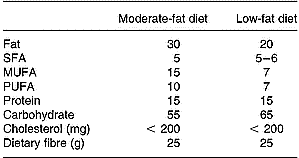
Eighty-nine overweight and obese subjects (twenty-five men and sixty-four women) were recruited for a 14-month randomised trial from among participants of the Tehran Lipid and Glucose Study attending the diet therapy clinic at the Lipid and Glucose Unit of the Endocrine Research Center. They had not participated in weight-reduction programmes during the previous 6 months and had maintained a stable weight ( ± 1 kg); none of the study participants had previously participated in dietary studies. They were non-smokers, free of chronic disease and readily participated in the monthly visits. Each patient was asked to complete personal health and medical history questionnaires that were used as a screening tool. Patients were excluded if they were taking any medications affecting nutrient metabolism, blood lipids and blood pressure, vitamin and mineral supplements and antacids containing Mg or Ca. The proposal of the present study was approved by the research council of the Endocrine Research Center of Shaheed Beheshti University of Medical Sciences (Tehran, Iran) and informed written consent was obtained from each subject. Forty-five subjects were randomised using a program generated by a random number table to an energy-controlled diet containing 30 % energy as fat, and forty-four subjects to an energy-controlled diet containing 20 % energy as fat (Fig. 1). The nutritionist who prescribed the diets had to be aware of the group assignment. Laboratory staff were not aware to which group the patients had been assigned. All subjects were given general oral and written information about healthy food choices and a diet 2090 kJ (500 kcal) below their energy needs according to their weight, which was offered according to specific individualised programmes at baseline and at subsequent visits. Nutrient goals for the intervention diets are shown in Table 1. Under- and over-reporters were defined as reported daily energy intakes less than 3350 kJ/d (800 kcal/d) and over 17 570 kJ/d (4200 kcal/d) respectively (Fung et al. Reference Fung, Hu, Pereira, Liu, Stampfer, Colditz and Willett2002).
Design of the trial. Among 121 subjects, 100 individuals that met the study criteria were randomly assigned to a moderate-fat diet and a low-fat diet (fifty on the moderate-fat diet and fifty on the low-fat one). Forty-five subjects on the moderate-fat diet and forty-four subjects on the low-fat diet followed-up the study for 14 months.

Nutrient goals (% energy) for the intervention diets
Study procedures
During the 3 weeks of run-in and 14 months of intervention feeding, we followed patients every month and checked their food records and current use of medications and measured their anthropometric indices. Habitual physical activity levels were ascertained by the Lipid Research Clinic questionnaire (Ainsworth et al. Reference Ainsworth, Jacobs and Leon1993) at baseline and after 7 and 14 months of intervention.
Measurements
Weight was measured while the subjects were minimally clothed without shoes using digital scales and recorded to the nearest 0·1 kg. Height was measured in a standing position, without shoes, using a tape meter while the shoulders were in a normal state. BMI was calculated as weight in kg divided by height in metres squared. Waist circumference was measured at the narrowest level over light clothing, using an unstretched tape meter, without any pressure to the body surface (Esmaillzadeh et al. Reference Esmaillzadeh, Mirmiran and Azizi2004). Blood samples (12 h fasting) were collected into tubes containing 0·1 % EDTA and centrifuged at 4°C and 500 g for 10 min to separate the plasma (Azizi et al. 2003b). Serum total cholesterol, HDL and TAG concentrations were measured by commercially available enzymic reagents (Pars Azmoon, Iran) adapted to the Selectra Autoanalyzer (Vital Scientific, Spankeren, Netherlands). HDL-cholesterol was measured after precipitation of the apo B-containing lipoproteins with phosphotungstic acid. LDL-cholesterol was calculated according to the Friedewald method (Friedewald et al. Reference Friedewald, Levy and Fredrickson1972). All samples were analysed when internal quality control met the acceptable criteria. Blood pressure was measured twice after the participants sat for 10 min (Azizi et al. Reference Azizi, Ghanbarian, Madjid and Rahmani2002). Additional covariate information regarding age, smoking habits (Azizi et al. 2003a), medical history and current use of medication (Mirmiran et al. Reference Mirmiran, Mohammadi, Allahverdian and Azizi2003) was obtained using validated questionnaires, as reported earlier, completed during the screening and every month. Measurements were obtained at baseline, and after 7 and 14 months of the dietary programme.
Statistical analysis
Data are presented as means and standard deviations unless stated otherwise. The sample of eighty subjects was determined to provide at least an 80 % power to detect a difference in weight loss of 2·1 kg between the groups, allowing for a dropout rate of 30 %. The primary outcome variable was change in body weight. Other outcome variables were serum LDL, HDL, TAG, total cholesterol, systolic and diastolic blood pressure, from baseline to 14 months. The changes in outcome variables were compared between the diet groups by unpaired t test and within each group by paired t test. P values less than 0·05, two sided, were considered statistically significant. All analyses were conducted using SPSS version 11·1 (SPSS Inc., Chicago, IL, USA).
Results
Baseline characteristics for all subjects are shown in Table 2. The mean age of the two groups was similar (45 (sd 5) years in the moderate-fat-diet group and 46 (sd 6) years in the low-fat-diet group). Mean weight was 80 (sd 11) kg in the moderate-fat group and 79 (sd 12) kg in the low-fat group. The mean of the serum lipid profiles and blood pressure were not different in the two groups at baseline. Table 3 shows the reported nutrient intake at baseline and after 7 and 14 months' intervention, in both the moderate- and low-fat-diet groups. Reported nutrient intake at baseline was similar in the two groups. The reported total fat intake decreased from 29 to 20 % at 7 and 14 months in the low-fat-diet group. In the moderate-fat group, total fat intake was similar at baseline, and after 7 and 14 months. There was no significant difference between SFA intake in the two groups any time after 7 and 14 months' intervention. The MUFA and PUFA intake was higher in the moderate-fat-diet group than in the low-fat one (15·1 (sd 4·1) % energy for the moderate-fat and 9·1 (sd 4·2) % energy for the low-fat one at 7 months for MUFA; 15·0 (sd 4·9) % energy for the moderate-fat and 9·9 (sd 5·3) % energy for the low-fat one at 14 months for MUFA; 9·9 (sd 3·9) % energy for the moderate-fat and 6·9 (sd 4·2) % energy for the low-fat one at 7 months for PUFA; 10·1 (sd 4·8) % energy for the moderate-fat diet and 6·9 (sd 5·1) % for the low-fat one at 14 months for PUFA). The reported carbohydrate intake for both groups was similar at baseline but it increased for the low-fat group at 7 and 14 months. Protein, fibre and cholesterol intakes of the two groups were similar.
Baseline characteristics of study participants of both groups (Mean values and standard deviations)

Reported nutrient intake among subjects at time points during the study (Mean values and standard deviations)

* P values for difference between the moderate-fat and low-fat groups by t test.
Changes in cardiovascular risk factors after 7 months are shown in Table 4. The highest reduction in body weight was seen after the first 7 months both in the moderate- and low-fat groups. Weight reduction was similar and significant after 7 months in both groups; − 5·3 (sd 1·3) kg in the moderate-fat group (P < 0·001), and − 5·2 (sd 1·9) kg in the low-fat group (P < 0·001). Changes in waist circumference were also similar to those seen in weight. The effects of low-fat and moderate-fat diets on cardiovascular risk factors were similar after 7 months.
Changes in cardiovascular risk factors assessed after 7 months of moderate- and low-fat diets (Mean values and standard deviations)

* P values for difference from baseline by paired t test.
† P values for difference between moderate-fat and low-fat group by t test.
Table 5 shows the changes in cardiovascular risk factors after 14 months' intervention. The moderate-fat diet was more successful after 14 months in reducing weight, waist circumference, LDL-cholesterol, TAG, and systolic and diastolic blood pressure. Although only the moderate-fat diet could significantly increase HDL after 14 months, there was no significant difference between the two groups at any time.
Changes in cardiovascular risk factors assessed after 14 months of moderate- and low-fat diets (Mean values and standard deviations)

* P values for difference from baseline by paired t test.
† P values for difference between moderate-fat and low-fat group by t test.
Discussion
The results of the present study testing two approaches to weight loss, a low-fat diet and a moderate-fat one, both having the same goals for energy, showed that the moderate-fat diet had more favourable effects on cardiovascular risks in the long term. The present results showed that after 14 months' intervention the changes in reduction of weight, waist circumference, LDL, TAG, total cholesterol, and systolic and diastolic blood pressure in the moderate-fat-diet group were significantly greater than for the low-fat one. However, after 7 months of intervention there were no significant differences between the two groups in decreasing the cardiovascular risks. Therefore, we can conclude that the moderate-fat diet is more suitable in the long term. As a low-fat diet is more restrictive to follow, it seems that dietary adherence to a moderate-fat diet is better than to low-fat ones. Therefore, weight maintenance, a key issue in long-term weight-reducing programmes, is achieved in energy-restricted moderate-fat diets.
A meta-analysis (Pirozzo et al. Reference Pirozzo, Summerbell, Cameron and Glasziou2002) showed that low-fat diets were not better than energy-restricted diets in achieving long-term weight loss. In their study, there were four studies at the 6-month follow-up, five studies at the 12-month follow-up and three studies at the 18-month follow-up. In most of the mentioned studies, there were small, non-significant differences in weight loss between the low-fat-diet groups and the comparison groups. The changes in metabolic risks also were not clinically significant in the low-fat-diet groups compared with other groups. However, in the present study the weight loss in the low-fat-diet group was modest and it was less than observed in other studies.
Regarding weight reduction, McManus et al. (Reference McManus, Antinoro and Sacks2001) also showed that a moderate-fat Mediterranean diet, controlled in energy, was more successful in long-term weight loss as compared with a low-fat one. In the present study, the results at 7 months showed similar amounts of weight loss in the two groups – about 5 kg. However, while the moderate-fat-diet group maintained their lower average weight through the 14-month study period, the low-fat group regained the weight lost. The moderate-fat-diet group was more likely to adhere to the diet; it seems that low-fat diets are less appetising, which makes long-term compliance difficult.
Esposito et al. (Reference Esposito, Marfella, Ciotola, Di Palo, Giugliano, Giugliano, D'Armiento, D'Andrea and Giugliano2004) also showed that consumption of a Mediterranean diet is more effective than a low-fat one in changing serum lipid concentrations.
Jeffery et al. (Reference Jeffery, Hellerstedt, French and Baxter1995) showed that a low-fat diet caused more weight loss early in the programme as compared with a higher-fat diet, but after 2 years both groups gained back all the weight lost. Toubro & Astrup (Reference Toubro and Astrup1997) showed a non-significant difference (P = 0·08) in weight regained after a 1-year weight-maintenance programme between an ad libitum low-fat (25 % energy) diet and a higher fat (unspecified fat content) one. Bahadori et al. (Reference Bahadori, Yazdani-Biuki, Krippl, Brath, Uitz and Wascher2005) in a 24-week study showed that a low-fat, low-glycaemic-index diet induced a significant reduction of fat mass; adherence to the diet was very good.
As has been reported in other studies, many obese individuals under-report their food intake (Lichtman et al. Reference Lichtman, Pisarska, Berman, Pestone, Dowling, Offenbacher, Weisel, Heshka, Matthews and Heymsfield1992; Johnson et al. Reference Johnson, Goran and Poehlman1994). Therefore, we tested under- and over-reporting and there were no individuals who had overestimated or underestimated their energy intakes in our sample. It seems that because individuals have been well educated on all portion sizes and the food amounts that should be consumed, they reported their energy intake correctly.
The results of the limited success of the low-fat diet would not have been predicted by experiments on metabolism. After consuming a meal, carbohydrate is used preferentially for oxidation compared with fat, which is stored (McManus et al. Reference McManus, Antinoro and Sacks2001). Therefore satiety might be more stimulated by carbohydrates rather than fat. Of course, motivation and adherence are very difficult to sustain in a weight-loss programme. Fat may enhance the palatability of foods, especially vegetables, in the moderate-fat diet.
In the present study, while outlining the specified diet, we did not actually provide the foods mentioned; this is one of our limitations. Diet adherence was, however, checked by food records. The strengths of the present study are its randomised design, long intervention period and frequent follow-up of patients. The present study provides the opportunity to assess the change in the serum lipid profile and blood pressure, which have been little emphasised in previous studies with the aim of comparing the long-term effects of moderate- and low-fat diets.
According to the results of the present study, we can conclude that the long-term effects of a moderate-fat diet, predominantly with unsaturated fatty acids, are more favourable than those of a low-fat one. Actually, the better adherence of subjects in the modified fat group may result in weight maintenance in the long term. Further studies need to be conducted on the use of this diet to prevent obesity. Also, the effect of this diet on other specific cardiovascular risks and inflammatory markers should be examined.



