Introduction
The development of preventive archaeology in Europe, as well as the impact of the Valletta Convention, has recently become a theme of debate and the topic of books, papers, and workshops (Bozóki-Ernyey, Reference Bozóki-Ernyey2007; Willems & van den Dries, Reference Willems and van den Dries2007; Kristiansen, Reference Kristiansen2009; Schlanger & Aitchison, Reference Schlanger and Aitchison2010; Demoule, Reference Demoule2012; Guermandi & Salas Rossenbach, Reference Guermandi and Salas Rossenbach2013; van der Haas & Schut, Reference Van der Haas and Schut2014; Florjanowicz, Reference Florjanocwicz2016; Novaković et al., Reference Novaković, Horňák, Guermandi, Stäble, Depaepe and Demoule2016). Among these contributions there is no shortage of articles giving a brief overview of archaeology in Italy (Maggi, Reference Maggi and Bozóki-Ernyey2007; Bitelli et al., Reference Bitelli, Pirraglia, Santangelo, Guermandi and Rossenbach2013; Guermandi, Reference Guermandi, Novaković, Horňák, Guermandi, Stäble, Depaepe and Demoule2016) but, beyond these thematic publications, the Valletta principles and issues such as contract archaeology and development-led archaeology are generally neglected by Italian scholars and ignored by public opinion. This lack of interest is due to a notion that archaeological services are activities essentially reserved for public authorities. From this point of view, the Italian tradition of a public, bureaucratic, and centralized management of antiquities combines with an academic training that fails to meet the needs of the job market and, more particularly, with a lack of business attitude among Italian archaeologists (Güll, Reference Güll, Guermandi and Rossenbach2013: 103–08; Knobloch, Reference Knobloch2016: 57–69).
Here I address the following issues: first, the legal framework of cultural heritage management, which is grounded on the principles of the Italian constitution, is outlined. Against the background of management of archaeology by the State enshrined in law, the actual needs of heritage protection have led to the emergence of a market-based archaeology, carried out by professionals and private companies, whose rise and growth are briefly sketched. The regulations governing archaeological excavations are compared with the day-to-day exercise of this development-led archaeology, highlighting the contradictions between rule and practice. The internal contradictions of the regulatory system hinder the full acceptance of the ‘Malta principles’ in Italy, especially concerning the planning and funding of archaeological research. Some recent reforms of public authorities could have provided the opportunity to reshape this regulatory system, but this did not take place, in part also because of the attitude of the Italian archaeologists themselves. I devote a section of this article to the behaviour of professional archaeologists over the last few years, to show how the rise of commercial archaeology in Italy has not been supported by equivalent entrepreneurial skills or professional ethics. In the final remarks I suggest some corrective measures which could bring regulation and practice closer together to create a better climate for the job market to operate in and a more effective protection of the archaeological heritage.
‘In the State We Trust’: The Italian Perspective on Archaeological Heritage
Italy has always adopted a highly restrictive and protective policy towards archaeological heritage: since 1909, the then Kingdom of Italy decreed the State ownership of all the archaeological findings discovered on the national territory, earlier than most European countries (Maggi, Reference Maggi and Bozóki-Ernyey2007: 147–48). The public property of archaeological sites and discoveries fostered its bureaucratic management by the public services, following a trend that has been in place since 1875 with the establishment of a Department of Fine Arts and Antiquities within the Ministry of Education; this administrative structure was gradually enlarged by the creation of local offices for the cataloguing and protection of cultural heritage, the soprintendenze (superintendencies) (Ragusa, Reference Ragusa2011: 101–43); later, all these departments were entrusted to the Ministry of Cultural Heritage (Ministero dei Beni e delle AttivitàCulturali, commonly referred to as MiBAC), which was set up in 1975 (Melis, Reference Melis2016).
The conservation of the historical and archaeological heritage is even invoked in the fundamental law of the Italian State, the Republican Constitution of 1948, in Article 9. Not only is the ownership of archaeological findings reserved to the State, namely to the Ministry of Cultural Heritage, but also the legislation and execution of archaeological activities as laid down in Article 117 of the Constitution and in Article 4 of the Code of Cultural Heritage and Landscape (Codice dei Beni culturali e del Paesaggio); local authorities are therefore excluded from cultural heritage management, but the administrative regions (regioni) can assist in the valorisation of this heritage; in Italian law, ‘valorisation’ (valorizzazione) is the set of rules and practices promoting awareness, usage, and enjoyment of the cultural heritage, while ‘protection’ (tutela) is the set of activities intended to safeguard and conserve it. The regions are also involved in the inventory of monuments, artworks, and archaeological objects (Gazzeri, Reference Gazzeri1998). The exceptions are the five autonomous regions (for historical or geographical reasons and/or the presence of linguistic minorities)—Friuli-Venezia Giulia, Trentino-Alto Adige/Südtirol, Val d'Aosta, Sicily, and Sardinia—whose responsibility for cultural heritage is established by their own statute. Two of them (Sicily and Trentino-Alto Adige/Südtirol) are empowered to legislate in cultural heritage. The Valle d'Aosta/Vallée d'Aoste follows the national legislation but has its own public service independent of MiBAC. One of the regions with ordinary autonomy, Emilia-Romagna, set up a cultural heritage office (Istituto per i Beni Culturali or IBC) to sustain its activities in cataloguing and valorisation.
This is the main difference between Italy and other European countries, not just federal States like Germany, Switzerland, or Belgium, where the cultural heritage laws and policies are set by each entity, but also in unitary States like the Netherlands or France, where the local departments manage the cultural heritage services or contribute to them. Moreover, the exclusion of local authorities from cultural heritage management is a counter-trend compared to the process of devolution that has been carried out over the last twenty years by Italy too, which has granted broad autonomy to the regions in various fields (Leyland et al., Reference Leyland, Frosini and Bologna2002).
The Italian regions, already envisaged by the Constitution of 1948, became operative only in 1970 and obtained major powers with the constitutional reform of 2001. At both these points in history there was some political debate over partially transferring the management of the cultural heritage to the regions, which met with resistance from the officers of the soprintendenze (and part of public opinion) to any significant transfer of their functions (Bobbio Reference Bobbio1997; Ragusa, Reference Ragusa2014: 347–51; Knobloch Reference Knobloch2016: 42–44).Therefore, the management and protection of public and private cultural heritage is still fulfilled by the soprintendenze, which are not an autonomous institution but local branches of the Ministry of Cultural Heritage.
According to a literal reading of Italian law, archaeological activities such as the storage, restoration, display, and recording of archaeological objects, the maintenance of archaeological maps and, of course, the excavation of archaeological sites should be left to public employees of the soprintendenze. The excavation licence (concessione di scavo) is the only exception provided for by law; this licence is provisionally granted to universities or other public or private entities (usually scientific institutions) for research excavations or for archaeological surveys (Article 88 of the Code of Cultural Heritage). The excavation licence was initially introduced to authorize the excavations of foreign missions in Italy (Ardovino, Reference Ardovino2013: 291–95), when both the soprintendenze and the universities depended on the Ministry of Public Education and there was therefore no break between archaeological research and heritage protection. After the creation of an ad hoc Ministry of Cultural Heritage, the purpose of the licence was to allow entities other than the Ministry to carry out archaeological investigations.
The application of this rule to the letter would make the practice of commercial archaeology in Italy impossible. In fact, professionals and archaeological companies have been operating in the public and private market since the 1980s, working on excavations and in other archaeological services (Cabasino, Reference Cabasino1997). To explain this contradiction we must go back to the late 1970s and early 1980s, when an embryonic form of professional archaeology grew in Italy and the rest of western Europe (Demoule, Reference Demoule2012: 612–17; Knobloch, Reference Knobloch2016: 49–62).
The Unwanted Child: Professional and Commercial Archaeology in Italy
The 1970s represent a turning point in the history of Italian archaeology: archaeologists imported from northern Europe the stratigraphic methods and the practice of digging with an excavation team made up of archaeological practitioners, instead of workmen supervised by a single archaeologist; the research programmes in urban archaeology were launched (Hudson, Reference Hudson1981; Regione Lombardia, 1985); a central institute for recording, cataloguing, and producing inventories of the historic and archaeological national heritage (the Istituto Centrale per il Catalogo e la Documentazione, or ICCD) was created (Caravale, Reference Caravale2016), in conjunction with the institution of the Ministry of Cultural Heritage and the definition of national standards in archaeological data (Parise Badoni & Ruggeri Giove, Reference Parise Badoni and Ruggeri Giove1984: 6‒7; Ragusa, Reference Ragusa2016).
The creation of an independent Ministry of Cultural Heritage with its own portfolio increased the number of archaeologists employed by the public sector; as a result, archaeological surveys and excavations, landscape monitoring, recording and cataloguing monuments and artefacts increased considerably. The newly-created ministry exploited a programme of public incentives to counter youth unemployment (Law no. 285/1977), which led to the creation of cooperatives by young unemployed graduates. These cooperatives were employed in activities overseen by the soprintendenze (Knobloch, Reference Knobloch2016: 50–53). It is noted that a similar programme ran at the same time in the United Kingdom, with the Manpower Services Commission, where public funding for the unemployed in times of economic downturn were used to finance archaeological projects (Crump, Reference Crump, Mytum and Waugh1987). The companies that arose from the Law no. 285 may be regarded as the prototype of the private archaeological companies founded later.
The combination of all these circumstances could have led to the development of field archaeology as a new profession responding to the public demand for specialists in heritage protection; but things did not go that way. When the young archaeologists employed under the Law no. 285 came to the end of their employment contract, under pressure from the Trade Unions, the Italian executive preferred to employ them in bulk in the Ministry of Cultural Heritage and retain a centralized system in the hands of the government departments (Knobloch, Reference Knobloch2016: 49–53).
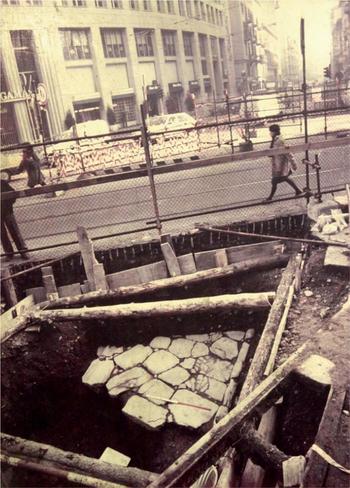
Such recruitment, however, did not overcome the public demand for cultural heritage management. On the one hand, the cataloguing workload compelled the ministry to recruit private professionals (Cabasino, Reference Cabasino1997: 77–78) as well as outsource the inventory to private firms, as in the case of the Giacimenti Culturali inventory of cultural resources in the second half of the 1980s, a major programme consisting of State-funded three-years projects involving almost 4000 young unemployed and 40 computer and technology companies employed to the catalogue and digitize finds and artworks (Knobloch, Reference Knobloch2016: 58). On the other hand, the major public works began to be accompanied by large-scale surveys and excavations; the construction of the third subway line in Milan from 1981 to 1990 (Figure 1) was the model for planned archaeological investigations linked with public works (Caporusso, Reference Caporusso and Caporusso1991). So, the soprintendenze were compelled to partially outsource excavation work to archaeology graduates who were not civil servants. Some of them, based on the example of contracting units in the United Kingdom, began to form ‘archaeological units’ (cooperative di scavo) engaged by the soprintendenze in planned and rescue excavations (La Rocca, Reference La Rocca and De Paolis1986). It was the dawn of commercial archaeology.
Milan, Missori Square, in 1989. Archaeological excavations for the construction of the underground station.

At first, these archaeological practitioners worked on behalf of the archaeological soprintendenze; if they were set up in worker cooperatives, they were classed as construction workers or craftsmen according to their contractual status; the Ministry of Cultural Heritage or other public authorities were charged for their activities, which were managed by the ministry executives. In this way, the exclusive jurisdiction of the Ministry of Cultural Heritage over archaeological activities was legally preserved. However, there was soon a shortage of public funding, due to the spread of preventive archaeology from public works to a broader category of projects. In the wake of this, the soprintendenze attempted to offload the cost of archaeological activities onto the developers (Knobloch, Reference Knobloch2016: 57–60). At this stage, archaeological companies and professionals were no longer outside contractors of the soprintendenze in a state monopoly, but freelancers working for development contractors and private builders. They began to offer their services under free-market conditions, in competition with each other.
The process described above (the growth of salvage and rescue excavations, the evolution of field archaeology from a voluntary or academic pursuit to a market-oriented activity, the initial support from public sources and then the attempt to offload the cost of excavations to the builders and developers) is not so unlike what happened in most of western Europe during the 1980s and 1990s (Everill, Reference Everill2009; Talon & Bellan, Reference Talon, Bellan, Demoule and Landes2009; Moya Maleno, Reference Moya Maleno2010). It is calculated that there are currently over 4000 archaeologists working in Italy. Only 400 of them are employed in the ministry offices; most others work on excavations as freelancers or employees of private firms (especially archaeological companies, but also engineering and building companies; see Bitelli et al., Reference Bitelli, Pirraglia, Santangelo, Guermandi and Rossenbach2013: 30–31; Pintucci et al., Reference Pintucci, Cella and Pate2014: 15–21).
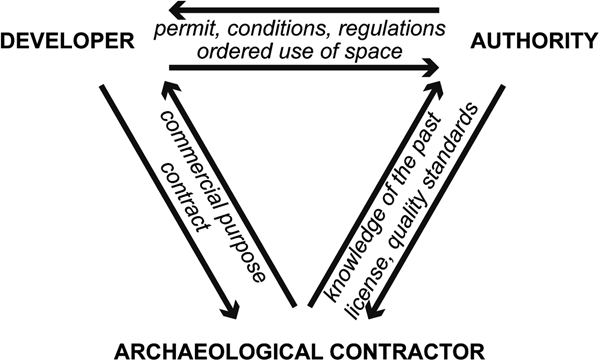
Over the last thirty years, while Italian legislation has remained substantially unchanged and yoked to an entirely public system of archaeological management (Malnati et al., Reference Malnati, Fichera and Martone2015), archaeological practices have naturally turned into market-based procedures, which seem to resemble the Dutch management of preventive archaeology, in accordance with the template proposed by Willem Willems (Reference Willems, D'Agata and Alaura2009: 89–91). This management system involves three partners: professional archaeologists, developers, and public authority (Figure 2). In this framework, professionals and/or private companies represent the archaeological practitioners, while the developers are the customers of preventive archaeological activities, and the government authority for cultural heritage is the guarantor of standards and releases the permits to developers and the licence to archaeological contractors.
The relationships between the archaeological contractors, cultural heritage authorities, and developers/builders.

The European countries which developed a preventive archaeology to implement the Malta principles generally updated their legislation on archaeological heritage (Bozóki-Ernyey, Reference Bozóki-Ernyey2007; Ulisse, Reference Ulisse, D'Andrea and Guermandi2008). In Italy, archaeological practice is still outside a legal framework, thus leading to situations that appear paradoxical.
The Riddle of the ‘Ghost-Diggers’: The Archaeological Workers That Do Not Exist in Law
The development of Italian legislation regarding archaeological activities over the last hundred years was marked by the following main stages: the 1939 Law on Artworks and Historical Objects (Legge di tutela delle cose di interesse artistico e storico), the 1999 Consolidated Text on Cultural Heritage and Landscape (Testo unico delle disposizioni legislative in materia di beni culturali e ambientali), the 2004 Code of Cultural Heritage and Landscape (Codice dei beni culturali e del paesaggio) and the 2006 Code of Public Procurement (Codice dei contratti pubblici, revised in 2016).
The regulation of archaeological excavations provided by the law of 1939 is laid down in Articles 43 to 47. The wording of these articles deserves consideration because it remained in force until the year 1999 and still forms the basis of the current regulations. The law stated that archaeological research and excavations were entrusted to the Ministry in the first instance (Article 43), then to others (individuals or institutions) in accordance with two procedures: licenced excavations (Articles 45–46) or authorized excavations (Article 47). The former regulated the research excavations entrusted to universities or cultural institutions by requesting the temporary occupation of the area involved in the research. The latter regulated the excavations carried out by owners on their own premises. The authorized excavations were the legacy of the nineteenth-century archaeological excavation methods, when stratigraphic techniques and professional archaeologists did not exist; it nevertheless provided the legal framework for the new archaeological activities which the soprintendenze applied to owners and builders from the 1980s.
The 1999 Consolidated Text follows the wording of the law of 1939 with minor amendments, but this law is merely a collection of the rules regarding cultural heritage and landscape which were issued earlier and were contained in various laws.
When drafting the new Code of Cultural Heritage in 2004, a revision of the rules on archaeological activities could have been expected. Yet the Code of 2004 is merely a rephrasing of the Law of 1939 and in some respects it is even worse (Capunzo, Reference Capunzo2010: 234–240; Guermandi, Reference Guermandi, Novaković, Horňák, Guermandi, Stäble, Depaepe and Demoule2016: 302–03). The law, in Article 4, entrusts the Ministry of Cultural Heritage with all heritage conservation activities. The authorisation for excavations provided by the Law of 1939 was removed from the Code.
Archaeological discoveries are outlined in the Code of Cultural Heritage (Articles 88 to 94) as the outcome of programmed research or chance finds and do not include monitoring and rescue archaeology related to earthmoving and construction. There is no mention of any archaeological activity carried out by private companies.
The term ‘preventive archaeology’, which appeared in European languages from the end of the 1970s (Demoule, Reference Demoule2012: 612) and was gradually adopted by the legislations of various States, appears in the Italian legislation only in 2006 with the Code of Public Procurement and concerns the production of an archaeological impact assessment only when it involves public works. The project developers are required to assign the drafting of an archaeological impact report, the so-called VIArch (Valutazione di Impatto Archeologico) to a professional archaeologist; the expert is chosen from a professional register, held by the Ministry of Cultural Heritage, which also includes archaeological university departments (Carpentieri, Reference Carpentieri, Sandulli, De Nictolis and Garofoli2008: 2387–91). This is the only law that explicitly mentions the activities of individual archaeologists outside the public service; this rule was added by analogy with other skilled technicians (e.g. geologists, engineers, and so on) involved in environmental impact assessment. At any rate, the register concerns only the business of writing the archaeological report; for any subsequent investigations or excavation, the procedure refers back to the activity of the soprintendenze (Article 28 of the Code of Cultural Heritage).
As can be seen, the fieldwork carried out by archaeological contractors is almost completely ignored by the law (Maggi, Reference Maggi and Bozóki-Ernyey2007: 153). Thus, the gap in legislation has inevitably been filled by praxis (Malnati, Reference Malnati, D'Andrea and Guermandi2008: 22–24). When a construction project requires prior authorisation (for example, in the case of public works, restorations of historic buildings, interventions on historic centres or areas with archaeological restrictions, and building projects that need an environmental impact assessment), it is customary for the soprintendenze to impose a watching brief during earthmoving operations, but they have neither the funding nor the staff to do it themselves. So, if developers want their construction project to go ahead, they are forced to employ a freelance archaeologist or archaeological company; these archaeologists monitor works such as levelling the ground and digging service trenches or the foundations of buildings under the direction of an officer from the soprintendenza; they dig trial trenches, or larger excavations and anything else required for the identification and recording of ancient remains. But these archaeological practitioners are third-party contractors engaged by the developer (Güll, Reference Güll2014: 15–17); in fact, the latter will pay the entire cost of the archaeological activities without any compensation granted by the State.
There is no article in the Code of Cultural Heritage that regulates this practice; basically, professional archaeology exists in terms of the labour market, but not in the eyes of the law. Consequently, what amounts to a market mechanism is not perceived as such by the parties concerned. The developers think the payment of archaeological activities is an extortion, given that the work should be carried out by the public authority; the officers of the soprintendenze consider themselves to be the real executors of the excavations, so lay claim to the choice of the company that carries them out and the intellectual property of possible scientific outputs; the archaeological companies and professionals believe that they are the contractors of the soprintendenze instead of the developers, so they prefer to ‘ingratiate themselves’ with the officers rather than promote their enterprise among customers to win the contract.
In order to overcome some of these problems and under the pressure of professional corporations, the Italian parliament enacted in 2014 an amendment of the Code of 2004 by introducing a register which certifies the professionals (archaeologists, art historians, restorers, etc.) licenced to operate on cultural heritage objects (Knobloch, Reference Knobloch2016: 78–82). The battle for professional recognition goes back to the late 1980s, when Ministry recruitment ended and archaeological units were on the increase (Bettelli & Reggi, Reference Bettelli, Reggi, Battistelli, Bettelli, Di Pillo, Farina, Levi and Moffa1992: 77‒8). The call for a professional organisation was a real concern in a corporatist welfare State like Italy. Surprisingly, the debate never actually addressed the key question of who the customer is: if the Ministry is the sole contractor, then one could argue that archaeological activities are carried out entirely by the State, and professional archaeologists are simply service providers for the soprintendenze. If instead the contractor is both public and private, then archaeology is, for all intents and purposes, a private practice and must be recognized as such. The 2014 amendment to the Code is only a partial resolution, because the activities entrusted to these professionals do not appear in any other article of this law; in any case, so far (November 2018) the Ministry has not yet approved the decree implementing this certification.
In sum, although archaeologists are no longer phantom professionals in the eyes of the Italian law, contract archaeology in construction and landscape planning continues to be a ghost.
Italian Archaeology Post-Malta: Preventive But Not Too Much
The Valletta Convention is broadly considered to be a turning point for European archaeology even by those sceptical of a market-oriented approach in cultural heritage management (Demoule, Reference Demoule2012: 620; van den Dries, Reference Van den Dries2011: 594‒5); its adoption significantly increased the number of rescue excavations and professional archaeologists, introduced the practices of preventive archaeology in planning, promoted the professionalization of archaeological practitioners with the adoption of procedures, quality standards, and codes of ethics. The signing of the treaty led several countries to revise their national legislation regarding antiquities.
Italy was among the first European countries to sign the Valletta Convention in 1992, but its ratification was postponed by the Italian government for several years (Knobloch, Reference Knobloch2016: 61). This delay was no accident: it reflects the opposition of the Ministry of Cultural Heritage to a model of heritage protection that involves private stakeholders in archaeological activities As Sandra Gatti puts it, ‘the so-called preventive archaeology—presented today as a great innovation—has always been carried out institutionally, at least for several decades, by the archaeological soprintendenze without extra expenditure and without intermediaries between those in authority and the developers’ (translated from Gatti, Reference Gatti2005). In fact, the protection guaranteed by the soprintendenze was not preventive archaeology but only salvage archaeology, because it is activated after the start of construction and not during the planning process. Moreover, freelance archaeologists or archaeological enterprises as intermediaries between the authority and the developers have been in existence for a long time (see above). For years, the Ministry tackled the issue of involving archaeology in the planning policy by memoranda of understanding between the soprintendenze and the contracting authorities for the main public works, like railways, motorways, subways, pipelines etc. (Proietti, Reference Proietti2004). The preventive archaeological assessment defined by the Code of Public Procurement (see above) was the final outcome of that policy (Carpentieri, Reference Carpentieri, Sandulli, De Nictolis and Garofoli2008: 2369–76), but this combination of the rules laid down by that Code and the Code of Cultural Heritage is not enough to implement the main innovative principles introduced by the Valletta Convention. Let us analyse them one by one.
The integrated conservation of archaeological heritage claimed in Article 5 of the Convention seeks a balance between the opposing requirements of archaeology and development by involving archaeologists in the planning process; thus, archaeological research, which was previously undertaken during excavation works, now starts in the initial phase of a project. The norm was only partly adopted by Italian law, since the risk assessment of archaeological discoveries during the evaluation phase is foreseen only for works of public interest (opere di pubblica utilità; in Italian law these are public infrastructure works built, if necessary, by private parties too; if they are built by a public administration, they are called opere pubbliche or public works), that is, for works requiring an environmental impact assessment (Bitelli et al., Reference Bitelli, Pirraglia, Santangelo, Guermandi and Rossenbach2013: 26). For private projects, the soprintendenze only request monitoring when the work is in progress (in the case of areas with archaeological restrictions; otherwise, one can only hope that the owner or developer reports any accidental discoveries).
The financing of preventive archaeology is also a key factor for understanding the rise of contract archaeology in Italy: the gradual outsourcing of rescue excavations to the private sector since the 1980s was the result not only of a shortage of technical personnel but also of a dearth of funding available to the soprintendenze. The budget for excavations (spese per le indagini e le attività finalizzate alla tutela delle aree e delle zone di interesse archeologico) for the year 2018 was 200,000 euros, in a budget of some 2.3 billion euros for the Heritage Ministry, that is less than 0.4 per cent of the total State budget (MiBAC, 2018). Nowadays, Italy is a country with a large public debt and strict budgetary constraints imposed by the European Union. A different management of rescue archaeology based entirely on the activity of the public service or even by private companies and professionals whose activities are publicly funded would be untenable.
The ‘developer funding’ system, i.e. the extension of the ‘polluter pays’ principle, is set out in Article 6 of the Valletta Convention, in which the archaeological investigations which must be undertaken are entrusted to the project developers, according to the principle that a public good (the cultural heritage) is of benefit to private interests. The signatory States applied this article of the Convention in different ways (Bradley et al., Reference Bradley, Haselgrove, Vander Linden and Webley2012: 3–4). In Italian law, just as the activity of archaeological contractors is not explicitly laid down, there is no formal requirement for developers to cover the cost of rescue archaeology. It should also be noted that developers are not the owners of potential findings or of the data from excavations; moreover, they cannot choose how the work will be conducted or how much they will pay as a consequence (the soprintendenze manage the investigations) and, finally, no financial compensation is offered.
Article 7 of the Convention deals with the publication of archaeological discoveries, to increase public awareness of the cultural heritage but also to provide the means for later environmental impact studies. Every State is required to take ‘all practical measures’ to ensure the publication of findings; the budget for the recording and publication of discoveries should be incorporated in the costs of preventive archaeology (Article 6, § ii). The Italian Code of Public Procurement stipulates that developers must pay for the publication of any discoveries, but this is not required for private works. Furthermore, there is a question about who holds the publishing rights: the officials of the soprintendenze claim the copyright, arguing that archaeological reports are administrative acts (Serlorenzi et al., Reference Serlorenzi, Iovine, Boi and Stacca2016). This advice is clearly untenable: a scientific publication is not an administrative act. In practice, functionaries and excavators are usually co-authors of publications concerning archaeological excavations, but it is seen almost as courtesy.
All these issues, raised by the Valletta Convention, are still outstanding in Italian law and administration. Unfortunately, beyond thematic publications, post-Malta archaeology is not at the heart of the Italian debate on cultural heritage (see for example Carletti & Giometti, Reference Carletti and Giometti2014). This is also true when we consider the reforms concerning public authorities, especially the Ministry of Cultural Heritage, carried out by the Italian government over the last five years.
Recent Changes and Proposals in Cultural Heritage Administration: Reformation or Counter-Reformation?
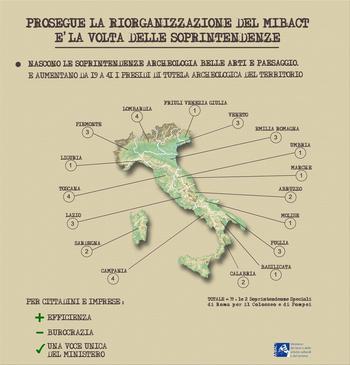
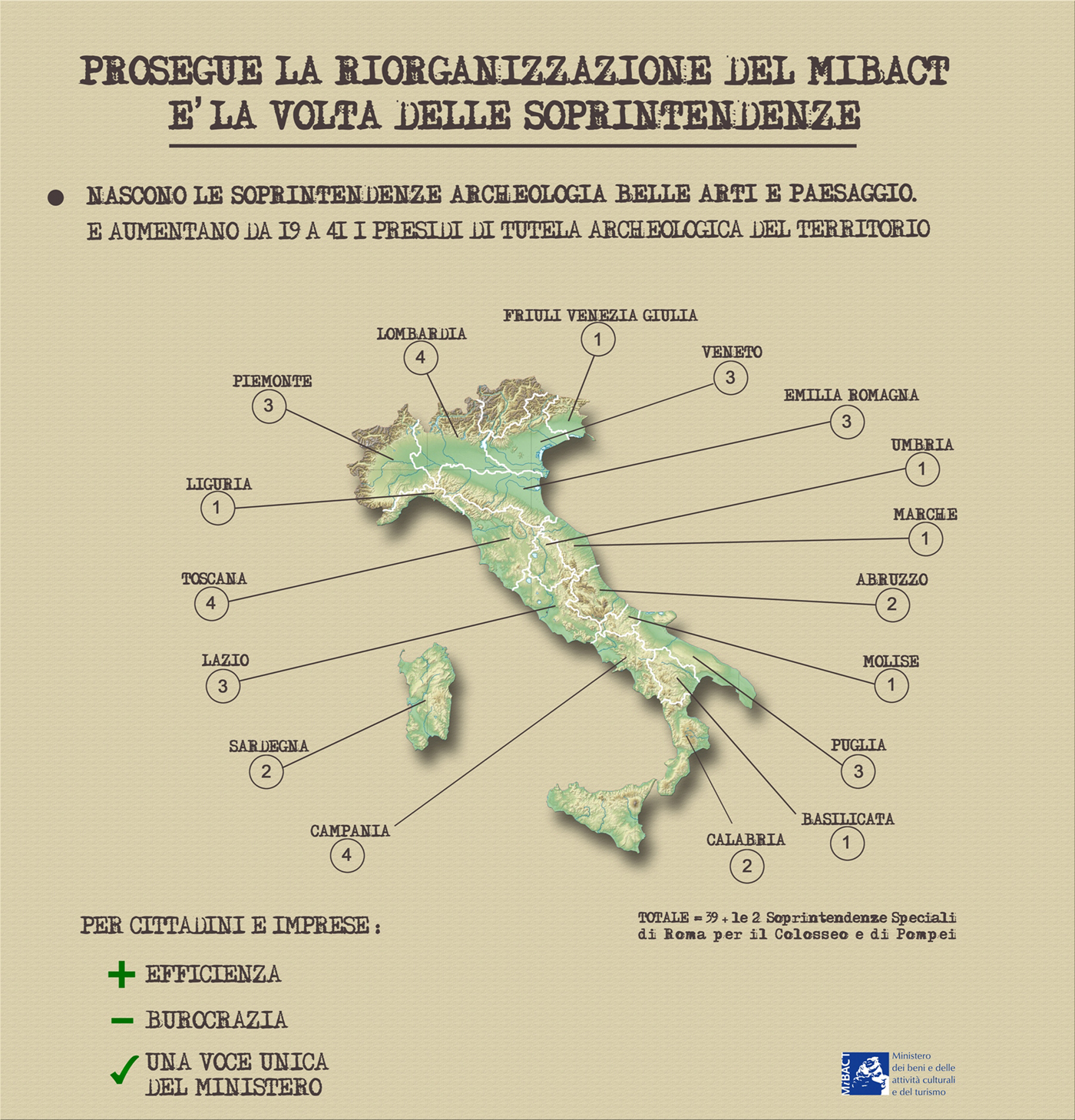
The MiBAC reform of 2014–2016 appears to be the most important reorganization of the bureaucratic apparatus governing the cultural heritage undertaken in the last hundred years; it has also given rise to some discontent among insiders, due to its unusual approval procedures by means of a range of ministerial decrees (Panza, Reference Panza2014; Cammelli, Reference Cammelli2015). Among the main changes implemented, the number of soprintendenze has been reduced; they were divided into three classes (archaeological, artistic-historical, and architectural) before the reform and have now been unified in single departments with a smaller territorial jurisdiction (Sciullo, Reference Sciullo2015; Sciullo, Reference Sciullo2016) (Figure 3). Alongside the new general soprintendenze, ‘museums centres’ (Poli museali) have been created; these new region-wide departments have been entrusted with the management and valorisation of public museums. The twenty most important public museums and archaeological sites have been given an independent budget and management, and their directors are now appointed by an international selection procedure instead of an internal recruitment within the Ministry (Carmosino, Reference Carmosino2016). While the number of local departments has decreased, new central offices have been created, such as a Central Institute of Archaeology.
An infographic of the Ministry of Cultural Heritage displaying the creation of the new unified soprintendenze. The caption refers to local offices for cultural heritage protection increasing from 19 to 41, but they actually decreased from 78 to 41 as a consequence of their unification.
The goals of this reform are to optimize the return from running costs, to reinforce the activities of public museums, and to increase the Ministry's revenue relating to the development and promotion of cultural tourism (MiBAC, 2015). Regarding the last two issues, the reform appears to have borne fruit: in the last four years, there has been a significant increase in revenues from cultural tourism, also thanks to a supportive international situation (Unicredit & Touring Club Italiano, 2017); some exceptional interventions have been successfully completed, such as the Great Pompeii Project (Cinquantaquattro, Reference Cinquantaquattro, Centroni and Filetici2014); museums and archaeological sites with special autonomy have shown a visible improvement and have increased the number of their visitors and activities (Figure 3). But such a radical reorganisation of what the then minister of Culture, Dario Franceschini, called ‘the economically most important ministry’ in Italy (Franceschini, Reference Franceschini2014), based on criteria of productivity and efficiency, fails to account for the role of private individuals working in the cultural heritage sphere, especially archaeologists; this is even truer when we consider that the ministerial decree enforcing the professional certification of cultural heritage professionals is still pending.
Apart from some management models borrowed from the private sector (e.g. the public selection procedure for museum directors), this reorganisation of the cultural heritage still seems to be oriented towards a State-owned, centralized structure. This mindset also affected the reform of the Republican Constitution that the Italian government proposed with great emphasis in 2016. The constitutional reform, which was rejected by a popular referendum in the same year, tackled several issues, including a revision of Article 117 which restored the exclusive legislative powers of the State in the protection of the cultural heritage by removing the role of the regions in valorisation. This proposed exclusion of the regions by the heritage administration was, surprisingly, welcomed by almost all the Italian archaeological establishment (Volpe, Reference Volpe2016a). Some leading figures even criticized the draft law for not being restrictive enough, since the regions still had limited powers in the promotion of the cultural heritage (Mazza, Reference Mazza2016). If that is the general attitude in Italian academia, it is no wonder that the role of private contractors in development-led archaeology is so overlooked.
While the debate about the rules of archaeological activities is stalling, the issue of ‘public archaeology’ has recently gained prominence in many quarters (Bonacchi & Nucciotti, Reference Bonacchi and Nucciotti2012; Paterlini & Ripanti, Reference Paterlini and Ripanti2016; Volpe, Reference Volpe2016b) demanding the Italian ratification of the European Convention on the value of cultural heritage for society, signed in Faro on 2005 (AgCult, 2018). Starting from the previous European conventions on cultural heritage and the United Nations Universal Declaration of Human Rights, the Faro Convention expands the concept of public archaeology, recognizing participation in cultural heritage management and protection as an individual right (see in particular Article 11), while calling for a joint action by public authorities, experts, owners, investors, businesses, non-governmental organisations, and civil action by these actors. The ratification of the convention, and the subsequent transposition of the convention's principles, could perhaps provide an opportunity to re-think the equation public = State, which is so ingrained in Italian archaeology, and the role of professionals and private stakeholders (Montella et al., Reference Montella, Petraroia, Manacorda and Di Macco2016).
In any case, an amendment of the archaeological heritage legislation will not be enough, in my opinion, to solve the shortcomings of Italian professional archaeology completely. The neglect of commercial archaeology by laws and politics is mirrored by the absence of a business attitude among Italian archaeologists. Ironically, this involves not only the archaeologists employed in the universities or in public service, but also the professional archaeologists themselves. This is an aspect that needs to be examined more closely.
Italian Archaeologists: A Model of Class ‘Un-consciousness’
Italian archaeologists are an occupational group that has proved unable, unlike other new professions, to promote its occupational self-interest with respect to salary, employment rights, and social status (Cabasino, Reference Cabasino and Parolini2007: 31–34); the total number of professionals working steadily in archaeology is relatively small, as is their average income, while the dropout rate is high (many freelance archaeologists, especially women, change career within 3 to 5 years).
The educational training of Italian archaeologists comes from university courses, usually in the faculties of humanities, which are much more suited, due to course content and mindset, to training university researchers or, at most, public officials rather than field archaeologists (Vanzetti, Reference Vanzetti and Parolini2007; Gentili & Leotta, Reference Gentili and Leotta2010). The syllabus often does not cover subjects like cultural heritage legislation or aspects such as GIS, data analysis, and land survey; history and history of art courses play a leading role; excavation methods and inventorying ancient artefacts are studied for the purpose of academic research rather than other fields of application like rescue archaeology. Moreover, academia is viewed as the top professional career, which is not the case in architecture, medicine, or law. Perhaps these flaws are not just typical of Italian universities, but they play a great part, so much so that most graduates in archaeology do not even try excavation archaeology but fall back on another job, usually in public education (an estimated 25 per cent of new graduates in archaeology work as teachers: www.almalaurea.it); alternatively, they consider field archaeology to be a temporary job, hoping to be employed by the Cultural Heritage Ministry (which takes several years or may never happen, given the few public posts available). Consequently, they describe themselves as archaeologists on account of their studies, but it is not their actual job. In an interview, Christian Greco, director of the prestigious Egyptian Museum in Turin, tells us: ‘I learned the dignity of work, whatever it is. I learned that it is important who you are, not what you do. I will always be an Egyptologist, even if I had to go back to serving beer in a bar, and certainly not because today I have a role’ (translated by the author from Imarisio, Reference Imarisio2018). While Greco is an inspiring example, unfortunately arguments like this are also used by many graduates who do not work as archaeologists. Since these graduates do not have the same occupation, they do not develop the work ethic or solidarity which underpins every profession. There is a sort of class solidarity among soprintendenza archaeologists or academic archaeologists, but far less among archaeologists working for the private sector. Not by chance, the trade unions representing the former are much stronger than the trade associations representing the latter; the main professional associations of Italian archaeologists, namely the ANA (Associazione Nazionale Archeologi) and the CIA (Confederazione Italiana Archeologi), recruit almost exclusively freelancers and, in any case, the number of their members covers no more than a quarter of the entire category (Pintucci et al., Reference Pintucci, Cella and Pate2014: 125).
Unfortunately, field archaeologists are poor not only in class awareness, but also in other skills that characterize private practice, like attention to the practitioner-client relationship and cooperation and mutual support among colleagues.
The idea of customer satisfaction, for example, is unpalatable to most contract archaeology workers, convinced that they are employees of the soprintendenze, ‘the good’ that protect the archaeological heritage, while the contractors are ‘the evil’ that threatens it. However, between them, the ‘good’ professionals and companies engage in predatory competitiveness based on the lowest possible price in the tendering process, the exploitation of new, low-paid graduates, and the use of non-transparent work agreements (Leoni, Reference Leoni and Parolini2007: 4–6; Carlini, Reference Carlini2011: 166–67). All these attitudes and behaviours contribute to a shortfall in archaeological jobs. During the recession of 2007–2013, a period marked by a credit crunch and a serious crisis in the construction sector, Italian construction work fell by 32 per cent (between 2010 and 2016), compared to an average of -4 per cent in the Euro area, while construction permits decreased by 66 per cent, according to data from Eurostat (ImpresaLavoro, 2017). This led to a ‘race to the bottom’ in the contract archaeology market (Cevoli, Reference Cevoli and Podini2013: 82–86; Dozzini, Reference Dozzini2013) and consequently to a sharp fall in earnings and employment; these effects can be deduced from a comparison of the 2006 census of the National Association of Archaeologists and that of 2011 (Cevoli, Reference Cevoli2006; Barrano & Cevoli, Reference Barrano, Cevoli and Mosca2011).
Conclusions: Italy, an Archaeologically Underdeveloped Country
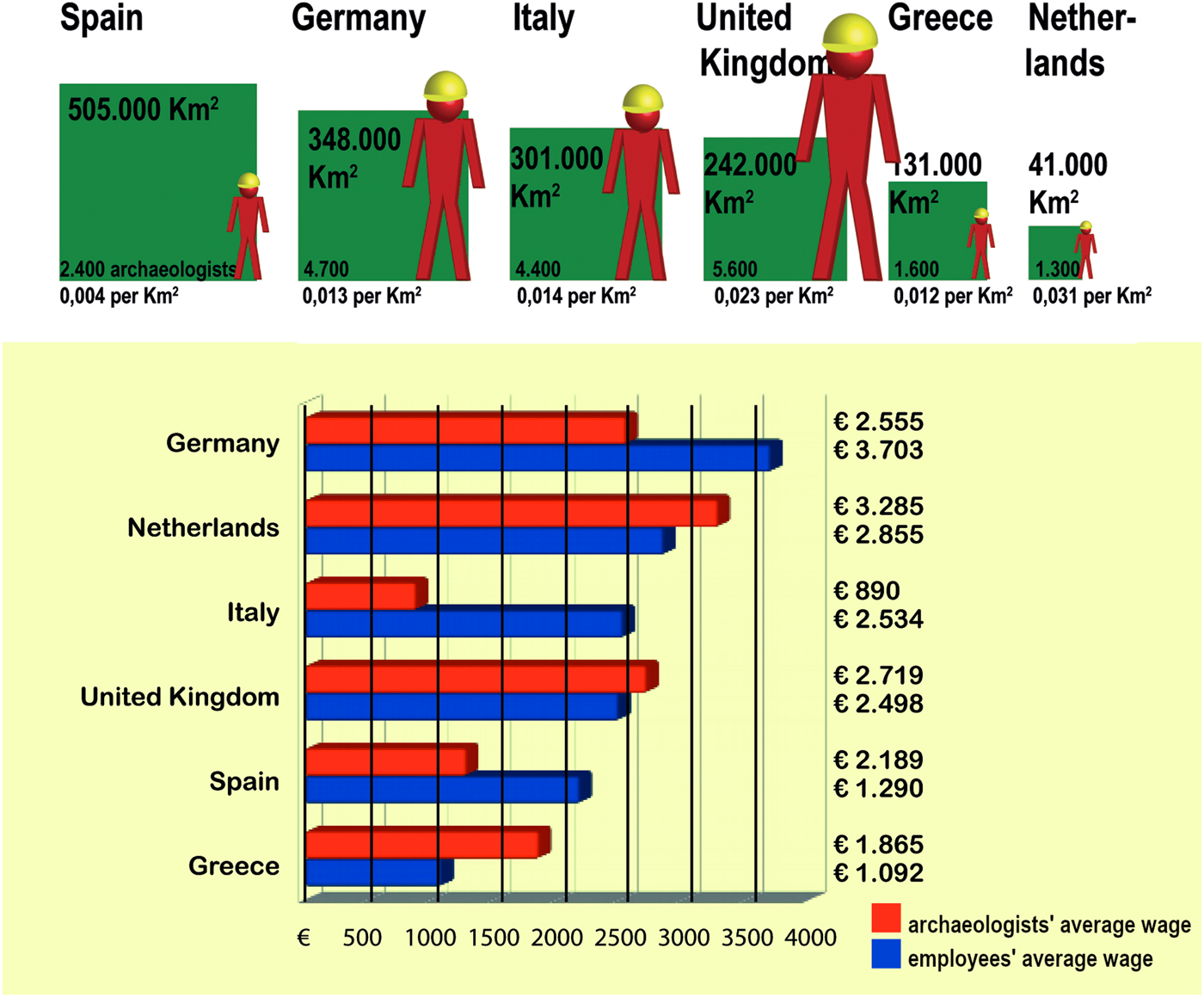
Italy is well-known for being a country with a rich and varied archaeological heritage, and it also benefits from highly protective national laws regarding archaeological findings. Despite these favourable conditions and the precocious development of an archaeological job market during the 1980s, today it occupies a relatively low rank among European countries in terms of the number and income of its archaeological practitioners (Figure 5). This article has tried to highlight the causes of this ‘underdevelopment’, which lie both in legislation and in the practice of preventive and rescue archaeology.
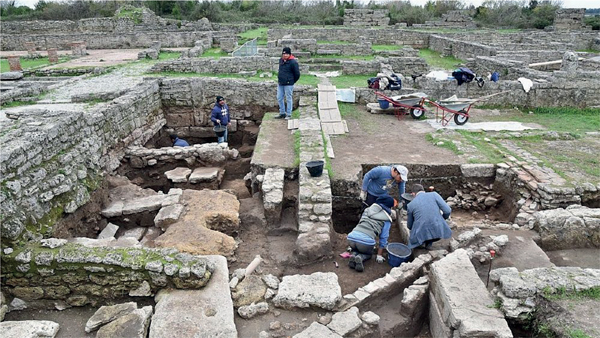
Archaeological excavations at the site of Poseidonia-Paestum by the autonomous museum and archaeological park of Paestum in 2016.

a. Number of archaeology employees compared to the land area of Italy and other European countries. b. Comparison of average income of archaeologists in Italy and other European countries. The graph shows the gross monthly average wage compared to the archaeologists’ wage for each nation (data for both graphs: Discovering the Archaeologists of Europe project: http://www.discovering-archaeologists.eu/).

In view of the assessment made here, some proposals are offered for a better organization of the job market and a more effective protection of the archaeological heritage.
With regard to heritage and landscape protection, expanding the remit of preventive archaeology procedures from public to private projects, as provided by the Code of Public Procurement, should lead to a significant increase in the number of commissions for archaeological contractors (Bitelli et al., Reference Bitelli, Pirraglia, Santangelo, Guermandi and Rossenbach2013: 28–33); this should also ensure the full protection of archaeological remains instead of the current ‘patchwork’ pattern.
As far as the rules are concerned, the legislation on archaeological research and excavations should be reshaped to formally recognize contract archaeology through a new licensing system which acknowledges the independent role of archaeological professionals and companies. More to the point, a redesign of the role of local authorities, with their participation in heritage protection, should offer a broader spectrum of public employment for archaeologists and a public service at a level closer to the citizens.
Yet even an extensively amended legal framework will not suffice to bring about a radical change in the archaeological job market unless there is a concurrent transformation in the mindset of practitioners. Only a mature work ethic and compliance with the rules within the profession will ensure a genuine improvement, which is needed to guarantee the survival of a profession that has been so undermined by the drop in its income and demand for its services.