Introduction
Epilachna dodecastigma (Weid.) (Coleoptera: Coccinellidae) is a polyphagous pest of solanaceous and cucurbitaceous crops (Choudhuri et al., Reference Choudhuri, Mondal and Ghosh1983; Khan et al., Reference Khan, Islam, Rahman and Rahman2000; Hossain et al., Reference Hossain, Khan, Haque, Mannan and Dash2009; Sarkar et al., Reference Sarkar, Mukherjee and Barik2015). The insect is a serious pest in many bitter gourd producing countries, notably in India and Bangladesh (Choudhuri et al., Reference Choudhuri, Mondal and Ghosh1983; Hossain et al., Reference Hossain, Khan, Haque, Mannan and Dash2009; Sarkar et al., Reference Sarkar, Mukherjee and Barik2013a, Reference Sarkar, Mukherjee and Barik2013b). Neonate larvae feed on the epidermal layer of the leaves of bitter gourd, Momordica charantia L. (Cucurbitaceae) and continue feeding on the leaves through four instars before pupation. Generally, the first and second instars do not migrate from the leaves on which the eggs were laid, but the third and fourth instars larvae spread out from one leaf to adjacent ones due to their voracious feeding habit. The larvae and adults start feeding by scraping on lower surface of leaves, causing a net-like appearance of the leaves, and subsequently the plant turns brown (Choudhuri et al., Reference Choudhuri, Mondal and Ghosh1983; Hossain et al., Reference Hossain, Khan, Haque, Mannan and Dash2009). E. dodecastigma are highly engaged in feeding during morning and evening. Infestation by this insect pest varies with temperature, season and region. Insect attack generally starts with the onset of the summer season and continues up to the beginning of winter when they hibernate. Heavy infestation by E. dodecastigma results in up to 80% yield loss of bitter gourd (Hossain et al., Reference Hossain, Khan, Haque, Mannan and Dash2009).
Host plant quality often influences fecundity, growth rate (GR) and development of herbivorous insects. Variations in water content and foliar nutrients between host plants, as well as within a particular host plant during its different developmental stages, affects survival, development and fecundity of herbivorous insects (Schoonhoven et al., Reference Schoonhoven, van Loon and Dicke2005; Roy and Barik, Reference Roy and Barik2012, Reference Roy and Barik2013; Roy et al., Reference Roy, Laskar and Barik2013). Polyphagous insects often show a preference for mature leaves because of the higher amounts of toxic secondary metabolites in young leaves (Schoonhoven et al., Reference Schoonhoven, van Loon and Dicke2005). Hence, it is of interest to examine whether mature leaves of bitter gourd are more nutritious to the insect E. dodecastigma compared to young and senescent leaves. A number of studies have demonstrated the influence of host plants – such as pumpkin, teasel gourd, sponge gourd, yard long bean, potato and bitter gourd – on the life cycle of the insect (Khan et al., Reference Khan, Islam, Rahman and Rahman2000; Hossain et al., Reference Hossain, Khan, Haque, Mannan and Dash2009). However, these studies have not considered the nutritional composition of the host plant at different developmental stages and its effect on food utilization, development and reproduction. Hence, this study was conducted to examine the foliar constituents of bitter gourd leaves at different developmental stages of the plant, i.e. young, mature and senescent stages, and their effect on food utilization efficiency, development, longevity and fecundity of the insect, E. dodecastigma.
Material and methods
Plant materials
Bitter gourd (Momordica charantia (cv Meghna 2)) were cultivated in the field at the Crop Research Farm (CRF) (23°16′ N and 87°54′ E), The University of Burdwan, West Bengal, India. The voucher specimen numbers were collected and numbered as Sarkar and Barik 1 and 2, and one of each were retained as a reference at Ecotaxonomy Laboratory, Department of Botany of The University of Burdwan. Different stages of leaves were classified mainly with the developmental time following leaf emergence through continuous monitoring of plants in the field. Leaf size [i.e. young leaf: length = 8.2 ± 0.5 cm and breadth = 6.3 ± 0.4 cm; mature leaf: length = 15.8 ± 0.6 cm and breadth = 11.5 ± 0.5 cm; senescent leaf: length = 16.4 ± 0.6 cm and breadth = 11.8 ± 0.3 cm (mean ± standard error; ten replicate of one leaf per each age)], leaf colour (i.e. young leaf: light green with shiny appearance; mature leaf: dark green; senescent leaf: yellowish green) and leaf texture (i.e. young leaf: herbaceous and scabarulous; mature leaf: somewhat coriaceous and scabarulous; senescent leaf: scabrid and coriaceous with marks of chlorosis) were considered during collection of different stages of leaves (Sarkar et al. Reference Sarkar, Mukherjee and Barik2013a). Fresh young (≥ 1 week old), mature (2–4 weeks old) and senescent (5–6 weeks old) M. charantia leaves were randomly collected from the field during June, 2012. Leaves were rinsed with distilled water and dried with paper towels before use.
Insects
Adult male and female E. dodecastigma used in this study were collected by light trap from the M. charantia plants grown in the CRF of The University of Burdwan. The insects were maintained separately in 1 L glass jars containing fresh young, mature and senescent bitter gourd leaves, respectively. The glass jars were covered with fine–mesh nylon nets and kept at 27 ±1 °C, 65 ± 10% relative humidity (RH) and 12 h light and 12 h dark (12L:12D) photoperiod in a biological oxygen demand incubator (ADS instruments and Tech., Calcutta, India). Two pairs of newly emerged adult males and females were separately released in sterilized glass jars (20 cm × 10 cm) covered with fine–mesh nylon net at 27 ± 0.5 °C, 12L: 12D, 65 ± 5% RH containing young, mature and senescent leaves, respectively for oviposition. A moist piece of cotton was placed around the cut ends of leaves followed by wrapping with aluminium foil to prevent water loss or withering. Fresh leaves were given daily by replacing the previous one until eggs were laid by the test insects, and the eggs with each type of plant leaves were placed separately in new sterilized glass jars. The larvae hatched from the eggs had been separately fed with the respective type of bitter gourd leaf for five generations. To study the larval development period, sixth generation eggs were separated and reared in sterilized glass jars containing 10 larvae on each type of leaf, and observations were made on their incubation period and period of each larval stage during their respective development.
Sixth generation larvae of the same weight were reared separately on young, mature and senescent bitter gourd leaves in sterilized glass jars for assessing the weight gain of the insects, the weight of food consumed and the weight of faeces produced. They were allowed to feed on weighed quantity of each type of leaf as a no-choice bioassay and then reweighed. The fresh weight gain during each instar was estimated by determining the differences in weight of larvae (by subtracting initial and final weight during the period of study). Ten experimental larvae at the beginning of each instar were weighed, dried in a hot air oven and reweighed to determine the dry weight of the larvae at the beginning of each instar. Ten larvae from each instar that fed on each type of leaf were weighed followed by drying in a hot air oven and reweighed to determine the dry weight of larvae. The remains of bitter gourd leaves after 24 h of insect feeding were oven dried and weighed. Sample leaves from each type of leaf were weighed followed by oven drying and then reweighed to estimate percentage dry weight conversion values to assess the dry weight of the diet. The quantity of the food consumed was determined by calculating the difference between the dry weight of diet remaining at the end of each experiment and total dry weight of diet initially provided. Faeces were collected at 24 h intervals and weighed, and then placed in a hot air oven and reweighed to find the dry weight of excreta. Ten larvae were used in each type of bitter gourd leaf treatment for each instar, and each instar had five replicates with a particular type of leaf.
Oviposition assay
The oviposition assay was conducted by taking laboratory-reared sixth generation male and female adults of same age that were reared separately on the three types of bitter gourd leaves. One pair male and female adults were fed on each type of leaf in a sterilized glass jar (10 cm × 10 cm) to examine their mating, egg laying behaviour and further developmental stages (N = 5 for each type of leaf). The females were allowed to oviposit, and the numbers of eggs per female were recorded for each type of leaf.
Food utilization indices
Food utilization indices (all based on dry weight) were calculated using the formulas of Waldbauer (Reference Waldbauer1968) to assess the feeding efficiencies of E. dodecastigma as follows:
-
Growth rate (GR) = A/B
-
Consumption rate (CR) = C/B
-
Relative growth rate (RGR) = A/BE
-
Consumption index (CI) = C/BE
-
Approximate digestibility (AD) (%) = 100 (C–F)/C
-
Efficiency of conversion of ingested food (ECI) (%) = 100A/C
-
Efficiency of conversion of digested food (ECD) (%) = 100A/(C–F)
-
Hatchability (%) = 100G/H
-
Larval survivability (LS) (%) =100Nh /Ng
-
Effective rate of rearing (ERR) (%) = 100I/J
-
Adult emergence (AE) (%) = 100K/I
-
Feeding index (FI) = L/M,
where A: dry weight gain of insect; B: duration of experimental period; C: dry weight of food eaten; E: mean dry weight of insect during time B; F: dry weight of faeces produced; G: number of eggs hatched; H: number of eggs laid by per female; Ng : number of larvae in beginning of instar; Nh : number of larvae in succeeding instar; I: number of cocoons harvested; J: number of larvae brushed (number of last instar larvae reached pupation); K: number of adults emerged; L: pupal weight; M: total weight of food consumed by the larvae.
Biochemical analysis of leaves
The differences in the nutritional quality of three types of bitter gourd leaves were estimated by subjecting the leaves from the same plants that the insects had fed on to various biochemical analyses. Each type of bitter gourd leaf (1 g each) was cut into pieces (0.5 cm) and was plunged in 5 ml boiling 80% ethanol for 5 min in a hot water bath. The leaf tissue in the solvent was slowly cooled down in a cold water bath, and crushed with a mortar and pestle. The supernatant was extracted and the leaf bits were further treated with 5 ml boiling 80% ethanol for 3 min to extract any nutrients still remaining in the tissue. The extract of each type of leaf tissue was centrifuged at 3000 × g for 20 min, and the supernatant and pellet were collected separately. The supernatant was used for determination of total carbohydrates, amino acids and phenols, and the pellet was used for protein determination. The supernatant was filtered through Whatman filter paper Grade No. 41, and then passed through charcoal powder to remove chlorophyll pigments.
Total carbohydrates were determined quantitatively by the Anthrone's method with a D-glucose reference curve and absorbance at 625 nm (Dubois et al., Reference Dubois, Gilles, Hamilton, Rebers and Smith1958). Total phenols in each type of leaf were measured by the procedure of Bray and Thorpe (Reference Bray and Thorpe1954) with a reference curve using catechol and absorbance was read at 650 nm. Determination of amino acids was measured using the ninhydrin spectrophotometric method of Moore and Stein (Reference Moore and Stein1948) with a reference curve using glycine and absorbance was read at 570 nm. A UV-visible spectrophotometer (Shimadzu, UV-1800240V) was used for all absorbance measurements.
The pellet from each type of leaf was suspended in 3 ml of 5% trichloroacetic acid (TCA) solution at 0 °C and kept on an ice bath for 15 min. 1 ml of the leaf suspension was added to 1 ml 10% TCA at 0 °C to precipitate the proteins. The precipitate was pelleted by centrifugation at 2000 × g for 20 min. The supernatant was discarded and the pellet was re-extracted once with absolute alcohol and twice with hot ethanol–ether mixture. The pellet was used for determination of total proteins by the method of Lowry et al. (Reference Lowry, Rose Brough, Farr and Randall1951) using a bovine serum albumin reference curve and absorbance was read at 750 nm.
Total lipids were determined following the method of Folch et al. (Reference Folch, Lees and Sloane–Stanley1957). One gram of each type of bitter gourd leaf was separately homogenized in 20 ml of chloroform : methanol (2 : 1 v/v) mixture for 10 min in a cell homogenizer. After vigorous shaking and filtering, each residue was stirred with 25 ml of chloroform: methanol mixture for 30 min. The mixture was passed through activated charcoal to remove chlorophyll pigments. The filtrate was shaken with 0.5 ml of 0.9% aqueous sodium chloride solution, and non-lipid contaminants were eliminated. The lipids thus extracted were dried in a desiccator and weighed in a monopan balance (± 0.01 mg) (Afcoset ER-182A).
To determine the nitrogen content, the leaf samples were oven dried at 55 °C for 72 h and then powdered. 100 mg of leaf powder was added to 1 g catalyst mixture (prepared from 1 g of selenium, 1 g of copper(II) sulphate pentahydrate and 20 g of potassium sulphate; all finely powdered and well mixed) and 5 ml concentrated-sulphuric acid. The mixture was heated for 1 h in a Kjeldahl flask and cooled, followed by the addition of 10 ml distilled water. The digested sample was loaded in the distillation system and 20 ml of 20% sodium hydroxide was added. The ammonia liberated during distillation was absorbed in 25 ml saturated boric acid and titrated against 0.04 N hydrochloric acid using methyl red as an indicator. Total nitrogen was measured by the procedure of Vogel (Reference Vogel1958). Each biochemical analysis was done five times.
Estimation of moisture content
One gram of each type of bitter gourd leaf, from the same plants that the insects had fed on, were placed separately in a hot-air oven at 50 ± 1 °C and kept for 72 h. The dried leaves were removed from the oven and weighed in a monopan balance (± 0.01 mg) (Afcoset ER-182A). Differences in the fresh and dry weights were used to determine the percentage water content of each type of leaf. The moisture content measurement of each type of leaf was repeated five times.
Statistical analysis
All data on the life history parameters of E. dodecastigma, food utilization indices and biochemical analyses of three types of bitter gourd leaves were analysed using one way analysis of variance (ANOVA) using SPSS software. Means associated with the data for each variable were separated using the Tukey test when significant values were obtained (Zar, Reference Zar1999). Correlation between the basic compounds of M. charantia leaves and longevity of male and female E. dodecastigma adults were carried out by SPSS software to comment role of the compounds in the insects.
Results
Life history parameters of E. dodecastigma
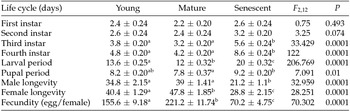
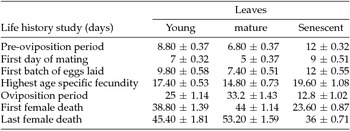
The larval developmental period from egg hatching to pupal stage was shortest on mature leaves followed by young leaves and senescent leaves (Table 1). The developmental time for the first two instars did not differ significantly when fed on the three types of bitter gourd leaves; whereas third and fourth instar larvae developed faster on young and mature leaves than senescent leaves (Table 1). Pupal duration was longest in insects fed on senescent leaves compared to mature leaves (Table 1).The fresh weight of a single pupa fed on young, mature or senescent leaves were 38.6 ± 0.03, 46.04 ± 0.07 and 32.4 ± 0.03 mg, respectively; whereas the dry weight of a single pupa fed on young, mature and senescent leaves were 8.84 ± 0.01, 10.5 ± 0.01 and 7.46 ± 0.02 mg, respectively. The dry weight of a single pupa differed significantly between the treatments (F 2, 12 = 224.870, P < 0.0001), and it was highest in mature leaf fed insects compared to young and senescent leaf fed insects. The longevity of male adults was lowest on senescent leaves compared to young and mature leaves. Female adults lived longer on mature leaves compared to young leaves and senescent leaves (Table 1). Fecundity was highest when the insects were fed on mature leaves compared to young leaves and was least on senescent leaves (Table 1). The life history study of adult females (preoviposition period, first day of mating, first batch of eggs laid, peak egg laying day, total oviposition period and death of first and last females) when fed on young, mature and senescent leaves is presented in Table 2.
Life cycle of Epilachna dodecastigma fed on young, mature and senescent bitter gourd leaves

Mean ± SE of five observations. Within the row means followed by same letter(s) are not significantly different by Tukey test.
Life history study of female Epilachna dodecastigma reared on young, mature and senescent bitter gourd leaves

Mean ± SE of five observations.
Food utilization efficiency
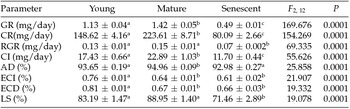
Data on food utilization efficiency measures for the first three instars larvae of E. dodecastigma are given in Table S1a–S1c (available online). Food utilization efficiency measures of fourth instar larvae are presented in Table 3. Insects reared on mature leaves showed higher values of GR and consumption rate (CR) followed by young and senescent leaves. Relative growth rate (RGR) values were comparatively better on young and mature leaves than senescent leaves. Consumption index (CI) values were highest and lowest for insects fed on mature leaves and senescent leaves, respectively. A higher value of approximate digestibility (AD) was observed on mature leaf fed insects whilst it was lower in young and senescent leaves fed insects. Both, efficiency of conversion of ingested food (ECI) and efficiency of conversion of digested food (ECD) values were highest in insects fed on young leaves compared to mature and senescent leaves. Larval survivability (LS) was highest in insects fed on young and mature leaves compared to insects fed on senescent leaves.
Food utilization efficiency measures of fourth instar larvae of Epilachna dodecastigma reared on young, mature and senescent bitter gourd leaves

Mean ± SE of five observations. Within the row means followed by same letter(s) are not significantly different by Tukey test.
Food utilization efficiency measures: GR: Growth rate, CR: Consumption rate, RGR: Relative growth rate, CI: Consumption index, AD: Approximate digestibility, ECI: Efficiency of conversion of ingested food, ECD: Efficiency of conversion of digested food, LS: Larval survivability.
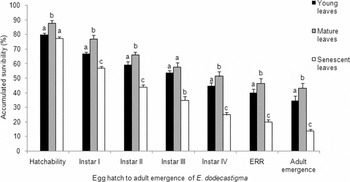
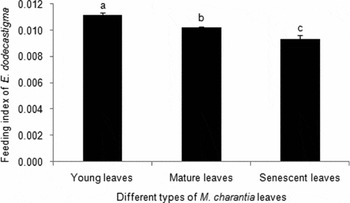
The hatchability percentage from E. dodecastigma eggs (F 2, 12 = 14.246, P < 0.001) was higher on mature leaves than young and senescent leaves (Fig. 1). The overall accumulated survival rate in all the larval stages was greatest when the insects were fed on mature leaves followed by young and senescent leaves (F 2, 57 = 22.419, P < 0.0001). The feeding index was highest on mature leaves, followed by young and senescent leaves (F 2, 12 = 18.726, P < 0.0002) (Fig. 2).
Accumulated survivability of Epilachna dodecastigma on young (Y), mature (M) and senescent (S) bitter gourd leaves. Means ± SE of five observations. The different letters over the bars indicate that the means are significantly different by Tukey test at P < 0.05.

Feeding index of Epilachna dodecastigma on young, mature and senescent bitter gourd leaves. Means ± SE of five observations. The different letters over the bars indicate that the means are significantly different by Tukey test at P < 0.05.

Biochemical analysis and moisture content of host plant
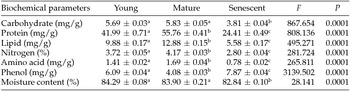
Biochemical analysis and moisture content of host plant are summarized in Table 4. Total carbohydrates were higher in young and mature leaves compared to senescent leaves. Total proteins varied significantly between the three types of leaves, and were highest in mature leaves and lowest in senescent leaves. Total nitrogen and amino acids were highest in mature leaves followed by young and senescent leaves. Lipid content was highest in mature leaves, intermediate in young leaves and least in senescent leaves. Phenol concentration was highest in senescent leaves and lowest in mature leaves. Young and mature leaves had the higher water content than senescent leaves.
Biochemical analysis of three types of bitter gourd leaves (mg/g dry weight of leaves)

Mean ± SE of five observations. Within the row means followed by same letter(s) are not significantly different by Tukey test.
Correlation between basic compounds of host plant and adult insects
A positive correlation was found between the nutrients (carbohydrate, protein, lipid, nitrogen and amino acid) as well as moisture content of three types of M. charantia leaves and longevity of male and female E. dodecastigma adults (Table 5). Phenol content of the three types of M. charantia leaves was negatively correlated with the longevity of male and female E. dodecastigma adults (Table 5).
Relationship between basic compounds of M. charantia leaves and longevity of Epilachna dodecastigma adults

Values in bold indicate significance at the level 0.05.
Discussion
This study showed a clear variation in nutrients (carbohydrates, proteins, nitrogen, amino acids and lipids) and water content in the bitter gourd leaves throughout the plant developmental stages. The nutrients in a host plant influence the life cycle parameters, GR, CR, utilization efficiency, developmental time, longevity, fecundity and survival of herbivorous insects (Scriber, Reference Scriber, Bell and Carde1984; Applebaum, Reference Applebaum, Kerkut and Gilbert1985; Awmack and Leather, Reference Awmack and Leather2002; Ramakrishna et al., Reference Ramakrishna, Sannappa and Govindan2003; Schoonhoven et al., Reference Schoonhoven, van Loon and Dicke2005; Shobana et al., Reference Shobana, Murugan and Naresh Kumar2010). Clear variation in food consumption and development of E. dodecastigma were observed when the insects were fed separately on young, mature and senescent bitter gourd leaves, indicating that differences in nutrients of three types of bitter gourd leaves influenced development and reproduction of the insect.
In the present study, nitrogen, proteins and amino acid content were highest in mature bitter gourd leaves followed by young and senescent leaves, which might explain higher growth, survival and reproduction of E. dodecastigma fed on mature bitter gourd leaves (Schoonhoven et al., Reference Schoonhoven, van Loon and Dicke2005). Most insects have requirements for optimum level of nitrogen, proteins and amino acids in their diet for the best growth, development and survival (Mattson Reference Mattson1980; Nation, Reference Nation2001). Low water content has been recognized as a limiting factor that causes reduction in the rate of growth of plant-fed caterpillars (Mattson and Scriber, Reference Mattson, Scriber, Slansky and Rodriguez1987; Shobana et al., Reference Shobana, Murugan and Naresh Kumar2010). The possible explanation for the lowest GR of senescent leaf fed instars is due to lower amount of water than other two types of leaves. Carbohydrates are exploited by the herbivores for their growth and development (Schoonhoven et al., Reference Schoonhoven, van Loon and Dicke2005), even though proteins and lipids act as an alternative source of energy. This study demonstrated lower GR of E. dodecastigma when fed on senescent leaves, indicating that the senescent leaves are of worst nutritional quality. Lipids serve as primary energy source during diapause and deficiency of lipids results in defective wing formation (Downer and Mathews, Reference Downer and Matthews1976; Nation, Reference Nation2001). Furthermore, all insects require lipids because sterols, which are the precursor for the synthesis of the 27-carbon ecdysteroid molting hormone of insects, cannot be synthesized. The current study indicated highest and lowest GR of E. dodecastigma when fed on mature and senescent leaves, respectively, which might be due to higher lipid content in mature leaves than senescent leaves.
Phenol determines the suitability of the substrate for exploitation by herbivorous insects, and thus governs host preferences and acceptability (Harborne, Reference Harborne2003; Schoonhoven et al., Reference Schoonhoven, van Loon and Dicke2005). Furthermore, increase in phenol content indicates reduction in adult longevity and fecundity, and retardation of larval growth (Harborne, Reference Harborne2003). The higher content of phenol in young and senescent leaves probably caused a reduction in female longevity and fecundity and retardation of larval growth of E. dodecastigma when compared to mature leaves, even though young leaves possessed a similar water content to mature leaves.
The ECD indicates the allocation of assimilated food to growth of insect. In the present study, the last two larval instars had a higher GR on mature leaves compared to young and senescent leaves, which may explain the shortest developmental time of mature leaf-fed insects compared to young- and senescent leaf-fed insects. The AD has been shown to be affected by water content of host leaves, and decreased water content in senescent leaves caused a reduction in the efficiency of nutrient digestion or absorption because the lower water level may interfere with feeding and nutritional processes (Scriber, Reference Scriber1977; Jeyabalan and Murugan, Reference Jeyabalan and Murugan1996). The first and third instar larvae of E. dodecastigma showed lower ECD values when fed on senescent leaves, which indicates lower growth of the senescent leaf-fed insect as a decrease in ECD indicates higher metabolic maintenance cost (Slansky and Scriber, Reference Slansky, Scriber, Kerkut and Gilbert1985). In this study, higher level of carbohydrates, proteins, lipids, nitrogen, amino acids and lower level of phenol in mature leaves might be the possible explanation for relatively higher CI of E. dodecastigma during the last three instars, and shortest larval period and development when the insects were fed on mature bitter gourd leaves.
A higher protein level in the diet had been shown to influence total egg output of herbivorous insects (Awmack and Leather, Reference Awmack and Leather2002; Shobana et al., Reference Shobana, Murugan and Naresh Kumar2010; Roy and Barik, Reference Roy and Barik2012, Reference Roy and Barik2013). This could explain the higher fecundity of E. dodecastigma females when fed on mature leaves. Furthermore, development of the insect reproductive system is dependent on nutrients acquired during their lifetime that influences allocation of more nutrients to egg production (Dadd, Reference Dadd, Kerkut and Gilbert1985; Slansky and Scriber, Reference Slansky, Scriber, Kerkut and Gilbert1985). Hence, the lower number of eggs laid by E. dodecastigma females in this study could be due to poor food quality of senescent leaves. The present study indicated that the insects fed on mature bitter gourd leaves showed higher longevity as adults, because of higher nutritional quality of their larval food. Similar results were observed, when Diacrisia casignetum insects were fed on mature leaves of sunflower plant (Roy and Barik, Reference Roy and Barik2012). In summary, this study indicates that the mature leaves are the best sources of food quality to support growth and development of E. dodecastigma compared to young and senescent leaves.
Supplementary material
To view supplementary material for this article, please visit http://dx.doi.org/10.1017/S1742758416000199.
Acknowledgements
We thank anonymous reviewers for helpful suggestions of an earlier version of the manuscript. The authors are thankful to Dr Poorani Janakiraman, National Bureau of Agriculturally Important Insects (formerly Project Directorate of Biological Control), Karnataka, India for identifying the insect, and Prof Ambarish Mukherjee, Department of Botany of this University for identifying the plant as well as characterizing young, mature and senescent leaves of this plant. The financial assistance from the Department of Science and Technology (DST) (SR/FT/LS–85/2009), India as a Fast Track proposal is gratefully acknowledged.