

Introduction
In 2009, a federal court in Florida ruled that the Swiss bank UBS had to hand over client information for up to 52,000 US citizens to the Inland Revenue Service. Well before the case was finally settled by an agreement between the US and Swiss governments, the latter issued the following statement in anticipation of a ruling against UBS: ‘The court would be substituting its own authority for that of the competent Swiss authorities, and therefore would violate Swiss sovereignty and international law.Footnote 1 This appeal to sovereignty is only one example among many in recent years where countries deny that outsiders have any say in their fiscal matters, even if the choices they make affect the tax base of other countries and, thereby, the well-being of their citizens. Can such appeals to sovereignty be justified and, if so, under what conditions?
This article proposes an inquiry into the normative status of state sovereignty in fiscal matters, in particular in the context of tax competition where countries use their tax regimes to compete for the mobile capital of investors and of multinational companies. Tax competition presents a series of challenges to the functioning of state finances and to social justice,Footnote 2 and most commentators today agree that some level of international tax cooperation will be necessary to respond to these challenges. What aspects of sovereignty, if any, would countries have to sacrifice under some of the proposed schemes of tax cooperation? The spectrum ranges from what has been called ‘sovereignty-preserving cooperation’Footnote 3 on the one hand to a world tax authority with substantial powers on the other. In the middle, and this is where, realistically, tax cooperation will be situated in the near future, we find what one might call ‘sovereignty-compromising cooperation’. This form of cooperation, so the argument runs, requires states to give up some of their fiscal sovereignty, but stops well short of establishing a supranational institution. Independently of its impact on sovereignty, it is worth highlighting that tax cooperation is not a collective action problem whose solution would bestow reciprocal benefits on all participants. Some states, like tax havens for instance, are likely to fare worse than under the status quo.
My analysis of the notion of sovereignty will proceed as follows. First, I will distinguish three different traditional meanings of sovereignty and highlight certain tensions between them. Second, focusing on the meaning of sovereignty most relevant in the context of this article, I will argue for a shift from Westphalian sovereignty that is centred on the notion of non-intervention to an understanding of sovereignty that assigns duties as well as rights to states in matters of international taxation. Third, I will analyse the implications of understanding sovereignty as an instrumental value to promote individual well-being. Fourth, it will become clear that when sovereignty is understood in this fashion, international tax cooperation is in fact more likely to enhance than to compromise sovereignty. Finally, I will offer some preliminary thoughts on what the correlative duties of sovereignty in fiscal policy might be. In other words, what are the obligations a state has towards other states in designing its fiscal policy?Footnote 4
The many facets of sovereignty
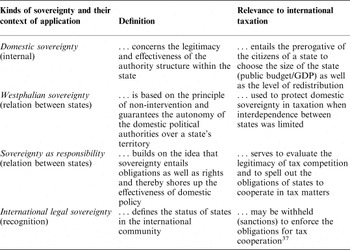
Sovereignty has been conceived of in multiple ways, partly because different disciplines emphasise different aspects of the concept. To avoid confusion, it is important to lay out some of the central meanings of the term. Stephen Krasner usefully distinguishes three meanings of sovereignty, namely domestic, Westphalian, and international legal sovereignty.Footnote 5Domestic sovereignty is a classic question of political theory and concerns the legitimacy and effectiveness of the authority structure within the state. Whereas the focus of domestic sovereignty lies on the internal affairs of the state, Westphalian sovereignty is a principle meant to govern relations between states. ‘The basic rule of Westphalian sovereignty is non-intervention in the internal affairs of other states’,Footnote 6 guaranteeing the autonomy of the domestic political authorities over a state's territory. Westphalian sovereignty provides the foundation for the neo-realist worldview in political science, whose advocates view international relations as anarchic and hence assume that states are free from external constraints. As will become clear later on, non-intervention is closely linked to the idea of self-determination, which assumes a fundamental role in many of the normative foundations of sovereignty. Finally, international legal sovereignty defines the status of states in the international community. Whether or not a state is recognised by other states influences issues such as diplomatic immunity, membership in international organisations, and the right to sign bilateral or multilateral treaties with other states.
In the context of tax competition and tax cooperation, Westphalian sovereignty is the kind of sovereignty that will preoccupy us, though the other two facets of the concept will become relevant at several junctions of the argument. As long as economic activities and factors of production were relatively immobile, not only was the autonomy of fiscal authorities guaranteed, but also fiscal policies were effective. Westphalian sovereignty in tax matters was by and large respected. However, in recent decades, the tax base – capital in particular – has become increasingly mobile. Regulatory changes like the discontinuation of capital controls by most countries in the 1960s and 1970s as well as the abolition of withholding taxes in the 1980s have significantly contributed to this trend. As a result, the behavioural changes of economic agents in response to taxation have become much more pronounced. They can now move their various forms of capital between countries and ‘shop’ for the lowest tax burden.Footnote 7 Notice that one might say Westphalian sovereignty is still respected. Countries still control their tax rates de jure and no other state has a say in their fiscal policy. However, due to the mobility of the tax base, de facto control over actual government revenues is weakened considerably.
While Westphalian sovereignty has been rendered meaningless under these circumstances, domestic sovereignty has been seriously undermined. In fiscal matters, domestic sovereignty manifests itself through the democratic choice of the size of the state as well as of the level of the redistribution of income and wealth. This is simply what self-determination means in the fiscal context. It is the government's task to implement the preferences of its citizens with respect to the ratio of the public budget to gross domestic product and in terms of social justice in fiscal policy.Footnote 8 Since tax competition puts pressure on government revenues and tends to shift the tax burden towards more regressive taxation on immobile factors such as labour and consumption, these democratic choices and with them domestic sovereignty are likely to be compromised by tax competition.Footnote 9 Rixen shows that this erosion of domestic sovereignty, or autonomy as he calls it, is an unintended consequence of the international double tax treaty regime.Footnote 10 In fact, ‘profit shifting and tax arbitrage are only possible because countries rely on a sovereignty preserving approach to international taxation.’Footnote 11 In other words, it is because countries struggle to preserve their Westphalian sovereignty that arbitrage becomes possible and the erosion of domestic sovereignty results.
This tension between Westphalian and domestic sovereignty confirms the widely held belief that the different facets of the notion of ‘sovereignty’ do not add up to an ‘integral package of mutually consistent principles and norms.’Footnote 12 Westphalian sovereignty stands in conflict with international legal sovereignty, too.Footnote 13 Consider the multiple agreements that states enter into on the basis of their legal sovereignty at the international level. Many of these will curtail Westphalian sovereignty. Most prominently in recent decades, the states of the EU have chosen to give up substantial powers to Brussels. Human rights documents like the European Human Rights Convention, the International Criminal Court, or trade-agreements like the World Trade Organization or NAFTA that come with dispute settlement procedures are other examples for international arrangements that compromise Westphalian sovereignty. In some cases, the recognition that comes with international legal sovereignty will even be conditional on a partial surrendering of Westphalian sovereignty, as in the case of the conditionality requirements imposed on sovereign lending by the International Monetary Fund.Footnote 14
There is no consensus as to how these trends should be interpreted. Krasner suggests that even before these delegations of sovereignty to supranational organisations, the idea of sovereignty based on non-intervention was a form of ‘organized hypocrisy’, with states intervening in each other's affairs all the time.Footnote 15 From this realist perspective on things, the setting up of supranational organisations is merely a different kind of intervention and one that apparently serves the national interests of the participants. Rustiala takes a different line, arguing that what looks like a loss of sovereignty to supranational bodies is not a departure from the statist paradigm after all, since states in most cases preserve veto rights or a right to exit.Footnote 16 In this case, the above developments would not constitute cases of intervention at all. Chris Brown challenges the absoluteness of sovereignty as non-intervention in the Westphalian paradigm and shows that sovereignty has been a contested notion since the beginning of the Westphalian system.Footnote 17
I want to make two comments on these different positions. First, it is important to distinguish between theory and practice. It is of course true that history since the Westphalian treaty is littered with cases of intervention and that, therefore, actual politics has not lived up to the norm of non-intervention. This is of secondary interest here. The question that preoccupies me is whether non-intervention should have been respected, whether political theorists can justify it as a norm fit to govern international relations. Brown rightly emphasises that Westphalian non-intervention ‘still largely dominate[s] the official self-understanding of the twenty-first century international system’.Footnote 18 Can this self-understanding be given a normative foundation?
Second, contrary to Brown, I believe that non-intervention is a constitutive feature of the Westphalian system that, if successfully challenged, will take the notion of Westphalian sovereignty down with it. You cannot have ‘Westphalian sovereignty plus certain kinds of legitimate intervention’ and still call the result Westphalian.Footnote 19
The central question, then, becomes why we should either stick to or abandon a notion of sovereignty that is based on non-intervention? The basic challenge to Westphalian sovereignty is twofold. First, in an interdependent world, Westphalian sovereignty is no longer adequate, or even logically possible. If the policies of state A affect other states in ways that, although not directly exercising authority over their policies, nevertheless indirectly undermine the effectiveness of these policies, then Westphalian sovereignty is compromised. Henry Shue attributes this tension to the form of sovereignty as a right governing interstate relations itself. If sovereignty is a right, this right takes ‘the form of limits on the behaviour of other agents.’Footnote 20
The parallel with individual liberty is instructive here. We do not conceive of individual liberty as absolute, but my liberty is limited by guarantees of the same fundamental liberties for everyone else. Establishing these guarantees requires cooperation and the surrender of some individual liberties to the state. Calling for individual liberty to be absolute would result in a meaningless, merely formal, conception of liberty and the right to liberty would lose its effectiveness. Any substantive conception of individual liberty is one that is necessarily limited.Footnote 21
Second, and more specific to the fiscal context, the rise in capital mobility over recent decades means that states are becoming more interdependent. In such a world, institutionalised cooperation and intervention will not only be inevitable, but increasingly necessary.Footnote 22 Under increasing fiscal interdependence, to put it in Shue's terms, an effective protection of the right to sovereignty will call for more substantive correlative duties on the part of other states. This is an argument about the content of sovereignty rather than about its form. These considerations lead me to the second step of my argument. I will suggest that we should drop the anachronistic idea of Westphalian sovereignty and replace it with the notion of ‘sovereignty as responsibility’.
Sovereignty with strings attached
In some domains of international law, the call for a redefinition of sovereignty has already been heard. In their book entitled The New Sovereignty, Chayes and Chayes set out a notion of sovereignty that is geared towards enabling states to pursue objectives through cooperation that they could once accomplish alone.Footnote 23 In the context of human rights protection in particular, the idea of a conditional sovereignty is gaining ground.Footnote 24 In the terminology introduced above, this idea calls for the recognition of international legal sovereignty to be withheld if a government violates the human rights of its citizens. Notice that theorising about domestic sovereignty has completed the shift towards a conditional notion long ago. Whereas in the classic accounts of Hobbes and Bodin, ‘order was paramount’ and ‘justice was secondary’, modern conceptualisations of sovereignty ground the authority and control of the state in justice and democratic legitimacy.Footnote 25 The same is true of international legal sovereignty, where diplomatic immunity and the recognition of states are subject to a number of (fairly minimal) conditions.
The conceptual thread that runs through all these changes in our understanding of sovereignty as a norm governing relations between states is the idea that sovereignty, like liberty, not only entails rights, but also obligations.Footnote 26 In light of the considerable advantages that states derive from the exchange of goods and services, knowledge and ideas, values and cultural heritage, to name but a few, the suggestion that the privileges of being a member of the international community comes with certain strings attached is hardly radical. Yet, not only realists will be quick to object that ‘sovereignty as responsibility’, as I will call it, is hopelessly idealistic and built on a vision of international relations that is utopian.
Granted, international politics is a long way still from internalising the idea of sovereignty as responsibility. However, there are encouraging signs that the shift from Westphalian sovereignty to a more demanding notion is not limited to academia.Footnote 27 Starting with the report of the International Commission on Intervention and State Sovereignty (ICISS) in 2001, which establishes the ‘responsibility to protect’ as an emerging principle of customary international law, the discourse of international institutions has started to match the trend observed among international legal theorists. The ICISS insists that ‘[t]here is no dilution of state sovereignty. But there is a necessary re-characterization involved: from sovereignty as control to sovereignty as responsibility in both internal functions and external duties.’Footnote 28 The report of the High-Level Panel on Threats, Challenges and Change, instituted by the then Secretary General of the UN, Kofi Annan, goes even further. ‘It asserts that all signatories of the UN Charter accept a responsibility both to protect their own citizens and to meet their international obligations to their fellow nations. Failure to fulfil these responsibilities can legitimately subject them to sanctions.’Footnote 29 The panel explicitly insists that the responsibilities attached to statehood reflect the nature of contemporary international relations, ‘[w]hatever perceptions may have prevailed when the Westphalian system first gave rise to the notion of State sovereignty.’Footnote 30
Of course, these lofty declarations do not mean that international relations have overnight lost their adversarial character, or that the concept of Westphalian sovereignty has lost all influence. But they show that the theoretical insight that the justifications for Westphalian sovereignty no longer hold has filtered through to practice. What it takes to transform the actual legal and institutional structures at the international level to ensure that they reflect this new understanding of sovereignty is a fascinating question, but not one that I will address in this article. The important lesson for the present context is that sovereignty as responsibility has the potential to overcome the shortcomings and contradictions of Westphalian sovereignty. I will turn to spelling out and justifying these obligations in more detail in the last section of the article.
The normative status of sovereignty
The statist paradigm has a strong grip on our view of international relations. Given the enormous influence of states in structuring human interaction, we sometimes forget to probe the justification for this dominant role.Footnote 31 Any such justification has to answer two fundamental questions. First, ‘[w]hat justifications are available for a global political order the component parts of which are deemed to be sovereign in the sense that they have the right to arrange their own affairs without external intervention?’Footnote 32 And second, what justifies the existence of the particular states that exist in our world as opposed to other configurations of the political map? Given the injustices associated with the current geopolitical landscape, it is the second of these questions that forms the ‘pièce de résistance’ for any justification of state sovereignty. A comprehensive treatment of these questions lies beyond the scope of this article, but an account of state sovereignty would be incomplete if it did not address them at least briefly.Footnote 33
The first question is usually answered by appeal to the close link between non-intervention and the benefits of self-determination. The well-being of individuals will be better served if decisions concerning their life are taken at a local rather than at a global level. This is not simply a justification of states as one kind of administrative entity, but of a general principle of subsidiarity. Political decisions should be made at the lowest possible level of government. Endicott puts it poignantly when he says that the ‘best argument against a world government is that this radical instance of subsidiarity would make global institutions of government (or the institutions of, say, one powerful nation) poor judges of what aspects of life to interfere with in the communities that are now nation states. And when it makes those judgments wisely, the global government might be inept at giving them effect in a way that answers to local (which used to be national) conditions.’Footnote 34 This quote makes it clear that there are both epistemic and efficiency reasons for having component parts of the global order that are sovereign.Footnote 35 Both are clearly instrumental in character, conceiving of sovereignty as a means to serve the well-being of individuals. While the Westphalian paradigm acknowledges the instrumental character of sovereignty, it is built on the implicit premise that non-intervention will always be the best means to render self-determination effective.Footnote 36
Many if not most cosmopolitan theorists are in fact prepared to accept this answer to the first question. However, they point out that sovereignty under the current configuration of states is highly partial in whose well-being it serves, privileging citizens of developed countries over those of the developing world. Given that national boundaries are arbitrary and that being born into a rich or a poor country is a matter of ‘brute luck’, these injustices undermine the normative justification for the current configuration of states. One might legitimately ask whether the states we know can be justified at all given the combination of their contingency and the injustices they create and uphold. If so, then this justification should be conditional on moving towards a better serving of the well-being of all individuals, independently of where they live. In other words, sovereignty will imply duties as well as rights.
The comparison between domestic sovereignty and sovereignty as responsibility is instructive here. The internal authority structure of the modern state is contingent on its serving the well-being of its citizens. If a government violates the interests of its citizens, its legitimacy is undermined and the democratic sovereignty of citizens no longer guaranteed. The idea of sovereignty as responsibility implies that sovereignty as a norm governing relations between states can be made conditional in a similar fashion. Not only may the recognition and legal international sovereignty of states depend on their fulfilling certain standards with respect to the treatment of their own citizens, but states also have obligations to take into account the effects of their policies on the citizens of other states. It is worth noting that redefining sovereignty in this way mitigates the contrast between the statist paradigm and a world government.
In sum, then, the answer to the first question raised above justifies non-intervention by appeal to the benefits of self-determination. However, the answer to the second question qualifies this non-intervention by making it conditional on serving the well-being of members as well as non-members of the political community in question. The relative weight that should be accorded to members and non-members in these considerations is one of the central questions of international political theory today.
Back to fiscal policy
The instrumental value of sovereignty has significant implications for the debate on tax competition. As illustrated in the introduction, opponents of various forms of tax cooperation regularly appeal to sovereignty to justify why reforms of this kind should be rejected. If one accepts that sovereignty is only of instrumental value, merely invoking it is not enough. The burden of proof is on the opponent of tax cooperation to spell out what fundamental value sovereignty serves and how that value trumps the values that tax cooperation aims to promote.
Moreover, under the paradigm of sovereignty as responsibility, it seems that sovereignty so understood is much less likely to conflict with tax cooperation in the first place. After all, the goal of tax cooperation is precisely to create an institutional framework under which the efforts of states to promote the fundamental interests of their citizens are not undermined by other states. As we have seen, the benefits of such a structure necessarily impose constraints on the policies of states. Yet these constraints are not to be viewed as constraints on sovereignty, but as constraints of sovereignty. This is one of the central insights of this article. To illustrate what I mean by these correlative duties of sovereignty, Table 1 summarises the different facets of sovereignty as well as their meaning in the context of fiscal policy.
Sovereignty and international taxation

If my conceptual analysis holds and we accept a version of sovereignty as responsibility, then the notion of ‘sovereignty-compromising cooperation’ used in the introduction is misleading. Many proposals for tax cooperation, though they may compromise the anachronistic Westphalian sovereignty, actually serve to promote sovereignty as responsibility.
Even if, in the abstract, the idea of sovereignty as responsibility sounds attractive, one might object that it is far from clear what follows from adopting this concept for the context of international taxation. This is a point well taken. When proposals akin to sovereignty as responsibility have challenged the mainstream view of sovereignty as non-intervention, these debates have for the most part concentrated on issues of human rights or on developing a theory of legitimate secession. The notion of sovereignty as responsibility has not yet taken hold in the fiscal context.Footnote 38 Yet, this is precisely what motivates this article. Fiscal policy strikes me as one of the domains of international law where Westphalian sovereignty is still dominant. One reason may be that the consequences are prima facie less dramatic than in the case of human rights violations. Another reason could be the fact that the power to tax has long been one of the central responsibilities as well as the power base of the state, explaining its reluctance to share it.
In order to spell out what sovereignty as responsibility means for international taxation, we need to answer the following question: What are the duties that states have towards other states in their fiscal policy? The answer will take the form of a combination of general principles that then enable us to judge first what forms of tax competition are legitimate and second what kinds of tax cooperation may be required from states. While most theoretical accounts as well as the practical efforts of the OECD and the EU tend to concentrate on the first, negative question, sovereignty as responsibility emphasises the second issue of formulating the positive obligations that states have in their fiscal policy. Developing a comprehensive account of these obligations lies beyond the scope of this article. In the last section, I will merely offer some tentative first steps towards developing such an account.
Spelling out the fiscal obligations of sovereignty
The correlative duties of sovereignty in fiscal matters are best thought of on the basis of the distinction between principle and actual policy. In a first step, principles need to be formulated that ensure sovereignty plays its instrumental role in promoting well-being. Second, policy instruments have to be designed that respect these principles. My focus here will be on the first step. Tax lawyers and public finance experts are better placed to address the second issue than I am.
Consider once more the analogy with liberty. Individual liberty has to be limited in order maximise the analogous liberty of everyone else. In a context of interdependence, limits are a necessary condition for effective protection. The same holds for state sovereignty. Sovereignty as a norm governing interstate relations will have to be subject to a number of constraints in order to be a substantive concept. One useful way to think of these constraints is as obligations. As an individual, I have an obligation to respect, for instance, the physical integrity of others as well as their private property. As a collective or state, we have an obligation to respect the choices other collectives make in promoting their well-being. This includes respect for the choices of other polities as to the size of the state and the level of redistribution they wish to attain within their community.Footnote 39 As it stands, this is of course too vague. To render this obligation more precise, I propose to break it down into three principles, which impose increasingly demanding duties on states in their fiscal policy.
1) Transparency: Transparency of income and tax information is a general requirement of justice that should be respected even within states.Footnote 40 However, rather than justifying this more ambitious claim, in the present context we can content ourselves with a weaker version: ‘States should provide all the information necessary for other states to levy the taxes they have a right to.’ If one of the basic ideas of sovereignty as responsibility is to shore up the effectiveness of fiscal policy choices by different polities, this obligation clearly forms part of that responsibility.Footnote 41
This transparency requirement has implications for both individual income taxation and corporate taxation. Concerning the former, transparency calls for the abolition of secrecy laws to the extent that these laws conceal information to which foreign tax authorities have a right.Footnote 42 This, incidentally, forms the basis for rejecting the appeal to sovereignty by the Swiss government in the UBS affair discussed in the introduction. The trust laws characteristic of common law countries would also have to be modified, since they allow both individuals and companies to obscure the traces of their tax liabilities.Footnote 43 With respect to corporate taxation, transparency obliges countries to help enforce any accounting requirements that multinational companies might have to satisfy, for instance under a regime of unitary taxation with formulary apportionment.Footnote 44
Note, however, that transparency is a relatively weak requirement. Consider the case of Ireland, which, for years, had a so-called ring-fencing policy in corporate taxation, taxing foreign multinationals at a lower rate than Irish companies in order to attract foreign capital while maintaining their domestic corporate tax revenue. There was no lack of transparency. And yet, the inflow of parts of the tax base from other countries clearly compromised the fiscal choices made by the polities in these countries.
Hence, a stronger principle is needed to complement transparency. Consider the following candidate: ‘States should not undermine the fiscal policy of other states.’ Though this certainly captures the spirit of sovereignty as responsibility, it is so general a formula that it begs the question. After all, both aggressive fiscal policies on the one hand and lower tax rates because citizens prefer a smaller state on the other ‘undermine’ the fiscal policies of other states in the sense that they might reduce their tax bases. Clearly, we want the latter to be compatible with sovereignty as responsibility if the concept is not to call for an outright harmonisation of taxes, which would be undesirable.Footnote 45 We are looking for a principle that allows us to arbitrate between legitimate and illegitimate forms of ‘undermining’. This leads me to my second principle.
2) Respect for the fiscal choices of others: As illustrated in the previous paragraph, in a world of fiscal interdependence, externalities of fiscal policies on the democratic choices and ultimately the well-being of citizens of other countries cannot be eliminated. All we can hope for is a principled way to strike a balance between the fiscal policies of different countries.
I believe that this is where most of the conceptual work needs to be done in spelling out the correlative duties of sovereignty in fiscal policy. Instead of going into considerably more detail on this issue, I will here limit myself to the assertion that whatever the content of the principle of respect may turn out to be, it would have to rule out one type of fiscal policy, namely discriminatory tax rates as in the Irish case discussed above.Footnote 46
Recall that self-determination in the fiscal context comprises the choice of the size of the state as well as the level of redistribution. Suppose the citizens of state A have a preference for a relatively large state with substantial redistribution from the rich to the poor. At the same time, for fear of scaring away multinational enterprises with high corporate tax rates, state A institutes a discriminatory tax rate for such enterprises that is substantially lower than the one for domestic companies. What this in effect means is that other countries, through the partial loss of their tax base, are bearing part of the costs of a large state with substantial redistribution in state A while seeing their own fiscal choices undermined by the outflow of capital. Another way to make the same point is to think of a world with discriminatory tax regimes as a world in which the distribution of part of the tax base and the adjacent benefits in terms of job creation is a zero sum game. The winners in this game, that is, those who institute discriminatory tax regimes, are playing a strategy that does not respect the fiscal choices of other countries.
Again, this is merely to serve as an illustration of one instance of what it means to respect the fiscal choices of other countries.
3) Distributive justice: Recall the normative foundation of state sovereignty set out above. While in the abstract, non-intervention may be justified by appeal to the benefits of self-determination for well-being, state sovereignty in the current, unjust world order comes at the price of correlative duties for the privileged states of the world. Rather then being free to perpetuate or even to worsen inequalities between the developing world and developed countries, the latter have a duty to pursue fiscal policies that favour conversion.Footnote 47
The central question concerning this aspect of the obligations attached to sovereignty is how demanding this obligation of justice should be. Different theories of justice will take diverse positions here, ranging from cosmopolitan theories at the relatively demanding end of the spectrum to communitarian theories at the other. As an example for a radical proposal, it is worth mentioning the idea of public finance theorists Richard and Peggy Musgrave, who argued that the distribution key in a unitary taxation scheme should be inversely proportional to a country's GDP.Footnote 48
It is not the point of this article to make a substantive commitment in this regard, but rather to argue that one of the correlative duties of state sovereignty in today's world is a duty of redistribution of some sort towards poorer countries. It is quite conceivable that even according to some of the less demanding theories of justice, this duty will turn out to be far more substantial than the present aid budgets of the developed world. In this case, from the perspective of the developed world, rather than padding ourselves on the back for the aid we give, we would have to admit that its levels are far below what is morally required of us.
Conclusion
International tax theory should follow the lead of other domains of international law in replacing the antiquated notion of Westphalian sovereignty with a concept of sovereignty that acknowledges obligations as well as rights of states in their conduct towards other countries. One candidate is the notion defended above, labelled sovereignty as responsibility, which also emphasises the instrumental character of sovereignty in promoting the more fundamental value of individual well-being.
This conceptual shift puts into perspective the prerogatives of the state in the context of international taxation. Whereas the traditional view regards tax cooperation as a constraint on sovereignty, the position laid out in this article holds that certain forms of tax cooperation are required by, and conducive to, the protection of sovereignty.
Of course, this argument will not suffice to eliminate political resistance to tax cooperation, because the motivations behind this resistance vary. Tax havens, for instance, understandably see it as a threat to their national interest. The argument presented here offers no magic formula to change their mind, but it shows two things. First, the appeal of tax havens to sovereignty lacks justification. Second, other countries, who would in fact gain from certain forms of tax cooperation, are wrong to think that it would compromise their sovereignty. This latter point might make some forms of tax cooperation seem somewhat less utopian.
The argument presented here goes beyond asserting that sovereignty is subject to constraints. In their fiscal conduct, states have a number of positive duties towards other states. These can be divided into a duty of transparency, a duty to respect the fiscal choices of other countries, and a duty of distributive justice. Though I have only given a rough outline as to the precise content of these duties, they give an indication of how we should rethink sovereignty in international fiscal policy.