I. INTRODUCTION
Refractory alloys with good high-temperature mechanical properties are considered for applications that require substantially higher service temperatures.Reference Senkov and Woodward1 However, applications of such alloys become limited due to their low ductility at room temperature and poor resistance to oxidation at elevated temperatures and high densities.Reference Senkov and Woodward1 To overcome these constraints, the metallurgical community is exploring multiprincipal alloys with high mixing entropies, or “high-entropy alloys (HEAs)”,Reference Senkov and Woodward1,Reference Yurchenko, Stepanov, Shaysultanov, Tikhonovsky and Salishche2 which are alloys composed of 5–13 elements in equiatomic or near-equiatomic concentrations (5–35 at.%).Reference Yurchenko, Stepanov, Tikhonovsky and Salishchev3–Reference Stepanov, Yurchenko, Zherebtsov, Tikhonovsky and Salishchev5 Lattice distortions increase the hardness and strength of these alloys, which form solid solutions over intermetallic phases due to the high mixing entropy.Reference Yurchenko, Stepanov, Tikhonovsky and Salishchev3,Reference Stepanov, Yurchenko, Zherebtsov, Tikhonovsky and Salishchev5,Reference Gao, Zhang, Yang and Guo6
The presence of multiple principal elements over a wide range of concentrations has opened a new dimension for researchers who explore new alloys.Reference Yurchenko, Stepanov, Zherebtsov, Tikhonovsky and Salishchev4 The development and microstructural/mechanical analyses of new HEAs with enhanced properties are critical for progress towards their potential use in high-temperature applications.Reference Stepanov, Yurchenko, Shaysultanov, Salishchev and Tikhonovsky7 Several new single-phase (e.g., HfNbTaTiZrReference Stepanov, Yurchenko, Zherebtsov, Tikhonovsky and Salishchev5) and multiphase (e.g., CrNbTiVZrReference Yurchenko, Stepanov, Shaysultanov, Tikhonovsky and Salishche2) refractory HEAs have been reported, exhibiting promising strength, ductility, toughness, thermal stability, and wear resistance levels at both room temperature and elevated temperatures.Reference Yurchenko, Stepanov, Tikhonovsky and Salishchev3,Reference Stepanov, Yurchenko, Shaysultanov, Salishchev and Tikhonovsky7,Reference Yang, Zhang and Liaw8 The high-temperature yield strengths observed for some HEAs, which are even better than those of Ni-based superalloys,Reference Yurchenko, Stepanov, Shaysultanov, Tikhonovsky and Salishche2,Reference Stepanov, Yurchenko, Shaysultanov, Salishchev and Tikhonovsky7,Reference Stepanov, Yurchenko, Skibin, Tikhonovsky and Salishchev9,Reference Yao, Qiao, Hawk, Zhou, Chen and Gao10 making them potential candidates in various automotive, aerospace, and nuclear applications. For example, high-temperature (1600 °C) strength capabilities of 405 MPa and 477 MPa were observed for MoNbTaW and MoNbTaVW, respectively.Reference Senkov, Wilks, Scott and Miracle11 Furthermore, good room-temperature ductility in HfNbTaTiZr has been reported.Reference Guo, Wang, Luo, Li, Chen, Su, Guo and Fu12 In the same study, HfNbTaTiZr was modified to form HfMoNbTiZr to reduce the cost and density and improve the strength, which demonstrates the versatility of the HEA design space.Reference Guo, Wang, Luo, Li, Chen, Su, Guo and Fu12 The replacement of heavy elements Ta and Hf with lighter elements (i.e., Cr and Mo, respectively) to form CrMo0.5NbTa0.5TiZr can result in a density of 8.2 g/cm3. The CrMo0.5NbTa0.5TiZr HEA showed good oxidation resistance (higher than Nb-based alloys, AlNbSiTi and MoNbSi) and yield strengths of 2000 MPa and 745 MPa at 25 °C and 1000 °C, respectively.Reference Guo, Wang, Luo, Li, Chen, Su, Guo and Fu12
Because exchanging elements and varying elemental concentrations have significant effects on the properties of refractory HEAs, there is a need for a combinatorial library including a wide range of elements and compositions of HEAs so that the most appropriate composition with enhanced properties can be selected for further research and commercialization. In this work, we consider alloys for high-temperature applications. Accordingly, the constituents were selected from refractory metals Cr, Nb, Ti, and Zr owing to their low densities and high melting points.Reference Yurchenko, Stepanov, Tikhonovsky and Salishchev3 Due to their potential to reduce the densityReference Yang, Zhang and Liaw8 and improve the oxidation resistance of alloys,Reference Yurchenko, Stepanov, Shaysultanov, Tikhonovsky and Salishche2 Al was also selected.Reference Yang, Zhang and Liaw8 Hf, Ta, and W were not selected due to their high densities.Reference Yurchenko, Stepanov, Tikhonovsky and Salishchev3 Furthermore, vanadium was not selected considering its adverse effects on the oxidation resistance of Al0.5CrMoNbTiV.Reference Liu, Wang, Zhang, Tang and Zhang13 We employ Mo due to its relatively low density compared to Ta and W and its good potential for high strength.Reference Guo, Wang, Luo, Li, Chen, Su, Guo and Fu12
Previous reports suggest the successful utilization of Nb, Ti, and Zr in HEAs at relatively equal concentrations due to the good relative solubility, a result of their propensity to form solid solutions without any intermediate compounds.Reference Gasik and Yu14 A number of HEAs containing equiatomic Nb, Ti, and Zr have been reported, including CrNbTiVZr,Reference Yurchenko, Stepanov, Shaysultanov, Tikhonovsky and Salishche2 HfNbTaTiZr, HfMoNbTiZr, CrMo0.5NbTa0.5TiZrReference Guo, Wang, Luo, Li, Chen, Su, Guo and Fu12; this finding motivated us to use equal ratios of Nb, Ti, and Zr.
It has been reported that varying the Al, Cr, or Mo concentration can have significant effects on the properties of HEAs. MoxNbTiVZr (x = 0.3–1.2), MoxNbTiV0.3Zr (x = 0.1–1.5),Reference Wu, Cai, Chen, Wang, Si, Wang, Wang and Hui15 and HfMoxNbTaTiZr (x = 0–1)Reference Juan, Tseng, Hsu, Tsai, Tsai, Lin, Chen, Lin and Yeh16 all showed improvements in strength, from 1289 to 1765 MPa, 932 to 1576 MPa, and 1015 to 1512 MPa, respectively, due to increases in the Mo content.
As observed in AlCrxNbTiV (x = 0 to 1.5), increasing the Cr content improved the HEA strength and oxidation resistance.Reference Stepanov, Yurchenko, Skibin, Tikhonovsky and Salishchev9 However, the relatively high shear modulus of Cr compared to other transition metals and its high notch sensitivityReference Morinaga, Nambu, Fukumori, Kato, Sakaki, Matsumoto, Torisaka and Horihata17 led to decreased ductility in Cr-bearing HEAs.Reference Zhang, Liu, Li, Chen and Zhang18 For example, the fracture strain of AlNbTiV was reduced from 5 to 1% when Cr was added to form AlCr0.5NbTiV.Reference Zhang, Liu, Li, Chen and Zhang18
While Al reduces the density and improves the strengthReference Stepanov, Yurchenko, Skibin, Tikhonovsky and Salishchev9 and oxidation resistance of refractory HEAs,Reference Yurchenko, Stepanov, Shaysultanov, Tikhonovsky and Salishche2 recent research on the effects of Al in HEAs has shown various results. Adding Al to CrMo0.5NbTa0.5TiZr stabilizes the solid-solution phases and reduces ordered intermetallics.Reference Yurchenko, Stepanov, Shaysultanov, Tikhonovsky and Salishche2 Similar HEAs, such as NbTaTiV, MoNbTiV, and HfNbTaTiZr, also retain their structure after Al inclusion.Reference Yurchenko, Stepanov, Shaysultanov, Tikhonovsky and Salishche2 However, it has been shown that including Al promotes the formation of intermetallics in NbTiVZr.Reference Yurchenko, Stepanov, Shaysultanov, Tikhonovsky and Salishche2
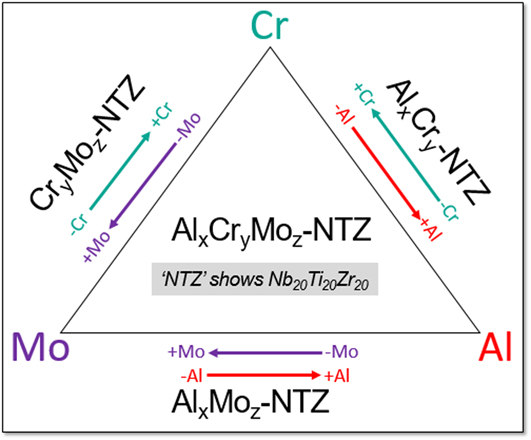
In this manuscript, we present the development of a combinatorial library of the AlxCryMozNbTiZr HEA system, which is henceforth abbreviated as “AlxCryMoz-NTZ”, where ‘NTZ’ refers to equiatomic Nb, Ti, and Zr. The combinatorial approach is shown in Fig. 1.
A combinatorial approach to the development and analysis of the AlxCryMozNbTiZr HEA.

Oxidation resistance is one of the most critical performance metrics of refractory metals and alloys for high-temperature applications. Therefore, the oxidation behavior should be analyzed to understand the effects of alloying elements on the oxidation resistance capabilities of refractory HEAs. Although there are many reports on the mechanical properties of refractory HEAs,Reference Yurchenko, Stepanov, Zherebtsov, Tikhonovsky and Salishchev4,Reference Stepanov, Yurchenko, Shaysultanov, Salishchev and Tikhonovsky7,Reference Stepanov, Yurchenko, Sokolovsky, Tikhonovsky and Salishchev19 only a few analyses of refractory HEAs pertain to the oxidation behavior of certain selected HEA systems.Reference Butler, Chaput, Dietrich and Senkov20–Reference Huang, Zhang, Shen and Vilar24 We discuss the high-temperature oxidation behavior of the AlxCryMoz-NTZ HEA system to understand the variation of the alloying elements.
II. EXPERIMENTAL
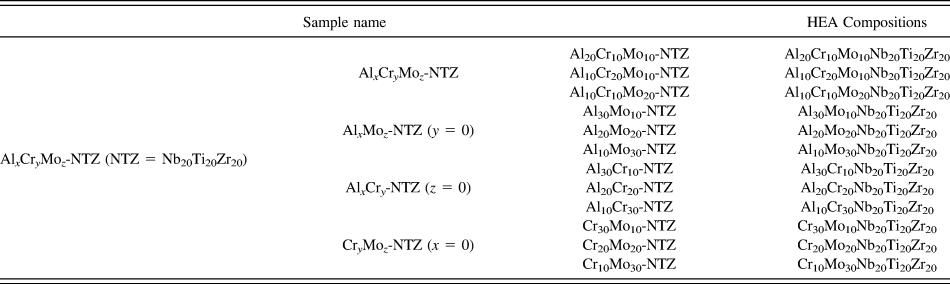
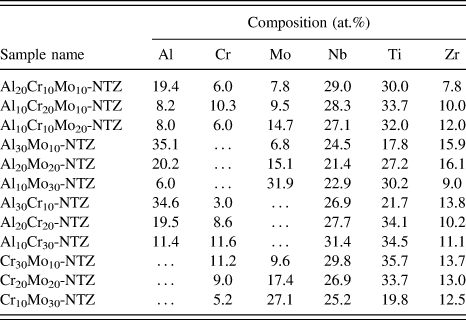
The metal sources (granules/sheets) of Al (99.9%), Cr (99.9%), Mo (99.9%), Nb (99.9% pure), Ti (99.9%), and Zr (99.2%) were melted using an arc melting furnace (ACM-01, DAIA-VACUUM, Tokyo, Japan) to form AlxCryMoz-NTZ. Details of the compositions of the samples are given in Table I.
Detailed compositions of the HEA AlxCryMoz-NTZ.

Melting was done in an inert gas (Ar) atmosphere (10−4–10−5 mbar). A high-purity Ti-sponge was also used as an oxygen getter to minimize oxidation. Water-cooled copper molds were used as a melting pit to prevent the melting of the mold and to reduce the temperature at a cooling rate up to 100 K/s after the melting process had completed. All the samples were remelted at least five times to enhance the chemical homogeneity. Further homogenization was carried out by heat treating the samples at 1200 °C up to 24 h in an Ar atmosphere, as per previous practices.Reference Yurchenko, Stepanov and Salishchev25–Reference Stepanov, Shaysultanov, Salishchev and Tikhonovsky27 A microstructural analysis of the AlxCryMoz-NTZ samples was carried out by X-ray diffraction (XRD, D/MAX-2500, Rigaku, Tokyo, Japan) and scanning electron microscopy coupled with energy dispersive spectroscopy (SEM-EDS, FEI Magellan 400, Hillsboro, Oregon). The effect of varying the composition on the isothermal oxidation resistance of AlxCryMoz-NTZ (2 × 4 mm2 samples) was analyzed via a thermogravimetric analysis (TGA) at 1000 °C in air up to 1 h. An oxidation test at 1000 °C for 20 h was conducted to assess the mass change and the integrity of the AlxCryMoz-NTZ HEA samples after extended oxidation.
III. RESULTS AND ANALYSIS
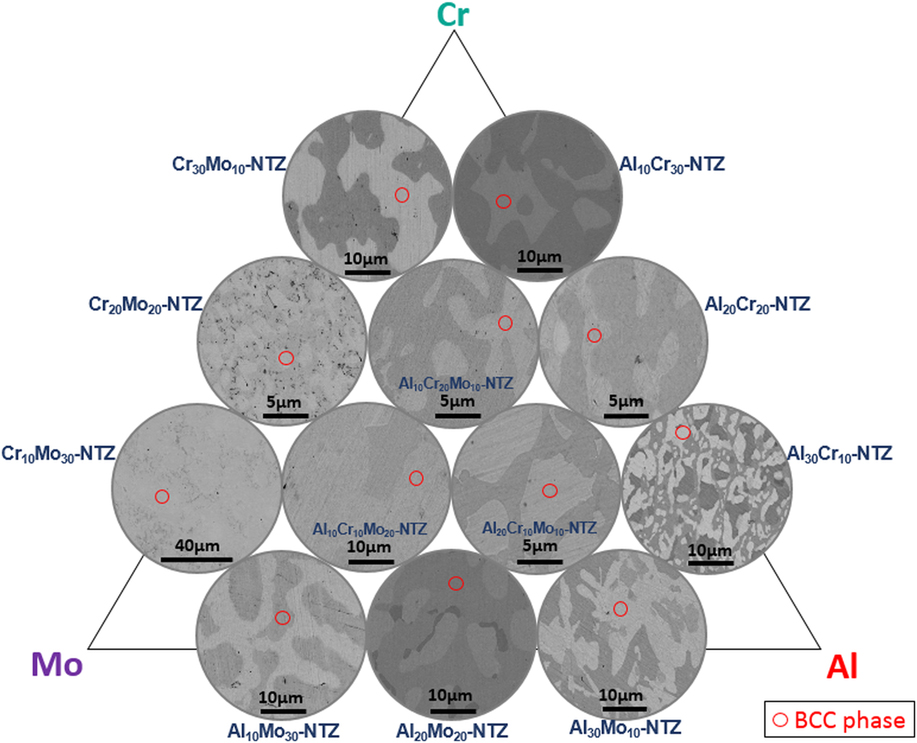
The SEM analysis of the homogenized AlxCryMoz-NTZ HEAs reveals a coarse granular microstructureReference Stepanov, Yurchenko, Shaysultanov, Salishchev and Tikhonovsky7 with clear boundaries between the solid solution and the secondary phases as shown in Fig. 2. The secondary phases in refractory HEAs have been identified as various kinds of intermetallic phases including the hexagonal C14 Laves phaseReference Yurchenko, Stepanov, Shaysultanov, Tikhonovsky and Salishche2–Reference Yurchenko, Stepanov, Zherebtsov, Tikhonovsky and Salishchev4,Reference Stepanov, Yurchenko, Shaysultanov, Salishchev and Tikhonovsky7,Reference Stepanov, Yurchenko, Sokolovsky, Tikhonovsky and Salishchev19,Reference Duan, Huang, Sun, Peng and Zhou28,Reference Raghavan29 and the cubic C15 Laves phase.Reference Kellou, Grosdidier, Coddet and Aourag30 In the AlCrNbTiVReference Stepanov, Yurchenko, Skibin, Tikhonovsky and Salishchev9 and AlCrMoNbTiReference Chen, Kauffmann, Gorr, Schliephake, Seemüller, Wagner, Christ and Heilmaier31 HEAs, the Laves phase compositions of (Nb, Ti)(Al, Cr, V)2Reference Stepanov, Yurchenko, Skibin, Tikhonovsky and Salishchev9 and (Nb, Ti)(Al, Cr, Mo)2Reference Chen, Kauffmann, Gorr, Schliephake, Seemüller, Wagner, Christ and Heilmaier31 were described as having AB2 stoichiometry in which A and B are elements with greater and lesser atomic sizes, respectively.Reference Stepanov, Yurchenko, Skibin, Tikhonovsky and Salishchev9
A combinatorial library of SEM images of the homogenized AlxCryMoz-NTZ samples.

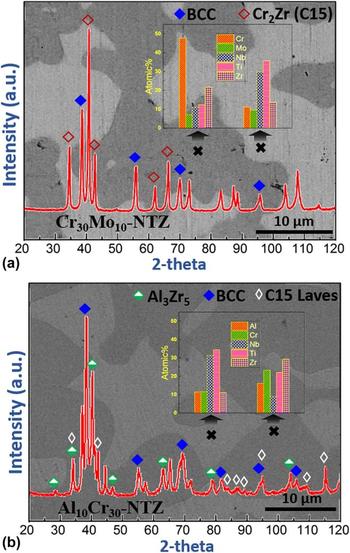
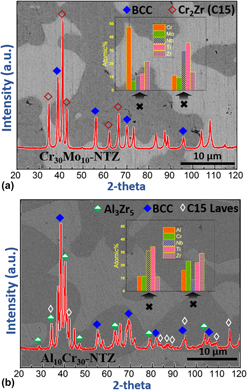
The coupled analyses of the SEM microstructures with XRD and EDS provided useful information about the structures and compositions of the constituent phases as illustrated using the cases of Cr30Mo10-NTZ and Al10Cr30-NTZ in Fig. 3. XRD patterns of the homogenized Cr30Mo10-NTZ and Al10Cr30-NTZ samples show major BCC structures along with secondary phases. A Cr2Zr-type C15 Laves phase was identified in Cr30Mo10-NTZ and an Al3Zr5-type intermetallic phase was identified in Al30Cr10-NTZ as the major secondary phases, respectively. The chemical compositions of the BCC phases and the intermetallic phases in the Cr30Mo10-NTZ and Al10Cr30-NTZ samples measured by the EDS analysis were presented in the insets of Fig. 3, respectively. Table II shows the chemical composition of the BCC phases observed in the twelve AlxCryMoz-NTZ samples. In general, the concentrations of Nb and Ti are higher than 20 at.%, while the concentrations of Zr are lower than 20 at.% in the BCC phases in the AlxCryMoz-NTZ samples.
Microstructural analyses of (a) Cr30Mo10-NTZ and (b) Al10Cr30-NTZ by SEM, XRD, and EDS.

EDS analysis of the BCC phases in the AlxCryMoz-NTZ samples.

The likelihood of intermetallic phases and solid solution phases in AlxCryMozNbTiZr HEAs was estimated by comparing the atomic size difference (δr), the Allen electronegativity difference (∆X Allen),Reference Yurchenko, Stepanov and Salishchev25 and the average value of the d-orbital energy level  $\overline {\left( {Md} \right)}$ with the intermetallic phase formation criteria. Yurchenko et al. analyzed that Laves phase formation is observed in HEAs having an atomic size difference (δr) greater than 5% and an Allen electronegativity difference (∆X Allen) exceeding 7%.Reference Yurchenko, Stepanov and Salishchev25
We calculated δr and ∆X Allen for AlxCryMozNbTiZr and these values are given in Table III. For most AlxCryMozNbTiZr HEAs, the δr values are greater than 5%, except for AlxMoz-NTZ HEAs. The ∆X Allen values of AlxCryMozNbTiZr exceed 7% for most compositions. An increase in the Cr content leads to an increase in ∆X Allen. However, for Al20Mo20-NTZ, Al10Mo30-NTZ, and Cr10Mo30-NTZ, ∆X Allen ≤ 7%. The values of δr and ∆X Allen suggest intermetallic phases in most AlxCryMozNbTiZr HEAs. While Al20Mo20-NTZ and Al10Mo30-NTZ have δr < 5 and ∆X Allen ≤ 7%, a microstructural analysis exhibits the existence of intermetallic phases similar to the other AlxCryMozNbTiZr HEAs as shown in Fig. 2.
Atomic size mismatch (δr), Allen electronegativity difference (∆X Allen), and average values of d-orbital energy level  $\overline {\left( {Md} \right)}$ calculated for AlxCryMozNbTiZr.

Morinaga et al. analyzed that superalloys having an average value of the energy level of the d-orbital  $\overline {\left( {Md} \right)}$ higher than 0.915 eV exhibit the σ phase.Reference Morinaga, Yukawa, Adachi and Ezaki32 Lu et al.Reference Lu, Dong, Jiang, Wang, Li and Zhang33 applied Morinaga’s approach to HEAs and observed that the HEAs with
 $\overline {Md} > 1.09$ exhibit stable intermetallic phases with few exceptions. As per the methods given in the literature,Reference Morinaga, Yukawa, Adachi and Ezaki32,Reference Lu, Dong, Jiang, Wang, Li and Zhang33 we calculated the average value of the energy level of the d-orbital
 $\left( {\overline {Md} } \right)$ for AlxCryMozNbTiZr, as shown in Table III. According to the
 $\overline {Md}$ values, secondary phases are expected to appear in all compositions of AlxCryMozNbTiZr.
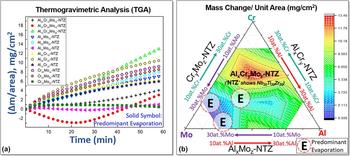
It has been reported that the oxidation of HEA yields a mixture of various oxides due to multiple principal elements.Reference Liu, Wang, Zhang, Tang and Zhang13,Reference Senkov, Senkova, Dimiduk, Woodward and Miracle21,Reference Waseem, Lee, Lee and Ryu34 The literature suggests the presence of various oxides, including TiO2, Nb2Zr6O17, TiNb2O7, ZrO2, NbCrO4, Cr2O3, NbO,Reference Butler, Chaput, Dietrich and Senkov20 Cr2O3,Reference Müller, Gorr, Christ, Chen, Kauffmann and Heilmaier35 Al2O3,Reference Gorr, Mueller, Christ, Mueller, Chen, Kauffmann and Heilmaier36 Cr2Ti5O13, Nb3Cr2O10, Nb2Zr8O21, Ti2ZrO6, Ti0.8O2, Cr2TiO5, and Nb2O5Reference Senkov, Senkova, Dimiduk, Woodward and Miracle21 in refractory HEAs. To analyze the effect of various constituent elements and quantify the oxidation resistance, the TGA method can be used for HEAs.Reference Butler, Chaput, Dietrich and Senkov20,Reference Senkov, Senkova, Dimiduk, Woodward and Miracle21,Reference Müller, Gorr, Christ, Chen, Kauffmann and Heilmaier35,Reference Kai, Li, Cheng, Chu, Huang, Tsay and Kai37 The change in the mass of the AlxCryMoz-NTZ HEA samples during oxidation and the change in the oxidation rate were estimated.Reference Coats and Redfern38 The samples were exposed to air at 1000 °C and the change in the mass was measured, as presented in Fig. 4(a). The mass change per unit area after one hour of oxidation at 1000 °C is mapped on a pseudo-ternary diagram as shown in Fig. 4(b).
(a) TGA curves and (b) total mass change/unit area after 1 h of oxidation at 1000 °C in a pseudo-ternary map of homogenized AlxCryMoz-NTZ.

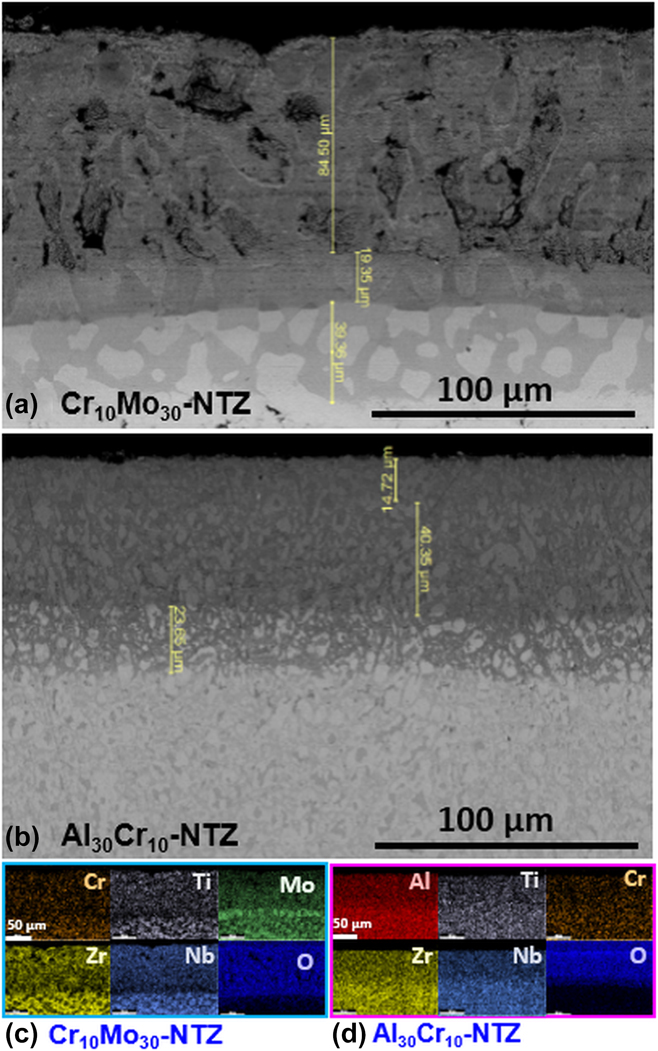
The HEA samples with a higher concentration of Mo showed a negative slope of the TGA curves [solid symbols in Fig. 4(a)]. For example, the masses of Al10Mo30-NTZ, Cr10Mo30-NTZ, and Al10Cr10Mo20-NTZ decreased at a certain period during the oxidation experiment. This behavior can be attributed to the formation of a volatile oxide, as has been reported for Mo-rich refractory alloys.Reference Karahan, Ouyang, Ray, Kramer and Akinc39 The evaporation during the oxidation of Al10Mo30-NTZ, Cr10Mo30-NTZ, and Al10Cr10Mo20-NTZ may also be related to the significant porosity in the oxide layers.Reference Meyer, Thom and Akinc40 The microstructural analysis of the oxidized samples revealed porous oxide layers for volatile oxidation in AlxCryMoz-NTZ. The representative microstructures of the porous (Cr10Mo30-NTZ) and dense oxide layers (Al30Cr10-NTZ, respectively) are shown in Figs. 5(a) and 5(b), respectively. Mixed phases were observed in the oxide layers Al30Cr10-NTZ, but no Al-rich layers were found in the oxide layers.
Microstructures of (a) Cr10Mo30-NTZ and (b) Al30Cr10-NTZ, and EDS analysis results of (c) Cr10Mo30-NTZ and (d) Al30Cr10-NTZ of the oxide layers of AlxCryMoz-NTZ.

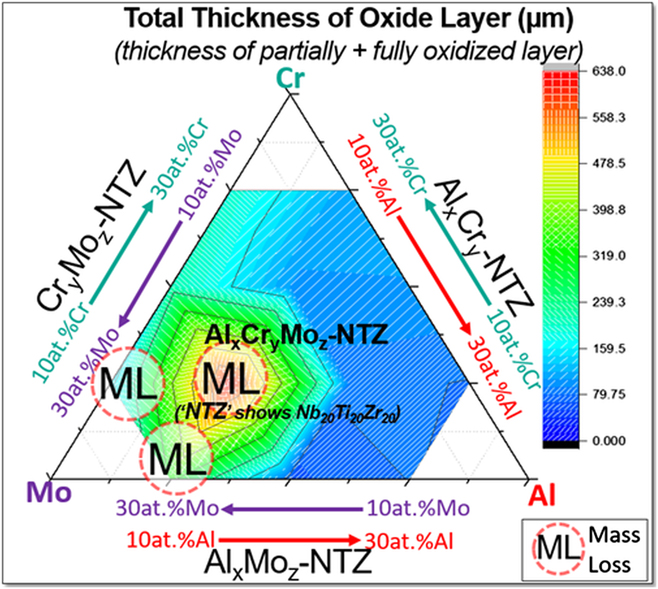
Figure 6 shows the variation in the surface oxide thicknesses after the TGA. The oxide layer thickness in the AlxCryMoz-NTZ HEA system varies between 60 and 600 µm. Although a direct comparison of the oxide thicknesses of the HEA compositions is less meaningful due to volatile oxidation in some samples, it is important to note the effect of Al on reducing the oxidation thickness in Mo-free AlxCry-NbTiZr as compared to that in Mo-bearing HEAs. Al10Cr30-NTZ shows a 107-µm-thick oxide scale that remains unchanged upon increasing the Al content to 20 at.%. A further addition of Al to yield Al30Cr10-NTZ shows a significant reduction in the oxide thickness to 79 µm, as shown in Fig. 6.
Variation in the thickness of the oxide layer of AlxCryMoz-NTZ.

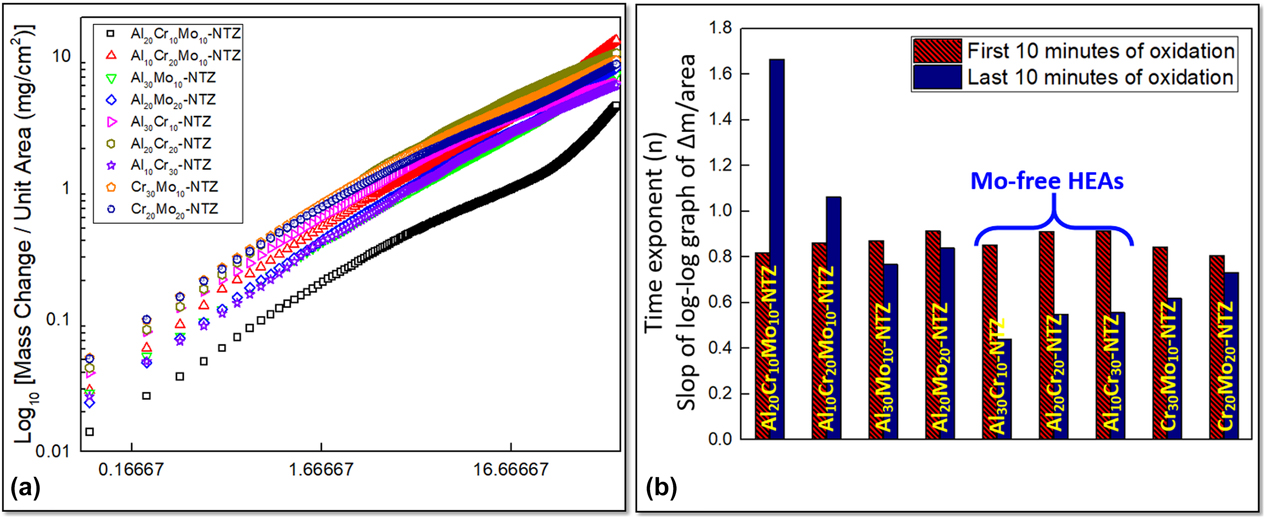
The formation of stable oxide films reduces the contact between oxygen and the bare metal surface and controls the oxidation rate. To determine the protectiveness of the oxide scale on AlxCryMoz-NTZ HEA, the mass change versus time was plotted on a log–log scale graph [Fig. 7(a)] and the slope was determined [Fig. 7(b)]. The protective oxide layer is observed when the log–log graph of the mass change versus time shows a slope (empirical exponent, n) of 0.5.Reference Senkov, Senkova, Dimiduk, Woodward and Miracle21 The plot of mass gain per unit surface area of CrMo0.5NbTa0.5TiZr on a logarithmic scale shows two distinct features. First, the oxidation started at a higher rate and exhibited n = 0.85 (up to 25 min), after which the development of the oxide scale reduced the rate of the reaction and n became 0.5 (which remained at that value for up to 60 min).Reference Senkov, Senkova, Dimiduk, Woodward and Miracle21 The oxidation of NbTiVZr at 1000 °C proceeded with n = 0.9 until the HEA sample was fully oxidized within 8 h.Reference Butler, Chaput, Dietrich and Senkov20 By contrast, the oxidation of CrNbTiZr was controlled by an oxygen-alloy interfacial reaction in the initial stage up to 1.8 h, with n remaining at 0.74, after which the diffusion of oxygen through the oxide scale started, controlling the rate of the oxidation reaction, with n reduced to 0.34 and remaining there until 100 h of oxidation.Reference Butler, Chaput, Dietrich and Senkov20 To compare the oxidation behaviors of these reported HEAs with that of AlxCryMoz-NTZ, the slopes of the first 10 min and the last 10 min were compared, as shown in Fig. 7(b), while the values for the samples which presented negative slopes were excluded. During the first ten minutes of oxidation, the AlxCryMoz-NTZ HEA shows n values ranging from 0.81 to 0.91.
(a) TGA curves on a log–log scale and (b) time exponent [slopes of log10(∆m/area) versus log10(time) curve] during the first and last ten minutes of oxidation.

During the last ten minutes of oxidation, the n value for AlxCryMoz-NTZ changed from the values during the initial 10 min. The slopes of the Mo-containing HEAs did not decrease much, as shown in Fig. 7(b). Some of them showed increased slopes, as shown in Al20Cr10Mo10-NTZ and Al10Cr20Mo10-NTZ. The Mo-free HEA samples of Al30Cr10-NTZ, Al20Cr20-NTZ showed n values close to 0.5, suggesting the formation of protective oxide layers. The slope of ∼0.5 for these alloys also suggests that the degree of protectiveness of the oxide layer on these alloys is comparable to that of CrMo0.5NbTa0.5TiZrReference Senkov, Senkova, Dimiduk, Woodward and Miracle21 and is better than those of NbTiVZr and CrNbTiZr.Reference Butler, Chaput, Dietrich and Senkov20 HEAs having higher Al contents (within their respective groups) showed lower n values during the last ten minutes of oxidation as well. Hence, Al is observed to be effective in forming a passive oxide layer.
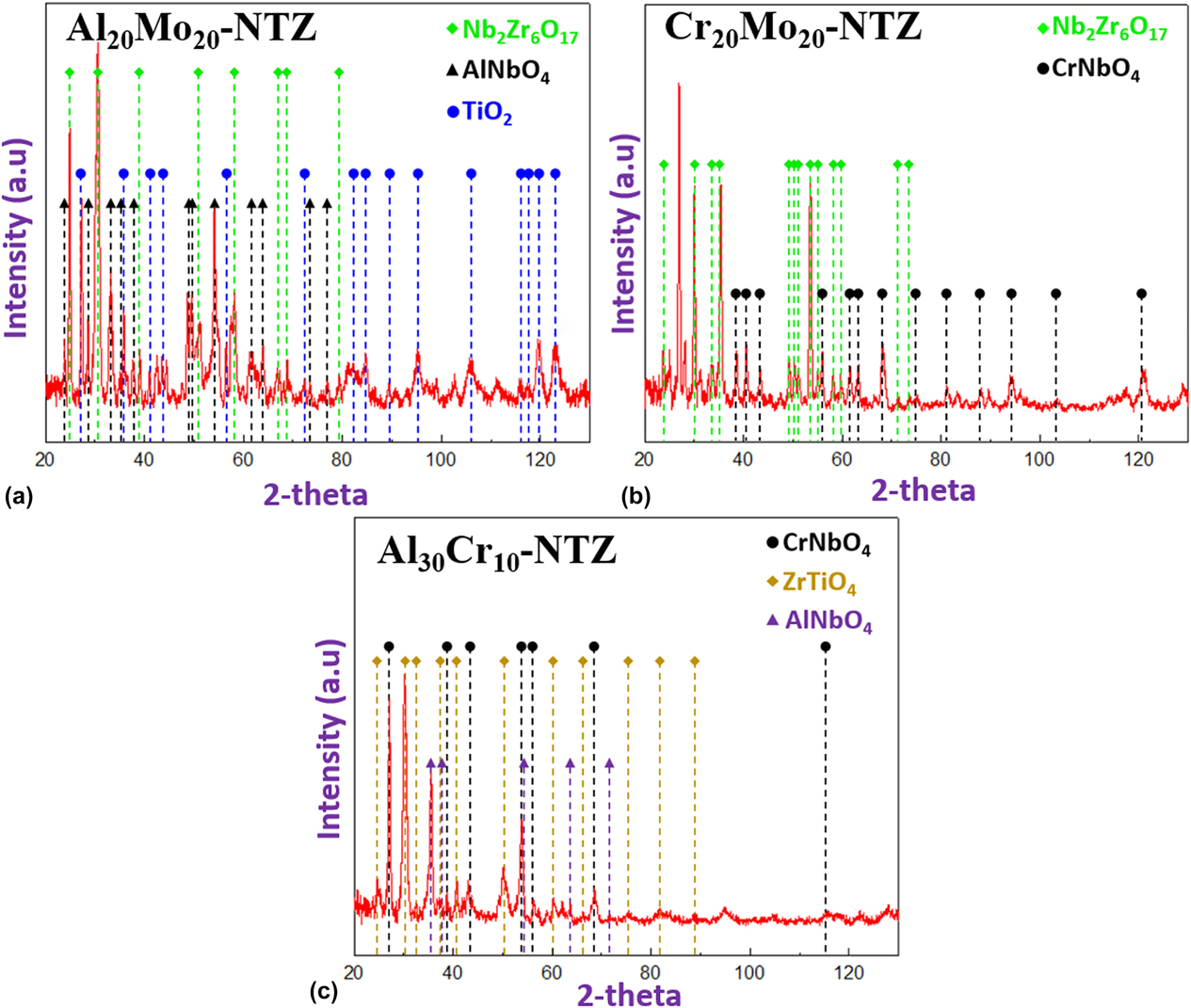
Mixtures of oxides are identified by an analysis of the XRD patterns of oxidized HEA samples (Fig. 8). For example, the oxide scale on Al20Mo20-NTZ shows Nb2Zr6O17, AlNbO4, and TiO2. Nb2Zr6O17 and ZrTiO4 are observed in the oxide scale of Cr20Mo20-NTZ and Al30Cr10-NTZ, respectively. In addition to these, other complex oxides may also be present. The compositions of the oxide scale are similar to those in other studies in which the formation of similar oxides after the oxidation of refractory HEAs was reported.Reference Butler, Chaput, Dietrich and Senkov20,Reference Senkov, Senkova, Dimiduk, Woodward and Miracle21,Reference Müller, Gorr, Christ, Chen, Kauffmann and Heilmaier35,Reference Gorr, Mueller, Christ, Mueller, Chen, Kauffmann and Heilmaier36
XRD analysis results of the oxide layers on three AlxCryMoz-NTZ HEAs [(a) Al20Mo20-NTZ, (b) Cr20Mo20-NTZ, and (c) Al30Cr10-NTZ] oxidized at 1000 °C for 1 h.

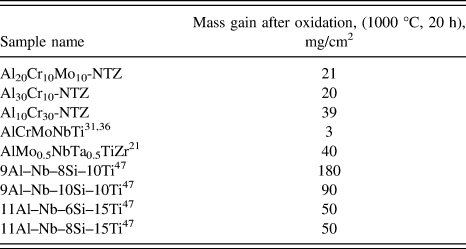
To analyze the response of these HEAs to prolonged oxidation, the samples were subjected to oxidation in static air (at 1000 °C) for 20 h. After 20 h of oxidation, the Al30Cr10-NTZ, Al20Cr10Mo10, and Al10Cr30-NTZ samples remained intact and their oxide layers remained adhered to the surface. The other samples were either fully oxidized or their oxide layers were detached. The comparison of oxidation resistance capabilities of Al30Cr10-NTZ, Al20Cr10Mo10, and Al10Cr30-NTZ demonstrates higher oxidation resistance in these samples relative to those of several Nb-based alloys (Table IV). Furthermore, we could find only two reports of HEAs with significant oxidation resistance: AlMo0.5NbTa0.5TiZrReference Senkov, Senkova, Dimiduk, Woodward and Miracle21 and AlCrMoNbTi.Reference Gorr, Mueller, Christ, Mueller, Chen, Kauffmann and Heilmaier36 The mass gain in AlCrMoNbTiReference Gorr, Mueller, Christ, Mueller, Chen, Kauffmann and Heilmaier36 was quite low, suggesting quite stellar oxidation resistance. However, Al30Cr10-NTZ, Al20Cr10Mo10, and Al10Cr30-NTZ reveal better oxidation resistance capabilities than AlMo0.5NbTa0.5TiZr. To quantify the volatile oxidation and evaporation of Mo-containing HEAs, TGA should be coupled with mass spectrometry.Reference Kamruddin, Ajikumar, Dash, Tyagi and Raj41
Comparison of the mass gain after prolonged oxidation of Al20Cr10Mo10-NTZ, Al30Cr10-NTZ, and Al10Cr30-NTZ with relevant HEAs and refractory alloys.

Recent publications pertaining to refractory HEAs report samples with higher mechanical strength and strain levels, but all of those alloys possess W,Reference Senkov, Wilks, Scott and Miracle11,Reference Zhang, Zuo, Tang, Gao, Dahmen, Liaw and Lu42,Reference Zou, Maiti, Steurer and Spolenak43 Ta,Reference Senkov, Wilks, Scott and Miracle11,Reference Zhang, Zuo, Tang, Gao, Dahmen, Liaw and Lu42,Reference Dirras, Gubicza, Heczel, Lilensten, Couzinié, Perrière, Guillot and Hocini44 V,Reference Wu, Cai, Chen, Wang, Si, Wang, Wang and Hui15,Reference Stepanov, Yurchenko, Panina, Tikhonovsky and Zherebtsov45 and/or Hf,Reference Guo, Wang, Luo, Li, Chen, Su, Guo and Fu12,Reference Zhang, Zuo, Tang, Gao, Dahmen, Liaw and Lu42,Reference Dirras, Gubicza, Heczel, Lilensten, Couzinié, Perrière, Guillot and Hocini44,Reference Fazakas, Zadorozhnyy, Varga, Inoue, Louzguine-Luzgin, Tian and Vitos46 with deleteriously high-density levels (due to Ta and W), high costs (due to Hf and Ta), or oxidation (due to V). Therefore, the commercial feasibility of such HEAs is uncertain. Al20Cr10Mo10-NTZ and Al30Cr10-NTZ showed good oxidation resistance levels without such deleterious elements. This forecasts the potential high-temperature applications of these HEAs; therefore, their mechanical properties need to be analyzed in detail in the near future.
IV. CONCLUSION
Here, arc-melted and homogenized AlxCryMoz-NTZ HEAs showed a BCC structure along with intermetallic phases including Al3Zr5, cubic C15 and hexagonal C14 Laves phases. Oxidation at 1000 °C for 1 h led to a 0.5–13.38 mg/cm2 gain in the mass. The Mo-rich HEAs were associated with mass losses due to volatile oxidation. Increasing the concentration of Al resulted in a reduction in the rate of the oxidation reaction, thus demonstrating the role of Al in improving the oxidation resistance of AlxCryMoz-NTZ. The time exponent of Mo-free HEAs was found to be closer to 0.5, ensuring the protectiveness of the oxide layer. Al30Cr10-NTZ showed a weight gain of 20 mg/cm2 after prolonged oxidation up to 20 h in air at 1000 °C. The enhanced oxidation resistance capabilities of Al30Cr10-NTZ forecast its potential for use in high-temperature applications.
ACKNOWLEDGMENT
This study was supported by National Research Foundation of Korea (NRF-2015R1A2A2A01002436 and NRF-2015R1A5A1037627).