Introduction
One of the major challenges of meeting the Millennium Development Goals in Nigeria and many other developing countries is the continued rapid growth of the population. With more than 140 million people in 2006, the country has a high annual growth rate of 3.2% and a total fertility rate (TFR) of 5.7 (FGN, 2009; NPC & ICF Macro, 2009). The number of people in need of health, education, economic empowerment and other services is therefore large and increasing. This, in turn, implies that the amount of resources, personnel and infrastructure required to meet the Millennium Development Goals is also increasing. Additionally, reproductive health in Nigeria has remained poor over the years compared within other sub-Saharan African countries, e.g. Ghana, Liberia and Senegal. In Nigeria, the maternal mortality rate has been estimated at 545 per 100,000 live births, infant mortality rate at 75 per 1000 live births and under-five mortality rate at 157 per 1000 live births (NPC & ICF Macro, 2009). According to WHO (2011), the largest proportion of maternal deaths in Nigeria are due to five major complications: haemorrhage, infection, unsafe abortion, hypertensive disease during pregnancy and obstructed labour, with 15% of women suffering from serious or long-term complications such as pelvic inflammatory disease and infertility. Maternal deaths as a result of high-risk teenage pregnancies, either from unsafe abortion or delivery complications, contribute significantly to the high maternal mortality rates recorded in different parts of the country (NPC & ICF Macro, 2009; WHO, 2012). Promotion of family planning has been identified as a means of reducing poverty and hunger in addition to averting maternal deaths by 32% and childhood deaths by almost 10% in countries with high birth rates (Cleland et al., Reference Cleland, Bernstein, Ezeh, Faundes, Glasier and Innis2006; WHO, 2012).
In response to these, and other demographic and health issues, the Federal Government of Nigeria put into effect the National Policy on Population and Development in 1988. This policy was later revised giving way to the National Policy on Population for Sustainable Development in 2005. The overall goal of the policy was to improve the quality of life and standard of living for the Nigeria population through the attainment of a number of specific goals, including the reduction of the total fertility rate (TFR) by at least 0.6 every five years by encouraging child spacing through the use of family planning (NPC, 2004).
Background
Despite continued efforts by government and other donor agencies to promote the use of modern FP methods, Nigeria remains one of the countries with the lowest contraceptive prevalence rates (CPR). Although knowledge of methods of modern family planning is as high as 70%, this does not translate into usage. Overall, less than 10% of women of reproductive age use any modern FP method in Nigeria (FMOH, 2009; NPC & ICF Macro, 2009). Over time, there appears to have been very little improvement in contraceptive use, rising from 3% in 1990 to 10% in 2008 (NPC & ICF Macro, 2009). Between 1990 and 2008 (an 18-year period), contraceptive prevalence (for all methods) increased from 6% to 15%. However, use of modern FP methods increased from 4% to 10% between the same time period (FOS, 1992; NPC, 2000; FMOH, 2004, 2006; NPC & ICF Macro, 2009). The low use of modern FP methods has been attributed to several factors. Prominent among these is the low contribution of health workers to providing information. This stems from the fact that, in Nigeria, many still regard family planning as exclusively for the married, and therefore family planning clinics are not user-friendly to unmarried women of reproductive age (15–49 years), who comprise 9% of the population (NBS, 2009). Discussion about sex and contraception with young or unmarried persons is still considered inappropriate, even among health workers (Otoide et al., Reference Otoide, Oronsaye and Okonofua2001; Abiodun & Balogun, Reference Abiodun and Balogun2009; Monjok et al., Reference Monjok, Smesny, Ekabua and Essien2010). Studies have shown that the main sources of information about contraception in Nigeria are friends or siblings, media, formal education and health-workers (Amazigo et al., Reference Amazigo, Silva, Kaufman and Obikeze1997; Okpani & Okpani, Reference Okpani and Okpani2000; Oye-Adeniran et al., Reference Oye-Adeniran, Adewole, Odeyemi, Ekanem and Umoh2005; Abiodun & Balogun, Reference Abiodun and Balogun2009; Monjok et al., Reference Monjok, Smesny, Ekabua and Essien2010; Ankomah et al., Reference Ankomah, Anyanti and Oladosu2011).
Of the different methods of family planning, the following are considered as modern methods: daily oral pills, after-sex oral pills (emergency contraception), condoms (male/female), injectables, implants, IUCDs, female sterilization and male sterilization. Other factors inhibiting the use of modern family planning that have been highlighted include fear of side effects, objection from partners, conflict with religious beliefs, objections from family members, not thinking about using contraceptive and unplanned early sexual debut (Otoide et al., Reference Otoide, Oronsaye and Okonofua2001; Abiodun & Balogun, Reference Abiodun and Balogun2009; Monjok et al., Reference Monjok, Smesny, Ekabua and Essien2010).
Caldwell et al. (Reference Caldwell, Orubuloye and Caldwell1992) reported that unmarried women in Ibadan, south-west Nigeria, were twice as likely to practise contraception as married women, despite the refusal of hospitals and family planning clinics at that time to provide services for the single. The majority of those practising contraception wished to prevent pre-marital pregnancy, which they linked to the desire for continued education or getting a job in the modern sector of the economy (Caldwell & Caldwell, Reference Caldwell and Caldwell2002). In an analysis of the early datasets of the Demographic and Health Surveys in West Africa, Caldwell et al. (Reference Caldwell, Orubuloye and Caldwell1992) found that levels of contraceptive practice were much higher among never-married than among currently married women in Nigeria and Cameroon, and almost as high in Ghana. This pattern of contraceptive usage has a major implication for Africa's fertility transition. A greater part of the decline would be accounted for by young women under the age of 25, a situation that is different from what is obtainable for Asia and Europe, where fertility declines are usually non-existent or very limited below age 25 (Gayawan et al., Reference Gayawan, Adebayo, Ipinyomi and Oyejola2010).
Considering the prevailing pattern and low usage of modern contraceptive methods in Nigeria, it is imperative to analyse the trend, level, determinants and geographical variation of use of modern FP methods in the country. This would enable hidden demographic and socioeconomic processes that enhance usage to be established. Most health indicators in Nigeria have been found to vary substantially according to geographical location (FMOH, 2009; NPC & ICF Macro, 2009). To further establish this variation, the Nigeria Demographic and Health Surveys present disaggregated data for the six geo-political zones of Nigeria, with each zone consisting of about six states. These are the North-West, North-East, North-Central, South-West, South-East and South-South zones. For instance, while the national TFR was 5.7 in 2008, it ranged from 4.5 in the South-West to 7.3 in the North-West; the prevalence of teenage childbearing among women aged 15–19 years ranged from 8% in the South-West to 45% in the North-West. While women in the South-West desired an average of 4.6 children (lowest), their counterparts in the North-West desired an average of 8.1 children (highest) (NPC & ICF Macro, 2009). Whereas only 3.5% of women of reproductive age from the North-East were using modern FP methods, more than one-fifth (21%) of women of reproductive age in the South-West were using them in 2008 (NPC & ICF Macro, 2009). This geographical information is highly aggregated and may therefore conceal local- and district- (state) specific effects. Moreover, no covariate was adjusted for, and this may therefore lead to a misleading conclusion. On the other hand, when available, information on use of modern family planning stratified into districts strongly depends on the sample, which may be rather unstable. Some kind of spatial smoothing technique is therefore required to stabilize rates observed in the sample.
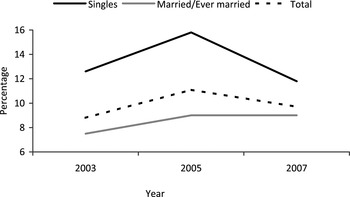
Previous studies have considered and modelled the influence of possible determinants of use of modern family planning methods parametrically and neglected the spatial aspect (Amazigo et al., Reference Amazigo, Silva, Kaufman and Obikeze1997; Odimegwu, Reference Odimegwu1999; Abiodun & Balogun, Reference Abiodun and Balogun2009; Okezie, et al., Reference Okezie, Ogbe and Okezie2010). Such assumption of a linear predictor for assessing the effect of covariates on the response variable is often too restrictive and rigid in realistically complex situations (Adebayo, Reference Adebayo2004). Classical parametric regression models also have severe problems with estimating small area effects, and simultaneously adjusting for other covariates, particularly when the effects of some covariates are non-linear or time-varying. In such instances, a very high number of parameters are needed for modelling purposes, which may result in unstable estimates with high variance. The Bayesian geo-additive approach (Fahrmeir & Lang, Reference Fahrmeir and Lang2001; Lang & Brezger, Reference Lang and Brezger2004; Brezger & Lang, Reference Brezger and Lang2006) that is adopted in this study proffers a solution to the challenges highlighted above. Further, the paper attempts to unravel the possible factors that led to an increase in use of modern family planning in Nigeria between 2003 and 2005, but a decline between 2005 and 2007, as evident from the descriptive analyses of these data (see Fig. 1). It is anticipated that knowledge of such effects will assist programmers in re-strategizing if the country is to attain Millennium Development Goals 4 and 5.
Modern FP usage by year and marital status of respondents.

Data and Methods
Survey methods
The National HIV/AIDS and Reproductive Health Survey (NARHS) was the first national study on HIV and reproductive health issues to be conducted in Nigeria. It aimed to assess and monitor levels of, and trends in, various indicators of HIV/AIDS and other reproductive health issues. The NARHS was conducted in 2003, 2005 and 2007. Specifically, it aimed to provide information on the reproductive and sexual health situation in Nigeria, the factors that influence reproductive and sexual health, and to provide data on the impact of ongoing HIV and reproductive health behaviour change interventions in Nigeria. As part of the survey, various types of mass media interventions that were implemented by the Society for Family Health (SFH) and other implementing partners were evaluated through exposure questions. Ethical approvals were sought and obtained from the Nigerian Institute of Medical Research, which is one of the Institutional Review Boards in Nigeria. Confidentiality of information was stressed and ensured to the respondents.
Eligible respondents for these surveys were women aged 15–49 years and men aged 15–64 years. Selection was through a stratified probability sampling technique based on locality of residence (i.e. rural or urban). Individual respondents were selected within households in various enumeration areas across the country. Within a state (administrative division), all eligible persons, irrespective of their place of residence (rural or urban), were given an equal chance of being included in the final sample. Using an appropriate formula that allows for comparison between baseline and subsequent follow-up studies, sample sizes were calculated based on a 5% level of significance and 80% power of the test. Questionnaires were pre-tested and administered by trained interviewers under the supervision of seasoned researchers.
Data
For this paper, a database consisting of records about sexually active women of reproductive age was created from the complete survey dataset (i.e. combined dataset of three waves of surveys: 2003, 2005 and 2007). In total, the database consists of 12,538 respondents. Various questions on knowledge and use of any FP method were included in the questionnaire. Possible determinants of use of modern FP methods that were considered in this paper include place of residence, educational attainment, religion, ethnicity, knowledge about methods of family planning and perception about availability and affordability of modern FP methods. To further understand whether any change in level of use of family planning method is attributable to exposure to campaigns and other mass media on family planning that were aired during the survey period, the possible association between use of modern family planning methods and exposure to mass media was explored. The influence of socioeconomic status (measured as possession and ownership of durables and assets) on use of modern FP methods was also explored.
Analysis
Consider observations (yi, xi, si, vi), i=1,…, n, where yi is a binary response variable, y takes the value 1 if the respondent used a contraceptive and 0 otherwise, a vector x=(x 1,…,xp)′ of metrical covariates: respondent's age, si=(1,…,37), the state (district) where respondent i lived during the survey, and a further vector v=(v 1,…, vq)′ of categorical covariates. Usually the dependence of yi is modelled on metrical, spatial and categorical covariates within the context of a generalized additive model (Hastie & Tibshirani, Reference Hastie and Tibshirani1990). The predictor ηi for the geo-additive model is defined as:

, where f 1,…, fp are non-linear (unknown) smooth functions of the metrical covariates, f spat is the non-linear effect of spatial covariates and βi=(β1,…, βL)′ is a vector of fixed effect parameters for the categorical covariates. and z 2005 and z 2007 are dummies for the second and third rounds of the NARHS, i.e. 2005 and 2007 (i.e. year of study with 2003 as the reference category). The spatial effects f spat may be further split into spatially correlated (structured) and uncorrelated (unstructured) effects as:

.
The rationale behind this is that a spatial effect is a surrogate of many unobserved influential factors, some of which may be strong spatial structures and others only present locally. In an attempt to explore possible determinants, trend and spatial variations in use of modern FP methods, analysis was based on predictor (1), above. The influence of characteristics of use of modern FP methods was modelled through a binary logistic model within a Bayesian perspective that jointly accounts for non-linear, trend and spatial effects. The Bayesian structured additive regression of the logit model is preferred because of ease of interpretation and the possibility of computing a posterior odds ratio (which is a measure of the strength of association in logistic regression) directly from the Markov chain Monte Carlo (MCMC) output. Fitting Bayesian models via MCMC entails treating all parameters as randomly distributed according to some prior distribution. The posterior distribution is intractable, so MCMC algorithms are used to generate samples from this prior distribution, which allow estimation and inference for the parameters (Diggle et al., Reference Diggle, Tawn and Moyeed1998).
Within a Bayesian context, all parameters and functions (say f for non-linear effects) are considered as random variables upon which appropriate priors are assumed. Independent diffuse priors are assumed on the parameters of fixed effects. For the non-linear effects, a Bayesian P-spline prior based on Lang & Brezger (Reference Lang and Brezger2004) and Brezger & Lang (Reference Brezger and Lang2006) was assumed. The P-spline allows for non-parametric estimation of f as a linear combination of the basis function (B-spline):
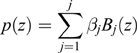
where Bj(z) are B-spline basis functions and the coefficient βj corresponds to the vector of unknown regression coefficients. Smoothness of function f is achieved by penalizing differences of coefficients of adjacent B-splines (Eilers & Marx, Reference Eilers and Marx1996) or in a Bayesian approach, as in this case, where βj values are further defined to follow first- or second-order Gaussian random walk smoothness priors:

, with i.i.d. (independent and identically distributed) errors u 1∼N(0, τ 2). The variance τ 2 controls the smoothness of f. Assigning a weakly informative inverse gamma prior (τ 2∼IG(ε, ε)); with ε very small, it is estimated jointly with the basis function coefficients. For further clarification and explanation of this concept, see Eilers & Marx (Reference Eilers and Marx1996), Lang & Brezger (Reference Lang and Brezger2004) and Brezger & Lang (Reference Brezger and Lang2006).
For the geographical effects f spat(s), s=1,…, S, a Gaussian Markov random field prior is assumed. Basically, this is an extension of first-order random walk priors to two-dimensional spatial arrays (see Rue & Held, Reference Rue and Held2005, for general information).
For the structured spatial effects f str(s) a Gaussian Markov random field prior (2) was chosen, which is common in spatial statistics (see Besag et al., 1991). Unstructured spatial effects are i.i.d. random effects:

where Ns is the number of adjacent sites and t∈∂s denotes that site t is a neighbour of site s. Again, τ 2 controls the amount of spatial smoothness.
In order to be able to estimate the smoothing parameters for non-linear and spatial effects simultaneously, highly dispersed but proper hyper-priors are assigned to them. Hence for all variance components, an inverse gamma distribution with hyperparameters a and b is chosen, e.g. τ 2∼IG(a, b). Standard choices of hyperparameters are a=1 and b=0.005 or a=b=0.001. The latter option was used in this case study.
Inference for non-linear effects in this study is based on a Bayesian version of penalized least squares with pointwise confidence intervals. The variable selection procedure aims at minimizing a goodness-of-fit criterion. Detailed information about the modelling approach using the Structured Additive Regression technique has been implemented in BayesX, a software for Bayesian analysis using MCMC and Restricted Maximum Likelihood techniques. For more information on the software, see Belitz et al. (Reference Belitz, Brezger, Kneib and Lang2009). All analyses are performed with BayesX.
Model building
Understanding the possible determinants of use of modern family planning methods has been identified as a potential means of designing interventions that will lead to increased contraceptive prevalence. In this paper, an attempt was made to explore the possible association between determinants, level, trend, geographical variations and use of modern FP in Nigeria. Seven models of different specifications were constructed from the simplest to more complex ones. For instance, the dependence of use of modern FP was first modelled on year of study, with 2003 as the reference category. This aimed to explore any possible trend in use of modern family planning methods over the 2003–2007 period. At subsequent steps, additional covariates such as demographic characteristics, knowledge about methods of family planning and spatial effects were controlled for in the models. To account for unobserved heterogeneity that may be present in the data, a random effect at state level was subsequently fitted. The various models explored are:
• Model M1: CPR=time1+time2
• Model M2: CPR=Model M1+f(state)
• Model M3: CPR=Model M2+age categories (linear age)+demographic covariates
• Model M4: CPR=Model M3+f(respondent's age)+demographic covariates
• Model M5: CPR=Model M4+knowledge
• Model M6: CPR=Model M5+SES+exposure
• Model M7: CPR=Model M6+state (random)
For all models, 15,000 iterations with 5000 ‘burn-in’ periods were used. Samples were based on every 10th observation yielding 1000 samples. The model diagnostic was based on the Deviance Information Criterion (DIC) given by  where
 is the posterior mean of the deviance and pD is the effective number of parameters (which is similar, but not equal, to degrees of freedom) (Spiegelhater et al., Reference Spiegelhalter, Best, Carlin and van der Linde2002). The model with the lowest DIC is considered best. At a first stage, data were analysed for all female respondents, and the data were then split by marital status into ‘never married’ and ‘currently/formerly married’. Sensitivity to the choice of priors was investigated in this paper by varying the priors for all parameters of the fixed, non-linear and spatial effects. It turned out that the results of the MCMC for various choices of parameters are indistinguishable.
Results
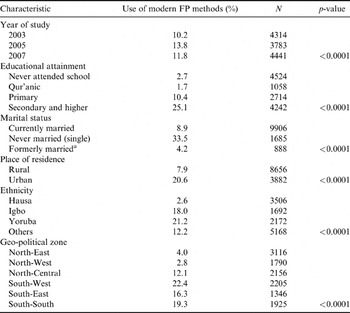
Table 1 presents findings from the bivariate analyses of use of modern FP according to selected characteristics. Use of modern FP methods was cross-classified according to selected characteristics (year of study, educational attainment, geo-political zone, etc.). The test of difference of proportions for use of modern FP methods according to selected characteristics was based on Pearson's chi-squared statistic. It became apparent that use of modern FP methods differs significantly for each of the characteristics considered (p<0.05), increasing from 10% to 14% between 2003 and 2005 but declining to 12% in 2007. It was observed that use of modern FP was higher among respondents who attained secondary or higher education, resided in urban areas, were never married and resided in the South-West.
Bivariate analysis of use of modern FP by selected characteristics

a Formerly married: divorced, separated or widowed.
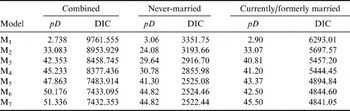
In an attempt to explore the possible determinants of use of modern FP while controlling for other factors, models M1 to M7, as specified in the Methods section, were fitted. Table 2 presents information on the DIC and pD for model diagnostics for both the combined data and for the never-married and currently/formerly married respondents separately. The results show that model M7, which incorporates trend, spatial, non-linear effect of age, demographic indices, knowledge, exposure, socioeconomic status and spatial random effect, is best based on the DIC for the combined and disaggregated data. Model diagnostics show that model performance becomes better with increased model complexity. Discussion of results is based on M1 and M7 (the best model based on the DIC).
Model comparison based on the deviance information criterion (DIC)

Fixed effects results
Analysis of all female respondents
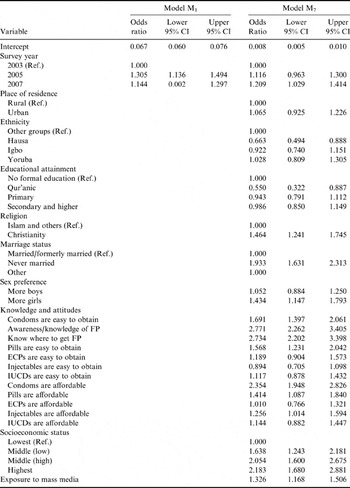
The results of the fixed effects for models M1 and M7 for the combined data are presented in Table 3. In model M1, the possible trend (with 2003 as the reference category) in use of modern FP methods was explored without adjusting for any covariate. The findings reveal that the odds of using modern family planning methods increased by 31% between 2003 and 2005, increasing only by 14% by 2007. Only the increase between 2003 and 2005 was statistically significant at p<0.05. In model M7, adjusting for some covariates resulted in a significant increase of 21% (p<0.05) in odds of using modern FP methods in 2007 when compared with the reference year (2003).
Results of fixed effects showing odds ratio and the 95% credible intervals for the full model (model M7) and model with trend alone (M1) for combined data (i.e. all women respondents)

A positive association between education and use of modern FP methods was noted, with odds increasing with higher level of education. Although respondents living in urban areas were more likely to use modern FP methods than their counterparts living in rural areas, this was not significant. The odds of using a modern FP method increased by 93% among never-married respondents compared with their counterparts who were currently married or cohabiting with a sexual partner or those that were formerly married (i.e. divorced, separated, widowed) (OR=1.933, CI: 1.631, 2.313). Compared with respondents in other ethnic groups, a significantly low use of modern FP methods was evident among the Hausas (OR=0.663, CI: 0.494, 0.888).
Sex preference of children has been considered to be an issue in African settings, especially in Nigeria. The analysis shows that respondents who desired more girls were 43% more likely to use modern FP methods compared with their counterparts who felt that sex did not matter (OR=1.434, CI: 1.147, 1.793). The odds of using modern contraceptives among respondents who desired more boys were about 5% (not significant) higher than for those who felt it was ‘up to God’.
As shown in previous studies, any attempt towards making people adopt contraceptive behaviour must ensure that products and services are available, affordable, accessible and promoted (Monjok et al., Reference Monjok, Smesny, Ekabua and Essien2010). Consequently, in this study, attempts were made to explore the possible association between use, and respondents' awareness/knowledge, of available modern FP methods: knowledge of where to get/buy the products; that condoms, pills, emergency contraceptive pills (ECPs) and IUCDs are easily obtainable and affordable. The results show that the odds of using modern FP methods among women respondents who are aware of family planning methods are about three times higher than those of their counterparts who do not have a similar knowledge/awareness (OR=2.771, CI: 2.262, 3.405). Just like awareness, knowledge of where to get/buy FP services/methods is also strongly associated with use of modern FP methods. The results show that knowledge of where to get/buy modern FP services/methods increased its use by 173% (OR=2.734, CI: 2.202, 3.398).
The findings show that use of modern FP methods is associated with knowledge that the services/methods are easy to obtain. Use of modern FP methods increased by 69% (OR=1.691, CI: 1.397, 2.061) among respondents who know that condoms are easy to obtain; by 57% (OR=1.568, CI: 1.231, 2.042) among those who know that pills are easy to obtain; by 19% (OR=1.189, CI: 0.904, 1.573) among those that know that ECPs are easy to obtain; and by 12% (OR=1.117, CI: 0.878, 1.098) among those that know that IUCDs are easy to obtain. A similar positive association between knowledge of affordability of FP products/methods/services and use was evident.
Socioeconomic status (SES) and exposure to mass media were also found to be positively associated with use of modern FP methods. The results indicate an increase in use of modern FP methods with increase in SES of the respondents. Compared with respondents in the lowest SES, usage of modern FP increased by 64% (OR=1.638, CI: 1.243, 2.181) among those in the middle–low category and by 118% (OR=2.183, CI: 1.680, 2.881) among those in the highest SES category. Respondents who have been exposed to mass media on use of any modern FP method have a 33% (OR=1.326, CI: 1.168, 1.506) higher usage of contraceptives compared with those without such exposure.
Analysis of disaggregated data by marital status
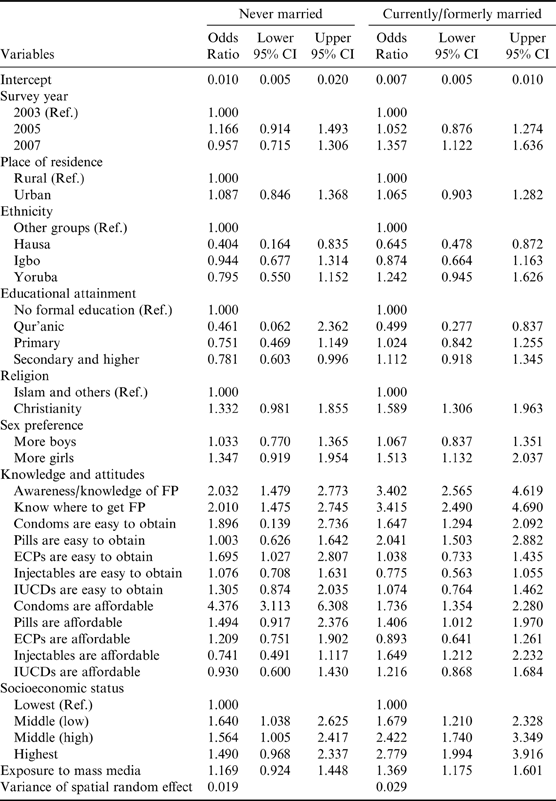
As a consequence of the substantial significant differential in use of modern FP methods with marital status, an attempt was made to run a separate analysis based on marital status: never married vs currently/formerly married. For the never-married respondents, in a similar model with predictor as in Model M1 (only trend), the odds of using modern contraceptives increased in 2005 by 30% compared with 2003 (OR=1.300, CI: 1.066, 1.621), but declined by 7% in 2007 (OR=0.926, CI: 0.730, 1.155). For currently/ever-married respondents, the odds increased by about 22% (OR=1.217, CI: 1.030, 1.436) and 21% (OR=1.213, CI: 1.035, 1.446) in 2005 and 2007, respectively, in comparison with 2003.
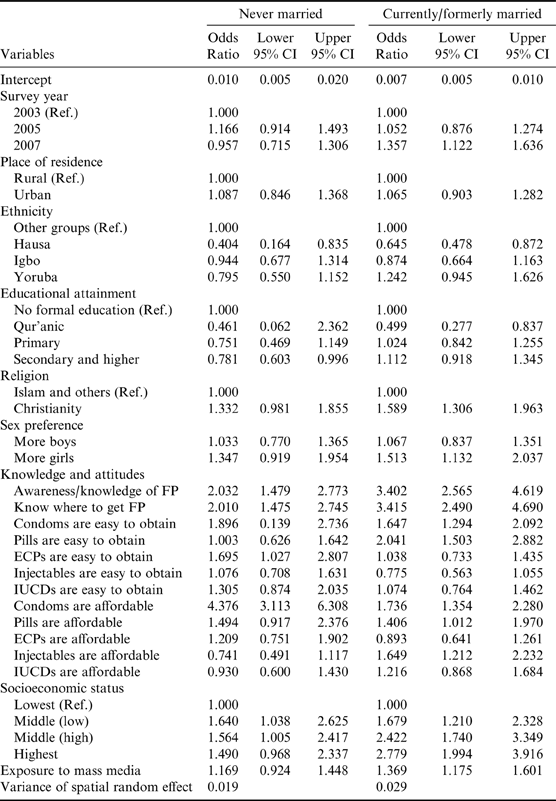
Table 4 presents the results for the model with predictor M7 for both never-married and currently/formerly married respondents. Inclusion of covariates in model M1 led to a non-significant effect of trend among the never-married respondents, but with a significant 36% increase in use of modern FP methods between 2003 and 2007 (OR=1.357, CI: 1.122, 1.636) among currently/formerly married. The findings from the disaggregated data are similar to those from the combined data. However, while use of modern FP methods was significantly low among currently/formerly married respondents with only Qur'anic education (OR=0.499, CI: 0.277, 0.837), this was not significant in never-married respondents. Similarly, the odds of using modern FP methods among currently/formerly married respondents who are Christians increased by 59% (OR=1.589, CI: 1.306, 1.963) compared with their counterparts (Muslim inclusive). Among currently/formerly married and never-married respondents, use of modern FP methods is positively and significantly associated with respondent's SES, a preference for female children, awareness/knowledge of family planning methods and knowledge of where to buy/get a FP method. Although exposure to mass media on FP methods/services is significantly associated with use of modern FP methods among the currently/formerly married respondents, it is not significant in the case of those who are never married.
Results of fixed effects showing odds ratio and the 95% credible intervals for the full model (model M7) for never-married and currently/formerly married women
Non-linear effects
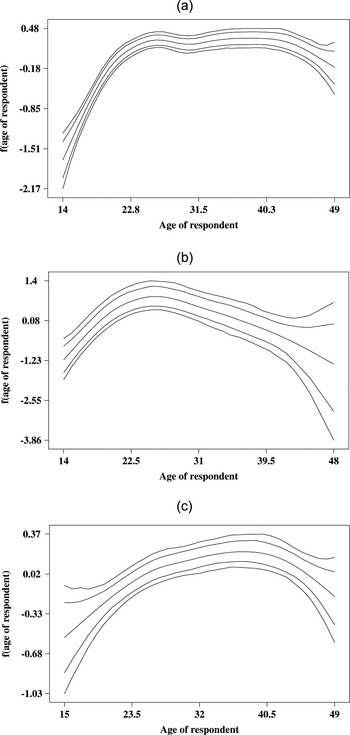
The results of the non-linear effects are shown in Fig. 2. For instance, for the combined data, the use of modern FP methods increased with every unit increase in age up until age 24 years before it stabilized (see Fig. 2a). Figure 2b shows an approximately inverse ‘V’ shape. With this, the use of modern FP methods increased up until age 24 years, after which a steady decline was evident among the never-married respondents. On the other hand, Fig. 2c reveals that use of modern FP methods increases steadily up until age 38 years before a sharp decline among the currently/formerly married respondents.
Posterior means of the non-linear effect of respondent's age and its 80% and 95% credible intervals for (a) the combined data, (b) never married (single), and (c) currently/formerly married.

Spatial effects
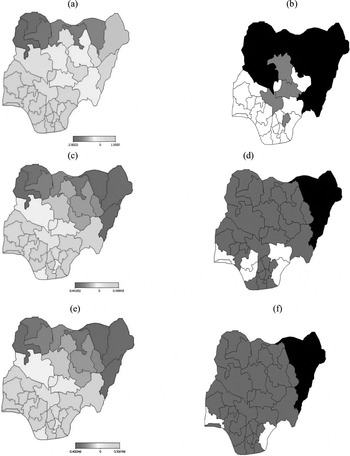
The spatial effects of the fitted models are shown in Fig. 3 (for the combined data) and Fig. 4 (for the disaggregated data). Figure 3 parts a, c and e present the posterior means for models M1 (trend only), M6 (extended covariates) and M7 (M6 with unstructured spatial effects), while parts b, d and f present the corresponding map of 95% credible interval, which is used to assess the significance of the spatial effect. From this, states with white colour are significantly associated with high use of modern FP methods (implying that the 95% credible interval lies on the positive side), states with black colour are significantly associated with low use of modern FP methods (implying that the 95% credible interval lies in the negative side), while use of modern FP is not significant in states with grey colour (the 95% credible interval include zero ‘0’). An interesting north–south geographical spatial pattern was noted in all the models. Respondents in the southern part of Nigeria are associated with higher usage of modern FP methods than those in the north. In model M1, almost all the states in the south are significantly associated with high use of modern FP methods. The net effect of spatial variation after controlling for some covariates showed that only Lagos, Ogun, Delta, Edo, Cross River and Benue states are significantly associated with high use of modern FP methods. On the other hand, Borno, Yobe and Adamawa states are significantly associated with low use of modern FP methods. Inclusion of an unstructured spatial effect shows that only Ogun and Cross River states are significantly associated with high use of modern FP methods.
Non-linear spatial effects for (a) model M1 and (b) its corresponding 95% posterior probabilities; (c) model M6 and (d) its corresponding 95% posterior probabilities; (e) model M7 and (f) its corresponding 95% posterior probabilities for all data.

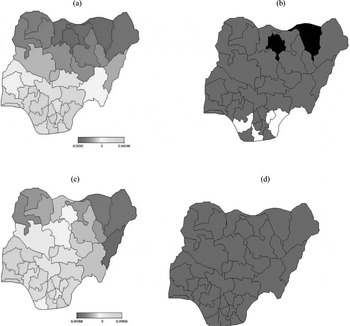
Non-linear spatial effects and its corresponding 95% posterior probabilities for model M7 for never-married respondents (a) and (b) and currently/formerly married respondents (c) and (d).

The results of the spatial effects for models with disaggregated data are shown in Fig. 4, parts a–d. For model M7 with never married (a and b), Cross River, Delta, Ebonyi and Rivers states are associated with significantly high use of modern FP, and Kano and Yobe states are associated with significant low usage of modern FP methods. The spatial effects in the remaining states are not significant. Figure 4 parts c and d show that there is no significant spatial effect in the use of modern FP among currently/formerly married women.
Discussion
Understanding the level, trend and geographical variations in determinants of use of modern family planning methods plays a major role in designing effective interventions that can lead to increased usage. Furthermore, it can assist policymakers in making critical decisions on allocation of resources. This study found substantial significant differentials in use of modern FP methods between currently/formerly married and never-married women in Nigeria. Separate analyses were therefore run for these two groups in order to compare use of modern FP, and determinants of use, within and outside marriage.
It was found that use of family planning by never-married respondents who believed that condoms are affordable is about four times higher than in currently/formerly married respondents. Never-married respondents who believed that emergency contraceptives pills are affordable and can easily be obtained were more likely to use modern family planning than their currently/formerly married counterparts. However, currently/formerly married women who believed that injectables and IUCDs are affordable and that pills are easy to obtain are more likely to use modern FP methods than those who were never married. These findings agree with studies that have shown that the use of injectables and IUCDs is higher among married and older women, whereas knowledge of and attitude towards emergency contraceptives, especially among married couples, is poor in Nigeria (Adekunle et al., Reference Adekunle, Arowojolu, Adedimeji and Okunlola2000; Okunlola et al., Reference Okunlola, Owonikoko, Roberts and Morhason-Bello2006; Aisien, Reference Aisien2007; Akani et al., Reference Akani, Enyindah and Babatunde2008; Odegbola & Ogedengbe, Reference Odegbola and Ogedengbe2008; Okonofua et al., Reference Okonofua, Omo-Aghoja, Hammed and Osazee2009). The likelihood of using injectables out of marriage is very low in Nigeria. It is likely that never-married respondents perceive injectables to be meant for married individuals. Use of ECPs is found to be the method of choice among never-married women. Although the findings revealed a positive association between use of modern family planning and socioeconomic status (combined data), this relationship was only sustained for currently/formerly married respondents. An inverse relationship between use of modern FP and socioeconomic status was evident among the never-married respondents. The implication is that economic empowerment might be an influencing factor for use of modern FP methods within marriage, whereas this does not seem to be a determinant of use outside of marriage.
Women respondents who were never married at the time of the survey were two times as likely to use modern FP methods than those who were currently/formerly married. This agrees with the findings of Caldwell et al. (Reference Caldwell, Orubuloye and Caldwell1992). The odds are almost two times higher for those who agreed that condoms and pills are easy to obtain, but this was not substantial for those who believed that other considered methods are easy to obtain. Respondents who believed that condoms are affordable had a two times higher use of modern FP compared with those who believed that other methods are affordable.
Use of modern FP methods increases with respondent's age up until 24 years, when it stabilizes among the general population (combined data). However, for never-married respondents, use of modern FP methods declines beyond age 24 years. An implication of this is that never-married women aged 25 years and above are less likely to want to control birth. At this age, most Nigerian women would have been married (Akpan, Reference Akpan2003; NPC & ICF Macro, 2009). Those who have not will see little reason to use contraceptives; a situation that can lead many of them into becoming ‘single’ mothers. On the other hand, among currently/formerly married women, use of modern FP methods increases steadily up until age 42 years before declining. At this age one would expect fertility to be declining as it is the age where women start reaching menopause.
Considerable geographical variation was found in the use of modern FP methods in Nigeria. There is a clear north–south divide, with use of modern FP methods being considerably lower in the northern compared with southern states. It is important to note, however, that after controlling for other variables, it is only in five states in the south – namely, Lagos, Ogun, Delta, Edo and Cross River (out of seventeen) – that significant spatial effects on use of modern FP methods among never-married women are found. Furthermore, three of the five states (Delta, Edo and Cross River) are in the South-South and two are from the South-West, with no state out of the five in the South-East zone showing any significant spatial effect on use of modern FP methods. Similarly, only in one state in the north – Benue (out of nineteen) – is there a positive significant spatial effect of use of modern FP methods. Two northern states, Kano and Yobe, had significantly low use of modern FP methods. This calls for immediate action and policy change on improving use of modern FP in the north. Even after adjusting for possible determinants of use of modern FP methods, use of any modern FP method in Yobe, Taraba and Adamawa states remains significantly low. However, among the never-married women, use of modern FP method was significantly low in Kano and Yobe states but significantly high in Delta, Rivers, Ebonyi and Cross River states. Although a similar spatial pattern was evident in the use of modern FP methods among currently/formerly married respondents, this was not significant.
Without the method of analysis employed in this study, it would not have been possible to identify that the low use of modern FP methods in the North-East was only significant in the states of Adamawa, Borno and Yobe rather than all the states in the North-East zone. Similarly, the high usage of modern FP methods in the South-West zone was only significant in the states of Lagos and Ogun, rather than in all six states in the zone.
Conclusions
The findings of this paper help in the understanding of the trend, level and possible determinants of use of modern FP methods in Nigeria, and assists identifying states with significantly low modern FP use allowing policymakers to prioritize use of limited resources. Thus intensive interventions should focus on the northern states. However, efforts should also be targeted at behaviour maintenance in those states that currently have a high use of modern FP methods. Unravelling the reason(s) for the decline in modern FP use between 2005 and 2007 will require further investigations beyond quantitative research.
Acknowledgments
The authors would like to acknowledge the Federal Ministry of Health for making available the data used in this study. Also, comments from the participants of the 2011 ESRC workshop at the University of Warwick are appreciated by the first author and have assisted in improving this manuscript. The authors would like to thank Joseph Inungu for reading through the first draft of this paper. The efforts of the anonymous reviewers are equally appreciated.