Introduction
Biological invasions are a recognized driver of global change, causing several economic and ecological impacts registered globally (Pyšek et al. Reference Pyšek, Hulme, Simberloff, Bacher, Blackburn and Carlton2020, Diagne et al. Reference Diagne, Leroy, Vaissière, Gozlan, Roiz and Jarić2021). Humans have been introducing species outside their native ranges for centuries, intentionally or not, and due to increasing globalization this trend is expected to grow exponentially in the next few years (Seebens et al. Reference Seebens, Blackburn, Dyer, Genovesi, Hulme and Jeschke2017, Reference Seebens, Bacher, Blackburn, Capinha, Dawson and Dullinger2021). Alien species become invasive when they successfully establish and spread in a new environment, causing harm to the native community or the economy and requiring great investments to repair or control their damage (IUCN Invasive Species Specialist Group 2000).
Eradicating invasive alien species (IAS) is often expensive and time-consuming, so there is scientific consensus that preventing introductions is the best available tool to avoid their impacts (Simberloff Reference Simberloff2003, Keller et al. Reference Keller, Geist, Jeschke and Kühn2011, Simberloff & Vitule Reference Simberloff and Vitule2014). This requires an integrated strategy to prevent possible ways for an alien species to reach a new environment and establish itself, but so far it has not been achieved in any instance (Essl et al. Reference Essl, Bacher, Blackburn, Booy, Brundu and Brunel2015, Hulme Reference Hulme2015).
Many alien species also have commercial value and are used, for example, in aquaculture, sport fishing, farming and the pet trade (McNeely Reference McNeely2001, Shackleton et al. Reference Shackleton, Shackleton and Kull2019). This creates a conflict between those actors who profit from alien species and those who focus on their potential impacts on biodiversity (Estévez et al. Reference Estévez, Anderson, Pizarro and Burgman2015). In this scenario, strong environmental policies are needed to balance both sides of the scale, leaving no gaps for irreversible damage. Globally, IAS policies are highly variable and not well integrated into a unified framework, considering that species do not respect geopolitical borders (Burgiel Reference Burgiel, Keller, Cadotte and Sandiford2015). The issue needs to be managed not only at regional and national scales, but also internationally (Burgiel Reference Burgiel, Keller, Cadotte and Sandiford2015, Pyšek et al. Reference Pyšek, Hulme, Simberloff, Bacher, Blackburn and Carlton2020).
The Convention on Biological Diversity (CBD) is an example of an international policy dealing with IAS; it requires that signatory countries work to prevent the introduction, spread and export of any invasive species (http://www.cbd.int/). However, there are no predicted sanctions for those that do not follow these guidelines; thus, the efficacy of the CBD in avoiding IAS impacts is questionable (Keller et al. Reference Keller, Geist, Jeschke and Kühn2011).
Brazil is a signatory country of the CBD and, in 1998, the Convention was ratified by the Brazilian government, yet 365 IAS have been officially recorded in its territory to date (MMA 2014, Pró-Espécies 2019), whereas unofficial records show continuously increasing numbers (e.g., Doria et al. Reference Doria, Agudelo, Akama, Barros, Bonfim and Carneiro2021, Vitule et al. Reference Vitule, Occhi, Carneiro, Daga, Frehse, Bezerra, Marques and Grelle2021). Our work aims to review the IAS policy in Brazil, concatenating diffuse information and delineating historical trends of the environmental legislation on the subject, as well as identifying potential gaps and avenues for improvement. We believe that this review could be an important instrument to guide legislature while avoiding conflicts and preventing misleading legal instruments at the state and municipal levels.
Methods
We reviewed the Brazilian federal legislation to identify any legal instruments dealing with IAS published up to October 2021. We used different keywords related to invasions to track the desired documents (a full list of keywords is available in Appendix S1). We searched the websites of the Federal Senate, Chamber of Deputies, National Environment Council (CONAMA), Brazilian Environmental Institute (IBAMA) and Ministry of Environment (MMA), as well as previous publications on IAS policies in Brazil (Zenni et al. Reference Zenni, Dechoum and Ziller2016, Reference Zenni, Herrera, Dechoum, Ziller, Matos, Núñez, Pauchard, Clements, Upadhyaya, Joshi and Shrestha2022) in our search.
The resulting legislation was organized by date of publication, legal instrument type, taxon and environment. All legal instruments retrieved were read in full and classified according to their objectives regarding IAS in different categories (a full description of each category is available in Supplementary Table S1, available online). Some pieces of legislation fell within more than one category, in which case they were counted twice. We included only legislation that was in force at the time of our review. We also distinguished whether the legal instrument was exclusively focused on the subject of IAS or was more generally related to environmental and health issues and only citing IAS in some excerpts from its text.
Results
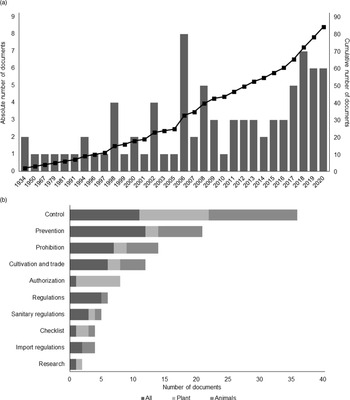
In total, we found 85 legal instruments in force related to IAS published in the federal sphere in Brazil until October 2021 (Table S2). From these, the greatest number took the form of decrees (28.2%), followed by normative instructions (24.7%), ordinances (21.2%), laws (16.5%) and regulations (7.1%); there were only two deliberations (2.4%). The first decree was published in 1934, and the most recent in 2020. On average, 2.7 documents were published per year, and the year with the highest number of published documents was 2006 (n = 8; Fig. 1a).
The absolute number of legal instruments published (a) by year (the black line shows the cumulative trend of policies published over the years) and (b) per category split by ‘All taxa’ (or a mixture of several taxa), ‘Plants’ and ‘Animals’ (including fauna in general, cnidarians, molluscs, crustaceans, fish, birds and mammals).

Most of the legal instruments refer to all or a mixture of several taxa (44.7%), followed by plants (24.7%) and animals (30.6%), divided into fauna in general (n = 11), mammals and molluscs (n = 5 each), cnidarians (n = 2) and other taxa such as crustaceans, fish and birds (n = 1 each). With respect to the environment, a great number of documents did not specify any particular environment (63.5%), while 16 (18.8%) focused on the terrestrial environment and 15 (17.6%) on the aquatic environment (i.e., freshwater and marine).
With regard to their objectives towards IAS, most of the legal instruments were classified as ‘control’ (n = 36) and ‘prevention’ (n = 21). Fourteen documents were classified as ‘prohibition’, setting sanctions on IAS introductions, whereas eight authorized the use of alien species in specific situations. Twelve documents regulated the use of these species in farming and/or trade, whereas other types of regulation (general, import or sanitary) account for 14 documents in total. Two documents were classified as ‘research’ and four were classified as ‘checklists’ of alien species (Fig. 1b). From the total of 85 legal instruments, only 30 were exclusively focused on IAS, while the remainder were more general with regard environment and health issues, citing IAS in just one or a few articles throughout the texts.
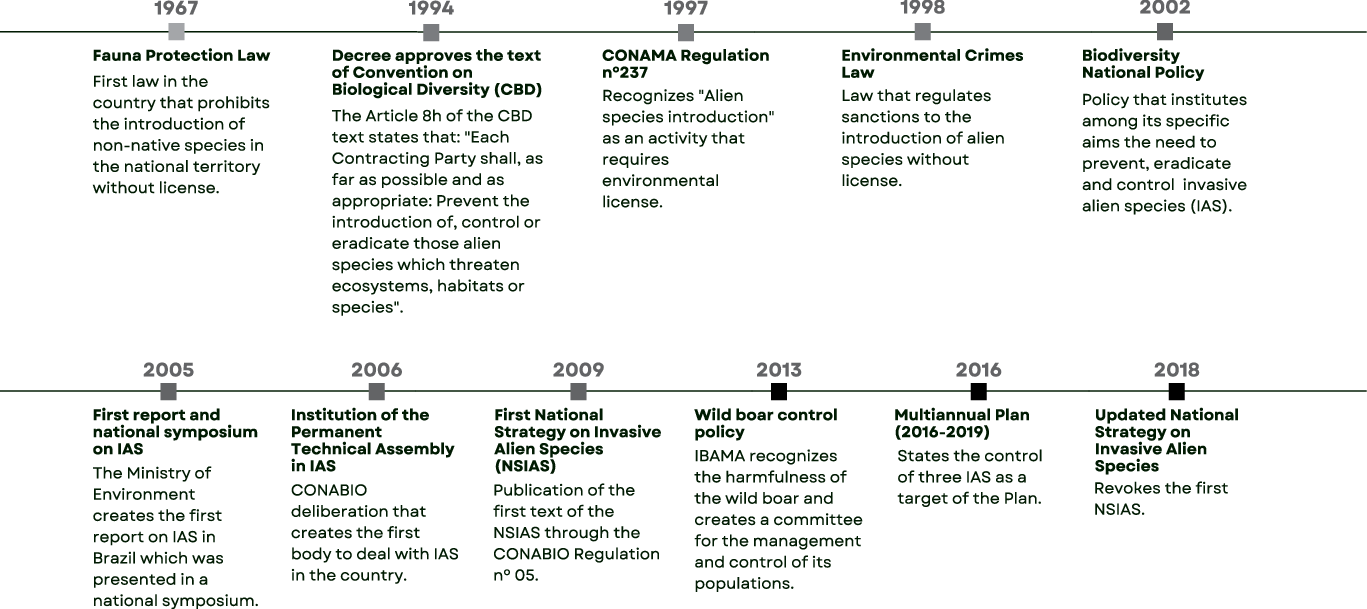
The first decree referring to IAS dates from the 1930s (Fig. 2). The term ‘invasive alien species’, however, was still not used to refer to alien species until the 1970s. Since 2000, there has been an increase in the number of legal instruments referring to IAS. The most important legal instruments regarding IAS are those related to the National Strategy for Invasive Alien Species (NSIAS) published in 2018. A detailed historical analysis regarding the legislation related to IAS is available in Appendix S2.
Main historical milestones related to the invasive alien species policy in Brazil.

Discussion
Our review is the first comprehensive analysis of IAS policy in Brazil; it expands on previous publications (e.g., Zenni et al. Reference Zenni, Dechoum and Ziller2016, Reference Zenni, Herrera, Dechoum, Ziller, Matos, Núñez, Pauchard, Clements, Upadhyaya, Joshi and Shrestha2022) and reveals new facets of such IAS policy. Using a systematic search, we were able to compile 85 legal instruments published in the federal sphere, adding 53 documents compared to those analysed previously (Zenni et al. Reference Zenni, Dechoum and Ziller2016, Reference Zenni, Herrera, Dechoum, Ziller, Matos, Núñez, Pauchard, Clements, Upadhyaya, Joshi and Shrestha2022). As expected, there has been an increase in legislation dealing with IAS over time, in concurrence with worldwide patterns (Turbelin et al. Reference Turbelin, Malamud and Francis2017). The large number of legal instruments in the Brazilian legislation regarding IAS places Brazil on a par with countries such as the USA and Australia, and with the European Union (Turbelin et al. Reference Turbelin, Malamud and Francis2017). Certainly, the problem of biological invasions is widely recognized by the legal system (Zenni et al. Reference Zenni, Dechoum and Ziller2016), yet Brazil still faces many problems related to this issue (Adelino et al. Reference Adelino, Heringer, Diagne, Courchamp, Faria and Zenni2021).
One probable reason for this is related to the large geographical area of Brazil, which may hinder effective enforcement and also provide internal sources of introductions (Magalhães & Andrade Reference Magalhães and Andrade2015, Vitule et al. Reference Vitule, Occhi, Kang, Matsuzaki, Bezerra and Daga2019), such as species that are native to specific biomes or basins (e.g., marmoset monkeys of the genus Callithrix and fish of the genus Cichla). Additionally, some species are endangered in their native ranges while simultaneously being invasive elsewhere, a conservation paradox that generates conflicting policies related to them (Marchetti & Engstrom Reference Marchetti and Engstrom2016). This is the case for the predatory fish Salminus brasiliensis and Arapaima gigas that are vulnerable in basins where they are native, being protected by State-level laws or international agreements (Geller et al. Reference Geller, Garcia, Casimiro, Pereira, Jarduli and Vitule2021, Catâneo et al. Reference Catâneo, Ximenes, Garcia-Davila, Van Damme, Pagotto and Vitule2022), but they are invasive in other Brazilian basins where there should be specific policies to control them (Vitule et al. Reference Vitule, Bornatowski, Freire and Abilhoa2014, Catâneo et al. Reference Catâneo, Ximenes, Garcia-Davila, Van Damme, Pagotto and Vitule2022). The conservation paradox is a challenge faced by large-scale and megadiverse countries such as Brazil, where policies are typically defined based on geopolitical boundaries instead of ecologically relevant scales (Vitule et al. Reference Vitule, Occhi, Kang, Matsuzaki, Bezerra and Daga2019).
Critically, there is no recognition in the Brazilian legislation of invasion as a process (Blackburn et al. Reference Blackburn, Pyšek, Bacher, Carlton, Duncan and Jarošík2011). This lack of clarity in defining stages that a species should overcome to become invasive can lead to misinformed decisions about what is targeted in policies, since each stage requires a different strategy to tackle the problem. For instance, at the initial stages of transportation and introduction, policies that aim to prevent and prohibit new introductions are key, as prevention is expected to be more efficient and less costly in the avoidance of IAS impacts (Keller et al. Reference Keller, Geist, Jeschke and Kühn2011, Zenni et al. Reference Zenni, Essl, García-Berthou and McDermott2021). However, in our analysis, the legislation categorized as ‘control’ was more abundant than that categorized as ‘prevention’ and ‘prohibition’, a trend that has also been observed globally (Turbelin et al. Reference Turbelin, Malamud and Francis2017).
Additionally, we found a clear contradiction in policies related to these initial stages. While there are general laws and decrees that prohibit the introduction of IAS (e.g., laws nº 5,197/1967, nº 9,605/1998 and nº 9,985/2000 and decrees nº 6,514/2008 and nº 6,586/2008), we also found a number of laws and decrees that allow the use of alien species to restore Legal Reserves (e.g., Law nº 12,651/2012 and Decree nº 7,830/2012) or for cultivation purposes (Decree nº 10,576/2020). Besides not following the precautionary principle that needs to be considered when it comes to IAS (IUCN Invasive Species Specialist Group 2000), this provides a legal opportunity for stakeholders interested in farming alien species to do so (Charvet et al. Reference Charvet, Occhi, Faria, Carvalho, Pedroso and Carneiro2021). When prevention fails and an alien species become established, control and eradication policies should be more effective. Although our results show that the vast majority of federal legal instruments deal with the control of IAS, there is still an increasing number of alien species found in Brazilian ecosystems (e.g., Casimiro et al. Reference Casimiro, Garcia, Vidotto-Magnoni, Vitule and Orsi2016, Doria et al. Reference Doria, Agudelo, Akama, Barros, Bonfim and Carneiro2021, Vitule et al. Reference Vitule, Occhi, Carneiro, Daga, Frehse, Bezerra, Marques and Grelle2021), despite the NSIAS being published in 2018. This could be a result of ineffective actions or delays in appropriate levels of attention being paid to the matter, probable only occurring after many IAS had already dispersed in the country and their control having become more challenging.
When a species successfully goes through all invasion stages and becomes fully invasive, its impacts are more evident and often require specific policies to mitigate them. In the Brazilian legislation, two cases are good examples of this: the wild boar Sus scrofa and the golden mussel Limnoperna fortunei. Both species have the highest numbers of specific legislations targeting them, and this is probably a reflection of the greater economic impacts they represent for agribusiness and hydroelectric plants. Agriculture and negative news media about the wild boar seem to have been determinants of policy regarding the species in the USA (Miller et al. Reference Miller, Opp and Webb2018). In Brazil, the focus of the legislation regarding these species is on mitigating their economic impacts and scarcely at all on protecting the biodiversity affected by them.
The wild boar has been listed as one of the 100 worst IAS in the world because of its impacts on natural and agricultural ecosystems (Lowe et al. Reference Lowe, Browne, Boudjelas and De Poorter2000) and the economic losses it causes (Cuthbert et al. Reference Cuthbert, Diagne, Haubrock, Turbelin and Courchamp2022). The introduction of the wild boar to Brazil occurred at different times with the release of countless individuals into the wild, leading IBAMA to suspend imports and licenses for this species (Pedrosa et al. Reference Pedrosa, Salerno, Padilha and Galetti2015). Recognizing their harmfulness, IBAMA also published a normative instruction that authorizes the hunting of the species and its hybrid lineages throughout nation’s territory. Unfortunately, this management plan has presented several challenges, with consequences that are as problematic as the impacts of the invasion itself. For instance, the number of municipalities in which populations of wild boar were found doubled between the years 2016 and 2019 (Batista Reference Batista2019, IBAMA 2019). The counterintuitive increase in the number of local wild boar populations despite management controls can be explained by the fact that hunting became a sporting practice. There are allegations that wild boar are being intentionally introduced into other regions to help expand their hunting for sport. The boar-hunting license is also being used as a mechanism to make it easier for civilians to carry guns (see Maciel et al. Reference Maciel, Guimarães, Grandin and Netto2021), as a result of the political agenda of the current government. This is an example of how failed policies can worsen the problem, leading to more unwanted introductions (Patoka et al. Reference Patoka, Magalhães, Kouba, Faulkes, Jerikho and Vitule2018), demonstrating that an appropriate evaluation of the efficacy of the existing legislation is urgently needed (Bailey et al. Reference Bailey, Deneau, Jean, Wiley, Leung and MacIsaac2011, Magalhães & Andrade Reference Magalhães and Andrade2015).
Besides recognizing invasion as a process consisting of different stages that require specific policies, there is a critical need for evidence-based information to guide environmental policy in order to advance future legislation (Likens Reference Likens2010, Zenni et al. Reference Zenni, Dechoum and Ziller2016). Unfortunately, scientific knowledge of the effects of IAS has been neglected in Brazil, and this is exemplified by new bills coming up at the state and municipality levels that aim to preserve alien species (Geller et al. Reference Geller, Garcia, Casimiro, Pereira, Jarduli and Vitule2021), such as Bill nº 614/2018 of Sao Paulo State and Bill nº 487/2018 of Parana State. Both bills prohibit the capture of Cichla fish where they are invasive (Ota et al. Reference Ota, Frota, Oliveira, Nardi, Proença and Message2019), in spite of the scientific evidence of these species causing negative impacts on native biodiversity (e.g., Latini & Petrere Reference Latini and Petrere2004, Pelicice & Agostinho Reference Pelicice and Agostinho2009, Carvalho et al. Reference Carvalho, Ferreira, Pelicice and Fernandes2021). The many economic and political interests involved (e.g., Azevedo-Santos et al. Reference Azevedo-Santos, Fearnside, Oliveira, Padial, Pelicice and Lima2017) represent a complicating factor that could lead to misguided measures promoting activities that threaten biodiversity and the maintenance of essential ecosystem services in the long term. Our review was focused on the federal sphere; however, as noted above, many Brazilian states and municipalities also have specific legislation related to IAS (Zenni et al. Reference Zenni, Dechoum and Ziller2016). Unfortunately, there is a lack of integration between these different levels (Zenni et al. Reference Zenni, Dechoum and Ziller2016), leading to many contradicting instruments that do not effectively solve the problem at larger scales.
Despite Brazil being considered a country with strict environmental legislation, in recent years the conservation agenda has not been the priority of the government (Abessa et al. Reference Abessa, Famá and Buruaem2019, Barbosa et al. Reference Barbosa, Alves and Grelle2021, Vale et al. Reference Vale, Berenguer, Menezes, Castro, Siqueira and Portela2021). It is important to highlight that Brazil has an international commitment as a signatory country of the CBD; however, it has not complied with the Aichi Biodiversity Targets, especially when it comes to Target nº 9 (Lima-Junior et al. Reference Lima-Junior, Magalhães, Pelicice, Vitule, Azevedo-Santos and Orsi2018). In addition to that, the Brazilian flora and fauna are expressly protected by the legal system, mainly in its Constitution, which prohibits any practices that jeopardize their ecological function or may cause the extinction of species. Therefore, there is a clear legal responsibility to discourage any practice that threatens biodiversity, as is the case for biological invasions (Pyšek & Richardson Reference Pyšek and Richardson2010).
Nevertheless, as we found in our review, the economic impacts of IAS often determine policy decisions, and indeed the economic costs of IAS might reach US$26.8 billion per year (Diagne et al. Reference Diagne, Leroy, Vaissière, Gozlan, Roiz and Jarić2021). These costs are also directly related to their social harm through IAS potentially being significant vectors of emerging diseases (Shinwari et al. Reference Shinwari, Gilani and Khan2012). Thus, stricter legislation to avoid the introduction of new alien species is urgently required, not just for the conservation of biodiversity and ecosystem services, but also to avoid economic losses and negative health impacts (Crowley et al. Reference Crowley, Hinchliffe and McDonald2017).
On the other hand, there has been some progress. The fact that Brazil has a national strategy towards IAS (i.e., the NSIAS) is noteworthy because many countries in South America only have general environmental legislation on the matter (Zenni et al. Reference Zenni, Herrera, Dechoum, Ziller, Matos, Núñez, Pauchard, Clements, Upadhyaya, Joshi and Shrestha2022). The NSIAS aims to implement a national database of occurrence data and management methods for the IAS present in the country (MMA 2018). Early detection, rapid response systems and invasion risk analysis are targets to be implemented, and these are recognized in other countries as important tools for avoiding the impacts of IAS (Tollington et al. Reference Tollington, Turbé, Rabitsch, Groombridge, Scalera, Essl and Shwartz2017, Reaser et al. Reference Reaser, Simpson, Guala, Morisette and Fuller2020). However, this is an extensive process that requires consultation with large numbers of experts; thus, its results would only have an impact over the long term. Independent databases of IAS records in Brazil exist (e.g., Bioinvasão Brasil and Instituto Hórus), but the data need to be organized and integrated in order to be accessible to policymakers.
Similarly, there should be an integrated international effort to deal with IAS in South America so that effective legislation in one country will not be impaired by poorer legislation in neighbouring countries (Keller et al. Reference Keller, Geist, Jeschke and Kühn2011, Zenni et al. Reference Zenni, Herrera, Dechoum, Ziller, Matos, Núñez, Pauchard, Clements, Upadhyaya, Joshi and Shrestha2022). One such example is European Union Regulation nº 1143/2014, which aims to coordinate the as-yet disparate efforts of its Member States to control IAS (Trouwborst Reference Trouwborst2015, Tollington et al. Reference Tollington, Turbé, Rabitsch, Groombridge, Scalera, Essl and Shwartz2017). It is necessary to review and organize the current legislation on IAS in different instances, with this being the first step towards the implementation of public policies for their effective control. The conservation of the environment goes beyond an obligation, as the right to a healthy environment is considered a transgenerational right for present and future generations, as stated by the 1988 Constitution of Brazil, and IAS should be a major consideration in this. If the gap between invasion and conservation sciences and legislation is not filled, the sustainability of essential societal activities will be threatened by biodiversity loss.
Supplementary material
To view supplementary material for this article, please visit https://doi.org/10.1017/S0376892922000406.
Acknowledgements
We are thankful to Flavia Duarte Ferraz Sampaio (Instituto Federal do Paraná – IFPR, Campus Curitiba, Paraná, Brazil) for advice on this work and to the editors and two anonymous reviewers for their suggestions that greatly improved this manuscript.
Financial support
We thank the Coordenação de Aperfeiçoamento de Pessoal de Nível Superior (CAPES) for financing part of this work (Finance Code 001) and the Conselho Nacional de Desenvolvimento Científico e Tecnológico (CNPq) for providing research grants to JRSV (Process numbers 310850/2012-6, 303776/2015-3 and 302367/2018-7).
Competing interests
The authors declare none.
Ethical standards
None.