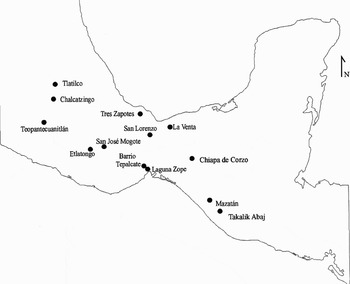
The Isthmus of Tehuantepec was a key area in the development of ancient Mesoamerica. Only 240 km wide from north to south, it forms a geographic bridge between two major cultural spheres, central Mexico to the northwest and the Maya area to the southeast. The northern Isthmus, with lushly forested mountains and the wide, fertile Gulf coastal plain of Veracruz and Tabasco, was heartland to the Olmecs, Mesoamerica's first civilization. The southern Isthmus in eastern Oaxaca is less well known archaeologically; it extends approximately from Salina Cruz and the Jalapa del Marqués Valley on the west to the Chiapas border on the east, and from the continental divide and the towns of Guevea de Humboldt, Matías Romero and Santa María Chimalapa on the north to the Pacific Ocean on the south. Today the southern Isthmus is home to five ethnic and linguistic groups: Zapotecs, Mixes, Zoques, Chontals, and Huaves. Tracing how and when these groups came to inhabit their present territories is a challenge for archaeologists working in the region (Figure 1).
The southern Isthmus with selected Early Formative period sites (redrawn from Clark 1994:Figure 1.3).

The earliest known permanent settlements in the southern Isthmus date back to the Early Formative period. Since the southern Isthmus is approximately equidistant from four well-documented centers of Early Formative occupation—the Gulf Coast Olmec region, the Chiapa de Corzo area of highland Chiapas, the Soconusco region of the Pacific coast, and highland Oaxaca—this is an ideal period with which to begin to disentangle the complex linguistic and ethnic panorama. San Lorenzo, the early Olmec capital, is approximately 150 km north of Ixtepec, Oaxaca, which is at the center of the southern Isthmus; the easiest route between these points is over the lowest part of the continental divide at less than 200 m above sea level near Matías Romero. The Soconusco region is about 350 km (from Ixtepec to Tapachula) to the southeast along the Pacific coast, and Chiapa de Corzo is about 210 km to the northeast. San José Mogote in the Oaxaca Valley is 210 km to the northwest through rugged mountains, and Etlatongo in the Nochixtlan Valley lies another 60 km further in the same direction. One of our research goals is to determine how the Formative period inhabitants of the southern Isthmus related to groups in these other areas.
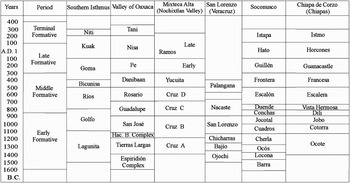
Surface surveys in the 1960s (Delgado Reference Delgado1965) and 1970s (J. Zeitlin Reference Zeitlin1978) located several possible Early Formative sites on the southern Isthmus, most notably the large site of Laguna Zope near Juchitán. Robert Zeitlin's stratigraphic excavations in 1972 at that site provided data for establishing a regional sequence of three Early and Middle Formative period phases: Lagunita (1500–1100 b.c.), Golfo (1100–800 b.c.) and Ríos (800–400 b.c.). For present purposes Lagunita and Golfo phases are considered Early Formative; the 1000 b.c. date dividing them may be modified in the future based on additional radiocarbon determinations. Zeitlin showed that Laguna Zope's early occupants produced marine shell ornaments, which, he argued, they exchanged over long distances for obsidian, decorated ceramics, and other items. He claimed that Laguna Zope's precociously large size (40 hectares during the Golfo phase) was due to the community's role as a central place and trading entrepot (R. Zeitlin Reference Zeitlin, Stark and Voorhies1978) and that only later did the region fill in with smaller dependent settlements. Although some other Early Formative sites had been noted on survey, for example, El Zapotal at Unión Hidalgo (Delgado Reference Delgado1965) and Iglesia Los Tepalcates at Ixtepec (J. Zeitlin Reference Zeitlin1978:173), the occupations were not confirmed through excavation, and, consequently, Laguna Zope has been portrayed in the archaeological literature as an isolated, special regional center. Our excavations in 2005 of Early and Middle Formative period deposits at the site of Barrio Tepalcate on the outskirts of Ciudad Ixtepec have helped to modify this perspective. In this paper we describe the excavations and recovered materials, and their implications for the southern Isthmus and neighboring regions (Figure 2).
Formative period phases in the southern Isthmus and related regions.

The extensive flat Pacific coastal plain, the most notable geographic feature of the southern Isthmus, is occasionally interrupted by worn remnants of Paleocene mountains and is cut by rivers that descend from the highlands to the north and west. The coastal plain is bordered to the south by an extensive lagoon system (the Laguna Superior is 15 km downriver from Laguna Zope) and flanked on the north by a mountain range that forms the continental divide and separates the southern Isthmus from Veracruz and the Gulf Coast lowlands. The region is characterized by extreme dry heat in spring and early summer, an erratic rainy season in late summer and early fall, and unusually strong winds in the winter. The harsh climate sets the region off from the other four regions of Early Formative period settlement mentioned above and led Gareth Lowe (Reference Lowe and Adams1977:245) to comment that of all the Isthmian areas “…cultural precocity was lowest in the very dry Tehuantepec plain.”
BARRIO TEPALCATE
Barrio Tepalcate sits on a low rise on the right bank of the Los Perros river, 18 km upstream from Laguna Zope and on the same side of the river. Both sites are in typical locations for early pre-Hispanic settlements on the southern Isthmus coastal plain where arid conditions mean that sites are concentrated along the main rivers, such as the Tehuantepec and the Ostuta as well as the Los Perros. Our work in the area began in 2003 with salvage excavations at El Carrizal, about 1.2 km upriver from Barrio Tepalcate and also on the same side of the river. This site is marked as Los Tepalcates on the map accompanying Agustín Delgado's 1959 site survey report (Delgado Reference Delgado1965:iv) but is not discussed in his text. Matthew Wallrath (Reference Wallrath1967) visited the site in 1960 as part of his southern Isthmus survey, and it is shown as Los Tepalcates on his map (1967:Figure 1). From his description (2 km from Ixtepec; visible in a river cut; material similar to Boca del Rio and Lieza), it is clear that he is referring to El Carrizal (1967:164). We excavated extensively at El Carrizal as part of the Salina Cruz-La Ventosa highway salvage project (Winter Reference Winter and Cerqueda2004). We now believe that Barrio Tepalcate is the earliest of three successively occupied communities within a short stretch along the right bank of the Los Perros River. Barrio Tepalcate was abandoned after the Ríos phase, and at least some of the inhabitants moved about 900 m upriver to the site we call Barrio Tepalacate Hornos, which was occupied during the Bicunisa phase (500–300 b.c.). We discovered this site in 2003 from surface sherds that had been dug up during construction of several large brick-making ovens some years ago. The site probably consisted of a few households. The next settlement, El Carrizal, another 300 m upriver, was occupied during the Goma (400–100 b.c.) and Kuak (100 b.c.–a.d. 200) phases, when population increased dramatically in most parts of Mesoamerica. The site covered 6–8 hectares and has two 6-meter-high mounds that served as temple platforms. El Carrizal was abandoned after the Kuak phase and the next occupation in the area was during the Classic period (Xuku and Tixum phases) across the river from El Carrizal at La Huana Milpería, perhaps by some descendants of the same original population. (We have not been able to recognize clearly the Niti phase used by Wallrath and R. Zeitlin.)
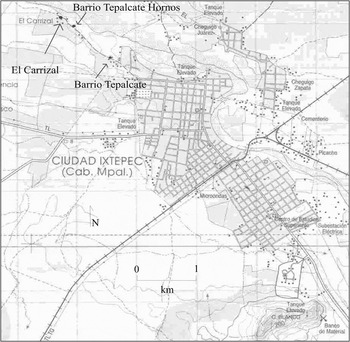
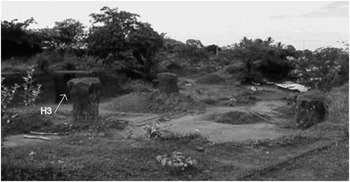
The settlement shifts may have been due to flooding and destruction of the communities or by overuse of soil in the immediate site areas. Both Barrio Tepalcate and El Carrizal revealed evidence of possible flooding. At Barrio Tepalcate, for example, in feature H3, sediment separating lenses of midden debris may have been deposited by floods. Also, the sediment covering all the Formative period features appear to be alluvial deposits postdating the occupation. Even at El Carrizal, which is on a low hill some 10 m above the river, a 20–30 cm thick layer of river sediment separates the Goma from the Kuak layers in many places. Extensive flooding may have buried many Formative period sites in the southern Isthmus, especially in the lower reaches of the rivers, and shifting river courses may have washed away some sites. Laguna Zope's location about 2 km west of the present river course may have been chosen to avoid annual flooding (Figure 3).
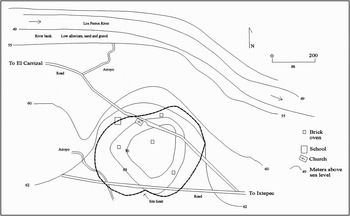
The Ixtepec area showing locations of Barrio Tepalcate and El Carrizal.

To the best of our knowledge, the Barrio Tepalcate site was first reported by Judith Zeitlin (Reference Zeitlin1978:173) as site IX 1 or Ixtepec 1, Iglesia Los Tepalcates, during her 1972 intensive site survey of several sectors of the Los Perros River. She classified it as a hamlet with surface materials scattered over some 2 ha and noted the presence of Lagunita, Golfo, Ríos, Goma, and Ulam phase ceramics. During our excavations at El Carrizal we surveyed Barrio Tepalcate, found some Early and Middle Formative period ceramics, and salvaged a Postclassic period tomb. Over the past 100 years or so, brickmakers have destroyed an estimated 70% of the Formative period portion of Barrio Tepalcate. They excavate the sandy silt to about 2 m below the ground surface, remove and discard sherds, stones, burned daub and other debris, form bricks in molds, dry them in the sun, and then fire them in ovens built on the site. We considered Barrio Tepalcate important since it was clearly different in size from Laguna Zope and, as noted, was probably the parent village for El Carrizal. Thus we designed a salvage project to recover in situ materials before the site was completely destroyed (Figure 4).
Barrio Tepalcate showing brick works and exposed cuts.

Our interventions included intensive surface survey to determine the extent of the site, to locate cultural materials and potential excavation areas, and to recover materials discarded by the brickmakers. Next we mapped the site (Figure 5) and then carried out three types of excavation: (1) salvage of miscellaneous features exposed in the brickmakers' profiles; (2) controlled stratigraphic excavation of selected cuts where we observed cultural features such as floors, ovens, and concentrations of ceramics; and (3) excavation of trenches corresponding to the foundations for a house under construction.
Barrio Tepalcate site map.

The Formative period occupation at Barrio Tepalcate is represented by fragments of burned daub from house walls, ovens, ceramic vessels and figurines, and lithics. Chipped stone includes local chert (flakes) and gray obsidian (mostly flakes and shatter from bipolar flaking). Groundstone includes numerous small metates made on flat river cobbles and their corresponding manos. These data suggest a permanent village settlement, presence of maize agriculture, and participation in exchange networks. It is interesting to note that today in this part of the southern Isthmus people raise a variety of corn called cuarenteno, which has a 40-day growing season and can be planted all year round as long as water is available.
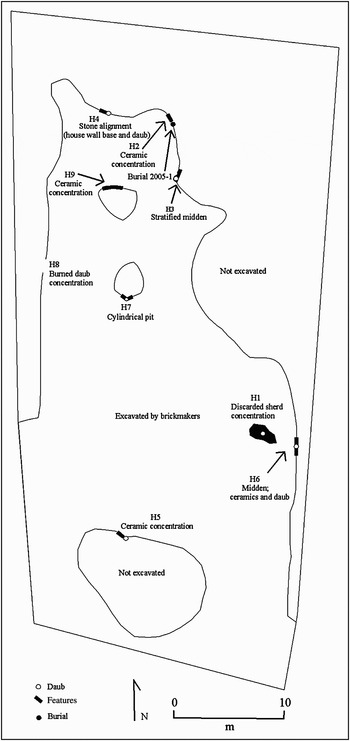
The archaeological features are remains of domestic units or households. Area H, the most complete, covered a minimum of 1000 m2 and included house remains (a wall alignment and occupation surface, feature H4), burial 2005-1 (H2), a midden with superimposed layers of cultural material separated by layers of sterile sand (H3), and a concentration of burned daub (H8) that could represent a second structure within the same domestic unit. The landowner denied us permission to open a large horizontal exposure. Areas F and I, farther to the west, had middens and ovens, corresponding mostly to the Middle Formative period Ríos phase.
Although much of the site has been destroyed, the brickmakers left some small remnants of the original land intact and their brick ovens are built on the original ground surface. A road marks the north limit of the early site where the hill begins to slope down toward the river. No early features were found on the slope. Some Classic period material was found at the edge of the road and farther north. The east side of the site has been destroyed except for a few remnants. Here also the hill slopes down slightly and this seems to mark the site limit since no features were found farther to the east. The southern limit of the site is defined by a slight slope; brickmakers' cuts showed no sherds or features indicating that their pits extend beyond the site limit. On the west side, the site slopes down slightly and the frequency of features in the profiles diminishes. So the site covers a maximum of 350 m north-south by 500 m east-west or 17.5 ha. Based on the presence of features, however, it covers no more than 200 by 200 m or 4 ha, which corresponds approximately to J. Zeitlin's original estimate of 2 ha.
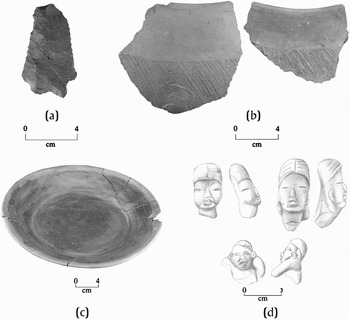
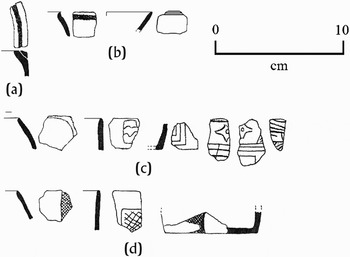
Among the lithics discarded by the brickmakers at Barrio Tepalcate we found the first definite evidence of Archaic period occupation in the southern Isthmus region: an elongated, triangular stemmed projectile point, a bifacial preform, a large core, and some large biface reduction flakes (Figure 6a). We found no Archaic features in the exposed cuts at Barrio Tepalcate. The Archaic material may derive from a transitory group that travelled along the Los Perros River and camped seasonally at Barrio Tepalcate. Both the raw materials and the lithic industry resemble Archaic materials from the Mitla area. The projectile point is similar in outline to other relatively thick points found in the Mitla area. A similar example was recovered in 2004 near Mitla by Cira Martínez López and Robert Markens in the Xaagá section of our highway salvage project. More common from the Mitla area, from Gheo Shih, for example, are points similar in form but with a rectangular or slightly tapered stem and no ears. Kent V. Flannery originally called these Jícaras points (Flannery, Marcus and Kowalewski Reference Flannery, Marcus, Kowalewski, Bricker and Saboff1981; Flannery ed. Reference Flannery1986), though in his publications they are called Pedernales points. MacNeish, Nelken-Terner and Johnson (Reference MacNeish, Nelken-Terner and Johnson1967:78) also report a Pedernales point base from Coxcatlan phase (4800–3500 b.c.) levels in El Riego Cave (Tc35w). Pedernales is a Texas point type (Suhm et al. Reference Suhm, Krieger and Jelks1954). The Mitla and Tehuacan specimens resemble Texas Pedernales points only in general outline but are narrower and considerably thicker and lack the distinctive barbs characteristic of non-resharpened examples from Texas. The Texas points are dated to 1200–800 b.c., while the Jícaras points and related varieties may date to around 7000–5000 years b.c. We call points like the Barrio Tepalcate specimen Xaagá points and the wide stemmed, earless examples Jícaras points.
(a) Archaic projectile point from Barrio Tepalcate; (b) tecomate rims from feature H3; (c) differentially fired bowl from feature H3; (d) Olmec-style figurine heads from Barrio Tepalcate.

Ceramics
Ceramics from Barrio Tepalcate correspond closely to those described by Robert Zeitlin (Reference Zeitlin1979) from Laguna Zope. Zeitlin's Lagunita phase is characterized by thin, decorated tecomates and has stylistic ties with the Ocós and Locona phases of Chiapas. We have not recognized this phase in the ceramics recovered at Barrio Tepalcate. Zeitlin's Golfo phase, considered Early Formative along with Lagunita, includes ceramics with Olmec-style designs and corresponds approximately to the San Lorenzo or Early Olmec horizon—that is, the San Lorenzo phase on the Gulf coast, the Cuadros phase in Chiapas, the San José phase in the Oaxaca Valley, and the Cruz B phase in the Nochixtlan Valley. This is the main period of interest in this paper. Zeitlin's Middle Formative Ríos phase, which includes abundant white-paste pottery and corresponds to the La Venta or Late Olmec horizon, is present at Barrio Tepalcate but is not discussed here.
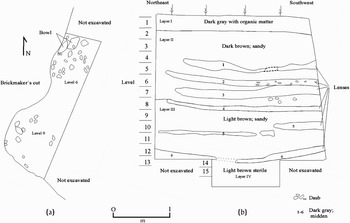
The ceramics described come from feature H3, a stratified midden deposit consisting of concentrations of sherds, lithics, and other debris in a dark organic matrix separated by layers of brown sandy silt. A 4-m-wide profile exposed by the brickmakers was cut back about 50 cm and excavated by arbitrary 20 cm levels to more than 2 m below the ground surface. Levels 6–12 contained Golfo-phase ceramics. At least 1,309 different vessels are represented in the sample including one complete bowl and many sherds large enough to reconstruct vessels on paper (Figures 7 and 8).
Plan of area H at Barrio Tepalcate.

Plan (a) and profile (b) of feature H3 excavation.

Our ceramic analysis employed the same criteria used to study other collections from Oaxaca: divisions based on general paste categories or groups, vessel forms, surface finish, surface treatment, and decoration (Martínez López et al. Reference Martínez López, Markens, Winter and Lind2000). We divided the Golfo phase ceramics from Barrio Tepalcate initially into two groups: sandy brown paste (96.5%) and fine paste (3.5%). Both pastes are probably local, and the ceramics presumably were made at Barrio Tepalcate. The sandy brown paste is analogous to “Tehuantepec local” samples from Laguna Zope in the University of Missouri Research Reactor (MURR) database (Blomster et al. Reference Blomster, Neff and Glascock2005:Table S3). The fine paste appears to be the same material but sifted or selected for fine texture. The sandy paste is usually fired to a brown or gray core color, the fine paste is fired to an orange-brown to light gray color, some fine paste vessels show both colors.
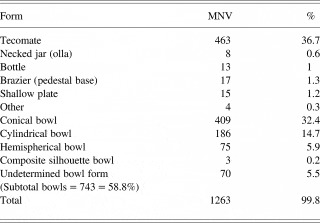
We divided the sandy brown paste ceramics into three subgroups: plain, wash-slipped, and differentially fired. Plain sandy brown paste vessels are predominantly tecomates; also present are pedestal base braziers and small shallow plates and, in smaller frequencies, (necked) cooking jars (ollas), water jars (cántaros), and conical and cylindrical bowls (Table 1). These vessels usually have a brown wash or slip the same color as the paste. Tecomate rims are slightly thickened on the interior and include two main groups: plain exterior and brushed band on the exterior below the rim. The brushed band group includes variations: flat or raised band; with or without raised bumps (pushed up from the interior); with or without additional impressed lines on the rim and on the raised bumps; and with or without a band of red paint (Figure 6b).
Feature H3; sandy-brown paste vessel forms by minimum number of vessels (MNV)

Barrio Tepalcate tecomates have relatively thick walls, exhibit burning on the exterior base, and appear to have been used for cooking rather than serving food. They are similar to Coe and Diehl's (Reference Coe and Diehl1980:160–161) San Lorenzo phase Camaño Coarse tecomates from San Lorenzo, which include examples with brushed bands and even with nodules pushed out from the interior. Cherla and Cuadros phase tecomates from Chiapas are not quite so similar (Clark and Cheetham Reference Clark, Cheetham, Carrión and Cook2005:Figures 19y and 25a). These plain tecomates are the principal cooking vessels and distinguish the Barrio Tepalcate assemblage from highland Oaxaca assemblages in which jars with out-curved necks are analogous to the tecomates. The Barrio Tepalcate tecomates are approximately the same size as the highland cooking jars and in both cases may imply use by family units.
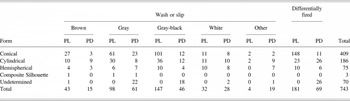
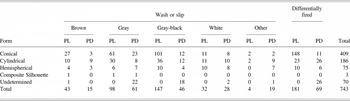
Vessels with surface washes or slips that differ in color from the paste comprise the second sandy-paste subgroup. Most are serving vessels: conical and cylindrical bowls with plain or externally thickened (bolstered) rims are common; hemispherical bowls (both open and restricted mouth), squash-shaped bowls, and some tecomates and cántaros also occur. The tecomates have pairs of suspension holes, which are absent in the plain tecomates, and may have been used for storage rather than cooking. Approximately 43% (n = 544) of this subgroup are vessels with brown, white, red, and other surface colors while 37% (n = 465) have gray and gray-black surface colors. Many of the bowls exhibit plastic decoration (Table 2).
Feature H3; bowls by wash-slip and plain (PL) or plastic decoration (PD). Number = MNV
Differentially-fired vessels form the third sandy brown paste group and make up 20% of the total (n = 254) (Figure 6c). Various combinations exist of white and black (actually light and dark gray) walls and rims: interior black, exterior white; interior black with white rim, exterior black with white rim; interior white, exterior black with white rim; and interior black with white rim, exterior white. The most common form is the conical bowl with outslanted wall and direct rim. One complete and several reconstructable examples vary between 5–7 cm high and 32–36 cm in diameter. Similar differentially fired bowls occur at San Lorenzo as Tular Black-and-White (Coe and Diehl Reference Coe and Diehl1980:182–184) and as imports in the Oaxaca and Nochixtlán Valleys in the highlands.
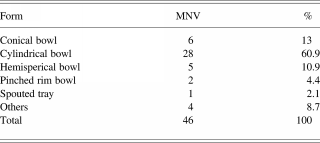
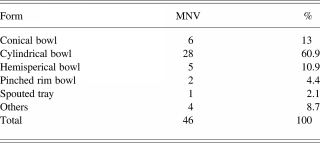
The fine-paste vessels in our sample are small cups (vasos) and bowls (Table 3). The spouted tray is an exception. Most vessels have white slip (N = 35; 76%) and less than half are incised (N = 14; 30%). Fine orange-brown paste occurs as unslipped and white-slipped vessels. Unslipped forms include cylindrical cups; white-slipped forms include small vessels with incised exteriors (Figure 9) and miniature conical bowls with indented bases, slipped on both surfaces. White-slipped vessels are analogous to La Mina White pottery from San Lorenzo (Coe and Diehl Reference Coe and Diehl1980:177–178). Some vasos with thin walls have indented bases and a white slip on both surfaces, smoothed but not burnished. The indented bases on the fine paste vessels are similar to the bases of the “paint dishes” described by Coe and Diehl (Reference Coe and Diehl1980:178). Compositional analysis showed that some Barrio Tepalcate fine-paste vessels are imports: the paste looks like the sandy-brown paste but without the sand grains, and the white slip on both the sandy-brown and the fine-paste vessels looks like the same material.
Examples of plastic decoration on fine-paste vessels from feature H3. (a) line on the rim; (b) line or lines on the exterior below the rim; (c) incised motifs; (d) cross-hatched motif.

Feature H3; fine-paste vessel forms and minimum number of vessels (MNV)
Associated with the Golfo phase pottery are solid figurines with elongated heads and narrow incised eyes, the “Solid Heads” and “Olmec Heads” of San Lorenzo A and B (Coe and Diehl Reference Coe and Diehl1980:264–275) or what we have called “Olmec style” heads from highland Oaxaca (Figure 6d). In the Oaxaca and Nochixtlan Valleys, at least at Etlatongo, Olmec-style figurines suddenly appear alongside traditional local figurine types (Winter Reference Winter2005); there is no parallel for this from Barrio Tepalcate though the sample is small.
Olmec-style designs
The San Lorenzo Olmec horizon is recognized throughout Mesoamerica by distinctive designs on ceramics. Both the design execution, excised or incised, sometimes with red paint in the lines, and standardized motifs are widespread. Many vessels from San Lorenzo and other sites show individual motifs such as crossed bands, the U motif, brackets, and others that derive from representations of mythical, supernatural creatures such as the Olmec dragon, the Olmec were-jaguar and possibly others that are rarely depicted as complete entities except at San Lorenzo itself (Blomster Reference Blomster2004:119–120; Di Castro and Cyphers Reference Di Castro and Cyphers2006). Many individual motifs are part-for-whole symbols; that is, they represent a part of the creature that in turn stands for the whole. We recognize them as such, and presumably the ancient potters and consumers of pottery did also. Although some archaeologists disagree, the presence of relatively complex and elaborate examples suggests that the motifs originated at San Lorenzo (see Blomster Reference Blomster2010), a uniquely large site and major center of innovation at the time. In addition, as Di Castro and Cyphers (Reference Di Castro and Cyphers2006:52, Figure 9) have pointed out, some of the motifs appear even earlier at San Lorenzo.
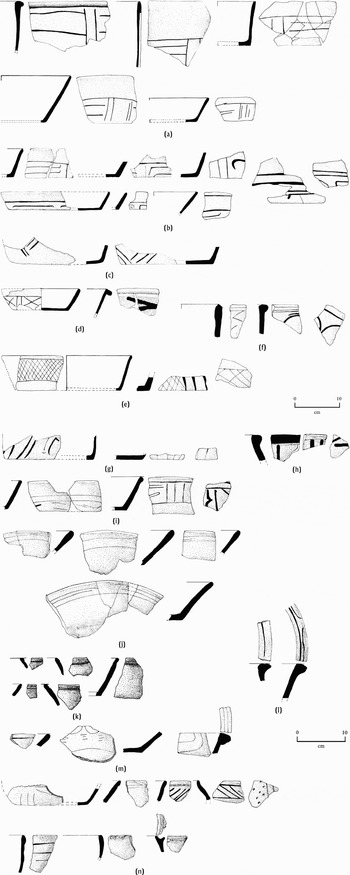
At Barrio Tepalcate incised and excised motifs occur mainly on conical and cylindrical bowls in the wash-slipped group (Figure 10). Bowls with out-slanted walls often show parallel lines just below the rim on the vessel interior (Figure 10j). More complex motifs rarely occur on vessel interiors but are common on exteriors of cylindrical bowls. Design placement varies with rim form: cylindrical vessels with direct rims are usually decorated on the lower two-thirds of the vessel walls, and vessels with exteriorly thickened rims often have a design beginning immediately below the rim. Similar design placement is reported from San Lorenzo (Di Castro and Cyphers Reference Di Castro and Cyphers2006:Figure 8).
Examples of plastic decoration on sandy-brown paste bowls from feature H3. (a) panels of alternating horizontal and vertical lines; (b) U motif; (c) V motif; (d) crossed bands; (e) open cross hatching; (f) curved lines similar to Limón Incised; (g) diagonal lines; (h) wide excised lines; (i) miscellaneous motifs and unique examples; (j) incised lines on the interior below the rim; (k) incised lines on the exterior below the rim; (l) line or lines on the rim; (m) unique examples; (n) other types of plastic decoration (modeled, notched, flanged).

While the presence of crossed bands and the U motif and the use of excising place the Barrio Tepalcate ceramics in the early Olmec horizon, the decorated examples differ somewhat from the San Lorenzo material. First, the techniques of decoration are not exactly the same. The San Lorenzo excised and incised vessels are classified as Calzadas Carved (excised) and Limón Incised (Coe and Diehl Reference Coe and Diehl1980:162–175); we have not been able to divide the Barrio Tepalcate examples into these two San Lorenzo types. Motifs at Barrio Tepalcate are made by incised, excised, and impressed lines of variable width and depth. Few vessels exhibit the wide excised lines characteristic of Olmec raspada motifs (Figure 10h).
Second, the Barrio Tepalcate ceramics are relatively less elaborated, and the inventory of design motifs is simpler. We found no examples showing complete anthropomorphic or zoomorphic creatures and none with the elaborate decorations found at San Lorenzo (see, for example Coe and Diehl Reference Coe and Diehl1980:Figures 138a, 138j, 140i). Geometric designs are common at Barrio Tepalcate and can be divided into rectangles, parallel diagonal lines, Vs, cross-hatching, and others (Figure 10). Only a few sherds show curvilinear designs and may be similar to Limón Incised. Motifs usually repeat symmetrically around the vessel circumference, a common pattern also present at San Lorenzo. But the other two patterns noted at San Lorenzo, bilateral symmetry and asymmetry (DiCastro and Cyphers Reference Di Castro and Cyphers2006:34), were not found at Barrio Tepalacate. At Barrio Tepalcate the crossed bands, U-motif, and brackets occur in relatively low frequencies, so the Barrio Tepalcate designs seem generally simpler than those of San Lorenzo. Based on visual inspection, we recognized no sherds from imported vessels in the feature H3 sample, so the Barrio Tepalcate material also differs from ceramics from San José Mogote and Etlatongo, which have both gray and white ware imports (Blomster, Neff, and Glascock Reference Blomster, Neff and Glascock2005) or Cantón Corralito, where the inferred Olmec colony had ceramics like those of the parent community, San Lorenzo (Cheetham Reference Cheetham2006).
What does this pattern mean? The ceramic assemblage and figurines align Barrio Tepalcate clearly with the broader Isthmus area, including San Lorenzo, Chiapa de Corzo, and the Soconusco region, occupied 3,000 years ago by Mixe-Zoque speakers. Also, Barrio Tepalcate ceramics are clearly Olmec style, both in form (for example, the tecomates) and design. If style is “a way of doing something,” as several archaeologists have argued (see, for example, Hegmon Reference Hegmon1992), then tecomates, as cooking vessels at San Lorenzo and Barrio Tepalcate, imply that the inhabitants had ways in common of preparing food in contrast to the people in the highlands who used another kind of vessel.
Designs at Barrio Tepalcate are Olmec style, like those from San Lorenzo, because they include some of the same motifs and occur on similar vessel forms. At San Lorenzo, independent separate design motifs can be related to the whole Olmec creature (Di Castro and Cyphers Reference Di Castro and Cyphers2006). Some examples of this kind were imported to highland Oaxaca from San Lorenzo; they seem fancier than the Barrio Tepalcate vessels. At sites like Barrio Tepalcate, where one finds just the motifs, we might question whether the designs signify anything more than simple decoration or imitation of things seen from other places. It seems likely, however, that the symbols would have been understood throughout the Mixe-Zoque area as representations of creatures that figured in local worldview and religion.
The excavated samples from Barrio Tepalcate and Laguna Zope are too small to rule out possible presence of more elegant examples with depiction of complete creatures. In fact, the Laguna Zope sherds come from what may be redeposited fill in stratigraphic pits, while the Barrio Tepalcate materials come from a primary deposit and exhibit more detail and variation than reported for Laguna Zope (Zeitlin Reference Zeitlin1979).
It is possible that ceramics exported to highland communities from San Lorenzo were special function vessels, perhaps used for drinking a cacao beverage. Common exports to the Oaxaca highlands are gray ware bowls with outslanted walls, exteriorly thickened rims and excised motifs on the exterior, vasos with excised designs on the exterior, and fine white (Xochiltepec White and Conejo Orange-on-White) hemispherical bowls with restricted mouths. All three forms are part of the local inventory at Barrio Tepalcate, so their function may have already been part of local tradition, and thus importation of the special vessel forms would have been functionally redundant. Regional centers in the highlands, however, such as Etlatongo and San José Mogote, received imported ceramics from San Lorenzo, while smaller sites, such as Tomaltepec and Tierras Largas in the Valley of Oaxaca, did not. An analogous situation in the Isthmus would see imports arriving at Laguna Zope but not at Barrio Tepalcate. So while few imports occur at Barrio Tepalcate, it is possible that they are much more common at Laguna Zope.
CONCLUSIONS
We return to the questions posed at the outset of this paper about the ethnic and linguistic identity of Barrio Tepalcate's inhabitants and how they related to groups in other regions. The Barrio Tepalcate excavations provide new data on settlement patterns, trade, and ethnicity in the southern Isthmus. Laguna Zope, as R. Zeitlin (Reference Zeitlin, Stark and Voorhies1978) noted years ago, was a regional center for the southern Isthmus. Barrio Tepalcate would have been one of the villages within Laguna Zope's interaction sphere. Other early village sites surely exist in the southern Isthmus region, though they remain to be located and studied. As we mentioned above, R. Zeitlin (Reference Zeitlin, Stark and Voorhies1978) estimated that Laguna Zope covered 40 ha in the Golfo phase. At that time Barrio Tepalcate covered no more than 4 ha. This contrast in size parallels the settlement pattern in highland Oaxaca valleys where San José Mogote (in the Valley of Oaxaca) and Etlatongo (in the Nochixtlán Valley) are several times larger than contemporary nearby villages and also functioned as regional centers. According to Joyce Marcus and Kent V. Flannery (Reference Marcus and Flannery1996:106), during the San José phase the “main village” of San José Mogote covered 20 ha, and outlying neighborhoods may have added 40–50 hectares for a total population of 1,000 people. Jeffrey P. Blomster (Reference Blomster2004:66) estimates that Etlatongo covered 26.2 ha in the Middle Cruz phase, which includes Cruz B, the Early Olmec horizon. Zeitlin's 40-ha estimate for Laguna Zope may be too large if the distribution of surface sherds does not accurately reflect the occupation area, although the site was probably several times larger than Barrio Tepalcate since, in contrast to the latter, it had a long continuous occupation and several Late Formative period mounds (Zeitlin and Zeitlin Reference Zeitlin and Zeitlin1993).
Barrio Tepalcate's inhabitants participated in long-distance trade and received nonlocal goods such as obsidian, some marine shell, and perhaps other materials. Whether they received the goods via Laguna Zope or through direct exchange is not known. As noted above, highland centers like San José Mogote and Etlatongo imported Gulf Coast ceramics, but these are rare or absent at nearby villages. The centers also have more elaborate local ceramics. Thus, exchange may have been controlled by higher-status individuals at the regional centers who received imports directly. This may have been the case with Laguna Zope though it remains to be shown with further excavation.
Laguna Zope's connections may have included trade by canoe along the rivers and coastal lagoons and overland to the Gulf Coast and highland Oaxaca. Although we recognized no obvious special function for Barrio Tepalcate, it may be on a route between the southern Isthmus and the Valley of Oaxaca. The shortest trail from the southern Isthmus to the Valley of Oaxaca would follow a nearly straight west-northwest line up the Los Perros River, across to the middle reaches of the Tehuantepec River, up to the headwaters of the Tehuantepec, and finally across the mountains into the Valley of Oaxaca. This route may have served to link the southern Isthmus, highland Chiapas, and Soconusco with the Oaxaca and Nochixtlan Valleys in the highlands. But a shorter route from San Lorenzo and the Gulf Coast to highland Oaxaca would have passed directly over the mountains. Some of the differences in imported ceramics between San José Mogote and Etlatongo may indicate that both routes were used in the Early Formative period and that each regional center leader had its own trade partners.
Golfo phase ceramics from Barrio Tepalcate are clearly different in form and decoration from contemporary highland Oaxaca ceramics but relatively similar to those from the northern Isthmus, highland Chiapas, and Soconusco. Inhabitants of Barrio Tepalcate and Laguna Zope presumably had contact with individuals or groups in the wider Isthmus area, the Mixe-Zoque homeland (Kaufman Reference Kaufman1976; see also Wichmann et al. Reference Wichmann, Beliaev, Davletshin, Uriarte and Lauck2008). Although specialists commonly speak of Oaxaca archeology, there are really two pre-Hispanic Oaxacas: the Mixe-Zoque area to the east and the Otomangue area to the west; they manifest many material differences that extend for millennia into the past.
According to Terrence Kaufman (Reference Kaufman1976:106), Mixe-Zoque linguistic divergence began around 1600 b.c. “probably by spreading north, east and south-east from a homeland in the middle of the Isthmus of Tehuantepec.” Our new data from the southern Isthmus would support a scenario in which the Early Formative period human populations concentrated in three regions—Soconusco along with highland Chiapas, the Gulf Coast, and the southern Isthmus—corresponding in turn to three major linguistic groups: (proto-) Zoque, (proto-) Popoluca, and (proto-) Mixe, respectively. Possible ancestors of the first two groups have been well documented during the past three decades through archaeological research in Chiapas and the Gulf coast. Our recent work at El Carrizal outside Ixtepec, at Tres Picos near Jalapa del Marqués, and at other southern Isthmus sites, documents presence of a large and widespread Late and Terminal Formative period population in the southern Isthmus. These people may have been descendants of the early groups at Barrio Tepalcate, Laguna Zope, and related sites, and ancestors of the present day Mixe. We hope that this hypothesis will be evaluated through additional research in the southern Isthmus.
RESUMEN
En 2005, en un proyecto de salvamento arqueológico, documentamos la aldea formativa de Barrio Tepalcate sobre el Río Los Perros en las afueras de Ciudad Ixtepec, Oaxaca, en la porción sur del Istmo de Tehuantepec. Barrio Tepalcate demuestra que Laguna Zope no era un asentamiento aislado sino que pertenecía a un conjunto de comunidades con una jerarquía de dos niveles, siendo Laguna Zope varias veces más grande que las demás. La cerámica correspondiente al Horizonte Olmeca Temprano muestra semejanzas con la de San Lorenzo, 150 km al norte, aunque los diseños son más sencillos. Identificamos pocos ejemplos de fragmentos de vasijas importadas de San Lorenzo, en contraste con los sitios grandes en los altos de Oaxaca, como, por ejemplo, Etlatongo y San José Mogote, en los cuales aparecen vasijas importadas. Así, el patrón de intercambio entre San Lorenzo y sus contemporáneos era variable. Los habitantes de Barrio Tepalcate probablemente hablaban una lengua mixe-zoqueana y hubieron sido ancestros de la gran población, probablemente hablantes de mixe, que floreció en el Istmo Sur durante el Formativo Tardío.
ACKNOWLEDGEMENTS
Funding for our 2005 excavations was generously provided by John E. Clark and Fred Nelson of the New World Archaeological Foundation and Brigham Young University. We thank Jeffrey P. Blomster for helpful comments on the manuscript; we also thank David Hilbert for photographs and Juan Cruz Pascual, Emilio Jiménez Hernández, and Ismael Vicente Cruz for preparing the line drawings.