Background
The mental health of children and adolescents is an escalating international concern. World-wide up to 20% of children and adolescents experience a mental illness and in many countries suicide is the leading cause of death for young people (World Health Organization, 2001). The large impact of youth mental illness is costly to individuals and society. Mental disorders are an antecedent to self-harm, suicidal thoughts and suicide (Prince et al., Reference Prince, Patel, Saxena, Maj, Maselko, Phillips and Rahman2007) and a precursor to adulthood major depression, anxiety disorder, illicit substance abuse/dependence, and intimate partner violence victimisation (Kessler, Angermeyer, & Anthony, Reference Kessler, Angermeyer and Anthony2007; McLeod, Horwood, & Fergusson, Reference McLeod, Horwood and Fergusson2016). Furthermore, a constellation of other health risk factors is associated with poor mental health in youth including antisocial behaviour (i.e., aggression, rule-breaking and oppositional behaviours) (Rasche et al., Reference Rasche, Dudeck, Otte, Klingner, Vasic and Streb2016), lower physical activity, smoking and alcohol consumption (Patel, Flisher, Hetrick, & McGorry, Reference Patel, Flisher, Hetrick and McGorry2007). These behaviours have a distinct impact on an individual's long-term health, academic prospects and future employment (Jacka et al., Reference Jacka, Pasco, Williams, Leslie, Dodd, Nicholson and Berk2011; Siegel & Welsh, Reference Siegel and Welsh2011). Thus, although in Australia mental illness is already the largest contributor to burden of disease (disability-adjusted life years lost) for those aged 15–24 (Australian Institute of Health and Welfare, 2011), it is likely that the costs to society extend well beyond the health domain.
Increasingly, evidence is starting to ‘unpick’ the complex web of disordered mental health and behavioural functioning in adolescents. For instance, research indicates that aggression may be facilitated by post-traumatic stress disorder and psychological distress (Rasche et al., Reference Rasche, Dudeck, Otte, Klingner, Vasic and Streb2016). There are vast immediate and long-term social and economic impacts of problematic behaviour (Siegel & Welsh, Reference Siegel and Welsh2011) stemming from childhood. Longitudinal data indicates that persistent antisocial behaviour is associated with mental health problems, substance dependence, financial problems and criminal behaviour in adulthood (Moffitt, Caspi, Harrington, & Milne, Reference Moffitt, Caspi, Harrington and Milne2002).
There is also burgeoning understanding about the relationships between mental health and physiology (Cacioppo et al., Reference Cacioppo, Ernst, Burleson, McClintock, Malarkey, Hawkley and Berntson2000; Klimecki, Leiberg, Lamm, & Singer, Reference Klimecki, Leiberg, Lamm and Singer2013; Walters & Kiehl, Reference Walters and Kiehl2015). For instance, an examination of just over 2600 college students in Ohio identified that chronically lonely individuals recorded elevated mean salivary cortisol levels across the day (Cacioppo et al., Reference Cacioppo, Ernst, Burleson, McClintock, Malarkey, Hawkley and Berntson2000). Likewise, behaviour has been noted to be associated with neurophysiology. Magnetic resonance imaging was used in a study of 191 incarcerated youth in the United States to explore grey matter volumes of the amygdala (associated with fear conditioning) and hippocampus (associated with behavioural control and memory problems) (Walters & Kiehl, Reference Walters and Kiehl2015). Their results noted that higher reported ‘fearlessness’ was associated with lower amygdala grey matter volume and higher reported ‘disinhibition’ was associated with lower hippocampal grey matter volume. Promisingly, there is the building evidence around brain plasticity with new information that activities can actually change functioning areas of the brain. Neuroimaging research has discovered that a mindfulness-based intervention resulted in increases in brainstem grey matter concentration concurrently with improvement in psychological wellbeing (Singleton et al., Reference Singleton, Hölzel, Vangel, Brach, Carmody and Lazar2014). Klimecki et al. (2013) investigated the impact of compassion training on functional neuronal responses using functional magnetic resonance imaging (fMRI). They noted that, compared to their control group, compassion training elicited increased neuronal activity in a brain region associated with positive affect and affiliation (Klimecki et al., Reference Klimecki, Leiberg, Lamm and Singer2013). Music interventions are likewise postulated to impact brain regions and thus emotions and behaviour. One study noted that activation of the brain acoustic sensory streams (as measured using electrophysiological and autonomic instrumentation) led to changes in mental health and dysfunctional behaviours in youth diagnosed with generalised anxiety disorder or adjustment disorder (Kazymov, Mamedov, Alieva, & Chobanova, Reference Kazymov, Mamedov, Alieva and Chobanova2014). Music therapy has also been seen to improve behavioural and developmental outcomes in children and adolescents with psychopathology (Gold, Voracek, & Wigram, Reference Gold, Voracek and Wigram2004).
DRUMBEAT is a multicomponent programme incorporating therapeutic use of music (i.e. drumming on a djembe), group therapeutic discussions and relationship building to assist people experiencing, or at risk of problematic health and social outcomes. DRUMBEAT was designed initially for Australian Aboriginal youth in the Western Australian Wheatbelt region by an Aboriginal elder and Holyoake staff. The aim of the DRUMBEAT programme is to promote social understanding, compassion and connection through a team drumming experience. Facilitators gain accreditation after attending a 3-day training course. The DRUMBEAT programme is facilitated by at least one accredited facilitator who leads group discussions and rhythms and harmonies with djembes. The programme incorporates teaching drumming and sound making skills to participants (who sit in a circle) via analogies, role play, games and group activities. The programme includes goal setting (with a focus on generating competence and confidence) and culminates in a group performance to an audience. After an initial session, incorporating learning base rhythms and developing group guidelines, six learning modules are covered including (1) rhythm of life, (2) relationships, (3) harmony, (4) individuality and self-expression, (5) emotions and feelings and (6) teamwork. Sessions eight and nine focus on developing and practicing harmonies to deliver at the performance scheduled for session ten.
Despite some difficulties with evaluating music interventions in the school setting (Crooke, Reference Crooke and McFerran2014), there is evidence that group music programmes delivered at school may have a positive impact on adolescent socio-emotional outcomes (Jackways, Reference Jackways2014; Uhlig, Jansen, & Scherder, Reference Uhlig, Jansen and Scherder2017). For instance, evaluation results of the Rap and Sing Music Therapy programme held in a school in the Netherlands identified that psychological wellbeing, self-description, self-esteem and emotion regulation of 190 grade eight students improved significantly post-programme when compared to a control group (Uhlig et al., Reference Uhlig, Jansen and Scherder2017). The DRUMBEAT programme has been implemented in schools widely in Australia and more recently in North America, the United Kingdom, New Zealand, Canada and Anguilla. Previously, DRUMBEAT has been shown to increase self-esteem and reduce reported behaviour incidents in primary and secondary school students (Wood, Ivery, Donovan, & Lambin, Reference Wood, Ivery, Donovan and Lambin2013). The value of implementing programmes such as DRUMBEAT in school settings includes high reach and extended contact which assists with programme uptake, accessibility and completion (Clarke, Morreale, Field, Hussein, & Barry, Reference Clarke, Morreale, Field, Hussein and Barry2015). A plethora of mental and behavioural programmes suitable for school implementation exist (for a comprehensive list of Australian programmes, see https://www.mindmatters.edu.au/tools-resources/programs-guide), however schools can struggle to identify which intervention is likely to be the most suitable and successful for their students. This is particularly problematic as many therapeutic programmes have not been evaluated by external researchers and there are few rigorous school programme evaluations published. In addition to being effective, a programme needs to fit into school setting limitations such as budgets and timetabling, term length and teacher expectations. Additional issues with running programmes in disadvantaged schools, such as low attendance and difficulties gaining parental consent, also need to be considered. With its combination of therapeutic components and structured programme, a study exploring the potential impact of DRUMBEAT on students’ mental and behavioural outcomes in disadvantaged schools was warranted.
Aim and Hypothesis
The aim of this study was to identify if mental wellbeing, psychological distress, post-traumatic stress symptoms and antisocial behaviour changed for adolescents following their attendance at a 10-week DRUMBEAT programme. It was hypothesised that the DRUMBEAT programme, delivered in the school setting, would be associated with increased mental wellbeing, and reduced psychological distress, post-traumatic stress symptoms and antisocial behaviour in boys and girls.
Methods
Design
A single group pre-test/post-test research design was implemented. Initially, a control group (using a wait-list) was proposed, however due to low student consent responses, and a limited data collection time-frame, this was not possible.
Sample selection
This study sought to recruit schools within areas of low socio-economic status (SES) due to the association between socio-economic disadvantage and higher rates of mental health disorders (Sawyer et al., Reference Sawyer, Kosky, Graetz, Arney, Zubrick and Baghurst2000) and antisocial and delinquent behaviours (Losel, Carson, & Bull, Reference Losel, Carson and Bull2003). Thus, three schools were purposely selected from three of the lowest socio-economic areas within the Perth metropolitan region, with one school each located in the northern, eastern and southern corridors.
Initial contact regarding the research was made with each school's psychologist. Once formal written approval was provided by the Principal, potential student participants were identified and agreed upon by school psychologists, student services coordinators and/or grade coordinators. Selection criteria included students within grades eight to ten (grade mix of groups decided by each school) who displayed antisocial behaviour. The uptake of the programme and research was approximately 50% of those invited – this was mainly due to the failure of students to return a signed consent form from their parent/guardian.
Ethical Considerations
Approval for the study was gained from the institutional ethics committee and the state education department. Students were told that their participation in the DRUMBEAT programme and the research was completely voluntary and that they could withdraw from either the programme and/or the research at any time. They were also informed that they could still participate in the DRUMBEAT programme if they declined or withdrew their involvement in the research. Informed written consent to participate in the research was gained from both the student and their parent/guardian. This project involved minimal risk to participants. As the research involved measurement of mental health constructs, the students and parents were informed (via the information and consent forms) that the school psychologist would be notified about students who exceeded normal thresholds for psychological distress and post-traumatic stress scores. Students who exceeded these thresholds could continue with the DRUMBEAT programme and the research. Participation in the DRUMBEAT programme did mean that students would miss one class per week for 10 weeks. This however, was considered by the school staff to be appropriate considering the social, learning and behavioural difficulties being faced by the students and the potential benefit of their participation in the DRUMBEAT programme.
Instruments and Measurement
The pre- and post-programme questionnaires included four instruments: (1) Warwick Edinburgh Mental Wellbeing Scale (WEMWBS) (Tennant et al., Reference Tennant, Hiller, Fishwick, Platt, Joseph, Weich and Stewart-Brown2007), (2) Kessler 5 (K5) (Australian Institute of Health and Welfare, 2009), (3) Abbreviated Post-traumatic stress disorder (PTSD) Checklist – Civilian version (A PCL-C) (Lang et al., Reference Lang, Wilkins, Roy-Byrne, Golinelli, Chavira, Sherbourne and Craske2012) and (4) Adapted Self-Reported Delinquency Scale (ASRDS) (Carroll, Durkin, Houghton, & Hattie, Reference Carroll, Durkin, Houghton and Hattie1996; Mak, Reference Mak1993). These instruments were chosen due to their brevity, readability and constructs (as below).
(1) Mental Wellbeing was assessed using the 14 item Warwick Edinburgh Mental Wellbeing Scale (WEMWBS) (Tennant et al., Reference Tennant, Hiller, Fishwick, Platt, Joseph, Weich and Stewart-Brown2007). This is a validated measure of positive mental wellbeing (content validity .89, internal reliability .87, test–retest .83). This instrument asks respondents to signify which response best describes their experience over the last 2 weeks; 1 = none of the time, 2 = rarely, 3 = some of the time, 4 = often, 5 = all of the time, for feelings and thoughts such as ‘I've been feeling cheerful’. All feelings and thoughts are positive thus a higher score indicates higher mental wellbeing (resultant score between 14 and 120). This instrument was recently tested in an Australian sample and performed well in adolescents aged 13–16 (Hunter, Houghton, & Wood, Reference Hunter, Houghton and Wood2015).
(2) Psychological distress was measured using the Kessler 5 (K5). The K5 is an adapted version of the Kessler 6 (K6) (Australian Institute of Health and Welfare, 2009). Recent testing of the K6 in adolescents demonstrated the scale to have .79 sensitivity and .83 specificity (Furukawa, Kessler, Slade, & Andrews, Reference Furukawa, Kessler, Slade and Andrews2003). The K5 was adapted for use with Australian Aboriginal populations. This adaptation involved the removal of the statement ‘I feel worthless’ as it is considered potentially offensive to Aboriginal and Torres Strait Islanders (Australian Institute of Health and Welfare, 2009). This K5 instrument asks respondents – During the past 30 days, about how often did you feel a) nervous, b) hopeless, c) restless or fidgety, d) so depressed that nothing could cheer you up, e) that everything was an effort. Response options include; 1 = none of the time, 2 = a little of the time, 3 = some of the time, 4 = most of the time, and 5 = all of the time. Responses were summed to generate a total K5 score (resultant score between 5 and 25).
(3) Post-traumatic stress symptoms were measured using the Abbreviated PTSD Checklist – Civilian version (A PCL-C) (sensitivity .92, specificity .72, efficiency .75) (Lang et al., Reference Lang, Wilkins, Roy-Byrne, Golinelli, Chavira, Sherbourne and Craske2012). This instrument includes six questions asking respondents to indicate, how much, in the last month (1 = not at all; 2 = a little bit; 3 = moderately; 4 = quite a bit; 5 = extremely), they had been bothered by; a) repeated, disturbing memories, thoughts, or images of a stressful experience; b) feeling very upset when something reminded you of a stressful experience; c) avoiding activities or situations because they reminded you of a stressful experience; d) feeling distant or cut off from other people; e) feeling irritable or having angry outbursts; and f) having difficulty concentrating. Responses were summed to generate a total A PCL-C score (resultant score between 6 and 30).
(4) Antisocial behaviours were measured using the Adapted Self-Reported Delinquency Scale (ASRDC) (goodness of fit >.85, internal consistency .67 to .91) (Carroll et al., Reference Carroll, Durkin, Houghton and Hattie1996). The ASRDC is a Western Australian adaptation of the Australian Self-reported Delinquency Scale (Mak, Reference Mak1993). The ASRDC asks respondents to indicate how often they have behaved in a particular way in the past month. This questionnaire incorporates 11 questions asking respondents In the past 1 month how often (Never, 1–3 times, 4–6 times, once a month, more than once a month, more than once a week they have; a) deliberately damaged your own property or that of others, b) disrupted other people's games or activities (e.g., classwork) c) sworn at others or called them names, d) not done your classwork or homework, e) hit, pushed, punched or slapped someone else, f) been unable to concentrate in the classroom, h) disrupted the class by calling out or by being out of your seat, i) teased or made fun of someone else, j) been sent out of the classroom, k) been suspended from school, l) skipped class or wagged school? Responses were summed to generate a total antisocial score (resultant score between 11 and 66).
Procedure
A series of eight DRUMBEAT programmes were delivered within the three schools over a seven-month period (between May 2014 and November 2014). Six programmes were single sex (three male, three female) and two programmes incorporated mixed genders. Each DRUMBEAT programme was facilitated by an accredited DRUMBEAT facilitator assigned to deliver the programmes within the schools. Each facilitator also had either a certificate or degree in youth work and had facilitated DRUMBEAT to disadvantaged youth previously. A school liaison staff member or school psychologist at each school assisted the DRUMBEAT facilitators with organising the DRUMBEAT programmes, co-facilitated the programme, and assisted the researchers with data collection.
Each research participant was assigned a unique confidential code to identify the school, DRUMBEAT group and student. A risk management plan was created by the research team and school staff whereby the research team alerted the school when a student scored equal to or higher than 12 on the K5, or 14 on the A PCL-C.
A hard copy of the questionnaire was completed at the first session (or second session for first-week absent members). The questionnaires were designed to be self-completed, however the DRUMBEAT facilitators and/or UWA researchers were available to assist students with questionnaire completion. Questions were read aloud (quietly to avoid student discomfort) to any students experiencing literacy issues. The post-programme questionnaire was completed at the final DRUMBEAT session after the performance. Students who did not attend the last DRUMBEAT session were asked by the school liaison or DRUMBEAT facilitator to complete the questionnaire as soon as possible after programme completion.
Of the eight DRUMBEAT programmes, four were held within a northern corridor school, three at the eastern corridor school and one at the southern corridor school. One programme at the eastern corridor school finished early (after only seven sessions) due to the co-facilitator being unwell and a late start. This programme did not include a performance and these data were excluded from analysis. The final dataset included three ‘girl only’ groups (grades 8–9, 9–10, 8–10), three ‘boy only’ groups (all grades 8–9) and the one ‘mixed gender’ group (grades 8–9). Group sizes ranged from 8–10 participants, however one grade 8–9 boy only group had only five participants.
Data Treatment and Analysis
Analyses of questionnaire data were completed by the first author using SPSS V21. Total scores for each student were calculated for the WEMWBS, K5, A PCL-C and ASRDC scales from the pre- and post-programme questionnaires. If one response was missing within an individual measure construct (e.g. A PCL-C), the individual's mean for that construct was imputed. Data were excluded from analysis if two or more responses were missing within a construct.
Previously published thresholds were used to categorise mental stress for each student into binomial categories. For the K5 (Commonwealth of Australia, 2005), scores less than or equal to 11 were classified as none to mild psychological distress (consistent with a diagnosis of no or mild depression and/or anxiety disorder), scores 12 or greater were classified as moderate to severe psychological distress (consistent with a diagnosis of moderate to severe depression and/or anxiety disorder). For the post-traumatic stress symptoms variable (Lang & Stein, Reference Lang and Stein2005), scores less than 14 were classified as PTSD unlikely, scores 14 or a greater were classified as possible PTSD (i.e., showing signs of PTSD thus should be referred for clinical assessment). These categories were used to provide names of students exceeding thresholds to the school psychologist.
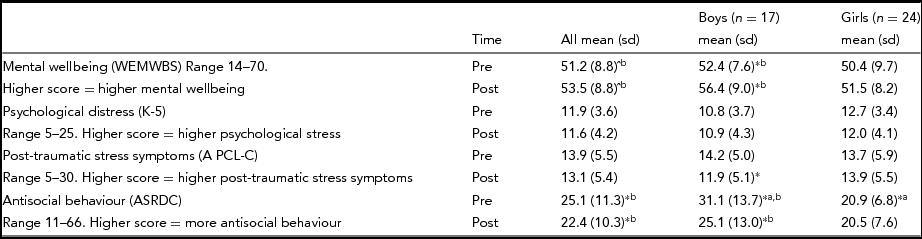
Descriptive statistics were also generated for each outcome continuous variables (see Table 1) and age. Repeated measures tests for differences between means were used to examine for differences between pre- and post-programme for WEMWBS, K5, A PCL-C and ASRDC scores (see Table 1). Analysis by gender was then undertaken (see Table 1). Due to the small sample size, further analysis by subgroup was not appropriate.
Participant mental wellbeing, psychological distress, post-traumatic stress symptoms and antisocial behaviour scores pre- and post-DRUMBEAT; all participants and by gender.

^p < .08, *p < .05, a = difference between boys and girls mean scores, b = differences between pre- and post-DRUMBEAT means scores, sd = standard deviation, WEMWBS = Warwick Edinburgh Mental Wellbeing Scale, K-5 = Kessler 5, A PCL-C = Abbreviated Post-traumatic Stress Disorder (PTSD) Checklist – Civilian version, ASRDC = Adapted Self-Reported Delinquency Scale. pre = pre-DRUMBEAT, post = post-DRUMBEAT programme.
Results
Baseline data were available for 63 adolescents. These results indicated that 57.1% (n = 36) of participants were experiencing moderate to severe psychological distress (i.e., exceeded normal threshold score for the K5), 49.2% (n = 31) high PTSS (exceeded normal threshold score for A PCL-C) and 34.9% (n = 22) both moderate to severe psychological distress and high post-traumatic stress symptoms. Antisocial behaviour (ASRDC scores) were strongly positively associated with both psychological distress (K5 scores) (Spearman's r = .36, p = .009) and post-traumatic stress symptoms (A PCL-C scores) (Spearman's r = .42, p = .002).
Of the 84 students who enrolled in a DRUMBEAT programme, 62 (73.8%) students completed the whole programme (due to incomplete programme at one school and students withdrawing from the programme or leaving school). Of these, 41 (66.1%, 24 girls and 17 boys) completed the programme and both the pre- and post-programme questionnaires (mainly due to school absences). The mean age of the final 41 sample was 13.8 years (SD = .7) with 17.0% (n = 7) identifying themselves as an Aboriginal and/or Torres Strait Islander. Country of origin was not asked due to perceived sensitivities relating to tensions at two of the schools between different cultural groups.
At baseline, boys were more likely to report higher antisocial behaviour than girls (p = .003). No significant differences were detected between boys’ and girls’ baseline mental wellbeing, psychological distress or post-traumatic stress symptoms. Bivariate analysis of all participants suggested reduced antisocial behaviour (p = .05) and improved mental wellbeing post-DRUMBEAT (p = .07); no changes were observed for psychological distress or post-traumatic stress symptoms scores. Gender split results however, indicated that there were significant improvements in boys’ mental wellbeing (p = .05), post-traumatic stress symptoms (p = .05) and antisocial behaviour (p = .02) after DRUMBEAT when compared to programme start. These changes were not evident for girls. Following participation in the DRUMBEAT programme, on average boys’ recorded 7.6% higher WEMWBS scores (mental wellbeing), 19.3% lower A PCL-C scores (post-traumatic stress symptoms) and 23.9% lower ARSDC (antisocial behaviours). No significant differences were detected for psychological distress changes between pre- and post-DRUMBEAT programme for either gender.
Discussion
With youth mental health and suicide being such a catastrophic issue in Australia and internationally (World Health Organization, 2001), ascertaining which group programmes are most effective in reducing psychological distress and improving mental wellbeing in children and adolescents is essential. In this study, boys reported significantly higher mental wellbeing, reduced post-traumatic stress symptoms and lower antisocial behaviour after participating in the DRUMBEAT programme. This therapeutic drumming and talking programme holds promise in being able to assist large numbers of disadvantaged boys experiencing mental and behavioural issues.
In this study, sample baseline post-traumatic symptom scores indicated that 34.9% of the participants were likely to be experiencing PTSD. This proportion highlights the importance of addressing this mental health problem. Participation in the DRUMBEAT programme led to a near 20% average decrease in boys’ post-traumatic stress symptoms. Programme content within DRUMBEAT does not specifically address traumatic experiences or symptoms, however it is likely that some programme components assist with trauma recovery. Research exploring drumming and its impact on PTSD is rare, however one published study noted that returned soldiers experiencing PTSD experienced reduced post-traumatic stress symptoms after participating in a group drumming programme (Bensimon, Amir, & Wolf, Reference Bensimon, Amir and Wolf2008). Further research exploring the potential impact of DRUMBEAT on post-traumatic stress symptoms within children and young people is warranted.
Our study also signified that higher average mental wellbeing was evident for boys after DRUMBEAT participation. Mental wellbeing is increasingly being recognised as an important protective factor against mental illness (Gargiulo & Stokes, Reference Gargiulo and Stokes2009). Maximising mental wellbeing in adolescent populations is considered a priority in attempts to reduce the burden of mental illness in populations, and as a preventive strategy for future physical and mental health (Clarke et al., Reference Clarke, Friede, Putz, Ashdown, Martin, Blake and Platt2011). Prior research with adolescents also indicated that DRUMBEAT increases self-esteem (Wood et al., Reference Wood, Ivery, Donovan and Lambin2013), and it is likely that DRUMBEAT contributes to supportive bi-directional relationships between self-esteem and mental wellbeing.
These study results also demonstrate that boys participated in significantly less antisocial behaviour after participating in DRUMBEAT. This aligns closely with previous research (Wood et al., Reference Wood, Ivery, Donovan and Lambin2013) in which objective measures of antisocial behaviours in school (behavioural incident reports) reduced for 29% of DRUMBEAT participants. Adolescent antisocial behaviour leads to high social, interpersonal and financial costs to individuals, families and communities (Piotrowska, Stride, Croft, & Rowe, Reference Piotrowska, Stride, Croft and Rowe2015), and is an ongoing stress and burden for teachers and school administrators (Sullivan, Johnson, Owens, & Conway, Reference Sullivan, Johnson, Owens and Conway2014). The time taken by school staff to address antisocial behaviour is significant, with 90% of school teachers and leaders reporting that behaviour management accounts for at least 10% of their time (Australian Government Department of Education and Training, 2014). Bringing together groups of boys exhibiting antisocial behaviours is certainly a challenge for DRUMBEAT facilitators, however the potential positive impact on behaviour is likely to have far-reaching benefits for the boys as they mature, and school staff and peers alike.
The findings that psychological distress was not lower after being involved in DRUMBEAT were contrary to expectation. It is possible that changes to psychological distress take time and that DRUMBEAT may reduce psychological stress in the longer term. Longer term follow-up would assist with examining the potential of DRUMBEAT to impact psychological distress.
It is important to identify mechanisms underpinning the impact of interventions; however, the observed benefits from DRUMBEAT participation can only be speculated at this stage. The multiple components integrated within DRUMBEAT such as education, music, motor activity and behavioural mimicry likely contribute to improved mental wellbeing and reduced post-traumatic stress and antisocial behaviour. The DRUMBEAT programme includes educational strategies evidenced as being characteristic of effective social and emotional interventions in schools such as teaching cognitive and affective skills, competence enhancement and empowering, interactive teaching methods (Clarke et al., Reference Clarke, Friede, Putz, Ashdown, Martin, Blake and Platt2011). Music has been noted previously to provide a calming effect for those listening to or ‘making’ music, and this is increasingly demonstrated through objective measurement. For example, prior research in a psychoneurology clinic in Azerbaijan identified that a music therapy intervention led to normalising of emotional status and reduction of heart rate and blood pressure for adolescents diagnosed with anxiety and/or adjustment disorder (Kazymov et al., Reference Kazymov, Mamedov, Alieva and Chobanova2014). Due to a strong neuronal connection between motor experience and empathic processes, coordinated movement (used in drumming) is also theorised to be a contributor to empathy and pro-social behaviour development (Behrends, Müller, & Dziobek, Reference Behrends, Müller and Dziobek2012). Behavioural mirroring is also suggested to play a role in creating affiliation, rapport and social cohesion (Lakin & Chartrand, Reference Lakin and Chartrand2003), and another component within DRUMBEAT that could contribute to emotional and social changes. Thus, the mirroring of movement and eye contact, combined with the sensorimotor activities associated with the drumming itself may improve mood (Shuman, Kennedy, DeWitt, Edelblute, & Wamboldt, Reference Shuman, Kennedy, DeWitt, Edelblute and Wamboldt2016) and strengthen group cohesion. Another potential factor generating positive changes is the link between post-traumatic stress and antisocial behaviour as noted in the baseline data analyses and prior research (Vermeiren, Reference Vermeiren2003). Participation in DRUMBEAT may directly reduce post-traumatic stress and antisocial behaviour; however, it is also possible that there are some bi-directional changes that are generated. For example, a reduction in post-traumatic stress symptoms resulting from DRUMBEAT participation may also lead to lower antisocial behaviour – this change in behaviour may then further reduce stress. Further exploration of mechanisms underpinning changes to mental health and antisocial behaviours via multicomponent programmes such as DRUMBEAT would be valuable.
It is important to consider alternative explanations for our study findings. Another change in the participants’ environments unrelated to DRUMBEAT could have led to the changes in outcomes. Although a waitlist group had been proposed to generate a comparison group, due to the difficulty in retrieving signed consent forms and programme timing, this was not achievable. Another factor impacting the mental health and antisocial behaviour of participants may have been changes to behaviour or extra support offered by school staff after being informed about students exceeding normal K5 and/or post-traumatic stress symptoms thresholds, although staff reported they were already alerted to the mental health states of these students hence their referral to DRUMBEAT. Unfortunately, the uptake of the DRUMBEAT programme was only approximately 50% of children within the invited sample. The school liaison staff did note this as being related to students forgetting to return consent forms (and a common dilemma faced in school-based programmes at these low SES schools). However, this does indicate potential selection bias within this study; for example, the participants in our sample may be more receptive to new programmes or have increased connectedness to the school. Not being able to compare differences for students who did not return consent forms is also a limitation of the study. Without consent we were not able to collect any data for those students who did not return their consent forms. Social acceptability bias may have impacted the self-reporting of participants with the adolescents being aware of expected changes following DRUMBEAT participation. Due to higher than expected absences, student withdrawal from the programme or school and the one incomplete programme, the sample size was lower than anticipated thus reducing the power to detect changes. This study did not follow-up participants after they had participated in DRUMBEAT thus it is unclear if self-reported mental health states and behaviour returned to pre-programme states.
The strengths of this study include the pre- and post-design using population validated measures of psychological distress, mental wellbeing and antisocial behaviour (although note the A PCL-C has only been used in adolescents in a Chinese adapted version (Hou et al., Reference Hou, Ting, Juan, HU, LIU and Ping2011)). Further, the DRUMBEAT programme was held at multiple sites increasing external generalisability. Despite the challenges involved, the evaluation of a programme within a real-world setting enhances the relevance of the results.
Additional research with larger samples and a control/comparison group will assist with building evidence about the impact of DRUMBEAT. A larger sample size will also enable exploration of outcomes related to participant characteristics (e.g., higher antisocial behaviours, cultural background) and/or programme components (e.g., facilitator, number of sessions attended). Sex differentials are also important to further explore, and this is particularly relevant with evidence that adolescent girls report higher stressors in specific domains (e.g., interpersonal), and respond more strongly to stressors (Hankin, Mermelstein, & Roesch, Reference Hankin, Mermelstein and Roesch2007). For girls, DRUMBEAT may have impacted ‘internalising’ behaviours, such as self-harm and thus further research is needed to establish the possible impact of DRUMBEAT on girls in other outcomes.
Conclusion
The DRUMBEAT programme shows promise as a potentially effective targeted strategy to significantly improve mental wellbeing and reduce post-traumatic stress symptoms and antisocial behaviour in socioeconomically disadvantaged adolescent boys. Further research incorporating larger samples and a control group will assist with verifying these findings and exploring potential moderators or confounders impacting programme success.
Acknowledgements
The authors would like to thank all those who assisted with facilitating this work including; the participating students, school staff, DRUMBEAT facilitators and management and our Research Assistants; Shannen Vallesi, Charlotte Schiefler, Nick Wood, Julian Ming and Madeleine Ford.
Financial Support
Dr Karen Martin was supported by the Western Australian Health Promotion Foundation (Healthway) through a Postdoctoral Research Fellowship (#23347) during this research.
Competing Interest Statement
The authors have declared that they have no competing or potential conflicts of interest.
Original Work Statement
This original research has not been previously published and is not under consideration in the same or substantially similar form in any other peer-reviewed journal. All authors listed have contributed sufficiently to the project to be included as authors and are listed on the manuscript title page. To the best of our knowledge, no conflict of interest, financial or other, exists.