INTRODUCTION
Staple length (SL) is a primary determinant of mohair price (McGregor & Butler Reference McGregor and Butler2004). SL affects the processing route, processing efficiency and the ultimate use and quality attributes of mohair textiles (Hunter Reference Hunter1993; Leeder et al. Reference Leeder, McGregor and Steadman1998). The standard practice is that, following skirting of a fleece, SL is visually assessed immediately following shearing and/or by fleece-selling agents at a warehouse during the preparations of bulk classed lines before sale. Efforts to reduce the variability of SL within bales of commercial mohair rely on a thorough understanding of SL variation within and between individual mohair fleeces. Processors of mohair also inspect purchased mohair and frequently employ staff to remove overly long or short mohair prior to processing.
While the extent of variation in SL at different fleece sites within the fleece of Merino sheep has been well studied following the initial work by Turner et al. (Reference Turner, Hayman, Riches, Roberts and Wilson1953), Lockart (Reference Lockart1954) and Young & Chapman (Reference Young and Chapman1957), it is not as well documented in Angora goats. The few studies that have examined mohair SL at different fleece sites have been limited by the low numbers of animals and fleece sites studied or have used only one genetic source (Venter Reference Venter1959; Engdahl & Bassett Reference Engdahl and Bassett1971; Stapleton Reference Stapleton1976; Gifford Reference Gifford1989; Taddeo et al. Reference Taddeo, Duga, Almeida, Willems and Somlo2000). None of these studies determine the sources of variation in SL at different sites or the relationship in SL between different sites.
The objectives of the current study were to determine how the average SL differences between nine sampling sites vary between sex and flock, to identify differences in SL variability between sampling sites as a result of between-animal and between-sire variability and to determine SL correlations between sampling sites in between-animal and between-sire variability.
MATERIALS AND METHODS
General
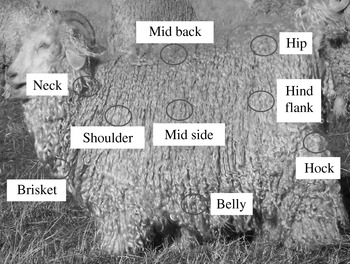
Full management details have been provided by McGregor & Butler (Reference McGregor and Butler2008a). In brief, Angora goats (n=313) from two farms (Horsham, Burragate), with pedigree breeding records from 15 known sires, were grazed on pasture from birth until 12 or 18 months of age. The goats were progeny of various genetic sources including sires of pure South African origin (n=2), pure Texan origin (n=4), 0·5 South African and 0·5 Texan (n=3), and other interbred admixtures that included sires of South African, Texan and Australian origin. These sires were representative of the genetics available in Australia (Ferguson & McGregor Reference Ferguson and McGregor2005). Both does and castrated males (wethers) were sampled. All animals were previously shorn at 6 months of age. Animals were then sampled at 12 months of age in the same year and, at Horsham, also at 18 months of age, so that all samplings were for 6 months' fleece growth. A mohair staple was taken from each of nine sites across the body of the Angora goats (Fig. 1).
The locations of the nine sampling sites.

Samples were placed in a conditioned fibre-testing laboratory for >48 h. Testing of animals was in a random order. Generally, for each animal all the site samples were measured in a random order before the samples from the next animal were tested. This two-stage sampling is analogous to a split plot design, and is the most appropriate approach when the objective is to compare sampling sites, and how these relationships differ with farm and sex. With the Burragate samples all the mid-side samples were measured first. The straightened SL was measured, to the nearest 5 mm, after removing crimp and twist by hand plucking to separate the fibres while firmly holding the base of the staple, and then using a ruler to measure from the base of the staple to the end of the dense part of the tip (McGregor & Butler Reference McGregor and Butler2008b).
Statistical analysis
For each of the two shearings, a parsimonious model of SL was developed to explain the various sources of variation between sites using a restricted maximum likelihood (REML) algorithm (Gilmour et al. Reference Gilmour, Thompson and Cullis1995), as implemented in GenStat version 10 (Payne Reference Payne2005). The unit of analysis was a single animal by site combination (n=2725 for 12-month shearing, n=2137 for 18-month shearing allowing for missing measurements). The modelling process concurrently investigated fixed effects for site, farm, sex and their interactions, as well as variances and covariances between sampling sites for individual animals and for sires. As there were only a limited number of sires used in the study, and thus it was difficult to individually estimate all the between-site covariances for sires, all the models assumed that the sites were equally correlated at the sire level (but not at the individual animal level). Terms were included or excluded from the parsimonious model using Wald tests for fixed effects, and change in deviance tests for terms involving variances and covariances. Further details are provided by Butler & McGregor (Reference Butler and McGregor2006). Standard errors are calculated using the standard asymptotic normal approximation. The 12-month Burragate mid-side samples were excluded from the analysis since, on average, they were about 5 cm longer than the SL at all the other sites. The extra length might have been due to bias from these mid-side samples being measured prior to all other samples by a different operator. All other samples were measured by a single operator.
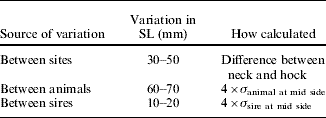
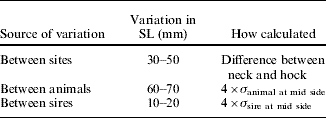
The approximate variation of mohair SL accounted for by sites, animals and sires was calculated as (1) the difference in SL between the shoulder and hock sites, (2) four times the between-animal (within-sire) standard deviation and (3) four times the between-sire standard deviation at the mid side, all calculated from the fitted models.
RESULTS
SL distribution for mid side or shoulder
The median mid-side SL at 12 months of age was Horsham 120 mm (range 65–160 mm). The median mid-side SL at 18 months of age was Horsham 110 mm (80–150 mm). The median shoulder SL at 12 months of age at Burragate was 130 mm (80–165 mm).
Selected models
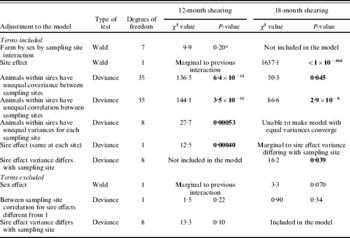
In the model for SL at the 12-month shearing the fixed effects were all combinations of farm, sex and site, i.e. a model that included the three factor interaction (Table 1). At the 18-month shearing, site was the only fixed effect included. There was no effect of sex (P>0·05, Table 1). No farm effect can be included for the 18-month shearing because measurements were only taken from Horsham.
Statistical significance of included and excluded terms in the REML model for SL

a Included because all two factor interactions are statistically significant (after adjustment for other two factor interactions; P-value for Farm.Sex=0·030, P-value for Farm.Site=8·9×10−16, P-value for Sex.Site=0·00082).
P-values in bold are significant at the 0·05 level.
The models chosen had, at each site, a random effect for sires and a nested random effect for individual animals within sires. At both the 12- and 18-month shearings the random effects for individual animals were chosen, using the change in deviance tests in Table 1, to have unequal variances for different sites, and unstructured covariances between sites. At both the 12- and 18-month shearings the random effects for sire had a correlation of 1 between sites. This implies that the sires with lower (higher) variation at one site (say the mid side) will be the same sires that have lower (higher) variation at any other site. However, at the 12-month shearing the between-sire variance was the same at each site, whereas at the 18-month shearing the between-sire variance was different at each site (Table 1).
Site differences in the average SL
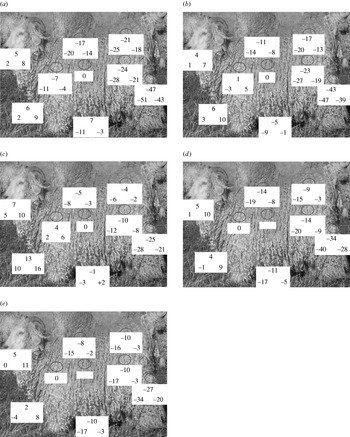
The effects of farm and sex were small compared with the strong effect of site (Table 1, Fig. 2). There was an anterior/posterior decline in SL. The forward sampling sites (neck and brisket) were longer than the mid side, but the differences were generally <7 mm (Fig. 2). In contrast, the rear sites (hip, hind flank, hock) were generally 10–40 mm shorter than the mid-side site, with the hock site having the shortest SL. The belly and mid back sites were also slightly shorter (c. 10 mm) than the mid-side site.
Deviations of SL (mm) at different sampling sites compared with SL at mid-side site for (a) 12-month shearing does at Horsham, (b) 12-month shearing wethers at Horsham, (c) 18-month shearing at Horsham, (d) 12-month shearing does at Burragate and (e) 12-month shearing wethers at Burragate.

Variability and covariances between sites for individual animals
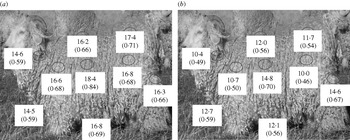
The standard deviation of SL for individual animals were higher at the 12-month shearing compared with the 18-month shearing (Fig. 3). The mid-side site had the highest between-animal variation of any site at both the 12- and 18-month shearing.
Between-animal standard deviation of SL (mm) for (a) 12-month shearing and (b) 18-month shearing. Between-animal standard deviation includes confounded component due to sampling variability within individual animals. s.e. are in parentheses.

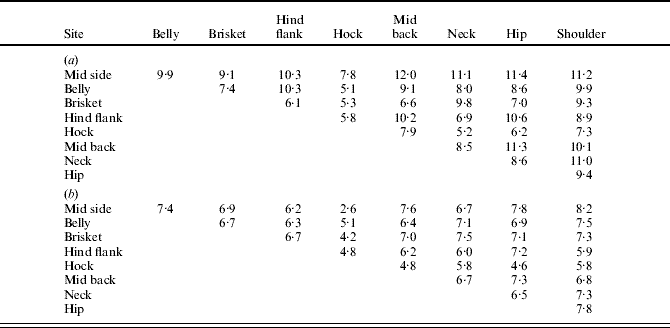
With the animal effects, the between-site covariances are closer to being equal than the between-site correlations (Table 1). Thus it is more informative to present the square root of the covariances rather than the more usual correlations (Table 2). The covariances are square root transformed so that they are presented on the same scale as the standard deviations (namely mm), and thus allow Fig. 3 and Table 2 to be directly compared.
Square root of covariance (mm) between sites of animal within sire effects for SL at (a) 12-month shearing and (b) 18-month shearing. Values are estimated using the fitted models
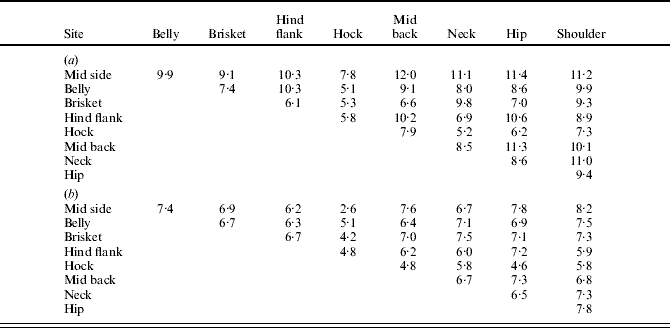
s.e. for pairs not involving hock: (a) 0·7–1·2; (b) 0·6–0·8.
s.e. for pairs involving hock: (a) 1·0–1·6; (b) 1·0–2·7.
Despite the covariances differing between pairs of sites, most pairs of sites have between-animal covariances around half of the standard deviations (Table 2). The hock has a low covariance compared with most other sites.
Variability and covariances between sites for sires
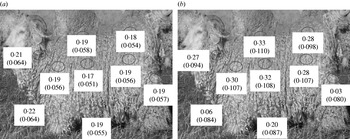
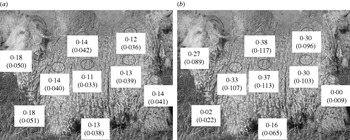
The estimated ratio of between-sire standard deviation to between-animal standard deviation of SL, r=(σS2/σA2)0·5 is presented, for each site and shearing (Fig. 4). These values are converted into apparent heritabilities using the formula h 2=4r 2/(1+r 2) (Fig. 5).
Ratio of between-sire standard deviation to between-animal standard deviation r=(σS2/σA2)0·5 of SL for (a) 12-month shearing and (b) 18-month shearing. s.e. are in parentheses.

Heritability h 2=4r 2/(1+r 2) of SL for (a) 12-month shearing and (b) 18-month shearing. Between-animal standard deviation includes confounded component due to sampling variability within individual animals. s.e. are in parentheses.

The results imply that heritabilities for the central/upper sampling sites of mid side, shoulder, hind flank, mid back and hip are moderate at 18 months (Fig. 5b). Within the precision limitations of the data, there is little to choose between these sites in terms of heritability. The lower sampling sites of brisket, belly and hock have low heritabilities at 18 months. All sites had moderately low heritability at 12 months (Fig. 5a).
Sources and extent of variation in SL
There was more variation in SL associated with differences between animals than due to variation between sites or between sires (Table 3).
Variation of the SL accounted for by sites, animals and sires and the method of calculation
DISCUSSION
There was an anterior–posterior decline in SL with the hock being particularly short. The difference between the mid side and hock typically was 30–50 mm. This pattern occurred irrespective of sex, farm or age. There was no evidence that the between-site correlation of the sire effects differed from 1, indicating that genetic selection for SL at one site will be reflected in SL over the whole fleece. However, low heritabilities of SL at the hock, belly and brisket or at any site at 12 months of age were obtained. There was more variability between sites than between sires, but the between-animal variation was greater.
Interpretation of results
Two previous studies in Australia found that the neck site produced mohair that was longer than the mid side and hind flank or breech regions (Stapleton Reference Stapleton1978; Gifford Reference Gifford1989). However, these studies were carried out prior to the introduction of new genetic material to Australia from South Africa and Texas, and thus have lower relevance to current international mohair production. As these studies only sampled three sites, their conclusions differ from the present study: they found the mid-side mohair to be close to the average of the three sites. Venter (Reference Venter1959), Engdahl & Bassett (Reference Engdahl and Bassett1971) and Taddeo et al. (Reference Taddeo, Duga, Almeida, Willems and Somlo2000) also found that the SL was longer on the neck than that from the mid side or thigh/breech in Angora goats. In Merino sheep, an anterior–posterior decline in SL and a mid-lateral decline in both the dorsal and ventral directions have been reported by Lockart (Reference Lockart1954) and Young & Chapman (Reference Young and Chapman1957) ; in the latter study the upper shoulder position was closest to the mean SL measurement based on measurements from all sites, whereas the mid-side site overestimated the mean SL of Merino wool.
The between-animal variation at each site consists of two components, namely the true variability between animals and the sampling variability within an animal. This sampling variability consists of those sources of variation associated with sampling and measuring the same site on the same animal at the same sampling time. As there was only one sample taken at each site for each animal, the true animal variation and the sampling variability are confounded, reflecting the usual situation during commercial testing. This needs to be taken into account when interpreting the observed between-animal variation.
Previously it has been observed that the primary result for the individual animal effect of mean fibre diameter at each site is that at each age the variability between animals varies substantially for different sites but the covariance between sites of the animal effects are essentially equal for each pair of sites (McGregor & Butler Reference McGregor and Butler2008a). This conclusion is not tenable for mean fibre diameter if covariances are replaced with correlations. A similar conclusion is true for SL at 18 months of age, with the exception of the hock site, which has a lower covariance with other sites. An interpretation of this result is that, if data are restricted to the 18-month shearing and exclude the hock site, and if the true animal SL at each site could be measured, then each site would be equally effective for animal selection (McGregor & Butler Reference McGregor and Butler2008a). However, because the sampling variability differs between sites, some sites will be more effective for between-animal selection than others (McGregor & Butler Reference McGregor and Butler2008a).
In the current study, at 18 months the observed between-animal variation was greater at the mid-side site than other sites, with the possible exception of the hock. Also the observed between-animal variation, at each site, was greater at the 12-month shearing than the 18-month shearing. This indicates that the best sites for selecting individual animals for fleece SL is any site except the hock and mid side, and this selection is better at 18 months of age.
When selecting bucks and does for breeding it is important to take into account genetic variability as well as between-animal variability. The genetic component can be ascertained from the between-sire variability. Since the between-site correlations for the sire effects can be taken to be equal to 1, sire selection pressure will be more effective on those sites with greater heritability.
Application of results
The results of this work can be applied in three different situations.
Within-flock selection (culling)
The between-animal (within-sires) standard deviations differ substantially between sites (Fig. 4). However, with the exception of the hock, at the 18-month shearing the square roots of the covariances between sites of the animal effects are similar in magnitude. This is in accord with the true animal effects having similar variance at each site and being equi-correlated between sites, but the within-animal sampling effects differing substantially between sampling sites. Under this scenario, selection of individual animals to increase SL of the fleece (such as within-flock culling) would be most effective on those sampling sites with lower observed between-animal standard deviations (McGregor & Butler Reference McGregor and Butler2008a). At the 18-month shearing, these are any site except the mid side and hock.
Another consideration that needs to be taken into account is the ease with which a site can be located and sampled. For a skilled operator working in a suitable race, the hip and mid back sites are easy to locate and do not require that an animal be turned on its side for sampling. Thus the hip and mid back sites can be recommended for within-flock selection.
These results differ from the advice of Gifford (Reference Gifford1989), who sampled only three sites from 39 one-year-old male goats, and concluded that the mid-side site was a more appropriate sampling site to assess the SL compared with the neck and thigh positions.
The lower between-animal standard deviations at each site, for the 18-month compared with the 12-month shearing, indicates that within-flock selection (culling) will be more effective at the older age. Delaying within-flock selection by 6 months will involve holding ‘unwanted’ males for longer but it is unlikely to increase generation interval, as Angora goats are usually not mated in either spring, when 12 months old, or early summer. Using the 18-month fleece SL measurement will not interfere with the usual farm practice of selecting young bucks. The authors have been unable to locate any other reports containing data to correlate SL at the preferred sampling age of 18-months of age with lifetime production.
Identification of sires for genetic selection
For genetic selection, heritabilities of around 0·3–0·4 should be achievable, provided the more central/upper sampling sites are used at an 18-month shearing. This implies genetic selection should be effective to increase SL, provided selection pressure and generation intervals are appropriate. The heritabilities obtained are similar to the average of 0·28 obtained in other studies of SL (Shelton & Bassett Reference Shelton and Bassett1970; Yalçin et al. Reference Yalçin, Aritürk, Imeryüz, Sincer and Müftüoglu1979; Gifford et al. Reference Gifford, Ponzoni, Lampe and Burr1991; Allain & Roguet Reference Allain and Roguet2003).
It is unknown to what extent the genetic variation is due to genetic differences between sires and to what extent the genetic variation is due to source of origin (Texan, South African, mixture), but the Australian Angora goat flock is an ill-defined mixture of animals from these three sources and most flocks will have animals with varying mixtures of Texan, South African and Australian genetics. This suggests that the heritabilities in the current study are likely to reflect the situation in Australian Angora goat flocks.
Genetic correlation (e.g. between-sire correlation) can be taken to be one. Thus, genetic selection at any central/upper sampling site should be effective for increasing the average SL over the whole fleece. Unlike for mean fibre diameter (McGregor & Butler Reference McGregor and Butler2008a), there is no evidence that genetic selection of SL at one sampling site will preferentially change SL at that site compared with other sampling sites on the fleece.
Preparation of mohair for sale (classing)
During the preparation of mohair for sale, the fleece is commonly divided into three major components: mainline fleece, skirtings or pieces, and contaminated and out-sorts fibre (McGregor & Butler Reference McGregor and Butler2008a). Generally fibre from the hock and belly would be removed from the mainline fleece as the belly fibre is considered to be contaminated and the hock fibre is considered to be skirtings as it has a higher incidence of medullated fibre than the mainline fleece (Stapleton Reference Stapleton1978). The present work indicates that mohair growing at the hock site is about 5 mm shorter than the fleece average, a difference too small to justify a separation into a shorter length category. Mohair growing at the brisket and neck sites is also slightly longer than the average for the fleece but this mohair should be removed from the main body of the fleece as it is one or two grades coarser and small increases in length of fibre at these sites are not likely to be of commercial importance (McGregor & Butler Reference McGregor and Butler2004).
CONCLUSIONS
The hip and mid back sites can be recommended for within-flock (culling) and genetic selection for SL due to their low sampling variability, moderate heritability and ease of location. Unlike for mean fibre diameter, there is no evidence that genetic selection of SL at one sampling site will make preferential genetic progress at that site compared with other sites on the fleece.
We are indebted to Mohair Australia and their members, in particular R. and J. Liddy, R. Doyle, G. Denney and R. Harris. We thank M. Ferguson and colleagues (DPI Hamilton) for assistance in sample collection and measurement. The Rural Industries Research and Development Corporation part funded this project.