Acetyl-CoA carboxylase (ACCase; EC 6.4.1.2) is an important enzyme in the first step of fatty-acid biosynthesis (Harwood Reference Harwood1988; Shorrosh et al. Reference Shorrosh, Dixon and Ohlrogge1994). ACCase-inhibiting herbicides (hereafter referred to as ACCase herbicides) obstruct de novo fatty-acid synthesis in sensitive weeds, resulting in necrosis and plant death. According to their chemical structures, ACCase herbicides can be classified into three classes: aryloxyphenoxypropionates (APPs), cyclohexanediones (CHDs), and phenylpyrazoline (PPZ) (Wenger et al. Reference Wenger, Niderman and Mathews2012). These herbicides are effective on the plastidic isoform in most grass weeds but show very little or no activity on the cytoplasmic isoform (Konishi and Sasaki Reference Konishi and Sasaki1994; Yu et al. Reference Yu, Kim and Tong2010). In the last 30 yr, 18 ACCase herbicides have been commercialized, providing successful control of grass weeds (Kaundun et al. Reference Kaundun, Bailly, Dale, Hutchings and Mclndoe2013a).
Because of their effectiveness and convenience for management of grass weeds, ACCase herbicides have been used year after year in various crop fields worldwide, including China. Unfortunately, an increasing number of grass weeds have evolved resistance to ACCase herbicides with their repeated use. To date, biotypes of 47 grass weed species have been documented to resist at least one ACCase herbicide (Heap Reference Heap2016). In many cases in which the ACCase resistance mechanism has been studied, resistance is due to specific amino acid substitution (AAS) in the carboxyltransferase (CT) domain resulting in an insensitive target site to herbicides (Délye Reference Délye2005; Powles and Yu Reference Powles and Yu2010). Seven codon positions with 13 AASs are implicated in ACCase resistance, namely Ile-1781-Leu/Val/Thr, Trp-1999-Cys/Leu/Ser, Trp-2027-Cys, Ile-2041-Asn/Val, Asp-2078-Gly, Cys-2088-Arg, and Gly-2096-Ala/Ser (Beckie and Tardif Reference Beckie and Tardif2012; Kaundun et al. Reference Kaundun, Bailly, Dale, Hutchings and Mclndoe2013a, Reference Kaundun, Hutchings, Dale and Mclndoe2013b). All the amino acid sequence positions described in this study follow the CT domain of blackgrass (Alopecurus myosuroides Huds.) accession AJ310767.
Shortawn foxtail is a very common and troublesome grass weed in China (Zhang Reference Zhang2003). It has a wide distribution in Europe, temperate Asia, and North America (Hashim et al. Reference Hashim, Hachinohe and Matsumoto2010). In China, shortawn foxtail is a typical noxious weed in some overwintering crop fields, especially in oilseed rape (Brassica napus L.) and wheat (Triticum aestivum L.) fields with a rice rotation. Postemergence treatment of fenoxaprop has been used more than 10 yr for the control of shortawn foxtail. High reliance on this herbicide has resulted in rapid evolution of ACCase resistance. Recently, Ile-1781-Leu, Ile-2041-Asn, and Asp-2078-Gly AASs in the ACCase gene of shortawn foxtail have been documented to confer different resistance levels to ACCase herbicides (Guo et al. Reference Guo, Yuan, Liu, Bi, Du, Zhang, Li and Wang2015b, Reference Guo, Lv, Zhang, Li, Wu, Lu, Liu and Wang2016; Xia et al. Reference Xia, Pan, Li, Wang, Feng and Dong2015). The varying levels of resistance are closely related to the herbicides, the dosage, weed species, and the specific resistance mechanism (Powles and Yu Reference Powles and Yu2010).
Given the fact that no new herbicides with novel mechanisms of action have been brought to the market in almost three decades (Duke Reference Duke2012), people must use existing herbicides in a more sustainable way. While ACCase herbicide resistance has evolved in many weeds, a large number of grass weeds are still susceptible to ACCase herbicides. Knowledge of the resistance mechanism will contribute to delay the expansion or sometimes overcome ACCase herbicide resistance. The present study identified a shortawn foxtail population that is resistant to ACCase herbicides. In this population, a very rare Ile-2041-Thr mutation in the ACCase gene was identified. Two subpopulations (F2 generation) originated from the same heterozygous plant were purified and used in dose–response experiments. We also developed a dCAPS (derived cleaved amplified polymorphic sequence) assay for the rapid identification of this mutation in shortawn foxtail.
Materials and Methods
Plant Material
In May 2014, seeds of a suspected ACCase herbicide–resistant shortawn foxtail population (JSLS-1) were collected from a fallow field in Lishui, Jiangsu province (31.56°N, 118.89°E). A previously reported herbicide-susceptible population (HNXY-1) that originated from Xixian, Henan province (32.33°N, 114.70°E), served as the control in this current study (Guo et al. Reference Guo, Yuan, Liu, Bi, Du, Zhang, Li and Wang2015b). The mature seeds of shortawn foxtail were collected from the spikes of at least 50 plants randomly distributed in the field and then mixed thoroughly. Seeds were air-dried and stored in the dark in sealed paper bags at 4 C until being used in experiments.
Resistance Confirmation Test
Shortawn foxtail seeds (after-ripened and thus not dormant) of the two populations were germinated on distilled water solidified with 0.6% plant agar in an artificial chamber (20/15 C, 12/12 h day/night). When the seedlings were about 1 cm long, they were transplanted into a growing tray (50 plants per tray) filled with loam soil. The trays were placed in a controlled glasshouse, and the culture conditions were the same as Guo et al. (Reference Guo, Liu, Li, Yuan, Du and Wang2015a).
Seedlings at the 3- to 4-leaf stage were treated with fenoxaprop at 62.1 g ai ha−1 using a moving nozzle cabinet sprayer with the spraying volume of 450 L ha−1 at 280 kPa. Survival was surveyed at 21 d after herbicide treatment. Plants were considered dead if they showed severe symptoms of leaf chlorosis, desiccation, and no active growth, and alive if they showed any visible regrowth.
ACCase Gene Fragment Sequencing
At the 2- to 3-leaf stage, about 1 cm2 leaf tissues from individual plants (all 50 JSLS-1 plants and 15 HNXY-1 plants) were cut and used for DNA extraction (Guo et al. Reference Guo, Liu, Li, Yuan, Du and Wang2015a). To identify whether a target-site mutation was correlated with the resistance, an ACCase CT domain fragment was amplified and sequenced from the resistant individuals of the JSLS-1 population and susceptible individuals from the two populations. The fragment encompassed all the known mutation sites conferring ACCase resistance, and the primers used in the research are listed in Table 1. A polymerase chain reaction (PCR) was conducted using a Bio-Rad T100 Thermal cycler (Bio-Rad, Hercules, CA) with the following reaction system: 2.5 ng of DNA, 2 μl of each primer (10 μM), 5 μl of 10× EasyTaq Buffer (TransGen Biotech, China), 4 μl of dNTPs (2.5 mM, TransGen Biotech, China), 0.5 μl of EasyTaq DNA Polymerase (5 U μl−1, TransGen Biotech, China), with ddH2O added to the final volume of 50 μl, and the following profile: 5 min at 94 C, 34 cycles of 30 s at 94 C, 40 s at 56 C, 90 s at 72 C, and a final step of 72 C for 10 min. The PCR products were purified using the EasyPure Quick Gel Extraction Kit (TransGen Biotech, China) and directly sequenced using the pair of PCR primers (Sangon Biotech, China). The nucleotide sequences and corresponding amino acid sequences were aligned and compared with DNAMAN v. 5.2.2 software.
Primers used in this study.

a Underlined nucleotides are modified from sequence of ACCase sequence to create a recognition site C^YCGRG for the restriction enzyme BsoBI.
b Abbreviation: dCAPS, derived cleaved amplified polymorphic sequence.
Development of the dCAPS Assay
The dCAPS procedure includes three steps: PCR, restriction digest, and gel electrophoresis. Based on the ACCase fragments’ sequence information, a dCAPS assay was developed for detecting the rare Ile-2041-Thr (ATT-2041-ACT) mutation specifically. A reverse primer D2041R and the corresponding restriction enzyme were selected by using the dCAPS Finder 2.0 software (Neff et al. Reference Neff, Turk and Kalishman2002). It is noteworthy that two forced mismatches were introduced on the D2041R primer to create a recognition site (C^YCGRG) for BsoBI (New England Biolabs). Primer D2041R enforced the third base and, obviously, only when the second base of the 2041 codon was cytosine could the fragment be recognized by the enzyme BsoBI.
For the dCAPS assay, the PCR system and the program were similar to those used in the ACCase sequencing, except that the final volume was 25 μl and the elongation time was 30 s. A quantity of 3 μl of the PCR products was digested with the enzyme BsoBI in a 20 μl system according to the manufacturer’s recommendations. The products were then visualized on 2.5% agarose gel in 1× TAE buffer. All primers used in the assay are listed in Table 1.
Acquisition of F2 Generation Seeds
Fifty germinating seedlings from the JSLS-1 population (F0 generation) were planted in a plastic tray and grown as described earlier. Two to three leaves of each plant were harvested for dCAPS assay and ACCase gene sequencing, and then the plant was cultured for further growth. Fortunately, one plant established as being heterozygous for the Ile-2041-Thr mutation was found. This plant was transplanted into a 12-cm-diameter pot and cultured in an artificial chamber until seed harvest. About 3 mo later, the seeds (F1 generation) were germinated and planted individually in 12-cm-diameter pots containing loam soils. DNA samples were collected and used for genotyping as described earlier. Finally, 120 plants were analyzed, and they were determined as being wild type (29 plants), mutant homozygous (36 plants), and mutant heterozygous (55 plants) for the Ile-2041-Thr mutation. The 36 mutant homozygous plants and the 29 wild-type plants were isolated and cultured in two similar artificial chambers as described in Guo et al. (Reference Guo, Yuan, Liu, Bi, Du, Zhang, Li and Wang2015b). When mature, seeds (F2 generation) were harvested and stored at 4 C until used. In this way, two purified populations, originated from the same heterozygous plant, were obtained, of which one (referred to hereafter as JSLS-1RR) was homozygous for the Ile-2041-Thr mutation and the other (referred to hereafter as JSLS-1SS) was wild type without any known ACCase mutations. To confirm ACCase susceptibilities in the purified populations, 20 seedlings from each of the HNXY-1 (referred to hereafter as HNXY-1SS), JSLS-1SS, and JSLS-1RR populations at the 3- to 4-leaf stage were treated with 62.1 g ai ha−1 fenoxaprop. Only the plants with the Thr-2041 substitution survived the herbicide. Ten individual plants from each of JSLS-1RR and JSLS-1SS populations were randomly selected for ACCase sequencing, and they were homozygous for the Ile-2041-Thr mutation and wild type without any known ACCase mutations, respectively.
Whole-Plant Dose–Response Experiments
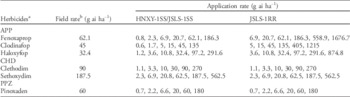
Germinating seedlings from JSLS-1RR, JSLS-1SS, and HNXY-1SS populations were transplanted into 12-cm-diameter pots containing loam soils and grown in a glasshouse as described earlier. Seedlings at the 3- to 4-leaf stage were treated with six commercial-formulation ACCase herbicides (Table 2) using the cabinet sprayer described earlier. Thirty minutes after application, the pots were returned to the greenhouse. Survival and dry weight of the aboveground plant parts were recorded at 21 d after treatment. The whole experiment was conducted twice, and each treatment had three replications.
Herbicide application rates used in the whole-plant dose–response study for susceptible and resistant shortawn foxtail populations.

a Abbreviations: APP, aryloxyphenoxypropionate; CHD, cyclohexanedione; PPZ, phenylpyrazoline.
b The recommended field rate is based on wheat for fenoxaprop, clodinafop, and pinoxaden; and on oilseed rape for haloxyfop, clethodim, and sethoxydim.
Statistics
The dry weight data were converted to a percentage of the control. Data were pooled on condition that there was no significant difference between the two experiments. The herbicide doses causing 50% growth reduction (GR50) were calculated using a four-parameter log-logistic curve (Equation 1) (Seefeldt et al. Reference Seefeldt, Jensen and Fuerst1995):
 $$\eqalignno{ y\,{\equals}\,{{c{\plus}\left( {d{\minus}c} \right)} \mathord{\left/ {\vphantom {{c{\plus}\left( {d{\minus}c} \right)} {\left\{ {1{\,\plus\,}\exp \left[ {b\left( {\log x{\minus}\log {\rm ED}_{{50}} } \right)} \right]} \right\}}}} \right. \kern-\nulldelimiterspace} {\left\{ {1{\plus}\exp \left[ {b\left( {\log x\,{\minus}\,\log {\rm ED}_{{50}} } \right)} \right]} \right\}}},\quad$$
where c is the lower limit, d is the upper limit, and b is the slope of the curve through GR50. The resistance index (RI) was indicated by the ratio of GR50 between the resistant and susceptible population.
Results and Discussion
ACCase Gene Sequencing Revealed a Rare Ile-2041-Thr Mutation in Resistant JSLS-1 Plants
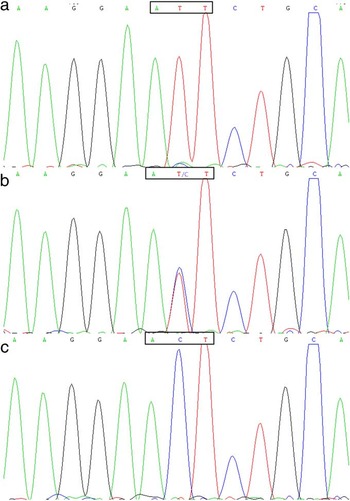
A resistance confirmation test showed that all 50 plants of the HNXY-1 population died and eight plants out of 50 putative resistant plants from JSLS-1 population survived the fenoxaprop treatment. A 1,437 bp PCR fragment of the shortawn foxtail ACCase gene covering the seven reported mutation sites was amplified from the eight individuals of JSLS-1 population that survived fenoxaprop treatment and from 10 susceptible individuals from each of the two populations. The ACCase gene sequence of shortawn foxtail had approximately 97.8% similarity with the same region of the documented ACCase gene sequence of blackgrass (GenBank accession AJ310767). The 1,437 bp nucleotide sequences obtained from the resistant and susceptible individuals of JSLS-1 population were deposited in the GenBank database (accession no. KX571248 and KX571249 for susceptible and resistant plants, respectively). Comparison of the ACCase gene fragment between the resistant and susceptible samples revealed four single-nucleotide polymorphisms leading to only one AAS: a single nucleotide change of ATT to ACT, causing an Ile-2041-Thr substitution (Figure 1a and c). Of the eight resistant individuals sequenced, six individuals were homozygous (Figure 1a) and two individuals were heterozygous (Figure 1b) for the Ile-2041-Thr mutation. There was no other mutation at positions 1781, 1999, 2027, 2078, 2088, and 2096, where resistance-endowing mutations have been documented in various weed species.
ACCase sequences with (a) the ATT codon for Ile-2041 in wild plants, (b) the ACT/ATT codons for Ile/Thr-2041 in heterozygous resistant plants, and (c) the ACT codon for Thr-2041 in homozygous resistant plants.

Seven different ACCase codon positions are implicated in resistance to ACCase herbicides, and the 2041 codon is a common one among them. To date, two kinds of AASs at the 2041 codon have been reported to confer resistance, namely Ile-2041-Asn and Ile-2041-Val (Beckie and Tardif Reference Beckie and Tardif2012; Délye et al. Reference Délye, Zhang, Chalopin, Michel and Powles2003). In this study, however, a very rare AAS, Ile-2041-Thr, was detected in the resistant plants of the JSLS-1 population. In a 1998 survey conducted in South Australia, 4% of ACCase mutant alleles of rigid ryegrass (Lolium rigidum Gaudin) were Ile-2041-Thr, but this mutant allele was not found in the 2003 and 2008 surveys (Malone et al. Reference Malone, Boutsalis, Baker and Preston2014). To our knowledge, that was the single previous report about this mutation.
Analysis of dCAPS Assay for Identifying the Ile-2041-Thr Mutation
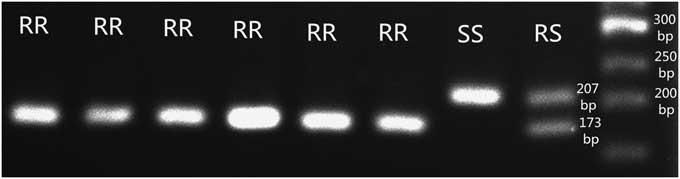
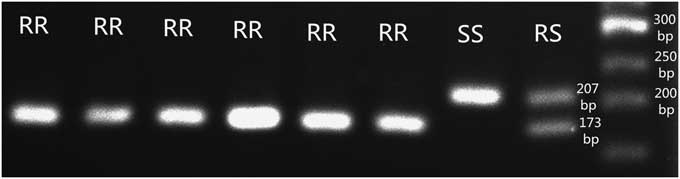
With the primer pair D2041F/D2041R, a 207 bp PCR fragment was amplified and used for the dCAPS assay. After digestion by the enzyme BsoBI, the plants homozygous for the Ile-2041-Thr mutation displayed a single digested band of 173 bp (and a 34 bp band invisible on the gel), while the wild-type plants showed an undigested PCR fragment of 207 bp. As expected, the heterozygous plants showed two bands of the 173 and 207 bp size (Figure 2).
Derived cleaved amplified polymorphic sequence (dCAPS) of individual shortawn foxtail plants. SS, wild-type Ile-2041plants; RS, heterozygous mutant Thr-2041 plants; RR, homozygous mutant Thr-2041 plants.
This dCAPS marker could specifically detect the Ile-2041-Thr mutation in shortawn foxtail without the need of gene sequencing. In our study, the intensity of the amplification product was always sufficient to make it visible on agarose gels. However, the amplification efficiency might be adversely affected for the dCAPS assay, considering the two mismatches were near the 3′-end sequence of the primer D2041R. We found that the PCR product intensity could obviously be increased by using a nested PCR procedure. For this dCAPS assay, a first PCR procedure could be performed with the primers AC-F1 and AC-R1. Then the PCR product was diluted by 10-fold and used as the template of the second PCR procedure, with the primers D2041F and D2041R.
Whole-Plant Dose–Response to ACCase Herbicides
In this study, we used two purified populations (F2 generation, originated from the same heterozygous plant) and one documented susceptible population to investigate the cross-resistance patterns of the Ile-2041-Thr mutation in shortawn foxtail. Plants homozygous for the Ile-2041-Thr mutations displayed different resistance levels to the three classes of ACCase herbicides. The detailed results are given in the following sections.
The APP Herbicides
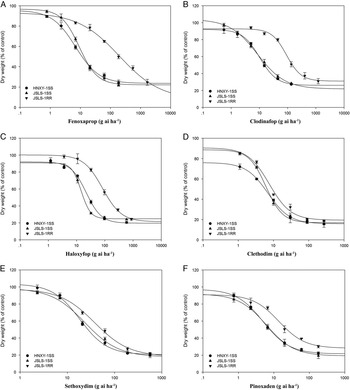
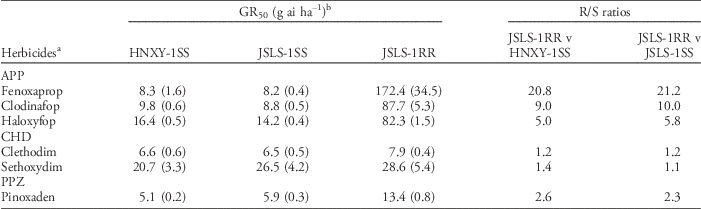
At the recommended field rate (62.1gaiha−1), all JSLS-1RR plants survived fenoxaprop treatment with about 34% growth reduction (Figure 3A). In contrast, no JSLS-1SS and HNXY-1SS plants survived the field rate. The GR50 values were 172.4, 8.2, and 8.3 g ai ha−1 for the JSLS-1RR, JSLS-1SS, and HNXY-1SS populations, respectively. Based on the RI, JSLS-1RR population was 21.2- and 20.8-fold resistant to fenoxaprop, compared with the JSLS-1SS and HNXY-1SS populations, respectively (Table 3). Similar dose–response curves were observed for the other two APP herbicides, clodinafop and haloxyfop. At the lower limit of the normal field rate of clodinafop (45 g ai ha−1) and haloxyfop (32.4 g ai ha−1), all Thr-2041 plants survived with only a few (20% and 17%) exhibiting growth reduction (Figure 3B and C). In comparison with JSLS-1SS, the resistance levels endowed by Ile-2041-Thr mutation were 10-fold to clodinafop and 5.8-fold to haloxyfop. When compared with HNXY-1SS, the Ile-2041-Thr mutation conferred 9-fold and 5-fold resistance to clodinafop and haloxyfop, respectively (Table 3).
Dose–response of the susceptible population (HNXY-1SS) and the purified subpopulations (JSLS-1SS and JSLS-1RR) to (A) fenoxaprop, (B) clodinafop, (C) haloxyfop, (D) clethodim, (E) sethoxydim, and (F) pinoxaden. The values are expressed as the percentage of the untreated control. The data represent the mean ± standard error of two experiments, each containing three replicates.

GR50 values of the purified resistant population JSLS-1RR and the susceptible populations (HNXY-1SS and JSLS-1SS) for ACCase-inhibiting herbicides, and the level of resistance indicated by the R/S ratios.

a Abbreviations: APP, aryloxyphenoxypropionate; CHD, cyclohexanedione; PPZ, phenylpyrazoline; GR50, dose required to reduce seedling dry weight by 50%; R, resistant; S, susceptible.
b Numbers in parentheses are standard errors (SE).
The CHD Herbicides
No plants from any population survived the clethodim (90 g ai ha−1) and sethoxydim (187.5 g ai ha−1) treatment, and even one-third of these field rates controlled most of plants (unpublished data). The GR50 values of these three populations were very close both for clethodim and for sethoxydim (Table 3). Therefore, it was very likely that the Ile-2041-Thr mutation was not resistant to the CHD herbicides.
The PPZ Herbicide Pinoxaden
Pinoxaden at the field rate (60 g ai ha−1), and even one-third of this rate (20 g ai ha−1), could control more than 90% plants of the JSLS-1SS and HNXY-1SS population (unpublished data). At the range of pinoxaden doses applied, Thr-2041 plants always displayed less growth reduction than plants of the JSLS-1SS and HNXY-1SS populations (Figure 3F). Based on the RI, the Ile-2041-Thr mutation conferred low-level resistance to pinoxaden (Table 3).
Compared with Ile-2041-Asn, the most common AAS in the 2041 codon, the Ile-2041-Thr mutation was quite unusual. Nevertheless, this does not mean that we could ignore it. In this study, the Ile-2041-Thr mutation conferred relatively low-level resistance in shortawn foxtail. In contrast, the Ile-2041-Asn mutation usually conferred higher resistance levels to ACCase herbicides. Taking fenoxaprop for an example, the GR50 value of an Ile-2041-Asn mutant shortawn foxtail population was 757.3 g ai ha−1 (Guo et al. Reference Guo, Lv, Zhang, Li, Wu, Lu, Liu and Wang2016), 4.4-fold that of the Ile-2041-Thr population in this research. However, the resistance levels are still high enough to ensure survival after herbicide application. In addition, the mutant plants seemed to be competitive with the wild plants, as mutant plants were found among the wild ones. If these APP herbicides are still used in the field, the proportion of this rare mutation is very likely increased. Fortunately, the Thr-2041 plants were sensitive to the CHD herbicides clethodim and sethoxydim. This contrasts with other mutations that confer higher and broader resistance to ACCase herbicides, such as the Ile-1781-Leu and Asp-2078-Gly mutations previously reported in shortawn foxtail (Guo et al. Reference Guo, Yuan, Liu, Bi, Du, Zhang, Li and Wang2015b; Xia et al. Reference Xia, Pan, Li, Wang, Feng and Dong2015).
In this study, we conducted herbicide dose–response research using F2 generation seeds. Given that they originated from the same plant. which was heterozygous for the Ile-2041-Thr mutation, the mutant (JSLS-1RR) and wild (JSLS-1SS) subpopulations should share the same genetic background. In our study, the wild subpopulation (JSLS-1SS) was sensitive to all ACCase herbicides used, so the resistance of the JSLS-1RR population was very likely a result of the Ile-2041-Thr mutation. Non–target site resistance (NTSR) has increasingly been shown to be the most common resistance mechanism to ACCase herbicides. Nonetheless, in view of the similar response to herbicides between JSLS-1SS and the proven susceptible population HNXY-1SS, NTSR may not be the predominant resistance mechanism in the JSLS-1RR population. In this way, we demonstrated the importance of the Ile-2041-Thr mutation in conferring ACCase resistance without measuring the ACCase activity. Two novel ACCase mutations, Ile-1781-Thr and Trp-1999-Ser, were revealed using similar methods without determining ACCase activity (Kaundun et al. Reference Kaundun, Bailly, Dale, Hutchings and Mclndoe2013a, Reference Kaundun, Hutchings, Dale and Mclndoe2013b). This method may be helpful to find other new allelic variants at known resistance codons in view of the high cost and complexity of ACCase activity assays.
A reliable molecular marker was developed to rapidly identify the rare Ile-2041-Thr mutation in shortawn foxtail population. In previous reports, some CAPS and dCAPS markers were developed, and most of them were designed to digest the wild amplicons (Délye et al. Reference Délye, Pernin and Michel2011). In this study, the dCAPS marker was dedicated to specifically find the thymine to cytosine change at the second base of the 2041 codon. The enzymes used in our assays are very inexpensive, and the cost of testing a sample was only one-fortieth of that of gene sequencing. This method was also time-saving: 100 samples could be tested within 1 d.
In addition to two known target site mutations in Ile-2041, a rare Ile-2041-Thr ACCase mutation was identified and its importance in ACCase herbicide efficacies was assessed in a shortawn foxtail population. This study provided a practical molecular marker that may also be used in other grass weed species. This study and several recent studies about herbicide resistance, not only to ACCase but also to acetolactate synthase herbicides (Han et al. Reference Han, Yu, Purba, Li, Walsh, Friesen and Powles2012; Liu et al. Reference Liu, Yuan, Du, Guo, Li, Bi and Wang2015), may imply that there are still some unknown AASs on the known mutation sites or new resistance-endowing amino acid residues waiting to be discovered.
Acknowledgments
This research was funded by the Special Fund for Agroscientific Research in the Public Interest (201303031) and the National Natural Science Foundation of China (31471787). The authors thank Tao Jin (King Agroot Company, Qingdao, China) for collecting seeds of shortawn foxtail.