For those interested in the history of music theory in England, the importance of the mid-fifteenth-century compilation now in the British Library, Lansdowne 763, has long been recognised.Footnote 1 Assembled by Johannes Wylde, precentor and preceptor of Waltham Abbey, the manuscript was later owned by the composer Thomas Tallis, who was employed at the same abbey at the time of its dissolution.Footnote 2 Described by Brian Trowell as ‘a distinctly retrospective collection by a working choirmaster’, Lansdowne 763 comprises twenty entries related to musical practice and theory.Footnote 3 As with many compilation manuscripts, scholarship has focused more on individual treatises than on the manuscript as a whole.Footnote 4 Its first section focuses on plainchant, solmisation and modal theory; mensural theory follows, then extemporised discant, and finally arithmetic proportions in the Boethian sense of musica speculativa, in which musica comprises the study of small whole-number proportions and thus found a home in the quadrivium.
The penultimate entry in Lansdowne 763 (fols. 117r–22v), which concerns proportions, is in Middle English.Footnote 5 This tract derives from the tradition of music theory transmitted in books one and two of Boethius's De institutione musica.Footnote 6 Although the Boethian tradition is represented in many late medieval Latin treatises, often as introductory material, there is no known direct Latin model for this Middle English tract in Lansdowne 763. The first section names and describes the five species of the proportions of inequality (multiplex, superparticular, superpartient, multiplex superparticular and multiplex superpartient). The second section lists the denominations of proportions and ends with two tables. The third section is concerned with the three manners of proportionality: geometric, arithmetic and harmonic. Each section begins with its own introductory rubric and ends with its own explicit, indicating their potential to stand independently.
The final entry in Lansdowne 763, a Latin proportion treatise, begins on a new leaf, with a five-line initial (fol. 123r).Footnote 7 The previous leaf ends with the acknowledgement, ‘secundum Chilston’.Footnote 8 While ‘secundum’ is a term that can indicate authorship, it is not as definitive as the nearly synonymous ‘quod’. A cautious reading therefore suggests that it be understood as an indication that the previous section was ‘according to’ Chilston. But how much of the previous section was Wylde associating with Chilston?
There are two distinct scholarly views of the entry in Lansdowne 763 on fols. 117r–22v. Meech understood these leaves to constitute a single treatise, which he attributed to Chilston.Footnote 9 This view was supported by Curt F. Bühler and Anne Heminger, among others.Footnote 10 The ‘Texts on Music in English from the Medieval and Early Modern Eras’ (hereafter TME) database separates out these folios into three treatises, attributing only the final one (fols. 120v–22v) to Chilston.Footnote 11 Theodor Dumitrescu and others follow this separation and attribution.Footnote 12
This article argues that the combined evidence of mise-en-page, rubrication, initials and incipit support the view that fols. 117r–22v transmit one treatise with three distinct sections that had a common origin and were all transmitted through Chilston. In our view, the codicological and palaeographical evidence of Lansdowne 763 suggests a collective presentation, which gives weight to the possibility that the attribution to Chilston at the end of the entry (fol. 122v) can also be retroactively applied to the first two sections. Although each discrete section opens with its own elaborate initial, there is a hierarchy of spaces for initials. This is consistent with the pattern throughout Lansdowne 763, where Wylde allocated proportional spaces for decorated initials at the beginnings of entries and subsections. Treatises by Torkesey (fol. 90r), Johannes de Muris (fol. 95r), Thomas Walsingham (fol. 98v) and Leonel Power (fol. 105v) each have text indented to allow more space for the initials that were later added, as does the treatise on fols. 113v–16v, which immediately precedes the treatise in question. Wylde began this Middle English proportion treatise on a new leaf (fol. 117r), leaving space for an opening initial spanning four text lines.Footnote 13 There is no text break before the second section of the treatise, and Wylde only left space for a two-line initial (fol. 118v).Footnote 14 Although the third section begins with a four-line initial, its opening rubric, which is not inked in red, refers back to the previous material in a way that suggests further continuation:
Thus ouerpassid the rwlis of Proporcions and of their Denominacions. nou shal ye vnderstonde that as Proporcion as a Comparison betwene diuerse quantiteis oythir numbris. So is Proporcionalitas a Comparison eythir a likenes be .2o. Proporcions in .3re. diuerse quantiteis atte last. the whech quantiteis or numbris been callid the Termis of that proporcionalite. And whan the ferst terme. passithe the .2de. than [it supra lin.] is callid the ferst excesse. And whan the .2de. terme passith the thirde. than it is callid the .2de. excesse.Footnote 15 (Thus having discussed the rules of proportions and of their denominations. Now shall ye understand that as proportion is a comparison between diverse quantities or numbers. So is proportionality a comparison or a likeness between two proportions in three diverse quantities at the end, which quantities or numbers are called the terms of that proportionality. And when the first term passes the second then it is called the first excess. And when the second term passes the third, then it is called the second excess.Footnote 16)
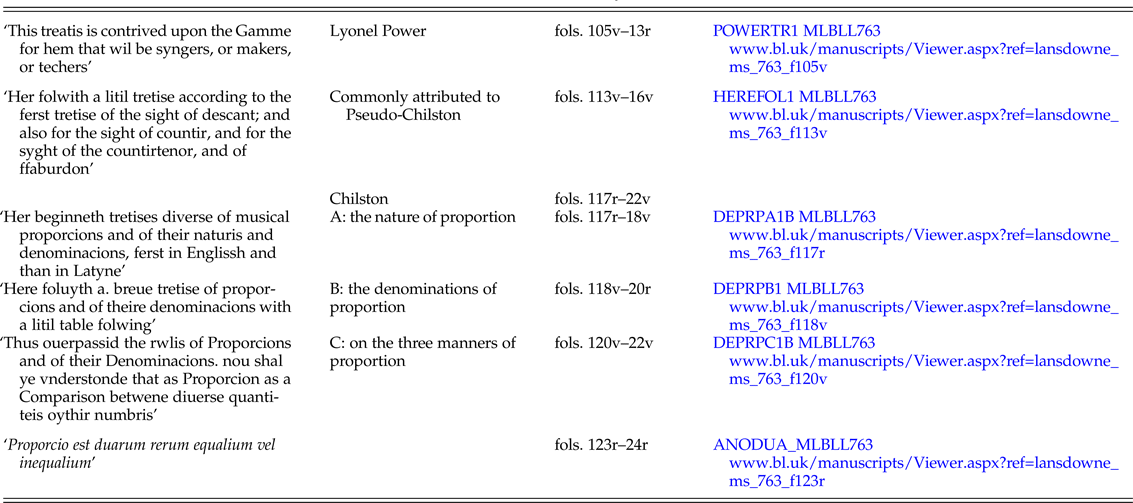
The incipit (fol. 117r) before the treatise reads ‘Here beginneth Tretises diuerse of musical proporcions. and of therre naturis. and denominacions. ferst in Englisshe. and than in latyne’ (‘Here begin separate treatises on musical proportions and their natures and denominations, first in English and then in Latin’). This does not unequivocally suggest that Wylde saw the text on fols. 117r–22v as separate treatises; it could be that his use of ‘Tretises diuerse’ is making a linguistic distinction between the English (fols. 117r–22v) and Latin (fols. 123r–24r) proportion treatises, potentially signifying a connection in Wylde's mind between the three treatises. The authors of this article seek to reconcile the two scholarly traditions, noting the potential independence of sections of the tract on fols. 117r–22v while suggesting that all are interconnected and associated with Chilston. We refer to them as Chilston A, B and C, respectively (Table 1).
Contents of London, British Library, Lansdowne 763, fols. 105v–24r

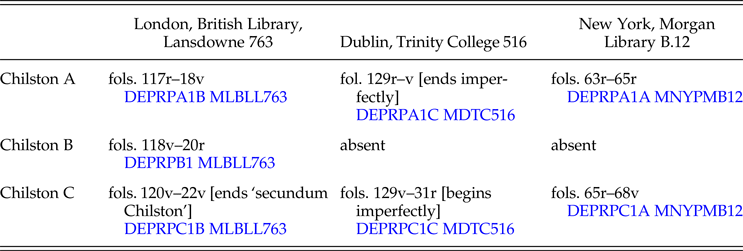
Partial concordances
The first and the third sections of the Lansdowne Middle English proportion treatise (Chilston A and C) also survive together elsewhere (Table 2) as an anonymous text in a scientific/mathematical compilation now in New York (Morgan Library, B.12, fols. 63r–68v) and as fragments (fols. 129r–31v) in a collection of miscellaneous texts in Trinity College Dublin 516 (hereafter TCD 516).Footnote 17 The content related to proportions in these manuscripts only came to the attention of modern scholars after the Second World War. Bühler was the first to connect the treatise in Morgan B.12 with the Middle English proportion treatise in Lansdowne 763, building on the work of Sanford B. Meech.Footnote 18 Morgan B.12, comprising seventy-six folios, is highly organised: three astronomical texts are followed by a short invocation to angels and two treatises on musical proportions. The first of these corresponds to Chilston A and Chilston C (combined together) while the second, in Latin, is entitled ‘Epistola de proporcionibus’.Footnote 19
Middle English proportion treatise in three manuscripts

Assembled across the middle years of the fifteenth century, TCD 516 is a sizable manuscript of 219 folios that belonged to and was mostly transcribed by John Benet, vicar of Harlington, Bedfordshire.Footnote 20 It comprises a Latin chronicle (documenting events that occurred between 1399 and 1462), historical accounts, prophecies, political texts, Latin proverbs, lists of English kings and general religious writings. Although Lansdowne 763 is the only source to attribute the proportion treatise to Chilston, the version in TCD 516 ends with an ambiguous sign, which John Scattergood interprets as the letter ‘C’.Footnote 21 This may suggest that the scribe of TCD 516 was making an oblique reference to Chilston.
Sir John Hawkins and Charles Burney recognised Chilston's importance in the history of music theory on account of this early vernacular treatise on proportions. As very little is known of his biography, scholarship on Chilston has focused on his appearance in Lansdowne 763.Footnote 22 This manuscript contains two other treatises in Middle English, which precede the proportion treatise (see Table 1).Footnote 23 Following Leonel Power's discant treatise (fols. 105v–13r) is an anonymous discant and faburden treatise (fols. 113v–16v), which Hawkins attributed to Chilston.Footnote 24 This attribution was reinforced by Hugo Riemann in his history of music theory.Footnote 25 Burney, on the other hand, saw the second treatise as an extension of the preceding treatise and accordingly attributed it to Power.Footnote 26 In 1935, Meech asserted that there was no evidence to substantiate attributing this treatise either to Chilston or to Power.Footnote 27 Following Johannes Wolf's use of the term in 1939, a consensus arose to attribute this second discant treatise to ‘Pseudo-Chilston’.Footnote 28
A gentlemanly dialogue?
In 1927, in the August issue of The Musical Times, the music scholar Jeffrey Pulver (1884–1984) implored:
We should like to know more of Chilston, for in the present state of our knowledge we cannot even decide with certainty when he lived. We have no means of ascertaining whether the words used by John Wylde were Chilston's own, or a paraphrase made by the copyist from a still earlier manuscript now lost. But one thing is certain; and this is that Chilston was a musical savant.Footnote 29
Nearly a century later, this early proponent of music theory in the English vernacular has attracted surprisingly little scholarship. Though Pulver's high estimation for Chilston rested in part on his belief that Chilston also authored the second of the three Middle English treatises in Lansdowne 763 (fols. 113v–16v, the one now generally assigned to Pseudo-Chilston), his recognition of Chilston's importance is striking. Particularly noteworthy is the suggestion Pulver makes, at the end of his article, that Chilston's writings ‘were employed in the instruction of choristers and composers for many a generation’.Footnote 30
A prolific English lexicographer, Pulver is best known for his work on the history of stringed instruments, particularly in England, a Dictionary of Musical Terms (eight editions published between 1913 and 1925), a Dictionary of Old English Music and Musical Instruments (1923, twelve editions), a Biographical Dictionary of Old English Music (1927, reprinted 1973), with books on Brahms (1926) and Paganini (1936) and numerous articles over a long period. His article on Chilston in The Musical Times came out in 1927, the same year that he published his Biographical Dictionary, in which he also included an article on Chilston.Footnote 31 Pulver had already referenced Chilston twice in his earlier Dictionary of Old English Music and so was aware of the dearth of biographical information available on Chilston's life.Footnote 32 Nonetheless, for Pulver, ‘the little we know suffices to place him among the great men who helped to found this nation's art upon a basis of law and order’.Footnote 33
Founded by J.A. Novello in 1844, as a continuation of Mainzer's Musical Times and Singing Circular (1842–44), The Musical Times is the oldest of all musical journals with a continuous record of publication. From the 1920s (to the 1990s) it had a special association with the Royal College of Organists, which contributed to a renewal of interest in church music. Its monthly issues provided a wide readership for articles published in series. One such series, ‘New Light on Late Tudor Composers’, was published between 1924 and 1929 by the Irish scholar William Henry Grattan Flood (1859–1928). On the same page, and immediately following Pulver's article on Chilston, in the August 1927 issue of The Musical Times is Flood's biographical article on John Hilton Senior, the twenty-seventh entry in the series.Footnote 34
Evidently, Flood read Pulver's article and responded to his call for attention to be paid to Chilston. In a letter to the editor in the October issue of The Musical Times, Flood wrote, ‘Although I cannot say for certain I have solved the difficulty as to the identity of this brilliant English theorist, yet I feel tolerably safe in equating him with John Celston, who, in the year 1446, wrote a treatise […] found in the British Museum, Royal 5, A vi.’Footnote 35 Although a possible concordance and a plausible date would seem to be a significant find for scholars of fifteenth-century music history, worthy of further investigation, Pulver was quick to dismiss Flood's identification and to minimise the significance of the discovery. In the very next issue of The Musical Times, Pulver denied the importance of this biographical detail, stating that, ‘I am afraid the added information that the learned Doctor gives takes us very little further in the history of Chilston’.Footnote 36
Pulver was no doubt familiar with Flood's scholarship, which included various unsupported claims that certain English composers, such as Dowland, Campion and Purcell, had Irish ancestry.Footnote 37 As someone particularly interested in the music of his nation, Pulver would not have been sympathetic towards a scholar who had challenged the Englishness of the English canon. Flood's reputation among others has not fared much better over the last hundred years: almost all references to his name also refer to him as a dubious scholar.Footnote 38 According to Axel Klein's recently updated (2019) Grove dictionary article, Flood is ‘regarded as unreliable for missing sources, his studies are characterized by an enthusiastic rather than thorough appreciation of detail. In some of his claims […], his patriotism led him to confuse clues with evidence.’Footnote 39 In the Encyclopaedia of Music in Ireland, Barra Boydell notes that Flood's ‘information is frequently suspect, and […] his patriotic desire to place Ireland at the centre of European musical history in particular led him to make unfounded and sometimes fantastic claims and assumptions’.Footnote 40
But Flood was not alone in his nationalistic tendencies. Is it possible that Pulver's own cultural biases prompted his swift and imperious response to Flood's suggestion? In the early years of the Irish Free State, with the ‘Irish Question’ undoubtedly in the recent memory of the educated British classes, it seems likely that Pulver could have harboured anti-Irish sentiments. For Pulver, English music and musicians reigned supreme, and remained at the centre of his musicological world. Like Flood, Pulver's nationalism came at the expense of other musical cultures. In his article ‘What is Wrong with Welsh Music?’, Pulver disregarded the musical landscape of Wales and proposed a ‘possible cure’, calling on Welsh musicians to ‘follow the example now being set in England’.Footnote 41 His article is rife with the belief in the superiority of musical skills that were typically cultivated in English cathedral choirs over the aural and oral practices that were integral to Celtic folk culture. Pulver bemoaned ‘the danger of too national a programme’ in Welsh choral singing, arguing instead in favour of the ‘universal’ principles of music that, in reality, are those particular to English classical music.
Flood's suggested concordance and date reinforce Chilston's importance as an English music theorist, which could have further supported an Anglocentric view of music history, but instead, Pulver retorted:
The questions that I put in my article, and which Dr. Flood has quoted in his letter to you, remains [sic] unanswered. […] We still do not know when and where he was born, when and where he died, or whether he composed or not. If Dr. Flood is right in his supposition, we have discovered one new thing – viz., that Chilston wrote something in 1446.Footnote 42
Hawkins and others had dated Chilston's treatise to the late fourteenth century. Pulver evidently accepted this early dating in 1923, when his article on ‘Quinible’ in A Dictionary of Old English Music and Musical Instruments explicitly dated the Chilston treatise to the end of the fourteenth century.Footnote 43 However, Pulver's 1927 article dates Chilston a little later, to the first half of the fifteenth century, with the qualification that ‘we cannot even decide with certainty when he lived’.Footnote 44 Later scholars have tried to ascertain Chilston's dates of activity by dating the inclusion of his treatise in various manuscripts. Meech speculated, in 1935, that the treatise was created in the first half of the century, based on the dialectical features.Footnote 45 Bühler, in 1946, argued that the palaeographical evidence suggested a date of 1425 for Morgan B.12.Footnote 46 The consensus on the compilation date of Lansdowne 763 is now c.1450, and a terminus post quem for the inclusion of Chilston's treatise in TCD 516 is 1468.Footnote 47 If these dates are accurate, this protracted citation history attests to the longevity of Chilston's treatise but sheds no light on his biography.
Although Pulver did not know about the concordant sources for Chilston's treatise, his rejection of potential biographical information on Chilston is surprising. Flood had attributed the ‘Regula sancti Bernardi de modo psallendi et cantandi in ecclesia’ in Royal 5 A VI to Chilston, which Pulver rightly rejected. But with regard to fifteenth- and sixteenth- century music, Flood had considerable knowledge. Following the publication of the English Patent Rolls, he produced an extensive survey of entries relating to music in fifteenth-century England.Footnote 48 In addition to his work on late Tudor composers mentioned previously, Flood published biographical sketches of thirty-two early Tudor composers in The Musical Times between 1919 and 1924. In 1925, these were published as a book, with a preface by the musicologist, composer and educational reformer Sir William Henry Hadow.Footnote 49 Flood also included a prefatory ‘Note’ (dated September 1924), in which he hopes the biographies he has unearthed, ‘based on independent research, carried out under much difficulty’, will ‘prove acceptable to those who would fain know something of the English school that developed naturally with the full-tide glory of the golden age of Taverner, Tallis’.Footnote 50 Flood acknowledges Hadow's role in the publication of Tudor Church Music, which ‘must compel the admiration and gratitude of all lovers of Tudor music’.Footnote 51 This does not seem like the action or language of someone whose views of English music were constrained by Irish nationalism.
Pulver (and later scholars) could have followed Flood's suggestion to investigate the Celston/Chilston connection, to see what it might reveal about the music theorist's biography, intellectual milieu, roles and responsibilities, as well as his intellectual interests. But instead, Pulver's repudiation seems to have discouraged any further assessment of Flood's suggestion. Flood himself might have pursued the identification had he not died the following year. Consideration of Celston/Chilston in Royal 5 A VI seemed to die with Flood. As TCD 516 – a source not known to Pulver and Flood – sheds further light on the circulation of the treatise attributed to Chilston in mid-fifteenth-century England, it is time to disentangle Flood's dubious reputation from this intriguing identification.
The scribe of Royal 5 A VI
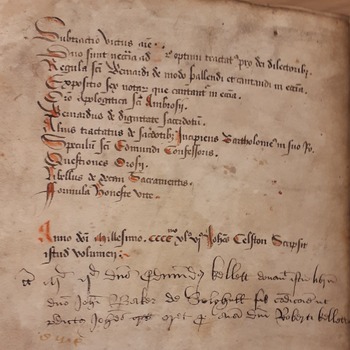
British Library, Royal 5 A VI is a volume of eighty-six folios (in gatherings of eight leaves), measuring 230 × 160 mm.Footnote 52 Initial capitals are red with blue flourishes, and there are red and blue pilcrows. Work of a corrector is evident, and the manuscript has been heavily annotated in many hands.Footnote 53 The volume contains elementary didactic tracts, theological notes and other devotional extracts; the fly-leaves (fols. 85r and 86r) were taken from a grammatical treatise.Footnote 54 At least two mid-fifteenth-century hands can be discerned. Contents are listed at the beginning and end of the compilation. At the end of the final list, on fol. 84v, a colophon states that Johannes Celston wrote this volume (‘Johannes Celston scripsit istud volumen’) in the year 1446 (see Figure 1).Footnote 55
Contents and colophon, London, British Library, Royal 5 A VI, fol. 84v. Reproduced by permission of the British Library Board. (colour online)

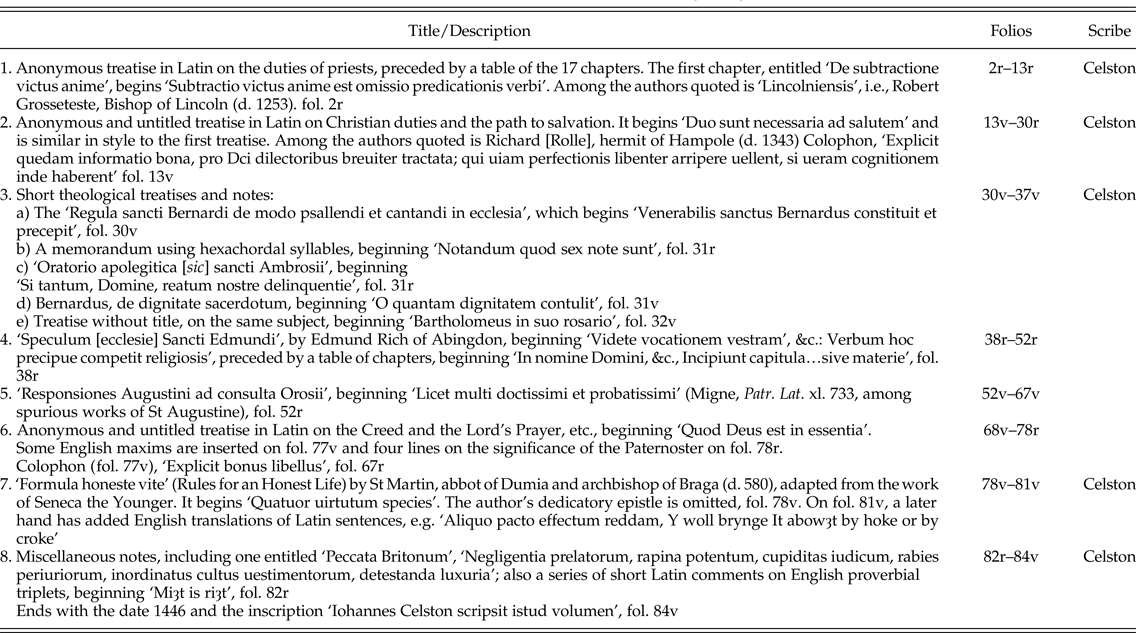
Celston – a name with many variant spellings in the fifteenth century, including Chelston, Celstan, Shilston or Chilston – copied the first three and the last two items included in Royal 5 A VI. Items 4, 5 and 6 are in a different hand. A summary of the contents of Royal 5 A VI is given in Table 3.
Contents of London, British Library, Royal 5 A VI

Royal 5 A VI is a compilation of mostly theological writings that uphold the medieval belief that the failings of postlapsarian knowledge could be addressed through sapientia (wisdom), virtus (virtue), eloquentia (eloquence) and necessitas (necessity). Within ecclesiastical circles, writers drew on canonical writings for scholastic purposes, but also in the belief that such authorities offered moral guidance. Royal 5 A VI corresponds to the kind of compilation known as pastoralia, that is to say, a ‘pastoral’ or priest's manual.Footnote 56 Such books were intended to assist priests who had limited knowledge of Latin. Latin literacy was variable among the secular clergy and thus some priests’ manuals contained Latin texts, as well as vernacular. Education varied greatly among parish priests and regular canons. The orders of Canons Regular, particularly those following the rule of St Augustine, played an explicit role in the cure of souls. In the twelfth century, the use of the adjective religiosus was not confined to those who had taken religious vows. For example, in the Ecclesiastical History of Orderic Vitalis (1075–c.1142), religiosus is most often used to indicate ‘men of religion’ in the sense of monks or regular canons, but it was also used to refer to married women, parents and noblemen who were ‘pious’; indeed, the term is used in the mid-twelfth-century Foundation of Waltham Abbey to describe a wife. While pastoralia were intended to support the development of a cleric's own morality, they may also have played a part in the wider community as a resource to support priests in the instruction of their parishioners, whose education and literacy was also highly variable. Synodal legislation required parish priests to teach the foundations of Christian faith: the Creed, Articles of Faith and the Paternoster. Catechetical books assisted in the instruction of the laity. In the fifteenth-century parochial context, a ‘reader’ was someone who interacted with a text in a variety of ways, from personal to group practices and including both silent and aural reading.Footnote 57 As literacy expanded more broadly in the late fourteenth and early fifteenth century, there was a decisive move to take spiritual writings out of the cloister and into lay environments.Footnote 58
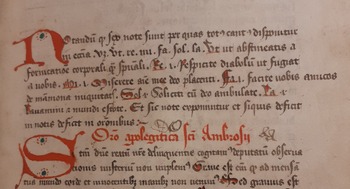
The third section of Royal 5 A VI (fols. 30v–37v) includes the ‘Regula sancti Bernardi de modo psallendi et cantandi in ecclesia’ (fols. 30v–31r, item 3a in Table 3), a version of a text that derives from St Bernard of Clairvaux's pronouncements on singing in church.Footnote 59 Between this text and the ‘Oratio apolegitica [sic] sancti Ambrosii’ (on fol. 31r) Celston included a memorandum, beginning ‘Notandum quod sex note sunt’ (fol. 31r, item 3b in Table 3; see Figure 2). In the contents on fol. 84v, Celston refers to this hexachordal memorandum as an ‘Expositio sex nota[rum] que cantant[ur] in ecc[lesi]a’ (Figure 1) and it is indeed an account of the six solmisation syllables of the hexachord used in church singing.
Solmisation memorandum, London, British Library, Royal 5 A VI, fol. 31r. Reproduced by permission of the British Library Board. (colour online)

The tradition of using the hexachord as an acrostic or mnemonic device is best known from the poem to St John the Baptist by Paul the Deacon that served as the model song for Ut queant laxis, attributed to Guido of Arezzo. The efficacy of the song derived from using the syllables that begin each line – ut, re, mi, fa, sol, la – to correspond to the hexachord that constituted the main way of teaching the musical gamut. As these syllables also make use of all five vowels and six different consonants, they could have served multiple pedagogical purposes.
Ut queant laxis, Resonare fibris, Mira gestorum, Famuli tuorum, Solve polluti, Labii reatum, Sancte Iohannes. (So that your servants can resound, with unrestrained voices, the miracles of your deeds, [to] absolve the sin of their polluted lips, O Saint John.)
The solmisation syllables of the hexachord are invoked as acrostics elsewhere, presumably because they were well known enough to serve a mnemonic function.Footnote 60 In an ecclesiastical and musical environment, they could also be used as meditative prompts.Footnote 61 This seems to be the function of the hexachordal memorandum in Royal 5 A VI (fol. 31r):
Notandum quod sex note sunt per quas tot[us] cant[us] disponitur in ecc[les]ia. V[i]z [i.e., Videlicet] ut, re, mi, fa, sol, la. Ut ut abstineatis [vos] a fornication[n]e corporali qu[am] spi[ritu]ali. Re. i [i = id. est.]. Respicite diabolu[m] ut fugiat a vobis. Mi. i. Miserere a[nima]e meae deo placenti. Fa. i. Facite vobis amicos de ma[m]mona iniquitatis. Sol. i. Soliciti cu[ram] deo ambulate. La. i. Lavamini et mundi estote. Et sic note exponuntur et siquis deficit in notis deficit in or[atio]nibus (It should be observed that there are six notes by which a whole chant is composed in the church, that is, ut, re, mi, fa, sol, la. Ut. To abstain from corporeal and spiritual fornication. Re. Keep watch on the devil so that he flees from you. Mi. Pity my soul being pleasing to God. Fa. Make friends for yourself from the mammon of iniquity. Sol. Diligently walk with God. La. Wash and be clean. The notes are explained in this way and anyone who is faulty in the notes is faulty in his prayers)
Notable in this memorandum is a phrase, ‘totus cantus disponitur’ (whole chant is composed), found verbatim in the anonymous Metrologus Liber, a theoretical tract rooted in Guidonian teaching that is transmitted in Lansdowne 763 (fol. 62r):Footnote 62
Sex sunt note vel sillabe. in quibus totus cantus disponitur scilicet Vt. Re. Mi. Fa. Sol. La. Cumque tam paucis notis vel sillabis tota armonia formetur. vtillimum est. alte eas memorie commendare. (There are six notes or syllables from which all song is composed, namely, ut, re, mi, fa, sol la. Since all harmony is formed from so few notes or syllables, it is most useful to commit them deeply to memory.)
Although fragmentary and of broad application, this phrase is not widely found. Its use in the context of memorisation may support the meditative use of the solmisation syllables in Royal 5 A VI. If Celston's source for the phrase was indeed the Metrologus Liber, it is noteworthy that Lansdowne 763 is its sole surviving source.
But Lansdowne 763 was not the source for Celston's memorandum in Royal 5 A VI. Rather, it seems to be based on a part of the treatise Summa de speculatione musicae attributed to Walter Odington (fl. 1298–1316), the most influential English authority on music theory from the fourteenth century. Walter's Summa de speculatione musicae is an encyclopaedic consideration of music theory that remained influential for over a century and a half. The complete treatise survives only in Cambridge, Corpus Christi College, 410, a manuscript apparently copied c.1425 in southern England; fragments survive in several other sources.Footnote 63 Logically arranged, Walter's Summa de speculatione musicae treats the mathematical basis of speculative music theory as a prerequisite for practical music. Walter drew on standard authorities, including Boethius, Isidore of Seville and Cassiodorus. He also referenced the work of Ibn Sīnā (also known in the West as Avicenna, c.970–1037), the twelfth-century English natural philosopher Adelard of Bath and the French music theorist Johannes de Garlandia (fl. c.1270–1320). The first four partes of the treatise are on speculative music theory (number in itself, number expressed in sound, number expressed in the construction of musical instruments and mathematical relationships expressed in time), while parts five and six address musica prattica (plainsong and polyphony).
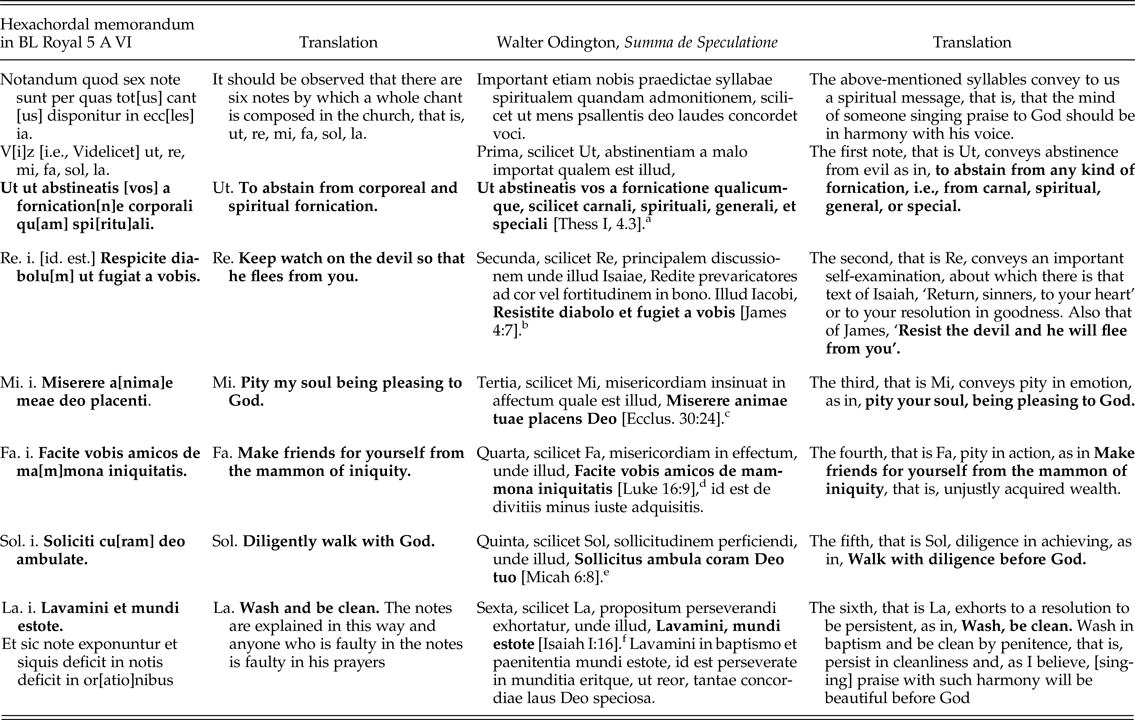
The hexachordal memorandum in Royal 5 A VI relates to the fourth section of the fifth part of Walter's Summa, ‘De harmonia simplici, id est de plano cantu’ (‘On simple harmony or plainsong’).Footnote 64 This part is a tonary or theoretical guide to plainsong, intended for practising ecclesiastical musicians. Following sections on ‘De signis vocum’, ‘De notis’ and ‘De clavibus’, the fourth section, ‘De nominibus vocum quae notis intimantur’, describes the hexachordal syllables and their associations.Footnote 65 While it is possible that Celston did not draw directly from Walter's teaching but that they shared a common point of origin in another source, the readings in the surviving manuscripts are close enough to imply a direct relationship (see the comparison of both texts, with translations in Table 4).
Comparison and translations of Celston's memorandum and an extract from Walter's De speculatione musicae (with common citations in bold)

a Thessalonicenses I, 4.3, ‘Hæc est enim voluntas Dei, sanctificatio vestra : ut abstineatis vos a fornication’. This passage also related to Acts 15:29, ‘ut abstineatis vos ab immolatis simulacrorum, et sanguine, et suffocato, et fornication’. This and following citations are from Biblia Sacra juxta Vulgatam Clementinam. Clementine Vulgate Project, http://vulsearch.sourceforge.net/index.html.
b James 4:7, ‘Subditi ergo estote Deo, resistite autem diabolo, et fugiet a vobis’.
c Ecclesiasticus 30:24, ‘Miserere animæ tuæ placens Deo’.
d Luke 16:9, ‘Et ego vobis dico: facite vobis amicos de mammona iniquitatis’.
e Micah 6:8, ‘et sollicitum ambulare cum Deo tuo’.
f Isaiah I:16, ‘Lavamini, mundi estote’.
The recontextualisation of Walter's hexachordal meditation in Celston's memorandum can be understood as an example of Paul Zumthor's notion of mouvance, whereby texts were ‘re-created over and over again as they were adapted to different audiences at different periods’.Footnote 66 Walter begins his passage by asserting that the six solmisation syllables convey a spiritual message, treating the syllables as memory aids to offer readers music theory with an added spiritual dimension. The focus in Celston's memorandum is on the pedagogical history of the Guidonian solmisation syllables for the composition of chant. Whereas Walter's ‘hexachordal contemplation’ makes the theological context explicit by identifying each biblical quotation linked to hexachordal notes, Celston's more concise rendition draws on the same biblical knowledge but omits the explicit biblical references (e.g., ‘illud Isaiae … illud Iacobi’) included in Walter's Summa. Celston's direct pairing of the hexachordal syllables with the biblical quotes reframes spiritual associations into an elementary music-pedagogical context.
Celston's memorandum represents a simpler, abbreviated version of the hexachordal meditation in Walter's Summa. For Celston, music theory was still contemplative, but the function of the spiritual aphorisms is less overtly exegetical and more pedagogical. Thirteenth-century theorists such as Lambertus, the St Emmemeram Anonymous, Franco of Cologne and Anonymous IV linked musical examples to empirical reasoning. Walter does the reverse, recontextualising the gamut back into the spiritual domain. While Celston retains Walter's biblical references, his use of the mnemonic for the elementary instruction of music theory may reflect a context that was at least partly oral/aural. Although both authors cite the same biblical sources, there are further discrepancies that highlight the differences between their respective audiences. For example, Walter's meditation on ‘Mi’ conveys pity for ‘your soul’ whereas Celston's aphorism is in the first person, ‘pity my soul being pleasing to God’, which connects to the personal nature of pastoralia.
The inclusion of the hexachordal memorandum in Celston's pastoral manual attests to his knowledge of music theory; such knowledge was usual for those educated in medieval religious institutions. The fact that Celston copied the ‘Regula sancti Bernardi de modo psallendi et cantandi in ecclesia’ into Royal 5 A VI (item 3a in Table 3) suggests that he may have himself been responsible for the instruction of chant. Like the Speculum cantancium sive psallencium in Lansdowne 763 (fols. 59r–60v), based on the chant formulae of St Gregory, Augustine and Bernard, the tract in Royal 5 A VI offers Patristic authority as guidance for the correct performance of plainchant.
Other texts in Royal 5 A VI shed further light on the intended use of this manuscript. Its version of Edmund Rich of Abingdon's Speculum (item 4 in Table 3) was the one that Helen P. Forshaw called the Speculum ecclesie, which re-inscribed into Latin the popular Anglo-Norman translation, Mirour de Seinte Eglyse.Footnote 67 This version is distinct from the earlier Latin version of Edmund's Speculum, which Forshaw called the Speculum religiosorum.Footnote 68 Edmund Rich of Abingdon, educated in Paris (c.1196–1202) and at Oxford (c.1214–22), was a secular canon, cathedral treasurer and preacher at Salisbury (c.1222–33), then archbishop of Canterbury (1233–40) and finally attached to the Cistercian house of Pontigny, where he was buried.Footnote 69 In Royal 5 A VI, the first eight chapters of Edmund's Speculum are taken from the Speculum religiosorum, and the rest from the later recension, the Speculum ecclesie.Footnote 70 Thus, Edmund's Speculum provides another instance of mouvance, and Forshaw's titles make explicit the relocation in the transmission of this text out of the monastic environment.Footnote 71 Nicholas Watson has argued that Edmund's audience, from the outset, was mixed religious, secular and lay. Proposing that the Speculum originated in the decade Edmund spent at Salisbury, the 1220s, Watson suggests it was intended for the cathedral's secular (but Latinate) canons.Footnote 72 The Speculum's contemplative theology is Augustinian, drawing on Hugh of St Victor's De arca morali and De arrha animae.Footnote 73 If its goal was to make contemplative theology accessible through the tabulation of the ethical priorities that govern religious life, this would have made the work particularly relevant to pastoral orders such as the Augustinians. The work integrates Victorine contemplative thought with contemporary pastoral theology, which exhibited a secular emphasis on ethics, action and belief.Footnote 74 As Watson observed, the Speculum provided a ‘meta-rule’, to help shape the lives of readers living under a variety of rules.Footnote 75
It seems likely that Celston was a clergyman, and the choice of several entries in Royal 5 A VI suggests that he may have been connected to the Augustinian Order. Lansdowne 763 originated in the Augustinian monastery of Waltham Abbey. John Wylde's ascription of the proportion treatise in this manuscript to ‘Chilston’ indicates that this writer was known in Augustinian circles. Like Celston, Chilston was familiar with Walter's Summa de speculatione musicae, drawing on the second part, a Boethian discussion of proportionality, to construct his Middle English version of these theories.Footnote 76
Assessing the implications of a shared identity
Catechetical materials associated with the laity were concerned with vernacular theology, following the belief that most religious instruction was for the benefit of those seeking salvation in the world, not in cloisters. Compilation texts often contain fragments of other kinds of knowledge – poetic meters, alphabetic cyphers for notation, and modality in plainchant. This may be the context for the inclusion of the hexachordal memorandum in Royal 5 A VI. It could have been intended for educated Latinate readers outside of religious communities. The scholastic element of Royal 5 A VI is reinforced by its inclusion of texts by writers who were themselves known to have received a broad education. Following his studies at the universities of Paris and Oxford before ordination, Edmund of Abingdon spent several years lecturing on mathematics and dialectics, helping to introduce the study of Aristotle to these two institutions. Similar breadth is found among Royal 5 A VI's other authors. Notably, the encyclopaedist and scholastic Bartholomaeus Anglicus studied with Robert Grosseteste at Oxford, before going to Paris; his De Proprietatibus Rerum (On the Properties of Things) was widely read in fifteenth-century England, following the pioneering translation by John Trevisa in 1398.Footnote 77 Celston also copied the Formula honestae vitae by the sixth-century Martin of Braga into Royal 5 A VI (item 7 in Table 3), a text based on a lost work of Seneca that helped ensure Seneca's high standing in later centuries. Seneca's pointed comments were especially well suited to inclusion in pastoral manuals.
The scholarly practice of adapting, reshaping and translating earlier learning characterises both the English translation of a proportion treatise, attributed to Chilston and included in Lansdowne 763, and Celston's inclusion of the hexachordal memorandum in Royal 5 A VI. That Chilston was catering to an audience who did not have advanced learning goes beyond his use of Middle English: his proportion treatise excludes the speculative elements of Boethius's De institutione musica. The tract names and describes ratios and proportions in a way that is consistent with Pythagorean harmonic theory, but it does not include the Neoplatonic speculative elements. In this sense, it vulgarises this vernacular version of Boethian music theory.Footnote 78
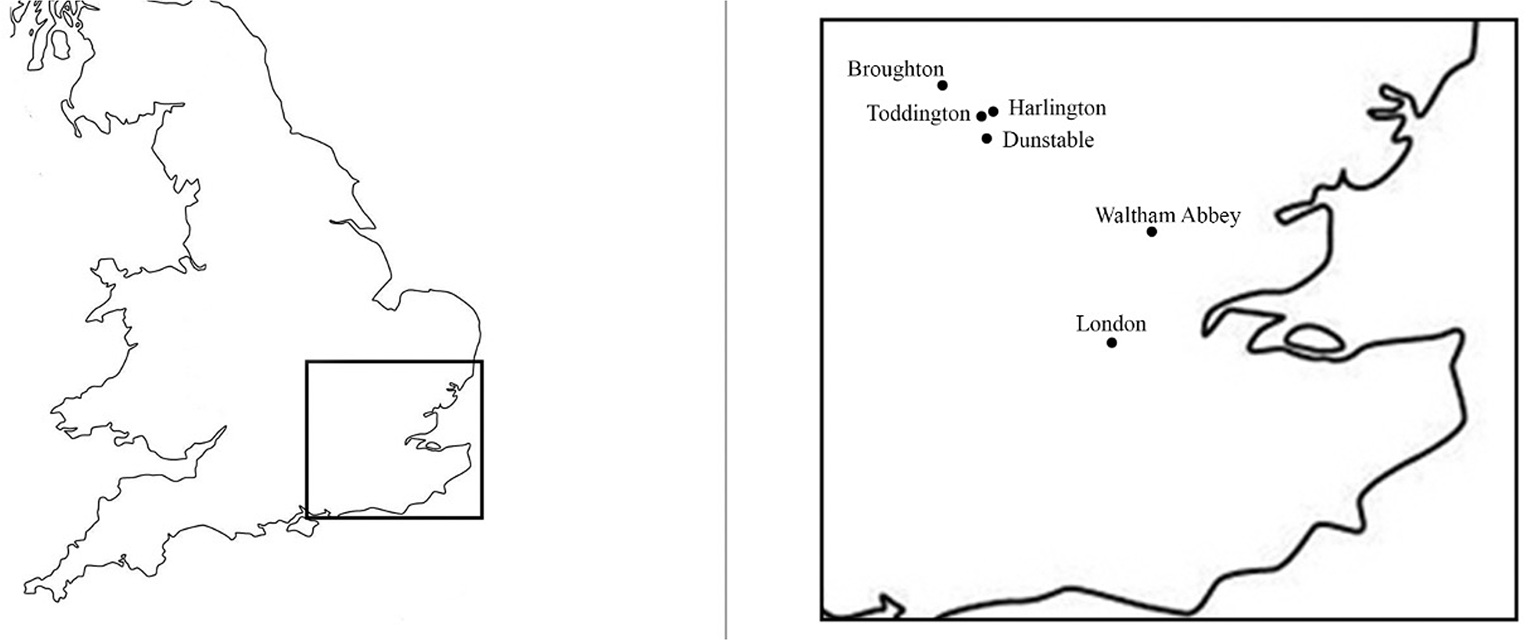
Although far from conclusive, the circumstantial evidence supports the identification of Celston with Chilston. It makes sense to continue to call him Chilston, as this is the version of his name in Lansdowne 763. His role in compiling a pastoral manual supports Chilston's likely vocation, and – crucially – provides 1446 as a date for at least some of his scribal activities.Footnote 79 In terms of his whereabouts, the treatise offers some hints. The three versions of Chilston's proportion treatise were probably copied from a common source, or within the same geographical area (see Figure 3). All are in a south-central East Midlands form of Middle English.Footnote 80 This suggests that Chilston was active in the area of the East Midlands between Broughton and Waltham Abbey in Essex.
Map showing the circulation of manuscripts containing Chilston's treatise.

Waltham Abbey was one of the most important Augustinian houses in England, the wealthiest religious house in Essex, and the last to be closed in the dissolution of monasteries (in 1540).Footnote 81 Situated in the Epping Forest district of Essex (now the outskirts of north-east London), Waltham Abbey is around 35 miles from Dunstable Priory, another important Augustinian centre. Chilston's proportion treatise could easily have travelled between the religious communities in this area.
The prior and convent of Dunstable presented John Benet, the compiler of TCD 516, as the resident vicar to Harlington (in present-day Bedfordshire), an appropriated parish.Footnote 82 Benet is likely to have maintained close contact with Dunstable Priory – a house with a considerable income, likely to have been rich in books.Footnote 83 Augustinian houses allowed parochial clergy to borrow from their libraries.Footnote 84 Thus, Benet could have acquired some of the exemplars in his miscellany (TCD 516) from Dunstable. Vernacular books in clerical environments generally served an instructional purpose. Chilston's proportion treatise was evidently among the vernacular texts that circulated in certain religious communities. Had Dunstable Priory wished to make a copy of this translation of a text on speculative music theory – a reasonable proposition for a significant Augustinian house – the version in Waltham Abbey (now Lansdowne 763) could have been their source.
Broader implications
By the fifteenth century, monastic houses possessed extensive collections of books, with subject matters extending far beyond the study of the religious rule and the rituals of daily services.Footnote 85 The best students received training in theology or canon law, and larger houses were encouraged to send a quota of members to universities after sufficient education within their own cloister schools.Footnote 86 The education offered in some abbeys included the seven liberal arts. Music could have been studied as a quadrivial subject by monks and canons, but the instruction of novices usually focused on the acquisition of the practical skills necessary for the liturgy more than on speculative music theory.Footnote 87
Given Wylde's position as precentor and preceptor at Waltham Abbey, it is possible that he was involved in providing instruction in music. The inclusion in Lansdowne 763 of texts specifically concerned with unchanged (unbroken) treble voices and the application of the gamut to young hands suggests that Wylde may have worked with boys. Immediately before Leonel Power's treatise on the performance of discant by treble voices, Lansdowne 763 includes Thomas of Walsingham's Regulae de figuris compositis et non compositis (fols. 98v–105r), also intended for the use of boys and younger monks (‘juvenilibus’).Footnote 88
Pedagogical breadth is evident in Lansdowne 763's inclusion of a brief theoretical treatise on the relationship between planets and modes or notes of the Gamut, De octo tonis (fols. 52r–v), and a speculative tractatulus on musical proportions and (heraldic) colours, Distinccio inter colores musicales et armorum heroum (fols. 88v–89r), in which musical colours are listed in ascending order of nobility.Footnote 89 A compilation within the compilation, De origine et effectu Musice (fols. 55v–59r) covers acoustics, chant and mensural music, borrowing heavily from the Quatuor principalia musicae.Footnote 90 In a series of glosses on several concepts in that treatise, Wylde indicates significant familiarity with earlier English music theory.Footnote 91 He may even have authored the ‘Musica manualis cum Tonali’ that appears in Oxford, Bodleian Library, Bodley 77, an early fifteenth-century English manuscript noted for its commentary on Boethius's De musica.Footnote 92
The late fourteenth and early fifteenth centuries witnessed a widespread vernacularisation and vulgarisation of scholarly texts, with the goal of making Latin academic discourse more accessible. Chilston's proportion treatise brought Boethian music theory to late medieval vernacular readers in England. Chilston retained Latin terminology alongside English explanations, to augment the translation. This provides evidence of an intended pedagogical role.
The Middle English treatise currently assigned to Pseudo-Chilston in Lansdowne 763 (fols. 113v–16v, see Table 1), which covers ‘the sight of descant…the sight of countir, and for the syght of the countirtenor and of ffaburdon’,Footnote 93 is the earliest surviving explanation of faburden.Footnote 94 The term is found in documents of indenture for English choirmasters from 1430 up to the Reformation, attesting to widespread use of the technique by professional choirs as well as by monks and canons in closed choirs.Footnote 95 In 1431, Richard Cliffe, a vicar in the parish church at Hemingbrough, Yorkshire, wrote recommending the appointment of a priest (William Watkinson) then serving at the secular cathedral of Lichfield, Staffordshire; the criteria for appointment included the ability to read and sing plainchant and ‘to synge a tribull til [to] faburdun’.Footnote 96 The technique was evidently known in the Midlands and seems likely to have grown out of English discant practices. The flexibility allowed by the treatise – ‘a man that hathe a low voyce may syng a countertenor in-stede of a mene, ffor whan the tenor is hye the countertenor may be low, and whan the tenor is low than the countertenor may be the mene’Footnote 97 – would have supported the use of faburden in environments of mixed voices.
The inclusion of musical-pedagogical texts in Lansdowne 763, Morgan B.12 and TCD 516 is echoed in Royal 5 A VI. Chilston's involvement in all of these texts provides a broader context for the dissemination of music pedagogy. This change in understanding Chilston's potential role as a pedagogue could lead to reconsidering his potential authorship of Pseudo-Chilston. Roger Bowers has argued that those in charge of singing boys would have offered instruction in other aspects of music, which could have included the principles of improvised discant.Footnote 98 It is possible that the Middle English texts in Lansdowne 763 would have assisted these readers. As the philosophical concepts of Boethius's text are omitted in the version of Chilston's treatise in Lansdowne 763, this reinforces the possibility that it was included to further practical goals.
Outside of religious institutions, the growth of literacy in late medieval England, and the emergence of English-reading audiences for technical texts, spurred the production of vernacular texts on a range of topics. This in turn led to a further rise in the number of readers of vernacular texts. These interconnected developments are explained by the French literary critic Pierre Macherey's principle that the construction of new readers and new types of reading materials are both manifestations of the same social process.Footnote 99 According to Macherey's theory of literary production, ‘readers are made by what makes the book’, and ‘the conditions that determine the production of the book also determine the forms of its communication’.Footnote 100 Chilston's treatise may have facilitated the conveyance of music theory to new kinds of readers, as suggested by its inclusion in the quadrivial Morgan B.12. Although the vernacular presentation of Boethian theories broadened the reach of musica speculativa, English translations did not prevent its Latin transmission. This may have been because university statutes required English students to continue to read the Latin De institutione musica throughout the fifteenth century.Footnote 101
It is almost a hundred years since Pulver dismissed Flood's suggested identification of Celston with Chilston:
Personally, I see no more reason for connecting the Chilston we know with the writer of Royal MS. 5. A.vi. than for denying their identity. The date of the last-named manuscript is 1446, and it is thus close enough to John Wylde's transcript to give Dr. Flood reason for suspecting identity. […] But suspicion, although a good ingredient in the research worker, is a bad foundation for history.Footnote 102
Pulver is certainly right that history cannot rely on suspicion alone. But the variability of spelling in the fifteenth century, the similarity of purpose and function of religious tracts that rely on Boethian music theory, and the likelihood that Royal 5 A VI was copied and used in a similar religious community to Lansdowne 763, during the same decades, constitutes more than suspicion. The confluence of circumstantial evidence may not definitively connect Celston to Chilston, but Flood's claim no longer seems ‘dubious’. Furthermore, the consequence of the possible identification allows the separation of Pseudo-Chilston from Chilston to be called into question. Although Chilston's proportion treatise seemed to address a different kind of reader from the discant treatise currently assigned to Pseudo-Chilston, the pedagogical angle of Celston's memorandum could provide evidence of an overlap and shared authorship. Although seemingly opposed – a practical treatise followed by a speculative theoretical one – the pedagogical nature of Celston's memorandum in Royal 5 A VI highlights the implicit pedagogical function of both Chilston's and Pseudo-Chilston's treatises in Lansdowne 763. Writers and readers in the fifteenth century did not always separate speculative from practical music theory. Focusing on the larger cultural context rather than the apparent differences between these texts allows us to acknowledge the possibility that one figure – Chilston/Celston/Pseudo-Chilston – was responsible for various pioneering efforts to broaden the reach of music theory in the fifteenth century.