Introduction
Infodemiology research involving big data harvested from web-based sources is nowadays becoming increasingly popular in biomedical science. In particular, online search traffic was shown to be a valid indicator of health-related human behavior as it can accurately reflect real-time public interest in particular diseases, conditions, or medical procedures. Reference Mavragani, Ochoa and Tsagarakis1 A growing body of published studies confirms the utility of analyzing web search data for measuring and monitoring online seeking behavior, detecting outbreaks, investigating seasonal trends, forecasting, and informing public health interventions. Reference Cohen, Brophy, Chen, Roberts, Quinn and Shea2–Reference Saegner and Austys4
Although the application of infodemiology approach in resuscitation research is relatively uncommon, it has been demonstrated that analysis of online search data for queries related to cardiac arrest (CA) and cardiopulmonary resuscitation (CPR) could be utilized for surveillance of the public interest and for targeting activities aimed at promoting CPR education and improving readiness of lay people to provide the life-saving help. Reference Murugiah and Rajput5,Reference Birkun, Baldi and Böttiger6 For instance, the analysis can detect occasional spikes of web search volumes for CA and CPR happening in reaction to CA events in celebrities, suggesting the opportunity to enhance public awareness of CA and CPR with correct informational support in media at the time of respective “teachable moments.” Reference Budrejko, Kempa and Raczak7–Reference Onyeka, Itanyi, Ezugwu and Allsop9
This study was designed to further explore the use of web search traffic data analysis in the field of resuscitation science, namely to investigate possible associations of online public interest in CPR and CA with epidemiological characteristics of out-of-hospital CA (OHCA) and national socioeconomic indicators in a set of European countries.
Methods
The study design was a retrospective review of open-source data and published data relative to the study subject.
The selection of countries for the study was determined by availability of published uniformly collected data on OHCA epidemiology in Europe. The data (incidence of confirmed CA, incidence of CA with CPR attempted, bystander CPR rate, return of spontaneous circulation [ROSC] rate, and hospital survival rate) were obtained from results of the EuReCa TWO study Reference Gräsner, Wnent and Herlitz10 that prospectively investigated epidemiology of OHCA in 28 European countries over a three-month period (October–December 2017).
For the same set of countries, Google Trends (GT; Google LLC; Mountain View, California USA) was utilized to generate web search traffic data for “Cardiopulmonary Resuscitation” and “Cardiac Arrest” search topics (ie, groups of terms that share the same concept in any language) for the year 2017. Google Trends provides data on popularity of online search measured in relative search volume (RSV); RSV is calculated as the number of searches for a given topic divided by total Google searches on all topics of a particular geography and time range, and normalized on a 0–100 scale, where 100 represents the peak popularity for the search. The normalization allows for unbiased comparison of relative popularity between different time periods or countries.
Country-level socioeconomic statistics were downloaded for the year 2017 from the World Bank’s World Development Indicators dataset (The World Bank Group; Washington, DC USA).
Spearman’s rank correlation coefficients (r S ) were calculated to measure association between country-specific mean yearly RSV, OHCA epidemiological data, and socioeconomic data. The RSV values were compared using the Wilcoxon test. A two-sided P value of <.05 was considered significant. The statistical analysis was carried out using IBM SPSS Statistics 26 (IBM Corporation; Armonk, New York USA).
All data from the open sources were included into the analysis as provided in the source databases. The study did not involve validation (evaluation of accuracy) of the open-source raw data. The data that support the findings of this study are openly available in Mendeley Data repository. Reference Birkun11
Because the study did not involve human participants, it did not require ethical approval.
Results
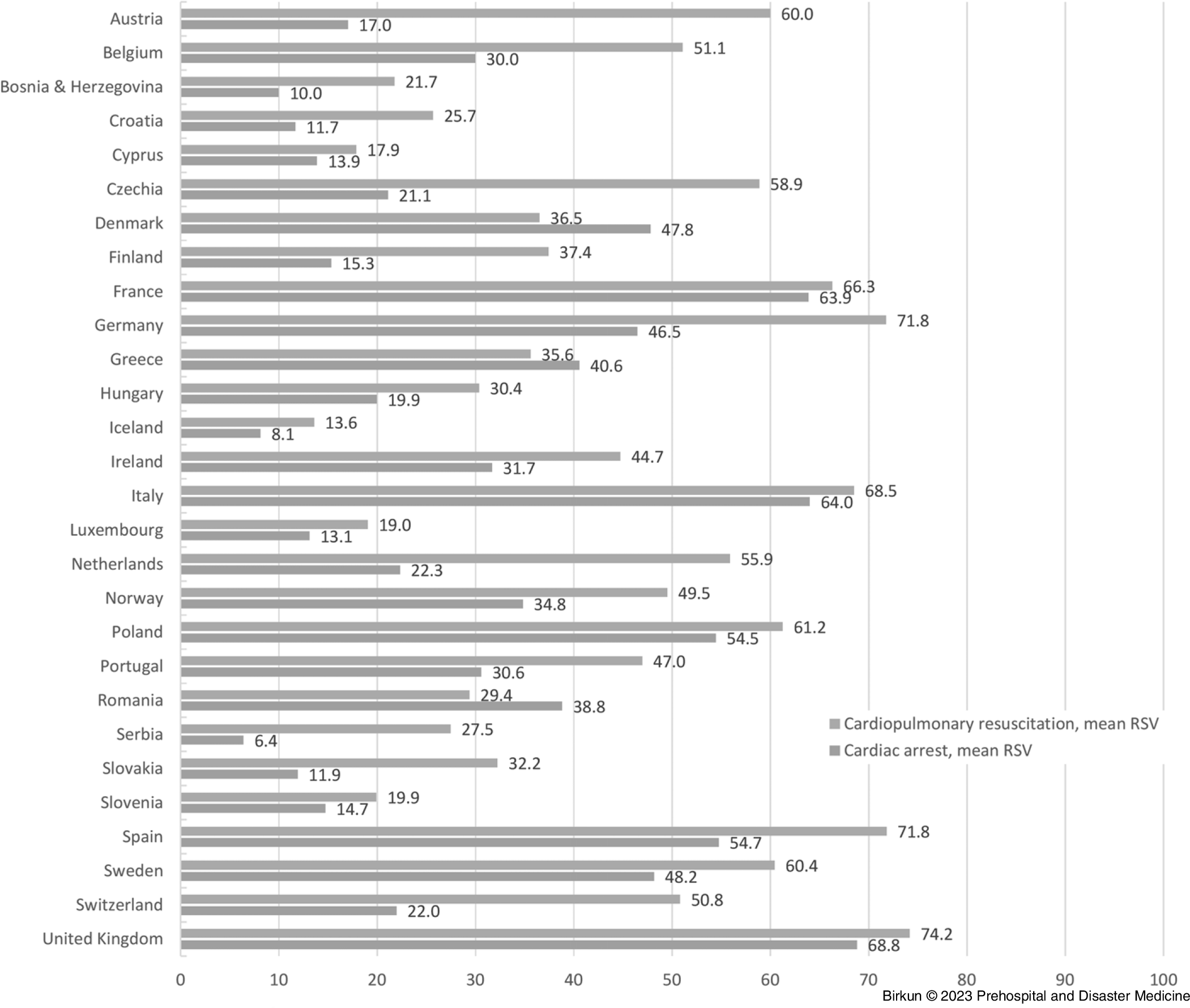
Distribution of mean year 2017 RSV data for CPR and CA search topics by country is shown in Figure 1. The RSV for CPR and CA demonstrated a strong correlation with each other (r S = 0.800; P <.001). For the whole sample of studied countries, yearly median RSV for CPR (45.8; interquartile range [IQR]: 27.9–60.3) was 1.7-times higher than for CA (26.2; IQR: 14.1–47.5; P <.001).
Mean RSV for CPR and CA Topics in 28 European Countries, 2017.
Note: The countries were selected in concordance with previous research by Gräsner and colleagues. Reference Gräsner, Wnent and Herlitz10
Abbreviation: RSV, relative search volume.

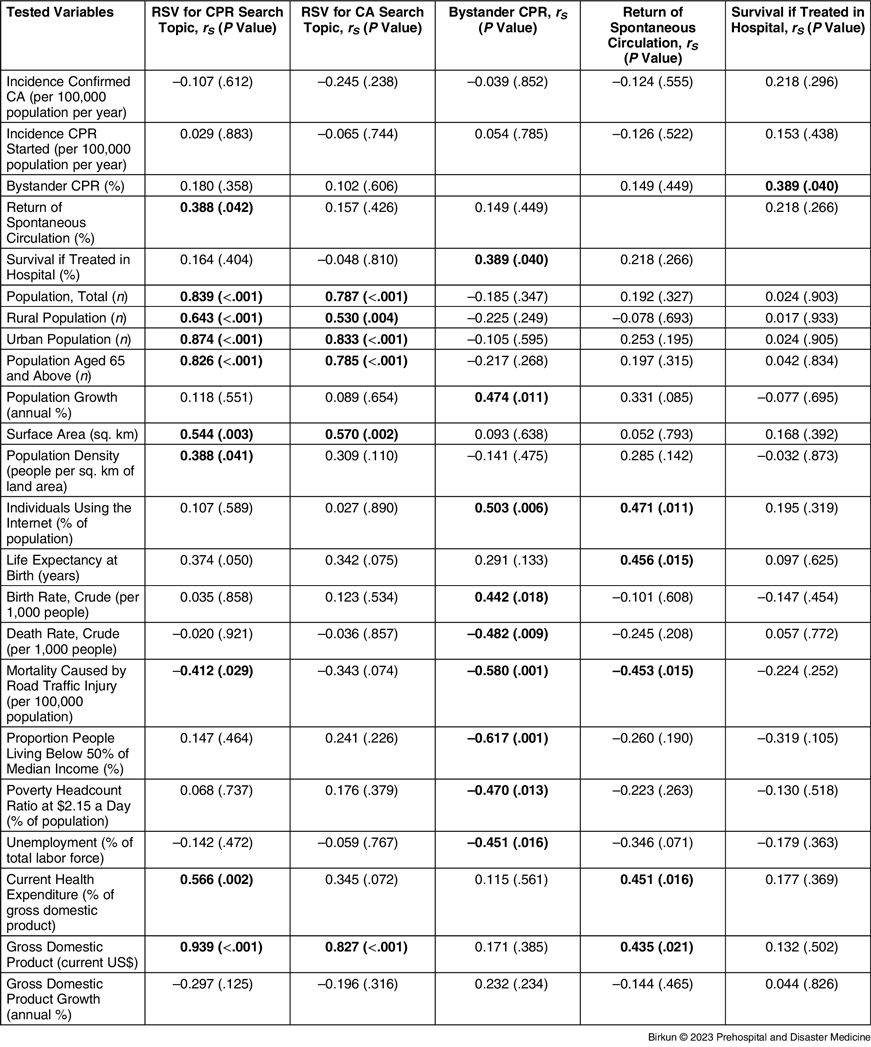
Analysis of relationships between CPR and CA search popularity and OHCA epidemiological data revealed a weak positive correlation of RSV for CPR with the rate of ROSC (Table 1), whereas OHCA incidence rates, bystander CPR rate, and hospital survival did not show any statistically significant correlations with RSV for the search topics.
Correlations of Mean RSV for CPR and CA Topics with OHCA Epidemiological Data and Socioeconomic Characteristics of 28 a European Countries, 2017

Notes: Statistically significant correlations are given in bold. The primary data are available online in Mendeley Data repository. Reference Birkun11
Abbreviations: CA, cardiac arrest; CPR, cardiopulmonary resuscitation; RSV, relative search volume; OHCA, out-of-hospital cardiac arrest.
a The countries were selected in concordance with previous research by Gräsner and colleagues. Reference Gräsner, Wnent and Herlitz10
In terms of relationship between RSV and socioeconomic characteristics of the countries, online interest in both CPR and CA exhibited a positive correlation (moderate to very strong) with countries’ total population, urban and rural population, population 65 years of age or older, countries’ surface area, and gross domestic product (Table 1). The RSV for CPR, but not for CA, also positively correlated with population density (weak correlation) and health expenditure (moderate) and negatively correlated with mortality caused by road traffic injury (moderate). The analysis did not reveal significant correlations of CPR or CA search popularity with countries’ population growth, life expectancy at birth, birth rate, death rate, poverty and unemployment indicators, gross domestic product growth, or the percentage of individuals using the Internet.
Bystander CPR showed a weak positive correlation with OHCA hospital survival, a moderate positive correlation with population growth, birth rate, and the percentage of individuals using the Internet, and a moderate negative correlation with death rate, mortality caused by road traffic injury, the proportion of people living below 50 percent of median income, poverty headcount ratio, and rate of unemployment (Table 1).
The ROSC rate moderately positively correlated with the life expectancy at birth, percentage of individuals using the Internet, gross domestic product, and current health expenditure and moderately negatively correlated with mortality caused by road traffic injury.
Out-of-hospital CA hospital survival demonstrated a weak statistically significant correlation with bystander CPR rate.
Discussion
In 2010, Murugiah and Rajput utilized Google search data to investigate a relationship between public interest in resuscitation and rates of all rhythm OHCA survival to hospital discharge for 18 United States cities. Reference Murugiah and Rajput5 The authors confirmed a positive correlation of RSV for the search term “CPR” with survival and hypothesized that higher RSV may reflect better community awareness of CPR and stronger public initiatives resulting in more effective implementation of the chain of survival.
Current exploratory research in the sample of 28 European countries did not reveal an association of public interest in CPR or CA with OHCA survival. Further, no correlation was detected between respective RSV indices and bystander CPR rate. These findings contradict the hypothesis by Murugiah and Rajput and suggest that neither CPR nor CA RSV could be utilized as a reliable measure of public readiness to attempt resuscitation.
Previous research has shown that popularity of Internet search concerning CPR could be basically maintained by online seeking related to resuscitation education and training, particularly by queries on CPR certification, as evidenced by the association between CPR RSV and resuscitation training-related search terms and yearly transient drops of CPR RSV during the non-working period of winter holidays. Reference Birkun, Baldi and Böttiger6 Current study observations further support this assumption. The revealed positive correlation of CPR RSV with gross domestic product and health expenditure may suggest higher demand and higher availability of CPR training in better developed public health systems which have more effective processes and regulations for mandatory CPR training (including obligatory CPR certification and recertification for health care and non-health care workers) and stronger public awareness and training campaigns on CPR supposedly resulting in more prevalent online search for opportunities to get trained. In turn, the positive correlation of CPR RSV with ROSC rate and the negative relationship of CPR RSV with mortality caused by road traffic injury may be explained by better performance of prehospital systems in countries with higher health care spending, in particular where more people are seeking for and receiving high-quality CPR training. In contrast to CPR, public interest in CA did not show an association with ROSC rate, according to previous research being presumably mainly supported by media reports about CA events in famous people. Reference Birkun, Baldi and Böttiger6
Alongside the RSV associations, the study revealed the positive correlation of bystander CPR rate with country’s population growth, birth rate, and the percentage of individuals using the Internet and the negative correlation of bystander CPR with population death rate, mortality from road traffic injuries, poverty, and unemployment rates. This is in line with previous research showing that socioeconomically-advantaged communities have higher engagement of bystanders in response to OHCA Reference van Nieuwenhuizen, Oving and Kunst12,Reference Shekhar and Globally13 that for instance could be related with better availability of public CPR education Reference Uny, Angus, Duncan and Dobbie14 or implementation of other system-level interventions known to be effective in improving bystander CPR rates (eg, dispatch-assisted CPR programs).
Another interesting finding was that CPR and CA RSV positively correlated with country’s population size, despite the fact that GT adjusts the web search data for population size presenting it as a relative volume. A possible explanation for this might be that higher number of country’s inhabitants determines more effective interpersonal communication and dissemination of interest in CPR and CA topics. However, the positive association of RSV with population density was confirmed for CPR topic only.
Further research is required to gain more detailed knowledge on associations of public interest in CPR and CA with OHCA epidemiology and socioeconomic characteristics of different countries, including those with low-income economies and poor CA outcomes, in order to better understand the perspective role of the RSV as a readily available and a real-time measure of health system performance in CA.
Limitations
This study has limitations. Besides the bias inherent to infodemiology research with GT (ie, analysis of relative rather than absolute data, search limited to a population having access to internet and seeking information through Google search engine, marginal variation of GT data depending on the date of acquisition), one should consider that the study focused on the 2017 data in the sample of predominantly high-income countries (93% of the countries under study). Similar study repeated in a different set of countries and/or timeframe may produce different results and conclusions. Further, as soon as the GT “search topic” feature targets a group of related terms, including acronyms, it is possible that RSV for CPR topic were influenced by “CPR” queries not related to resuscitation.
Conclusions
Although results of the study conducted for the sample of European countries are not encouraging in terms of using GT data for measuring and tracking public readiness to attempt CPR, the association of online interest in CPR with ROSC suggests that GT could be used to identify geographies with relatively low performance of prehospital systems in providing care to CA victims, including regions where effective epidemiological surveillance for CA is unavailable. Further, GT could be utilized for monitoring public interest in CA and CPR in such geographies, detecting optimal opportunities (eg, spikes of interest created by media reports on CA) for promotional and educational interventions aimed at enhancing public attitudes towards CPR, and evaluating effects of such interventions based on a change of the public interest.
Conflicts of interest
The author declares none.