For the Edwardian gentleman, patriotism must have posed something of a problem: on the one hand he was by definition quintessentially and stereotypically English; on the other hand, to be a gentleman demanded a certain dignified restraint in matters of self-expression, including the expression of national pride, and a gentleman was obliged to be courteous to all, regardless of nationality. As the anonymous author of an article on English patriotic poetry in the 1900 issue of The Quarterly Review wrote:
the temperament of Englishmen is – or was – so shamefaced and undemonstrative that it will hardly tolerate appeals to patriotism except at a crisis, and will not tolerate them even then if the note is pitched high.Footnote 1
The author illustrated the point by reference to a passage in Rudyard Kipling’s Stalky & Co (1899), a serialized novel based loosely on Kipling’s experiences as a schoolboy at the United Services College in Devon. The passage in question concerns an address to the school by one Mr Raymond Martin, a fictional member of parliament, in the course of which ‘in a raucous voice’ he urged the boys to consider their present and future duties to ‘their glorious native land’. The speaker was in no doubt that some of the boys ‘looked forward to leading their men against the bullets of England’s foes’, and he ‘cried aloud’ about ‘the hope of Honour and the dream of Glory’. At the climax of his peroration he unfurled the Union Jack and waved it aloft, expecting thunderous applause. However Mr Martin MP had badly misjudged his audience. Kipling describes how the schoolboys sat through his speech ‘flushed and uneasy, in sour disgust’, and received his flag-waving with silence.Footnote 2 As the author in The Quarterly Review noted, the passage illustrates the way in which an overly demonstrative ‘patriotic harangue’ breached unwritten rules of English etiquette, and provoked embarrassment and shamefacedness amongst those who were obliged to listen.Footnote 3
This article seeks to explore the relationship between patriotism and the manners of the English gentleman in Edwardian music. For reasons which are perhaps self-evident, and to which we shall return in due course, the article focuses on folk-song rhapsodies and English landscape tone poems written during the years from 1904 to 1914. Some of the ground traversed will no doubt be familiar: there is a significant secondary literature concerning folk-song and the rural scene as symbols of English identity, particularly in early twentieth-century music. The point I wish to make is that the English quality that many listeners detect in this music may be due not only to the presence of these national symbols, but also, and more particularly, to the method of their presentation. Thus this article is concerned with the way in which the manners of the English gentleman are employed when representing England.
Much early and mid-twentieth century writing about late Victorian, Edwardian and inter-War English music was concerned to a greater or lesser extent with identifying an unspecified, inherent, and ultimately indefinable ‘English’ quality. Such an approach involved the notion that the development of a composer’s musical language was the result of quasi-evolutionary forces, and therefore any composer’s work to some extent inevitably reflected national and/or racial traits.Footnote 4 The worldview that underpins such an idea is quite properly associated with some of the most odious aspects of twentieth-century European history, including the eugenics movement, and, ultimately, Fascism. Nevertheless, the influence of the quasi-evolutionary account of musical style lingered long into the twentieth century.Footnote 5 Perhaps prompted by scholarly developments from outside the field,Footnote 6 more recent musicology has tended to shun this idea. Certainly since the publication in 1993 of Robert Stradling and Meirion Hughes’s trenchant history of English music from 1860 to 1940,Footnote 7 which sought to expose the political motivations behind developments in English music education, composition, performance and reception during that time, musicologists have tended to treat the association between the idea of Englishness and certain kinds of music – primarily folk-song and the pastoral rural scene – as an objective historical phenomenon (frequently regarded as ‘hopelessly ideological’Footnote 8) rather than as a result of natural, aesthetic qualities of the music itself.Footnote 9
This article proceeds from a similar standpoint and seeks to avoid the pitfalls of the national/racial strain of English music history by adopting two broad strategies. To begin with, the first part of the article will set out a model of musical signification that suggests how we might consider manners as part of a musical semiotic process. Being explicit about the nature of the signification process, and thereafter relating it to specific aspects of the score, avoids the need to appeal to a mysterious and contentious musico-aesthetic realm as a basis for interpretation. Secondly the article will discuss some of the qualities of the English gentleman as he appears in the popular press in the decades before World War I, qualities that seem antithetical in significant ways to a robust, impassioned expression of national identity. The ideals of Englishness and gentlemanliness that lie at the heart of this article are precisely defined and located in contemporary sources: there is no appeal to any abstract, spiritual idea of national identity. In the course of that discussion we shall explore an important distinction between patriotism and nationalism, and the way in which notions of gentlemanly behaviour relate to the difference between the two. Thereafter the article applies these ideas to a number of tone poems and folk-song rhapsodies, and considers their likely reception by contemporary London audiences, to demonstrate the way in which it is gentlemanliness, as much as rural scenes and folk-song, which characterizes the polite patriotism of this Edwardian musical style.
Manners as Part of a Model of Musical Signification
Manners regulate the interaction between an addressor and an addressee. They may be detected in the rhetoric of a given piece of music; not only in what is being ‘said’ but also in the way in which it is said, by the relative rhetorical positions of the musical subject and the listener. It would be a mistake, however, when looking for manners in music, to map the addressor/addressee relationship in a simplistic way on to either composer/audience or performer/audience. The complexities of musical signification, and in particular the concept of subjectivity in music, will not yield to such a straightforward approach. The point is that music of the time under consideration here addresses its audience by employing signs of subjectivity, evoking a virtual subject with which an audience is invited to identify. Listening involves responding to these signs by participating as that subjectivity.Footnote 10 George Poulet made a similar point in relation to the phenomenology of reading.Footnote 11 On taking up a book, he wrote:
I am aware of a rational being, of a consciousness; the consciousness of another, no different from the one I automatically assume in every human being I encounter, except that in this case the consciousness is open to me, welcomes me, lets me look deep inside itself, and even allows me, with unheard of licence, to think what it thinks and feel what it feels.Footnote 12
In the act of reading Poulet becomes ‘a self who is granted the experience of thinking thoughts foreign to him’Footnote 13 – reading summons a virtual subjectivity. As Poulet writes, most eloquently:
this thought which is alien to me and yet in me, must also have in me a subject which is alien to me. It all happens, then, as though reading were the act by which a thought managed to bestow itself within me with a subject not myself. Whenever I read, I mentally pronounce an I, and yet the I which I pronounce is not myself.Footnote 14 Reading, then, is the act in which the subjective principle which I call I, is modified in such a way that I no longer have the right, strictly speaking, to consider it as my I. I am on loan to another, and this other thinks, feels, suffers, and acts within me.Footnote 15
This description of the phenomenology of reading is remarkably applicable to musical signification.Footnote 16 Indeed, it seems arguable that the subjectivity evoked by music might be even more seductive, and even more fundamental to the way that it communicates than that evoked by reading. While the idea that music operates as a purely syntactic semiotic field devoid of semantic content is by now a well-worn and misleading cliché, it nevertheless remains the case that, by comparison with literature, it relies far less on semantic content to convey its meaning. Instead, as a growing body of academic writing suggests, music often operates by permitting or enabling certain kinaesthetic responses in its audience.Footnote 17 Amongst the most rigorous explorations of this idea is Naomi Cumming’s The Sonic Self, in which she describes the way that the vocality of instrumental timbre, melodic gestural force and tonal wilfulness can contribute to the sense of a virtual agent. As she is careful to make clear, this agent ‘is formed by the music itself. The [musical] sign creates the “subject”, not the “subject” the sign’.Footnote 18 Evoked thus, the virtual musical persona can dance (or gallop, march, laugh, sigh or weep) and the audience, participating as that persona, not only listens but also, internally, dances along. Because the response to music is quasi-physical there are fewer barriers (of comprehension, style, language, culture and the like) for readers seeking to identify with a textual subjectivity arising from a work of poetry or prose. Thus music, potentially, can offer its audience an engagement with a virtual subjectivity that is even more direct, immediate and intimate than the one Poulet describes as arising from literature.
Readers may well be familiar with notion of musical subjectivity from Edward T. Cone’s The Composer’s Voice. Cone pursues the analogy music/language and musical work/utterance, and suggests that ‘any instrumental composition … can be interpreted as the symbolic utterance of a virtual persona’. He acknowledges that the utterance can take many forms, analogous at times, perhaps, to a monologue or soliloquy, and at other times to a play in which ‘a number of virtual agents assume leading roles’. Standing somehow behind or above all of this is a complete musical persona, ‘the experiencing subject of the entire composition, in whose thought the play, or narrative, or reverie takes place’.Footnote 19 Lawrence Kramer, too, has addressed the issue of subjectivity in music.Footnote 20 Of some importance for the present study is his point that the evocation of a musical subjectivity creates a space for an interaction between that virtual persona and the audience, a process that leaves open the possibility that the audience may choose not to adopt the subject position offered through the music:
The music calls me to rehearse the subjectivity it performs, and commonly I do. But everyone knows that changes get made in rehearsal. Listeners commonly recast the subjectivity that addresses them through music by their acts and habits of listening, describing and remembering. The dialogical metaphor needs to be given full weight: the point is not that the music ‘speaks’ and the listener hears, but that the music speaks and the listener, in hearing, replies. The substance of the reply is remarkably open …Footnote 21
Thus the way in which the subjectivity is offered and in which it addresses its audience can be critical elements in the success or failure of a work of music. In the context of patriotic Edwardian music we must look for gentlemanly manners both in the way in which the audience is approached, invited and/or encouraged to participate as the subjectivity that arises from performance, and also in the nature of that subjectivity, the way it acts, and the attitudes or modes of expression with which the audience is invited to identify. Bad manners at these points, or any lack of sensitivity to the likely attitudes of an audience, might count strongly against a work’s reception. Kipling’s Mr Raymond Martin MP was guilty of bad manners at precisely these points: he failed to respect that many of the students may have had no ambition to serve in Britain’s armed forces, and he then had the gall to presume that every student would identify with his passionate demonstration of patriotic feeling. It is therefore worth considering at this stage in some detail the characteristics of the English gentleman, as a guide to the kinds of values and qualities that composers might or indeed should have expected their audiences to hold, and which will thus have informed the nature of the subjectivities, the virtual personae, through which their music speaks.
Keeping a Stiff Upper Lip
The qualities I wish to trace in Edwardian music are closely associated with the English gentleman, a national self-image of particular significance to the growing middle-class concert audiences of the time. Simon McVeigh and Cyril Ehrlich have described how the decades before World War I saw an unprecedented growth in London concert life, reflecting the rapidly expanding consumer culture and the commercialization of leisure at this time. Whereas the 1884–85 season offered Londoners 238 concerts, soirées, matinées and recitals, by 1904–5 this had expanded to 603.Footnote 22 Such growth (which may well have exceeded demandFootnote 23) was in response to a burgeoning market for leisure and luxury goods from a ‘large and anonymous middle-class public’.Footnote 24 The code of behaviour embodied by the gentleman was central to middle-class values: as T.O. Lloyd put it, ‘most of the middle class was dominated by a desire for respectability’,Footnote 25 and one way to ensure its achievement was to emulate the idealized English gentleman. Writing in The Monthly Review in 1905 John Howley encapsulated the close relationship between the Edwardian middle class, its desire for respectability and gentlemanly bearing:
Reserve has taken refuge among the mid-middle class, among those who are not of the Smart Set, who lack the wealth or impudence required to give them footing in the fashion columns, yet hold their heads too high to relish the pleasures of the vulgar. This ever-decreasing body forms a social oasis where mid-Victorian respectability still lingers. It is made up of quiet business folk, of steadygoing but unambitious professional men, of those families who form the bulk of the military, naval, and clerical castes, and of the smaller squirearchy. You will know them by the raiment of their women, by their grave and earnest demeanour, by their dignity and decorum in public places.Footnote 26
More bluntly, Sir Ernest Barker suggested that it was ‘snobbery at its best [that] made the code of the gentleman pervasive’.Footnote 27 What, then, was the ideal type that this middle class aspired to emulate? An anonymous author in the New London Journal wrote in 1906,
Among the first marks of the gentleman are his composure, self-control, easy confidence, naturalness … He has nothing to gain or lose by his intercourse with mankind, so he can afford to be self-contained; he has no need for emphasis. Strength is serene; it is weakness that is insistent, doubtful, self-advertising.Footnote 28
One of the inevitable consequences of such an attitude was that the gentleman frequently gave the impression of emotional detachment, a ‘stiff upper lip’ that was both a great virtue and an acknowledged defect. To judge from frequent references in popular journals of the time, Edwardian Englishmen regarded themselves – and were aware that they were internationally regarded – as emotionally cool. Commenting on the public reaction to the death of the Duchess of Teck in 1897 Mary Jeune declared ‘[w]e are curiously shy and chary of showing anything which looks like sentiment or emotion, and yet we are the most emotional people in the world’Footnote 29 ‘It is not our habit to wear our hearts upon our sleeves’ declared an anonymous author in Blackwood’s Edinburgh Magazine: ‘we are not wont to parade our feelings in the eye of the world’.Footnote 30 John Galsworthy, author of The Forsyte Saga, writing in 1915 for an American audience, observed that ‘[t]he Englishman is no more given to extremes than is his climate; against its damp and perpetual changes he has become coated with a sort of bluntness’.Footnote 31 ‘England’, he wrote,
produces more than its proper percentage of cranks and poets, and, I take it, this is nature’s way of redressing the balance in a country where feelings are not shown, sentiments not expressed, and extremes laughed at. Not that the Englishman lacks heart; he is not cold, as is generally supposed; on the contrary he is warm-hearted and feels very strongly; but just as peasants, for lack of words to express their feelings, become stolid, so it is with the Englishman, from sheer lack of the habit of self-expression.Footnote 32
As these passages suggest, for Englishmen strong feelings were not problematic per se. Indeed, for many, a capacity to feel deep emotion was an essential feature of the national character. Advocating for a revival of British theatre, H. Hamilton Fyfe suggested that
[b]eneath a calm surface there flow in our English nature deep and strong currents of noble emotion, of passionate attachment to ideals, of hidden feeling that, once aroused, sweeps away convention and the obstacles of prejudice or pride in a flood which may not be withstood.Footnote 33
Ford Madox Ford contended that the famous English reserve arose not because the Englishman ‘lacked feeling’, but was rather due to his self-awareness of the ‘depth of his capacity to feel’, prompting him to avoid facing squarely the horrors of the world in order to avoid being moved ‘beyond bearing’.Footnote 34 Thus the problem was not strong emotion, but how to express it in a socially acceptable way. The code of the gentleman was engaged for precisely this purpose, binding the more outgoing qualities of the English character ‘in the iron band of reserve, which happily prevent[ed] our tearing a passion to tatters’.Footnote 35 In 1901, in the wake of the death of Queen Victoria, one writer ventured to suggest that ‘[t]he House of Commons has always been emotional – not extravagantly or violently, as a rule, but with restraint and dignity, characteristic, as one likes to think, of the nation of which it is the heart’.Footnote 36
Unsurprisingly, in such a climate, overt or unrestrained displays of emotion were generally frowned upon. Galsworthy suggested that while the Englishman was ‘in truth an idealist’, his nature was nevertheless ‘to snub, disguise, and mock his own inherent optimism. To admit enthusiasms is “bad form” if he is a “gentleman”; and “swank” or mere waste of good heat if he is not a “gentleman”.’Footnote 37 He praised the public school system for fostering a reserved and self-sufficient manner, describing one aspect of its ‘philosophy’ thus:
Never show your feelings – to do so is not manly and bores your fellows. Don’t cry out when you’re hurt, making yourself a nuisance to other people. Tell no tales about your companions, and no lies about yourself. Avoid all ‘swank’, ‘side’, ‘swagger’, braggadocio of speech or manner on pain of being laughed at.Footnote 38
Bemoaning the ‘hysteria frequently displayed in the pulpit’, Wilfrid Leadman suggested that ‘[t]he spectacle of a man or woman in a hysterical fit is apt to excite feelings of disgust and pity in the minds of healthy individuals’. The English, he commented are ‘stolid and unemotional’, and ‘contemptuous … of the feverish impulsiveness of Southerners’.Footnote 39 Edward Baughan noted that the ‘gentleman in music … had a horror of singers who have made reputations’, ascribing it to ‘something vulgar in their emotionalism’, and that they ‘put too much side on’.Footnote 40
It is at this point that the relationship between gentlemanliness/vulgarity and patriotism/nationalism becomes clear. In Edwardian England the distinction between patriotism and nationalism, while very real, was more of tone or degree than of substance; to adopt Julia Stapleton’s phrase, English patriotism existed at the ‘thin end of a thick nationalist wedge’.Footnote 41 George Orwell famously drew a line between the essentially defensive stance of patriotism, a ‘devotion to a particular place and a particular way of life which one believes to be the best in the world but has no wish to force upon other people’, and nationalism as ‘the habit of identifying oneself with a single nation or other unit, placing it beyond good and evil and recognising no other duty than that of advancing its interests’.Footnote 42 But there is a common basis to Orwell’s formulations of patriotism and nationalism: each is founded on a view of the world that values ‘here/us’ over ‘there/them’. Like nationalism, twentieth-century English patriotism has been widely understood as involving ‘a conception of the English people as a distinct spiritual or cultural whole’.Footnote 43 For G.K. Chesterton, perhaps the most prominent Edwardian contributor to the topic, patriotism was an entirely natural and fundamentally human result of regarding oneself as being in ‘the best possible relation with our immediate surroundings’, and he extolled its ‘fundamental spiritual advantage’.Footnote 44 Chesterton’s patriotism was ‘a recrudescence of romantic nationalism’.Footnote 45 The difference between the two arises from the way that national loyalty is expressed and acted on.Footnote 46 Without the restraint required of the gentleman, expression of love for country could very easily become boorish and crude. L.T. Hobhouse decried the ‘vulgarity’ of an English nationalism that ‘boasts that a single British colony is greater than the land which produced Kant and Goethe’.Footnote 47 Similarly Chesterton bemoaned the ‘deaf and raucous Jingoism’Footnote 48 of his day, and the ‘peculiar lack of any generosity or delicacy in … English nationalism’.Footnote 49
One late-Victorian author suggested that the English gentleman banished unabashed displays emotion from his bearing because, in some sense, it amounted to a kind of lying:
for it is not only sheer brutal lying that a gentleman avoids and hates; it is falsehood of all kinds and shades, hinted as well as spoken, acted as well as hinted, all flattery and cajolery directed towards others, all ostentations, puffing and glorification of oneself. To this is very largely to be ascribed the reserve and coldness with which he is credited, and which do undoubtedly form one of his defects.Footnote 50
Here the qualities of the gentleman begin to overlap with those of that other great symbol of English national character, John Bull, whom Hobhouse described in 1904 as an
easy-going, stout, well-meaning, rather dull old gentleman, a little proud if the truth be told of his very dulness, and apt to conceive of it as an incident in that fundamental honesty which distinguished him from his sharp-witted neighbours, … hard to move, but implacable when once stirred, narrow perhaps, but fundamentally just and honourable in all his dealings.Footnote 51
Indeed, the great store placed on honesty and straightforward plain speaking may go some way to accounting for the fact that gentlemen regarded themselves, in the main, as amateurs.Footnote 52 In many quarters, and particularly in music criticism, professionalism attracted a degree of disdain. Charles Kennedy Scott blamed what he saw as the decline in English music since Elizabethan times on professionalism itself:
How did we lose so precious a possession? … by forgetting that professionalism is no substitute for what should be a general love and interest.Footnote 53
One may detect in music criticism of the Edwardian years a distinction commonly drawn between ‘naturalness’ and ‘cleverness’.Footnote 54 In H. Walford Davies’s opinion musical activity was ‘in every sense of the word, natural’,Footnote 55 and his anonymous biographer in The Musical Times wrote that ‘mere cleverness will not atone for incoherency and lack of inspiration’.Footnote 56 Foreign composers were particularly susceptible to criticism on this basis: Richard Strauss was accused of being ‘more clever than deep: brilliant rather than sincere’;Footnote 57 Ernest Newman questioned whether Nicholas Medtner’s ‘extraordinary technical competence’ did not ‘sometimes get in the way of thinking’.Footnote 58 Thus the English valued a certain blunt honesty, even at the expense of elegance, if it meant avoiding any suggestion of ‘mere’ professional cleverness. Technique and display were liable to draw undue attention to oneself: thus, to avoid being accused of a lack of taste, a gentleman ‘should not talk about himself, except in an “interview”, and even then as little as possible’.Footnote 59
Notwithstanding these complexities, in the years before World War I a great deal of cultural activity in England was directed towards national identity, and much of it was frankly patriotic. To help understand how English composers contributed to this social dialogue and yet negotiated the difficulties presented by the gentlemanly ‘stiff upper lip’, we shall now consider some of the folk-song rhapsodies and nature portraits of the Edwardian era.
Observing Landscapes, Overhearing Folk-songs
The three single-movement ‘Norfolk Rhapsodies’ Vaughan Williams composed following his encounters with folk-singers around Norfolk in early 1905 are amongst the earliest examples of a sub-genre of orchestral music that was to prove popular and influential over the ensuing decade. Apparently, Vaughan Williams originally intended to incorporate a range of folk-songs into a ‘Norfolk Symphony’. While such a work never eventuated, the two surviving rhapsodies composed in 1905–06 to some extent correspond with the first and second movements of a symphonic form. (The Norfolk Rhapsody No. 3, written at the same time and which may have acted as a finale, has not survived). Vaughan Williams’s interest in English folk-song was piqued when he overheard a labourer singing Bushes and Briars at Ingrave, Essex in 1903,Footnote 60 and from that point he became deeply involved with the Folk-Song Society.Footnote 61 It is hardly necessary to describe the way in which folk-song was widely (although not universallyFootnote 62) understood to be an expression of something fundamental about English national identity.Footnote 63 It will suffice here to recall comments Vaughan Williams made in a lecture to the Oxford Folk-Music Society in November 1910, reported verbatim in The Musical Times the following year. By defining folk-song as ‘a spontaneous musical utterance by unlettered people which, by process of evolution, has become the common property of that people’,Footnote 64 he emphasized the ways in which folk-song embodied that amateur, unsophisticated honesty that the English prized in themselves. As such, folk-song ‘represent[ed] national characteristics in their very simplest form’. In Vaughan Williams’s view, engagement with English folk-song was inevitable, natural and very much to be welcomed:
the individual is the member of some race and shares many of his characteristics with his fellow countrymen, and the most individual art is usually the most characteristic of the race as a whole. Therefore I would advise all musicians and lovers of music to study their own folk-songs; it will probably fill up a blank in their musical horizon, and help to suggest to them their own limitations and qualities, and their general tendencies as a musical race.Footnote 65
To write an orchestral rhapsody based on English folk-songs, then, was an exercise in the expression of national identity.
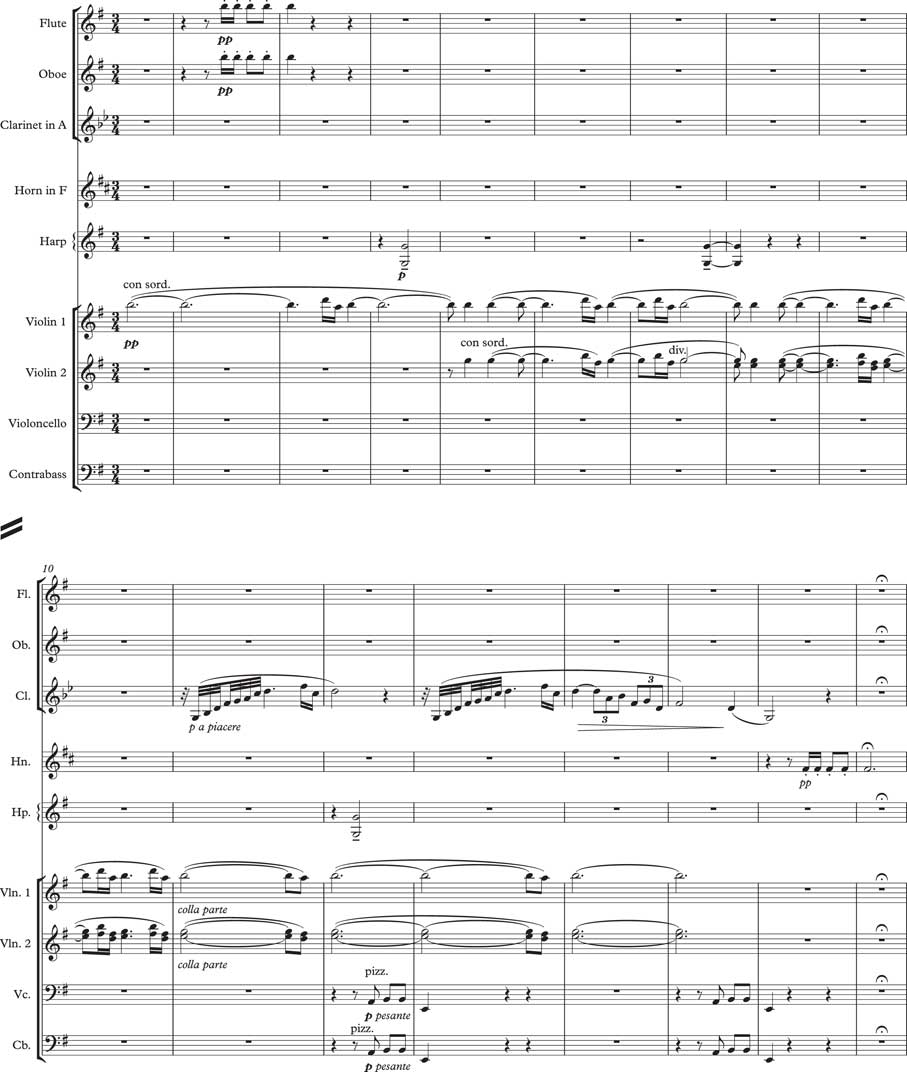
Significantly Vaughan Williams does not begin his Norfolk Rhapsody No. 1 with a folk-song. Example 1 gives the first 17 bars. Many of the motivic shapes prefigure elements of the folk-songs to follow: the Dorian-mode turn in the violins is drawn from the final element of the second phrase of ‘The Captain’s Apprentice’ and the pizzicato bass is an element of the first phrase of the same tune. However, the function of the opening bars is broader than simply to introduce the piece’s main motivic material: this particular gentle, static orchestral sonority, primarily based on strings with points of colour from other instruments, is an example of the way in which English composers of this time developed a ‘scene-setting’ device, a musical shorthand for a depiction of the English rural scene.
Ralph Vaughan Williams, Norfolk Rhapsody No. 1, bars 1–17

In the course of lectures in January and February 1910 Dr H. Walford Davies described precisely how music was capable of achieving such a specific signification. The Musical Times reported his lectures in terms that are remarkably pertinent to the opening bars of the Norfolk Rhapsody No. 1, and worth quoting at length:
Pictures and music design to present colour and harmony in like ways, … [T]he lecturer desired the audience to imagine a picture of the simplest kind before them which had a maximum of colour-appeal and a minimum of any detail that could suggest objects and awaken association of ideas. Imagine, he said, a plain sunset over the sea, or a moonrise over a lake, with no design of line discernable, no church, no cedar tree, or grave-stone in the foreground. Let there be variety of light and shade; there may perhaps be vague shapes and forms in the clouds that add delight; but the interest of detail should be reduced to a minimum, that of colour raised to a maximum. Now let a full chord on a perfect orchestra be imagined. It should be pianissimo for the sake of the analogy, since the mere physical nearness and excitation of a fortissimo chord is apt to absorb the hearer’s powers and disturb contemplation. It should be a rich chord of many notes, but distant as the landscape, and euphonious, and altogether as bearable. Link these two, sunset picture and orchestral chord, in the mind. There is a detail of colour harmoniously blended in both, but in the picture, no diverting detail of line, in the chord no charm of melodic rise or fall. Both are motionless, and the observing eye and ear must remain still too … Both eye and ear may deliberately vary the impression during that time by directing their attention first to one point, then to another. Here it may be seen that the absolute analogue to a picture is not a contemplative moment, but a sustained chord, that may be full, as the picture, of recognizable varieties of colour – muted strings here, a plaintiff oboe there, an insistent horn elsewhere – to which the mind can direct the ear’s detailed attention.Footnote 66
This technique perhaps stemmed from the opening bars of Das Rheingold, but it certainly found fertile soil in Edwardian England: examples may be found not only in the Norfolk Rhapsodies, but also in a range of other works by Vaughan Williams’s contemporaries.
Accepting that Vaughan Williams’s first 17 bars present a picture of an English rural scene, the question arises, where might we locate the musical subjectivity? Where is Cone’s governing musical persona? Walford Davies has already given us a clue, when he remarked on ‘the hearer’s … contemplation’ and ‘the ear’s detailed attention’: there is a sense here in which the audience’s role in this musical moment is that of an observer. In Rural Scenes and National Representations, Elizabeth Helsinger suggests that a similar process is at work when we view a Victorian landscape painting:
Landscapes do not only indicate the presence of subjectively constituted places within a topological space, … they also point to their observers. They project the possibility of a subject while they refer to a portion of the land.Footnote 67
The rural scene in fact points back at us, out of the music as it were, to the subjectivity embodied by the music, which itself views the scene from a distance, inviting the audience to stand by it and observe alongside it. The subjectivity presents us with a picture. It does not speak directly, and instead adopts a cool, objective and mediated mode of address. Thus, the musical presentation of the rural landscape interposes an intervening object between the musical subjectivity and the audience, and it establishes a ‘shoulder to shoulder’ relationship. An audience member, at this early stage in the Norfolk Rhapsody No. 1, is invited to participate only as an observer rather than an actor.
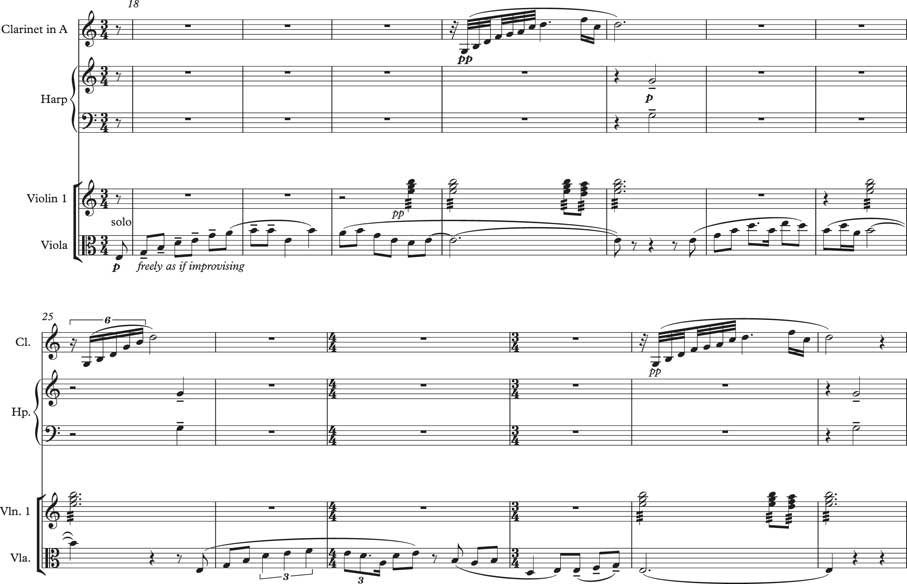
Following this opening rural scene, Vaughan Williams presents the folk-song ‘The Captain’s Apprentice’, ‘collected’ in early 1905 at King’s Lynn. It appears on a solo viola, entire and relatively unadorned, over bars 18 to 30 (Ex. 2). It may seem obvious, but it is worth making explicit that just as imitation birdsong operates as a musical icon of the bird, so folk-song stands as an icon for figures of the English folk: as well as the song we are presented with the singer. The folk-singer is clearly a musical subjectivity but it is not to be equated with Cone’s complete musical persona. The performative function of English folk-song – that it was something to be sung – had been subtly but decisively altered by the time of the first decade of the twentieth century, a change which owes much to the archaeological attitudes of folk-song collectors. In the 1910 lecture to which we referred previously, Vaughan Williams traced the revival of interest in English folk-song from the publication in 1848 of ‘Sussex songs’ by the Rev. John Broadwood, through the efforts of Carl Engel in 1878,Footnote 68 Baring Gould’s ‘Songs of the West’ (1889), Frank Kidson’s Traditional Tunes from Yorkshire (1891), Lucy Broadwood and J.A. Fuller-Maitland’s English Country Songs (1893), the formation of the Folk-song Society in 1898, and Cecil Sharp’s researches in Somerset in 1903. Following their revelatory first-hand experiences of English folk-song in 1899 and 1903, SharpFootnote 69 and Vaughan Williams launched what Stradling and Hughes have described as a folk-song crusade,Footnote 70 leading a charge to the countryside to record for posterity what was understood to be a dying musical practice. Thus, in Edwardian England folk-songs were frequently encountered in collections presented by musically literate amateur and professional scholars, rather than as a living aspect of rural culture. The activity described by Vaughan Williams was paternal and curatorial rather than ethnomusicological, as we understand that discipline today. Tellingly, the term used to describe the activity of listening to and writing down folk-song was ‘collecting’, as if the snatches of melody were scientific or archaeological specimens.Footnote 71 Folk-song was seen as a naturally occurring object rather than a motivated human activity; those who sang it did not ‘produce’ it, and certainly did not ‘own’ it. The collector had as much right to it as any, and indeed may have regarded him or herself as having a higher moral claim, given that the desire for it sprang purely from motives of conservation.
Ralph Vaughan Williams, Norfolk Rhapsody No. 1, bars 18–30

There are several signs of this cultural objectification of folk-song in the first statement of ‘The Captain’s Apprentice’. In the context of an orchestral score, a passage for a solo instrument is significant. A relatively small, fragile sound in a large hall requires the attention of the audience, and in the act of attentive listening an audience member is made aware not only of the solo line but also of his or her own active, deliberate reception of it. Such attentive listening illustrates to the listener the distance between him or her as a subject and the solo voice as an object. This distance may, perhaps, be emphasized in performance by the way that other members of the orchestra also sit and listen. Equally tellingly, the tune is presented almost without accompanying harmony. Harmony, of course, is a sign of culture and context. In this case Vaughan Williams only provides a few snatches of the scene-setting music from the previous 17 bars as a background to the solo viola. Such harmony as is implied is entirely static, a suspended tonic, which is suspenseful because it seems to wait for something to occur. Finally, ‘The Captain’s Apprentice’, like much English folk-song, is built from a strong, self-contained phrase structure, underpinned by a simple implied harmonic paragraph with a decisive end point. In this case Vaughan Williams repeats its two final phrases, but this serves only to emphasize the extent to which this music lacks nothing, does not lend itself to development, and thus it resists being drawn into or becoming part of Vaughan Williams’s musical language.Footnote 72 For these reasons the folk-song does not easily participate in the musical dialogue. Rather it is better understood as being presented by the governing subjectivity. The voice that is speaking through the viola is clearly that of the folk-singer, but it is a voice set at a distance, a picturesque character in the plot rather than its narrator. Thus, like landscape, the folk-singer/folk-song intervenes as a mediating object between the narrating musical subjectivity and its audience. By inviting the audience to join the narrator in observing an intervening object, and thus speaking, as it were, in the third person, Vaughan Williams permits a potentially ungentlemanly topic to be approached in a polite, gentlemanly way.
A further device relied on by English composers to signify the distance between the folk-singer and the governing musical subjectivity – a technique not present in the Norfolk Rhapsody No. 1 – is evident in the opening bars of Gustav Holst’s A Somerset Rhapsody (1907). Tellingly, Holst requests that the initial statement of the sheep shearing song ‘It’s a Rosebud in June’, scored for oboe solo, be played ‘whenever possible’ on an oboe d’amore, an instrument only rarely heard in the concert hall. Instrumental timbre can play a decisive role in the way musical subjectivity operates. Parts for wind instruments have been included in works for string-based ensembles since at least the seventeenth century, however I wish to argue that in the nineteenth and early twentieth centuries (at least in relation to post-romantic musical practice) connotatively they retain something of their status as voices peripheral to the central dialogue of orchestral music, which is ultimately conducted through the massed strings. The strings remain the standard, neutral tone against which the colour of other instruments is measured and contrasted. Thus the timbres of wind instruments lend themselves more naturally to playing the role of what Cone might call a secondary virtual agent, whereas, in this context, one might well expect Cone’s complete musical persona to be enacted by a solid body of strings. The timbre of the oboe d’amore’s opening melody in A Somerset Rhapsody emphasizes its quality as a distinct and individual voice: it does not invite universal participation in the way that a string instrument or piano might. It is too clearly someone else’s voice to be adopted by the audience as its own.
Also of note in the opening bars of A Somerset Rhapsody is the sustained, muted octave B high on the second violins that opens the work: it is not difficult to hear this as a shorthand version of the musical depiction of the rural scene, a pencil sketch perhaps, rather than a full oil painting, but nevertheless identifiably a rural scene against which Holst places his folk-singer. The folk-song is characterized by a strong phrase structure that articulates a self-contained form, a kind of musical analogue of the blunt and straightforward honesty of Englishness as exemplified by John Bull. Thus, in a remarkably concise few bars, Holst combines each of the techniques we have discussed so far that suggest gentlemanly manners in the opening of a folk-song rhapsody.
However, it is not only the way in which these folk-song rhapsodies begin that betrays their gentlemanliness. Every one of the pieces that has been and will be considered in the course of this article progresses from a static, detached beginning to music which is characterized by more vigorous movement and complexity. The next part of this article turns to consider in more detail this second and equally vital step in the characteristic rhetoric of the Edwardian orchestral rhapsody, that is, the gradual processes by which the governing musical subjectivity becomes engaged with both folk-song and landscape, and thus invites the listener to move from observer of to participant in the patriotic dialogue.
And So Say All of Us
Each of the musical features that indicate the passivity of the musical subjectivity in the opening passages of these orchestral rhapsodies discussed to date exists at one extreme of a binary continuum: solo instrument/massed instruments; winds/strings; closed/open musical phrases; and slow/fast harmonic rhythm. As the second appearance of the folk-song in A Somerset Rhapsody demonstrates, two other binary pairs become relevant as soon as the process of engagement commences: separation/integration between melody and harmony; and predictable/adventurous harmonic language.
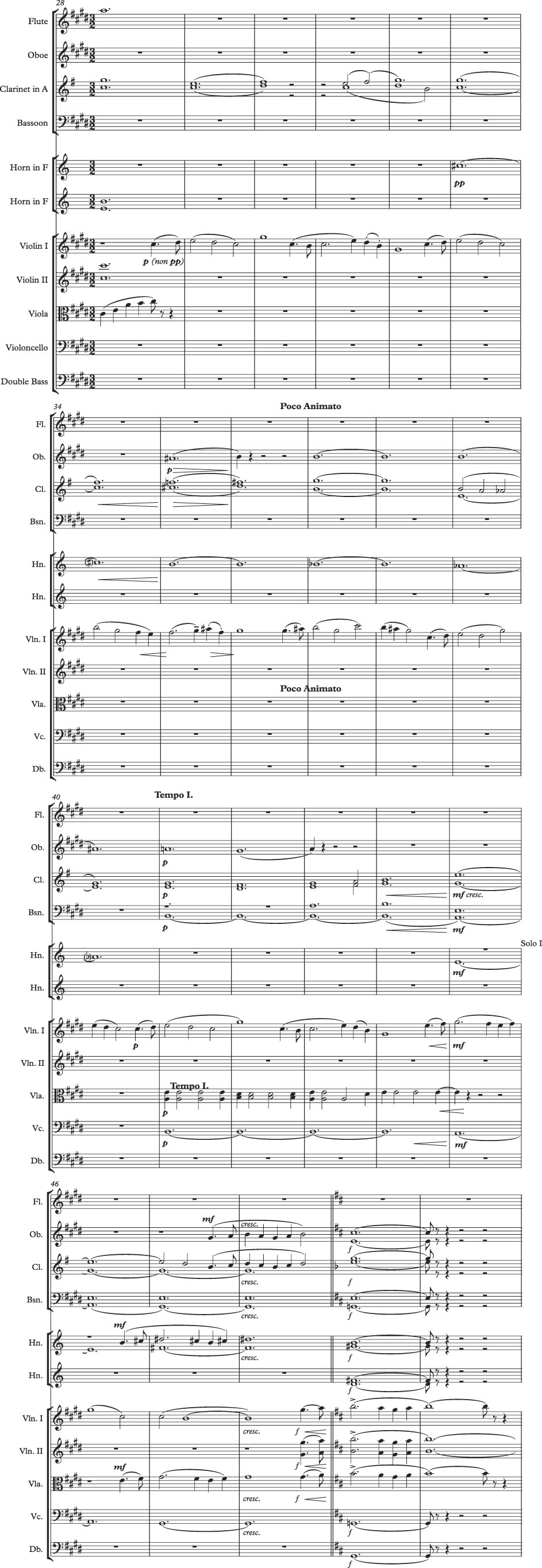
The inverted dominant pedal in the first 27 bars of Holst’s work implies an entirely traditional and predictable harmonic background: depending on the melodic movement it suggests either chord i or v in E minor, and the implied harmonic rhythm is slow, if not static. The harmony, such as it is, is entirely at the service of, and largely dictated by the melody. However, from bar 28 as the folk-song is introduced a second time on the violins, the relationship between melody and harmony undergoes a transformation (Ex. 3). While it is clear that the melody has been transposed, there remains considerable ambiguity about where it has been transposed to: one might hear it as simply a transposition to C-sharp minor, however the accompanying chords seem to fit more comfortably in E major. Thus, where the first statement of the folk-song began on the implied tonic, the second statement seems to begin on the sixth scale degree. For the most part Holst chooses quite regular tonal formations, frequently with added sixths and sevenths, except, perhaps, the unusual and only quasi-functional French sixth chord in bar 35. At the same time as he introduces harmonic complexity, Holst begins to blur the distinction between the harmonic and melodic functions of his piece. While the clarinet, horn and oboe parts in bars 29 to 40 are largely devoted to accompanying the folk-song, even here there are hints of counterpoint: the suspension in the second clarinet in bar 32, the horn’s slow chromatic descent from bar 33, and the chromatic passing notes in the first clarinet in bar 39. The decisive moment comes at bar 46, when the first horn imitates the immediately preceding phrase of the folk-song. Then, at bar 47, the oboes and clarinet take up an independent melodic role based on the same rising major third. In this way the accompanying parts, which to a significant extent embody the governing musical persona, move beyond a static harmonic function and begin to participate more actively in the musical process. Complex and inventive harmony, chromatic countermelody and the beginnings of a contrapuntal texture demonstrate the skill of the composer, and an increasing engagement with the relatively objective musical material of the folk-song.
Gustav Holst, A Somerset Rhapsody, bars 28–50

Frederic Delius’s rhapsody Brigg Fair (1907) is a set of variations on the titular folk-song, and as such it provides a remarkably clear and staged demonstration of the process of gradual engagement. Of course it is widely acknowledged that Delius was no gentleman. The picture that Eric Fenby paints, having lived with Delius in his final years, is bracingly frank: he describes how the composer wielded a ‘penetrating truthfulness’ in a manner that was ‘utterly indifferent [as to] whether he hurt people or not’, and also the way in which his ‘splendid generosity’ lived alongside a ‘dreadful selfishness’ and ‘colossal egotism’.Footnote 73 There is a subtle acknowledgment of the difficulties of Delius’s personality running through both Thomas Beecham’s biographyFootnote 74 and Christopher Palmer’s monograph on his music.Footnote 75 Robert Stradling described Delius’s personality in withering terms, concluding that his biography is ‘an outstanding record of utterly self-willed monomania’, and that ‘he was a man …. untrammelled by consideration and social conscience to a degree which is almost breath-taking’.Footnote 76 Nevertheless, it is worth bearing in mind that Brigg Fair was written between April and July 1907,Footnote 77 at a time when Delius’s reputation in England was relatively strong in certain circles, and when he may well have sensed an opportunity for further success there.Footnote 78 Thus, even if Delius himself could not be described as a gentleman, he had good reason to write music that approached his potential English audience in a polite, gentlemanly fashion.
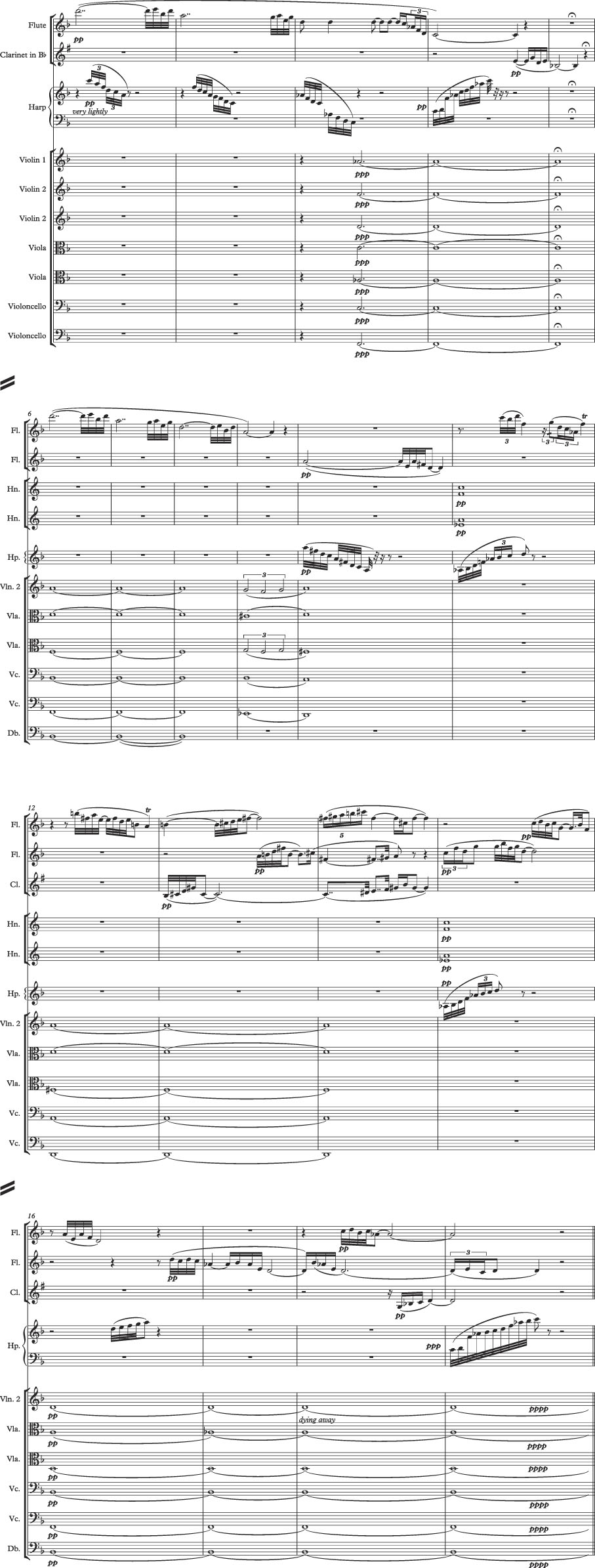
Like Vaughan Williams’s Norfolk Rhapsody No. 1, Brigg Fair begins with a musical depiction of a rural scene (bars 1 to 19), which is performed, according to Delius’s score indication, ‘slow-pastoral’ (Ex. 4).Footnote 79 The work then moves to a relatively straight presentation of the folk-song itself, with a chordal accompaniment on pizzicato strings (bars 20 to 35). However, even before the folk-song is complete the process of engagement begins: at bar 27 Delius adventurously supports the folk-song’s B♭ with a French sixth chord (E♭/G/A/C♯); and it continues in the second half of the statement of the theme with the introduction of descending lines of countermelody on the clarinet and bassoons. The accompaniment to the folk-song’s first variation (bar 36 on) now appears on arco strings, although minus the first violins (which have been silent from the beginning of the work) and basses. First violins duly enter for the second variation (bar 52 on), which is scored entirely for strings, with each part (minus basses) divided, and which features some remarkably chromatic and typically Delian harmonic part-writing. The third variation (bar 68 on) is scored for the entire string cohort, divisi, with descending chromatic lines and relatively adventurous harmonies. The tune appears only in upper winds. Thus, over the course of the first three variations, the major developments are from solo voice to massed voices, from winds to strings, and from relatively simple to more adventurous harmony. The journey toward full participation of the governing subjectivity still has some way to go, however, as the variations are still presented in strict 16-bar blocks, and there is still a clear division between the melodic and the harmonic material.
Frederick Delius, Brigg Fair: An English Rhapsody, bars 1–19

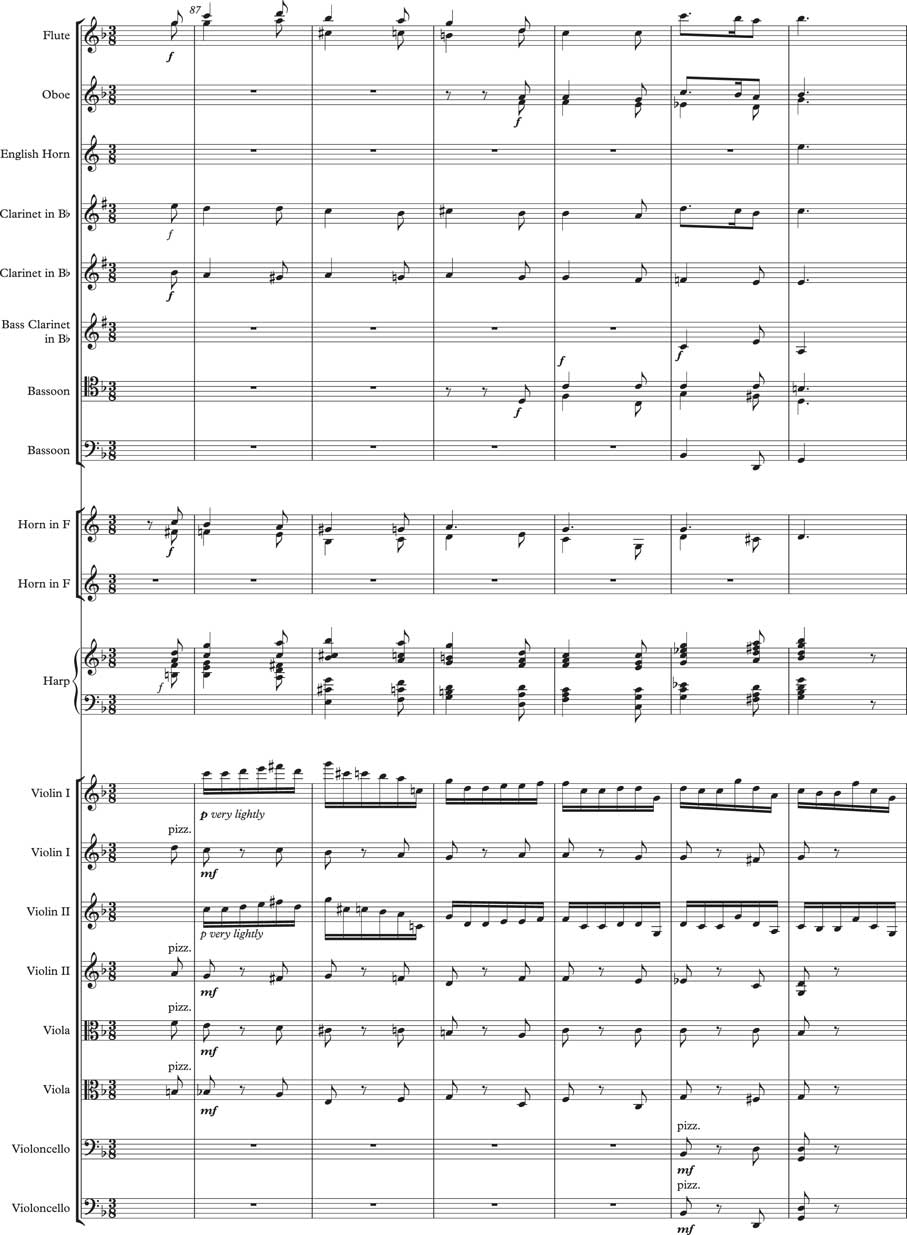
Delius begins to break the strictures of the 16-bar form of the folk-song with bars 84 to 86, a kind of mini codetta to the third variation, before, at bar 87, the fourth variation begins (Ex. 5). Notably, the fourth variation expands to 22 bars in length. Although the running semiquavers continue throughout the fifth and sixth variations (from bars 109 and 125 respectively), these variations return to the shape and 16-bar length of the theme, which here is more clearly stated, first on the horns and then trumpets. The ways in which the musical material of the folk-song is varied and rearranged in the third variation, and the appearance of an entirely new and diverting musical feature, the running semiquavers in the upper strings in the fourth, are each examples of a more direct intervention on the part of the composer, and therefore can be heard as evidence of the increasing engagement of the governing subjectivity.
Frederick Delius, Brigg Fair: An English Rhapsody, bars 87–93

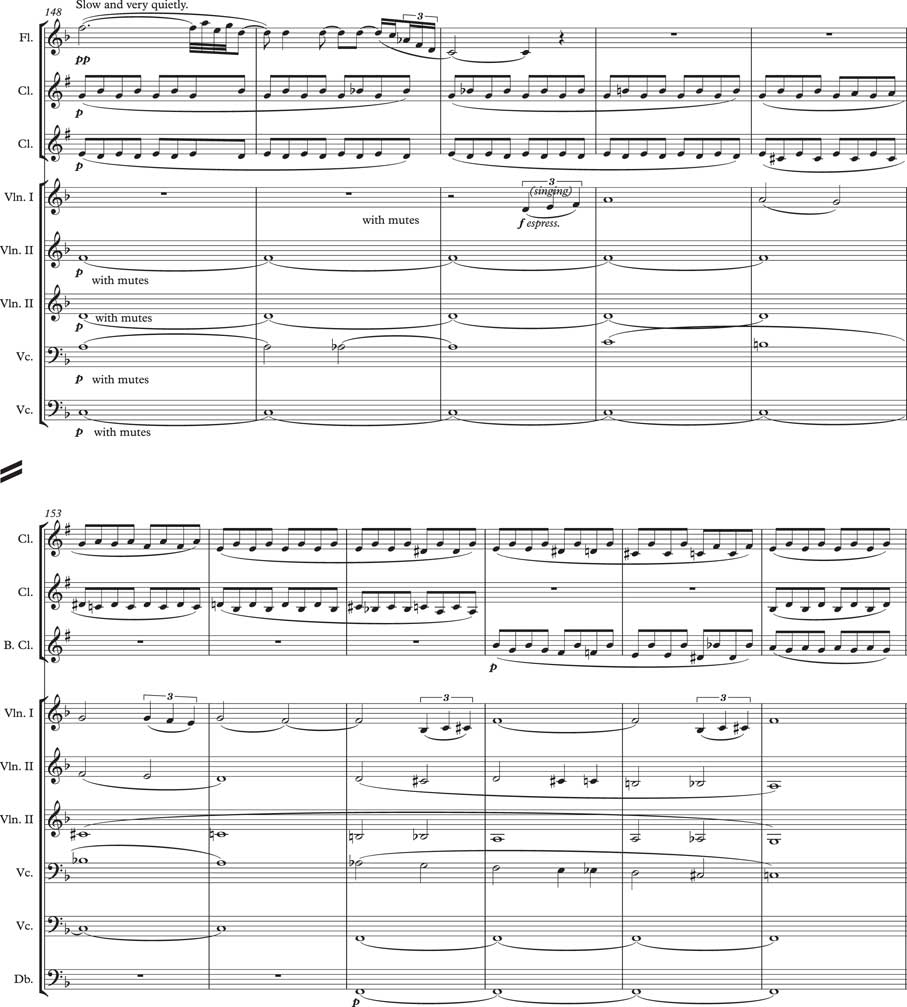
From bar 148 Delius interrupts his series of variations and returns to the landscape music of the opening bars. However, as with the folk-song, it is subtly but decisively altered in ways that suggest that the subjectivity invoked and offered is less detached than in the introduction. The arabesques on wind instruments that characterized the introduction return only once – in the flute over bars 148 to 150 – and instead Delius provides a murmuring, oscillating figure on clarinets (Ex. 6). This figure is not static: chromatic inflections echo the descending chromatic lines with which the theme was harmonized over its first six variations. What were once truly static harmonies on the strings are now inflected and transformed into long, gently breathing melodies, the most prominent feature of which is a stepwise minor third, closely echoing the opening of the folk-song itself. Again, there is increasing evidence of the composer’s skill here, a manipulation of what was previously objective material that speaks of increasingly subjective involvement.
Frederick Delius, Brigg Fair: An English Rhapsody, bars 148–157

The sequence of variations recommences at bar 194. Here, for the first time, the folk-song appears in simple time, one result of which is to decisively depart from the strict 16-bar periodicity of its previous incarnations. The bar length of each variation from this point on is increasingly variable. At the same time the theme appears in ever more musically sophisticated guises: in the ninth variation (from bar 214) as a kind of descant above a new and striking countermelody; with accelerando and decelerando within the tenth variation (bars 229 to 254); as a doleful march in the eleventh variation (from bar 254); and transposed into G-sharp minor for the majestic and sombre tread of the twelfth variation.
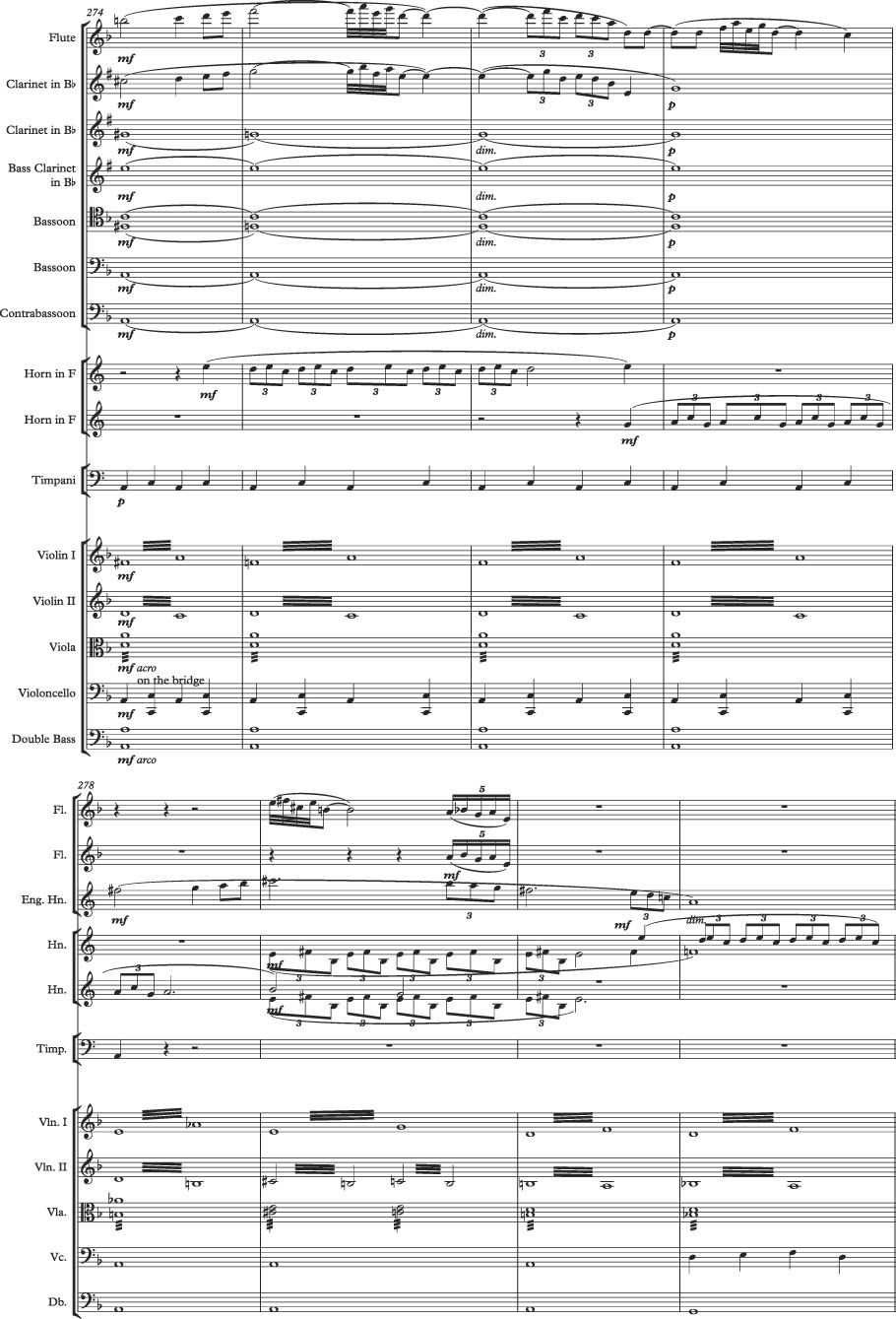
From bar 274 the pastoral scene-setting music of the opening bars reappears, showing further signs of development. The string sonorities, which in the opening bars were so static and stable, are now presented on tremolo upper strings, and the harmonic changes (now occurring every bar) suggest relatively complex chromatic voice-leading. The arabesques on the flute familiar from the opening reappear, as well as the murmuring figure from the second pastoral interlude, now in triplets and on horns. Delius introduces a significantly new melody on cor anglais (which goes on to feature as a countermelody to the next variation) as well as hinting at the folk-song itself in the first cello line from bar 281. The combination of all of these elements is a virtuosic demonstration of the composer’s skill, and unmistakeably a sign of the growing engagement of the governing musical subjectivity with this musical material (Ex. 7).
Frederick Delius, Brigg Fair: An English Rhapsody, bars 274–281

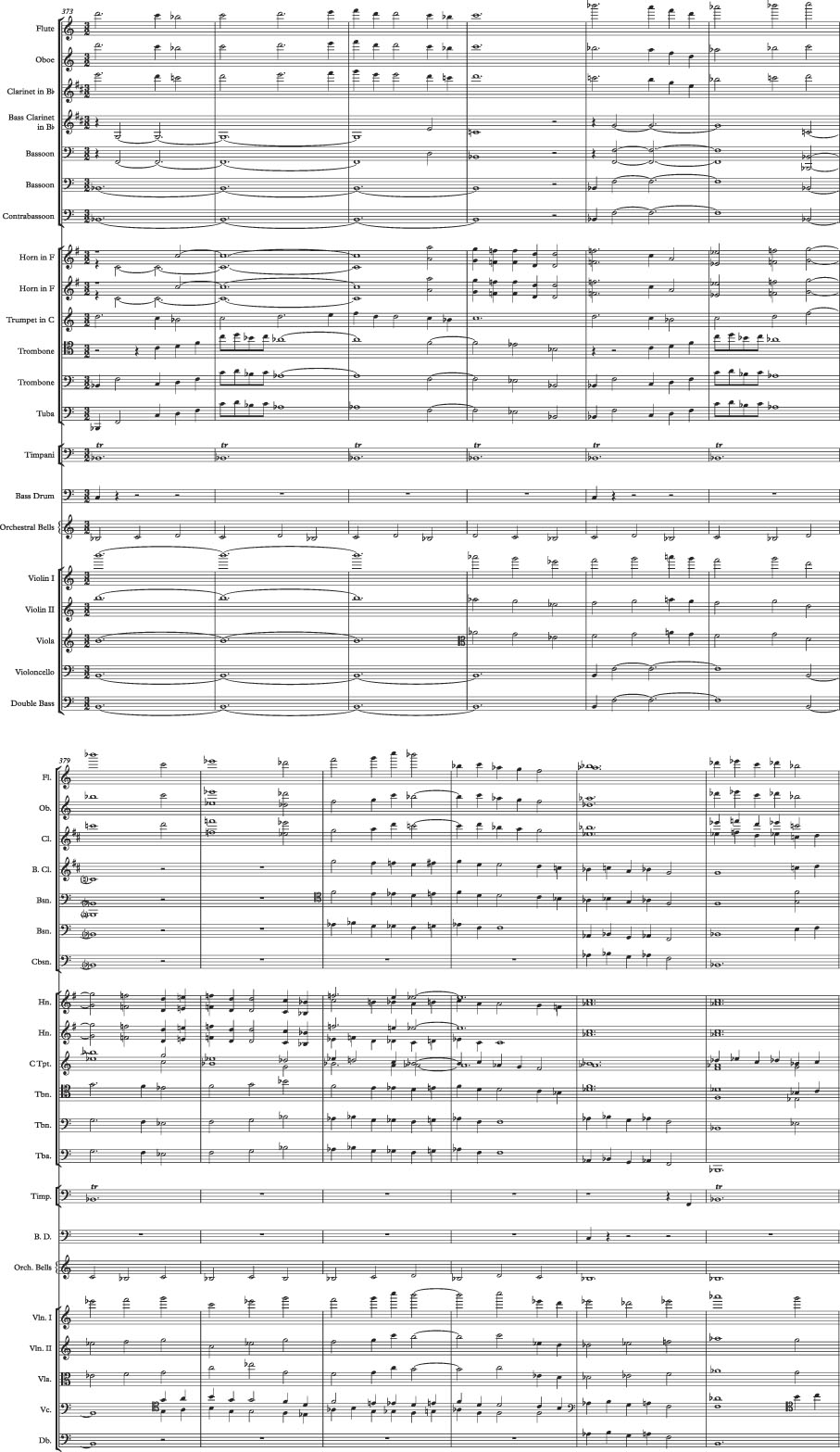
At bar 373 Delius begins the seventeenth and grandest variation. By every measure the governing musical subjectivity is fully engaged, and the audience is likewise invited to participate fully. It is impossible to discern a clear statement of ‘Brigg Fair’, but equally it is impossible to miss its influence. This is essentially a polyphonic texture, with no demarcation between melody and accompaniment, in which the melodic contour of the folk-song infects almost every line: the folk-song has been fully absorbed into a contemporary musical idiom. The harmonic language, with its sliding chromatic shifts, is clearly Delius’s own, rather than anything dictated by the expectations that might arise from the folk-song. There are hints of the flute arabesque from the pastoral episodes, which, having been absorbed, appears here as a quaver figure first on brass and later on upper strings. With this music there is no longer any separation between the musical subjectivity and any musical object, be it folk-song or landscape (Ex. 8).
Frederick Delius, Brigg Fair: An English Rhapsody, bars 373–384

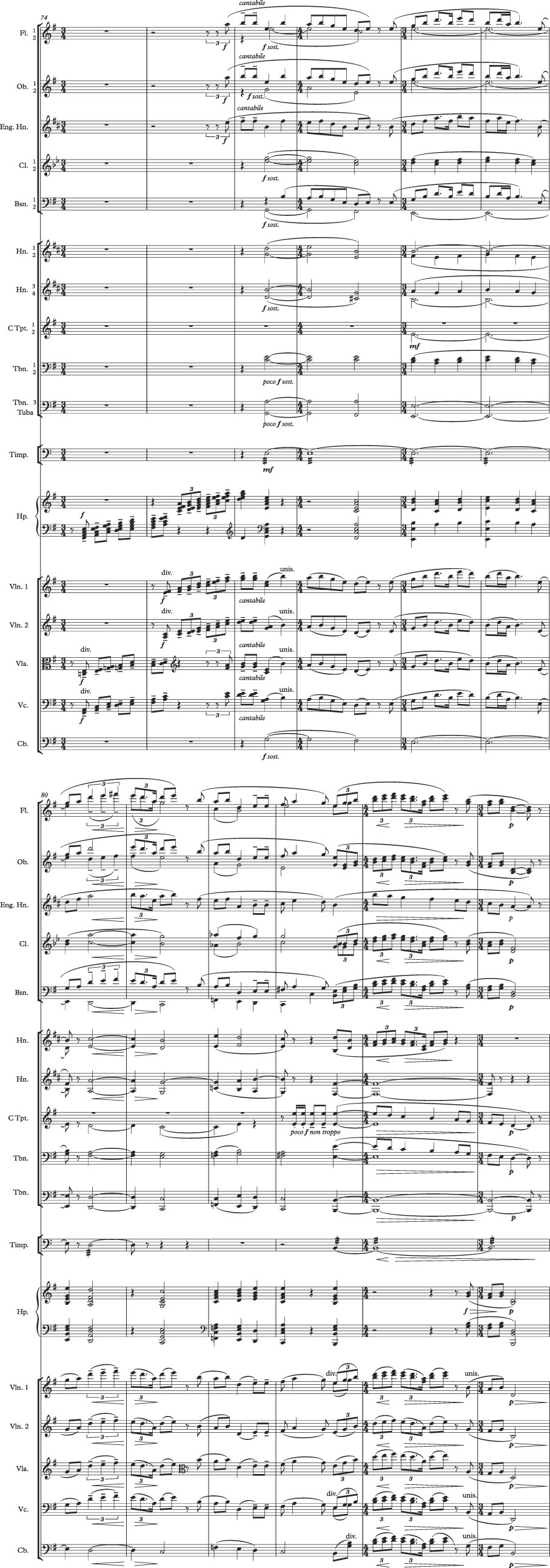
Indeed, the degree to which Delius is able to assimilate folk-song contours into his distinctive compositional voice highlights an important difference between his music and that of many contemporary English composers, most obviously Vaughan Williams. Even at the most intense climaxes in his early folk-song rhapsodies and tone poems, Vaughan Williams preserves a distinction between melody and harmony, and frequently retains the blockish simplicity of the folk-song. Unlike Delius, whose seventeenth variation is supremely suave and sophisticated, Vaughan Williams’s climaxes tend to be more homespun and simply assembled from raw, objective musical material. Consider bars 74–85 of the Norfolk Rhapsody No. 1 (Ex. 9). Here, at the most intense climax of the work, the entire texture is reducible to simple melody and self-contained harmony. This passage displays a certain amateurism and plain, even blunt, honesty. Perhaps it is simply that this is an early work and does not represent his mature practice. On the other hand it is arguably an instance of a certain ‘sophisticated unsophistication’Footnote 80 that has been traced into Vaughan Williams’s later works including the Four Hymns for tenor, viola and strings (1914),Footnote 81 the Pastoral Symphony (1921)Footnote 82 and perhaps even the Symphony No. 4 (1935).Footnote 83 As Ben Earle notes, this effect does not arise naturally from any inherent national/racial quality: rather it is the result of the composer labouring to achieve a deliberate ‘clumsiness’ and ‘aim[ing] for a rough-hewn quality’.Footnote 84 For Vaughan Williams, it seems, preserving the substance of the folk-song at the high point of his rhapsody was a way to reflect the essential honesty and plain-speaking quality – the John Bull side – of his version of the English gentleman.
Ralph Vaughan Williams, Norfolk Rhapsody No. 1, bars 74–85

Whether in Delius, Vaughan Williams, Holst, or indeed in the works of Butterworth and Stanford that we shall discuss briefly later in this article, following careful introduction and preparation, these high points mark the end point of the process by which the governing subjectivity engages with and adopts the folk-song and landscape as its own voice: in these bars it speaks more or less directly. It is as if, after viewing the landscape and listening to the folk-song, it says ‘I am as English as the land and her folk, and I’ll take up their song in my own voice’. The audience is invited to take this journey with the governing musical subjectivity. The specific qualities of the musical landscape and folk-song, when taken up en masse, become like a war cry, school song or hymn. They are adopted by the group and become universalized, a shared trait, a badge of belonging. Thus the passion permitted by this rhetorical strategy arises less from any inherently expressive qualities of the musical material, than from a response to what the material stands for. It is passionate, but at a slight remove, a less confronting, more polite mode of address. Such high points in the music may well be patriotic, but they aim to avoid becoming a harangue, and they are approached so carefully, with such meticulous preparation, that they generally stay well within the bounds of gentlemanly manners.
Gentle Endings
One of Mr Raymond Martin MP’s gravest breaches of etiquette was to finish his speech on a note of expectant triumph, flag unfurled and waving. It was simply ungentlemanly of him to presume the effect of his speech on his audience, a presumption that demonstrated a conceited self-confidence in his powers as an orator. Even worse, if there had been members of the audience who had felt patriotic stirrings, he should not have expected them to roar or stamp or otherwise demonstrate strong feeling. If one intended to stir patriotism in the heart of the Edwardian gentleman, great tact was called for, not only in the way that one approached the topic, but also in the way one left it. In a sense, one was obliged to leave the Edwardian gentleman such that, even if he had been moved at the climax of the work, by its end he would be returned comfortably to his undemonstrative, restrained natural state. Thus it was important that a folk-song rhapsody such as those we have been discussing to date ended by withdrawing from the intense engagement of the climax, and reintroducing a mediating distance between the musical subject and its object.
Again Brigg Fair provides the definitive example of this process. From bar 384 Delius directs that his seventeenth variation becomes gradually softer and slower, and the coda which follows (bars 391 to 412) returns to the distancing techniques of the opening: the folk-song reappears on a solo oboe, accompanied by relatively stable and decreasingly complex harmony on the strings, and, finally, little arabesques on the flute and English horn. The final bars are marked ‘rather slower and dying away to the end’ and ‘pppp’.
The conclusion of Vaughan Williams’s Norfolk Rhapsody No. 1 is of particular interest in this context. In its original 1906 form the work ended ‘brilliantly’, which may well have been appropriate for the first movement of a three-movement Norfolk symphony. However Vaughan Williams substantially revised the work for the purposes of a performance he conducted in Bournemouth in 1914, and amongst the most significant changes he introduced was to the final bars, which now, like Brigg Fair, return the listener to the gentle landscape evoked in the work’s opening.Footnote 85 This adjustment appears to reflect the work’s change in status from the opening movement in a three-movement structure, in which case its ending is not the ending, to a stand-alone orchestral rhapsody, in which case the final bars take on increased significance and require more subtle and delicate treatment if the work is to maintain its gentlemanly mode of address.
Other Gentlemen
All of George Butterworth’s surviving published orchestral music ends gently. Indeed, if the percentage of his orchestral works that display the qualities described in this article is any guide, Butterworth may well be the most gentlemanly of Edwardian composers.Footnote 86 By the Banks of Green Willow, composed in 1913, is an exemplary model of the kinds of rhetorical strategies under discussion. It opens with the eponymous folk-song on a solo clarinet; very quickly this is taken up in the strings, developed, set in counterpoint, and used fragmentarily in a kind of impassioned orchestral arioso, which builds to a significant climax. Butterworth then introduces the folk-song ‘Green Bushes’ on oboe and flute accompanied by harp, which takes the work to its very gentle ending. These same techniques feature in each of the Two English Idylls of 1911, although here there is more than one transition from the objective presentation of the folk-song to subjective engagement with it. As each of the three tunes set in the first ‘Idyll’ appears successively, it is presented first on a solo wind instrument with a simple accompaniment, and then is integrated swiftly into the full orchestral texture. The work continues as a kind of antiphonal dialogue between fleeting phrases of folk-song and passages that demonstrate a range of strategies by which their objective voices can be taken up by the massed voice of the orchestra. Thus Butterworth achieves a quite remarkable fluidity between third person and more direct modes of address, never letting one mode dominate for very long.
Butterworth’s most significant orchestral work is the rhapsody A Shropshire Lad (1912), which is not based on a folk-song but rather on his own setting of Housman’s poem ‘Loveliest of Trees’. As such, patriotic sentiment is filtered through the regional allegiance of Housman’s speaking voice. The main body of the piece is amongst the most directly passionate music Butterworth produced, but even so, in its beginning and ending, it proceeds according to the dictates of the gentleman. The opening, with its static chords on the lower strings and antiphony between clarinets and upper strings (which owes something to the pastoral scene from Berlioz’s Symphonie fantastique), is very clearly a manifestation of a musical landscape, against which the main theme appears on cor anglais. After the intensity of the main central section, the piece ends with a not-unexpected return to the landscape music of the opening bars. Here the flute sings a second self-quotation, this time the line ‘With rue my heart is laden’ from another of Butterworth’s Housman settings, returning the listener gently to rural Shropshire.
Charles Stanford, a pillar of the English musical renaissance as composer, academic and teacher, wore his Irish heritage proudly. His ‘Irish’ symphony (1889) was received with considerable acclaim, and from 1902 to 1922 he produced six single-movement ‘Irish’ rhapsodies for orchestra, featuring traditional Irish tunes. Indeed, Vaillancourt suggests that Stanford’s enormously successful Irish Rhapsody No. 1 (1902), which included the famous ‘Londonderry Air’, may have proved something of a model for Vaughan Williams’s Norfolk rhapsodies.Footnote 87 Stanford’s background was not simply Irish; more particularly he was born in Dublin in a Protestant family, and he was politically aligned with Ulster. Thus the topic of national identity was particularly fraught and sensitive when, in 1913, the year following the introduction of the third Home Rule Bill to the British Parliament and the formation of the Ulster Unionists, he wrote his fourth Irish Rhapsody, subtitled ‘The fisherman of Lough Neagh and what he saw’. The work opens with a familiar scene-setting passage, hushed strings and flute, against which the English horn sings ‘I will raise my sail black, mistfully in the morning’. After a period of development, with increasing harmonic rhythm and polyphony, the song is taken up en masse in the strings, before the orchestral accompaniment dies away simply to a static trill on the dominant in the violins. At this point Stanford introduces an Ulster marching tune, a defiant and provocative expression of his particular political sentiment. Stanford sets the simply harmonized, four-square marching tune for a fanfare of trumpets, introduced to the score for the first time, against the barest of accompaniments from strings and harp: it seems entirely natural to hear it from the point of view of an observer, watching, as it were, as a band of marchers troops past. Subsequently the marching tune is gradually taken up by the strings, passed around the orchestra, and developed as part of the total orchestral texture, eventually contributing to an extended paean of Northern Irish patriotism and, in this case, an emphatic and triumphant finale. Whether this tips over from patriotism to nationalism depends, perhaps, on one’s point of view: it may have sounded very different in republican Dublin from in loyalist Belfast. Nevertheless, successful or not, Stanford’s strategy is clear, and depends on the gentle introduction of potentially emotionally volatile material first as a musical object, before inviting the subjective participation of an audience.
The gentlemanly rhetorical strategy (objective, detached introduction of the patriotic musical material, a gradual engagement with it building to a climax, and a gradual withdrawal to an emotionally cool ending) proved capable of adaptation to melodic material other than folk-song or, as in the case of A Shropshire Lad, a pre-composed song. Vaughan Williams demonstrated this possibility in In the Fen Country (1904), in which the technique was applied to a newly composed tune, albeit one which owed a great deal to the general contour of English folk-song. He also adopted the approach in his Fantasia on a Theme of Thomas Tallis for string orchestra, written in 1910 and premiered at the Gloucester Festival that year, and subsequently revised in 1913 and again in 1919. Here the psalter tune itself is introduced as carefully and as objectively as possible, on pizzicato lower strings, against a static inverse pedal high on the violins. Pizzicato, obviously, provides no opportunity for the players to exploit the singing (and therefore, subjectively human) qualities of string instruments. Subsequently the material is gradually incorporated into a genuinely passionate integrated string texture. Similarly, the violin’s birdsong in The Lark Ascending (composed in 1914, although not premiered until 1921) first appears as an extended unmetered arabesque on the solo violin against a static chord from the orchestra. The rhetorical opposition between bird and observer gradually breaks down over the course of the work as the orchestra takes up small fragments of the lark’s flight/song, and weaves these seamlessly into the fabric of an increasingly active, subjective musical persona.
Conclusion
While I have sought to argue that a peculiarly English quality may be evident in the works under discussion, this is not because of any inherent, immanent quality of the music arising from the racial temperament of the composer. Rather, the qualities of the gentleman are detectable because of a confluence of factors, a number of which are objectively demonstrable aspects of the musico-historical context, and the last of which is methodological. First, in the years before World War I at least some English composers understood the expression of national identity to be part of the reason to write music in the first place. Not simply a convenient label for a consequential or secondary phenomenon that emerged as a result of a shared cultural context, the idea of national character in music became a conscious and motivated aspect of the context itself in the years before World War I: consider Vaughan Williams’s views, touched on earlier in this article, and those of Rutland Boughton, who once wrote in a similar vein that ‘any school of music must be national before it can be universal.Footnote 88 Second, one method by which composers engaged with national identity was by employing quite specific musical signs – landscape and folk-song – which have been discussed at some length above, and which were to a significant extent alien to and intrusive on a composer’s instinctive musical language. Third, at the same time that patriotic feeling exerted such a profound influence in Edwardian music, national self-identity coalesced around the idea of the English gentleman, an idea that was primarily a body of expectations about behaviour and demeanour. Importantly, there was tension between the emotional restraint demanded of the gentleman and the unbridled expression of nationalism. Finally, in that context, by approaching musical signification from the standpoint of the relationship between the listener and the subjectivity offered in the course of performance, it becomes possible to consider and account for music’s rhetorical effect, and thereby to examine what can reasonably be understood as the manners that are enacted, or in a remarkably real sense, embodied in this repertoire.
Placing the listener at the centre of our concerns is the essential step in guarding against the pitfalls of nationalist/evolutionary thinking. By conducting an enquiry that looks not to difficult-to-identify aspects of the score (perhaps entirely mysterious to a casual audience) but rather to the attitudes and behaviours of a culturally embedded, thoroughly historicized listener, by considering the potential of this music to stage an encounter between that listener and the subjectivity evoked and offered in the course of performance, and by giving due weight to the direct, sensual, kinaesthetic response this music can elicit, it is possible to discuss the expression of national identity in Edwardian music without recourse to problematic aesthetic ideology. As a consequence we have encountered the manners of Edwardian gentleman in various guises: perhaps most succinctly in Holst’s A Somerset Rhapsody; approaching the limit of acceptable professionalism and sophistication in Brigg Fair; with more than a hint of John Bull’s amateurism and bluntness in Vaughan Williams; testing the boundary between patriotism and nationalism in Stanford’s Irish Rhapsody No. 4; and, even though this has not been the occasion to examine his music at length, perhaps most deftly in Butterworth’s By the Banks of Green Willow and Two English Idylls.