Naphthenic acids (NAs) account for >85% of acids in crude oil and are responsible for the acidity of crude oil, resulting in the corrosion to refinery pipes and equipment. In general, crude oils with a total acid number (TAN) >0.5 mg KOH g–1 are regarded as acidic oils and pose a corrosion risk for refineries (Wang et al., Reference Wang, Li, Sun, Duan, Song, Zhang and Liu2014b). Removing NAs from crude oil is achieved by extraction, adsorption and hydrotreatment, among other processes. However, solvent extraction requires several washing steps that consume large amounts of solvent and cause serious emulsion effects (Redondo et al., Reference Redondo, Dieuzeide and Amadeo2020). Adsorption requires a large investment in infrastructure, including adsorption, desorption and solvent recovery units; moreover, other highly polar compounds in petroleum reduce the adsorption efficiency (Wang et al., Reference Wang, Li, Sun, Duan, Song, Zhang and Liu2014b). Hydrotreatment operations require conditions that are expensive to maintain, such as hydrogen pressures >4 MPa and temperatures >300°C (Wang et al., Reference Wang, Li, Sun, Duan, Song, Zhang and Liu2014b). Among the various deacidification methods, esterification between NAs and alcohol is an effective and low-cost approach due to its mild reaction conditions, high yield and few negative effects on the quality of the crude oil (Wang et al., Reference Wang, Li, Sun, Duan, Song, Zhang and Liu2014b; Khan et al., Reference Khan, Riaz, Yi and Kim2017).
Heteropolyacids (HPAs) are polyoxometalates composed of heteropolyanions having metal–oxygen octahedra as their basic structural unit. Keggin-type HPAs are the most important in catalysis (Lopez-Salinas et al., Reference Lopez-Salinas, Hernandez-Cortez, Schifter, Torres-Garcıa, Navarrete and Gutierrez-Carrillo2000). 12-Tungstophosphoric acid (H3PW12O40; HPW) is a stable and strongly acidic HPA with a Keggin structure that can be used as a superior esterification catalyst (Cardoso et al., Reference Cardoso, Augusti and Silva2008; Patel & Brahmkhatri, Reference Patel and Brahmkhatri2013). The disadvantages of HPW are its low surface area and stability (Das & Parida, Reference Das and Parida2007). The deposition of HPW onto various porous supports can disperse the active sites over a large specific surface area and thus improve the catalytic activity of HPW.
Layered double hydroxides (LDHs) are anionic lamellar minerals represented by the general formula [M 2+1−xM 3+x(OH)2][An −x/n]⋅mH2O, where M 2+ and M 3+ are bi- and tri-valent metal cations, x is the ratio of M 3+/(M 2+ + M 3+) and A is an interlayer anion (Mao et al., Reference Mao, Zhou, Tong, Yu and Lin2017). The LDHs are ideal inorganic supports for immobilizing HPW because their interlayer spaces are very flexible at accommodating guest molecules of various sizes (Ma et al., Reference Ma, Yang, Chen, Zhang, Cheng and Wang2017) and their unique structures can disperse the intercalant effectively (Wang et al., Reference Wang, Yang, Zhan, Wu and Li2017). Introducing HPW anions into the interlayer of LDHs might not only increase the acidity of LDHs, but also improve the stability and dispersion of HPW (Ma et al., Reference Ma, Yang, Chen, Zhang, Cheng and Wang2017; Enferadi-Kerenkan et al., Reference Enferadi-Kerenkan, Do and Kaliaguine2018). Thus, HPW-intercalated LDHs can be used as active esterification catalysts (Das & Parida, Reference Das and Parida2007; Omwoma et al., Reference Omwoma, Chen, Tsunashima and Song2014).
Wu et al. (Reference Wu, Liu, Lei, Qiu, Wang and Wang2017b) synthesized HPW-intercalated MgAl, ZnAl and NiAl LDHs as catalysts for removing NAs from crude oil via esterification between NAs and ethylene glycol (EG). The introduction of HPW into LDHs improved the esterification activity of LDHs due to their increased acidity. Moreover, the interlayer of LDHs acted as a reactor because the catalytic sites are located in the interlayer. Reactants must be close to the edges of LDHs or enter the interlayer to adsorb and react with the active sites (Hu et al., Reference Hu, Zhang, Xu, Mu, Zu and Wang1998; Guo et al., Reference Guo, Li, Hu, Wang and Wang2001). Such a reaction can be considered as an interlayer catalytic reaction in which the interlayer of LDHs provides both the catalytic sites and the reaction field (Wang et al., Reference Wang, Duan, Lei, Wu, Guo and Wang2015; She et al., Reference She, Liu, Aymonier and Zhou2021). Some researchers also immobilized the catalytic sites in the interlayer of LDHs and developed various interlayer reactions in a nanosized confined region (An et al., Reference An, Zhang, Shi and He2006; Shi et al., Reference Shi, Yu and He2010; Shi & He, Reference Shi and He2011; Liu et al., Reference Liu, An, Zhao, Liu and He2013; Chen et al., Reference Chen, Yao, Miras and Song2015; Varga et al., Reference Varga, Kukovecz, Kónya, Korecz, Muráth and Csendes2016; She et al., Reference She, Liu, Aymonier and Zhou2021). As expected, the interlayer space of LDHs affected the catalytic activity. An et al. (Reference An, Zhang, Shi and He2006) synthesized l-proline-intercalated MgAl LDH catalysts for an aldol reaction between benzaldehyde and acetone and reported that the decrease in the interlayer spacing (d 003) of LDHs decreased the catalytic activity. If the d 003 value of HPW-intercalated LDHs could be tuned, the esterification activity of the LDHs could be controlled. In our most recent report (Wang et al., Reference Wang, Li, Wu and Ding2020), a series of HPW-intercalated LDHs were synthesized and their d 003 values were successfully tuned by varying the synthesis conditions. Moreover, increasing the d 003 values improved the esterification activity for a model oil containing cyclohexanecarboxylic acid (CHCA).
However, the composition of NAs is complicated and varies with the source of crude oil (Wu et al., Reference Wu, Visscher and Gates2019). In general, NAs composed of five- or six-membered rings and one carboxyl bonded to the rings or various side chains predominate in crude oil (Barrow et al., Reference Barrow, Headley, Peru and Derrick2009; Wu et al., Reference Wu, Visscher and Gates2019). It is expected that the structure of NAs might affect the catalytic activity of HPW-intercalated LDHs. Moreover, the influence of the d 003 value might vary among NAs with various structures. So far, there have been no reports investigating the effects of NA structure and the d 003 values of HPW-intercalated LDHs on the esterification activity. During the present study, the effect of NA structure on the esterification activity over HPW-intercalated LDHs was investigated using NAs with various side chains and rings as reactants. Subsequently, the influence of the d 003 value of HPW-intercalated LDHs on the esterification activity for NAs with various structures was studied using two LDHs with various d 003 values as catalysts. In addition, the esterification kinetics of CHCA (a representative and widely used NA compound) over two such LDHs were investigated to further understand the role played by the interlayer spacing. Finally, the esterification reaction mechanism of CHCA was investigated based on product identification.
Experimental
Synthesis of LDHs
The HPW-intercalated MgAl LDHs were synthesized via an ion-exchange method using a nitrate MgAl LDH with an Mg/Al molar ratio of 2 as a precursor, which was prepared according to Wang et al. (Reference Wang, Duan, Wu, Tang and Li2014a) and is referred to as Mg2Al-NO3. By tuning the exchange time, HPW-intercalated LDHs with various d 003 values can be synthesized, as reported previously (Wang et al., Reference Wang, Li, Wu and Ding2020). Herein, a HPW-intercalated LDH containing two LDH phases with d 003 values of 1.46 and 1.07 nm was synthesized at 373 K for 1 h. This sample has the greatest ratio of the LDH phase with a d 003 value of 1.46 nm to the LDH phase with a d 003 value of 1.07 nm (Wang et al., Reference Wang, Li, Wu and Ding2020). Another HPW-intercalated LDH containing only one LDH phase with a d 003 value of 1.07 nm was synthesized at 373 K for 12 h. The two samples are referred to as Mg2Al-PW-1 and Mg2Al-PW-12, respectively. The brief synthesis procedure is as follows: firstly, 1 g of Mg2Al-NO3 was dispersed in deionized and CO2-free water. Then, 2.78 g HPW was dissolved in 50 mL of water with pH adjusted to 4.5 using 1 M NaOH. The HPW solution was added dropwise to the above suspension and the pH of the mixture was adjusted to 4.5 using diluted HNO3. Subsequently, the mixture was transferred into a three-necked flask equipped with a condenser and thermometer and maintained at 373 K for 1 or 12 h under vigorous stirring. Finally, the solid products were collected by filtration, washing and drying under vacuum at 353 K for 6 h.
Characterization of LDHs
X-ray diffraction (XRD) traces were recorded on an X'Pert Pro diffractometer (PANalytical, The Netherlands) using Cu-Kα radiation, operated at 40 kV and 40 mA in the 2θ range of 5–70° with a scanning step of 0.02° and a counting time of 12 s per step.
Fourier-transform infrared (FTIR) spectra were recorded with a WQ520 spectrophotometer (Beifen, China) using the KBr pellet technique. A total of 32 scans with a resolution of 2 cm−1 were taken for each sample.
The composition (Mg, Al, P, W) of LDHs was measured via inductively coupled plasma atomic emission spectroscopy (ICP-AES) using an Optima 7300 V spectrometer (PerkinElmer, USA).
Esterification tests and kinetics
Six NAs with various structures including CHCA, cyclohexylacetic acid (CHAA), cyclohexylpropionic acid (CHPA), cyclohexylbutyric acid (CHBA), cyclopentanecarboxylic acid (CPCA) and benzoic acid (BA) were selected as model compounds to test the esterification activity of Mg2Al-PW-1 and Mg2Al-PW-12. The above NAs were diluted using a hydrotreated diesel to prepare a model oil with a TAN of 2 mg of KOH g–1. For each esterification reaction, 20 g of model oil, 1 mL of EG and 0.2 g of LDHs were added to a three-necked flask equipped with a thermocouple, an electric motor stirrer and a condenser connected to a water separator. The mixture was heated in an oil bath at 423 K and maintained for 2 h under stirring. After the reaction, the liquid product was collected and its TAN was measured according to GB/T 258-2016. The deacidification ratio is calculated according to Equation 1, where TAN0 and TANf refer to the TAN values of the oil before and after esterification, respectively.

For the kinetics experiment, CHCA was dissolved in a hydrotreated diesel and the concentration was set at a TAN of 3 mg KOH g–1, corresponding to a CHCA concentration of 0.06 mol L–1. Then, 50 mL of oil, 2.5 mL of EG and 0.5 g of LDHs were added to the above apparatus. The reaction was performed at 373, 393, 413 and 433 K for 2 h. At each 20 min interval, 2 mL of liquid was taken out to measure the TAN. The concentration of CHCA (C A) can be calculated using the TAN and the deacidification ratio.
For the reaction mechanism experiment, CHCA was dissolved in n-dodecane. After reaction at 423 K for 2 h, the liquid was separated from the suspension via filtration and analysed using gas chromatography and mass spectroscopy (GC-MS) on a 7890A gas chromatograph (Agilent, USA) coupled with a 5975C mass spectrometer (Agilent, USA) and equipped with an HP-5 MS capillary column (30 m × 250 μm × 0.25 μm). The temperature programme was as follows: from 323 to 443 K at a rate of 20 K min–1, then 1 K min–1 up to 445 K, at which point it was maintained for 1 min, and finally 20 K min–1 up to 533 K. The GC injector and MS ion-source temperature were kept at 553 and 503 K, respectively. The MS detector was operated in the electron impact (EI) mode at 70 eV.
Results and discussion
Characterization of HPW-intercalated MgAl LDHs with various d 003 values
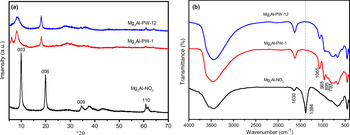
As reported previously (Wang et al., Reference Wang, Li, Wu and Ding2020), using a short exchange time, a mixed LDH with d 003 values of 1.46 and 1.07 nm can be synthesized, whereas a prolonged exchange time induces the formation of a single LDH phase with a d 003 value of 1.07 nm. Herein, the Mg2Al-PW-1 contains two LDH phases with d 003 values of 1.46 and 1.07 nm while Mg2Al-PW-12 has a single LDH phase with a d 003 value of 1.07 nm. These LDHs were chosen as esterification catalysts to investigate the effect of d 003 values because the former has the greatest relative content of the LDH phase with a d 003 value of 1.46 nm and the latter has the greatest relative content of the LDH phase with a d 003 value of 1.07 nm. Their XRD traces and FTIR spectra are shown in Fig. 1a,b. Compared with the Mg2Al-NO3 precursor, the introduction of HPW leads to a shift in the (003) reflection from 9.9°2θ towards lower °2θ values, suggesting a larger interlayer spacing. The formation of two LDH phases with d 003 values of 1.46 and 1.07 nm in Mg2Al-PW-1 is attributed to the various orientations of HPW anions within the interlayer space: the 1.46 nm phase was mainly caused by P2W18O626– and PW11O397– anions with their C2 axes tilted towards and perpendicular to the LDH layers, respectively, whereas the 1.07 nm phase was mainly produced via grafting of PW12O403– anions onto the vacancies in the layers with their C2 axes perpendicular to the layers (Wang et al., Reference Wang, Li, Wu and Ding2020). The relative content of the two LDHs phases determined by the ratio of the (003) peak area with a d 003 value of 1.46 nm to that with a d 003 value of 1.07 nm (Wang et al., Reference Wang, Li, Wu and Ding2020) was 0.16 for Mg2Al-PW-1. With a prolonged exchange time, the LDH phase with the d 003 value of 1.07 nm dominated in the XRD trace of Mg2Al-PW-12. For both LDHs, their FTIR spectra show the absence of a band at 1384 cm–1 assigned to the stretching vibration of nitrate and the presence of a series of bands at 1065, 965, 895 and 793 cm–1 assigned to the characteristic vibrations of HPW anions, confirming the complete replacement of nitrate by HPW anions. The HPW contents of Mg2Al-PW-1 and Mg2Al-PW-12 are 71.2% and 73.7%, respectively. The slightly greater HPW content of the latter LDH can be ascribed to its smaller Mg/Al ratio, which is due to the prolonged exchange time in the acidic system (Wang et al., Reference Wang, Li, Wu and Ding2020).
(a) XRD traces and (b) FTIR spectra of the nitrate LDH precursor and HPW-intercalated LDHs with various d 003 values.

Catalytic activity of NAs with various structures
To investigate the effects of the molecular structure of NAs on the catalytic esterification activities of HPW-intercalated LDHs with various d 003 values, six NAs (CHCA, CHAA, CHPA, CHBA, CPCA and BA) that occur frequently in crude oil and petroleum fractions were chosen as model compounds because they can model more closely actual NA compositions in oils (Zhang et al., Reference Zhang, Ma, Wang, Liu, Shuler and Tang2006; Oh et al., Reference Oh, Park, Rhee and Kim2011). Their structures are shown in Scheme 1. Their molecular sizes obtained via Material Studio software using the DMol3 program (Gupta & Khatri, Reference Gupta and Khatri2019) are listed in Table 1. The 3D models of the NAs are presented in Fig. S1. These NAs are classified by their chain length and rings. One class comprises CHCA, CHAA, CHPA and CHBA, which have the same six-membered ring but various side chains. The other class includes CPCA, BA and CHCA, which have the same side chain but various rings. Note that BA is not strictly a NA, but the six compounds will be categorized collectively as NAs for convenience (Wu et al., Reference Wu, Visscher and Gates2017a). The esterification activities of the two classes of NAs over Mg2Al-PW-12 are discussed. Following this, the esterification activities of these NAs over two LDHs with various d 003 values (Mg2Al-PW-12 and Mg2Al-PW-1) are compared.
Molecule structures of the NA model compounds.

Deacidification ratios for NAs with various structures over two LDHs.

a The increment in deacidification ratio is calculated from the deacidification ratio difference between Mg2Al-PW-1 and Mg2Al-PW-12 divided by the deacidification ratio of Mg2Al-PW-12.
The deacidification ratios of the NAs with various side chains over Mg2Al-PW-12 are listed in Table 1. The catalytic activities follow the order CHAA > CHPA > CHBA > CHCA, which follows directly the molecule size of the NAs, except for CHCA. Although CHCA has the smallest size, it is a secondary carboxyl acid and thus displays greater steric hindrance in esterification than the other three primary carboxyl acids (Takahashi et al., Reference Takahashi, Shibagaki and Matsushita1989). The NAs and alcohol reactants might enter the interlayer space of LDHs to interact with the acidic catalytic sites induced by HPW and thus generate the ester products that diffuse into the bulk solution (Wu et al., Reference Wu, Liu, Lei, Qiu, Wang and Wang2017b). This might be considered to be an interlayer catalytic esterification reaction. The NAs with smaller molecule sizes prefer to enter the interlayer of LDHs, leading to improved deacidification ratios. Silva et al. (Reference Silva, Costa, Chiaro, Delgado, De Figueiredo and Senna2013) used clays as adsorbents for removing NAs from a model crude oil and also reported that the mass transfer coefficients of CPCA, CHAA and CHBA in the adsorbent decreased with increasing molecule size. In addition to the molecular size, the reactivity of these NAs is also related to the inductive effect. For esterification catalysed by acidic sites, the nucleophilic species generated from the deprotonation of the alcohol –OH can attack the carbocation of the carboxylic acid formed via the interaction between the acidic sites in catalysts and carbonyl oxygen, generating an intermediate that finally eliminates water to produce ester (Zeng et al., Reference Zeng, Li, Xue, Chen, Che and Patel2012). As the chain length of the carboxylic acid increases, the inductive effect increases the electron-donating ability of carboxylic acid and favours the protonation of the carboxylate oxygen. However, this leads to lower electrophilicity of the carbonyl carbon and thus the rate-limiting nucleophilic attack by alcohol is hindered significantly, thus reducing the esterification activity of carboxylic acids with longer chains (Srilatha et al., Reference Srilatha, Lingaiah, Sai-Prasad, Prabhavathi-Devi, Prasad and Venkateswar2009; Osatiashtiani et al., Reference Osatiashtiani, Durndell, Manayil, Lee and Wilson2016).
The deacidification ratios of CPCA, CHCA and BA, which have the same side chain but various rings, over Mg2Al-PW-12 are also listed in Table 1. The activities follow the order CPCA > CHCA > BA. Among the three NAs, CPCA has the smallest molecule size and so is more able to enter the interlayer. Moreover, the steric substituent constant of cyclo-C5H9 is smaller than that for cyclo-C6H11 (Hirota et al., Reference Hirota, Sakakibara, Yuzuri and Kuroda2001; Osatiashtiani et al., Reference Osatiashtiani, Durndell, Manayil, Lee and Wilson2016). Steric hindrance of carboxylic acids might induce electronic repulsion between the non-bonded atoms of reacting molecules, which might reduce the electron density in the intermolecular region and hinder bonding interactions, leading to poor reactivity for acid-catalysed esterification (Liu et al., Reference Liu, Lotero and Goodwin2006). Although the molecule size of BA is slightly smaller than that of CHCA (0.69 vs 0.70 nm), its carboxyl group is directly bonded with an aromatic ring, leading to conjugation between them. In general, conjugated carboxyl groups are less reactive than non-conjugated ones in esterification reactions (Anand et al., Reference Anand, Milhotra and Milhotra1999) because the electron-donating effect of the aromatic ring might reduce the electrophilicity of carbon in the carbonyl (Sun et al., Reference Sun, Hua and Yin2006). As a result, esterification of BA is more difficult to achieve than that of CHCA, which is in accordance with previous work (Takahashi et al., Reference Takahashi, Shibagaki and Matsushita1989; Ram & Chalres, Reference Ram and Charles1997).
Mg2Al-PW-1 was also used as an esterification catalyst for NAs, and the results of this process are listed in Table 1. The order of deacidification ratios for the NAs follows a similar trend to that over Mg2Al-PW-12. For each NA, the deacidification ratio over Mg2Al-PW-1 is much greater than that over Mg2Al-PW-12. This can be attributed to the larger d 003 value of Mg2Al-PW-1, which facilitates reactant diffusion into the larger interlayer space. To compare the degree of improvement of the deacidification ratios caused by the greater d 003 value, the increments in the deacidification ratios over the two LDHs for each NA are listed in Table 1. The enlarged interlayer space improves activity more significantly for the NAs with larger molecule sizes than for those with smaller molecule sizes. For CHBA, which has the greatest molecule size, the deacidification ratio over Mg2Al-PW-1 was increased by 17.6% when compared to that over Mg2Al-PW-12, which is the greatest increment among the NAs. Varga et al. (Reference Varga, Kukovecz, Kónya, Korecz, Muráth and Csendes2016) synthesized two Mn(II)-l-cysteine complex-intercalated CaAl LDHs with d 003 values of 0.86 and 0.92 nm as catalysts for the epoxidation of cyclohexene. The conversion of cyclohexene over the latter LDH was greater than that over the former due to the increased d 003 value, which reduced diffusion resistance. For CHCA with its steric hindrance, the catalyst with a greater d 003 value increased the deacidification ratio by 15.8%, which indicates that a greater d 003 value also aids NAs with steric hindrance to access the catalytic sites in LDHs. Among all of the NAs, the deacidification ratio increment of BA is the smallest. This might suggest that the interlayer spacing has a relatively limited influence on reactions controlled by the electronic effect. Mg2Al-PW-1 has fewer total acidic sites and a smaller specific surface area than Mg2Al-PW-12; therefore, the enhancement in the esterification activity for NAs with various structures over Mg2Al-PW-1 might be attributed mainly to the larger interlayer spacing (Wang et al., Reference Wang, Li, Wu and Ding2020).
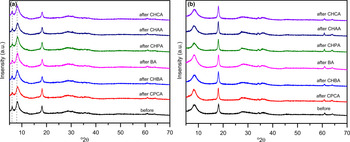
All catalysts after reactions with the NAs of various structures were recovered via filtration and washing with toluene. Their XRD traces are shown in Fig. 2. No obvious changes in reflections are observed in the two series of catalysts before and after the reaction; therefore, the structures of the LDHs were retained.
XRD traces of (a) Mg2Al-PW-1 and (b) Mg2Al-PW-12 after reaction with NAs of various structures.

Reaction kinetics
The esterification kinetics over Mg2Al-PW-1 and Mg2Al-PW-12 were studied using CHCA as a model compound because CHCA represents closely the NAs in petroleum fractions due to its representative structural features (Zhang et al., Reference Zhang, Ma, Wang, Liu, Shuler and Tang2006, Reference Zhang, Klamerth and El-Din2016; Manan et al., Reference Manan, Atkins, Jacquemin, Hardacre and Rooney2012) and because it is less reactive than other NAs, as shown in Table 1. Kinetics studies of the model compound (which is difficult to handle) would offer useful information for understanding the catalyst's behaviour and for designing the actual industrial process (Krishnamoorthy et al., Reference Krishnamoorthy, Baker and Amiridis1998; Kaisalo et al., Reference Kaisalo, Simell and Lehtonen2016). To eliminate the limitation of mass transfer, a series of preliminary experiments was performed. Catalysts with various particle sizes (i.e. 40–60, 20–40 and 10–20 mesh) were tested. The stirring speed during the reaction was adjusted. The deacidification ratio is nearly constant at sizes <10–20 mesh and for stirring speeds >200 rpm. This demonstrates that the mass transfer limitation can be removed with a catalyst particle size of 20–40 mesh and a stirring speed of 300 rpm. Therefore, the kinetics experiments were carried out under such conditions.
The variation of deacidification ratio with reaction time over Mg2Al-PW-1 and Mg2Al-PW-12 at a temperature of 373 K is shown in Fig. 3a. The esterification between CHCA and EG can be expressed as in Scheme 2. Due to the excessive EG and the continuous removal of water from the reaction, the esterification rate (r A) can be described as in Equation 2, in which n is the reaction order (Huang et al., Reference Huang, Zhu, Wu, Wang and Fang2011). Due to the great excess of EG, this reaction might be safely assumed to be first order (Zeng et al., Reference Zeng, Li, Xue, Chen, Che and Patel2012; Patel & Brahmkhatri, Reference Patel and Brahmkhatri2013). By integrating the reaction time from 0 to t, the kinetics equation can be converted to Equation 3, where C A0 is the initial concentration of CHCA. The plot of ln(C A0/C A) vs time (t) is shown in Fig. 3b, demonstrating a linear relationship between CHCA consumption and reaction time. The rate constant (k) can be obtained from the slope of the linear equation. Such kinetics experiments were also performed at 393, 413 and 433 K. The plots of ln(C A0/C A) vs t are shown in Fig. 4. All of the plots show linear relationships for both catalysts. Table 2 lists the values of the coefficient of determination (R 2) and k for the esterification reactions over the two catalysts at each reaction temperature. The high R 2 values demonstrate the adequacy of the first-order reaction model (Al-Saadi et al., Reference Al-Saadi, Mathan and He2020), which is in accordance with Cardoso et al. (Reference Cardoso, Augusti and Silva2008). With increasing temperature, the value of k increased. All k values over Mg2Al-PW-1 are greater than those over Mg2Al-PW-12, regardless of the reaction temperature.


Plots of (a) deacidification ratio and (b) CHCA concentration as a function of reaction time over catalysts Mg2Al-PW-1 and Mg2Al-PW-12 at 373 K.

Plots of CHCA concentration as a function of reaction time over catalysts Mg2Al-PW-1 and Mg2Al-PW-12 at (a) 393 K, (b) 413 K and (c) 433 K.

Esterification between CHCA and EG.

The correlation coefficients (R 2) and rate constants (k) for esterification at various temperatures.

The Arrhenius equation was applied to calculate the activation energy (E a) over the two catalysts. The plot of ln(k) vs 1/T is shown in Fig. 5 and the value of E a was determined from the slope of plot. The E a values are 26.25 kJ mol–1 for Mg2Al-PW-1 and 32.18 kJ mol–1 for Mg2Al-PW-12. These values lie within the range of E a reported in previous works on the esterification of NAs over ZnAl LDH and MgAl LDH catalysts (Huang et al., Reference Huang, Zhu, Wu, Wang and Fang2011; Li et al., Reference Li, Zhu, Liu and Wu2013; Redondo et al., Reference Redondo, Dieuzeide and Amadeo2020). The smaller E a of Mg2Al-PW-1 compared to that of Mg2Al-PW-12 further demonstrates that the enlarged interlayer space accelerates the reaction in the interlayer.
Arrhenius plots (ln(k) vs 1/T) of (a) Mg2Al-PW-1 and (b) Mg2Al-PW-12.

Mechanism of esterification
To investigate the mechanism of esterification between CHCA and EG, the reaction was performed in an n-dodecane solvent over the Mg2Al-PW-1 catalyst. The feed and products were detected using GC-MS and their total ion chromatograms are shown in Fig. 6. For the feed, the strong peak at the retention time of 7.64 min is attributed to CHCA. After the reaction, this peak nearly disappears, while a strong peak (I in Fig. 6) at 8.56 min and a very weak peak (II in Fig. 6) at 8.64 min are observed. The mass spectra of I and II are shown in Fig. 7. Following identification in the National Institute of Standards and Technology (NIST) database, I and II can be assigned to 2-hydroxyethyl cyclohexanecarboxylate (CAS 16179-44-5) and 2-(cyclohexanecarbonyloxy) ethyl cyclohexanecarboxylate (CAS 22735-96-2), respectively. The GC-MS results suggest that the reaction between CHCA and EG tends to form unilateral ester I rather than bilateral ester II.
Total ion chromatograms of (a) feed and (b) products over Mg2Al-PW-1 catalyst. I and II refer to ester product I and ester product II, respectively.

Mass spectra of (a) ester product I and (b) ester product II.

Previous research revealed that HPW-intercalated LDHs would offer greater numbers of stronger acidic sites than their nitrate precursor (Wu et al., Reference Wu, Liu, Lei, Qiu, Wang and Wang2017b). This increased acidity is responsible for the esterification activity. A blank esterification experiment for CHCA over the Mg2Al-NO3 precursor was performed and the deacidification ratio obtained was 33.9% (i.e. much lower than that over HPW-intercalated LDHs). Based on the acid-catalysed esterification theory (Rana et al., Reference Rana, Cho, Cho and Kim2018), the GC-MS results and the origin of the acid sites in HPW-intercalated LDHs (Wu et al., Reference Wu, Liu, Lei, Qiu, Wang and Wang2017b), the reaction mechanism of esterification over Mg2Al-PW-1 could be proposed as follows (Scheme 3): firstly, the acidic sites in the catalyst can interact with the oxygen atoms in the carbonyls of the NA, leading to the increased electrophilicity of the carbon atoms in the carbonyls; secondly, such species may be attacked by the nucleophile hydroxyl in the alcohol to form intermediates. Undergoing a series of rearrangement and dehydration reactions, such intermediates can finally be converted to ester, and then the catalyst is recovered (Li et al., Reference Li, Li and Eli2007).
Possible esterification mechanism of NA and alcohol.

Conclusion
Two HPW-intercalated MgAl LDHs with various interlayer spacings (d 003 values of 1.46 and 1.07 nm) were used as catalysts for the esterification of NAs with various structures. For CHCA, CHAA, CHPA and CHBA, which have the same ring but various side chains, the esterification activity decreased with increasing chain length, except for CHCA, because CHCA is a secondary carboxyl acid. For CHCA, CPCA and BA, which have the same side chain but various rings, the esterification activity decreased with increasing molecular size, except for BA, because BA has a conjugated carboxyl group. The LDH with a greater d 003 value can improve significantly the activity for all NAs, being particularly effective for the NAs with greater molecule sizes and steric hindrances. The esterification reactions over both LDHs follow first-order kinetics, while the LDH with a greater d 003 value can reduce the E a by 18.4%. Due to the catalytic sites being in the interlayer, reactants must move to the edge of the interlayer or enter the interlayer to come into contact with the catalytic sites. Therefore, an enlarged interlayer spacing would facilitate the reactants diffusing into the interlayer and thus improve catalytic activity. Product identification shows that unilateral ester is the dominant product. The present investigation reveals the influences of NA structures and the interlayer spacing on the esterification activity of HPW-intercalated LDHs. It may offer an alternative for enhancing the esterification activity of HPW-intercalated LDHs for removing NAs from petroleum by enlarging the interlayer spacing.
Supplementary material
To view supplementary material for this article, please visit https://doi.org/10.1180/clm.2022.3.
Financial support
The authors acknowledge financial support from the National Natural Science Foundation of China (Project No. 21978242).