Non-technical Summary
For a long time, the evolution of West Siberian zokors remained poorly covered. In this paper, we present a description of the evolution of the West Siberian zokor lineage (Myospalacinae, Rodentia) from the late early Pleistocene to the present along with descriptions of two new species and one subspecies (Myospalax myospalax krukoveri n. ssp., Myospalax convexus n. sp., Prosiphneus razdoleanensis n. sp.) ancestral to the extant Myospalax myospalax (Siberian zokor). We also reveal differences in the ontogeny of molars of modern species that were not previously detailed. These differences, together with paleontological data, indicate that in the West Siberian lineage, peramorphosis occurred in the structure of the chewing surface (with the exception of the lower m1), whereas in all other zokor lineages, there was pedomorphosis. On the basis of this pattern, we propose to split the genus Myospalax, with the separation of Myospalax myospalax and its rootless ancestral forms (Myospalax myospalax krukoveri and Myospalax convexus) into a separate genus.
Introduction
Zokors are subterranean rodent species within the subfamily Myospalacinae (Spalacidae). The subfamily as a whole is endemic to Asia. Individual species of the subfamily are even more localized endemics with limited distribution. In southern West Siberia, only one species of Myospalacinae is extant: Myospalax myospalax Laxmann, Reference Laxmann1769 (Siberian zokor). The paleo- and biogeography of Siberian zokors needs revision, but it can be stated that this species is confined to meadow biotopes in southeastern West Siberia, part of the Altai Mountains, and northeastern Kazakhstan (Galkina et al., Reference Galkina, Markina and Teletin1969; Galkina and Nadeev, Reference Galkina and Nadeev1980; Makhmutov, Reference Makhmutov1983). The molars of modern species of the zokor subfamily can be characterized as euhypsodont (continuously growing teeth). Following the classification of von Koenigswald (Reference von Koenigswald2011), the molars of modern zokors can be categorized as sidewall hypsodont with balanced wear. Such molars are in an equilibrium between tooth eruption and tooth wear, and disruption of this balance (e.g., a change in diet) can lead to malfunctions. This type has evolved in many rodent lineages due to the evolutionary process of the prolongation of formation of the enamel-covered sidewall (Agustí et al., Reference Agustí, Castillo and Galobart1993). In terms of heterochrony, this evolutionary outcome can be described as pedomorphosis (i.e., retaining juvenile ancestral features in adult stages of ontogeny; McNamara, Reference McNamara2012).
The evolution of zokors has been repeatedly studied from the perspectives of biology and paleontology (Teilhard de Chardin, Reference Teilhard de Chardin1942; Adamenko and Zazhigin, Reference Adamenko, Zazhigin, Peive, Kuznetzova, Menner and Tomofeev1965; Zazhigin, Reference Zazhigin1980; Lawrence, Reference Lawrence1991; Zheng, Reference Zheng, Tomida, Li and Setoguchi1994; Pokatilov, Reference Pokatilov2012; Liu et al., Reference Liu, Zheng, Cui and Wang2014; Qin et al., Reference Qin, Wang, Liu, Song and Jin2021; Liu et al., Reference Liu, Zhang, Cai, Kuang and Wan2022). Modern concepts of subfamily taxonomy, based on molecular, morphological, and paleontological data, divide modern species into two genera, Myospalax Laxmann, Reference Laxmann1769 and Eospalax Allen, Reference Allen1938, with corresponding ancestral forms (Flynn, Reference Flynn2009; Liu et al., Reference Liu, Zhang, Cai, Kuang and Wan2022; Zhang et al., Reference Zhang, Lei, Zhou, Chen and Shi2022). Unfortunately, the fossil material from the Pleistocene of West Siberia, represented by molars, has been little studied to date. Remains of zokors from this region have only been assigned to the genus level without a detailed description of morphology or species identification (Adamenko and Zazhigin, Reference Adamenko, Zazhigin, Peive, Kuznetzova, Menner and Tomofeev1965; Vdovin and Galkina, Reference Vdovin, Galkina, Kashmenskaya and Nikolaev1976; Galkina and Nadeev, Reference Galkina and Nadeev1980; Zazhigin, Reference Zazhigin1980; Krukover, Reference Krukover1992, Reference Krukover2007). In addition, the ontogenetic variability of the molars of modern zokors has not yet been fully described. However, some of the modern phylogenetic constructions based on molecular data do not consider some of the species. These analyses did not consider either Myospalax myospalax Laxmann, Reference Laxmann1769 (Liu et al., Reference Liu, Zhang, Cai, Kuang and Wan2022; Zhang et al., Reference Zhang, Lei, Zhou, Chen and Shi2022) or the genus Eospalax (Puzachenko et al., Reference Puzachenko, Pavlenko, Korablev and Tsvirka2013). In studies where two genera have been compared (Tsvirka et al., Reference Tsvirka, Pavlenko and Korablev2011; Pavlenko et al., Reference Pavlenko, Korablev and Tsvirka2014; Butkauskas et al., Reference Butkauskas, Starodubaite, Potapov, Potapova, Abramov and Litvinov2020), including Myospalax myospalax, the phylogenetic trees were unrooted and contradicted each other, which only raised further questions about the phylogenetic systematics of Myospalacinae.
Our study of the ontogeny of modern and fossil zokor molars allows us to take a new look at their evolution. We set two aims: (1) to describe the lineage of West Siberian zokors and compare them with modern Myospalax myospalax and (2) to identify differences in the evolutionary development of the molars of zokors. The second goal involves describing the evolution of molars in terms of heterochrony. Although pedomorphosis is obvious for the evolutionary transition to euhypsodont molars, there is no such certainty for the formation of the chewing surface structure. To resolve this puzzle, we analyzed samples of modern zokors from Russia, Mongolia, and China, as well as fossil material from 10 West Siberian localities, using linear morphometrics and geometric morphometrics. Previously, these methods have been used to study only the skulls of modern zokor species, not individual molars and fragmented fossil specimens (Puzachenko et al., Reference Puzachenko, Pavlenko and Korablev2009, Reference Puzachenko, Pavlenko, Korablev and Tsvirka2013; Butkauskas et al., Reference Butkauskas, Starodubaite, Potapov, Potapova, Abramov and Litvinov2020; Kang et al., Reference Kang, Su, Yao, Wang, Zhang and Ji2021, Reference Kang, Wang, Yao, An, Pu, Zhang, Zhang, Hou, Zhang and Su2023). Geometric morphometric analyses of isolated teeth have been widely used for species identification in other groups of rodents (McGuire, Reference McGuire2011; Calede and Glusman, Reference Calede and Glusman2017; Smith and Wilson, Reference Smith and Wilson2017; Wyatt et al., Reference Wyatt, Hopkins and Davis2021; Vitek and Chen, Reference Vitek and Chen2022). Because this technique has not been previously used in zokors, one goal of our study is to evaluate the potential of geometric morphometrics to enable the taxonomic identification of zokor molars.
Geological and faunal setting
Southern West Siberia has been the subject of research for many decades in terms of geology and paleontology (Gromov, Reference Gromov1948; Adamenko and Zazhigin, Reference Adamenko, Zazhigin, Peive, Kuznetzova, Menner and Tomofeev1965; Arkhipov, Reference Arkhipov1971; Adamenko, Reference Adamenko1974; Vangengeim, Reference Vangengeim1977; Zazhigin, Reference Zazhigin1980; Krukover, Reference Krukover1992; Zykina and Zykin, Reference Zykina and Zykin2012). Small mammals, mainly voles, are widely used for Quaternary biostratigraphic schemes in this region (Adamenko and Zazhigin, Reference Adamenko, Zazhigin, Peive, Kuznetzova, Menner and Tomofeev1965; Vangengeim, Reference Vangengeim1977; Zazhigin, Reference Zazhigin1980; Krukover, Reference Krukover1992, Reference Krukover2007). A number of faunal complexes have been correlated with those of eastern Europe established for Pleistocene fossils (Zazhigin, Reference Zazhigin1980; Krukover, Reference Krukover2007). The West Siberian rodents of the late early Pleistocene are characterized by the predominance of voles with unrooted cheekteeth, the first appearance of Microtus hintoni Schrank, Reference Schrank1798, and the general dominance of voles of the genus Allophaiomys Kormos, Reference Kormos1932. This Razdolean faunal complex partially correlates with the eastern European biochrons MQR8–7 or with the Tamanian faunal complex (~0.8–1.2 Ma) (Zazhigin, Reference Zazhigin1980; Krukover, Reference Krukover2007; Pokatilov, Reference Pokatilov2012; Tesakov et al., Reference Tesakov, Frolov, Titov, Dickinson, Meijer, Parfitt, Preece and Penkman2020). The next biostratigraphic stage in the evolution of the West Siberian fauna is the Vyatkino faunal complex and corresponds with the disappearance of voles of the genus Allophaiomys and the rise of the Microtus group (Zazhigin, Reference Zazhigin1980). This complex is divided into early, middle, and late stages by evolutionary level in the Prolagurus–Lagurus and Microtus group lineages (Krukover, Reference Krukover1992, Reference Krukover2007). The Vyatkino complex may be partly correlated with the eastern European biochrons MQR7–3 or with the Tiraspol faunal complex (~0.4–0.8 Ma) (Zazhigin, Reference Zazhigin1980; Tesakov et al., Reference Tesakov, Frolov, Titov, Dickinson, Meijer, Parfitt, Preece and Penkman2020). The appearance of Stenocranius gregalis Pallas, Reference Pallas1779 and Lagurus lagurus Pallas, Reference Pallas1773 in the second half of the Middle Pleistocene marks the end of the Vyatkino stage. No independent faunal complexes have been described for later faunas.
Zokors have also been used in biostratigraphic schemes, using mainly the presence/absence of roots in molars rather than the morphology of the chewing surface. The main evolutionary boundary was marked by the disappearance of the rooted Prosiphneus Teilhard de Chardin, Reference Teilhard de Chardin1926 and the appearance of the first euhypsodont Myospalax at the end of the early Pleistocene (Zazhigin, Reference Zazhigin1980; Krukover, Reference Krukover2007). This boundary, together with the evolutionary level of voles from the corresponding localities (Shelabolikha-3, Malinovka-2), served as the basis for identifying a certain analog of the eastern European “Petropavlovsk-Karay-Dubinskay” fauna transiting between the Razdolean and Vyatkino complexes (Krukover, Reference Krukover2007). Recognizing the transient character of fauna from Shelabolikha-3 and Malinovka-2 localities, we consider it as a late stage of the Razdolean complex and do not identify it as a separate complex. In our work, we used remains of zokors from the following localities: Razdole (51°49′59.4″N, 81°44′31.0″E), Makhanovo (51°48′28″N, 81°43′22″E), Gonba-1 (53°25′37″N, 83°34′09″E), typical fauna of the Razdolean complex; Shelabolikha-3 (53°25′42″N, 82°35′36″E), Malinovka-2 (53°24′53″N, 82°45′23″E), late stage of the Razdolean complex; Belovo-2 (52°38′33″N, 83°38′05″E), Vyatkino-1 (52°32′20″N, 83°37′51″E), Gonba-2 (53°25′37″N, 83°34′09″E), Gonba-3 (53°25′37″N, 83°34′09″E), Malinovka-3 (53°24′53″N, 82°45′23″E), Vyatkino complex (Fig. 1), geographic datum WGS84. These localities and the corresponding sections have been described previously (Zazhigin, Reference Zazhigin1980; Krukover, Reference Krukover2007). Where the name of the locality is the same but the sequence number differs, it is implied that the locality comes from the same section but at different stratigraphic levels.
West Siberian sections with studied localities (black star). Map adapted from https://d-maps.com/.

Materials and methods
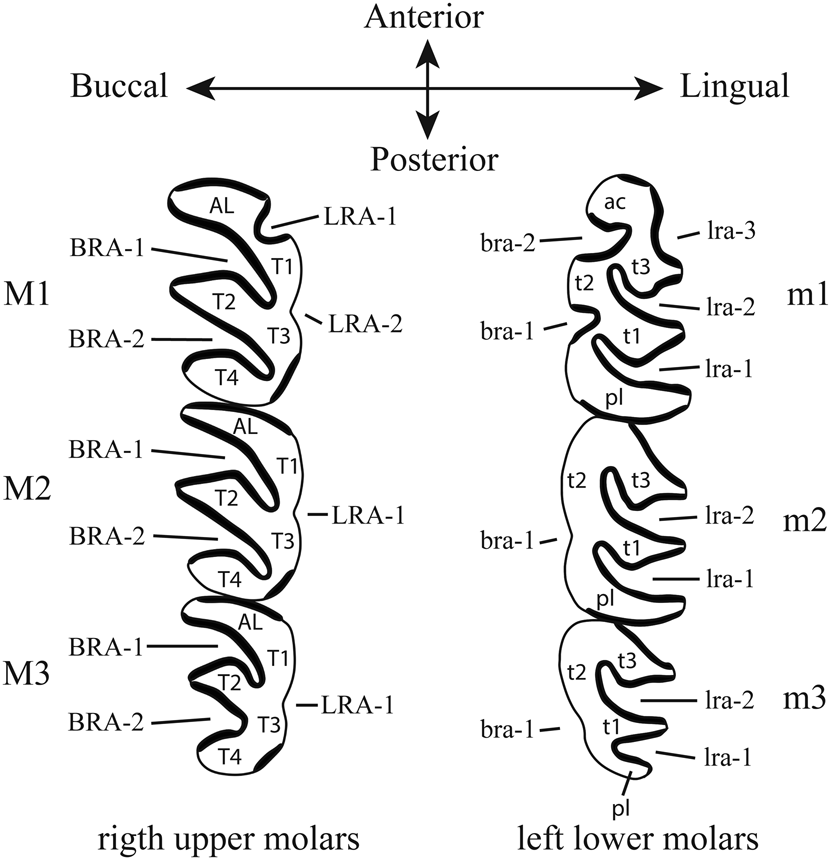
This research is based on a total of 152 skulls of extant zokors with upper and lower molars and 123 fossil specimens including upper and lower jaws as well as isolated molars. On the basis of these materials, we prepared an ontogenetic series for the structure of the chewing surface of modern species of the genus Myospalax (Myospalax myospalax, Myospalax aspalax Pallas, Reference Pallas1778, Myospalax armandii Milne-Edwards, Reference Milne-Edwards1867, and Myospalax psilurus Milne-Edwards, Reference Milne-Edwards1874) and Pleistocene West Siberian zokors. Because morphological differences between the molars of Myospalax aspalax and Myospalax armandii are unclear and require separate study, we assigned these species to the morphological group aspalax–armandii. For the description of molars, we used the terminology presented in the studies of Liu et al. (Reference Liu, Zheng, Cui and Wang2014) and Qin et al. (Reference Qin, Wang, Liu, Song and Jin2021) shown in Figure 2.
Terminology of dental structures of zokor molars adopted from studies of Liu et al. (Reference Liu, Zheng, Cui and Wang2014) and Qin et al. (Reference Qin, Wang, Liu, Song and Jin2021). Upper molars are labeled by capital letters M, lower molars are labeled by lowercase letters m, and numbers 1–3 mark the position of the molars (i.e., M1 labels the first upper molar, m2 labels the second lower molar, etc.) AL = anterior lobe; ac = anterior cup; pl = posterior lobe; T (t) = triangle; LRA (lra) = lingual reentrant angle; BRA (bra) = buccal reentrant angle.

Photos of paleontological material were taken with an Altami-U3CMOS05100KPA camera. Measurements were made from photographs using the tpsUtil ver.1.82 and tpsDig2 ver.2.32 programs (Rohlf, Reference Rohlf2015). The following measurements were used as the main characteristics for the description of the chewing surface: length, width, enamel thickness, and dentin field width between the turning points of BRA1 (first buccal reentrant angle) and LRA2 (second lingual reentrant angle) for M1 (Fig. 2). We consider the width of the dentin field between LRA2 and BRA1 (WLRA2–BRA1), the most significant parameter reflecting evolutionary changes in the morphology of the first upper molars of the West Siberian euhypsodont zokors. This parameter reflects the degree of isolation of dentin fields from each other due to the development of LRA2 and BRA1. For comparison with fossil zokors, measurements of the upper M1 of modern Myospalax myospalax were used. The first upper molars are the most diagnosed molars between zokor species (Ognev, Reference Ognev1947; Puzachenko et al., Reference Puzachenko, Pavlenko and Korablev2009), so they were chosen for statistical analysis. Statistical analyses were run using the Shapiro–Wilk test, Levene's test, Student's t-test, Mann–Whitney U test, and bivariate analysis, all carried out in Past.4.04 (Hammer et al., Reference Hammer, Harper and Ryan2001). We used t-test, Mann–Whitney U test, and bivariate analysis to compare Middle Pleistocene (N = 8) and modern (N = 19) specimens. The following parameters were used for comparison: length (L), width (W), and width of the dentin field between the turning points of LRA2 and BRA1 (WLRA2–BRA1) of the upper M1. We used the Shapiro–Wilk test to test the data for normality and Levene's test to assess homoscedaticity. On the basis of the results, we decided to use a Mann–Whitney U test to explore variability in length. For the other two variables (W and WLRA2–BRA1), we used a t-test. For all three parameters, we performed bivariate analyses.
For the upper M1 of modern and fossil zokors, we performed a geometric morphometric analysis by using 200 semi-landmarks equidistantly placed on the contour of the upper M1 in the program tpsDig2 ver.2.32 (Rohlf, Reference Rohlf2015). All semi-landmarks were converted to landmarks using tpsUtil ver.1.82 (Rohlf, Reference Rohlf2015). The first semi-landmark of the curve was placed on the buccal edge of the metacone. This geometrical position is well identified in all samples and can be considered homologous. Thus, the first semi-landmark after conversion to landmark can be described as a landmark of type 2 (i.e., extremes of curvature characterizing a single structure; Weber and Bookstein, Reference Weber and Bookstein2011). No general concept of landmark placement on the molar chewing surface of zokors has been developed, as has been done for other groups of rodents (McGuire, Reference McGuire2011; Calede and Glusman, Reference Calede and Glusman2017). We decided to completely outline the exterior contour of the chewing surface of the first upper molars by the curve. Similar approaches have already been applied to other rodent groups where such curves as a whole are considered homologous (Calede and Glusman, Reference Calede and Glusman2017; Smith and Wilson, Reference Smith and Wilson2017). From the first semi-landmark, the curve was drawn first along the lingual side, then along the buccal side, and closed at the first semi-landmark. We decided to place 200 landmarks to maximize the representation of morphological variability in the samples without missing any unexpected features. Only molars of full-grown individuals were included in the analysis. We used left and right molars in the analysis because of the limited fossil sample. Since no significant differences between them were found, we mirrored the photos of the right molars. We used a generalized Procrustes analysis to remove nonshape variation. We used two data sets in the analysis: those including Myospalax psilurus, Myospalax armandii and Myospalax aspalax and those with only West Siberian zokors. For each data set, principal component analysis (PCA) and canonical variate analysis (CVA) were performed. To test the classification accuracy, we also performed CVA (including a jackknife cross-validation test) for the first five principal components. To test whether the differences in shape between the studied groups were significant, we used Procrustes ANOVA. All statistical analyses were performed in MorphoJ 1.07 and Past.4.04 (Hammer et al., Reference Hammer, Harper and Ryan2001; Klingenberg, Reference Klingenberg2011).
Repositories and institutional abbreviations
Collections of specimens from modern populations belong to the Zoological Museum of Moscow State University (ZMMU, Moscow, Russia) and the Zoological Institute of the Russian Academy of Sciences (ZIN, Saint Petersburg, Russia). Paleontological specimens are in the collections of the Geological Institute of the Russian Academy of Sciences (GIN, Moscow, Russia) and the Center of Collective Use “Collection GEOCHRON” of the Institute of Petroleum Geology and Geophysics of the Siberian Branch of the Russian Academy of Sciences (CCU “Collection GEOCHRON,” Novosibirsk, Russia).
Systematic paleontology
Class Mammalia Linnaeus, Reference Linnaeus1758
Order Rodentia Bowdich, Reference Bowdich1821
Family Spalacidae Gray, Reference Gray1821
Subfamily Myospalacinae Lilljeborg, Reference Lilljeborg1866
Genus Myospalax Laxmann, Reference Laxmann1769
Type species
Myospalax myospalax Laxmann, Reference Laxmann1769.
Myospalax myospalax Laxmann, Reference Laxmann1769
Figures 3, 4, 5.9–5.14
Ontogeny of chewing surface (upper molars) of modern and Pleistocene zokors. The numbers indicate the following ontogenetic stages: 1 = presence of lingual juvenile reentrant angles; 2 = closing of these angles; 3 = formation of enamel islands; 4 = abrasion of enamel islands.

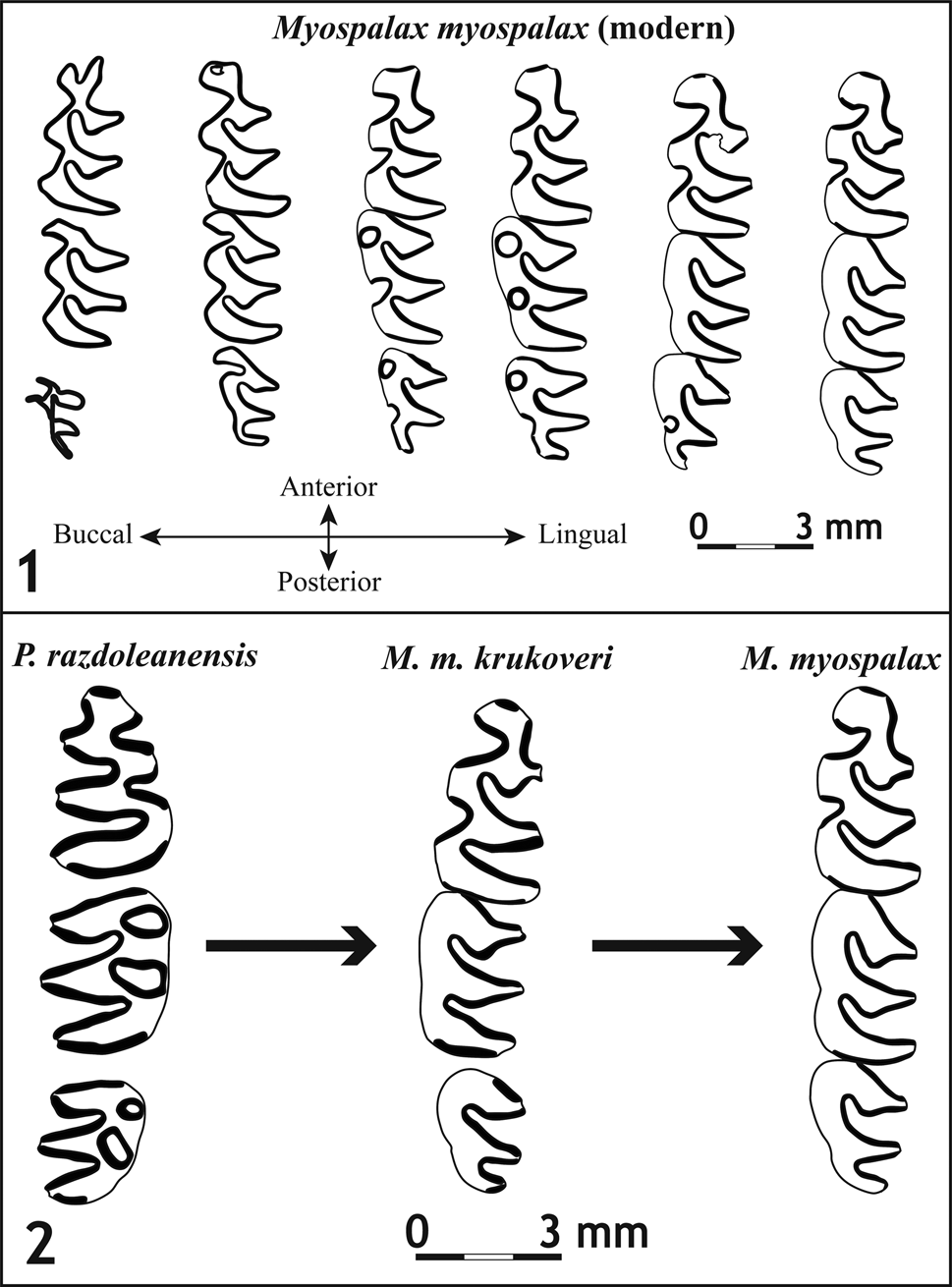
Lower molars of the West Siberian lineage. (1) Ontogeny of chewing surface (m1–m3) of modern Myospalax myospalax. (2) Evolution of morphology of West Siberian lineage during Pleistocene.

Photos of upper molars of the West Siberian lineage. (1–4) Holotype of Prosiphneus razdoleanensis (GIN RAN no. 664-1637), upper M1: (1) chewing surface; (2) alveolar side of the molar; (3) buccal side of the molar; (4) lingual side of the molar. (5–8) Holotype of Myospalax convexus (GeoChron no. 2118-54), upper M1: (5) chewing surface; (6) alveolar side of the molar; (7) lingual side of the molar; (8) buccal side of the molar. (9–12) Holotype of Myospalax myospalax krukoveri (GeoChron no. 2118-1) upper M1–M3: (9) chewing surface; (10) alveolar side of the molar; (11) lingual side of the molar; (12) buccal side of the molar. (13) Sample of upper M1 of Myospalax myospalax krukoveri. (14) Sample of upper M1 of modern Myospalax myospalax.

Holotype
Lost, as is the type series.
Neotype
Skull of subadult animal with upper and lower molars with enamel islands in the second and third molars (ZIN no. 66657). Collected by A. Martynova in 1972 near Medvedka village (northeastern territory of modern Kazakhstan).
Diagnosis
Zokors with rootless, relatively large molars. Four stages are identified in the ontogeny of molar teeth: presence of marked lingual (maxillary row) or buccal (mandibular row) reentrant angles, closing of these angles, formation of enamel islands, and abrasion of enamel islands with formation of less-marked reentrant angles (adult stage). This is true for all molars with the exception of the lower m1, where the buccal reentrant angles remain open. Upper molars have two (M1) or one (M2–M3) lingual reentrant angles and two buccal reentrant angles in the structure. An enamel gap (dentine tract) is present on the upper M1 on the front side of the anterior lobe near LRA1. Lower molars have three (m1) or two (m2–m3) lingual reentrant angles and two (m1) or one (m2–m3) buccal reentrant angles in the adult (post-island) stage. Buccal reentrant angles at m2–m3 are always shallower than the reentrant angles at m1. The structure of the anterior cup of the lower m1 includes two dentine tracts marked on the chewing surface.
Remarks
Previous diagnoses did not include a description of the enamel island formation process (Ognev, Reference Ognev1947). Since this process is not present in other modern zokor species, we consider it necessary to include it in the diagnosis. We also included in the diagnosis the presence of enamel gaps (dentine tracts) on the upper M1 and the lower m1 because these traits differ in other modern species of the genus Myospalax. Since the location of the holotype or type series is unknown, we considered it necessary to designate the neotype because of the principal ontogenetic differences of Myospalax myospalax, which we described in the preceding.
Holotype
One fragment of the maxilla with М1–М3 from an adult animal (CCU “Collection GEOCHRON” no. 2118/1). Left bank of the Ob River, 4 km lower from the Belovo village (locality Belovo-2, Middle Pleistocene) (Krukover, Reference Krukover1992), collected by A. Krukover.
Diagnosis
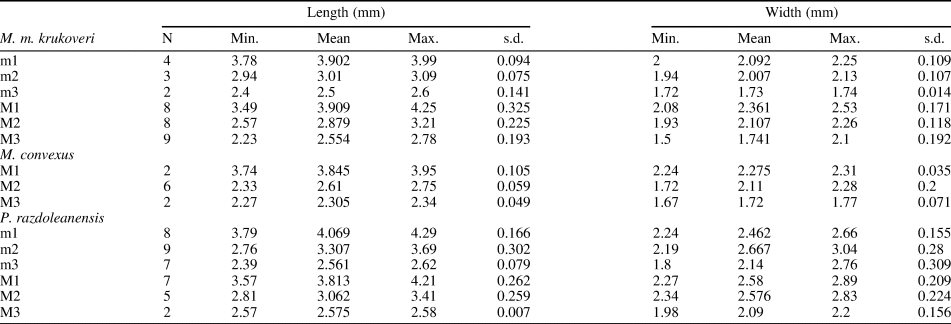
Zokors with rootless molars. Ontogeny of molars (M1–M3, m2–m3) involves a stage with abrasion of enamel islands and formation of shallower reentrant angles. Enamel islands have a circular shape. Part of the upper and lower molars at the “post-island” stage with shallower lingual (M1–M3) and buccal (m2–m3) reentrant angles compared with modern Myospalax myospalax. While the length of the upper M1 (Table 1) is comparable to modern Myospalax myospalax, M1 is generally wider, and the distance between the turning point of LRA2 and BRA1 is greater.
Measurements (in mm) of upper and lower molars of Myospalax myospalax krukoveri, Myospalax convexus, and Prosiphneus razdoleanensis.

Occurrence
Belovo-2, Gonba-2, Gonba-3, Vyatkino-1, and Malinovka-3 localities, West Siberia. Vyatkino layers, first half of the Middle Pleistocene.
Description
Rootless zokors with four stages of molar ontogeny: the presence of deep lingual (maxillary row) or buccal (mandibular row) juvenile reentrant angles, closing of these angles, formation of enamel islands, and abrasion of enamel islands with formation of less deep reentrant angles. The mechanism of enamel island formation is similar to that of modern Myospalax myospalax. The enamel islands have a circular shape. Enamel is thicker on the straight sections of the chewing surface contour and thinner on the turning points and varies between 0.04 and 0.18 mm. Length and width measurements are given in Table 1.
M1
LRA1 is clearly visible during the entire ontogeny. LRA2 is deep in the early stages of ontogeny. During ontogeny, LRA2 will close and form an enamel island. After the abrasion of the enamel island, a shallower LRA2 is formed, with all the dentin fields widely fused. On some specimens, the anterior lobe and T4 dentine fields are more isolated than in the other parts. The distance between the turning points of LRA2 and BRA1 in adult specimens varies between 0.55 and 0.82 mm. Enamel is clearly present on the buccal and anterior sides and less on the posterior and lingual sides. Buccal reentrants are inclined inward and slightly posteriorly. An enamel gap (dentine tract) is present on the anterior side of the anterior lobe near the LRA1.
M2
Dentine fields are almost isolated from each other in the early ontogenetic stages. Juvenile LRA1 has a triangular shape and transforms into a circular enamel island during ontogeny. After abrasion of the enamel island, a shallower LRA1 is formed, and all dentin fields are widely fuse together. T2 is generally larger than the anterior lobe and T4. Enamel is present on buccal and anterior sides and almost absent on posterior and lingual sides. Buccal reentrants are inclined inward and slightly posteriorly.
M3
Juvenile LRA1 and the enamel island at later ontogenetic stages are similar to those of M2. The anterior lobe is the largest part of the molar, while T4 is the smallest. In most of the samples, BRA1 is inclined inward and slightly posteriorly, and BRA2 is inclined only inward. In this case, BRA2 is smaller than BRA1 and has a more open shape. In some specimens, buccal reentrants are almost identical (Fig. 5.3). These types are characterized by a more developed and isolated T4. Enamel is present on buccal and anterior sides. In some specimens, enamel is also present on the posterior side.
m1
Enamel islands do not form during the whole ontogeny. Buccal reentrants are less developed than lingual reentrants, with the exception of lra3. Buccal reentrants and lra3 are inclined inward. lra1 and lra2 are inclined inward and slightly anteriorly. Enamel is present on all sides of the molar with gaps between reentrants. In the anterior cap, enamel is present with two gaps (dentin tracts) on the buccal and lingual sides (Fig. 4.2). Dentin fields are partially fused, with the t1 and t2 fields fused the most.
m2
During ontogeny, two circular enamel islands are formed then worn out in later stages. After abrasion of the enamel islands, the enamel is present on the lingual, anterior, and posterior sides. After abrasion of enamel islands, only one poorly developed reentrant (bra1) is formed. All dentin fields are widely fused. Lingual reentrants are inclined inward and slightly anteriorly.
m3
The process of formation and abrasion of enamel islands is similar to the process of formation and abrasion of m2. The posterior lobe is poorly developed. Enamel is present on lingual, anterior, and posterior sides. The largest is the anterior part of the molar. lra1 is less developed than lra2. lra1 is inclined inward. lra2 is inclined inward and slightly anteriorly. All dentin fields are fused.
Etymology
In honor of Anatoly Krukover, in memory of his study and work on the collection of Pleistocene rodents of West Siberia.
Materials
I: one mandible fragment with m1–m2, isolated molars: 3 М1, 2 М2, 3 М3, 1 m2, 3 m3. GIN no. 946/201–220 collected by V. Zazhigin, 1964. II: one fragment of the maxilla with М1–М3, one with М1, four fragments with М2 and М3, one with М2, two mandible fragments with m1–m2 and three with m1–m3, isolated molars: 5 M1, 5 M2, 8 M3, 2 m1, 5 m2, 5 m3. CCU “Collection GEOCHRON” no. 2118/1–53 collected by A. Krukover.
Remarks
Molars of zokors from West Siberian localities of the first half of the Middle Pleistocene have most of the main morphological traits characteristic of Myospalax myospalax, which does not allow us to describe them as a separate species. However, these characteristics differ on a quantitative level along with linear dimensions, so it was decided to describe a new chronological subspecies based on this sample. A specific characteristic of Myospalax myospalax krukoveri is the morphotype of the upper and lower molars with shallower reentrant angles (lingual side of M1–M3, buccal side of m2–m3) in the adult stage compared with modern Myospalax myospalax. The length of the first upper molars is comparable to modern Myospalax myospalax, but the width is generally greater, as is the degree of fusion of the dentine fields. In addition, there are morphotypes with developed T4 of M3 (Fig. 5.3), which is not common for modern Myospalax myospalax.
Holotype
Isolated upper M1 of the adult animal (CCU “Collection GEOCHRON” no. 2118/54). Left bank of Ob River, 0.5–4.0 km downstream from the Shelabolikha village (locality Shelabolikha-3, early Pleistocene) (Krukover, Reference Krukover1992), collected by A. Krukover.
Diagnosis
Rootless zokors with ontogenetic stages of upper molars involving formation of enamel islands, their abrasion, and formation of the chewing surface with a convex lingual side. Enamel islands have elongated oval shapes. Upper molars at the “post-island” stage do not have developed lingual reentrant angles. The anterior and posterior sides of T2 of M1, M2, and M3 are convex in most specimens.
Occurrence
Shelabolikha-3 and Malinovka-2 localities, West Siberia. Kochkovo Formation, late early Pleistocene.
Description
Rootless zokors with four ontogenetic stages of molar development in general similar to Myospalax myospalax. Enamel islands have elongated oval shapes. The thickness of the enamel varies from 0.06 to 0.18 mm. Length and width measurements are given in Table 1.
M1
LRA1 is clearly visible in the early stages of ontogeny but absent in the later stages. However, there is still a small section of enamel in place of LRA1 in the later stages. In the early stages of ontogeny, an enamel island is formed in place of LRA2. Enamel islands have elongated oval shapes. Relative to the long side, the enamel island is oriented perpendicular to the axis of the tooth length. After abrasion of the enamel island, LRA2 is not developed enough to be visible on the chewing surface (similar to LRA1) but has small marks on the lingual side. Because of this, the lingual side of the molar in adult specimens (post-island stage) has a convex shape. In addition, the anterior and posterior sides of the T2 are convex in adult specimens, with all the dentin fields widely fused. T2 is larger than the anterior lobe and T4. The enamel gap (dentine tract) is present on the anterior side of the anterior lobe near the LRA1 or near the section of enamel instead of the LRA1. Buccal reentrants are inclined inward and slightly posteriorly. Enamel clearly present on buccal and partially on anterior sides.
M2
The dentinal fields are almost isolated from each other in the early ontogenetic stages with the presence of a deep elongated LRA1. After the formation and abrasion of the enamel island, the lingual side has a convex shape with all the dentin fields widely fused. T2 is larger than the anterior lobe and T4. The anterior and posterior sides of T2 are convex. Enamel is present on the buccal and anterior sides. Buccal reentrants are inclined inward and slightly posteriorly.
M3
Characteristics similar to those of M2. The special feature of this molar is that BRA1 is inclined inward and slightly posteriorly and BRA2 only inward. In addition, the T4 of the molar is less developed than the T2 and anterior lobe.
Etymology
Species name derived from the Latin word convexus, meaning convex and referring to the shape of upper molars.
Materials
Isolated molars: 3 M1, 6 M2, 5 M3. CCU “Collection GEOCHRON” no. 2118/54–70 collected by A. Krukover.
Remarks
Due to the absence of lower molar material, we cannot characterize their morphology. However, from the morphology of the upper molars of Myospalax convexus, as well as the morphology of the lower molars of more modern and archaic forms, it is possible to make certain assumptions. Most likely, the lower m2 and m3 should be convex on the buccal side at later ontogenetic stages. In the lower m1, enamel islands most likely either should not form, or such a formation is possible at very late ontogenetic stages.
According to Galkina and Nadeev (Reference Galkina and Nadeev1980), at the stratigraphic level to which Myospalax convexus is related, there are also zokor molars that have roots at later ontogenetic stages. Unfortunately, the morphology of these finds has not been described in detail. No molars with roots or traces of root formation were found in our fossil material for this stratigraphic level.
Genus Prosiphneus Teilhard de Chardin, Reference Teilhard de Chardin1926
Type species
Prosiphneus licenti Teilhard de Chardin, Reference Teilhard de Chardin1926
Holotype
Isolated upper M1 of adult animal with enamel island formed from LRA2 (GIN no. 664/1637). Right bank of the Alei River, 1.5 km southeast from the village Razdole (Razdole locality, early Pleistocene) (Zazhigin, Reference Zazhigin1980), collected by V. Zazhigin, 1963–1965.
Diagnosis
Zokors with rooted hypsodont molars. Three stages are identified in the ontogeny of molar teeth: presence of deep lingual (maxillary row) or buccal (mandibular row) reentrant angles, closing of these angles, and formation of enamel islands. At the latest ontogenetic stage, reentrant angles close on both lingual and buccal sides, forming large enamel islands. LRA1 is present in the early stages of ontogeny. At the later stages, a circular enamel island forms instead of LRA1 and remains during the whole ontogeny. An enamel gap (dentine tract) is present on the upper M1 on the anterior lobe near LRA1. The structure of the anterior cup of the lower m1 includes enamel on the anterior part and two dentine tracts present on the buccal and lingual sides.
Occurrence
Razdole, Makhanovo, and Gonba-1 localities, West Siberia. Kochkovo Formation, late early Pleistocene.
Description
Zokors with high-crowned (hypsodont) rooted molars. Roots are fused during most of the ontogeny and split apart at the latest ontogenetic stages. During ontogeny, reentrant angles close and form enamel islands. The thickness of the enamel varies from 0.1 to 0.2 mm. Length and width measurements are given in Table 1.
M1
LRA1 is clearly visible and deep in the early stages of ontogeny. During later stages, a circular enamel island forms instead of LRA1 and remains during the rest of the ontogenetic stages. LRA2 as LRA1 is also visible in the early ontogenetic stages; during later stages, an enamel island will form instead. The difference between the enamel island instead of LRA2 and the enamel island instead of LRA1 is that the first island will form earlier, will have an oval shape, and will wear off at the latest ontogenetic stages. After the formation of this enamel island (formed instead of LRA2), the lingual side has a convex shape. Buccal reentrants are open during most of ontogeny and close with the formation of large oval enamel islands at the latest stages. When present, the lingual reentrants are inclined inward, and the buccal reentrants are inclined inward and posteriorly. Dentine fields are partially isolated due to the presence of either lingual reentrants in early ontogenetic stages or enamel islands in later stages (with the exception of the latest stages, when the buccal reentrants are closed). AL, T2, and T4 have a convex shape on the anterior and posterior sides. Enamel is present on all sides of the molar but disappears as enamel islands form. An enamel gap (dentine tract) is present on the anterior side of the anterior lobe near the LRA1 as long as this reentrant is open.
M2
The dentinal fields are almost isolated from each other in the early ontogenetic stages with the presence of either a deep LRA1 or an oval enamel island that forms instead of LRA1. T2 is larger than AL and T4. The anterior and posterior sides of T2 are convex. Enamel is present on all sides of the molar in early ontogeny and disappears on the lingual side as the enamel island forms. When present, the lingual reentrants are inclined inward, and the buccal reentrants are inclined inward and, on some specimens, also posteriorly.
M3
Most characteristics are similar to those of M2. T4 is less developed than T2 and the anterior lobe.
m1
In early ontogenetic stages, there are three lingual and two buccal reentrants. Buccal reentrants are less developed than lingual reentrants, with the exception of lra3. Buccal reentrants and lra3 are inclined inward. lra1 and lra2 are inclined inward and, on some specimens, also slightly anteriorly. During ontogeny, buccal reentrants will close, forming circular enamel islands. Enamel is present on all sides of the molar in early ontogeny and disappears on the buccal side as enamel islands form. On the anterior cap, enamel with two gaps (dentin tracts) on the buccal and lingual sides is present. The anterior cap is short and wide and has an oval shape. Dentine fields are partially fused at early ontogenetic stages, with the anterior cap and t3 fields fused the most. With the formation of enamel islands, dentin fields will be partially isolated from each other.
m2
In early ontogenetic stages, there are two lingual and two buccal reentrants. Lingual reentrants are inclined inward and slightly anteriorly; bra1 is inclined inward and slightly anteriorly, while bra2 is inclined inward. Two enamel islands are formed instead of buccal reentrants. Enamel is present on all sides of the molar in early ontogeny and disappears on the buccal side as enamel islands form.
m3
Ontogenetic development is similar to that of m2. The posterior lobe is less developed than the t1 and t3 lobes.
Etymology
Species name refers to Razdolean faunal complex.
Materials
I: one mandible fragment with m2–m3, isolated molars: 9 M1, 6 M2, 3 M3, 8 m1, 7 m1, and 7 m3. GIN no. 664/1601–1660, 2083–2097 collected by V. Zazhigin, 1963–1965. II: one fragment of the maxilla with М3, one mandible fragment with m1, one mandible fragment with m2, isolated molars: 2 M1, 2 M2, 1 M3, 1 m1, 2 m2, 2 m3. CCU “Collection GEOCHRON” no. 2118/71–84 collected by A. Krukover.
Remarks
The generic status of rooted zokors is the subject of a long-term discussion (Galkina and Nadeev, Reference Galkina and Nadeev1980; Zheng, Reference Zheng, Tomida, Li and Setoguchi1994; Li and Wang, Reference Li and Wang2015; Qin et al., Reference Qin, Wang, Liu, Song and Jin2021). In our opinion, to solve this question, schemes of ontogenetic development of molars for each species are necessary. At this point, we follow the traditional generic name Prosiphneus for rooted zokors from the West Siberian localities (Zazhigin, Reference Zazhigin1980; Krukover, Reference Krukover1992, Reference Krukover2007).
The closest species to Prosiphneus razdoleanensis in terms of stratigraphical and geographical range are species from the genus Episiphneus Kretzoi, Reference Kretzoi1961 (Episiphneus youngi Teilhard de Chardin, Reference Teilhard de Chardin1940; Episiphneus dalianensis Qin et al., Reference Qin, Wang, Liu, Song and Jin2021). The presence of the gap in the enamel contour marking the dentine tract on the anterior side of the upper M1 anterior lobe together with the shape of the LRA1 during different ontogenetic stages allow us to separate Prosiphneus razdoleanensis from other species of the Episiphneus group. The molar size of Prosiphneus razdoleanensis is also larger than that of Episiphneus dalianensis (Qin et al., Reference Qin, Wang, Liu, Song and Jin2021).
Results
The data obtained from our analyses can be used to describe in detail the unique mechanism of enamel island formation during the ontogeny of Myospalax myospalax molars. Within modern species of the subfamily Myospalacinae, this mechanism is found only in the Myospalax myospalax population. In the juvenile stages, deep reentrant angles are present on the buccal (lower m2–m3) or lingual (upper M1–M3) molar sides with enamel contouring reentrant angles. As the animal becomes older, the corresponding reentrant angles close and form enamel islands (Figs. 3, 4). In turn, these enamel islands wear off as the teeth grow and completely disappear at later ontogenetic stages. This mechanism of enamel island formation is completely absent in the lower m1.
The order of formation and abrasion of enamel islands differs depending on the order of the molars in the jaw. In the upper dentition, the first enamel island forms on M1, then on M2, and after that on M3, in the lower dentition on m2, and then on m3. The same order is true for abrasion of enamel islands. Instead of closed reentrant angles with enamel, new reentrant angles form, but they are shallower and often without enamel. At the same time, the first reentrant lingual angle at M1 (LRA1) will not close during ontogeny (Fig. 3). A total of four stages have been identified as successive ontogenetic stages showing closure of the reentrant angles, formation of enamel islands, and their abrasion. Similar stages are found in the rootless ancestral forms of Myospalax myospalax (Myospalax myospalax krukoveri; Myospalax convexus).
In the ontogeny of other zokor species from the genera Myospalax and Eospalax, the reentrant angle closing stages (and therefore all later stages) are absent. The early Pleistocene rooted zokors ancestral to Myospalax myospalax, Myospalax aspalax, Myospalax armandii, and Myospalax psilurus (Prosiphneus razdoleanensis; Episiphneus youngi; Episiphneus dalianensis) have stages of reentrant angle closure and enamel island formation, but the post-island stage is absent (Alexeeva, Reference Alexeeva2006; Qin et al., Reference Qin, Wang, Liu, Song and Jin2021) (Fig. 3). During the latest stages of Prosiphneus razdoleanensis ontogeny, the enamel island formed instead of LRA2 will wear off, yet enamel islands instead of buccal reentrants will appear.
The greatest divergence in the morphology of zokor molars is observed in the first upper molars. This is true both for evolutionary divergence within the same phylogenetic lineage and for contemporaneous species from different lineages. Because of the strong ontogenetic variability of the West Siberian lineage, a comparison of the same ontogenetic stages becomes crucial. One of the characteristic traits of the first upper molars of Myospalax myospalax in the adult (post-island) stage is the presence of a slightly deep second reentrant lingual angle (LRA2). The enamel on the contour of the angle is either missing or thinner than on the rest of the tooth. In all other modern species of the subfamily, this angle remains open and has thick enamel along the contour of the reentrant angle. Most of the modern Myospalax myospalax population is characterized by a deep first reentrant lingual angle (LRA1). In rare specimens, this reentrant angle may also be slightly deeper than LRA2. Myospalax myospalax and other zokor species can be separated by this trait from Myospalax aspalax and Myospalax armandii, which do not have LRA1 at all. Together with ontogenetic characteristics, these traits can clearly separate Myospalax myospalax from other modern zokors.
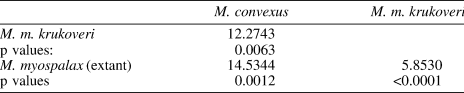
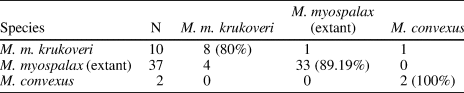
West Siberian zokors from localities of the first half of the Middle Pleistocene (M. m. krukoveri) are characterized by morphotypes with shallower LRA2 compared with the modern Myospalax myospalax population (Fig. 6). The results of the Shapiro–Wilk test did not show evidence of nonnormality for length (W = 0.9437, p = 0.1504), width (W = 0.9817, p = 0.8995), and WLRA2–BRA1 (W = 0.9817, p = 0.8979) variability. The samples were homoscedastic (Levene's test, p > 0.05). The results of the Mann–Whitney U test for length variability showed little difference between Middle Pleistocene and modern samples (U = 61.5, Z = 0.74407, p = 0.45683). By contrast, the results of the t-test of W (t-score = 2.4052, critical t-value = 2.0595, p = 0.023891) and WLRA2–BRA1 (t-score = 4.7359, critical t-value = 2.0595, p < 0.001) showed a significant difference. In terms of geometry, the lingual side of the first upper molars of M. m. krukoveri has a shape more similar to a substraight line (Fig. 3). In turn, the remains of the first rootless West Siberian zokors (M. convexus) have a convex shape at the lingual side of the upper molars at the adult stage. Morphotype of this kind was not found within M. m. krukoveri and modern M. myospalax. Geometric morphometric analysis confirms the morphological differences both between modern species of the genus Myospalax and between modern Myospalax myospalax and its ancestral rootless forms (Fig. 7). The results of the Procrustes ANOVA showed significant differences in shape for both groups of samples, including Myospalax psilurus, Myospalax armandii, and Myospalax aspalax (df = 1,584, F = 53.29, p < 0.0001) and West Siberian only (df = 792, F = 4.59, p < 0.0001). In the principal component analysis, which included Myospalax myospalax, Myospalax psilurus, and morphological group aspalax–armandii, all three of these groups are well separated from each other. Among modern species, the sample group belonging to Myospalax myospalax is the most isolated. In analyses where only modern and fossil West Siberian material was used, the Myospalax convexus group is the most separated (Fig. 7). In the PCA plot, the Myospalax myospalax krukoveri group overlaps with the modern Myospalax myospalax group. The greatest divergence between these groups is due to PC2 responding to the development of LRA2 and BRA1 (Fig. 8.3). Canonical variate analysis also indicates that Myospalax convexus is most strongly separated from the rest of the West Siberian zokor groups. Myospalax myospalax krukoveri is separated from extant Myospalax myospalax by both the first and second canonical variates (Fig. 8.4). Mahalanobis distances among groups range from 5.85 (extant Myospalax myospalax versus Myospalax myospalax krukoveri) to 14.53 (extant Myospalax myospalax versus Myospalax convexus) (Table 2). Results of permutation tests indicate that the mean shapes vary among taxa with p <0.01 in pairwise permutation tests (10,000 permutation rounds) for Mahalanobis distances among groups. The CVA that was performed on the first five principal components (responsible for 86% of the variances) from data set with West Siberian zokors correctly classified species 87.76% of the time (Table 3).
Bivariate analysis of upper M1 molars of modern Myospalax myospalax (green points) and Myospalax myospalax krukoveri (light brown squares) through parameters such as length (L), width (W), and width of dentin field between turning points of LRA2 (second lingual reentrant angle) and BRA1 (first buccal reentrant angle). The red line on each graph is the least squares regression line.

Geometric morphometric analysis of upper M1 molars of modern Myospalax myospalax (green points), Myospalax myospalax krukoveri (light yellow squares), Myospalax convexus (orange hexagon), Myospalax psilurus (purple stars), and aspalax–armandii morphological group (black triangles). At the upper part of the figure is a visualization of the results of the principal component analysis (PCA) including Myospalax psilurus, Myospalax armandii, and Myospalax aspalax. The bottom part of the figure represents the results of the principal component analysis and canonical variate analysis (CVA) with only West Siberian zokor species.

Parameters of morphometric analyses. (1) Linear measurement scheme (left) and example of landmark placement in geometric morphometric analysis. (2) Starting (red) and target (black) shape among principal component (PC) axes for sample group including Myospalax psilurus, Myospalax armandii, and Myospalax aspalax. (3) Starting (red) and target (black) shape among principal component axes for sample group with only West Siberian zokors. (4) Starting (red) and target (black) shape among canonical variate (CV) axes for sample group with only West Siberian zokors. LRA = lingual reentrant angle; BRA = buccal reentrant angle.

Permutation test based on Mahalanobis distances (10,000 permutations) and their corresponding p values of the comparison between groups of West Siberian zokors.

Classification rates of West Siberian zokors obtained from canonical variate analysis (based on the first five principal components) using jackknife cross-validation method. Percentages of correct classification are shown in parentheses.

When comparing early Pleistocene rooted zokor species, LRA2, as a characteristic trait, becomes less important due to the absence of the post-island stage during ontogeny. We emphasize the presence of LRA1 and a gap in the enamel contour on the anterior side of the anterior lobe, near LRA1, as important traits of West Siberian rooted zokors. In later ontogenetic stages, LRA1 will close and form an enamel island. These traits were found in all samples from the localities of West Siberian rooted zokors that we studied. The geographically and stratigraphically closest rooted zokors (Episiphneus youngi) do not have this enamel gap, nor do they have deep LRA1 or a related enamel island at later ontogenetic stages (Erbajeva, Reference Erbajeva1970; Qin et al., Reference Qin, Wang, Liu, Song and Jin2021).
Discussion
Studies describing the morphology of modern zokor molars generally use the molars of adult specimens (Zheng, Reference Zheng, Tomida, Li and Setoguchi1994; Puzachenko et al., Reference Puzachenko, Pavlenko and Korablev2009; Li and Wang, Reference Li and Wang2015; Qin et al., Reference Qin, Wang, Liu, Song and Jin2021). The morphology of juvenile specimens is often not described, making it difficult to measure ontogenetic differences between species. Although the first observations of the ontogenetic features of the West Siberian lineage were made long ago (Ognev, Reference Ognev1947; Galkina and Nadeyev, Reference Galkina and Nadeev1980), they have never been described in detail. We fill this gap and describe the principal differences in the ontogeny of modern zokors and their evolutionary development. In the West Siberian lineage, ontogeny became more complex with the addition of the post-island stage in rootless forms. At the same time, the stages of closure of reentrant angles and formation of enamel islands were displaced to earlier stages in ontogeny (Fig. 3). There was no significant change in the size of the molars during this process (Table 1). In terms of heterochrony, this can be described as peramorphosis (i.e., the descendant form is more developed and has more complex ontogeny relative to the ancestral form; McNamara, Reference McNamara2012). Thus, the West Siberian rootless zokors combine peramorphosis of the chewing surface and pedomorphosis of the enamel sidewalls (transition to euhypsodont). The exception is the lower m1, in which enamel islands on the buccal side stop forming during the transition from rooted to rootless forms. In the case of this molar, it would be correct to consider pedomorphosis for the chewing surface as a result of evolution.
In the evolution of other zokor lineages, there is a process of retention of juvenile features of the chewing surface from rooted ancestral forms in all molars (Qin et al., Reference Qin, Wang, Liu, Song and Jin2021). Although early Pleistocene rooted zokors (Episiphneus youngi; Episiphneus dalianensis) have a stage of enamel island formation, modern Myospalax psilurus and Myospalax aspalax show no such stage in ontogeny. In addition, in these lineages, the size of the molars is sequentially increasing (Qin et al., Reference Qin, Wang, Liu, Song and Jin2021). In this case, it is possible to suggest pedomorphosis as a central process in the evolution of molar ontogeny (McNamara, Reference McNamara2012). The lack of specimens of zokors from the genus Eospalax in our study prevents us from describing their evolution with the same certainty. Nevertheless, published data (Teilhard de Chardin and Young, Reference Teilhard de Chardin and Young1931; Teilhard de Chardin, Reference Teilhard de Chardin1942; Zheng, Reference Zheng, Tomida, Li and Setoguchi1994; Liu et al., Reference Liu, Zheng, Cui and Wang2014; Qin et al., Reference Qin, Wang, Liu, Song and Jin2021) suggest a similar result of pedomorphosis in the evolutionary development of the chewing surface.
The species-level identification of euhypsodont zokors using geometric morphometrics shows potential for development (Fig. 7; Table 3). In our study, we grouped samples according to their species identification on the basis of morphological characteristics. The results obtained agree with the results of comparative anatomical analysis and morphometric analysis by linear measurements. In future studies, different combinations of landmark and semi-landmark placement on all molars should be tested to improve the efficacy of the method. In addition, grouping samples of modern zokors according to geographical principles may allow us to reveal differences at the subspecies level or between morphologically similar species.
Two new species and one subspecies described from West Siberian material with the addition of the specific aspects of their ontogeny raise the question of the present systematic of Myospalacinae. The association of M. myospalax, M. aspalax, and M. psilurus in one genus can be questioned on the basis of the differences in molar evolution across taxa. There can be two solutions to this problem. The first is to abandon the modern subfamily species classification with two genera and return to a classification where all rootless zokors are grouped into one genus Myospalax, as already proposed in another study (Tsvirka et al., Reference Tsvirka, Pavlenko and Korablev2011). Nevertheless, there will be a contradiction with modern molecular research (Liu et al., Reference Liu, Zhang, Cai, Kuang and Wan2022; Zhang et al., Reference Zhang, Lei, Zhou, Chen and Shi2022). The second solution that we are inclined to follow is to split the genus Myospalax with the separation of Myospalax myospalax and its rootless ancestral forms (Myospalax myospalax krukoveri and Myospalax convexus) into a separate genus. This genus will be characterized by a more complex ontogeny of the molars (with the exception of the lower m1) than that of the other rootless zokors. As the type species for the genus Myospalax is Myospalax myospalax, the generic name Myospalax will be retained for the West Siberian lineage. Myospalax aspalax, Myospalax armandii, and Myospalax psilurus should then be separated into a genus for which the name Siphneus can be used, as the type species for the previously described genus Siphneus is Myospalax aspalax (Brants, Reference Brants1827).
Acknowledgments
We thank V. Lebedev and L. Voita for their consultation and help in providing collections from the Zoological Museum of Moscow State University and the Zoological Institute of the Russian Academy of Sciences. We thank the two anonymous reviewers for their constructive feedback.
Declaration of competing interests
The authors declare none.