Despite a rich and varied critical heritage, reception of George Meredith's Reference Meredith and Adams1879 novel The Egoist has tended to rely on the author's Essay on Comedy as a key to unlocking the novel's many mysteries. Written just two years earlier as a lecture for the London Institution, the Essay would seem an apt place to start. A blueprint for Meredith's attempt to offer a revitalizing corrective for the tedium of everyday life, that “monstrous monotonousness” of convention and complacency that enfolds us (The Egoist 5; Prelude), the Essay helps explain, and thus rehabilitate, the novel's apparent oddities: its fragmentary and discontinuous narration, dynamic conception of character, and infamous, ostentatious stylistic eccentricities, to name but the most obvious anomalies. The parallels between the Essay and the novel are well rehearsed by critics; indeed, this connection has served both the novel and critics well, generating a range of forceful and illuminating readings.Footnote 1 It must be said, too, that the critical tendency to see The Egoist as an outgrowth of the Essay represents a significant improvement over the main thrust of contemporary reviews of the novel, in which the four most frequently used words were “affectation,” “obscurity,” “artificiality,” and “weakness” (I. Williams 11; Lucas 3).
However, while it has illuminated some aspects of the novel well, the use of Meredith's Essay as a starting point for criticism has also deflected attention away from the novel's more experimental currents and peregrinations, as well as from Meredith's influence beyond his own peculiar canon and the national and generic confines of English comedy more generally. The Egoist, of course, is far from a straightforward rendering of Meredith's theory into fiction. Importantly, the novel also makes a commentary on the Essay, written several years before it and without the benefit of a full-scale dramatization of “a definite situation for a number of characters” (The Egoist 3; Prelude). That commentary can be found in part in the surplus of importance placed on embodiment and the social reading of bodily dispositions in the novel, an aspect of Meredith's theory that is implied in the Essay but not made explicit there. As I argue in this essay, The Egoist makes subtle yet crucial use of habitual physical orientation and behavior – characteristic ways of talking, moving, and acting, including stance, gait, speech, and gesture – that draws more directly on Victorian preoccupations with the inescapable materiality of the body as well as anticipates key theories of Henri Bergson, Sigmund Freud, and Pierre Bourdieu.
Thus, with its careful attention to the movements and displacements of the body, The Egoist can be usefully read as an experiment in redefining nineteenth-century understandings of the “patterning” of human behavior and consciousness. Read in this light, the novel represents a critical intervention at the very moment that the study of psychology was beginning to be codified as a specialized field and as a profession, an intervention that has been largely obscured by the subsequent ascendancy of Freudian psychoanalysis and other interiorizing models of ego psychology in the last century (Sedgwick 138–39). Neither traditional novel nor scientific case study, The Egoist offers a competing, experimental model for exploring what was quickly becoming known as “personality.”Footnote 2 Significantly, it was the emphasis on the unspoken, gestural language of the body in The Egoist that was to prove so influential. Indeed, echoes of Meredith in Bergson's 1900 essay Laughter (Le Rire) and Freud's explicit use of scenes from The Egoist to illustrate his now famous (and eponymous) theory of slips in The Psychopathology of Everyday Life (1901) signal the major if seldom acknowledged influence of Meredith, the “last Victorian,” on early-twentieth-century thought and on the transformations of modernity.
Mind in Movement
Recent work in Victorian studies has demonstrated the increasing importance of the materiality of the body to nineteenth-century understandings of mind and what it means to be human. William A. Cohen's Embodied: Victorian Literature and the Senses (2009) argues convincingly that the celebrated Victorian literary mode of representing characterological roundness and psychological depth depends, surprisingly, not on “a traditional conception of a distinct, immaterial human essence” but rather on fundamentally embodied experience: “the depiction of physical substance, interaction, and incorporation” (xi–xii). The importance of the material existence of the human body was, of course, the topic of much contemporary scientific inquiry and cultural debate, as Rick Rylance's history of the development of psychology, Victorian Psychology and British Culture, 1850–1880 (2000), has shown. And Nicholas Dames's recovery of now-forgotten nineteenth-century theories of the novel, The Physiology of the Novel (2007), reminds us of the link between nineteenth-century study of the human body and ideas about fiction and the act of reading itself.
This emphasis on the body is shared by earlier twentieth-century theorists who, like the Victorian novelists Cohen discusses, challenge an uncritical belief in a transcendent, immaterial human essence, on the one hand, and a fixed model of physical determinism, on the other. In a foundational lecture, “Techniques of the Body,” given at the Société de Psychologie in 1934, Marcel Mauss makes the case for an analysis of a “psychological mediator” in the gap between biology and sociology – an analysis, that is, of the psychological “cog-wheel” that connects the physiological apparatus to the facts and conditions of social life in any society (73, 85). Thus, Mauss sought to develop a notion of “the social nature of the ‘habitus,’” the Latin word that he uses to describe the “techniques and work of collective and individual practical reason rather than, in the ordinary way, merely the soul and its repetitive faculties” (73). Pierre Bourdieu elaborated this notion of the habitus in particularly useful and influential ways. An acquired system of embodied dispositions, a durable training in the collective social construction of the world, the habitus is, for Bourdieu, the unspoken imprint of culture on the body, where the idiosyncratic/personal meets the systemic/social (93–94).Footnote 3 Of course, as early as 1900 Henri Bergson theorized the social as something “encrusted on the living,” to be exposed and revitalized by laughter: “The attitudes, gestures, and movements of the human body are laughable in exact proportion as that body reminds us of a mere machine” (79). An urgent and frontal attack on the mind-numbing “common sense” of the nineteenth century, Bergson's theory highlights the growing threat to the status of the individual, indeed of the human, in an increasingly mechanized and functionalist society.
For Meredith, who anticipated these formulations in his representations of embodiment, I argue, these burning issues were also a question of narrative form.Footnote 4 How to represent the man of habit – the man with an index finger on a page of the Book of Egoism? How best to reveal his citational power to authorize and naturalize the continuance of the past, as well as our readiness to accept the conventional – the egoist's affectation, self-delusion, and folly – as “real”? In earlier novels, most notably The Ordeal of Richard Feverel (1859), the novel that made Meredith's name despite its having been boycotted by Mudie for its frank sexual passages, Meredith mocked the mechanical, pseudoscientific approach to education, with young Richard brought up by his father Sir Austin's “system” to disastrous effects.Footnote 5 Meredith's answer in The Egoist is to take this satire further in likening social etiquette to bodily regulation: to create ironic distance by portraying his “hero” through the viewpoints of other characters, most notably the novel's witty, clear-sighted women. In the geographically isolated, hermetically sealed, rigidly hierarchical and regimented world of the country estate, the novel's reflections upon social life and self-discipline depend entirely on the observation of human behavior – embodied, material, thinking and feeling – in the drawing room of high culture.
The plot of the novel is relatively simple. It concerns the ill-fated engagement of Clara Middleton to Sir Willoughby Patterne, premier of his family, fifth head of the “race” inhabiting Patterne Hall, and the “hope of his county” (7; ch. 1). By turns hypersensitive and morose, Willoughby, the egoist of Meredith's title, is painfully self-conscious, habitual in his thinking and comportment, and Rousseauian in feeling. His name, as has often been pointed out, has an obvious association with pattern, recalling Willoughby's exemplary traits as a wealthy young landowner, the model of an English gentleman (Mayo 453). Clara Middleton, whose name identifies her with clarity and moderation, is also ideal – beautiful, intelligent, wealthy, and young – but has none of Willoughby's blinding egoism. Rather, she exhibits a “prompt and most musical responsiveness” (36; ch. 5). Accepting his proposal after he comes into his inheritance, Clara gradually realizes that she cannot marry this self-centered hero, and threatens to become the second woman to jilt Willoughby. The first, ironically named Constantia Durham (she is anything but constant or durable), eloped with a Colonel Harry Oxford prior to Clara's arrival.
The arc of the narrative is formed, therefore, by Willoughby's courtship of Clara and her increasing reluctance to marry him. The rest of the novel involves the other characters’ responses to the challenge Clara poses to the formalized, regimented world of Patterne Hall. Under the double-blossom cherry tree, Clara first confides discreetly in Willoughby's cousin, the scholar Vernon Whitford, who quietly loves her. With Vernon she shares a concern for the future of Willoughby's young ward Crossjay and an esteem for her father, the Rev. Dr. Middleton. Clara also speaks with Laetitia Dale, a shy, intelligent woman who has always loved the selfish Willoughby but continues to be ignored by him. Although Clara repeatedly attempts to draw her father's attention to her dilemma (he is more concerned with the Patterne wine than with her well-being) and even appeals to Willoughby directly, the arrival of Colonel De Craye, an Irishman, marks the lingering possibility of Clara's escape in the mold of her predecessor, Miss Durham. The novel ends with Clara leaving for the Alps with Vernon but only after an abandoned attempt to flee by herself to London by rail, a bizarre turn of events involving a late-night eavesdrop, Willoughby's last-ditch proposal to Laetitia, and the involvement of Laetitia's ailing father and all the great, gossiping ladies of the county. So The Egoist marries off its glossy hero, and never has it seemed so difficult.
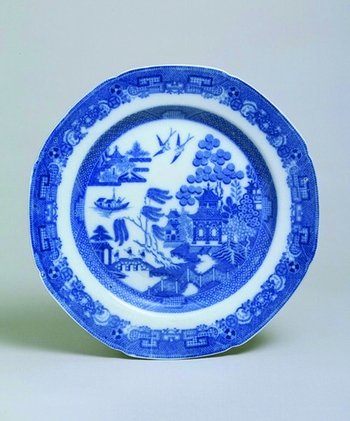
For the Victorians, the plot would have been immediately reminiscent of the popular Willow Pattern of china, and the romantic legend connected with it, imported into England from China during the last half of the eighteenth century, as Patricia O'Hara has memorably recounted (Figure 13).Footnote 6 That story represents an attempt to explain the design, which became standardized in England around 1830 (Osborne 829). Its scenes include a pagoda at the edge of water, two birds in the sky, a boat being poled on the water, a fence in the foreground, a three-arched bridge with three figures walking on it, and a prominent willow tree overhanging the bridge (829). According to the legend, the wealthy mandarin who inhabits the stately pagoda was a widower and had a lovely daughter; she opposed her father's wish to marry a suitor of high degree in favor of a poor and honorable man, her father's secretary, with whom she had exchanged vows under the blossoming tree (Mayo 455). The daughter is held prisoner and, pining for her freedom, is rescued and carried off by her lover while her father entertains the suitor in the banquet hall; escaping over the willow bridge, they are turned into birds by the gods in honor of their fidelity (455).
Factory of Josiah Spode, “Blue Willow” plate. Lead-glazed earthenware. c. 1820. Collection of the V&A, London. ©V&A Images

The correspondence between plot and plate is direct although Meredith plays some with sequence and emphasis. As Mayo has pointed out, Clara makes a bid for her freedom before recognizing Whitford as a lover, and even then she does so ambiguously; the reasons for Clara's revolt interest Meredith more than does her new love anyway (456). In addition, Meredith incorporates the porcelain-idea into the dowager Mrs. Mountstuart Jenkinson's enigmatic phrase for Clara, “a dainty rogue in porcelain” (36; ch. 5), and twice into the plot itself: once upon the arrival of De Craye's wedding present, a broken porcelain vase; and a second time in Lady Busshe's gift of a porcelain service, which she uses to test her suspicion of a fissure between Willoughby and Clara. Not only is the plot remarkably simple then, it was also already well known to contemporary readers through the familiar blue Willow plate. Its pattern – already so much a part of everyday domestic life – here also takes on a feeling of narrative form.
Despite the plot's clear outline and its origins in popular iconography, The Egoist frequently reads like an opaque text. Even at a first glance it shows itself to be a hard, dense, at times obscure verbal structure. The novel's complexity lies in its subtlety of characterization and its oblique, discontinuous narration. Meredith's dynamic conception of character places emphasis on minute attention to bodily tics, twitches, spasms, convulsions, and sudden exclamations. His dialogue is epigrammatic and often limited to single-syllable words and telegraphic phrasing. In addition, key scenes are left out of the narration, only to be described later by other characters. As Wilde aptly quips, Meredith “breaks his shins” over his own wit: “As a writer he has mastered everything except language: as a novelist he can do everything, except tell a story: as an artist he is everything, except articulate” (298). Meredith's stylistic eccentricity enacts a kind of rigid egoism of its own; it is self-reflexive, as if to say these foibles are mine, and they are probably yours, too. As Rachel M. Brownstein has written, “The self-consciousness that marks his style is his subject” (185).
Mechanized Minds, Volatile Bodies
Throughout The Egoist, descriptions of bodily habits and dispositions stand in for the exposition of characters’ thoughts, feelings, and beliefs, especially where the narrative is otherwise obscure or silent. Noting the frequency and intransigence of these aporias, Stuart P. Sherman wrote in the Nation at Meredith's death in 1909:
It is true that he undertook a very difficult task. He desired to represent men and women dramatically, revealing the secret springs of their characters in their speeches and acts. But for fatally long periods in many of his novels he would allow them neither to speak nor to act. (490)
This kind of ambivalent stance – Meredith as brilliant-but-flawed artist – marks a significant portion of the criticism. Yet Sherman also signals a peculiar structuring latency in Meredith's writing, a feeling that something is always about to happen, which such critical ambivalence typically masks: Meredith's “fatal” flaws are indeed telling, as refusals often are. While Meredith does not always allow his characters to act or speak, he frequently lets them gesture – that is, produce by means of the body the automatic, outward expression of a mental state or, in Bergson's words, a kind of “inner itching” (153). It is this socially inscribed, unconscious, habitual realm of the body – the mind in movement – that surfaces in The Egoist. Meredith draws our attention to the apparent contradiction that the intellect is to be found in bodily movements and tensions: a complex choreography, a comedy of gestures. For Meredith, an indefatigable daily walker, it is in moving that we perceive the world, and the sensory experience of ourselves perceiving.
The novel begins with a scene that establishes Willoughby as a ruthless egoist cut from the pattern of hereditary aristocracy and primogeniture. Surrounded by the “anxious watch of eyes” of the ladies of the Hall – the county dowagers Mrs. Mountstuart, Lady Culmer, and Lady Busshe, and his doting, dotty aunts Eleanor and Isabel – Willoughby has been systematically raised to be an English gentleman. In the process, those around him have become mere “echoes of one another in worship of a family idol” (200; ch. 24). His inheritance of one of England's great Houses – built aforetime on “a grand old Egoism” (6; Prelude) – is likened both to the blood line of a species and to the growth of a very old tree. When Lieutenant Crossjay Patterne of the Marines calls at the Hall, for example, Willoughby coldly replies “Not at home”; Meredith explains, “For if the oak is to become a stately tree, we must provide against the crowding of timber” (7; ch. 1). Thus, in the opening scene Willoughby displays a “hereditary aptitude in the use of the knife” – that is, “the art of cutting” or refusing to recognize “besieging” poorer relations and younger sons – evoking both the haughty vigilance of egoism and its tough, hard, durable wood (7–8; ch. 1). Indeed, his behavior comes as no surprise to those at the Hall occupied with “strict observation of his movements at all hours” (10; ch. 1). “They perceived in him a fresh development and very subtle manifestation of the very old thing from which he had sprung” (10; ch. 1).
In this passage, the English gentleman is defined by what he is not, a description that relies on the habits of dress and belongings. As Lieutenant Patterne approaches the Hall, coming down the avenue of limes, Willoughby espies:
a thick-set stumpy man crossing the gravel space from the avenue to the front steps of the Hall, decidedly not bearing the stamp of the gentleman “on his hat, his coat, his feet, or anything else that was his,” Willoughby subsequently observed to the ladies of his family in the Scriptural style of gentlemen who did bear the stamp. His brief sketch of the creature was repulsive. The visitor carried a bag, and his coat-collar was up, his hat was melancholy; he had the appearance of a bankrupt tradesman absconding; no gloves, no umbrella. (9; ch. 1)
The son of tailors, Meredith knew how prestige was acquired and how it reproduced itself by pattern. The individual ego, embodied in the figure of the first-born son and arrayed in the accustomed manner, becomes both evidence of class superiority and its necessary local placeholder, the means of its habitual propagation.
At an even more basic level, physiognomy plays a significant role in the presentation of the novel's main characters. It is Mrs. Mountstuart, grande dame and quintessence of worldliness, “a lady certain to say the remembered, if not the right, thing,” who identifies characters with vaguely physiological epigrams (10; ch. 2). Before we find out that Laetitia has long loved Willoughby and that she writes romantic poems and stories to help support herself and her father, for example, Mrs. Mountstuart says of Laetitia Dale, “Here she comes, with a romantic tale on her eyelashes” (10; ch. 2). This “portrait” of Laetitia has the power of attaching something both intangible and material – her romantic longings and her writings – to the length of her eyelashes. Because of its clever turn of phrase and mystifying obliqueness, the witticism sticks. Willoughby refers to it throughout the novel; when he questions her about “a dejected droop of the eyelashes,” she clarifies and confirms the phrase's insight, replying, “I am, I think, constitutionally melancholy” (192; ch. 23). The narrator's own description of Laetitia as “portionless and a poetess,” by comparison, does not accrue the same importance as Mrs. Mountstuart's one-liner (15; ch. 3). Similarly, her clever remark for Vernon Whitford, “‘He is a Phoebus Apollo turned fasting friar,’” Meredith tells us, “painted the sunken brilliancy of the lean long-walker and scholar at a stroke” (10; ch. 2). Less memorably, when Vernon denies being annoyed by Willoughby Dr. Middleton tells him, “But you have it on the forehead, Mr. Whitford,” drawing a finger along his brows, “There” (202; ch. 24). Dr. Middleton's gesture points to something plainly visible and already there; Mrs. Mountstuart's gestural phrases, in Bergson's words, “see in embryo” (77) – and thereby seem to bring about – something latent. They are not simply descriptive but performative as well.
Mrs. Mountstuart's epigrams for the romantic couple are abstract and, perhaps appropriately, more insinuating. Of the young Sir Willoughby, on the day of his majority when the “rich, handsome, courteous, generous, lord of the Hall, the feast, and the dance, he excited his guests of both sexes to a holiday of flattery,” Mrs. Mountstuart says: “You see he has a leg” (10–11; ch. 2). A pyrotechnic of single syllables, this phrase illuminates at the same time that it mystifies; as Brownstein writes,
Not two legs but one. It “will walk straight into the hearts of women.” Is it a phallus or the leg made in bowing, made for dancing attendance? Does it suggest his deep subservience to women, and to conventions? Far commoner synecdoches for the whole man are “a head” and “a heart.” Is “leg” to suggest that Sir Willoughby has neither? He is physically a perfect specimen; nonetheless, “leg” mystifies. (194)
Meredith reinforces the sexual connotation when the full phrase is given later, this time without emphasis, almost deadpan by comparison: “Mrs. Mountstuart touched a thrilling chord. ‘In spite of men's hateful modern costume, you see he has a leg’” (12; ch.2). While this sexual meaning never completely disappears – that is, in fact, the edge the joke plays on – it is memorable more for its obscurity. Indeed, the power of the phrase comes from its rapid-fire brevity, its refusal to say more, and the productive confusion that this creates. The meanings proliferate, as they do when the phrase is later recalled in less physical terms:
Willoughby aired his amiable superlatives in the eye of Miss Middleton; he had a leg. He was the heir of successful competitors. He had a style, a tone, an artist tailor, an authority of manner: he had in the hopeful ardour of the chase among a multitude a freshness that gave him advantage; and together with his undeviating energy when there was a prize to be won and possessed, these were scarcely resistible. He spared no pains, for he was adust and athirst for the winning-post. (33; ch. 5)
Here, the “leg” is a bearing, a certain demeanor, a mien – something exuded from within. The “leg” is reflected in descriptions of his posture as well:
Willoughby's comportment while the showers of adulation drenched him might be likened to the composure of Indian Gods undergoing worship, but unlike them he reposed upon no seat of amplitude to preserve him from a betrayal of intoxication; he had to continue tripping, dancing, exactly balancing himself, head to right, head to left, addressing his idolaters in phrases of perfect choiceness. This is only to say that it is easier to be a wooden idol than one in the flesh; yet Willoughby was equal to his task. The little prince's education teaches him that he is other than you, and by virtue of the instruction he receives, and also something, we know not what, within, he is enabled to maintain his posture where you would be tottering. (14; ch. 2)
The “leg” refers to something physical and visibly plain: it is phallic, conventional, and cloaked. It also refers to something “within,” a gentlemanly quality that once again appears only in contrast with the lower classes and Celts, a “poetic leg”:
Well, footmen and courtiers and Scottish highlanders, and the corps de ballet, draymen too, have legs, and staring legs, shapely enough. But what are they? not the modulated instrument we mean – simply legs for leg-work, dumb as the brutes. Our cavalier's is the poetic leg, a portent, valiance. He has it as Cicero had a tongue. It is a lute to scatter songs to his mistress; a rapier, is she obdurate. In sooth a leg with brains in it, soul. (13, emphasis added; ch. 2)
The “leg” then is not just a physical property or reference but a mental quality, “a leg with brains in it.” It is the embodiment of a poetic instrument, aura. Referring at once to his heroic physique and to a characteristic “style” and “authority of manner,” Willoughby's “leg” marks the space between body and mind; it is a habit without language.
The most significant – and figurative, if no less ambiguous and suggestive – of Mrs. Mountstuart's epigrams is her pronouncement that Clara is “a dainty rogue in porcelain” (36; ch. 5).Footnote 7 Clara is described as “young, healthy, handsome; she was therefore fitted to be his wife, the mother of his children, his companion picture” (37; ch. 5). But “she is one of that sort,” Mrs. Mountstuart tells him. When Willoughby objects to the word “rogue” being applied to the future mistress of Patterne Hall, they have this telling exchange:
Mrs. Mountstuart's response thus denies a distinction between mind and body; it is all surface to her. The suggestion here is that Clara, loving liberty and spaciousness, can be no perfect heroine and that the signs of this are outwardly visible. That she is not – or will not be – “intact,” either (figuratively) as Willoughby's “companion picture” or (literally) as the chaste vessel for his children, is left unclear. Clara's status as virgin-exemplar is further put into question when Colonel De Craye's wedding present of a broken porcelain vase precedes his own opportune arrival, everywhere threatening Clara's break from Patterne. When Willoughby claims to know Clara's character (even though he does not understand the assessment of Clara as flawed), Mrs. Mountstuart counters, “She has no character yet. You are forming it, and pray be advised and be merry; the solid is your safest guide; physiognomy and manners will give you more of a girl's character than all the divings you can do. She is a charming girl, only she is one of that sort” (38; ch. 5).
Mrs. Mountstuart's perceptive advice is taken up by the narrative itself, further contrasting Willoughby's “habit of diving” beneath the surface without first studying the “index-page” of appearances (39; ch. 5). Willoughby has “no tally of Nature's writing above to set beside his discoveries in the deeps” (39; ch. 5). Indeed, the novel stages Willoughby's egoism as a problem of reading. Mrs. Mountstuart's “directions for the reading of” Clara's character are “the same that she practiced in reading Sir Willoughby's” (39; ch. 5). Meredith writes, “Miss Middleton's features were legible as to the mainspring of her character” (39; ch. 5). When the older woman commands, “Let me see her,” Clara is critically observed in a passage which, in helping to explain the “rogue,” bears quotation in full:
She had the mouth that smiles in repose. The lips met full on the centre of the bow and thinned along to a lifting dimple; the eyelids also lifted slightly at the outer corners, and seemed, like the lip into the limpid cheek, quickening up the temples, as with a run of light, or the ascension indicated off a shoot of colour. Her features were playfellows of one another, none of them pretending to rigid correctness, nor the nose to the ordinary dignity of governess among merry girls, despite which the nose was of a fair design, not acutely interrogative or inviting to gambols. Aspens imaged in water, waiting for the breeze, would offer a susceptible lover some suggestion of her face: a pure, smooth-white face, tenderly flushed in the cheeks, where the gentle dints, were faintly intermelting even during quietness. Her eyes were brown, set well between mild lids, often shadowed, not unwakeful. Her hair of lighter brown, swelling above her temples on the sweep to the knot, imposed the triangle of the fabulous wild woodland visage from brow to mouth and chin, evidently in agreement with her taste; and the triangle suited her; but her face was not significant of a tameless wildness or of weakness; her equable shut mouth threw its long curve to guard the small round chin from that effect; her eyes wavered only in humour, they were steady when thoughtfulness was awakened; and at such seasons the build of her winter-beechwood hair lost the touch of nymphlike and whimsical, and strangely, by mere outline, added to her appearance of studious concentration. Observe the hawk on stretched wings over the prey he spies, for an idea of this change in the look of a young lady whom Vernon Whitford could liken to the Mountain Echo, and Mrs. Mountstuart pronounced to be “a dainty rogue in porcelain.” (35–36; ch. 5)
The fragmented catalogue of individual features, “playfellows of one another, none of them pretending to rigid correctness,” that begins this passage – mouth, lips, eyelids, cheeks, temples, nose, eyes, hair, brow, chin – gives way to a synthesis: the changeable character that Clara will prove to be, summed up by two contrasting images of her. Significantly, both of these images – Vernon Whitford's idea of the Mountain Echo, “the swift wild spirit” of a woman “singularly spiritualized” (29; ch. 4) and Mrs. Mountstuart's image of “a dainty rogue in porcelain” – are to be located in the smallest and most latent of bodily gestures and dispositions, “this change in the look of a young lady” (36; ch. 5). By contrast, Willoughby, seeing only what he has been trained to look for, does not see this change.
From the beginning of the novel, therefore, habits of demeanor and comportment reveal traits that are individual and durable enough to make up a recognizable character – to the reader and to individual characters themselves – and do so in language. Just as Mrs. Mountstuart's epigrams use the bodily habitus to emphasize particular characteristics and eccentricities, they also represent individuals as generic types. “She is one of that sort. . .. Rogues in porcelain” (38; ch. 5). In a double sense then, the body gives the individual away.
Mrs. Mountstuart's “portraits” are really sketches drawn from a quick and ready intuition. They are gestural – characterizing, typifying, and performative. When Willoughby questions the use of “rogue” to describe Clara, we are told, “Like all rapid phrasers, Mrs. Mountstuart detested the analysis of her sentence. It had an outline in vagueness, and was flung out to be apprehended, not dissected” (39; ch. 5). Indeed, she is much like Meredith himself. In this, and in her prophetic choice of Laetitia for Willoughby's bride early on in the novel, she is a kind of author-by-proxy within the text.Footnote 8 Linked to her perceptive and performative use of language – she makes things happen with her words – Mrs. Mountstuart recalls the comic element that Bergson associates with the power of the caricaturist:
However regular we may imagine a face to be, however harmonious its lines and supple its movements, their adjustment is never altogether perfect: there will always be discoverable the signs of some impending bias, the vague suggestion of a possible grimace, in short, some favourite distortion towards which nature seems to be particularly inclined. The art of the caricaturist consists in detecting this, at times, imperceptible tendency, and in rendering it visible to all eyes by magnifying it. (77)
Indeed, with her bons mots Mrs. Mountstuart holds sway in the county, authorizing her own kind of power, the power to name. With each “quiet little touch of nature” she detects a barely perceptible tendency or inclination toward outward expression in the body, and with a clap of thunder she throws light there (11; ch. 2). Hers is an art of exaggeration, not for its own sake but rather, as Bergson writes, “to make manifest to our eyes the distortions which [she] sees in embryo” (77). It is not just the particular exaggerations of temperament that Mrs. Mountstuart finds remarkable, but the potential for rigidness that each reveals, in Bergson's words, the exposure of a “success in dulling the outward life of the soul, in petrifying its movements” (79).
Meredith incorporates a self-conscious awareness of this into the narrative. He writes of Willoughby, “He was handsome; so correctly handsome, that a slight unfriendly touch precipitated him into caricature. His habitual air of happy pride, of indignant contentment rather, could easily be overdone” (41; ch. 6). And of Mrs. Mountstuart he says, “Her word went over the county: and had she been an uncharitable woman she could have ruled the county with an iron rod of caricature, so sharp was her touch. A grain of malice would have sent county faces and characters awry into the currency” (10; ch. 2). The distortions that she directs our attention to she highlights with reference to the body. Her observations, like those of a good caricaturist, are also enactments. As Clara later notes of her cleverness, “She could tattoo me with epigrams” (225; ch. 27). Mrs. Mountstuart's witticisms not only discover individual temperament and character from the outward appearance of the body, they have the effect of seeming to write themselves on the body. They are comic in as much as they point up the habitual embodiment of dispositions, laughing at their apparent permanence but ultimately rendering them changeable by making them conscious and visible to the social body.
In addition to physiognomy, Meredith's representations of bodies in their habitual spaces – and their movement through it – further develop and distinguish the novel's characters. Willoughby, for one, is associated with his laboratory, which he frequents “never less than an hour [every day], if I can snatch it” (313; ch. 37). “A habit,” he says, “In there I throw off the world” (313; ch. 37). The room helps define Willoughby as an amateur scientist in the spirit of the times, when scientific study was still housed in the home. Recalling the formulas and systems pilloried in Richard Feveral, Willoughby's interest in science seems trendy and vain in contrast with the “self-slaughter” of the classical men, Dr. Middleton and Vernon, and the convivial Irishman, Colonel De Craye, who is associated with the jocular, masculine space of the smoking-room (120; ch. 15). Willoughby's laboratory is also the scene of several key moments in the narrative. It is where Lady Busshe's wedding present of a china service is brought, thus corresponding with Clara's attempted escape, much as the breaking of De Cray's porcelain vase foreshadowed its possibility. One of the novel's notorious elided scenes takes place here: the scene in which Clara believes Willoughby will release her but he does not. All we see is the laboratory door shutting behind her afterward: “a hard sob of anger barred her voice” (272; ch. 32). Finally, the laboratory is where Sir Willoughby shuts himself up for relief from the “breath of the world, the world's view of him,” which was partly “his vital breath, his view of himself” (312; ch. 37). Thus, here Willoughby variably stretches out, yawns, and groans; his nostrils lift, his hands shake, his facial muscles relax; he experiences “a violent shake of the body and limbs” (312–13; ch. 37). Ironically cloaked in what Willoughby proudly calls “the work of Science,” the language of his “stretching fits” suggests masturbation instead (312–13; ch. 37). Whatever the case, Meredith presents this room as a completely personal, individual space where the body is free to range from social convention.
In place of the elided laboratory scene between Willoughby and Clara, Meredith depicts Laetitia reading and contemplating the outcome of the interview: “His was a monumental pride that could not stoop. She had preserved this image of the gentleman for a relic in the shipwreck of her idolatry. So she mused between the lines of her book” (271; ch. 32). She has not yet completely realized what Clara meant on their walk together, hand in hand, when she said, “Our dreams of heroes and heroines are cold glitter beside the reality” (131; ch. 16). Thus, Laetitia is also characterized by her solitude, enclosure, and constant presence in the domestic space of Patterne Hall. Her reading is similarly autotelic. Willoughby's “image of the constant woman” (32; ch. 4), Laetitia upholds by the intensity of her love and her presence the collective belief in Willoughby as the “sun” of Patterne (374; ch. 44). She is “what the doctors call anaemic; a rather bloodless creature” (130; ch. 16). With characteristic ambivalence, she tells Clara on their intimate walk together, “My days are monotonous, but if I have a dread, it is that there will be an alteration in them” (130; ch. 16). Every morning she walks across the park to see her father, but we never see her in her own home; she is always at Patterne Hall. As Willoughby tells Clara, “I believe, if the whole place were swept away to-morrow, Laetitia Dale could reconstruct it, and put those aspens on the north of the lake in number and situation correctly where you have them now. I would guarantee her description of it in absence correct” (103; ch. 13). Laetitia's fantasy of the romantic hero is indeed the glue of the Patterne world; her longing is outstripped only by her patience. It is perhaps only fitting that in Willoughby's apocalyptic vision, she is evoked to put everything back together again, only then to be absented from the picture, as Clara notes. Whereas Laetitia clings to the monotony of her days and finds dubious comfort in them, Clara finds only bondage. Indeed, Clara's internment in “the sanctuary of her chamber, the pure white room” (197; ch. 24), recalls the Patterne pearls stowed safely in their iron box (83–84; ch. 10). She tells Laetitia that she could love Patterne's homely picturesque for her sake, and in time: “Since . . . since this . . . this change in me,” she haltingly explains, “I find I cannot separate landscape from associations” (130; ch. 16).
Clara's father Dr. Middleton, himself a “fine old picture” and “a specimen of art peculiarly English,” is linked with the Hall's wine cellar and library (156; ch. 20). His classical erudition and inside jokes, however, are merely dull versions of Mrs. Mountstuart's bons mots. He has “a comfortable pride in his digestion,” and his civilized taste for “French cookery and wines of known vintages” contrasts with Crossjay's physical hunger and boyish habits (155–56; ch. 20). Like Vernon, Dr. Middleton sees the appeal of the Hall for a scholar: it is remote, quiet, and predictable. His “leisurely promenade up and down the lawn with ladies and deferential gentlemen, in anticipation of the dinner bell, was Dr. Middleton's evening pleasure” (155; ch. 20). In contrast, Vernon roams the countryside and frequents the lake, where he swims with Crossjay each morning. Like Crossjay, he is only at the Hall temporarily. He is often found outdoors when not studying or tutoring, his time indoors represented largely indirectly. Vernon's habitual space is the threshold; indeed, we are told early on that Vernon is a new kind of Englishman. The contrast between Vernon's letters from abroad and Willoughby's provides the clearest example:
Vernon seemed a sheepish fellow, without stature abroad, glad of a compliment, grateful for a dinner, endeavouring sadly to digest all he saw and heard. But one was a Patterne; the other a Whitford. One had genius; the other pottered after him with the title of student. One was the English gentleman wherever he went; the other was a new kind of thing, nondescript, produced in England of late, and not likely to come to much good himself, or do much good to the country. (23; ch. 4)
Part of what it means to be a Whitford is that Vernon spends much time chaperoning and chasing his delinquent charge across the Hall grounds. This connects him both with the natural – and, by extension, the romantic and poetic – as well as the civilizing function. His worship of the double-blossom cherry tree, that “Vestal of civilization” where Clara first confides in him, links him with the gardener's creative “improvement” of nature, like him “a new kind of thing” (65; ch. 9). Vernon fosters and disciplines Crossjay, who represents pure Nature, as if cultivating the wild acorn dropped from the stately Patterne oak. Crossjay is himself associated with the bunches of wild-flowers that he picks regularly for Miss Middleton, “dismissed to the dust-heap by the great officials of the household” as “vulgar weeds” (64; ch. 9). Not incidentally, it is Crossjay's education that both occasions and justifies the time spent in Clara's presence. Like Clara and the upright middle class that he represents, Vernon is a peripheral observer: outside Willoughby's static world of hereditary privilege yet still firmly embedded within its pattern.
The world of Patterne Hall is regimented and unchanging when Clara enters it:
She asked for some little, free play of mind in a house that seemed to wear, as it were, a cap of iron. . .. The habit of the house, with its iron cap, was on him; as it was on the servants, and would be, oh, shudders of the shipwrecked that see their end in drowning! on the wife. (67; ch. 9)
From the opening chapter, the Hall is described as a seemingly timeless world of habitual appearances. The “anxious watch of eyes” over the infancy of Willoughby awaits – and thus occasions – the replication of the pattern. As Maaja A. Stewart and Elvira Casal note, “At the beginning of the novel, the references and scenes relating to the past confuse the sense of time of the action, emphasizing that Willoughby never moves beyond the day of his majority” (218–19). He is a man, Meredith says, “who lived backwards almost as intensely as in the present” (30; ch. 4). As a result, through their long association with each other the characters who inhabit the world of Patterne Hall have formalized their interactions (Stewart and Casal 211). Meredith writes, “Clara wondered whether inclination or Sir Willoughby had disciplined their individuality out of them and made them his shadows, his echoes” (64; ch. 8). They take this rigid code of behavior seriously, for their power and privilege lies only in subservience to it. Indeed, as Stewart and Casal note, “Laetitia, because of her devotion, and others, because of sheer inertia, support this illusion of a timeless world” (219). Willoughby is likened to an “immovable stone-man,” whose “petrifaction of egoism” would austerely refuse the petition for release (82; ch. 10). Clara “conceived the state of marriage with him as that of a woman tied not to a man of heart, but to an obelisk, lettered all over with hieroglyphics, and everlastingly hearing him expound them, relishingly renewing his lectures on them” (82; ch. 10). Meredith writes, “What he revealed was not the cause of her sickness: women can bear revelations – they are exciting: but the monotonousness. He slew imagination” (325; ch. 39).
Thus, when Clara arrives at the Hall Meredith emphasizes society's unspoken expectations of her to conform to convention and become Willoughby's “companion picture.” To flatter him, the ladies of the Hall exalt Clara as a “type,” the static, brittle image of an ideal bride. Her beauty is described as two-dimensional and lifeless: “She was compared to those delicate flowers, the ladies of the Court of China, on rice-paper” (36; ch. 5). She reminds them of “the bewitching silken shepardesses, who live though they never were”; “the favourite lineaments of the women of Leonardo, the angels of Luini”; and the “crayon sketches of demoiselles of the French aristocracy” (36–37; ch. 5). Working to support his claim on her, these comparisons are, in fact, iterations of Willoughby's own more ominous view of Clara as a kind of mirror image, “divinely feminine in reflective bashfulness” (50; ch. 7). Indeed, the surface of her skin frequently becomes readable. When she blushes at his first caress and declaration that “You are mine, my Clara – utterly mine; every thought, every feeling. We are one,” it agrees with “his highest definitions of female character” (50; ch. 7). In accepting Willoughby's proposal at first, Clara herself seems to (mis)recognize this image as her own, so powerful Meredith makes its influence seem.
As her self-awareness and resistance grow, however, Clara is increasingly characterized by motion and fluidity against this backdrop of stasis and rigidity. It is in the contrast between the stifling habitual space of the Hall and the open countryside that we see this most clearly, both in her penetrations (real and imagined) of the barriers of the Patterne compound and in her movements within the confines of that world. Perhaps only Crossjay, in experiencing the nomadism of adolescence, is more mobile throughout the novel. Like the jay, he has roving habits and a harsh impertinent voice, epitomized by the “odd ring in the ear” produced by his repetition of Willoughby's “not at home” (27; ch. 4).Footnote 9 To a somewhat lesser extent, Mrs. Mountstuart is defined by movement, too. Seeming to be everywhere at once, she is often in carriages, and otherwise directing the social traffic of the novel, either bringing people together or talking about doing so. Her space is the social arena of the dinner party and the drawing-room (and, it must be said, the novel) – self-conscious, hyper-refined, and volatile. Unlike Crossjay and Mrs. Mountstuart, however, Clara moves with autonomy, directness, and intent. Meredith describes her with the same natural imagery that he had previously used to describe the Comic Spirit: sounds in the mountains and the free movement of air through the wide spaces of nature (Stewart and Casal 215). In the Essay, Meredith equates the effect of comedy to “the South-west coming off the sea, or a cry in the Alps” (34). Similarly, Clara is compared to an Alpine mountain echo by Vernon: “She gives you an idea of the Mountain Echo” (29; ch. 4). He civilizes this image of her when he later makes note of “her prompt and most musical responsiveness” (36; ch. 5).
Indeed, Clara moves both literally and figuratively through the world of Patterne Hall with the force of a ricochet. In her revolt against Willoughby and the challenge she presents to his artificial world, she moves to and from the Hall and takes on various unpredictable guises. From the enclosed space of the Hall she frequently travels to outlying points such as the post office and the railway station, thus linking her to an external world of circulation and exchange. Clara's personality is similarly represented as flexible and changing, as we see in this description of her figure and her walking:
See the silver birch in a breeze: here it swells, there it scatters, and it is puffed to a round and it streams like a pennon, and now gives the glimpse and shine of the white stem's line within, now hurries over it, denying that it was visible, with a chatter along the sweeping folds, while still the white peeps through. (139; ch. 18)
Her swaying, changeable motion suggests an adaptive and variable habit. The color of “the silver birch” links her with the “volleys of silvery laughter” of Meredith's beloved Comic Spirit and the “breeze” recalls the South-west that is associated with it (Essay 48). Finally, her quirky responsiveness to the external environment is illustrated further by her mode of dress:
She had the wonderful art of dressing to suit the season and the sky. To-day the art was ravishingly companionable with her sweet-lighted face: too sweet, too vividly meaningful for pretty, if not of the strict severity for beautiful. Millinery would tell us that she wore a fichu of thin white muslin crossed in front on a dress of the same light stuff, trimmed with deep rose. She carried a grey-silk parasol, traced at the borders with green creepers, and across the arm devoted to Crossjay a length of trailing ivy, and in that hand a bunch of the first long grasses. These hues of red rose and pale green ruffled and pouted in the billowy white of the dress ballooning and valleying softly, like a yacht before the sail bends low; but she walked not like one blown against; resembling rather the day of the South-west driving the clouds, gallantly firm in commotion; interfusing colour and varying in her features from laugh to smile and look of settled pleasure, like the heavens above the breeze. (140; ch. 18)
Habitus and Narrative Form
This use of physiognomy and physical orientation within habitual space to distinguish characters would be merely interesting if Meredith's conception of character were not so dynamic. Indeed, it is precisely through the representation of habitual personality (mechanized minds) that Meredith unsettles the very notion of stable, fixed identity; it is primarily through a vocabulary of bodily habitus and movement (volatile bodies) that he depicts its continuous recalibrations. Thus, in addition to helping form individual characters, bodily habits – and breaks in those habits – have an important narrative function in The Egoist. At key moments in the novel, facial expressions, muscular contractions, vocal states, and other forms of kinesics signal changes in the habitual awareness and perceptions of the main characters where the narrative is otherwise silent.
Meredith prepares us for reading this sensitive register in the novel early on, linking narrative developments to changes in the bodily habitus. Before the plot gains real momentum with the arrival of Colonel De Craye, we are told that Clara imagines a look of surprise changing Willoughby's “habitual air of happy pride” (41; ch. 6). Meredith writes, “Surprise, when he threw emphasis on it, stretched him with the tall eyebrows of a mask – limitless under the spell of caricature; and in time, whenever she was not pleased by her thoughts, she had that, and not his likeness, for the vision of him” (41; ch. 6). In turn, when Willoughby lectures Clara that it is not good for women to be “surprised by a sudden revelation of man's character,” and that some day she will tell him what she has learned of him, Clara tellingly stumbles over her words as with a surplus of knowledge: “An impulse of double-minded acquiescence caused Clara to stammer as on a sob, – ‘I – I daresay I shall” (54; ch. 7). Similarly, when Willoughby tells her she should not judge him by his letters, she staccatos, “I do not; I like them” (56; ch. 7). These examples from the early chapters, whose titles “His Courtship” and “The Betrothed” brim with narrative anticipation and ironic portent, prepare the way for Meredith's use of gestural language in the later accounts of both Willoughby's ultimate surprise and Clara's sputtering false starts that eventually bring this development about. For if her voice frequently “occupie[s] a pause,” it is a pause that speaks of a potentiality rather than an absence (71; ch. 9). Even Willoughby understands this, if dimly. Meredith writes, “Regarding Clara, his genius for perusing the heart which was not in perfect harmony with him through the series of responsive movements to his own, informed him of a something in her character that might have suggested to Mrs. Mountstuart her indefensible, absurd ‘rogue in porcelain’” (74–75; ch. 10).
Another notable scene between Clara and Willoughby suggests the importance of the bodily register to the plot. While Clara is mustering the courage to make her first plea for release, uttering, “I am unworthy. I am volatile. I love my liberty. I want to be free . . .,” Willoughby interrupts and shouts, “Flitch!” (89; ch. 11). The expletive, which sounds like the “flinch” that it constitutes, is actually a person's name: a former servant who reappears at the Hall to beg reinstatement. Willoughby refuses to help despite the ties of old associations and the needs of Flitch's wife and nine hungry children (Sundell 525). The noun “flitch,” of course, also refers to a side of bacon and comes from the same root as “flesh,” underscoring both his family's mundane, physical needs for survival in the midst of the Patternes’ worldly abundance and Flitch's embodiment of physical volatility in making jerky, “accidental” movements each time he enters the scene. By calling out Flitch's name at the very moment Clara begins to assert herself, effectively (colloquially?) dismissing her explicit desire “to be free” (89; ch. 11), Willoughby calls attention to his own habitual system of denial, shown here as a kind of involuntary tic or “flinch” of the “flesh.”
In the chapter before what is often seen as the turning point in the novel – Clara's consciousness-raising talk with Laetitia – Meredith sums up the situation through a series of significant physical gestures. Discussing what Willoughby calls “the management of that boy,” the question of whether Crossjay will be educated or sent to the military, Clara airs her feelings on the side of Vernon's tutoring the boy:
She said to the ladies, “Ah, no! Mr. Whitford has chosen the only method for teaching a boy like Crossjay.”
“I propose to make a man of him,” said Sir Willoughby.
“What is to become of him if he learns nothing?”
“If he pleases me, he will be provided for. I have never abandoned a dependent.”
Clara let her eyes rest on his and, without turning or dropping, shut them. (64; ch. 8)
Clara's shutting of her eyes expresses what she cannot yet articulate: her repugnance at Willoughby's lording of power over his “dependent” loved ones with innumerable strings attached – “If he pleases me, he will be provided for.” Clara's silent refusal speaks loudly to Willoughby precisely because it is through the regulation of others’ bodies that he maintains his status at Patterne. Meredith writes:
The effect was discomforting to him. He was very sensitive to the intentions of eyes and tones; which was one secret of his rigid grasp of the dwellers in his household. They were taught that they had to render agreement under sharp scrutiny. Studious eyes, devoid of warmth, devoid of the shyness of sex, that suddenly closed on their look, signified a want of comprehension of some kind, it might be hostility of understanding. Was it possible he did not possess her utterly? He frowned up.
Clara saw the lift of his brows, and thought, “My mind is my own, married or not.”
It was the point in dispute. (64; ch. 8)
His frown triggers her thought, and the central tension of the novel – whether Clara will be able to break her engagement to Willoughby – reaches a breaking point without a single word being spoken.
Against the backdrop of the regimented, habitual world of Patterne, Clara's transformations – of herself and the world of the Hall – are similarly represented through the bodily habitus. At her first leap for liberty in which she tells him that she would understand if he realized that Laetitia were more suited to him, Willoughby repeats, “I could not marry Laetitia Dale,” mistaking her underlying meaning for “feminine jealousy” and reassuring Clara that “if [Laetitia] is displeasing in the sight of my bride by . . . by the breadth of an eyelash, then . . .” (106; ch. 13). Willoughby completes his sentence by waving Laetitia off into the wilderness with his arm. Clara's response is similarly non-verbal: she “shut her eyes and rolled her eyeballs in a frenzy of unuttered revolt” (106; ch. 13). What cannot be said is expressed by the body. Gestures are also used to enforce the status quo. When Clara petitions Willoughby for release directly, he asks her to take his arm, an action that enforces his claim on her without making a sound, indeed by its very silence: “To consent to touch him while petitioning for a detachment, appeared discordant to Clara, but, if she expected him to accede it, it was right that she should do as much as she could, and she surrendered her hand at arm's length, disdaining the imprisoned fingers” (109; ch. 13).
References to the body also appear in passages on the dynamic between Willoughby and Laetitia, but they are noticeably figurative in nature. When Willoughby claims that men do not change and women do, Laetitia responds, “The generic woman appears to have an extraordinary faculty for swallowing the individual” (114; ch. 14). Willoughby returns the conversation to his own susceptibility: “I dread changes. The shadow of the tenth of an inch in the customary elevation of an eyelid! . . . Happily I have inherited habits of business and personal economy” (115–16; ch. 14). And when she remarks that she is in her thirtieth year, he observes, “Genius . . . is unacquainted with wrinkles” (116; ch. 14). For both, the body is merely an abstraction. In Willoughby's view, habits of business and intellect unite and protect them from the inconvenient instabilities figured by the body – and, increasingly, by the movements of the younger woman, Clara. It is Laetitia, however, who will find out that this illusion comes at great cost – her self.
Yet most of the book is taken up with the conflict that arises in Clara's mind. In a crucial chapter that in many ways forms the novel's central hinge, “Clara's Meditations” (ch. 21), Clara's thoughts about her situation are shot through with physical sensations. This follows on the chapter in which Willoughby ingratiates Dr. Middleton with the aged and great Patterne wine, after which he refuses in “his doctoral tongue” Clara's pleas to leave the Hall in the morning. Upon his good-night, she is reduced once again to a single airy syllable: “‘Oh!’ she lifted her breast with the interjection, standing in shame of the curtained conspiracy and herself” (164; ch. 20). The chapter “Clara's Meditations” then opens in a crisis of sleeplessness: “She was in a fever, lying like stone, with her brain burning” (165; ch. 21). This is an inverse image of the Clara we have seen so far, with clear mind and spirited vigor of movement. She too has fallen prey to the illusory world of Patterne Hall: she is shamed. Momentarily finding comfort in abstractions, she has the “disembodied thought” that she might imitate Vernon's self-control, his ability to bear what is distasteful to him in order to cultivate “a life within” (166; ch. 21). Yet a growing awareness of the severity of her situation and a desire to escape it are marked by a “sharp physical thought: ‘The difference! the difference!’ told her she was a woman and could not submit” (166; ch. 21). This “physical thought” marks both an ending and a limit: a termination of the phase in which Clara imagines herself in the same position as Willoughby's friends and the world vis-à-vis his egoism, as well as the assertion of a clear, marked repulsion – “I cannot! I cannot!” (167; ch. 21). As her blushing and mortified facial expressions and half-spoken utterances have already intimated, “[i]n her case duty was shame: hence, it could not be broadly duty. That intolerable difference proscribed the word” (166; ch. 21).
With her brain “burning high and kindling everything,” Clara reviews the situation with “incandescent reason” (166; ch. 21). Was she really so volatile? As inconsistent as Constantia Durham? Might she not have misread him? “It was all in one flash . . . a series of intensely vivid pictures: – his face, at her petition to be released, lowering behind [his admirers] for a background and a comment. ‘I cannot! I cannot!’” she cries aloud (166–67; ch. 21). This moment of mental clarity and physical pain, relying on the juxtaposition of Willoughby's image in her eyes against the world's customary view of him (now further differentiated from her own by the prospect of sexual intimacy with him), marks a change in Clara's own habitual thinking.
Something similar happens, to very different effect, when De Craye goes riding with Clara and realizes his feelings for her. Meredith writes, “It was the clouding of the brain by the man's heart, which had come to the knowledge that it was caught. . .. He was hit at last. That accident effected by Mr. Flitch had fired the shot. Clean through the heart, does not tell us of our misfortune till the heart is asked to renew its natural beating” (179; ch. 22). He reconstructs the accident brought about by Flitch which brought about their first meeting and, hence, a retrospective scene of love-at-first sight, “a thought of Miss Middleton standing above his prostrate form on the road, and walking beside him to the Hall. Her words? What have they been? She had not uttered words, she had shed meanings” (179; ch. 22). Clara's repulsion and De Craye's ravishment both accompany accidental or unconscious physical shocks and effect a break in their habitual thinking. Both events take place in the imagination, in the “morass of fancy” or the space of memory.
Indeed, for Clara this change of thinking is followed by a kind of extended revelation in dream sequence:
Poor troubled bodies waking up in the night to behold visually the spectre cast forth from the perplexed machinery inside them, stare at it for a space, till touching consciousness they dive down under the sheets with fish-like alacrity. Clara looked at her thought, and suddenly headed downward in a crimson gulf. (167; ch. 21)
She calmly “thinks” first of De Craye as a refuge – a refreshing, harmless “holiday character,” marked by his physical form and expressions: his “lithe figure, neat firm footing of the stag, swift intelligent expression, and his ready frolicsomeness, pleasant humour, cordial temper, and his Irishry, whereon he was at liberty to play, as on the emblem harp of the Isle, were soothing to think of” (167; ch. 21). His classical given name, Horace, reminds her of reading poetry with her father and further wraps her in a feeling of safety. The next association is with Vernon, whose advice urges her to do everything for herself, to learn to know her own mind: “He talked of patience, of self-examination and patience. But all of her – she was all marked urgent. This house was a cage, and the world – her brain was a cage, until she could obtain her prospect of freedom” (168; ch. 21). As if coming out of a dream on the word “freedom,” Clara sees that for her, unlike Vernon, the external strictures of the world of the Hall slide easily into demands on her not to know what she thinks and perceives. Meredith writes, “As for the house, she might leave it; yonder was the dawn” (168; ch. 21).
Gazing at the sunrise at the window and at herself in the mirror, she turns away from both: they “stamped her as a slave in a frame.” Having had her awakening, Clara takes stock of her sleep-like habituation: “It seemed to her she had been so long in this place that she was fixed here: it was her world, and to imagine an Alp, was like seeking to get back to childhood” (168; ch. 21). Sensing her doom, Clara begins writing a letter to her friend and promised bridesmaid Lucy Darleton, but then she cannot produce a word. This first attempt ends in shredding the letter into pieces, an act that Meredith suggests is paradigmatic of maidenhood: “Total ignorance being their pledge of purity to men, they have to expunge the writing of their perceptives on the tablets of the brain: they have to know not when they do know” (170; ch. 21). Similarly, having dwelled deeply on her troubles in a fitful night, compared here to producing the effects of an opiate, Clara integrates her discovery into consciousness after she sees Vernon and Crossjay enter the park for their morning swim:
“Am I solemnly engaged?” she asked herself. She seemed to be awakening.
She glanced at her bed, where she had passed the night of ineffectual moaning, and out on the high wave of grass, where Crossjay and his good friend had vanished.
Was the struggle all to be gone over again?
Little by little her intelligence of her actual position crept up to submerge her heart.
“I am in his house!” she said. It resembled a discovery, so strangely had her opiate and power of dreaming wrought through her tortures. She said it gasping. She was in his house, his guest, his betrothed, sworn to him. The fact stood out cut in steel on the pitiless daylight. (171; ch. 21)
Meredith thus represents Clara's habitual physical thinking as a kind of dream against which her conscious actions take shape. It is this “writing on the brain” that, once acknowledged, instigates a new letter to Lucy Darleton and Clara's attempt at escape.
Emblems of habitual life also provide the ground for Clara's attempt to flee Patterne, a moment of rebellion that is both punctuated and epitomized by the burning physical sensation of a glass of brandy. Alone, soaking wet from the rain, in a railway station inn, Clara and Vernon drink out of the same glass: “All this came of breaking loose for an hour!” (221; ch. 27). First, there is the book of the trains that tells Clara what time she needs to leave and that lets us know that De Craye, when he asks for the schedule himself over breakfast, has caught onto her intent and the double meaning of her morning announcement, “the rest of the day I shall be at liberty” (203; ch. 25). Then there is the “mechanical service” of morning prayers, which neither Clara nor De Craye attend, to Willoughby's great agitation: his “legs crossing and uncrossing audibly, and his tight-folded arms and clearing of the throat, were faint indications of his condition” (210; ch. 25). Finally, at the breakfast table, she faces a clock (211; ch. 25). De Craye once again insinuates himself when he corrects its time – it is five minutes slow by his own watch – thus helping save Clara from missing her train. De Craye further abets her escape by running interference when Willoughby tries to get her to see the wedding present of a porcelain service just arrived from Lady Busshe and stored in the laboratory. When Clara is discovered missing amidst a growing storm, the search party throws open the Hall doors to “a framed picture of a deluge” (214; ch. 25). The customary horizontal orientation of landscape painting is here replaced by portraiture's vertical frame, a sign of the impending threat to Clara's nature of becoming another picture in the Patterne family gallery.
Outside, Vernon pursues Clara through the rain, courting “the clouds of the South-west with a lover's blood” (216; ch. 26). Drawing the connection between walking and thinking, Meredith writes, “A rapid walker poetically and humourously minded gathers multitudes of images on his way” (216; ch. 26). Vernon's initial happy recklessness is, however, soon dashed by a fear for Clara's safety. He is fortuitously picked up on the road to the station by Dr. Corney, another Irishman with “a Celtic intelligence for a meaning behind an illogical tongue,” who advises a dose of hot brandy and water for wet skin and, we presume, a rough truth. Inside the railway station inn, where he takes Clara for cover, Vernon gathers a different set of images than those of the revitalizing storm. They are ushered into “a room of portraits” of the publican's ancestors, “all looking as one,” gazing “straight at the guest” with “the aspect of the national energy which has vanquished obstacles to subside on its ideal” (220, 227; ch. 27–28). The irony of these portraits lining the walls of the anteroom to Clara's escape from Patterne Hall is great. They represent the persistence of the habitual “reflex of mind” that Clara must shun in fleeing, the old pull of her sense of duty and responsibility to her father and friends. They serve as a ground for her determination to be free in this crucial scene with Vernon.
When Vernon says of Clara's declaration that she has opened her heart to him and is not ashamed of having done so, “It is an excellent habit, they say,” Clara responds touchingly, “It is not a habit with me” (222; ch. 27). Having provisionally broken with custom, Meredith seems to be saying, Clara now stands on the threshold: “I am going, and I leave my character behind” (222; ch. 27). However, through a quick series of events once again involving Flitch and De Craye in a carriage, she returns to the Hall. But she does so having realized the possibility of her freedom, out of an active determination to be free and not merely a reflex to escape, as Vernon helps her to discern (223; ch. 27). After he leaves she is tempted to pocket the spoon in the empty tumbler for a memento, going so far as fantasizing what she will tell her grandchildren of this day. Meredith gleams: “[T]he conclusion was hazy, like the conception; she had her idea” (228; ch. 28).
The rest of the novel thus unfolds in the wake of Clara's return. Willoughby, who learns of Clara's attempted betrayal when Flitch returns her purse “intact” (nonetheless revealing that she had been in the fly with De Craye), maneuvers to save face. Seeing his chance, he bends “his deliberate steps” toward Laetitia: “One who read and knew and worshipped him would be sitting there starlike: sitting there, awaiting him, his fixed star” (317; ch. 37). Emphasizing the overpowering force of Willoughby's movements, Meredith writes, “The mind was guilty of some hesitation; the feet went forward” (320; ch. 38). Willoughby's proposal to her in the drawing-room, which Crossjay overhears under the Patterne aunts’ silky coverlet, she refuses, notably in language that she will later use to accept: “I am changed. . .. I was an exceedingly foolish, romantic girl. . .. I shall not marry” (321–23; ch. 38). Here, Laetitia's “habit of wholly subservient sweetness” gives way to something else, a consciousness reminiscent of the self-awareness that Clara discusses with her at the beginning of the novel: “Our dreams of heroes and heroines are cold glitter beside the reality” (131; ch. 16). Laetitia's “ideal of the feminine” – that “self-imposed ideal of her daily acting” as the “representative of her sex,” that “cramp of a bondage of such old date as to seem iron” – is about to be reconciled with her “acuter character” (267; ch. 32).
Clara's change of perspective is indeed contagious; it causes Willoughby and Laetitia to see themselves – and their own “rooted attachment” – differently (310; ch. 37). It forces the “imps” of Patterne Hall to reassess Willoughby's long-standing edict “I am the sun of the house!” (374; ch. 44). In the moment of crisis, Lady Busshe, Lady Culmer, Mrs. Mountstuart, and Mr. Dale become a real-life frieze of portraits like the pictures “all looking as one” at the railway station (227; ch. 28): they “had a similarity in the variety of their expressions that made up one giant eye for him, perfectly, if awfully, legible” (390–91; ch. 46). Closeted in his laboratory afterward, where we have earlier been told “he could stride to and fro, and stretch out his arms for physical relief, secure from observation of his fantastical shapes,” Willoughby makes a strange discovery (312; ch. 37). Anticipating Bergson, Meredith writes:
He had learnt to read the world: his partial capacity for reading persons had fled. The mysteries of his own bosom were bare to him; but he could comprehend them only in their immediate relation to the world outside. The hateful world had caught him and transformed him to a machine. The discovery that he made was, that in the gratification of the egoistic instinct we may so beset ourselves as to deal a slaughtering wound upon Self to whatsoever quarter we turn. (399; ch. 47)
Like Laetitia, Willoughby also becomes aware of “his habitual personality” (416; ch. 49). Through his dealings with the comic muse, “He had lost command of his countenance” (416; ch. 49). Laetitia consents to marry him but, as Brownstein notes, not because she wants to (189). Laetitia declares, “But it is right that you should know what I am when I consent. I was once a foolish romantic girl; now I am a sickly woman, all illusions vanished. . .. I would not have you change your opinion of him; only that you should see how I read him” (420–21; ch. 49). “So the knot was cut,” Meredith writes (424; ch. 50), the novel's climax bringing about a “transformation of brides” that none of the Patterne ladies could have predicted on her own in her “habitual submission” (383–84; ch. 45).
As Stewart and Casal note, “The social commitments the major characters make at the end of the novel are fluid and self-aware” (211). Indeed, the Comic Spirit – born of “united social intelligence” rather than individual insight – has exposed the ready-made in human gestures and values and, in doing so, has vitalized the inert, stagnating world of Patterne Hall. At the end of The Egoist, that Spirit appears with Clara and Vernon over the Lake of Constance. Sitting beside them on their lofty, snowy perch, she takes a glance down at the world and makes one final gesture: “she compresses her lips” (425; ch. 50). Constituting the last words of the novel, this silencing gesture links comedy to the bodily habitus and the bodily habitus to narrative.
Throughout The Egoist the idea of habit is central to Meredith's fictional methods and representational strategies. It also calls attention to the period's shifting attitudes and taxonomies. The Egoist is a radical critique of his era's assumptions and beliefs, the suggested alterations of the son of tailors. Meredith's representation of bodily habits and dispositions can be seen, in this light, as an early attempt to redefine Victorian understandings of human behavior and its “patterns.” Indeed, what this reading helps show is that the novel is a major text of reference in the movement from physiological psychology to Freudian psychoanalysis; in the argument that remains, I shall demonstrate how it slips between an earlier nineteenth-century focus on the human nervous system and burgeoning theories of the abstract structures of the psyche.
Meredithian Slips
The Egoist makes a fascinating appearance in Freud's The Psychopathology of Everyday Life (1901). Borrowing a passage from the American psychologist Ernest Jones, who declared The Egoist “the masterpiece of the greatest English novelist,” Freud illustrates his theory of slips of the tongue with a key scene from the novel (VI: 98–100).Footnote 10 When Clara Middleton realizes the full extent of her plight in having agreed to marry Sir Willoughby Patterne, she laments:
“If some noble gentleman could see me as I am and not disdain to aid me! Oh! to be caught out of this prison of thorns and brambles. I cannot tear my own way out. I am a coward. A beckoning of a finger would change me, I believe. I could fly bleeding and through hootings to a comrade. . .. Constantia met a soldier. Perhaps she prayed and her prayer was answered. She did ill. But, oh, how I love her for it! His name was Harry Oxford. . .. She did not waver, she cut the links, she signed herself over. Oh, brave girl, what do you think of me? But I have no Harry Whitford; I am alone.” The sudden consciousness that she had put another name for Oxford struck her a buffet, drowning her in crimson. (qtd. in Freud, VI: 99)
According to Freud's now familiar (and eponymous) theory of slips, Clara's lapsus reveals an underlying motive. The slip betrays her unacknowledged wish to be on more intimate terms with Vernon Whitford.
Two other instances from the novel illustrate this phenomenon. When Clara makes the same mistake in a conversation with Sir Willoughby, she exhibits “the spontaneous hesitation and sudden change of subject that one is familiar with in psycho-analysis” (Freud 99). The slip comes in response to a patronizing comment about Whitford by Sir Willoughby:
“False alarm! The resolution to do anything unaccustomed is quite beyond old Vernon.”
“But if Mr. Oxford – Whitford . . . your swans coming sailing up the lake, how beautiful they look when they are indignant! I was going to ask you, surely men witnessing a marked admiration for some one else will naturally be discouraged?”
Sir Willoughby stiffened with sudden enlightenment. (104; ch. 13)
Meredith represents a half-conscious complex here in Clara's substitution of Harry Oxford's name for Vernon's. The mistake, understandable given that both names end in “-ford,” takes on added significance for Willoughby and the reader when Clara self-consciously attempts to divert attention away from it. As is typical with slips of the tongue, she ends up confessing more than there is to confess (Freud VI: 100).
Clara betrays her motives a third time in speaking to young Crossjay:
“Tell Mr. Vernon at night – tell Mr. Whitford at night you had the money from me as part of my allowance to you for pocket-money. I used to like to have pocket-money, Crossjay. And you may tell him I gave you the holiday, and I may write to him for his excuse, if he is not too harsh to grant it. He can be very harsh.” (206–07; ch. 25)
Meredith, writing in the late 1870s, knew about Freudian slips without the benefit of having read Freud. Careful readers of the novel in the 1880s and 1890s surely picked up on these lapses too. Today, Freud's theories are so much a part of readers’ expectations and “common sense” – indeed, what it means even to read – that I have found it useful to withhold these examples until this point in my argument. As we have seen, The Egoist makes much of the body's volatility despite the mind's habit-forming tendencies; the verbal slip is merely the most privileged of Meredith's examinations of these phenomena. That this has been especially so since Meredith's appearance in Freud's Psychopathology suggests a historicizing view of Meredith as a key transitional figure.Footnote 11
The Egoist's significance for the history of psychology and the novel does not end with Freud's appropriation of it. Indeed, the novel reveals both the theory of the unconscious that it anticipated and the tradition of British psychology that was about to be superseded by it. As Rylance has noted, “Psychoanalysis, with its clinical and personalized emphases, its discursively closed explication, and its roots in continental thought, has, over time, helped obscure that distinctively British psychology of the nineteenth century that was conceived in very different traditions and with different aims and materials” (8). This is perhaps illustrated best by a moment where Freud's own text slips, where a trace of “that distinctively British psychology of the nineteenth century” needs accounting for, that is, where the body intrudes upon abstractions and threatens Freud's authoritative discourse.Footnote 12 Commenting on the subtlety and volatility of Meredith's text, Freud's German translator, J. Theodor von Kalmár, writes in a footnote to the first of Clara's slips, “I had originally proposed to translate the English words ‘beckoning of a finger’ by ‘leiser Wink’ [‘slight hint’] till I realized that by suppressing the word ‘finger’ I was robbing the sentence of a psychological subtlety” (VI: 99n). The “psychological subtlety” lies in the non-verbal, archetypal gesture of the beckoning finger. Kalmár “corrects” himself, but the fault line – the need for “translation” not only between languages but between theoretical models – is registered.
The Egoist charts a theory of the functioning of the unconscious not only in language but through a comedy of manners – or, as I have been arguing after Bergson, a comedy of gestures – linking half-conscious cultural routines to the biological mechanisms of habit. Finding a physical basis for habit in the plasticity of the brain, William James would elaborate this point in more scientific terms in a celebrated 1887 article in Popular Science Monthly.Footnote 13 Eschewing the laboratory for the drawing-room and the lecture hall for the novel, however, George Meredith represents this psychological nexus by turning to the older tradition of comedy. Of the new (psycho)analytic mode's susceptibility to be misunderstood and misused, parodied by Willoughby's “habit of diving” beneath the surface “without studying that index-page,” Meredith is likewise skeptical (39; ch. 5). Rather, The Egoist is his attempt at revitalizing old forms in the face of newer, more market-friendly modes – joining, that is, Mrs. Mountstuart's art of reading “Nature's writing above” with Willoughby's “discoveries in the deeps” (39; ch. 5) – a synthesis of body and mind in fiction.