Many argued during the cold war that the balance of conventional power between NATO and the Warsaw Pact was not very important. Deterrence between nuclear states depended on the balance of resolve—on the states' relative willingness to run the risk of nuclear escalation, rather than on the balance of military strength.Footnote 1 Even if the balance of military power between the United States and the Soviet Union was relatively unimportant given those states' very large nuclear arsenals and the risks inherent in them, is the balance between India and Pakistan important? What of the balance between China and the United States, or a nuclear-armed Iran and the United States?
Posing the question more generally, how does the balance of military power between two nuclear states affect deterrence and the dynamics of escalation? As I will elaborate, the balance of military power does not matter much for deterrence in the theory of nuclear brinkmanship. Indeed, the balance of power plays virtually no role in the logic of brinkmanship.
However, the balance of military power's irrelevance in standard accounts of brinkmanship is more a matter of assumption than deduction. It is hard to reconcile this aspect of the theory with key features of actual crises. For example, states in the midst of a nuclear crisis frequently appear to face a fundamental trade-off between bringing more military power to bear and raising the risk of escalation to nuclear war. When deciding whether or not to escalate, a state can often take steps that more fully exploit its military capabilities and potential. This increases the chances of prevailing if any subsequent fighting remains limited and the conflict does not escalate to a catastrophic nuclear exchange. But these steps also make it more likely that the crisis will ultimately end in this way.
India faced this trade-off between power and risk in the Kargil War. In early 1999, Pakistani troops surreptitiously crossed the Line of Control (LoC) and took up fortified positions overlooking India's National Highway 1A, the key supply route for Indian forces on the Siachen Glacier. India learned of the incursion in early May and launched an attack to expel the Pakistanis. Concerned about possible escalation, Indian authorities made two key decisions.
First, they ordered Indian ground forces to stay on the Indian side of the LoC and not to expand the war elsewhere by crossing the international border. Prohibiting horizontal escalation in this way reduced the risk of nuclear escalation. But this decision also meant that Indian troops would fight under very adverse conditions which lowered the probability of success and raised the cost. Dislodging the Pakistanis required Indian forces to fight at high altitudes above 15,000 feet, often uphill against dug-in positions.Footnote 2
Second, Indian authorities allowed the use of air power but limited operations to the Indian side of the LoC. India had not used air power against Pakistani forces since the 1971 war, and Indian political leaders turned down the initial request to use it, at least in part because of concerns about escalation.Footnote 3 Indian authorities subsequently decided to accept this risk and approved the use of air power after initial attempts to take the Pakistani positions failed. But these leaders were willing to go only so far. Requiring the air force to remain behind the LoC limited its effectiveness against the Pakistani positions. Both of these key decisions reflect Indian efforts to balance a higher probability of success if the conflict remained limited against a higher probability that the conflict would escalate and “go out of control.”
The United States and the Soviet Union confronted the same fundamental trade-off at several points during the Cuban missile crisis. In the early stage of the crisis, debate among President Kennedy's advisers focused on launching a military strike against the missile bases. A military attack offered the prospect of eliminating the nuclear missiles. But it also raised the risk of escalation and a general nuclear war.Footnote 4 As President Kennedy explained to congressional leaders just before his televised speech announcing the discovery of Soviet missiles in Cuba, “if we invade, we take the risk, which we have to contemplate, that their weapons will be fired.”Footnote 5
Kremlin leaders faced a similar trade-off. Shortly after learning Kennedy would be making a speech on Cuba, members of the Soviet Presidium met to discuss what instructions to give to the Soviet commander in Cuba in the event of an American invasion, which was thought to be imminent. Unless the commander was authorized to use tactical nuclear weapons, the 41,000–strong Soviet contingent faced almost certain defeat. But these leaders worried that tactical use in Cuba would create a very high risk of escalation to general nuclear war and decided not to give their authorization.Footnote 6
Lieber and Press suggest that the United States would face a similar trade-off in a crisis with North Korea or more generally against any nuclear armed opponent. They argue that the “core of US conventional military strategy, refined over many years, is to incapacitate the enemy by disabling its central nervous system—its ability to understand what is happening on the battlefield, make decisions, and control its forces.”Footnote 7 But this kind of attack also would make nuclear escalation more likely. That is, bringing power to bear in what is the most effective military way raises the risk that the conflict will escalate into a nuclear exchange.
Although the trade-off between power and risk appears to play an important role in the dynamics of escalation in actual cases, there is no such trade-off in the theory of nuclear brinkmanship. States in brinkmanship crises do exert coercive pressure on each other by making what Schelling calls “threats that leave something to chance,” that is, taking steps that raise the risk of escalation to all-out nuclear war.Footnote 8 And states do take some steps and not others in brinkmanship based on their relative riskiness. But the sole criterion for deciding whether to take a step is its effect on the risk of escalation. The trade-off between power and risk is missing from brinkmanship.
This paper makes a start on integrating the balance of power into nuclear deterrence theory by developing a simple game-theoretic model of the trade-off between bringing more power to bear and running a higher risk of uncontrolled escalation. At the outset of the game, a challenger decides how much military power, if any, to use to try to achieve its ends. The more power it brings to bear, the higher the probability of prevailing if events remain under control and the conflict does not escalate to a catastrophic nuclear exchange. However, bringing more power to bear makes the conflict less stable in that it increases the potential risk that events will go out of control. The defender then chooses how much of this escalatory potential to exploit in an effort to compel the challenger to back down. That is, the defender determines the actual risk that events will go out of control if neither state backs down. If events remain under control, the states engage in a contest of strength and the probability that the challenger prevails depends on how much power it brought to bear.
The analysis yields five main results. The first centers on the balance of resolve. Roughly, a state's resolve is the highest risk of an all-out nuclear war that it would be willing to run in order to prevail. In other words, it is the maximum risk a state would be willing to “bid” in a risk-taking competition.Footnote 9 The balance of resolve favors a state when its resolve is higher than its adversary's. When the balance of resolve is known, both states know which state is willing to run a higher risk and hence which state would prevail in a contest of resolve.
The more likely the balance of resolve is to favor the defender, the less power the challenger brings to bear. When the balance of resolve is known to favor the defender, both states know that the defender is willing to outbid the challenger in a competition in risk taking, and the latent threat to do so induces the challenger to bring less power to bear. When the balance of resolve is uncertain, the challenger trades off the advantages of bringing more power to bear, which improves its chances of prevailing in a contest of military strength if the conflict does not escalate, against the disadvantages of facing a higher risk of escalation if the defender turns out to be more resolute and transforms the contest of strength into a test of resolve. The result of this trade-off is that the challenger brings less power to bear the more likely it is that the balance of resolve favors the defender.
Second, the present analysis sets bounds on the claim that the the balance of military power is irrelevant by showing that the relevance of the balance depends on a key assumption about the trade-off between power and risk. Even if this assumption held to a reasonable degree between the Soviet Union and the United States given their forces and doctrines, it may not hold in other current cases. Those cases, like India and Pakistan, China and the United States, the United States and a nuclear-armed “rogue” or “outlier,” must be evaluated in their own right.
The third result centers on the stability-instability paradox that was first discussed during the Cold War and has framed much of the discussion of the effects of nuclear proliferation on the likelihood of war in South Asia.Footnote 10 But as Kapur observes in the context of the conflict in South Asia, the underlying mechanism is unclear with different researchers imputing different causal chains to the stability-instability paradox.Footnote 11 My analysis analysis highlights a fundamental tension in the way that brinkmanship and the stability-instability paradox treat the risk of escalation. It also formalizes the paradox and offers a clearer mechanism linking the potential risk of escalation to the likelihood of conflict at lower levels of violence. Greater instability, defined as a sharper trade-off between power and potential risk, does not make conflict at all lower levels of violence less likely as is commonly argued. Rather, greater instability makes conflict at higher levels of violence less likely and more likely at lower levels.
Fourth, the analysis explains the incentives that different states have to adopt different nuclear doctrines and force postures. States that are weaker but more resolute than their adversaries have an incentive to adopt doctrines and deploy forces that make the use of force riskier and thus easier to transform a contest of military strength into a test of resolve. A strong but less resolute state has the opposite incentive. We can see these incentives at work in decisions about NATO's forces and doctrine during the Cold War as well as in the more recent evolution of India's and Pakistan's forces and doctrines.
Finally, the model sheds light on when and if a weak state can use nuclear weapons to blackmail a stronger state. When, that is, can a militarily weak nuclear-armed state use the threat of nuclear escalation offensively? This prospect underlies American efforts to limit or slow nuclear proliferation. The analysis identifies circumstances when blackmail is likely to be possible and when it is not.
Military Power, the Nuclear Revolution, and Brinkmanship
The balance of military power, much less the trade-off between power and risk, plays virtually no role in nuclear brinkmanship. Indeed, the essence of the nuclear revolution is often thought to be that it transformed contests of relative military strength into contests of resolve.Footnote 12 Crises become a competition in risk taking in which resolve and a willingness to run risks are more important in determining the outcome than the balance of military power is.
During the late 1950s and early 1960s, strategists and policy-makers anticipated the arrival of a technological condition of mutual assured destruction (MAD) in which both the United States and the Soviet Union could launch a devastating nuclear second strike even after absorbing a massive nuclear first strike.Footnote 13 Secure, second-strike forces would render defense impossible because neither state could physically protect itself from an attack. It was the advent of MAD and not simply the development of nuclear weapons that marked the nuclear revolution.Footnote 14
A state's assured-destruction capability gives it the ability to impose costs on an adversary that outweigh any possible gains the adversary might hope to achieve. If, therefore, a state could make its threat to impose these costs sufficiently credible, an adversary would prefer backing down to continuing the conflict. In particular, a state that was losing a contest of military strength on the battlefield could compel an adversary to back down if the losing state could make its threat to impose these costs sufficiently credible. Thus the ability to exert coercive pressure would seem to turn on the credibility of the threat, not the balance of military power. In this way, crises become contests of resolve rather than contests of relative military strength.
But how can a state make the threat to impose a sanction credible when carrying it out would subsequently result in its own destruction? Given that both states have second-strike capabilities and can therefore make the costs outweigh any gains, why would either state be able to exert more coercive pressure on its adversary than its adversary could exert on it? Why do these capabilities not simply cancel each other out?
Schelling's notion of brinkmanship provided an explanation.Footnote 15 Even if a state cannot credibly threaten to deliberately launch an all-out nuclear attack, it can credibly make “threats that leave something to chance.” That is, a state may be able to credibly threaten and actually engage in a process—a crisis or a limited war—that raises the risk that events will go out of control and end in a catastrophic nuclear exchange. How much risk a state could credibly threaten to run would depend on what was at stake in the political conflict. The higher the stakes, the more risk a state would be willing to run.
In a brinkmanship crisis, states exert coercive pressure on each other by taking steps that raise the risk that events will go out of control. This is a real and shared risk that the confrontation will end in a catastrophic nuclear exchange. States do not bid up the risk eagerly or enthusiastically. Rather, a state faces a series of terrible choices throughout the conflict. A state can back down or it can decide to hang on a little longer and accept a somewhat greater risk in the hope that its adversary will find the situation too dangerous and back down. If neither state backs down, the crisis continues with each state bidding up the risk until one state eventually finds the risk too high and backs down or until events actually do spiral out of control.
It is important to be clear about what precisely is at risk in “threats that leave something to chance.” Most narrowly, one can think of there being what Snyder and Diesing call an “autonomous” risk that the crisis will end in a large, counter-value, nuclear exchange without any national authority ordering such an attack.Footnote 16 This is the most literal reading of the nature of the risk in Schelling's description of brinkmanship in which two actors are tied together by a rope and standing near a brink. While neither can credibly threaten to push the other over the brink deliberately, “loose gravel, gusty winds, and a propensity toward dizziness” make it possible for “one to credibility threaten to fall off accidentally.”Footnote 17 It is also the nature of the risk in Schelling's use of a roll of a die to impose the disastrous outcome in other illustrations of brinkmanship.Footnote 18
Another somewhat broader interpretation of what is at risk is also possible. Suppose there are situations that are so dire that the states are sure to escalate and thereby incur very high costs.Footnote 19 These costs could come through a process of deliberate decisions, inadvertence, or accident.Footnote 20 Because the expected costs of getting into these situations are so high for both states, neither state can credibly threaten to deliberately put itself or its adversary in them. For example, no state can credibly threaten to deliberately cross another state's nuclear-use threshold if the states believe the crisis is sure to spiral out of control once this threshold has been crossed. However, the states still can make threats that leave something to chance. What is left to chance in this broader interpretation is the prospect of getting into one of these dire situations. For example, a state might inadvertently cross another's nuclear threshold because of uncertainty about that threshold.Footnote 21
Military forces do play a role in brinkmanship, but the balance of military power does not. Military actions provide a way of generating the risk that events will go out of control. As Schelling framed the issue,
Discussions of troop requirements and weaponry for NATO have been much concerned with the battlefield consequences of different troop strengths and nuclear doctrines ... The idea that European armament should be designed for resisting Soviet invasion, and is to be judged solely by its ability to contain an attack, is based on the notion that limited war is a tactical operation. It is not. What that notion overlooks is that the main consequence of limited war, and potentially a main purpose for engaging in it, is to raise the risk of larger war [emphasis added]. Footnote 22
According to Jervis,
because gaining the upper hand in purely military terms cannot protect one's country, various moves in a limited war—such as using large armies, employing tactical nuclear weapons, or even engaging in limited strategic strikes—are less important for influencing the course of the battle than for showing the other side that a continuation of the conflict raises an unacceptable danger that things will get out of hand.Footnote 23
In other words, military forces are to be judged primarily in terms of the risks these forces generate when used and the coercive pressure inherent in that risk. A weak force is effectively as good as a strong force as long as both are equally good at generating the risk that the crisis will go out of control.
In brief, there is no trade-off between power and risk. Deciding to take some steps and not others because of the risk of escalation is an essential element of brinkmanship. But the central focus is on the level of risk each step generates, not on any possible effect that these steps may also have on the probability of prevailing if events do not go out of control.
The risk of nuclear escalation is also at the heart of the stability-instability paradox that has framed much of the discussion of nuclear proliferation's effects on the likelihood of war in South Asia. Kapur summarizes the basic logic:
Strategic stability, meaning a low likelihood that conventional war will escalate to the nuclear level, reduces the danger of launching a conventional war. But in lowering the potential costs of conventional conflict, strategic stability also makes the outbreak of such violence more likely.Footnote 24
That is, the less likely a conventional war is to escalate to a nuclear war, the lower the expected cost of launching a conventional war and the more likely states are to start them.
It will be useful in what follows to restate the paradox somewhat more precisely. Let ε be the probability that a conventional war escalates to the nuclear level, and take κ to be the probability of a conventional war.Footnote 25 Then the stability-instability paradox asserts that a decrease in ε leads to an increase in κ.Footnote 26
Note that the risk of nuclear escalation is completely endogenous in brinkmanship. The states choose how much risk to run and, as Ganguly and Wagner point out, brinkmanship models typically assume that the states are physically able to generate as high a risk as they want.Footnote 27 Because the more resolute state is always able to outbid the other state, the balance of military power does not matter in the preceding discussion of brinkmanship. A weak but resolute state that was losing a contest of strength could always outbid its adversary in a contest of resolve.
By contrast, the simplest formulation of the stability-instability paradox takes the risk of nuclear escalation ε to be a completely exogenous constant. The risk of nuclear escalation is not something the states can manipulate to exert coercive pressure on each other. It is simply a risk that has to be accepted if a state starts a conventional war.
Taking the risk of nuclear escalation to be completely exogenous is a very strong assumption. More generally, it reflects the basic idea that the risk of nuclear escalation depends at least in part on something exogenous—on something beyond the control of the states, at least in the short run of a crisis. More concretely, the risk of escalation is determined at least partially by the characteristics of the states' nuclear forces, postures, and doctrines, or by the actions taken during a conflict, for example, a policy of launching on warning. Indeed, an exogenous influence on the risk of escalation is the basis of arms control that seeks to reduce these sources of risk.
The model developed here draws from both of these approaches to risk. The trade-off between power and risk is exogenous (at least during the time frame of the model) and affects the maximum amount of risk the states can generate. The actual amount of risk the states run is determined endogenously and depends on the stakes.
A Model
The model formalizes the trade-off between military power and the risk of escalation in a very simple, reduced-form game. A challenger, C, is considering the use of force to achieve an objective. To fix ideas, suppose the challenger is deciding whether to try to take some territory from a defender, D. The more power the challenger brings to bear, the higher the probability of taking the territory if the conflict does not escalate to an unlimited nuclear war. But bringing more power to bear also increases the potential risk of escalation and widens the scope for transforming the contest of strength into one of resolve. After the challenger decides how much power to bring to bear, the defender decides whether to exploit this potential and, if so, how much risk to generate.Footnote 28 This discussion assumes there is complete information.
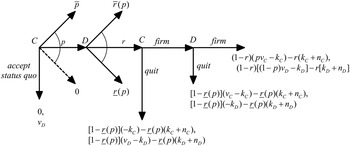
The game is illustrated in Figure 1. The challenger begins by accepting or challenging the status quo. The game ends if there is no challenge, and the defender retains control of the territory worth v D > 0. The challenger's payoff is normalized to zero.
A model of nuclear brinkmanship and military power.

The challenger challenges the status quo by bringing military power to bear and starting to fight. Formally, the challenger chooses
 $p \in \lpar 0\comma \; \bar p\rsqb $
where p is the probability that the challenger prevails if the crisis remains under control and does not escalate to an unlimited nuclear exchange.Footnote
29
The defender prevails with probability 1–p. The higher p, the more military might the challenger is bringing to bear and the better off it will be as long as the crisis remains a contest of military strength. The upper bound
 $\bar p$
is the challenger's probability of prevailing if it brings all of its military power to bear. Fighting (that is, choosing any p > 0) imposes costs k
C
and k
D
on the challenger and defender.
Bringing more power to bear (selecting a larger p) may include the “tactical” use of nuclear weapons, that is, the use of nuclear weapons against an adversary's military forces to defeat an attack. Examples include NATO's possible use of tactical nuclear strikes to disrupt a Soviet invasion or Pakistan's use of nuclear weapons on its own territory intended to blunt an Indian attack.Footnote 30 Of course bringing more power to bear in this way may also substantially increase the potential risk of escalation to all-out war with nuclear strikes against cities.
Once the challenger has set p, the defender decides how much risk and coercive pressure to generate. Formally, the defender chooses the risk r that the crisis will go out of control if neither state subsequently backs down. This is a simple, reduced-form way of modelling the idea that the defender can respond to the challenger's actions in many different (unmodelled) ways that generate varying degrees of risk. For example, whether or not the Kremlin authorized the use of tactical nuclear weapons in Cuba had a large effect on the probability that an American invasion would ultimately escalate to an all-out war. Indeed, it was this effect that dissuaded the Kremlin from authorizing the use of tactical nuclear weapons.
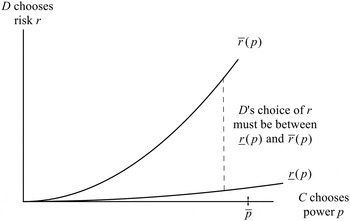
The model's defining feature is that the amount of power the challenger brings to bear affects the stability of the conflict. More specifically, how much power the challenger brings to bear limits how much risk the defender can generate. If the challenger brings p to bear, the defender must choose a risk r between
 $\underline r \lpar p\rpar $
and
 $\bar r\lpar p\rpar $
with
 $\underline r \lpar p\rpar \lt \bar r\lpar p\rpar $
.
The upper bound
 $\bar r\lpar p\rpar $
is the potential risk inherent in bringing p to bear. If the defender chooses, it can bid the actual risk up to this level in an effort to coerce the challenger into backing down. The higher
 $\bar r\lpar p\rpar $
, the larger the potential risk and the less stable the conflict.
We assume that the more power the challenger brings to bear, the less stable the conflict and the larger the potential risk. This formalizes the trade-off I highlighted in the discussion of the Kargil War and the Cuban missile crisis. Actions that seemed to offer a higher probability of military success, like crossing the Line of Control, using air power in Kargil, or attacking the missiles in Cuba, also seemed to create a larger potential risk. More precisely, assume the potential risk
 $\bar r\lpar p\rpar $
is zero if the challenger exerts no power and increases at an increasing rate as the challenger brings more power to bear. In symbols,
 $\bar r\lpar 0\rpar = 0$
with
 $\bar r^{\prime}\lpar p\rpar \gt 0$
and
 $\bar r^{{\prime}{\prime}}\lpar p\rpar \gt 0$
(as long as
 $\bar r\lpar p\rpar \lt 1$
).
The lower bound
 $\underline r \lpar p\rpar $
is the “existential” risk generated by bringing p to bear. That is,
 $\underline r \lpar p\rpar $
is the minimal or inescapable risk that fighting at p generates. Once the fighting starts, there is no avoiding this risk.Footnote
31
We assume this risk is zero at p = 0 and weakly increases at a weakly increasing rate:
 $\underline r \lpar 0\rpar = 0$
with
 $\underline r ^{\prime}\lpar p\rpar \ge 0$
and
 $\underline r ^{{\prime}{\prime}}\lpar p\rpar \ge 0$
as long as
 $\underline r \lpar p\rpar \lt 1$
. Taking
 $\underline r $
to be weakly increasing allows for the possibility that there is no existential risk, that is,
 $\underline r \lpar p\rpar = 0$
for all p. Finally, the scope for escalation,
 $\bar r\lpar p\rpar - \underline r \lpar p\rpar $
, is also assumed to increase at an increasing rate. A simple example satisfying these conditions is
 $\underline r \lpar p\rpar = \underline h {p^2}$
and
 $\bar r\lpar p\rpar = \bar h{p^2}$
with
 $\underline h \lt \bar h$
. Figure 2 illustrates the choice of p and r at the start of the game.Footnote
32
The risk functions

The risk functions can be seen as a generalization of the stability-instability paradox. If
 $\bar r\lpar p\rpar = \underline r \lpar p\rpar = \varepsilon $
for all
 $p \le \bar p$
, then fighting at any p generates a constant risk ε of nuclear escalation. Letting the potential and existential risks vary with p generalizes the stability-instability paradox in two ways. First, if we think of different values of p as representing different types or levels of conflict, then how states fight, or the level of violence at which they fight, affects the risk of all-out war. Second, letting the potential risk differ from the existential risk means that the amount of power brought to bear limits and influences the risk of escalation to general nuclear war, but it does not determine it. The actual level of risk the states run is endogenously determined as it is in brinkmanship.
Once the challenger has chosen p and the defender has chosen r, the challenger decides whether to quit or stand firm. The advantage of quitting is that the state only has to hazard the existential risk
 $\underline r \lpar p\rpar $
rather than the possibly higher risk r. The disadvantage is that the challenger gives up any chance of acquiring the territory whereas it would prevail with probability p if the states fight and the conflict does not escalate out of control. It follows that the challenger's expected payoff to quitting is
 $[1 - \underline r \lpar p\rpar ]\lpar 0 - {k_C}\rpar- \underline r \lpar p\rpar \lpar {k_C} + {n_C}\rpar $
where n
C
is the additional cost of an all-out nuclear war if there is one.Footnote
33
The defender keeps the territory if the challenger quits and events remain under control, and this leaves the defender with
 $[ 1 - \underline r \lpar p\rpar ]$
 $\times\, \lpar {v_D} - {k_D}\rpar - \underline r \lpar p\rpar [{k_D} + {n_D}]$
.
If the challenger stands firm, the defender has to decide whether to quit. Quitting again trades off a lower risk of disaster for a higher probability of prevailing if the conflict remains under control. The defender's and challenger's respective payoffs are
 $[1 - \underline r \lpar p\rpar ]\lpar 0 - {k_D}\rpar - \underline r \lpar p\rpar \lpar {k_D} + {n_D}\rpar $
and
 $[ 1 - \underline r \lpar p\rpar ]\lpar {v_C} - {k_C}\rpar - \underline r \lpar p\rpar \lpar {n_C} + {k_C}\rpar $
.
If both states stand firm, the challenger prevails with probability p in the contest for the territory. That is, the challenger obtains
 $p\lpar {v_C} - {k_C}\rpar + \lpar 1 - p\rpar \lpar 0 - {k_C}\rpar = p{v_C} - {k_C}$
as long as the contest remains under control which it does with probability 1−r. As a result, the challenger's payoff if both states stand firm is
 $\lpar 1 - r\rpar \lpar p{v_C} - {k_C}\rpar- r\lpar {n_C} + {k_C}\rpar $
. The defender obtains
 $\lpar 1 - r\rpar [\lpar 1 - p\rpar \lpar {v_D} - {k_D}\rpar + p\lpar 0 - {k_D}\rpar ]- r\lpar {n_D} + {k_D}\rpar $
.Footnote
34
The fundamental assumption and key point of departure for analysis is that the amount of power brought to bear affects the conflict's stability. This assumption is based most directly on the apparent trade-off decision makers have actually faced during nuclear crises. We can, however, also frame the trade-off in terms of Schelling's notions of “rocking the boat” and “fighting in a canoe.” Schelling sometimes used boat rocking as an example of a threat that leaves something to chance.
One cannot initiate certain disaster as a profitable way of putting compellent pressure on someone, but one can initiate a moderate risk of mutual disaster ... “Rocking the boat” is a good example. If I say, “Row, or I'll tip the boat over and drown us both,” you'll not believe me. I cannot actually tip the boat over to make you row. But if I start rocking the boat so that it may tip over—not because I want it to but because I do not completely control things once I start rocking the boat—you'll be more impressed.Footnote 35
Now suppose the boat is a canoe and one of the two parties in the boat is physically stronger than the other. The trade-off between power and risk is inherent in Schelling's image of fighting in the canoe. “Limited war ... is like fighting in a canoe. A blow hard enough to hurt is in some danger of overturning the canoe. One may stand up to strike a better blow, but if the other yields it may not have been the harder blow that worried him.”Footnote 36 That is, taking steps like standing up, which bring more power to bear and increase the probability that the stronger will prevail in the contest of physical strength, also raises the risk of capsizing. The risk functions formalize this trade-off.
To push the analogy further and foreshadow some of the results, consider three cases: calm, moderate, and heavy seas. If the seas are calm, neither party is able to rock the boat hard enough to generate much risk of tipping over even if the parties stand up. There is some risk, but it is not high enough to compel either to back down nor even to deter them from bringing their full power to bear by standing up. In these circumstances, the physically stronger party seems more likely to prevail. In moderate seas, the weaker party cannot rock the boat hard enough to generate much risk of capsizing as long as the stronger does not stand up. The stronger may still choose to fight, but may also decide not to stand up and thus not bring its full power to bear. In heavy seas, by contrast, both parties can rock the boat hard enough to make capsizing likely. The balance of physical strength is now largely irrelevant, and the side willing to run the greatest risk will prevail—unless, of course, the boat flips over and both drown.
However rough the seas, bringing more power to bear by standing up raises the risk of tipping over. But the intensity of the trade-off between power and risk varies with the seas. If the seas are calm, standing up does not raise the risk much. If
 $\bar r\lpar p\rpar = \bar h{p^2}$
, calm seas correspond to a low
 $\bar h$
. If the seas are moderate,
 $\bar h$
is larger, the trade-off is sharper, and standing up is riskier. When the seas are heavy,
 $\bar h$
is still larger and standing up generates even more risk.Footnote
37
The Brinkmanship Subgame
The first step in characterizing the subgame perfect equilibria of the game is to analyze play starting with the defender's choice of r given p. The analysis shows that the defender has no incentive to engage in a contest of resolve when the balance of resolve favors the challenger. Rather, the defender minimizes the risk of escalation by setting r to the lowest level,
 $r = \underline r \lpar p\rpar $
. By contrast, the defender transforms the contest of strength into one of resolve in which it is sure to prevail when the balance of resolve favors the defender and the potential for raising the risk
 $\bar r\lpar p\rpar $
is high enough. That is, the defender generates a level of risk r it is willing to run but the challenger is not. This risk compels the challenger to back down.
The states' levels of resolve are critical to solving the game. Define a state's resolve to be the maximum risk it would be willing to run in order to win the “prize” of fighting for the territory given that the challenger prevails in this fight with probability p. Formally, consider the last node in the tree where the defender chooses between quitting or standing firm and continuing to fight. It stands firm when the payoff to doing so is at least as large as the payoff to quitting:
 $\lpar 1 - r\rpar [\lpar 1 - p\rpar {v_D} - {k_D}]$
 $- r[{k_D} + {n_D}] \ge [1 - \underline r \lpar p\rpar ]\lpar - {k_D}\rpar - \underline r \lpar p\rpar \lpar {k_D} + {n_D}\rpar $
or
 $$r \le \displaystyle{{\lpar 1 - p\rpar {v_D} + \underline r \lpar p\rpar {n_D}} \over {\lpar 1 - p\rpar {v_D} + {n_D}}} \equiv {R_D}\lpar p\rpar$$
where R D (p) is defined to be the defender's resolve at p.
As for the challenger's resolve, suppose the challenger is choosing between standing firm and quitting, given that the defender will subsequently stand firm. Standing firm in these circumstances yields
 $\lpar 1 - r\rpar \lpar p{v_C} - {k_C}\rpar - r\lpar {k_C} + {n_C}\rpar $
while quitting brings
 $ - {k_C} - \underline r \lpar p\rpar {n_C}$
. Hence, the challenger prefers standing firm whenever
 $\lpar 1 - r\rpar \lpar p{v_C} - {k_C}\rpar - r\lpar {k_C} + {n_C}\rpar \ge - {k_C} - \underline r \lpar p\rpar {n_C}$
or
 $$r \le \displaystyle{{\,p{v_C} + \underline r \lpar p\rpar {n_C}} \over {\,p{v_C} + {n_C}}} \equiv {R_C}\lpar p\rpar$$
where R C (p) is the challenger's resolve at p.
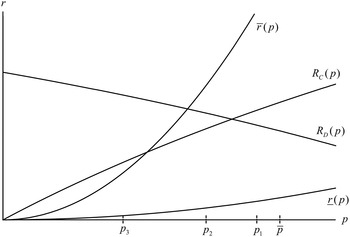
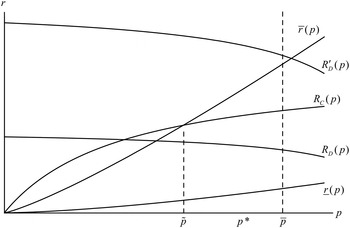
A crucial consequence of the trade-off between power and risk is that the states' levels of resolve vary with p. As illustrated in Figure 3, the challenger's resolve is increasing in p and the defender's resolve, subject to some qualifications, is decreasing. The intuition here is that the value of the prize of fighting at p increases for the challenger and decreases for the defender as p increases. As a result, the challenger is willing to run a higher risk in order to win this prize whereas the defender is willing to run a lower risk only.Footnote 38
Resolve and risk

Turning to the subgame perfect equilibrium of the brinkmanship subgame, observe first that the defender never bluffs by bidding more than its resolve, that is, the defender never chooses
 $r \gt {R_D}\lpar p\rpar $
, when there is complete information. To see why, suppose that it did. As long as there is complete information, the challenger knows that this is a bluff. Reasoning backwards from the end of the tree, the challenger knows that the defender is sure to quit when
 $r \gt {R_D}\lpar p\rpar $
. As a result, the challenger stands firm.
Given that the challenger stands firm and the defender quits when
 $r \gt {R_D}\lpar p\rpar $
, the defender's payoff to bidding any
 $r \gt {R_D}\lpar p\rpar $
is
 $ - {k_D} - \underline r \lpar p\rpar {n_D}$
. It follows that bidding
 $r \gt {R_D}\lpar p\rpar $
cannot be part of equilibrium play, since the defender is sure to do better by bidding
 $r = \underline r \lpar p\rpar $
and then standing firm. This brings
 $[1 - \underline r \lpar p\rpar ]{v_D} - {k_D} - \underline r \lpar p\rpar {n_D}$
if the challenger quits and
 $[1 - \underline r \lpar p\rpar ]\lpar 1 - p\rpar {v_D} - {k_D} - \underline r \lpar p\rpar {n_D}$
if the challenger stands firm. Both are strictly larger than the defender's payoff to bidding r. Hence, the defender never bids more than its resolve, and consequently
 $r \le {R_D}\lpar p\rpar $
in any equilibrium.
In light of this, there are three cases to consider: the defender is unwilling to outbid the challenger in a contest of resolve; the defender is both willing and able to outbid the challenger; and, finally, the defender is willing but unable to outbid the challenger. Suppose the defender is unwilling to outbid the challenger in a contest of resolve. That is, the balance of resolve favors the challenger:
 ${R_C}\lpar p\rpar \gt {R_D}\lpar p\rpar $
as at
 ${p_1}$
in Figure 3. This unfavorable balance implies that the challenger is willing to run any risk the defender is willing to run. In symbols,
 $r \le {R_D}\lpar p\rpar \lt {R_C}\lpar p\rpar $
. Because the defender is unwilling to bid the risk up high enough to compel the challenger to back down, generating any lesser risk only makes things more dangerous and raises the expected costs. As a result, the defender runs the minimal risk possible by setting
 $r = \underline r \lpar p\rpar $
.Footnote
39
To specify the payoffs associated with this case, observe that both the challenger and defender stand firm after a bid of
 $r = \underline r \lpar p\rpar $
. Doing so entails no additional risk and offers at least some chance of prevailing if events remain under control. Thus, the states' payoffs at p when the balance of resolve favors the challenger are
 $[1 - \underline r \lpar p\rpar ]\lpar p{v_C} - {k_C}\rpar - \underline r \lpar p\rpar [{k_C} + {n_C}]$
and
 $[1 - \underline r \lpar p\rpar ][\lpar 1 - p\rpar {v_D} - {k_D}]- \underline r \lpar p\rpar [{k_D} + {n_D}] $
.
In the second case, the defender is both willing and able to outbid the challenger. That is, the balance of resolve favors the defender and the potential risk is high enough that the defender can generate more risk than the challenger is willing to run. In symbols,
 ${R_D}\lpar p\rpar \gt {R_C}\lpar p\rpar $
and
 $\bar r\lpar p\rpar \gt {R_C}\lpar p\rpar $
as, for example, at
 ${p_2}$
. In these circumstances, the defender maximizes its payoff by transforming the contest of strength into a contest of resolve which it is sure to win. It does this by bidding the risk up to a level that generates enough coercive pressure to compel the challenger to back down. Formally, the defender bids an r between
 ${R_C}\lpar p\rpar $
and
 $\min \lcub {R_D}\lpar p\rpar \comma \; \bar r\lpar p\rpar \rcub $
.
Subsequent play and payoffs following this bid are easy to determine. Since the risk is less than the defender's resolve, the defender is sure to stand firm if it has to choose between standing firm and quitting at the end of the game. This means that the challenger will have to run risk r if it stands firm. However, this risk exceeds the challenger's resolve, so it prefers to back down. Thus, bidding any r between
 ${R_C}\lpar p\rpar $
and
 $\min \lcub {R_D}\lpar p\rpar \comma \; \bar r\lpar p\rpar \rcub $
yields payoffs of
 $ - {k_C} - \underline r \lpar p\rpar {n_C}$
and
 ${v_D} - {k_D} - \underline r \lpar p\rpar \lpar {v_D} + {n_D}\rpar $
.
Finally, suppose the defender is willing but unable to outbid the challenger. More precisely, the balance of resolve favors the defender, but the situation is sufficiently stable that the challenger is willing to run the highest risk that can be generated:
 ${R_D}\lpar p\rpar \gt {R_C}\lpar p\rpar $
but
 ${R_C}\lpar p\rpar \gt \bar r\lpar p\rpar $
as at
 ${p_3}$
. In these circumstances, the defender, although more resolute than the challenger, is unable to compel the challenger to back down. Any risk the defender can run (that is, any
 $r \le \bar r\lpar p\rpar \rpar $
, the challenger is also willing to run. Thus, generating any risk above
 $\underline r \lpar p\rpar $
only makes things more dangerous and raises the expected costs. Hence, the defender runs the minimal risk possible by setting
 $r = \underline r \lpar p\rpar $
. Both states are willing to run this risk (
 $r \le \bar r\lpar p\rpar \lt {R_C}\lpar p\rpar \lt {R_D}\lpar p\rpar $
), so each subsequently stands firm. This yields payoffs of
 $p{v_C} - {k_C} - \underline r \lpar p\rpar [p{v_C} + {n_C}]$
and
 $\lpar 1 - p\rpar {v_D} - {k_D} - \underline r \lpar p\rpar [\lpar 1 - p\rpar {v_D} + {n_D}]$
.
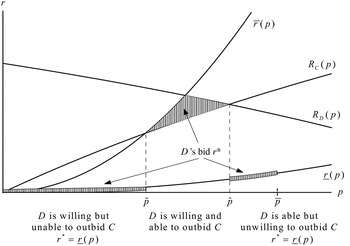
Figure 4 summarizes these results, showing how the defender's bid varies with the power the challenger brings to bear. Lemma 1 states the results formally.
Lemma 1
The states' subgame perfect equilibrium payoffs in the brinkmanship subgame starting after any
 $p \in \lpar 0\comma \; \bar p]$
are:
-
(a) If the defender is either unwilling or unable to outbid the challenger, that is, if
 ${R_D}\lpar p\rpar \le {R_C}\lpar p\rpar $
or
$\bar r\lpar p\rpar \le {R_C}\lpar p\rpar $
, then the defender bids the minimal risk
${r^{ \ast} } = \underline r \lpar p\rpar $
and the states' payoffs are
$p{v_C} - {k_C} - \underline r \lpar p\rpar [p{v_C} + {n_C}]$
and
$\lpar 1 - p\rpar {v_D} - {k_D} - \underline r \lpar p\rpar [\lpar 1 - p\rpar {v_D} + {n_D}]$
;
-
(b) If the defender is willing and able to outbid the defender, that is, if
${R_D}\lpar p\rpar \gt {R_C}\lpar p\rpar $
and
$\bar r\lpar p\rpar \gt {R_C}\lpar p\rpar $
, then it does so with any
${R_C}\lpar p\rpar \le {r^{ \ast} } \le \min \lcub {R_D}\lpar p\rpar \comma \; \bar r\lpar p\rpar \rcub $
and the states obtain
$ - {k_C} - \underline r \lpar p\rpar {n_C}$
and
${v_D} - {k_D} - \underline r \lpar p\rpar \lpar {v_D} + {n_D}\rpar $
.Footnote
40


Proof: The lemma is a direct consequence of backwards induction.
D's bid as a function of power p

A surprising implication of Lemma 1 is that the challenger may at times bring more rather than less power to bear in order to prevent the defender from transforming the contest of strength into one of resolve. Let
 $\widehat{p}$
denote the point at which
 ${R_C}\lpar p\rpar $
and
 ${R_D}\lpar p\rpar $
cross. If
 $\widehat{p}$
is less than the maximum amount of power the challenger can bring to bear, that is, if
 $\widehat{p} \lt \bar p$
as in Figure 4, then the defender is no longer willing to outbid the challenger when the challenger brings more than
 $\widehat{p}$
to bear and the risk the defender runs drops to the existential risk
 ${r^{ \ast} } = \underline r \lpar p\rpar $
. This gives the challenger an incentive to bring more power to bear. By contrast, the challenger cannot induce the defender to bid the minimal risk by bringing more power to bear when
 $\widehat{p} \gt \bar p$
as it is in Figure 5 when the defender's resolve is given by
 ${R_D}^{\prime}\lpar p\rpar $
.
More and less resolute defenders

Complete-Information Equilibria
There are many different equilibria depending on the relationship assumed to hold among the parameters. We focus on two cases of substantive interest. Roughly, the balance of resolve favors the challenger in the first and the defender in the second. The key result is that when there is complete information and balance of resolve favors the defender, the defender's latent threat to transform the contest of strength into a test of resolve and then outbid the challenger induces the challenger to bring less power to bear. India, for example, limited its operations in Kargil to its side of the LoC, trading military advantage for greater stability.
Before formalizing the cases, it is useful to define
 $\widetilde{p}$
to be the level of power at which the maximal risk the challenger is willing to run equals the maximal risk that the defender can generate, that is,
 $\widetilde{p}$
satisfies
 ${R_C}\lpar \widetilde{p}\rpar = \bar r\lpar \widetilde{p}\rpar $
.Footnote
41
If the challenger brings less power to bear than
 $\widetilde{p}$
, the defender cannot outbid the challenger in a contest of resolve. The situation is sufficiently stable and the potential risk sufficiently low that the challenger is willing to run any risk the defender can generate:
 $p \lt \widetilde{p}$
implies
 $\bar r\lpar p\rpar \lt {R_C}\lpar p\rpar $
. By contrast, the defender can outbid the challenger when
 $p \gt \widetilde{p}$
.
To specify the first case in which the balance of resolve favors the challenger, suppose the stakes for the defender
 ${v_D}$
are sufficiently small that the defender is never both willing and able to outbid the challenger. This is the situation in Figure 5 when the defender's resolve is
 ${R_D}\lpar p\rpar $
. The defender is unable to outbid the challenger when
 $p \lt \widetilde{p}$
. When
 $p \gt \widetilde{p}$
, the defender can generate enough risk to outbid the challenger but is unwilling to do so (that is,
 ${R_D}\lpar p\rpar \lt {R_C}\lpar p\rpar $
).
As Lemma 1 shows, the defender has no incentive to add to the existential risk and sets
 $r = \underline r \lpar p\rpar $
in these circumstances. This leaves the challenger with
 ${W_C}\lpar p\rpar = p{v_C} - {k_C} - \underline r \lpar p\rpar \lpar p{v_C} + {n_C}\rpar $
for
 $p \in \lpar 0\comma \; \bar p]$
. If the challenger decides not to use force (p = 0), it obtains
 ${W_C}\lpar 0\rpar \equiv 0$
. It follows that the challenger brings the unique level of power
 ${p^{ \ast} }$
to bear that maximizes this payoff where
 ${p^{ \ast} }$
balances the marginal gain of a higher probability of prevailing against the marginal cost of a higher existential risk of disaster. If there is no existential risk (
 $\underline r \lpar p\rpar = 0$
for all p) and the balance of resolve favors the challenger, the challenger brings its full power to bear with
 $p = \bar p$
.Footnote
42
Now consider the case in which the balance of resolve favors the defender. Assume more specifically the defender's stakes are so large that the balance of resolve favors the defender even if the challenger brings its full power to bear. That is,
 ${R_D}^{\prime}\lpar \bar p\rpar \gt {R_C}\lpar \bar p\rpar $
where
 ${R_D}^{\prime}$
in Figure 5 denotes the defender's resolve.Footnote
43
To focus on the substantively interesting case, suppose further that
 ${p^{ \ast} }$
is larger than
 $\widetilde{p}$
. Were this not so, the challenger could not be outbid at its optimal level of power
 ${p^{ \ast} }$
and the balance of resolve would not matter. That is,
 ${p^{ \ast} } \le \widetilde{p}$
means
 $\overline r \lpar {p^{ \ast} }\rpar \le {R_C}\lpar {p^{ \ast} }\rpar $
and hence that the challenger cannot be outbid at
 ${p^{ \ast} }$
.
When the balance of resolve favors the defender with
 ${p^{ \ast} } \gt \widetilde{p}$
, the defender's latent threat to turn a contest of military strength into a contest of resolve induces the challenger to bring less power to bear. In particular, the challenger either foregoes the use of force (p = 0) or brings
 $\widetilde{p}$
rather than
 ${p^{ \ast} }$
to bear.
To verify that the challenger's equilibrium choice is either zero or
 $\widetilde{p}$
, note that if the challenger brings more power than
 $\widetilde{p}$
to bear, the defender is willing and able to outbid the challenger.Footnote
44
According to Lemma 1, the challenger backs down in these circumstances and obtains
 ${W_C}\lpar p\rpar = - {k_C} - \underline r \lpar p\rpar {n_C}$
for
 $p \in \lpar \widetilde{p}\comma \; \bar p]$
. If, by contrast, the challenger brings
 $\widetilde{p}$
or less to bear, it cannot be outbid and the defender sets
 $r = \underline r \lpar p\rpar $
. This gives the challenger
 ${W_C}\lpar p\rpar = p{v_C} - {k_C} - \underline r \lpar p\rpar \lpar p{v_C} + {n_C}\rpar $
for
 $p \in \lpar 0\comma \; \widetilde{p}]$
. The maximum occurs at either 0 or
 $\widetilde{p}$
.Footnote
45
If
 ${W_C}\lpar \widetilde{p}\rpar \gt 0$
, the challenger brings
 $\widetilde{p}$
to bear. If, however, the chances of prevailing
 $\widetilde{p}$
are sufficiently small, then
 ${W_C}\lpar \widetilde{p}\rpar \lt 0$
and the challenger foregoes the use of power (p = 0).
Proposition 1
When there is no uncertainty about the balance of resolve, the risk is never bid up above the existential level. If the balance of resolve favors the challenger, the states fight in equilibrium at power
 ${p^{ \ast} }$
and risk
 $\underline r \lpar {p^{ \ast} }\rpar $
when
 ${W_C}\lpar {p^{ \ast} }\rpar \gt 0$
. The challenger foregoes the use of force with
 ${p^{ \ast} } = 0$
when
 ${W_C}\lpar {p^{ \ast} }\rpar = 0$
. If the balance of resolve favors the defender and
 ${p^{ \ast} } \gt \widetilde{p}$
, the defender's latent threat to transform a contest of military strength into a contest of resolve induces the challenger to bring less power to bear. The states fight in equilibrium at power
 $\widetilde{p}$
and risk
 $\underline r \lpar \widetilde{p}\rpar $
when
 ${W_C}\lpar \widetilde{p}\rpar \gt 0$
. The challenger foregoes the use of force when
 $\widetilde{p}$
is small, that is, when
 ${W_C}\lpar \widetilde{p}\rpar \lt 0$
.
Proof: The proposition follows directly from Lemma 1 and backwards induction.
The higher the challenger's payoff to prevailing, the more risk it is willing to run and the more power it is willing to bring to bear (
 $\partial \widetilde{p}/\partial {v_C} \gt 0$
and
 $\partial {p^{ \ast} }/\partial {v_C} \ge 0$
). Conversely, the higher the costs of fighting or of escalation, the less power the challenger is willing to bring to bear (
 $\partial {p^{ \ast} }/\partial {k_C} \lt 0$
,
 $\partial \widetilde{p}/\partial {n_C} \lt 0$
and
 $\partial {p^{ \ast} }/\partial {n_C} \le 0$
).Footnote
46
The Risk Functions and Nuclear Deterrence Theory
My analysis formalizes the stability of the strategic environment in a very simple and highly stylized way. Even so, the risk functions provide a framework for analyzing and clarifying important issues in nuclear deterrence theory and policy.
The stability-instability paradox revisited
The simplest version of the stability-instability paradox asserts that the more likely conventional conflict is to escalate to a nuclear conflict, the less likely states are to engage in conventional conflict. However, the implications of the paradox and the underlying mechanism are less clear when we allow for multiple levels of conflict—low, medium, and high-intensity conflict. Does greater instability at the strategic-nuclear level make violence at all lower levels less likely? Does it make conflict at some lower levels less likely and more likely at others? Snyder seems to suggest the former, “the greater the instability of the ‘strategic’ balance of terror, the lower the stability of the overall balance at its lower levels.”Footnote 47 Jervis too suggests this. “To the extent that the military balance is stable at the level of all-out war, it will become less stable at lower levels of violence.”Footnote 48
My analysis leads to a different conclusion. Increasing instability in the form of a sharper trade-off between power and risk induces the challenger to bring less power to bear. This makes conflict at higher levels of violence less likely but conflict at lower levels more likely.
To develop this linkage, note that the size or severity of the trade-off between power and risk can be seen as a measure of stability. That is, the sharper the trade-off between power and risk, the higher the risk associated with bringing a given amount of power to bear and the less stable the conflict. To fix ideas, assume again that
 $\bar r\lpar p\rpar = \bar h{p^2}$
and
 $\underline r \lpar p\rpar = \underline h {p^2}$
with
 $\underline h \lt \bar h \lt 1$
.Footnote
49
The parameters
 $\bar h$
and
 $\underline h $
formalize the severity of the trade-off between power and risk. The larger
 $\bar h$
, the greater the potential risk of bringing p to bear (
 $\partial \bar r/\partial \bar h \gt 0$
) and the sharper the trade-off between power and risk (
 ${\partial ^2}\bar r/\partial \bar h\partial p \gt 0$
). Less formally, the larger
 $\bar h$
, the rougher the seas and the higher the risk of capsizing the weaker party can generate by rocking the boat. The larger
 $\underline h $
, the greater the existential risk (
 $\partial \underline r /\partial \underline h \gt 0$
) and the sharper the trade-off (
 ${\partial ^2}\underline r /\partial \underline h \partial p \gt 0$
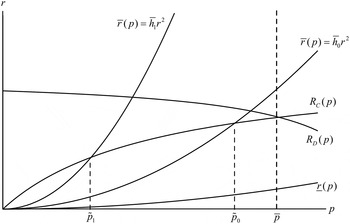
). Figure 6 illustrates the effects of increasing
 $\overline h $
from
 ${\overline h _0}$
to a higher
 ${\overline h _1}$
.
The effects of changes in the potential-risk function

We can now use Proposition 1 to link changes in stability to the levels of power brought to bear and the likelihood of conflict. According to Proposition 1, the challenger brings
 ${p^{ \ast} }$
to bear when the balance of resolve favors the challenger and
 $\widetilde{p}$
to bear when the balance of resolve favors the defender. Moreover, the levels of power
 $\widetilde{p}$
and
 ${p^{ \ast} }$
depend on the properties of the risk functions and especially on the trade-off between power and risk. The sharper the trade-off, the lower
 $\widetilde{p}$
and
 ${p^{ \ast} }$
and the less power the challenger brings to bear. As Figure 6 indicates, an increase in
 $\bar h$
from
 ${\bar h_0}$
to a larger
 ${\bar h_1}$
lowers
 $\widetilde{p}$
from
 ${\widetilde{p}_0}$
to
 ${\widetilde{p}_1}$
.Footnote
50
Thus a strong but less-resolute challenger brings less and less power to bear as the situation becomes less stable. As the trade-off between power and risk becomes sharper, the more resolute defender's latent threat to transform the contest of strength into a test of resolve “binds” at a lower level of violence, that is,
 ${R_C}\lpar p\rpar = \bar r\lpar p\rpar $
at a lower p. This in turn lowers the challenger's payoff to challenging the status quo (
 $\partial {W_C}\lpar \widetilde{p}\rpar /\partial \widetilde{p} \lt 0$
).Footnote
51
Indeed, if the level of instability is high enough, the chances of prevailing at
 $\widetilde{p}$
are too low to make the use of force worthwhile and there is no challenge. That is,
 ${W_C}\lpar \widetilde{p}\rpar \lt 0$
when
 $\bar h$
is high enough. In sum, the framework developed here leads to the following stability-instability paradox: greater strategic instability leads to less power being brought to bear and thus less large-scale (high p) conflict, often more lower-level conflict (that is, when
 ${W_C}\lpar \widetilde{p}\rpar \gt 0$
), and sometimes no conflict at all (when
 ${W_C}\lpar \widetilde{p}\rpar \lt 0$
).
This is the essence of what Kapur argues has happened in South Asia.Footnote 52 A high degree of instability deters India from bringing its conventional superiority to bear against Pakistan. This in turn enables Pakistan to pursue low-level conflict which otherwise would be deterred by the threat of a large-scale Indian conventional retaliation. In this way, “the existence of a substantial degree of strategic instability has fueled lower-level violence”Footnote 53
The (ir)relevance of the balance of military power
As observed earlier, a common argument during the Cold War was that the balance of military power between the Soviet Union and United States was relatively unimportant. Virtually any use of force would quickly become a contest of resolve.Footnote 54 The model shows that whether this is the case depends on an important implicit assumption about stability and the trade-off between power and risk.
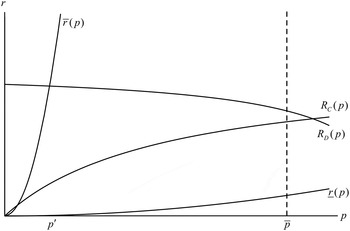
The military balance becomes irrelevant if bringing even a small amount of power to bear raises the potential risk to very high levels. Standing up to fight in these circumstances is too dangerous and the outcome will be determined by which party is willing to run the bigger risk by rocking the boat the hardest. More formally, when
 $\bar h$
is large, the states can bid the risk up to very high levels if they choose to do so, and the balance of resolve determines the outcome. Figure 7 illustrates this situation. Once
 $p \gt p^{\prime}$
, neither state is willing to bid the risk up to the highest level possible, that is, to
 $\bar r\lpar p\rpar $
. The potential risk is no longer a “binding constraint,” and the risks the states run are determined solely by their levels of resolve.Footnote
55
High potential risk and MAD during the Cold War

Put another way, suppose the large nuclear and conventional forces the United States and Soviet Union and their respective NATO and Warsaw Pact allies had during the Cold War, along with their command and control capabilities and the existing technology, combined to create a strategic environment in which the potential risk generated by any significant use of force was high. Then contests of strength would become contests of resolve. But it is important to emphasize that even if this assumption held to a reasonable degree between the superpowers during the Cold War, it may or may not hold in other cases. Those cases, such as India and Pakistan, China and the United States, the United States and a nuclear-armed “rogue,” must be evaluated in their own right.
Risk functions and nuclear doctrines
Because the amount of power brought to bear (
 $\widetilde{p}$
or
 ${p^{ \ast} }$
) depends on the trade-offs embodied in the risk functions, states have an incentive to try to shape these trade-offs. The model assumes this is impossible over the short run in that the states take the functions
 $\bar r\lpar p\rpar $
and
 $\underline r \lpar p\rpar $
as exogenously given. Over the longer run, however, states may be able to influence these trade-offs to some degree. Efforts to do so help explain important aspects of states' nuclear doctrines and postures.
Suppose a state that is weaker but more resolute than its adversary is trying to dissuade that adversary from using force. Examples include Pakistan's efforts to deter Indian threats to Pakistan's vital interests, or North Korea's or a nuclear-armed Iran's attempts to deter the United States in a regional confrontation.Footnote
56
According to Proposition 1, a stronger but less resolute state brings
 $\widetilde{p}$
to bear as long as the expected payoff to fighting at
 $\widetilde{p}$
is higher than the payoff to foregoing a challenge—as long as
 ${W_C}\lpar \widetilde{p}\rpar \gt 0$
. If
 $\widetilde{p}$
is too small, then the prospect of prevailing will be too low to warrant the cost of fighting and the stronger state will choose not to fight. This occurs whenever
 ${W_D}\lpar \widetilde{p}\rpar \lt 0$
. Thus any changes in technology, doctrine, or force posture that sharpens the trade-off between power and potential risk makes the weaker state better off by inducing the stronger state to bring less power to bear. In symbols, an increase in
 $\bar h$
leads to a decrease in
 $\widetilde{p}$
and an increase in
 ${W_D}\lpar \widetilde{p}\rpar $
.Footnote
57
These effects highlight in a very simple way some of the incentives a weak state has to “go nuclear” and thereby be able to transform a contest of strength into one of resolve. If a weak state has no nuclear weapons, it cannot threaten to engage in a process that may ultimately end in its launching a nuclear attack against its adversary. In other words, the potential and minimal risks are zero:
 $\bar r\lpar p\rpar = \underline r \lpar p\rpar = 0$
for all p. In the absence of any risk of escalation, the stronger state brings all of its power to bear (
 ${p^{ \ast} } = \bar p$
). Nuclear weapons and the latent threat of escalation compel it to bring less power to bear (
 $\widetilde{p} \lt \bar p$
).
More generally, a militarily weak but resolute state that already has nuclear weapons will be advantaged by a doctrine, posture, and force structure in which the potential risk rises rapidly as more power is brought to bear (a large
 $\bar h$
). We can see these incentives in the evolution of Pakistan's nuclear doctrine.
In order to deter a militarily stronger adversary from threatening its vital interests, Pakistan, like NATO before it, has eschewed a no-first-use nuclear doctrine. After becoming an overt nuclear state in 1998, Pakistan moved toward a nuclear posture that envisioned the possibly rapid, “first use of nuclear weapons against conventional attacks.” This in turn required the operationalization of nuclear weapons as “usable warfighting instruments.”Footnote 58 As former Pakistani General Feroz Khan puts it, “with relatively smaller conventional forces, and lacking adequate technical means, especially in early warning and surveillance, Pakistan relies on a more proactive nuclear defensive policy.”Footnote 59 Pakistan's Ambassador to the United States made the same point in the spring of 2001. Because of the growing conventional asymmetry with India, “Pakistan will be increasingly forced to rely on strategic capabilities … Risks of escalation through accident and miscalculation cannot be discounted.”Footnote 60
In brief, Pakistan's nuclear posture, which Narang describes as “asymmetric escalation,” entails a fundamental trade-off. When compared to a posture of “assured retaliation,” which emphasizes survivable second-strike forces targeted against an adversary's key strategic centers, asymmetric escalation depends on being able to use or credibly threaten to use nuclear weapons against invading conventional forces. However, the forces needed to implement this “can generate severe command and control pressures that increase the risk of inadvertent use of nuclear weapons.”Footnote 61
Pakistan's acceptance of a riskier force posture is in keeping with the incentives highlighted in the model. The potential risk of nuclear escalation if India brings a given amount of power to bear is higher if Pakistan has an asymmetric-escalation doctrine. That is,
 $\overline h $
is higher as illustrated in the shift from
 ${h_0}$
to
 ${h_1}$
in Figure 6. As a result, India brings less power to bear (
 $\widetilde{p}$
decreases) and Pakistan is better off (
 ${W_D}\lpar \widetilde{p}\rpar $
increases).
Now consider the incentives facing a state that expects to be both weaker and less resolute than its adversary. Because this state will not try to outbid its adversary, a higher potential risk and the accompanying ability to bid the risk up to higher levels does no good. However, this state would benefit if its adversary faced a higher existential risk. As a result, this state has an incentive to “couple” its adversary's use of force to a higher risk of escalation. This reduces the amount of power the adversary brings to bear and leaves the weaker, less resolute state better off.
In terms of Proposition 1, the challenger brings
 ${p^{ \ast} }$
to bear when it is more resolute than the defender. The power
 ${p^{ \ast} }$
is unaffected by changes in the trade-off between power and potential risk. However, it decreases as the trade-off between power and existential risk increases. In symbols,
 $\partial {p^{ \ast} }/\partial \bar h = 0$
and
 $\partial {p^{ \ast} }/\partial \underline h \lt 0$
. The defender's payoff
 ${W_D}\lpar {p^{ \ast} }\rpar $
also increases as
 $\underline h $
increases.Footnote
62
We can see these incentives at play in the debate over theater nuclear forces (TNF) in Europe. As the Soviet Union built up its conventional and nuclear forces during the 1970s, some observers became concerned that the United States and NATO were weaker than the Soviet Union and Warsaw Pact and that the United States was less resolute than the Soviet Union over the “stakes” of Western Europe. As Assistant Secretary of State Richard Burt put it, “The expansion of the Soviet ICBM force brought to reality a prospect Europe had long faced—the possibility that a nuclear conflict might be limited to Europe.”Footnote 63 That is, the expansion of the Soviet ICBM force and the resulting nuclear parity with the United States meant that the United States would have to run a higher risk of escalation to all-out war if NATO were losing a conventional war in Europe—or even a “limited” nuclear war—and the United States used its strategic forces based in the United States and at sea to carry out limited nuclear options against targets in the Soviet Union. Many worried that the United States would be unwilling to hazard this higher risk.Footnote 64
In response to these concerns, NATO decided to modernize its nuclear forces by deploying Tomahawk cruise missiles and Pershing IIs.Footnote
65
These European-based forces would be capable of striking targets in the Soviet Union. However, these forces were not intended to “equal Soviet force levels.”Footnote
66
Rather, the goal was to couple long-range US strategic forces to any conflict in Western Europe, that is, raise the risk that a Soviet invasion would necessarily escalate and ultimately involve US strategic forces. In terms of the model, coupling increases
 $\underline h $
. Consistent with Proposition 1, a high enough risk would deter the Soviet Union from any use of force even if both the balance of strength and the balance of resolve favored the Soviet Union.
Finally, consider the incentives facing a stronger but less resolute state. India in relation to Pakistan or the United States in a confrontation with a nuclear-armed “rogue” state are likely examples. A stronger but less resolute state wants to lower the risk of bringing any given amount of power to bear and has an incentive to adopt a nuclear posture that does so. In terms of the model, a strong but less resolute state brings
 $\widetilde{p}$
to bear rather than
 ${p^{ \ast} }$
because of the latent threat of being outbid. Reducing the risk of bringing power to bear (lowering
 $\bar h$
) increases
 $\widetilde{p}$
.
These incentives can be seen in the evolution of India's nuclear posture following the Kargil War and, especially, the December 2001 attack on the Indian parliament. India quickly linked the attackers to militant groups based in Pakistan and held Pakistan partially responsible for the attack. Among other things, India demanded that Pakistan prevent future infiltration into Kashmir.Footnote 67
India also launched Operation Parakram to buttress its demands. This operation entailed a massive mobilization of Indian military forces, the largest since the 1971 Bangladesh war. Given the peacetime deployment of its forces, India took weeks to move its armored strike corps into position along the border. This gave Pakistan time to countermobilize and gave the United States time to bring political pressure to bear on both India and Pakistan. On 12 January, Pakistani President Musharraf made a televised address and promised that Pakistan would not allow its territory to be used as a base for launching terrorist attacks.
Indian forces remained mobilized but tensions eased until 14 May when suicide bombers struck an Indian base in Jammu. Tensions rose through the rest of May with India signaling an intent to go to war and renewed pressure on Pakistan from the United States and other countries. The crisis peaked in June when Musharraf promised a permanent end to infiltration and infiltration actually did decline. India began pulling its forces back from the border and demobilizing in October. Although Indian political leaders claimed that Operation Parakram had achieved its ends, there was widespread dissatisfaction with the outcome and the ability of Indian forces to compel Pakistan to make meaningful concessions. Indeed, infiltration into Kashmir subsequently resumed. As Tellis observed, “India did not secure the one thing its military mobilization was intended to achieve: conclusive termination of Pakistan's involvement in terrorism directed against India.”Footnote 68
Operation Parakram was based on the Sundarji doctrine entailing “an ‘all or nothing’ posture of the massive, but slow moving strike forces based far from the border.”Footnote 69 It “aimed to launch both deep thrusts into the Rajasthan sector and destroy Pakistan's offensive formations in detail.”Footnote 70 Critics argued that a war-fighting strategy that called for massive armored thrusts to dismember Pakistan or destroy its forces “was too crude and inflexible a tool to respond to terrorist attacks and other indirect challenges.”Footnote 71
Responding to these concerns, India announced a new doctrine in the spring of 2004. Popularly known as “Cold Start,” the doctrine emphasizes being able to mobilize quickly and carry out limited operations. “Rather than seek to deliver a catastrophic blow to Pakistan (i.e., cutting the country in two), the goal of Indian military operations would be to make shallow territorial gains, 50–80 kilometers deep, that could be used in postconflict negotiations to extract concessions from Islamabad.”Footnote 72 Mindful of the risks of escalation, Cold Start would use division-size forces that “lack the power to deliver a knockout blow. In the minds of the Indian miliary planners, this denies Pakistan the ‘regime survival’ justification for employing nuclear weapons in response to India's conventional attack.”Footnote 73
Viewing the evolution of India's doctrine in terms of the model, we can see how the use of massive conventional force planned in Operation Parakram created a very large potential risk of nuclear escalation. In symbols,
 $\bar h$
was quite large. Moreover, forces capable of launching deep thrusts into Pakistan and destroying its offensive formations “in detail” posed a threat to Pakistan's vital interests even if the initial dispute did not. Anticipating that the balance of resolve would favor Pakistan and that Pakistan would outbid it in a competition in risk-taking, India decided not to attack and eventually demobilized. Possibly overstating the point, Sood and Sawhney conclude that the “single reason which stopped the Indian political leadership from starting the war was the fear that Pakistan might use its nuclear weapons.”Footnote
74
Whether achievable or not, the goal of Cold Start is to make it possible to be able to bring substantial conventional power to bear against Pakistan without raising the risk of nuclear escalation to unacceptably high levels. In terms of the model, the purpose of Cold Start is to ease the trade-off between power and risk by lowering
 $\bar h$
. This increases the amount of power a state is willing to bring to bear and makes this state better off (both
 $\widetilde{p}$
and
 ${W_C}\lpar \widetilde{p}\rpar $
increase as
 $\bar h$
decreases).
The model also illustrates a second aspect of Cold Start. To the extent that India can tie its hands by deploying forces that Pakistan actually believes “lack the power to deliver a knockout blow” and therefore do not pose a threat to its vital national interests, the stakes for Pakistan go down. Formally,
 ${v_D}$
decreases if the issue shifts from the fate of Pakistan to the fate of Kashmir. This reduces D's resolve and shifts
 ${R_D}\lpar p\rpar $
down. If D's resolve shifts down far enough, say from
 ${R_D}^{\prime}\lpar p\rpar $
to
 ${R_D}\lpar p\rpar $
in Figure 5, the balance of resolve over these more limited stakes will shift in favor of C, and C will bring more power to bear.
Can the weak use nuclear weapons to blackmail the strong?
Weak states have an incentive to “go nuclear” to deter other states from threatening their vital interests like “regime change.” In these circumstances, the balance of resolve favors the weak state, and the latent threat of nuclear escalation deters the stronger state from bringing its full power to bear and may well deter it from attacking altogether. But can a weak nuclear state use the threat of nuclear escalation offensively? Can a weak state with nuclear weapons blackmail a strong state? This prospect is a significant factor underlying American efforts to limit the spread of nuclear weapons. As Waltz describes this concern in the case of Iran, some observers and policy-makers “worry that a nuclear weapon would embolden it, providing Tehran with a shield that would allow it to act more aggressively and increase its support for terrorism.”Footnote 75
The model provides some insight into the prospect of nuclear blackmail. The essence of the blackmail argument is that the risk of escalation will deter a stronger, less resolute state from bringing significant military power to bear against the blackmailer.Footnote 76 As discussed earlier, a weak but more resolute state can deter a stronger adversary from bringing significant power to bear if doing so would generate a potential risk the stronger state is unwilling to run. Only in these circumstances will the more resolute state be able to transform a contest of strength into one of resolve where it has the advantage. In brief, the ability of the weak to blackmail the strong is contingent. Insofar as a weak state's military forces are so limited that they cannot generate much potential risk, that state will be unable to blackmail a stronger, less resolute state.Footnote 77
Recent empirical work on the effects of nuclear weapons on crisis outcomes, while possibly suggestive, is not directly related to the question at issue here. Kroenig studies a data set of fifty-two crises between nuclear-armed states and reports that the state with more nuclear weapons than its adversary is more likely to prevail. However, the question at issue here is whether a weak state is more likely to provoke and prevail against a stronger adversary if the weak state acquires nuclear weapons.Footnote 78 Beardsley and Asal and Sechser and Fuhrmann study, among other things, the effects of having nuclear weapons compared to not having them but obtain conflicting results.Footnote 79 The former find compellent threats are more likely to succeed if the threatener has nuclear weapons; the latter find the opposite. Neither focuses on the specific case in which the state making the threats is substantially weaker than its adversary.
Uncertainty about the Balance of Resolve
How does uncertainty about the balance of power affect the dynamics of escalation? More specifically, how does uncertainty affect the amount of power the challenger brings to bear? How likely is it that the defender will try to transform a contest of strength into one of resolve by bidding the risk up above the minimal level
 $\underline r $
and how high will the risk go?
When the balance of resolve is uncertain, the challenger faces a trade-off when bringing more than
 $\widetilde{p}$
to bear. The more power it brings to bear, the more likely it is to prevail if events remain under control. But bringing more power to bear also increases the challenger's resolve (recall that
 ${R_C}\lpar p\rpar $
is increasing in p). As a result, the possibly more resolute defender has to bid the risk of escalation up to a higher level in order to compel the challenger to back down. The optimal amount of power the challenger brings to bear in equilibrium balances this trade-off.
We focus on the case in which the challenger is unsure whether the balance of resolve is favorable or unfavorable. More precisely, the challenger believes it is facing one of two possible types of defender, a resolute defender
 $D^{\prime}$
or an irresolute defender D, whose respective payoffs to prevailing are
 ${v_D}^{\prime}$
and
 ${v_D}$
with
 ${v_D}^{\prime} \gt {v_D}$
. The probability of facing the “tougher” type
 $D^{\prime}$
is
 $\tau $
and the chances of facing D are
 $1 - \tau $
. Let
 ${R_D}^{\prime}\lpar p\rpar $
and
 ${R_D}\lpar p\rpar $
denote the resolve of
 $D^{\prime}$
and D.
Two assumptions formalize the idea that the resolute defender
 $D^{\prime}$
is more resolute than the challenger who in turn is more resolute than the less resolute defender. Assume (1)
 ${R_D}^{\prime}\lpar \bar p\rpar \gt \bar r\lpar \bar p\rpar \gt {R_C}\lpar \bar p\rpar $
and (2)
 ${R_C}\lpar \widetilde{p}\rpar \gt {R_D}\lpar \widetilde{p}\rpar $
. Both of these hold in Figure 5. Assumption (1) ensures that the resolute defender
 $D^{\prime}$
is always willing to outbid the challenger and is actually able to do so for some
 $p \lt \bar p$
.Footnote
80
Assumption (2) implies that the irresolute defender is never both willing and able to outbid the challenger.Footnote
81
As in the complete-information game, the key to analyzing the game when there is uncertainty about the balance of resolve is characterizing the equilibrium of the brinkmanship game given p. When information is incomplete, this continuation game is effectively a signaling game between the defender who sends signal r and the challenger who decides whether to quit or stand firm after seeing r. This signaling game has an essentially unique equilibrium that satisfies two selection criteria.Footnote 82
To describe this equilibrium, let
 $\rho \lpar p\rpar $
and
 $\rho ^{\prime}\lpar p\rpar $
denote the risks D and
 $D^{\prime}$
bid. Uncertainty about the defender's resolve does not matter if
 $p \lt \widetilde{p}$
. Regardless of its resolve, the defender cannot outbid the challenger because the potential risk
 $\bar r\lpar p\rpar $
is too low (that is,
 ${R_C}\lpar p\rpar \lt \bar r\lpar p\rpar $
). Running a risk greater than
 $\underline r \lpar p\rpar $
therefore only adds to the danger and increases the expected costs without bringing enough coercive pressure to bear to compel the challenger to back down. As a result, the defender, regardless of its resolve, prefers to generate no additional risk. Formally, both D and
 $D^{\prime}$
run the minimal risk:
 $\rho \lpar p\rpar = \rho ^{\prime}\lpar p\rpar = \underline r \lpar p\rpar $
. This leaves the challenger with a payoff of
 ${U_C}\lpar p\rpar \equiv \lpar 1 - \underline r \rpar p{v_C} - {k_C} - \underline r {n_C}$
for
 $p \lt \widetilde{p}$
.
If the challenger brings more than
 $\widetilde{p}$
to bear, the defender can generate more risk than the challenger is willing to run. This results in a separating equilibrium. The resolute defender
 $D^{\prime}$
transforms the contest of strength into one of resolve by bidding a risk just high enough to compel the challenger to back down, namely
 $\rho ^{\prime}\lpar p\rpar = {R_C}\lpar p\rpar $
.Footnote
83
The challenger stands firm with probability p after this bid. By contrast, the less resolute defender D runs the minimal risk by setting
 $\rho \lpar p\rpar = \underline r \lpar p\rpar $
, and both states subsequently stand firm.Footnote
84
(See the appendix for the derivation of the equilibrium.)
To specify the challenger's payoff to
 $p \gt \widetilde{p}$
, observe that the challenger must be indifferent between quitting and standing firm since it randomizes over these two alternatives after a bid of R
C
(p) by standing firm with probability p. If the challenger were not indifferent between standing firm and quitting, mixing could not be equilibrium behavior. Thus the challenger's payoff to standing firm also equals payoff to quitting which is
 $ - {k_C} - \underline r \lpar p\rpar {n_C}$
. As a result, the challenger is sure to get
 $ - {k_C} - \underline r \lpar p\rpar {n_C}$
when the defender bids R
C
(p) after the challenger brings p to bear. It follows that the challenger's payoff to any
 $p \gt \widetilde{p}$
is
 $$\eqalign{{U_C}{\rm (}p{\rm )} & = (1 - \tau )\left[ {{\rm (}1 - \underline{r} (\,p{\rm ))}[\,p{v_C} - {k_C}{\rm ]} - \underline{r} (\,p{\rm )}({k_C} + {n_C}{\rm )}} \right] \cr & \quad + \tau [ - {k_C} - \underline{r} (\,p{\rm )}{n_C}] \cr & = {\rm (}1 - \tau {\rm )}[1 - \underline{r} {\rm (}p{\rm )]}p{v_C} - {k_C} - \underline{r} {\rm (}p{\rm )}{n_C}.} $$
The first term on the right side of the first equation is the challenger's payoff to fighting at the minimal risk
 $\underline r \lpar p\rpar $
weighted by the probability of this bid which is the probability of facing the irresolute defender. The second term is the challenger's payoff given a bid of
 ${R_C}\lpar p\rpar $
weighted by the probability of this bid.
The challenger's equilibrium choice of p follows immediately. It chooses the unique p that maximizes the challenger's payoff U
C
(p) over
 $0 \le p \le \overline p $
. Let
 ${p^{ \ast \ast }}$
denote this maximizer.Footnote
85
If
 ${p^{ \ast \ast }} = 0$
, the challenger acquiesces to the status quo and foregoes the use of force. If
 ${p^{ \ast \ast }} \in \lpar 0\comma \; \widetilde{p}]$
, both D and
 $D^{\prime}$
run as little risk as possible by bidding
 $\underline r \lpar {p^{ \ast \ast }}\rpar $
. If the challenger brings
 ${p^{ \ast \ast }} \gt \widetilde{p}$
to bear, D again bids
 $\underline r \lpar {p^{ \ast \ast }}\rpar $
. By contrast, the resolute defender
 $D^{\prime}$
transforms the contest of strength into a test of resolve by bidding
 ${R_C}\lpar {p^{ \ast \ast }}\rpar $
. The challenger stands firm with probability
 ${p^{ \ast \ast }}$
after a bid of
 ${R_C}\lpar {p^{ \ast \ast }}\rpar $
, and
 $D^{\prime}$
stands firm. Hence the probability that a conflict becomes a contest of resolve is
 $\tau $
, and the probability of a contest of resolve in which both states stand firm and run risk
 ${R_C}\lpar {p^{ \ast \ast }}\rpar $
is
 $\tau {p^{ \ast \ast }}$
.
The more likely it is that the balance of resolve favors the defender (the higher
 $\tau $
), the less power the challenger brings to bear (
 $\partial {p^{ \ast \ast }}/\partial \tau \lt 0$
). By contrast, the higher the stakes for the challenger, the more power it brings to bear. That is,
 ${p^{ \ast \ast }}$
is increasing in the challenger's payoff to prevailing,
 ${v_C}$
, and decreasing in the cost of disaster,
 ${n_C}$
. Higher stakes also make contests of resolve in which both sides stand firm more likely and more dangerous:
 $\tau {p^{ \ast \ast }}$
and
 $\rho ^{\prime}\lpar {p^{ \ast \ast }}\rpar = {R_C}\lpar {p^{ \ast \ast }}\rpar $
, are increasing in
 ${v_C}$
and decreasing in
 ${n_C}$
.Footnote
86
Conclusion
A very large open question in nuclear deterrence theory is whether and how the balance of military power affects the dynamics of escalation. The balance of military strength plays virtually no role in standard accounts of brinkmanship. But this is largely by assumption and seems inconsistent with important aspects of some cases. This paper takes a step toward integrating the military balance into nuclear deterrence theory by incorporating a trade-off between power and risk in a very simple, reduced-form model of nuclear brinkmanship. A challenge for future work is to open up this reduced form by developing models with more complete and explicit microfoundations.
The present analysis shows that the more confident the challenger is that its adversary is more resolute, the less power the challenger brings to bear. The model also formalizes the stability-instability paradox and provides a clearer mechanism linking the potential risk of escalation to the likelihood of conflict at lower levels of violence. Greater instability defined as a sharper trade-off between power and potential risk makes conflict at higher levels of violence less likely and more likely at lower levels.
More broadly, the analysis explains some of the incentives that different states have to adopt different nuclear doctrines and force postures. A state that expects to be weaker but more resolute than its adversary has an incentive to adopt doctrines and deploy forces that make the use of force riskier and thus easier to transform a contest of military strength into a test of resolve. A strong but less resolute state has the opposite incentive. Understanding these incentives helps explain important aspects of NATO's forces and doctrines during the Cold War as well as the more recent evolution of India's and Pakistan's forces and doctrines.
Appendix
This appendix states all of the formal results and proves some of the main ones. The online appendix contains proofs of all of the results. The first step in characterizing the equilibria of the asymmetric-information game is describing the equilibria of the brinkmanship subgame. Let
 ${\Gamma _B}\lpar p\rpar $
denote the brinkmanship continuation game given p. A pure strategy in this subgame for D is a pair
 $\lcub \rho \lpar p\rpar \comma \; {q_D}\lpar r\vert p\rpar \rcub $
where
 $\rho \lpar p\rpar \in [\underline r \lpar p\rpar \comma \; \overline r \lpar p\rpar ]$
is D's bid and
 ${q_D}\lpar r\vert p\rpar \in \lcub 0\comma \; 1\rcub $
indicates whether D quits (
 ${q_D}\lpar r\vert p\rpar = 1$
) or stands firm (
 ${q_D}\lpar r\vert p\rpar = 0$
) after r. (When we consider mixed strategies,
 ${q_D}\lpar r\vert p\rpar \in [0\comma \; 1]$
is the probability that D quits.) Similarly, a pure strategy for
 $D^{\prime}$
is the analogous pair
 $\lcub \rho ^{\prime}\lpar p\rpar \comma \; {q_D}^{\prime}\lpar r\vert p\rpar \rcub $
. A strategy for C is a function
 ${q_C}\lpar r\vert p\rpar $
for all
 $r \in [\underline r \comma \; \overline r ]$
where
 ${q_C}\lpar r\vert p\rpar $
is the probability C quits after bid r given p. We ease the notation by suppressing the argument “p” when it is not needed for clarity. A belief system for the challenger is a function t(r) which is the conditional probability of facing
 $D^{\prime}$
given a bid of r. Finally, a PBE of the brinkmanship continuation game is an assessment
 $\Delta = \lcub \rho \comma \; {q_D}\comma \; \rho ^{\prime}\comma \; {q_D}^{\prime}\comma \; {q_C}\comma \; t\rcub $
which is sequentially rational and in which t is derived from C's prior beliefs by Bayes's rule when possible.
Three lemmas help characterize the PBEs of the brinkmanship game. Lemma 1A demonstrates that neither D nor
 $D^{\prime}$
ever bids an
 $r \in \lpar \underline r \comma \; {R_C}\lpar p\rpar \rpar $
. C is sure to stand firm after such a bid and, consequently, D and
 $D^{\prime}$
would have done better by bidding
 $\underline r $
. Lemma 2A guarantees that at most one
 $r \in \lpar {R_C}\comma \; \overline r ]$
is played with positive probability in a PBE. Using this result, Lemma 3A shows that no
 $r \in \lpar {R_C}\comma \; \overline r ]$
is played with positive probability in any PBE satisfying D1. Taken together, these lemmas imply that a PBE satisfying D1 can put positive probability on at most
 $\underline r $
and
 ${R_C}\lpar p\rpar $
.
Lemma 1A
Let
 $\Delta = \lcub \rho \comma \; {q_D}\comma \; \rho ^{\prime}\comma \; {q_D}^{\prime}\comma \; {q_C}\comma \; t\rcub $
be a PBE of
 ${\Gamma _B}\lpar p\rpar $
. Then
 $\rho \notin \lpar \underline r \comma \; {R_C}\lpar p\rpar \rpar $
and
 $\rho ^{\prime} \notin \lpar \underline r \comma \; {R_C}\lpar p\rpar \rpar $
.
Lemma 2A
Let
 $\Delta $
be a PBE in which
 $r \in \lpar {R_C}\comma \; \overline r ]$
is played with positive probability. Then no other
 $\widehat{r} \in \lpar {R_C}\comma \; \overline r ]$
is played with positive probability.
Lemma 3A
Let
 $\Delta $
be a PBE satisfying D1. Then no
 $r \in \lpar {R_C}\comma \; \overline r ]$
is played with positive probability in
 $\Delta $
.
Proofs: See the online appendix.
The previous lemmas make it easy to specify a PBE satisfying D1. Lemma 1A implies that both D and
 $D^{\prime}$
bid
 $\underline r $
and all states subsequently stand firm whenever
 $p \lt \widetilde{p}$
as this implies
 $\overline r \lt {R_C}$
. Proposition 1A describes a separating PBE satisfying D1 when
 $p \in \lpar \widetilde{p}\comma \; \overline p ]$
. Define the assessment
 ${\Delta _0}$
in which D plays according to
 $\rho = \underline r $
,
 ${q_D}\lpar r\rpar = 0$
for
 $r \le {R_D}$
and
 ${q_D}\lpar r\rpar = 1$
for
 $r \gt {R_D}$
;
 $D^{\prime}$
plays according to
 $\rho ^{\prime} = {R_C}$
,
 ${q_D}^{\prime}\lpar r\rpar = 0$
for
 $r \le {R_D}^{\prime}$
and
 ${q_D}^{\prime}\lpar r\rpar = 1$
for
 $r \gt {R_D}^{\prime}$
; and C follows
 ${q_C}\lpar r\rpar = 0$
for
 $r \ne {R_C}$
and
 ${q_C}\lpar {R_C}\rpar = 1 - p$
. C's beliefs are t(r) = 0 if
 $r = \underline r $
,
 $t\lpar r\rpar = \tau $
for
 $r \in \lpar \underline r \comma \; {R_C}\rpar $
,
 $t\lpar {R_C}\rpar = 1$
, and t(r) = 0 for
 $r \in \lpar {R_C}\comma \; \overline r ]$
.
Proposition 1A
If
 $p \in \lpar \widetilde{p}\comma \; \overline p ]$
,
 ${\Delta _0}$
is a PBE satisfying D1.
Proof: Verifying that
 ${\Delta _0}$
is a PBE is straightforward (see the online appendix for details). To demonstrate that
 ${\Delta _0}$
satisfies D1 consider any deviation
 $r \gt {R_C}$
. C is indifferent between quitting and standing firm for some beliefs, so any
 ${q_C}\lpar r\rpar \in [0\comma \; 1]$
can be rationalized as a best response. Moreover,
 $D^{\prime}$
stands firm after bidding r since
 ${R_D}^{\prime}\lpar p\rpar \ge {R_D}^{\prime}\lpar \overline p \rpar \gt \overline r \lpar p\rpar \ge r$
. This implies the responses
 ${q_C}\lpar r\rpar $
for which r is weakly profitable for
 $D^{\prime}$
are defined by
 $\eqalign{{q_C}\lpar r\rpar [\lpar 1 - \underline r \rpar {v_D}^{\prime} - {k_D} - \underline r {n_D}]+ [1 - {q_C}\lpar r\rpar ][\lpar 1 - p\rpar {v_D}^{\prime} - {k_D} - r[\lpar 1 - p\rpar {v_D}^{\prime} + \underline r {n_D}]\ge \lpar 1 - p\rpar }$
 $\eqalign{[\lpar 1 - \underline r \rpar {v_D}^{\prime} - {k_D} - \underline r {n_D}]+ p[\lpar 1 - p\rpar {v_D}^{\prime} - {k_D} - {R_C}[\lpar 1 - p\rpar {v_D}^{\prime} + \underline r {n_D}]]}$
. This simplifies to
 ${q_C}\lpar r\rpar \ge {\widetilde{q}_0}\lpar r\rpar \equiv 1 - p + p[\lpar 1 - p\rpar {v_D}^{\prime} + \underline r {n_D}]\lpar r - {R_C}\rpar $
.
As for D, assumption (2) ensures that D is certain to quit if it bids r and C stands firm. That is,
 $r \gt {R_C}\lpar p\rpar \gt {R_C}\lpar \widetilde{p}\rpar $
and
 ${R_D}\lpar \widetilde{p}\rpar \gt {R_D}\lpar p\rpar $
since
 ${R_C}$
is increasing and
 ${R_D}$
is decreasing and, by assumption (2),
 ${R_C}\lpar \widetilde{p}\rpar \gt {R_D}\lpar \widetilde{p}\rpar $
. Accordingly, deviating to r is strictly profitable for D if
 ${q_C}\lpar r\rpar [\lpar 1 - \underline r \rpar {v_D} - $
 $ {k_D} - \underline r {n_D}]+ [1 - {q_C}\lpar r\rpar ]\lpar - {k_D} - \underline r {n_D}\rpar \gt \lpar 1 - p\rpar \lpar 1 - \underline r \rpar {v_D} - {k_D} - \underline r {n_D}$
or
 ${q_C}\lpar r\rpar \gt 1 - p$
.
The set of C's responses to r for which r is weakly profitable for
 $D^{\prime}$
is a strict subset of the set of responses for which r is strictly profitable for D. That is,
 $\lcub {q_C}\lpar r\rpar \colon {q_C}\lpar r\rpar \ge $
 ${\widetilde{q}_0}\lpar r\rpar \rcub \subset \lcub {q_C}\lpar r\rpar \colon {q_C}\lpar r\rpar \gt 1 - p\rcub $
. D1 therefore eliminates
 $D^{\prime}$
and requires C to put probability one on D after
 $r \gt {R_C}$
.
 ${\Delta _0}$
does this as t(r) = 0 for
 $r \gt {R_C}$
.
For
 $r \in \lpar \underline r \comma \; {R_C}\rpar $
, C's unique best response is
 ${q_C}\lpar r\rpar = 0$
regardless of its beliefs. As a result, D1 has no bite, and any
 $t\lpar r\rpar \in [0\comma \; 1]$
is consistent with D1. Hence, C's out-of-equilibrium beliefs in
 ${\Delta _0}$
satisfy D1.
D1 does not pin down a unique PBE. As Corollary 1A shows, other equilibria satisfying D1 exist. This multiplicity of equilibria arises from C's indifference between quitting and standing firm following a bid of
 $r = {R_C}$
. To describe some of these equilibria, define the assessment
 ${\Delta _q}$
to be the same as
 ${\Delta _0}$
except that
 ${q_C}\lpar {R_C}\rpar = q$
for any
 $q \in [{q_b}\comma \; 1 - p\rpar $
where
 ${q_b}$
is the smallest probability of quitting for which
 $D^{\prime}$
is willing to bid
 ${R_C}$
. That is,
 ${q_b}$
is the smallest q satisfying
 $\eqalign{\lpar 1 - \underline r \rpar [\lpar 1 - p\rpar {v_D}^{\prime} - {k_D}]- \underline r [{k_D} \;+\; {n_D}] \le q[- {k_D} - \underline r {n_D}] \;+\; \lpar 1 - q\rpar [\lpar 1 - {R_C}\rpar [\lpar 1 - p\rpar {v_D}^{\prime} - {k_D}]-{v_D}^{\prime} - {k_D}]}$
 $ - {R_C}[{k_D} \;+\; {n_D}]$
.
Corollary 1A
 ${\Delta _q}$
for
 $q \in [{q_b}\comma \; 1 - p\rpar $
are PBEs satisfying D1.
Proof: See the online appendix.
Although many PBEs satisfy D1, only
 ${\Delta _0}$
satisfies an additional discrete-bid criterion. As noted, the multiplicity of equilibria arises from C's indifference following
 $r = {R_C}$
. The main idea underlying the discrete-bid criterion is that if the set of bids was discrete, the defender would be unlikely to be able to bid exactly
 ${R_C}$
.
To define this criterion, consider a discrete-bid analogue of the brinkmanship game when
 $p \gt \widetilde{p}$
. C must now select a bid from a finite set of offers
 ${r_0}\comma \; ...\comma \; {r_n}$
such that
 $\underline r = {r_0} \lt \cdots \lt {r_{m - 1}} \lt {R_C} \lt {r_m} \lt \cdots \lt {r_n} = \overline r $
with
 ${r_j} - {r_{j - 1}} \le \delta $
for all j and a
 $\delta \gt 0$
. (The brinkmanship models in Powell Reference Powell1990 have this structure. Every step toward the brink raises the risk of disaster by a fixed amount
 $\delta $
.)
Call the discrete-bid brinkmanship game described above
 $\Gamma _B^\delta \lpar p\rpar $
. Define the assessment
 ${\Delta _\delta }$
to be: D plays
 ${r_m}$
with probability
 ${\mu _\delta }$
and
 $\underline r $
with probability
 $1 - {\mu _\delta }$
where
 ${\mu _\delta } \equiv \tau \lpar p{v_C} + {n_C}\rpar \lpar {r_m} - {R_C}\rpar /[\lpar 1 - \tau \rpar \lpar 1 - \underline r \rpar {v_C}]$
,
 ${q_D}\lpar {r_j}\rpar = 0$
for any
 ${r_j} \le {R_D}$
and
 ${q_D}\lpar {r_j}\rpar = 1$
for
 ${r_j} \gt {R_D}$
.
 $D^{\prime}$
plays according to
 $\rho ^{\prime} = {r_m}$
,
 ${q_D}^{\prime}\lpar {r_j}\rpar = 0$
for
 ${r_j} \le {R_D}^{\prime}$
and
 ${q_D}^{\prime}\lpar {r_j}\rpar = 1$
for
 ${r_j} \gt {R_D}^{\prime}$
. C follows
 ${q_C}\lpar {r_j}\rpar = 0$
for
 $r \ne {r_m}$
and
 ${q_C}\lpar {r_m}\rpar = 1 - p$
. C's beliefs are
 $t\lpar \underline r \rpar = 0$
,
 $t\lpar r\rpar = \tau $
for
 $\underline r \lt {r_j} \le {r_{m - 1}}$
,
 $t\lpar {r_m}\rpar = \tau /[\tau + \lpar 1 - \tau \rpar {\mu _\delta }]$
, and
 $t\lpar {r_j}\rpar = 0$
for
 ${r_j} \gt {r_m}$
.
The next lemma shows that all the PBEs of
 $\Gamma _B^\delta $
satisfying D1 are the same as
 ${\Delta _\delta }$
except possibly at C's beliefs following an out-of-equilibrium offer less than
 ${R_C}$
. These beliefs have no effect: C, D, and
 $D^{\prime}$
stand firm after this bid. Proposition 2A demonstrates that if the maximal distance between adjacent offers
 $\delta $
goes to zero, then the limit of
 ${\Delta _\delta }$
is identical to
 ${\Delta _0}$
except possibly for C's beliefs at t(r) for
 $r \in \lpar \underline r \comma \; {R_C}\rpar $
. In this sense, D1 and the limit-criterion uniquely select
 ${\Delta _0}$
.
Lemma 4A
Assume
 $p \gt \widetilde{p}$
and let
 $\Delta $
be any PBE of
 $\Gamma _B^\delta $
satisfying D1. Then
 $\Delta $
is identical to
 ${\Delta _\delta }$
except possibly for C's beliefs
 $t\lpar {r_j}\rpar $
for
 $\underline r \lt {r_j} \le {r_{m - 1}}$
.
Proof: See the online appendix.
It immediately follows that
 ${\Delta _\delta }$
converges to
 ${\Delta _0}$
except possibly for C's beliefs at
 $r \in \lpar \underline r \comma \; {R_C}\rpar $
. Since
 $\delta \ge {r_m} - {r_{m - 1}} \gt {r_m} - {R_C}$
, we have
 ${\mu _\delta } \to 0$
and
 $t\lpar {r_m}\rpar \to 0$
as
 $\delta \to 0$
.
Proposition 2A
Assume
 $p \gt \widetilde{p}$
. Then the assessment
 $\mathop {\lim }\nolimits_{\delta \to 0} {\Delta _\delta }$
is identical to
 ${\Delta _0}$
except possibly at the irrelevant beliefs t(r) for
 $r \in \lpar \underline r \comma \; {R_C}\rpar $
.
Proof: See online appendix.
Turning to C's choice of p, Lemma 1A implies
 $\rho = \rho ^{\prime} = \underline r $
if C brings
 $p \in \lpar 0\comma \; \widetilde{p}\rpar $
to bear. Proposition 2A implies D and
 $D^{\prime}$
respectively bid
 $\underline r $
and
 ${R_C}$
when
 $p \in \lpar \widetilde{p}\comma \; \overline p ]$
. That is,
 $${U_C}\lpar p\rpar = \left\{{\matrix{ {\,p{v_C} - {k_C} - \underline r \lpar p\rpar {n_C}} & {\hbox{if}\, 0 \lt p \lt \widetilde{\,p}} \cr {\lpar 1 - \tau \rpar [1 - \underline r \lpar p\rpar ]p{v_C} - {k_C} - \underline r \lpar p\rpar {n_C}} & {\hbox{if}\, \widetilde{\,p} \lt p \le \bar p} \cr } {\rm .}} \right.$$
As for the optimal p, define
 ${U_C}\lpar 0\rpar = 0$
and
 ${U_C}\lpar \widetilde{p}\rpar = \mathop {\lim }\nolimits_{p \uparrow \widetilde{p}} {U_C}\lpar p\rpar = [1 - \underline r \lpar \widetilde{p}\rpar ]\ \widetilde{p}{v_C} \,- $
 $ {k_C} - \underline r \lpar \widetilde{p}\rpar {n_C}$
. Then
 ${U_C}\lpar p\rpar $
has a generically unique maximizer
 ${p^{ \ast \ast }}$
given this specification of
 ${U_C}\lpar \widetilde{p}\rpar $
(see the online appendix for details). As for the justification of this specification, the online appendix shows that the brinkmanship game following
 $\widetilde{p}$
has multiple equilibria satisfying D1, and C's equilibrium payoffs vary across these equilibria. However, these payoffs are bounded above by
 ${U_C}\lpar \widetilde{p}\rpar $
, and a unique equilibrium path yields
 ${U_C}\lpar \widetilde{p}\rpar $
. Hence which equilibrium is played after
 $\widetilde{p}$
has no effect on the optimal choice of p if
 ${p^{ \ast \ast }} \ne \widetilde{p}$
. If
 ${p^{ \ast \ast }} = \widetilde{p}$
, the states must play an equilibrium with the unique path giving C a payoff of
 ${U_C}\lpar \widetilde{p}\rpar $
. Otherwise C's payoff to p would discontinuously jump down at
 $\widetilde{p}$
and C would not have a best reply to the defender's strategy.
Turning to the comparative statics, assume
 ${p^{ \ast \ast }}$
is interior solution leaves
 ${U_C}^{\prime}\lpar {p^{ \ast \ast }}\rpar = 0$
. Using
 ${U_C}^{\prime \prime} \lt 0$
gives
 ${\rm sgn \{ }\partial {p^{ \ast \ast }}/\partial {n_C}{\rm \} } = {\rm sgn \{ }{\partial ^2}{U_C}{\rm (}p^{ \ast \ast })/\partial {n_C}\partial p{\rm \} }$
. Differentiation gives
 $\partial {U_C}/\partial p = - \underline r ^{\prime}{n_C} + \lpar 1 - \tau \rpar [\lpar 1 - \underline r \rpar {v_C} - \underline r ^{\prime}p{v_C}]$
. Trivially,
 ${\partial ^2}{U_C}/\partial {n_C}\partial p = - \underline r ^{\prime} \lt 0$
and
 $\partial {p^{ \ast \ast }}/\partial {n_C} \lt 0$
. Further,
 ${\partial ^2}{U_C}/\partial {v_C}\partial p = \lpar 1 - \tau \rpar [1 - \underline r - \underline r ^{\prime}p]$
. But
 ${U_C}^{\prime}\lpar {p^{ \ast \ast }}\rpar = 0$
ensures
 $\lpar 1 - \tau \rpar [1 - \underline r - \underline r ^{\prime}p]= \underline r ^{\prime}{n_C}/{v_C} \gt 0$
. Thus
 $\partial {p^{ \ast \ast }}/\partial {v_C} \gt 0$
. And,
 ${\partial ^2}{U_C}/\partial \tau \partial p = \underline r ^{\prime}p{v_C} - \lpar 1 - \underline r \rpar$
 ${v_C} = - \underline r ^{\prime}{n_C}/\lpar 1 - \tau \rpar \lt 0$
, so
 $\partial {p^{ \ast \ast }}/\partial \tau \lt 0$
. As for
 $\partial {R_C}\lpar {p^{ \ast \ast }}\rpar /\partial {v_C}$
and
 $\partial {R_C}\lpar {p^{ \ast \ast }}\rpar /\partial {n_C}$
, write
 ${R_C}\lpar {p^{ \ast \ast }}\rpar = 1 - \lpar 1 - \underline r \lpar {p^{ \ast \ast }}\rpar /[1 + {p^{ \ast \ast }}{v_C}/{n_C}]$
. The results follow immediately.
Supplementary Material
Supplementary material for this article is available at http://dx.doi.org/10.1017/S0020818315000028.