U.K. and Spanish politics have experienced the very distinctive emergence of secessionist claims in the last few years. This process peaked in 2014, when independence referenda were held in the historic regions of Scotland and Catalonia, though unofficially in the latter. In both cases, the unexpectedly high participation of civil society in the campaigns propelled territorial issues to the top of the political agenda, causing significant polarization. Feminist scholars have long been concerned with the challenges and constraints of contexts in which territorial identities become salient and nationalist projects are invigorated. Although complex institutional settings are thought to open up opportunity structures for the women's movement (Banaszak, Beckwith, and Rucht Reference Banaszak, Beckwith and Rucht2003; Haussman, Sawer, and Vickers Reference Haussman, Sawer and Vickers2010), plurinational states do not seem to provide the most propitious context for feminist campaigning. Sharp territorial cleavages appear to compromise the unity of the women's movement (Celis and Meier Reference Celis and Meier2011; Franceschet and Piscopo Reference Franceschet and Piscopo2013; Vickers Reference Vickers2010, Reference Vickers2011), while feminist claims can become obscured alongside those of more prominent nationalist groups (Rebouché and Fearon Reference Rebouché, Fearon, O'Flynn and Russell2005; Thapar-Björkert Reference Thapar-Björkert, Waylen, Celis, Kantola and Weldon2013). The lack of cross-regional solidarity and the engagement of women in “competing” feminist and nationalist projects jeopardize effective campaigning.
Unsurprisingly, and though scholarly works recurrently express concern for the eventual decline of the women's movement (Sawer Reference Sawer2010; Walby Reference Walby2011), the potential of territorial debates to energize the movement has rarely been acknowledged (for an exception, see Mackay Reference Mackay, Grey and Sawer2008). Since analysis of extremely divisive scenarios such as referenda on independence is virtually nonexistent, Catalonia and Scotland provide valuable case studies for exploring this uncharted territory. The centrality of territorial issues and identities may discourage participation in the women's movement and lead to internal controversies. However, strong grassroots mobilization can also generate significant opportunities for greater involvement. This leads us to the driving questions of this study: Did the movement mirror the strong response of civil society and get involved in territorial debates in these two regions? If so, what conditions enabled this outcome? Did engagement give impetus to the movement, or did it lead to the split that scholars might predict, or both?
A “most similar systems” design facilitated a comparative perspective that accounted for the different reactions of the Catalan and the Scottish women's movements to analogous processes. I looked specifically at the presence of political and discursive opportunity structures and the different dynamics of the movement in each setting. Guided by previous studies, I assumed that the availability of elite allies, left-leaning party systems, and political debates that resonate with key feminist concerns would determine dissimilar levels of engagement, and that previous experiences in benefiting from institutional reform would help the process.
The first section of this article reviews the academic debates surrounding the effects of intense territorial cleavages on the women's movement. The second section describes the methodological foundations of the study and the general lines of the explanatory framework. The three subsequent segments analyze the divergent outcomes and explanatory factors for each case separately and for the two comparatively. In the concluding section, I discuss whether significant territorial debates and reforms represent a renaissance opportunity for the movement and conditions that might encourage it.
TERRITORIAL SALIENCE AND THE WOMEN'S MOVEMENT
The “institutionalist turn” in gender and politics studies has helped place territorial issues in the spotlight (Haussman, Sawer, and Vickers Reference Haussman, Sawer and Vickers2010; Vickers, Chappell, and Meier Reference Vickers, Chappell and Meier2013). Greater attention has thus been given to “if and how federal mechanisms can be operated to achieve women-friendly outcomes” (Vickers Reference Vickers2011, 259). The federal advantage has often been scrutinized through the lenses of the women's movement. The territorial model deeply affects how women, like other political actors involved in “rescaling,” organize and where they focus their efforts (Banaszak, Beckwith, and Rucht Reference Banaszak, Beckwith and Rucht2003; Outshoorn and Kantola Reference Outshoorn and Kantola2007; Sawer and Vickers Reference Sawer, Vickers, Haussman, Sawer and Vickers2010). The possibility of benefiting from opportunity structures at different administrative levels, close-to-home governments, and constitutional change provides strong incentive to mirror complex institutional settings (Gray Reference Gray2006; Mackay Reference Mackay2014; Vickers Reference Vickers2013).
However, context-sensitive analyses that approach federalism as a nested institution (Erk and Swenden Reference Erk, Swenden, Erk and Swenden2010) find that competing nation-building processes provoke distinct challenges and constraints. Where several demoi exist with intense territorial cleavages that sometimes go hand in hand with linguistic and cultural divisions, the women's movement features greater disunity than in uninational countries (Celis and Meier Reference Celis and Meier2011; Vickers Reference Vickers2010, Reference Vickers2011). Agendas and equality-seeking strategies become more region specific in reaction to the divergent political dynamics of each territory (Brown et al. Reference Brown, Donaghy, Mackay and Meehan2002; Gray Reference Gray2006; Sawer and Vickers Reference Sawer, Vickers, Haussman, Sawer and Vickers2010). Additionally, strong territorial identities seem to align poorly with nonspatial identities such as gender, which are often considered erosive to the nation-building process. Long-standing feminist skepticism regarding the emancipatory potential of nationalism is well documented (Rebouché and Fearon Reference Rebouché, Fearon, O'Flynn and Russell2005; Vickers Reference Vickers2006; Walby Reference Walby, Delanty and Kumar2006). The clash between the two identity-based movements stems primarily from the key role of women as carriers of cultural traditions and norms, as well as from the gendered nature of nationalist projects (Thapar-Björkert Reference Thapar-Björkert, Waylen, Celis, Kantola and Weldon2013).
Scholars often draw on social movement theory to acknowledge women as possible “agents” and not merely carriers of their symbolic repertoires (Walby Reference Walby2011).Footnote 1 Civic and modernizing nationalist projects have the potential to resonate with the demands of the women's movement and open up discursive opportunity structures that facilitate their engagement in the nation-building process (Dufour and Traisnel Reference Dufour, Traisnel and Smith2014; Vickers Reference Vickers2010) and nurture the idea of a “double oppression”: one that is both national and gendered (Maillé Reference Maillé2007). Periods of institutional reform foster that potential (Mackay Reference Mackay2014). The presence of feminist allies and left-wing parties in nationalist campaigns also represents a political opportunity structure with proven capacity for mobilization and success, especially when those campaigns need or want women's support (Celis, Mackay, and Meier Reference Celis, Mackay and Meier2013; Mackay Reference Mackay2010; Vickers Reference Vickers2006, Reference Vickers2011). Conditions thus begin to resemble those identified in the broader literature, where opportunity structures are often coupled with the presence of elite allies, progressive parties in office, and resonant discourses (Beckwith Reference Beckwith2007). However, any positive impact on the women's movement is thought to be conditional on the endorsement of nationalism—which may cause internal controversy (Celis and Meier Reference Celis and Meier2011)—and mediated by its characteristics. Scarce attention has been given to the influence of the general terms of territorial debates or the ideological orientation of the party system as a whole.
Similarly, the subjective component of opportunity structures and the interpretative process through which they are perceived merit more consideration (Del Giorgio Reference Del Giorgio2010). There is a significant body of research on the characteristics of the women's movement—orientation toward the state, alliances, repertoires, etc.—and their effect on mobilization and success in different settings, including federations (Celis, Mackay, and Meier Reference Celis, Mackay and Meier2013; Dobrowolsky Reference Dobrowolsky2002; Grey and Sawer Reference Grey and Sawer2008). Still, studies of countries featuring strong territorial debates would benefit from a closer look at the inner dynamics of the women's movement, their importance, and how they might shape interpretation of this divisive context as a potential source of opportunities.
This work explores the impact of these dynamics as I examine the opportunities that accompany nationalist projects and the broader institutional and political context.
METHODOLOGY
Spain and the United Kingdom represent ideal cases for a comparative analysis, as they can be considered “most similar” across a range of institutional variables. They feature quite complex territorial models—often labeled “quasi-federal”—based on high levels of decentralization, asymmetry between territories, and strong self-governing demands (Keating Reference Keating2012; Moreno Reference Moreno2008) associated with civic nationalist projects (Gibernau Reference Gibernau2014). Additionally, the timing and features involved in the rise of secessionist movements in Scotland and Catalonia were almost identical. In both cases, referenda were announced in 2012 and held in 2014, and they became equally central to the political agenda. Similarities also appear in the women's movement, which has long been regionalized and mirrors the fragmented institutional setting (Bustelo and Ortbals Reference Bustelo, Ortbals, Outshoorn and Kantola2007; Mackay Reference Mackay2010).
More importantly, both cases present key factors with great potential for creating dissimilar opportunity structures and explaining opposite outcomes. The legal and political frameworks in each country caused the referendum in Scotland to be official, while the referendum in Catalonia was deemed unofficial as it lacked the approval of Spanish president Mariano Rajoy's cabinet.Footnote 2 This led to divergent debates. Similarly, the Scottish party system is predominantly left-leaning, both generally and within the nationalist project. This contrasts with the complex, crosscutting left-right and centralist-nationalist cleavages of the Catalan political landscape.Footnote 3 Finally, levels of involvement of the women's movement with the institutional arena differed in the two regions, which may shape their views on the need to seize those opportunities. Based on these differences, in this study, I hypothesized that variations in the dependent variable—level of engagement—would be explained by the presence of diverging political opportunity structures (elite allies, left-oriented party system, and pro-independence campaign), discursive opportunity structures (general terms of the debate and discourses that resonate with key feminist concerns), and the particular dynamics of the women's movement in each setting (engagement with institutions, experience in dealing with territorial debates, and the emergence of other priority issues).
Secondary literature and other relevant documents were thoroughly reviewed to understand the political and institutional context in each country. To capture the response of the women's movement during the period analyzed (2012–2014),Footnote 4 the study focused on autonomous women's groups, leaving aside women's sections in political parties, trade unions, or mixed grassroots organizations,Footnote 5 though these also merit further analysis. I conducted semistructured, in-depth interviews with key members of the most relevant organizations in each territory,Footnote 6 well-known experts on gender and politics, and representatives of two regional women's participatory structures: the National Women's Council of Catalonia (Consell Nacional de les Dones de Catalunya) and the Scottish Women's Convention.Footnote 7 Websites and publications from each organization were thoroughly analyzed, together with secondary literature. These combined sources made it possible to identify indicators of engagement in the referendum campaign (events, publications, etc.), along with signs of revival (more women involved,Footnote 8 more organizations, etc.) or division in the movement that were associated with territorial issues (controversies), and to single out their inner dynamics (engagement with institutions, priority issues, etc.). The interviews were particularly significant for validating the explanatory factors, as the activists’ perceptions reflect reasons for participation in the movement or lack of it.
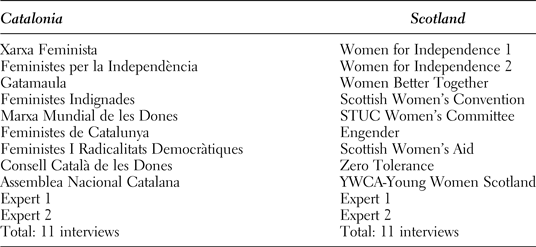
The representativeness of the women's groups is especially relevant to this analysis (Table 1), so the groups in Catalonia were selected from Ca la Dona (The Women's House), the main meeting point for the Catalan women's movement. It can provide an accurate snapshot of the movement's response.Footnote 9 In Scotland, selection of groups for sampling was based on a previous study (Celis, Mackay, and Meier Reference Celis, Mackay and Meier2013), with the addition of three other women's groups: Women for Independence, Women Better Together, and the YWCA. The first two were included because of their relevance in the campaign and the third because of its level of recent activity. The four experts contacted in the frame of this study verified the significance and accuracy of the selection.
List of Interviews

SCOTLAND
Engagement of the Women's Movement in the Referendum Campaign
Territorial issues have been at the center of Scottish politics for a long time. However, the devolution settlement has been particularly questioned since the Edinburgh Agreement was signed, granting limited power to the Scottish Parliament to hold a binding referendum on independence. The process was officially launched at the end of 2012, though the yes and no campaigns had already been set up a few months before. Yes Scotland was led by the Scottish National Party (SNP) and included radical left-wing parties and platforms such as the Scottish Socialist Party and the Radical Independence Campaign. However, the exceptional level of civic engagement turned the yes campaign into a conglomerate of local and theme-based groups rather than a completely centrally driven project (Macwhirter Reference Macwhirter2014). In contrast, the vote-seeking structure Better Together assembled a more ideologically diverse set of actors that encompassed the Labour Party, Liberals, and Conservatives and failed to trigger similar levels of social involvement.
How did the women's movement react to this extraordinary context? Women were quite disengaged during the first months of the campaign, when debates were mainly legalistic and male dominated and failed to connect with broader issues (Bell and Mackay Reference Bell and Mackay2013). The situation changed when the future of Scotland—broadly speaking—became the main topic of discussion. Women's groups mirrored Scottish civic response and turned the referendum campaign into a top priority. By the spring of 2014, 81% of the Scottish population claimed to be “quite” or “very” interested in the referendum debates (Liñeira Reference Liñeira2014). Women's groups could not take an official position concerning independence because of their legal status as charities.Footnote 10 Still, they did engage by organizing numerous events, generating briefing papers regarding the consequences of the different outcomes of the referendum,Footnote 11 and running campaigns encouraging women to vote.Footnote 12 The Scottish Women's Convention, as the main participatory structure, devoted its 2014 debates throughout the country to the referendum, with hundreds of women expressing their views.
Moreover, women's groups were created within the frame of the yes and no campaigns. Women Better Together (WBT) was founded by senior politicians participating at the core of the no campaign, who quickly realized the relevance of women's votes. The group evolved toward a formalized network that organized events, canvassed, and participated in media debates. WBT replicated Better Together's top-down model of targeting undecided voters. Its level of activity peaked in the summer of 2014 as polling day approached.Footnote 13 The main arguments supporting the No vote appealed to sisterhood across the United Kingdom and what had been achieved in the frame of a united country.
On the other side of the vote, Women for Independence (WFI) gave decisive impetus to the Scottish women's movement. This grassroots group was publicly launched in September 2012 within the frame of the Yes Scotland platform, but it remained independent. It began with a group of women who came together at the beginning of that year to discuss what to do in the event of a vote on independence. The founding members were women with experience in political parties and autonomous women's groups.Footnote 14 Though early initiatives were quite media oriented, WFI was soon overwhelmed by the eagerness of women to raise their voices in the campaign. Mirroring the structure of the yes platform, self-organized local groups sprang up quickly and profusely all over the country, to the degree that the core group no longer had control over activities or members. The decentralized WFI took full advantage of social media while also hosting numerous coffee meetings, social gatherings, and debates concerning both urban and rural Scotland. Its twofold objective was to include women in the political process and help them raise their voices in support of independence.Footnote 15 Success in the first goal greatly surpassed expectations, attracting many new participants who had not previously been involved in politics. Surprisingly, this massive engagement peaked immediately after the independence referendum was defeated. In October 2014, WFI showed that the group was able to maintain momentum by gathering 1,000 women in the city of Perth to discuss “what's next?” After formalizing national and local branches, WFI boasted in 2015 more than 1,000 official members, as many as 53 local groups, and 5,000 women on its mailing list—very impressive figures for a rather small country like Scotland.Footnote 16 The grassroots nature of the pro-independence campaign provided an extraordinarily fertile ground for a boost in the movement both in terms of structures and participants.
The question remains as to whether a polarized society might have yielded some sort of division within the Scottish women's movement, as the literature suggests. Interestingly, data gathered for this study indicate that cross-organizational actions rapidly resumed after September 18, 2014. The cross-party 50:50 campaign for equal representation of women was deliberately launched in the autumn of 2014 to reunite the movement.Footnote 17 It brought together members and activists from the main political parties in an attempt to achieve a gender-balanced Parliament in 2016, among other projects. Women's groups also collaborated on the submission of proposals to the Smith Commission, which oversaw the development of the devolution commitments after the referendum, proving that territorial salience had not been divisive.
Political and Discursive Opportunity Structures
In light of this remarkable engagement, did the women's movement see the referendum process as chance to mobilize? The independence vote was seen as an opportunity for radical change and yielded the extraordinary, extensive political engagement of Scottish society. It opened the door to debates regarding the future of Scotland and discussion of topics including defense, international affairs, currency, and housing. Activists appreciated this openness, as one participant highlighted: “I think it opened up a space for people to talk about things. … This wasn't like voting for slightly different policies.”Footnote 18 More importantly, welfare, equality, and discontent with Westminster austerity and pro-establishment policies dominated the debates (Boyd and Morrison Reference Boyd and Morrison2014; Mooney and Scott Reference Mooney and Scott2016). This outcome was rather predictable in a significantly left-oriented party system and given “the fact that one of the mainsprings of the push to devolution was to defend the welfare settlement in Scotland” (Keating Reference Keating2012, 21). Indeed, welfare and equality quickly became instrumental to the substate nation-building process (McEwen Reference McEwen2005). The Scottish distinctive identity has a long association with values linked to justice and welfare rather than ethnicity or culture (Rosie and Bond Reference Rosie, Bond and Keating2007).
The referendum campaign echoed these long-standing patterns, engaging supporters for and against independence in making a case for a fairer Scotland. Yes Scotland expressed its particular commitment to an anti-neoliberal discourse by opposing the U.K. austerity framework and invoking the Nordic model (Boyd and Morrison Reference Boyd and Morrison2014). Meanwhile, Better Together argued that welfare policies were only viable within the frame of the United Kingdom. The dominant discourses thus resonated with the main and most relevant demands of the women's movement in Scotland (Boyd and Morrison Reference Boyd and Morrison2014) and elsewhere (Dean and Aune Reference Dean and Aune2015), which revolve around a nucleus of issues including the gendered impact of austerity.
Initially, however, the debates were not especially gender sensitive, and women found it difficult to obtain balanced representation in public discussions (Bell and Mackay Reference Bell and Mackay2013; Kenny Reference Kenny2014). Women began to gain relevance thanks to the detection of a remarkable voting gap and to feminist campaigning.Footnote 19 Referendum polls quickly revealed a significant gender gap that identified women among the groups that were more undecided and less likely to vote yes (Ormstron Reference Ormstron2013), echoing in some way the long-lasting difficulty of the SNP to attract female supporters (Johns, Bennie, and Mitchell Reference Johns, Bennie and Mitchell2011). This gave both campaigns strong incentives to incorporate women and women's issues. They made an increasing effort to depict themselves as potential allies of the women's movement. As expected, commercials, canvassing activities, and key publications such as The Future of Scotland—issued by First Minister Alex Salmond's cabinet—showed increasing interest in being women-friendly by putting issues such as child care in the spotlight (Boyd and Morrison Reference Boyd and Morrison2014; Kenny Reference Kenny2014). Women's groups were very aware of the intentions of both campaigns to attract female voters, as the following quotes so aptly indicate:
There was such a concern on whether women would vote … how women would vote. There was a gender gap on voting intentions. That almost enabled us to push harder on some issues because the government was quite clear about its intention to persuade women to vote for independence. (Interview 1, women's group, Scotland)
I've never had so many phone-calls asking me to meet cabinet secretaries. … They just wanted to reassure that they were on side with our initiatives. … They felt that they had to send a message that they were sympathetic to women. (Interview 4, women's group, Scotland)
These comments illustrate the propensity of the political parties—particularly the SNP as the party in office—to show interest in women's concerns and project themselves as feminist allies, as well as the willingness of women's groups to seize those opportunities. Gender-related issues were not central to the campaigns (Morrison Reference Morrison2015), but political and discursive opportunity structures helped trigger engagement and expansion of the movement in terms of participants and structures, just as they had in the 1990s (Mackay Reference Mackay2010).
The Dynamics of the Women's Movement
The perception of the vote on independence as a chance for the women's movement to campaign was mediated by the dynamics of the movement and the centrality of constitutional issues in its agenda. The earlier devolution process had created some consensus regarding the idea that constitutional novelty and territorial debates can facilitate feminist success. In the 1990s, women successfully used discursive and political opportunity structures to move gender equality measures forward in Scotland's new institutional setting (Brown Reference Brown, Breitenbach and Mackay2001; Dobrowolsky Reference Dobrowolsky2002; Mackay and McAllister Reference Mackay and McAllister2012). In sharp contrast with what was happening in other parts of the United Kingdom, the Scottish women's movement experienced a significant revival in the frame of this territorial reform (Breitenbach and Mackay Reference Breitenbach and Mackay2001; Mackay Reference Mackay, Grey and Sawer2008). It built strong ties with the institutional arena and the regional elites, using democratization demands to insert feminist concerns into the agenda (Mackay Reference Mackay2010). This legacy shaped the movement's approach to the referendum campaign. In the words of one interviewee, “when you have an option to create new institutions … this offers an opportunity for thinking of different ways of doing things that might involve more gender equality … It was not difficult to get an agreement on that because it is evidence-based.”Footnote 20 A state-oriented movement with positive experiences in dealing with territorial issues found it rather natural to place the independence vote at the top of its agenda, alongside the rest of Scottish society. Its frequent engagement in public consultation processes involving a variety of governmental policies also paved the way for incorporating a feminist view in the intricate debates around the future of the country.
CATALONIA
Engagement of the Women's Movement in the Referendum Campaign
Controversy around territorial issues and the self-governing demands of the “historic regions” of Catalonia and the Basque Country have long been present at the core of Spanish politics (Keating and Wilson Reference Keating and Wilson2009; Moreno Reference Moreno2008). However, the very recent development of the pro-independence movement in Catalonia has sent territorial issues back to the top of regional and national political agendas (Muñoz and Guinjoan Reference Muñoz and Guinjoan2013).
The women's movement in Spain is highly decentralized, with substate branches mirroring their respective region-specific dynamics and priorities (Bustelo and Ortbals Reference Bustelo, Ortbals, Outshoorn and Kantola2007). The Catalan women's movement might reasonably be expected to have reacted in some way to the referendum process that has dominated the Catalan political agenda these many months. Curiously, however, the territorial debates—an area of remarkable grassroots mobilization in which women played a significant role—remained rather marginal and showed no capacity to energize the movement during the period analyzed. Ca la Dona is a key meeting point for Catalan women's groups and provides a good example of this lack of involvement. In 2013, more than 800 entities—from political parties to civic organizations and local councils—endorsed the National Agreement on the Right to Decide, which supported holding a referendum without advocating for any specific result. The constituent organizations of Ca la Dona signed the manifesto in 2014, two months before voting day, after significant controversy regarding the participation (and potential side effects) of the women's movement in a process not directly linked to women's issues.Footnote 21 Similarly, their activities and publications avoided engaging in these debates, neither supporting or opposing a plebiscite nor discussing any kind of institutional reform.
This significant level of reluctance was perceptible in the scarcity of women's organizations that emerged in direct response to the referendum process. Feministes per la Independència (Feminists for Independence, FxI) was the only autonomous group that was created to engage with territorial issues and somehow compensate the silence of the women's movement. Informal contact around the idea began in the context of increasing civic mobilization in 2012. The group was officially launched in September 2014 and soon had more than 60 members. Most of them had been active in other women's groups and/or in pro-independence platforms. FxI organized events and debates directed at the women's movement and participated in a wide range of activities hosted by other pro-independence organizations. It even met with representatives from WFI to learn from the Scottish experience. However, reducing the gender gap in mobilization and support for independence was not an issue in Catalonia (Verge, Guinjoan, and Rodon Reference Verge, Guinjoan and Rodon2015)Footnote 22; the main goal was to shape the political agenda and incorporate a feminist perspective into a process that was considered gender-blind. Despite this effort, women's groups saw territorial issues as potentially divisive and pragmatically opted for disengagement. As one activist put it, “[this topic] always comes up. … But we decided that the most pragmatic and healthy way to proceed was to avoid those topics on which we could not reach a consensus.”Footnote 23
Political and Discursive Opportunity Structures
Why did the women's movement remain aloof from an issue so central to the political and social agenda? Broadly speaking, the rise of secessionism derives from the lack of response to demands for greater autonomy for Catalonia (Gibernau Reference Gibernau2014). The long-standing though marginal support for independence increased from 14% in 2006 to around 45% in 2014 (Liñeira and Cetrà Reference Liñeira and Cetrà2015). The 2010 decision of the Constitutional Court regarding the Catalan Statute of Autonomy—equivalent to a regional constitution—marked a clear turning point. Several articles and dispositions were amended, even though the norm had been approved by both the Spanish and the Catalan Parliament and ratified by referendum. The obvious discontent with that decision transformed the right to self-government into a central political claim in Catalonia. Pro-independence support progressively grew, as did membership in grassroots groups such as Òmniun Cultural or the Assemblea Nacional Catalana (Catalan National Assembly, ANC). Territorial issues reached the top of the political agenda as secessionism gained momentum, splitting the Catalan party system between those for and against self-determination rights. Convergència i Unió (CiU), which had traditionally supported a decentralized state, proved to be one of the leading forces in the process.Footnote 24 After the first massive demonstration in September 2012, Catalan president Artur Mas called early elections and included the independence referendum in CiU's electoral manifesto. Pro-referendum parties enlarged their majority, and in January 2013, the Declaration on the Sovereignty and Right to Decide of the People of Catalonia was passed and a vote on independence approved.Footnote 25
The “sovereignty process” dominated the parliamentary and governmental agenda in the subsequent months (Morata et al. Reference Morata, Ntutumu, Marta Soler and Marcet2014a). The opposition of the national government to any agreement on territorial reform significantly narrowed political debates to revolve around the right of the Catalan people to legally vote on independence. The composition of the Catalan party system, with crosscutting left-right and centralist-nationalist cleavages (Liñeira, Muñoz, and Rico Reference Liñeira, Muñoz and Rico2014), worked against enlargement of these discussions, as the main line of agreement within each camp was opposition to or defense of an official referendum (Morata et al. Reference Morata, Ntutumu, Marta Soler and Marcet2014b). Similarly, the center-right orientation of the CiU nationalist project that has dominated recent Catalan history hindered the introduction of topics that were central to the Scottish agenda. Indeed, during the same period, regional institutions became the object of tense protests as CiU made extensive budget cuts affecting welfare policies (Cruells and Ruiz Reference Cruells, Ruiz and Woehrle2014). Attempts made by radical left parties such as the Candidatura d'Unitat Popular (CUP, Popular Unity Candidacy)—which only held three seats in the Parliament—to include a broader approach linked to an anti-austerity discourse were rather unsuccessful (Morata et al. Reference Morata, Ntutumu, Marta Soler and Marcet2014b).Footnote 26 Because the gender gap in voting was not significant in Catalonia, political parties lacked any strong incentive to reverse this tendency.
The women's movement perceived the lack of resonant discourses and potential allies. Particularly, activists highlighted the prominent role of CiU in driving territorial debates as a key factor in making them less appealing to women. Two quotes are especially illustrative in that regard:
I'm afraid the process is not being seen as an opportunity. I think the old Catalan establishment leads the process … If it were led by a party like CUP, which can be a transformative force from a gender perspective, which is a feminist party as well as pro-independence party … but obviously CUP has not got a strong voice within the process (Interview 14, women's group, Catalonia)
There is like a general attitude of skepticism. From an anti-capitalist point of view, it is not easy to connect with the whole issue of independence. It's hard to talk about it without getting the sense that you are getting close to CiU, to Artur Mas. (Interview 18, women's group, Catalonia)
Unlike in Scotland, women's groups in Catalonia felt rather alienated from the referendum campaign. They saw it as legalistic and associated it with a party that has never had a strong connection with the women's movement or been particularly sympathetic to their claims, especially with regard to key issues such as austerity.Footnote 27 Still, given the wide range of actors involved in the debates, they could have used discourses from far-left parties such as the CUP to open up new opportunities or actively engage in the grassroots campaign for the right to vote. The dynamics of the movement shed light on their reluctance to do so.
The Dynamics of the Women's Movement
In sharp contrast to the Scottish case, the Catalan women's movement has no legacy attesting to the potential of territorial debates to yield feminist success. There were some remarkable attempts to connect feminism and nationhood during the 1970s when territorial issues were discussed as part of the democratization process (Rodó-de-Zárate Reference Rodó-de-Zárate, Brown and Browne2016), and women have certainly been very active in secessionist parties and grassroots platforms such as the CUP and ANC. Still, territorial topics have never been a priority for the movement. Autonomous women's groups have traditionally been reluctant to engage in the nation/state-building process for fear of being co-opted by public institutions—including political parties (Palomares and García Reference Palomares and García2012).Footnote 28 As one interviewee put it, “there has traditionally been a general attitude against the state, against the nation, as the ones that have oppressed women”Footnote 29. Thus, their immediate reaction emphasized the divisive potential of territorial debates rather than the opportunities they might create.
Instead, other relevant concerns occupied the agenda of the women's movement during the period analyzed. Reproductive rights, a traditional priority issue for organized women in Spain (Valiente Reference Valiente2007), again took center stage. The Bill on the Protection of Life of the Unborn and the Rights of Pregnant Women, issued by President Rajoy's cabinet in 2013, sought to significantly restrict access to abortion. The regressive character of this legal framework triggered a strong reaction from the women's movement. In 2012, participants began to launch platforms and campaigns all over the country. Interestingly, many of them were coordinated at the state level, temporarily reuniting a rather fragmented movement. The National Coordination Group of Feminist Organizations was reactivated, a National Platform for the Right to decide was established, and Madrid witnessed the first large national demonstration on the topic in decades (García Reference García2015). This campaign also boosted participation in the movement, as many young women joined during this period. Fierce opposition and the lack of support from public opinion forced the minister of justice to withdraw the bill and resign, which was perceived as a great victory.
Along other lines, the changing party system in Spain was seen to open up incipient opportunities for campaigning. The emergence in 2014 of new political parties such as Podemos, with their strong anti-austerity agendas and preference for radical democracy, captured the attention of the movement. In Catalonia, this interest crystallized in the creation of new cross-organizational women's groups interested in influencing the new politics agenda, such as Feminismes i Radicalitats Democràtiques (Feminisms and Democratic Radicalisms). Additionally, the gendered nature and impact of austerity policies provoked the emergence of innovative networks such as Vaga de Totes (Women's Strike), which organized a strike in Catalonia in November 2014 to make reproductive work more visible to social and political actors.
Skeptical of the institutional arena and not traditionally engaged with territorial debates, the women's movement preferred to focus on topics considered more important or likely to succeed. Mobilization around those issues brought new energy to the movement in terms of activities, numbers and structures. However, in 2015, the debate shifted from the right to hold a referendum to defining a path toward a declaration of independence in the frame of a changing party system. In such a scenario, the women's movement can be expected to find greater incentive for mobilization, to ensure that any eventual Catalan republic takes gender equality seriously.
COMPARATIVE RESULTS
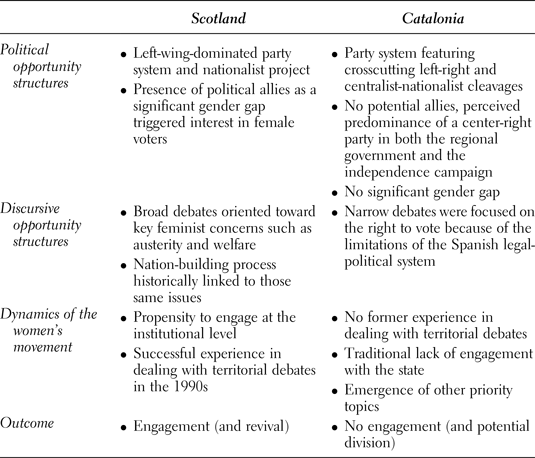
Contrary to what is generally assumed, this study showed that even in extremely divisive scenarios, territorial debates hold some potential for catalyzing a feminist renaissance (see Table 2). The women's movement engaged with the Scottish context in a remarkable way. It made territorial politics central to its agenda and articulated greater numbers of participants and structures, particularly in the frame of WFI. Though state-level campaigning diminished as regional politics demanded greater attention, polarized debates on independence did not jeopardize alliances among women in Scotland. Conversely, in Catalonia, women's groups did not feel compelled to engage in territorial debates, and this issue remained marginal. Instead, the movement flourished around other priority issues that became central to their agenda, such as the campaign for reproductive rights.
Summary of the Explanatory Factors of the Study

The opposite effects of the referendum processes in Scotland and Catalonia were mediated by the characteristics of the respective political and legal systems, which opened up divergent political and discursive opportunity structures. The Scottish case shows the influence of discourse resonance, in which broader discussions on both sides of the vote gave significant attention to long-standing concerns of the women's movement, such as welfare and austerity policies. Path dependency also played a role in this: the nation-building process in Scotland is historically aligned with social-democratic values, and debates on independence were no exception. Second, women in Scotland identified the presence of potential allies. A left-dominated party system that was eager to gain female support provided a strong incentive for women's groups to mobilize. These conditions were absent in Catalonia, where debates necessarily focused on the right to vote on independence and the parties leading the pro-plebiscite campaign did little to open up spaces for engagement. They were not perceived as particularly women-friendly or interested in gendering debates.
The inner dynamics of the women's movement shaped the ways in which these same opportunities were perceived. In the Scottish case, the movement drew inspiration from prior experience in dealing with territorial politics and demonstrated a determined willingness to seize the chances offered by the referendum campaign. They had learned lessons from the earlier devolution process, when constitutional reforms resulted in notable benefits for women. Catalan groups, however, are traditionally disinclined to engage with the institutional arena and were likewise reluctant to prioritize territorial issues, which have never been central to their agenda. Instead, a topic that has always been relevant for the women's movement came to the forefront, absorbing most of the time and resources in the period analyzed.
CONCLUSIONS
Territorial debates can shake entire societies, as seen in Scotland and Catalonia. The Scottish case illustrates that they can also become a powerful carrying structure for feminist politics. It also indicates the place they should occupy at the core of feminist research agendas in years to come, as potential catalyzers of revival in the women's movement and not only sources of division.
The comparative findings of this study align with former works in unveiling the significant role of political and discursive opportunity structures—and their classic indicators—in explaining the engagement of the women's movement in these potentially divisive scenarios. However, here the nature of those opportunities exceeded the characteristics of nationalist projects and related to the general terms of the debate and the actors involved. This reveals that feminist engagement is not necessarily subordinated to the endorsement of nationalism, as earlier scholars have suggested. Similarly, this work sheds light on the importance of the dynamics of the women's movement and speaks of the need to explore the availability of opportunities, how they are perceived and interpreted, and why.
The cases of Scotland and Catalonia suggest that only complex explanatory frameworks can aptly capture the divergent effects of these deeply contentious contexts. Similarly, they draw attention to the changing nature of current civic nationalisms and their interaction with other burgeoning projects in postcrisis Europe, such as those against austerity or for greater democracy. The engagement of the women's movement may increase as nationalist projects and territorial debates show greater resonance with these issues. Scotland and Catalonia should be at the heart of further research to discover the opportunities and constraints they will offer in the near future.