1. INTRODUCTION
The author had invaluable experience in conducting joint research on diaspora and Constitution with two other Korean professors in 2018. The research project at the time was to investigate the existence of diaspora disposition in the Constitution, what the legislative background would be if it was stipulated in the Constitution, and whether there is any benefit in the case of a constitutionalization of diaspora.Footnote 1 The three researchers conducted research by dividing countries into geographical regions. The target countries were the 35 OECD (Organization for Economic Cooperation and Development) member countries and the G20 countries. I had been responsible for the analysis of 16 countries, namely Portugal, Brazil, Spain, Argentina, Mexico, Chile, Colombia, Italy, Greece, France, Belgium, Switzerland, Canada, the US, the UK, and Ireland.Footnote 2 In proceeding with the research, I made some personal estimations. The first was that single-ethnic nation-states would be particularly interested in diaspora policy. So, I presumed that most Latin American immigration countries would be weak in diaspora policy and would base the jus soli principle on a nationality decision. Under this estimation, I guessed that Portugal, Spain, Italy, Greece, France, Belgium, Switzerland, the UK, and Ireland would be interested in diaspora policy and Brazil, Argentina, Mexico, Chile, Colombia, the US, and Canada would be less interested in diaspora policies. The second estimation was that, even if the country was formed by immigration, if the nation is big and strong, interest in diaspora would be relatively high. The US and Canada would be such cases. Third, I assumed that even developing countries will gradually become interested in diaspora policy if the overseas diaspora community grows. I thought Brazil, Mexico, and Colombia would be such cases. As I proceeded with my research, I was able to confirm that my original expectations roughly fit my research conclusion.
After the end of the joint research, I further examined the diaspora policies, limiting the scope of my analysis to five Latin American countries, namely Brazil, Argentina, Chile, Mexico, and Colombia. This is because, based on the results of the co-research, we had the opportunity to participate in ALSA 2018 in Gold Coast, Australia.Footnote 3 This paper is a revised version of the paper presented at the conference. At that time, I pondered the following questions. First, what is the reason that an immigration country will be interested in diaspora? First of all, I saw that the home country would be interested in diaspora policy in terms of development because the diaspora community would increase the domestic remittances and investment.Footnote 4 Brazil, Argentina, and Chile experienced a surge in diaspora as a result of the military regime and economic crisis, while Mexico and Colombia increased their diaspora due to politically and economically unstable domestic circumstances. Second, re-democratization is expected to increase interest in diaspora policy. Since the overseas diaspora community may possess anti-governmental tendencies, during the dictatorship-government period, it was my belief that the existing governmental entity is likely to have a lukewarm approach to diaspora policy. Third, what would be the specific content of diaspora policy when designing it? Will the diaspora policy be designed to minimize interference by diaspora with domestic politics and contribute only to development, or will it open the way for the participation of diaspora in the politics of the home country? Fourth, will it continue to support the existing assumption that Latin American countries will not be primarily interested in diaspora policy because they are multinational or multi-ethnic? Since the 1500s, colonies have settled and racial assimilation has occurred over a long period of time; the pure multi-ethnics component is not as prevalent as people think and Latin America’s unique mixed race based on nationality forms a majority of the population. So I thought that diaspora policy based on de jure nationality might be possible instead of policy based on pure ethnicity. Fifth, if these assumptions are correct, there should be a big change in the migration policy and the diaspora is likely to be mentioned in the Constitution or migration law and policy. This is why I wanted to look at changes in migration policy in the historical context (Section 2). Sixth, the easiest way to find out the intentions of diaspora policy in the home country is to verify the structure of the dual-citizenship system, the level of the diaspora-management agency within the governmental hierarchy, and whether voting rights and the right to be elected have been granted. If the diaspora policy lets the diaspora community elect political representatives for the National Assembly, and if there is a diaspora-management agency at the ministerial level, it could be construed to be a fairly high level of diaspora-engagement policy. Seventh, if the home country does pursue a firm diaspora-engagement policy, then its main purpose would be to expand its state power. Then, what is the most efficient way to design diaspora-engagement policy? I tried to analyze several relevant theories in relation to this methodology and it was the network-power theory that was deemed the most appropriate. I structured this paper on these various assumptions.
The relationship between state and absent citizens has become more important since the globalization of the 1990s. Absent citizens residing overseas include not only their own nationals who have nationality, but also those who do not have their own nationality but are linked by blood. The view of the modern nation-state, under the influence of globalization, is changing continually. Since the birth of the nation-state in the form of a sovereign state through the Treaty of Westphalia in 1648, international law has defined the possession of territory, population, government, and the capacity to enter into relations with other states as constitutive factors of a sovereign independent state.Footnote 5 Thus, the Constitution of each country has dispositions on territory, population, and government.
Among the above factors, the scope of the population is more likely to be a source of conflict among countries than the territory, which is legally fixed and defined in nature by each country. For example, when dealing with the issue of dual nationality, the question of which country has diplomatic protection rights as well as the issue of stateless persons can come up.
In the past, resolving statelessness was an issue in international law but, now, dual/multinationality has come to draw more attention. In the past, dual nationality was considered an unacceptable trend, but now countries are actively recognizing dual citizenship. Scholars have come up with various theories to explain this trend. Why are nations passive about immigration and refugees while accepting dual citizenship? What is the reason for the passive acceptance of foreigners’ entry into the country, while actively embracing policies for overseas kin? The trans-border nationhood is a de facto expansion of state power through the expansion of the population abroad. In other words, there is an inclination to be relatively generous about trans-border nationhood because it is possible to expand the national power through the expansion of the people in the current international society where the territory cannot be expanded without the utilization of military force.
In fact, countries have been increasing the de facto number of their citizens through two broad policy measures. The first is by increasing the number of overseas nationals utilizing the concept of dual nationality, meaning state-based expansion of state power. There are many countries that make it easy to acquire nationality for up to three generations of descendants by providing ease in the procedure of acquiring dual citizenship. Countries that have operated colonies in the past, such as Italy, Spain, and Portugal, have a large number of compatriots abroad who meet the conditions. Since most of the dual nationals abroad live in their country of residence, not many return to their ancestral home country. Dual nationality may give them a special bond to the home country. However, it may cause a number of important problems with regard to political engagement with the ancestral home land.Footnote 6
The second is by expanding state power through promoting dual culturalism by maintaining interactions with the home country. It is a nation-based expansion of state power. It is a way to support overseas nationals through organizations such as the Korean Language School, the Korean Cultural Center, the Overseas Korean Association, and the King Sejong Institute, by maintaining cultural ties with their home country. It is a way of indirectly improving the state power by supporting overseas nationals by helping them to adapt successfully to the local society and actively inducing the trans-state political participation of the resident countries. This method is mainly used by Asian and Latin American countries.
These two methods are very useful in terms of expanding the international power of the country. However, the protection of emigrants was not the object of much interest in the Latin American countries. This is due to the characteristics of immigrating countries. Recently, however, there has been greater interest in diaspora policy. In this paper, I would like to enhance the understanding of the recent changes in the migration policies by applying the network-power theory that David Singh Grewal describes in communication studies.Footnote 7 In other words, I will analyze the phenomenon of trans-border nationalism through the trans-border nationhood. Grewal’s network-power theory can be properly used to analyze the diaspora-engagement policy of Latin American countries in recent years.
Grewal defines “A network is an interconnected group of people linked to one another in a way that makes them capable of beneficial cooperation, which can take various forms, including the exchange of goods and ideas.”Footnote 8 And “a network is united by a standard, which is a shared norm or practice that facilitates cooperation among members of a network.”Footnote 9 And he asserted that network can be power when it is well structured and managed openly, guaranteeing multiple access. He explains that the network may be formed by reason, force, or chance, singly or in combination. He argues further that these standards are maintained through sovereign power that is exerted downward from an authority as “collective consent to collective circumstances from which the implications for the individuals constituting the sovereign.”Footnote 10
Applying this theory to the diaspora policy: the home country makes a standard of the world diaspora network (diaspora-engagement policy), applies it to the overseas diaspora community, and increases the scale of a diaspora community with homogeneous cultural homogeneity, being one axis of international policy of the mother country to expand state power in the international community. Of course, it will be a prerequisite for the home country to implement transparent and accountable policies acceptable to the diaspora community.
Since globalization, personal mobility has become easier and connected with the development of SNS technology. From the standpoint of the state, it is impossible to expand the territory by force, but it is possible to connect this trans-border nationhood to strengthen the state power. This is the reason why Latin American countries, which traditionally were indifferent to emigrants, have interest in formulating diaspora policies. I see this as the diaspora-network power: neo-state power. In other words, the network-power or neo-state-power theory sees that it is national power to make a lot of people abroad who are friendly to the mother country. The territory is difficult for the state to artificially expand, but the human network can be enlarged by the active efforts of the state. The country can build powerful human assets by expanding the scope of diaspora and giving it more rights and benefits. Based on this network-power theory, this paper examines the recent changes in migration policies and diaspora-engagement policies of Latin American countries.
2. MIGRATION POLICY IN A HISTORICAL CONTEXT
In this chapter, let us review the migration policy in a historical context that is relatively common in most countries. The history of migration policy has a common point. In general, migration policies have been designed in terms of national security but, as democratization and globalization continue, migration policies have been revised based on human rights protection and diaspora is to be seen as an overseas strategic asset. We can see the changes in the policy categorized into several stages. Before World War I, most countries regarded people as a national asset and imposed restrictions on emigration. After that, the development of international human rights allowed a limited number of people to move abroad; however, the flux of migration was strictly controlled. From the 1990s, migration liberalization policy began to become common due to increased interest in human rights on free movement and globalization. Migration and diaspora policy tended to converge after the 2008 global financial crisis, as the number of migrants and the size of the diaspora grew.
2.1 Emigration-Control Policy (Before World War I)
Since the birth of the sovereign state in 1648 under the Treaty of Westphalia, people were regarded as one of the factors constituting the sovereign state and a national asset. The migration policy was designed with the view that there is an outflow of national assets when people migrate abroad. The migration policy at the beginning of the sovereign-state system was to limit the outflow of its own people, and there was no need to strictly limit the entry of foreigners into the country. In fact, because people relocated relatively freely before the migration was strictly controlled by the rise of the sovereign state, the clear demarcation of territory meant that the freedom of migration would be limited.
At that time, international law showed two characteristics. First, it was the rule of international law that the sovereign state could control the entry and exit of its citizens, as it was considered a domestic matter. Since international law did not regard individuals as the subject of international law at that time, it did not make efforts to guarantee individual migration rights regardless of their nationality. This situation continued until World War I. Second, since the use of force by the state was not prohibited, regional warfare was frequent and constant border changes resulted in a high probability of involuntary nationality changes.
2.2 Immigration-Control Policy Based on National Security (After World War I)
The international human rights law developed rapidly as a result of World War I and World War II without precedent. The idea of protecting human rights regardless of nationality started to take its place in international law and national law. However, Western countries strengthened immigration-control policies, as a large number of foreign immigrants and refugees migrated. It is important to note that mass migration and mobility have occurred worldwide, and that international law began to regard them as persons to be protected and to view the freedom of entry and exit as a human right.Footnote 11
On the other hand, immigration was perceived as an easy way to obtain highly qualified human assets free of charge. For example, in the US, scientists and intellectuals from the collapsed Germany were accepted to dramatically develop the nuclear and space industries. In the case of Korea, it appealed to the patriotism of overseas scientists during the military regime and encouraged them to return to contribute to their home economies.
However, the immigration-control policy at the time was not designed based on the idea of respect for human rights, but rather in terms of national security and economic development, in particular in Latin America. So, although immigration was strictly controlled, emigration was often allowed only on requiring permission from the government.
2.3 Migration-Liberalization Policy Period (From the 1990s Liberalization to the Present)
Since the reunification of Germany in 1990 and the collapse of the Soviet Union in 1991, the international mobility of individuals has accelerated as a consequence of the collapse of the Cold War system. International human rights law has already provided the principle of universal human rights protection that protects individuals from the state, and regional human rights Commissions and regional human rights courts were established in all regions except Asia. The legal foundation of migration policy began to change slowly from the national-security principle to the human rights (human-dignity) principle, including the freedom of migration. More nations have expressed their position on expanding the freedom of entry and exit of its citizens.
The government’s migration policy was examined in terms of the management of human resources. Since emigration was recognized as a loss of human capital, it classified the types of migrants as human resources and non-human resources. Due to this change in migration policy, there have been considerable changes in academic research on migration policies. Meanwhile, the object of migration policy became a human being called an “immigrant” and the policy approach is to evaluate the economic-asset value of the “human capital.”
2.4 Emigration and Diaspora-Convergence Policy
Meanwhile, in 1990, emigration policy began to show mixed use with diaspora policy. This tendency appears more strongly when dual nationality is generalized and overseas diaspora is considered as a factor of human resources and network state power. As free movement of the individual became possible, the number of overseas nationals who moved abroad or returned home increased. The so-called mobility of individuals surged. The diaspora policy in a broad sense, including overseas nationals as well as their descendants, attracts a great deal of attention.
Convergence of emigration policy and diaspora policy has a significant implication in terms of the state-power approach. This is because the diaspora-engagement policy has two major points of importance from the perspective of the home country. The first is that it can expand its influence on the diaspora-residence countries’ policies.Footnote 12 For example, American Jewish society and Mexican society have a strong influence over the lobby of the US Congress in addition to direct entry into the US Congress.Footnote 13 This effort is the same not only in Japan, but also in Korea. They try to secure a political bridgehead that can help the home country by actively supporting overseas diaspora entering Congress. Second, overseas diasporas are the human assets of their home countries. In the past, during the Park Chung-hee regime in Korea, there were cases where US-Korean scientists were invited to return to the home country appealing to their patriotism. Overseas diasporas in developed countries are de facto human assets. Overseas diasporas are not only a source of human capital, but also a source of funds for economic development, such as investment and remittance. China is greatly indebted to the investment of the overseas Chinese such as those in Taiwan at the beginning of its economic development. In the case of Korea, investment in the home country by the Korean diaspora in Japan and in the US contributed greatly to its economic development. In the case of Cuba, remittances sent by overseas Cubans in the US are a great support in maintaining the economy. In this world where the mobile network has increased as it has, the emigration policy and diaspora policy tend to harmonize or converge with each other.
However, diaspora-engagement policy does not appear to be a formalized form in all countries. Generally, diaspora policies, in both developing and developed countries, are occurring in countries with strong blood relations. Israel, Spain, Portugal, and France, as well as Korea and Japan, are all interested in diaspora-engagement policy. If there are many overseas diaspora, countries are interested in diaspora policy. Mexico and Colombia are very interested in diaspora-engagement policy because of their economic power and because they have many diasporas. Since the diaspora-engagement policy is made to include overseas nationals and descendants of foreign nationality, it is the dual-nationality policy and support of language and culture education that are often used as a networking platform with the home country and, in some cases, as an intensive diaspora-engagement policy, in order to build a strong bond with the home country, the right to vote in the home country and the right to be elected as congressman are given.
On the other hand, immigrant countries in Latin America, which have few blood relations, are trying to expand their network power basically through the support of the dual-citizenship system and by providing support to the overseas diaspora community. It is a way to help overseas diaspora become more successful in their country of residence. In the case of Japan or Korea, they provide various supports for overseas residents to settle into the local society. An example is the direct or indirect support for the Korean associations abroad, the Korean Language School, and the local Korean chambers of commerce, and also providing assistance in educating the next generation of leaders by supporting young businessman mentoring the younger generation to help them succeed in the local society.
In this way, the scope of policy interest is expanding from the policy of overseas nationals to the policy of overseas diaspora. So it is unclear whether the home country is expanding from an emigration policy to an expanded diaspora policy, or whether the two policies are still different. This problem becomes more apparent when the purpose of the dual-nationality policy is unclear. Since most of the dual citizens reside in their resident country rather than their home countries, even though they have the nationality of their home country, there is often no need for a dual nationality. So, even if one is qualified for dual nationality, he/she does not necessarily have to apply for home nationality. The policy for these people (dual-citizenship candidates) is in fact a diaspora policy, but an emigration policy also applies. Emigration policy includes the departure-permission policy of the home country and the management of the overseas residents.Footnote 14 Consequently, the three policies overlap each other when the country handles overseas human resources in the context of a national power and development strategy. It is highly likely that the concept definitions will collide with reality in some countries.
Certainly, the terms “immigration” and “emigration” that are used in migration policy are mainly used in the sending and importing countries. Diaspora is a term used mainly by scholars and it is only a few years ago that the term appeared in national migration policy. If these terms are to be used as government policies, their meanings must be defined. For example, the emigration policy is a policy that governs the departure or entry of nationals abroad. This policy is based on personal jurisdiction that applies to nationals abroad linked to nationality. There is always the possibility of conflict with foreign territorial jurisdiction, such as when the home country is recruiting national students abroad or dual citizens who are foreign scientists or promoting a home-country return policy. This is because, if the scientists they are interested in are also important human resources to the country of residence, they will be seen as an outflow of human capital.
The country can no longer expand de jure territory for the sake of state power. The alternative is to increase the number of overseas nationals working abroad through diaspora-networking power. Diaspora policy is increasing in importance when the country is incorporating it into its migration policy. The traditional diaspora-engagement policy was a relatively passive policy to connect with overseas diaspora through language and cultural education. Modern diaspora policy, in addition to this, is a policy to engage overseas nationals through various engagement policies such as granting dual nationality and recognition of the right to vote and/or to be voted for in the home country’s election. This diaspora-network standard facilitates not only overseas kin unity with the home country, but also the purpose of expanding influence on the country of residence.
3. TRANS-BORDER NATIONHOOD AND NETWORK-POWER THEORY
Academic research on migration policy was initially approached from the perspective of the protection of migrants’ human rights. For example, Dowty concludes that human rights violations have been achieved by blocking the departure from the country or by forcing departure from the country, analyzing the policy of totalitarian states in the Closed Borders from the point of view of their control policy.Footnote 15 For example, Fascist totalitarian nations such as Italy, Spain, and Germany have allowed intellectuals from an opposing ideological point of view to enact forced or voluntary departure. This phenomenon was present in Hitler’s government and in the communist countries that allowed the departure of the ideological dissidents in terms of system choice. On the other hand, in the case of North Korea, individuals were, instead, restricted from entering and leaving the country, by imposing the punishment of being branded as a reactionary rather than being forced to leave their own country. Therefore, the freedom of migration of the people regardless of nationality could be analyzed from the viewpoint of international human rights, transcending the domestic policy of migration policy. Regardless of the political system, if entry and departure are restricted, there can be reasonable doubt that human rights are being violated.
Another research approach is to study migration policies from the perspective of national development.Footnote 16 If migration is the freedom of individual mobility, collecting high-quality human capital, regardless of nationality, can have a considerable influence on state power. Ulrich Beck explains the mobility of human resources from a cosmopolitan and nationalist perspective.Footnote 17 The cosmopolitan and nationalist theory analyzes how the movement of human resources has affected countries after globalization. From a nationalist point of view, immigration is negative for national development because it is an outflow of human resources, while, from a cosmopolitan viewpoint, it is positive in the world’s production systems, because it is moving according to the need for human resources.Footnote 18 However, in a country where the freedom of movement of migrants is ensured, foreign immigration policy cannot be used as a policy to limit the mobility of human resources, with the exception of statutory restrictions on workers in industrial sectors that are crucial to the national interest. The limitation of the movement of human resources should be approached from the viewpoint of competitiveness of the people rather than a policy-based limitation. In other words, just like investment incentives, the flow of the key labour force requires attractive incentives to stay or return to the home country.
In the nation-state, “national” is based on a single nation (mono-national). Some countries, such as Korea and Japan, are mono-national (and mono-ethnic), but most countries are multinational. Because Latin American countries are immigrant-based countries, multi-ethnic countries are common. So the nation-state theory based on a single nation in international law does not adequately reflect the real world.Footnote 19 Because nationals are determined through the grant of nationality, there may be other ethnics in one country and the same ethnics in other countries.Footnote 20 As international human mobility becomes easier, the phenomenon of designing a diaspora policy based on nationality or ethnicity reflects the reality of globalization. A single-ethnic nation-state such as Korea often displays a hostile attitude to other ethnics in the country and it is common to feel brotherhood for the same ethnics abroad; this is called trans-border nationhood.Footnote 21 As a single-ethnic nation-state has both internal and external homogeneity, they have strong explosive power in the age of individual mobility as it is currently. In the same sense, Roger Brubaker also analyzed the reciprocally connected states between overseas and home countries in terms of internal and external politics of belonging.Footnote 22 In modern society, as it is impossible to expand territory by force anymore, capital and technology mobility and personal mobility are the most important factors in the expansion of state competence. Thus, trans-border nationhood can be driven by a nation-state based on personal mobility and with active political will. Roger Brubaker also observed that the nation-state is rather capable of implementing a migration-control policy that could have influence on the trans-border persons, mentioning that “The nation-state remains the decisive locus of membership even in a globalizing world.” In this manner, Roger Brubaker’s “external politics of belonging” can be explained by the network-power theory. He argues that this phenomenon does not necessarily mean post-national nor transnational, but rather a form of trans-border nationalism.Footnote 23 Specifically, trans-border nationalism is most often used as a policy to enhance transnational nationalism, through such mechanisms as the dual-nationality system, the easiness of acquiring nationality of descendants, the recognition of the right to vote by overseas diaspora, and the support system for overseas diaspora.Footnote 24
If a country expands national power in a way that brings overseas diaspora together, a new territory can be designed. De Villiers proposed the concept of cultural autonomy by considering that the same minorities are distributed in different regions within a country.Footnote 25 By expanding the concept of De Villiers internationally, the concept of cultural territory can be used, instead of traditional physical territories, as a way to bring together overseas diaspora spread across the globe. It is effective to expand cultural territory by gathering overseas diaspora to spread abroad. As De Villiers said, the home country should give a certain level of political power and autonomy so that overseas diaspora can find and decide what they need in order to consolidate their capabilities into one.
Roger Brubaker’s trans-border nationalism theory and De Villiers’s cultural-autonomy theory are useful in explaining countries’ diaspora-expansion policies, but they do not explain which diaspora-engagement policy is appropriate. In other words, these theories do not explain what the policy of the diaspora engagement is, and how useful and effective it is. This analysis of measurement is covered extensively in international politics. In international politics, the correlates of the war composite index of national capabilities (CINC) and the structural network-power index (SNPI) are often used as measures of national power.Footnote 26 The SNPI reflects mobility and network, which are characteristics of globalization. However, since the power theory of international politics is intended to measure all elements of state power, it is inconvenient to measure diaspora policy alone. In this regard, David Singh Grewal’s network-power theory is a great help in understanding the diaspora-engagement policy. The network standard of Grewal can be analyzed more clearly through the factors of Bela SolteszFootnote 27 and Boyle and KitchinFootnote 28 mentioned below. It will be possible to determine which diaspora-engagement policy is beneficial to state power through the network standard for the diaspora-engagement policy taken by the home country.Footnote 29
4. CONSTITUTIONALIZATION OF TRANS-BORDER NATIONHOOD IN LATIN AMERICA
As mentioned above, I had the opportunity to analyze the constitutionalization trends of trans-border nationhood with two colleagues. We compared the Constitutions of 35 countries, including OECD and some non-member countries. Not all countries in the world have been surveyed, but the survey sample is significant. As a result of the survey, the tendency for linking overseas diaspora with their home countries became clearer.Footnote 30
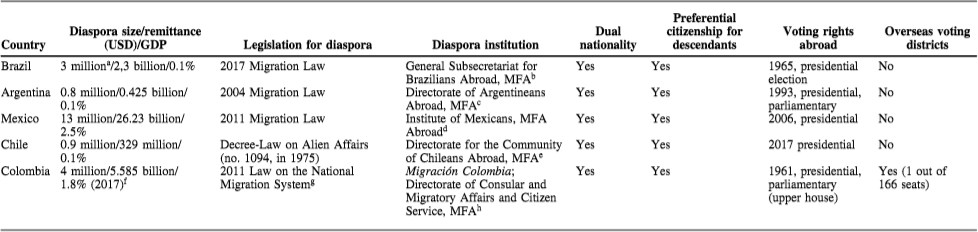
A comparison of the tendencies of some Latin American countries is shown in the following chart. Spain and Portugal, formerly empire countries, are adopting jus sanguine as a standard of nationality. Both countries recognize dual nationality. In the case of Portugal, the right to vote and the parliamentary seats are assigned to overseas diaspora, and they are actively pursuing policies for overseas diaspora. However, Spain has a relatively weaker diaspora policy than Portugal. On the other hand, Latin American countries are all adopting jus soli on the basis of nationality and most countries recognize dual nationality. Brazil enacted the Migration Act in 2017 and strengthened its protection policy for overseas diaspora. I will look at the policies of some of the countries that were surveyed for overseas diaspora.

a Pamplona, Isadora. “Quantos brasileiros vivem fora do país?” UOL, 22 June 2018, https://noticias.uol.com.br/ultimas-noticias/deutschewelle/2018/06/22/quantos-brasileiros-vivem-fora-do-pais.htm (accessed 8 October 2019).
b General Subsecretariat for Brazilians Abroad (Subsecretaria-Geral das Comunidades Brasileiras no Exterior, SGEB), Department for Consular Affairs and for Brazilians Abroad (Departamento Consular e de Brasileiros no Exterior, DCB), Division of Brazilian Communities Abroad (Divisao das Comunidades Brasileiras no Exterior, DBR) in MFA (Ministry of Foreign Affairs).
c Directorate of Argentineans Abroad (Direccion de Argentinos en el Exterior), within the General Directorate of Consular Affairs (Direccion General de Asuntos Consulares) in MFA.
d Institute of Mexicans Abroad (Instituto de los Mexicanos en el Exterior, IME).
e Directorate for the Community of Chileans Abroad (Direccion para la Comunidad de Chilenos en el Exterior, DICOEX), within the General Directorate of Consular Affairs and Immigration (Direccion General de Asuntos Consulares y de Inmigracion, DIGECONSU) of the Ministry of Foreign Affairs. The DICOEX is divided into two subdirectorates: of Development (de Desarrollo) and of Operations (de Operaciones).
f Lukas et al. (Reference Lukas2018), p. 13.
g Law on Return Migration (no. 1565/2012); Decree on the National Intersectorial Commission on Migration (no. 1239/2003).
h Direccion de Asuntos Consulares, Migratorios y de Atencion al Ciudadano.
Source: Soltész (Reference Soltész2016); Kang, Lee, & Jo (Reference Kang, Lee and Jo2018); Lukas et al. (Reference Lukas2018); IOM (2018).
Latin America comprises a group of countries formed by immigration that went through colonial experiences. So immigration was a major source of Latin American formation. The common feature of immigration countries is that the criterion of nationality is based on jus soli without exception.Footnote 31
The territory and nationality are the most important connecting elements that bind the people of a immigration nation. In addition, because immigrants often have the nationality of their home country, the place of residence is an important link in the legal sense. In other words, nationality and place of residence are important reference points in immigration policy.Footnote 32
So, it was common for Latin American countries to design immigration policies based on national security considering foreigners as hostile elements. Foreign migrants who migrated to the country were treated from the viewpoint of national security and the state did not pay much attention to the people who migrated abroad. In fact, due to the nature of the immigration country, there were not many nationals abroad, and the governments did not pay much attention to their inhabitants abroad. This is because the brotherhood abroad was not big. Thus, the migration policies of Latin America are traditionally immigration policies, and the emigration policies for overseas diaspora were not of interest, except for some countries such as Mexico and Colombia.
This passive migration policy has changed significantly over the past 30 years as globalization progressed. For economic reasons, immigration has increased in Latin America and the number of out-of-state migrants has surged. Mexico is the country with the largest number of overseas emigrants. Mexico accounts for more than half of Latin American immigrants in the US and has the largest number of immigrants in other areas, followed by Colombia and Brazil.Footnote 33 The US and Spain were the overwhelmingly preferred countries of destination, followed by Argentina. In the case of regional integration such as Mercosur, the free movement of people is guaranteed, so migration in the member countries of the region occurs in greater numbers.
As a result of migration, the phenomenon that occurs in the home country is remittance from abroad. If the purpose of migration is economic and there is family in the home country, the remittance amounts become larger. Following Mexico, Guatemala, Colombia, El Salvador, and the Dominican Republic have many remittances.Footnote 34 As such, as the number of overseas diaspora increased, remittances from overseas increased, and the Latin world began to recognize dual nationality. Migration policies follow the trend of encompassing diaspora as well as emigration.
Certainly, the main reasons why the home country became interested in their nationals residing in foreign countries are remittances and potential for development. But even these can be the underlying driving force, but cannot be served as the official governmental reason. If so, what could be the official stated reason for adopting a diaspora-engagement policy? The visible reason is the protection of its inhabitants or their compatriots. These policy reasons are reasonable at first glance; however, there is a contradiction if examined in detail. First of all, the policy of protecting the nationals abroad is an obligation of the state in an open society. However, it is different from the traditional migration policy when the state extends the protection to the overseas diaspora. This is because immigration states generally set the scope of protection on the basis of nationality. The scope of diaspora that countries include in their diaspora policies is politically not constant.
This policy change is recognized as a means of protecting the citizens and diplomatic means in the host country by increasing the number of overseas diaspora living abroad. In particular, investment promotion and remittance became of interest in diaspora policy for economic development of the home country. As a secondary reason, the protection of overseas diaspora is also an important diplomatic issue because a large number of foreign immigrants are illegal. Including these reasons, Latin American countries have recently approached the migration policy from the standpoint of network-power theory. However, the formal reason is the international human rights theory of protection and ties to their own nationals and their descendants.
From the viewpoint of the network-power theory, nationals abroad are great assets to expand the personal territory. If settled well and socially successful in the country of residence, it is a good way to expand the influence of the home country in the country of residence. In the same sense, in the case of a resident country, not only can immigrants help to maintain good relations with the immigrants’ home country, but there is no reason to object to support for their settlement in society. Of course, if the problem of domestic intervention does not occur, there is no reason to object to it.
Bela Soltész attempted to categorize diaspora policy in Latin American countries through data measurements.Footnote 35 In the 1990s, as migration liberalization progressed, he measured how much interest these countries had in diaspora policy. Bela Soltész concluded that the diaspora phenomenon and diaspora-governance capability were not significantly correlated. In other words, countries with high emigration rates, such as Bolivia and Honduras, have weak diaspora governance, while Brazil and Chile have less policy interest, despite diaspora-governance capacity. On the other hand, the most active countries in diaspora policy were Mexico, Ecuador, and Colombia, and the governments’ diaspora policy was also active.
So, what is the reason for a country to set up a diaspora policy or a dedicated agency and its driving forces? The biggest motive is to use diaspora resources abroad, which fits well into the perspective of the new state-power theory. Bela Soltész suggested the three most important factors that constitute diaspora-engagement policy: (1) dual-citizenship regimes and extraterritorial voting rights, (2) diaspora-related laws and policy documents, and (3) specialized institutional bodies in a country’s governance.Footnote 36
First, the dual-citizenship regimes are factors to legally relate to the home country through the granting of nationality.
Second, the diaspora vote system gives overseas diaspora the right to vote for their country’s president or legislators. The qualifications and conditions vary from country to country.
Third, where in the statutory structure are the laws related to diaspora policy located? If they are stipulated in the Constitution, this shows the political importance of the diaspora policy.
Fourth, we need to see which government agencies are dedicated to diaspora policy. If diaspora policy is stipulated in the Constitution, this is highly likely to establish a central agency of the ministerial level dedicated to the building and enforcement of diaspora policies. In general, the Ministry of Foreign Affairs is in charge of the diaspora policy but, if the diaspora-inclusion policy is strengthened, it is highly likely that an independent institution will take charge of it.
Boyle and Kitchin, on the other hand, argue that countries are affected by the following five factors when setting up a diaspora strategy: (1) the nature and history of a country’s state institutions; (2) the nature, scale, timing, and geography of their diaspora; (3) the prior and existing relationships with their diaspora; (4) the capacity of domestic private, public, and community organizations; and (5) the countries’ geopolitical strengths, weaknesses, and challenges that may influence the countries’ formulation and implementation of their diaspora strategies.Footnote 37 These requirements are merely lists of subjective factors and one country’s experience is difficult to apply to other countries. Based on the factors of Belaezs and the factors of Boyle and Kitchin, let us examine the following factors. It is not an analysis that quantifies each factor by weighting it, but rather an objective indicator for quantitative analysis: (1) number of overseas diaspora relative to the population, (2) economic power of the country, (3) constitutional provisions and legal regulation on diaspora, (4) diaspora institution, (5) permission for dual citizenship, (6) whether the granting of nationality to descendants is easy, (7) voting rights for diaspora, and (8) election of overseas residents (presence of overseas election districts).
4.1 Brazil’s Diaspora Policy
Brazil traditionally implemented immigration policy based on national security. Although there was no special policy for overseas diaspora, interest in diaspora policy increased due to the soaring number of overseas migrants since the opening of the market in the 1990s. Brazil has already been in the position of an emigration state since the early 1980s, but it was mistakenly considered by most people as a pure immigration state. Brazil has already stated in its 1988 Federal Constitution that human rights protection is a fundamental principle. Migration law and policy needed to be reformed to attend to the Constitution and to protect nationals abroad because the number of emigrants has constantly increased. To protect nationals abroad, foreigners in Brazil must be protected properly. Scholars hold that the main reason for emigration is for economic reasons.Footnote 38 Preferred destinations include the US, Japan,Footnote 39 Portugal, Italy, and Spain.
The direct expression of Brazil’s interest in diaspora is evidenced by the fact that, in 1994, the Federal Constitution was amended to allow dual citizenship and, in 1995, Programa de Apoio aos Brasileiros no Exterior was established. Brazil officially launched its diaspora policy in 2004 when it installed SGEB, the Subsecretaria de Cooperação e Comunidades Brasileiras no Exterior, which officially began using the term “Brazilian Community Abroad” (comunidade brasileira no exterior).Footnote 40 In 2008, the Conferência Brasileiros no Mundo was held under the supervision of Itamaraty, where several ministries such as the Ministry of Labor and the Ministry of Education met with academics to discuss the so-called Brazilian diaspora policy.Footnote 41 In 2010, the Conferências Brasileiros no Mundo (CBM) was regularized in Presidential Decree no. 7214/2010 and the Conselho de Representantes de Brasileiros no Exterior (CRBE) was established, building the relationship between the diaspora and the home country.Footnote 42 Certainly, the government of Henrique Cardoso and the government of Lula (2003–11) put much effort into diaspora policy. Especially, the Lula government, which was trying to carry out great diplomacy on the world stage for the first time in Brazilian history, was interested in diaspora-engagement policy. Nonetheless, considering that there was no secretary who answers directly to the president, nor government institution at the ministerial or subministerial level, and no diaspora delegate in the federal Parliament, it could be considered that Brazil’s diaspora policy is rudimentary, drawn from the conclusion of Alex Brum, who analyzed Brazilian diaspora policy from 1995 to 2016.Footnote 43
However, since 2017, the Brazilian diaspora policy has become more active. New migration law (lei de migração, Law no. 13.445/2017) has been enacted. By stipulating the legal disposition on diaspora, a legal foundation has been laid for more aggressive diaspora-engagement policy. The new Migration Act states the protection disposition of overseas diaspora. In other words, Brazil has established the emigrant rules of Brazilian emigrants who migrate abroad in Chapter 7 (emigrants abroad) of the migration law. Emigrant in migration law is defined as “emigrant—Brazilian who establishes temporarily or definitively abroad (emigrante—brasileiro que se estabeleça temporária ou definitivamente no exterior)”.Footnote 44
The organization dedicated to overseas diaspora is the Brazil General Subsecretariat for Brazilians Abroad (Subsecretaria-Geral das Comunidades Brasileiras no Exterior (SGEB)), Department for Consular Affairs and for Brazilians Abroad (Departamento Consular e de Brasileiros no Exterior (DCB)), Division of Brazilian Communities Abroad (Divisao das Comunidades Brasileiras no Exterior (DBR)). The General Subsecretariat for Brazilians Abroad (SGEB) was established in 2007, at the time of the Lula government.
Easiness for descendants in nationality acquisition and recognition of multiple nationality was addressed in 1988, in Article 12 of the Federal Constitution of Brazil, which stipulates birth and naturalization as a method of acquiring Brazilian nationality. Article 12 of the Federal Constitution classifies the acquisition of Brazilian nationality into two categories by naturalization: (1) those who, as set forth by law, acquire Brazilian nationality, it being the only requirement for persons originating from Portuguese-speaking countries, residence for one uninterrupted year, and good moral repute; and (2) foreigners of any nationality, resident in the Federative Republic of Brazil for over 15 uninterrupted years and without criminal conviction, provided that they apply for the Brazilian nationality.
Brazil also acknowledged dual citizenship through amendments to the Constitution when European nations recognized dual citizenship. Article 12(b) of the Federal Constitution stipulates that Brazilian nationals residing abroad shall not lose their Brazilian nationality if they are forced to naturalize in order to exercise their permanent-residence status or citizenship under local regulations. It recognizes dual citizenship for involuntary naturalization.
In conclusion, Brazil established a milestone in diaspora policy with the enactment of the new migration law in 2017. However, it is still a passive diaspora policy because the diaspora institution is at the subsecretariat level under the Ministry of Foreign Affairs, it does not grant the right to vote in parliamentary elections, and has not given parliamentary seats to the diaspora community.
4.2 Argentine’s Diaspora Policy
Argentina is estimated to have about 1 million people living abroad of its population of 4,427 million (2017).Footnote 45 Argentina is said to migrate mainly to Spain, the US, Italy, and Chile. Therefore, economic reasons and blood relationships determine the country of origin. Argentina was also interested in diaspora policy while there was a left-wing government under Néstor y Cristina Fernández de Kirchner (2003–15), like Brazil. First of all, it was of great interest to protect the human rights of overseas nationals and national development. Ana Margheritis analyzed the Argentine diaspora policy between 2000 and 2015. In 1986, after the democratization, Argentina drafted a poll of rights of overseas nationals and, in 1991, they were able to vote in the presidential election abroad (Law no. 24,007, Ley 24.007/1991).Footnote 46 Argentina has an estimated 956,800 overseas migrants, which was estimated at 2.4% of the population in 2010 due to the aftermath of the economic crisis in 2001.Footnote 47 Argentina’s diaspora policy was established formally in 2004 by the enactment of the new migration law (Ley de Migraciones 25.781/2003), promulgated on 20 January 2004. In the immigration law, a special chapter on Argentines abroad establishes their social rights and the role of the state as their guarantor. The law later became a reference to the enactment of the Brazilian immigration law.Footnote 48 As a competent authority, the Secretary of Foreign Relations of the Ministry of Foreign Affairs (Secretaria de Relaciones Exteriores, Ministerio de Relaciones Exteriores) is designated and includes the protection of Argentines abroad within its priority objectives, as well as the actions tending to achieve that they integrate socially and economically in their place of residence. A new office (called UEXIL) was created within that ministry to provide support to political exiles. The General Directorate of Migration (Direccion General de Migraciones) within the Ministry of the Interior and the Raices (Red Argentina de Cientificos en el Exterior; Argentine Network of Scientists Abroad) programme was established at the Ministry of Education to strengthen co-operation with overseas scientists. Argentina’s national standard is jus soli and jus sanguinis as complementary. Dual nationality is allowed under the limited-reciprocity principle. If a dual national is staying in Argentina for more than 90 days, he/she must use an Argentine passport. A foreign passport must be used for a stay of less than 90 days. Argentina, like Brazil, does not recognize involuntary abandonment of nationality. In other words, if an Argentine should give up his nationality of Argentina as a requirement to acquire a foreign nationality, his Argentine nationality will remain the same. In Argentina, the economic importance of their diaspora is as low as in Brazil. The limits of Argentina are in line with the limits of Brazil. Even though the left-wing government led the policy in order to protect the human rights of overseas citizens, there was no significant progress from the perspective of national development. In particular, in order to protect human rights, it was necessary to design a protective diaspora policy for overseas nationals, since it approved the presidential voting rights in 1991 after the democratic recovery and, in 1994, the Federal Constitution was enacted based on the principle of respect for human rights. Nonetheless, the fact that the diaspora institution belongs to the Ministry of Foreign Affairs and even with over 2% of the population abroad, there is no representative in the Congress to represent the diaspora community, showing the limits of the diaspora policy. However, it can be seen as progress that overseas diaspora have the right to vote not only in the presidential election, but also in the Parliament, as in Colombia.
4.3 Chile’s Diaspora Policy
Chile has a population of 18.5 million and the diaspora population is estimated at 900,000. Chile is a country with almost the same immigration and emigration. Chile is an economically stable country but, in the past Pinochet military regime, there were many exiles abroad. Therefore, the diaspora community began to be formed by the intellectuals who sought overseas asylum and, after recovery of democracy, the government of the home country began to pay attention. The diaspora community in the order size are in Argentina, the US, Brazil, and Sweden. As in Argentina and Brazil, the impact of diaspora on the national economy is low in Chile. Overall, diaspora policy is passive. However, interest in Chile’s diaspora policy has been increasing since the 2000s when compared to the past. Chile’s principle of nationality is based on jus soli and jus sanguinis as complementary. In the case of nationalization by naturalization, the preferential acquisition of nationality for descendants is recognized. In other words, Chilean nationality is granted for a descendant if one of the grandparents is a Chilean national. The government department responsible for overseas diaspora is the Ministry of Foreign Affairs, within which was established in 2000 the Directorate for the Community of Chileans Abroad (Direccion para la Comunidad de Chilenos en el Exterior (DICOEX)), within the General Directorate of Consular Affairs and Immigration (Dirección General de Asuntos Consulares y de Inmigración (DIGECONSU)) of the Ministry of Foreign Affairs. The DICOEX is divided into two subdirectorates: of Development (de Desarrollo) and of Operations (de Operaciones). The Chilean government has established the Talent Network for Innovation of Chile. It is a network of experts built to support the time, experience, knowledge, capital, network, etc. of Chilean internationals to grow internationally. In Chile, the diaspora policy is now in its infancy, too. In Michelle Bachelet Jeria (2014–16), the government enacted Law no. 20,748/2014 to allow nationals abroad to exercise their right to vote in the presidential election and it was exercised for the first time in the 2017 presidential election.Footnote 49 The Chilean diaspora policy can be evaluated as government-led passive and in the incipient stage, considering that the responsible institution is at the subsecretarial level in the Ministry of Foreign Affairs and has no representative in the Congress.
4.4 Colombia’s Diaspora Policy
Colombia has a population of 49.07 million (2017, World Bank), with an estimated 4.7 million people living abroad in 2012.Footnote 50 The diaspora history of Colombia is unusual. Colombia suffered a civil war with the left-wing FARC, which killed more than 220,000 people by the time a peace treaty was signed in December 2016. As national security became such a big issue, the migration policy had two tracks—that is, the Ministry of Foreign Affairs was responsible for the general migration policy and the DAS (Departamento Administrativo de Seguridad) was monitoring the migration flows in terms of national security. In 2009, the government began to separate migration policy and national security. In 2011, Colombia enacted Law no. 1465 (Ley 1465/2011) and established the National Immigration System.Footnote 51 In addition, Migración Colombia has been established as an independent agency responsible for the migration-management policy attached to the Ministry of Foreign Affairs through the Enforcement Decree of the Law (Presidential Decree no. 4062/2011). The department responsible for overseas diaspora is the Directorate of Consular and Migratory Affairs and Citizen Service (Direccion de Asuntos Consulares, Migratorios de Atencion al Ciudadano).
Colombian diaspora sends a significant amount of remittances. In 2015, it recorded a remittance of $4.6 billion. Given the importance of the diaspora to the development of Colombia, the government offers very efficient diaspora services such as Colombia Nos Une, RedEsColombia, Plan Comunidad Exterior, and Colombiano Seguro en el Exterior. In short, Colombia’s diaspora policy is directly linked to development and, for that purpose, the government is actively pursuing diaspora-engagement policy.
Colombia’s principle of nationality is jus soli (principle) and jus sanguinis (complementary). Although dual nationality is allowed, certain civil-servant rights are limited for dual citizens. As in other Latin American countries, Colombian nationality is retained if Colombian nationality is compelled to abandonment as a condition to obtain the nationality of the residence country.
The characteristic of the Colombian law is that it distinguishes between nationality and citizenship. The Constitution of Colombia states that nationality is proof of a relationship with the state under international law, and citizenship is a qualification to bear rights and obligations to nationals over 18 years of age.Footnote 52
Colombia has recognized the right of overseas diaspora to vote in presidential and senatorial elections since 1961. In the 1991 Constitution, a special electoral district was created for political minorities, ethnic minorities, and overseas diaspora, giving up to five seats in Congress. The seat assigned in the National Assembly to the overseas diaspora is one seat out of a total of 166 seats, equivalent to 0.60%. Colombia, which was founded on the principle of participatory democracy and decentralization through the Constitution in 1991, maintains the most developed diaspora-engagement policy among compared countries.
4.5 Mexico’s Diaspora Policy
From the theoretical point of view of the diaspora policy of the migrant-sending state, Mexico demonstrates the evolution of the diaspora policy following international trends. Mexico is the most emigrated country in Latin America. The number of overseas immigrants is over 1,200 million, which represents 10.4% of the whole population, and 98% of them are concentrated in the US. Thus, the Mexican diaspora policy is concentrated in the US, and it established an effective diaspora service network through the consulates in the US. From the viewpoint of the migration policy of this paper, Mexico, which has a lot of overseas compatriots in the US, initially implemented a passive approach on migration policy. However, after the establishment of Nafta in 1994, Vincent Fox’s (2000–06) government began to launch active diaspora policy. This phenomenon is a major driver of the Mexican economy’s openness and the American Mexican diaspora’s expansion of influence in both countries’ politics and economy.Footnote 53 According to Délano’s research, the diaspora-engagement policy in Mexico is more beneficial to the Mexican national interest than could be lost because of such a policy. It is also emphasized that lobbying in the US through diaspora is a very effective diplomatic means. Mexico established the Institute of Mexicans Abroad (Instituto de los Mexicanos en el Exterior) in 2003. From 2006, he recognized the right of the overseas diaspora to vote in presidential elections and, from 2012, governor elections in the District Federal, Michoacán, and Morelos states.Footnote 54
The nationality standard of Mexico is jus soli (principle) and jus sanguinis (complementary). Mexico, like Colombia, distinguishes between nationality and citizenship. Nationality is proof linking the people and the nation in international law, and citizenship is the ability to exercise certain rights and duties. Citizenship is granted for persons 18 years of age or older.Footnote 55 Mexican nationals who have acquired a foreign nationality due to their overseas birth are subject to some restrictions on the right to public service.
Mexico gives overseas diaspora the convenience of nationality acquisition. The general naturalization requirement is more than five years in Mexico but, if one of the parents is a Mexican national, it will be shortened to two years. These residence requirements are exempted if the applicant has outstanding achievements that benefit Mexico in the fields of culture, society, science, technology, sports, or business. The rules of residence are reduced from five years to one year in the case of second-generation Mexicans (grandparents are Mexican nationals).
However, Mexico’s limitations are that, despite the political and economic importance of the diaspora, the diaspora policy is managed at the subministry level and there is no diaspora representative in the National Assembly. This is due to the intrinsic limitations of the immigration state and the state-run diaspora policy.
5. CONCLUSION
This study examines national diaspora policies. Specifically, I sought to analyze factors affecting the design of diaspora policy and the interest of diaspora policy, such as the legal provisions, dual citizenship, the right to vote abroad, the election district for diaspora, and the establishment of a diaspora-dedicated organization. The reason for reviewing these factors is that countries have shifted migration policy from a passive policy of national security to an aggressive policy of expansion of state power with globalization as a watershed. Diaspora-engagement policy is a common phenomenon, but the way in which each country designs it differs, depending on the given circumstances.
Diaspora-engagement policy is very useful in terms of expanding de facto territory through overseas human resources. However, it is unclear whether the theoretical basis supporting the diaspora-engagement policy will be enough for the expansion of national power. It is desirable for people, regardless of nationality, to migrate freely in terms of international human rights but, in practice, each country has an individual migration policy. For the same reason, it is more likely that the granting of dual nationality will be an individual approach in the national interest rather than equally given to all.
Many scholars are making efforts to secure the rationale for the reasons and contents of the diaspora-engagement policy. However, the experience of one country is difficult to apply to other countries. Nevertheless, as a matter of research analysis, the constitutional or legal provisions on overseas diaspora, the governmental organization dedicated for overseas diaspora, the beneficial granting of nationality to descendants, and the granting of the right to vote and the allocation of parliamentary seats for overseas diaspora will help to grasp the diaspora policy of the state.
Until the democratization of the 1990s, the migration policy in Latin America strictly regulated the entry and exit of citizens and foreigners in accordance with the domestic security interests. However, after the opening of the market, the immigration was relatively free and the mass-emigration phenomenon occurred due to domestic political and economic instability. Mass emigration has also occurred in countries with relatively large economies such as Mexico, Colombia, and Brazil. Mexico and Colombia have special interests in diaspora-engagement policy, and Brazil, Argentina, and Chile were less interested. However, the recent phenomenon is that Brazil is also becoming interested in diaspora-engagement policy. It means that diaspora began to be seen as a factor of expansion of national power in foreign policy.
Since the people of Latin American countries have few ethnic-national ties in their history, aggressive diaspora-engagement policy will be more effective for the solidarity of overseas diaspora. Theoretically, it is because the factors that connect the diaspora with the origin country are fewer than with ethnic-national diaspora such as in Korea or Japan. The phenomenon that actively promotes diaspora-engagement policy from the viewpoint of the network-power theory of seeing diaspora as a factor of de facto state power is prominent in Mexico and Colombia, where both the number of diaspora and the nation’s economic power are steadily increasing.
The common characteristics of the surveyed countries are that the constitutional obligation to protect human rights has occurred not only for foreign nationals, but also for overseas citizens, with the principle of respect for human rights in the Constitution. To protect nationals and diaspora abroad, the protection of foreigners’ human rights in the country has also become necessary. So the fundamental principle of migration law began to shift from national security to human rights protection. Since then, these countries have started to establish diaspora-engagement policy in earnest. However, these countries also have limitations as immigration countries. As the number of overseas diaspora grows, the nation is leading diaspora policy, but there are still two major challenges. One is that the diaspora institution is at a subministerial level, making it difficult for the diaspora-community side to establish and implement policies. The second that is linked to the first is whether it gives the nationals abroad the right to be elected. To date, Colombia is the only country to have overcome these two limitations.
Roger Bruke’s trans-border nationalism theory and De Villiers’s cultural-autonomy theory suggest that Colombia’s diaspora-engagement policy sets a good standard for increasing diaspora-network power relative to other countries. However, since what the diaspora concept is and the policy objectives that the state is pursuing under the current diaspora-engagement policy are unclear, the conceptualization work on diaspora should continue to track and analyze these policy changes in Latin America.