1 Introduction
The purpose of this paper is to show that in some languages what are arguably marked phonological elements may not occur twice in surface forms of the same word. Where two marked elements are expected, dissimilation eliminates one of them. These elements include geminates and homorganic nasal–obstruent clusters (hereafter nasal clusters), as shown in (1) (where NiCi denotes homorganicity and NiCj heterorganicity).
(1)


As seen in (1), restrictions in Mori Bawah, Ngaju Dayak and Nhanda make the association between multiple markedness and dissimilation a priori less than fully general, but despite language-particular restrictions the cross-linguistic pattern seems sufficiently robust to justify bringing it to the attention of theoreticians. The proposal offered here thus has fundamental similarities with Alderete (Reference Alderete and McCarthy1997) in arguing that rather than being driven by avoidance of consecutive elements which share a featural identity, the Obligatory Contour Principle (OCP) as it applies to dissimilation is inextricably connected with markedness. The novel contributions of the paper lie (i) in adding further empirical support for this claim, using language data that may not be readily accessible to non-specialists, (ii) in generalising the argument to a larger class of data and (iii) in focusing on the kinds of conditions that govern exceptions to markedness-triggered dissimilation patterns, some of which should prove to be theoretically challenging.
Before proceeding, I should clarify my use of ‘marked’, since the notion of markedness has been under attack for at least the past four decades, and its utility has been questioned most searchingly by Haspelmath (Reference Haspelmath2006).
2 Twelve senses of the term ‘markedness’
Haspelmath (Reference Haspelmath2006) convincingly shows that the terms ‘marked’ and ‘unmarked’ have been used with at least twelve distinct senses in the linguistics literature since they were first introduced by Trubetzkoy and Jakobson in the 1930s. Although Trubetzkoy (Reference Trubetzkoy1931) used the terms ‘marked’ and ‘unmarked’ exclusively for privative oppositions (language-particular neutralisations between a pair of segments that differ in a single feature value), later writers extended the term to such diverse cases that the unity of the concept has been seriously compromised, and Haspelmath advocates abandoning it altogether. What he favours instead is direct reference to the causal mechanisms responsible for types of linguistic behaviour that have been attributed to ‘markedness’, the most prominent of which is frequency (itself arguably a product of inherent difficulty).
In this paper ‘marked’ refers to geminates as against their singleton counterparts, and to NC clusters as against the second consonant alone. It thus corresponds to the senses that Haspelmath (Reference Haspelmath2006) calls (i) markedness as complexity, (ii) phonetic markedness (markedness as phonetic difficulty), (iii) textual markedness (markedness as rarity in texts), (iv) typological markedness (markedness as typological implication or cross-linguistic rarity) and (v) distributional markedness (markedness as restricted distribution). I take it as reasonably non-controversial that geminates are more complex than their singleton counterparts, and that they share the properties of being phonetically more difficult, lower in text frequency, cross-linguistically rare and positionally more restricted than their singleton counterparts. Similarly, NC clusters differ from the second consonant alone in most or all of the same ways. However, I prefer to retain the terms ‘marked’ and ‘unmarked’, even while recognising that they may be obscure if not narrowly defined, since the terminological alternatives to them would be cumbersome, particularly in titles.
3 Delimiting the Obligatory Contour Principle
Although the OCP was initially proposed only to account for the observation that languages tend strongly to avoid two consecutive high tones within a morpheme (Leben Reference Leben1973), it subsequently evolved into a much more general claim about avoidance of featural identity in phonological segments that occur in adjacent syllables. My purpose here is not to review the extensive literature on the OCP, but rather to argue that dissimilation in some languages is more insightfully described and ultimately explained in terms of markedness rather than featural identity.
Alderete (Reference Alderete and McCarthy1997: 17) notes that, despite its proven value in some areas, the OCP is problematic when applied to dissimilation and segmental co-occurrence restrictions, since ‘such phenomena typically rule out more than one marked element in some domain. But the OCP, as a bald declarative statement, says nothing about the markedness of the elements involved’. He illustrates this claim with four types of evidence that are relatively theory-independent: (i) a detailed account of Lyman's Law in Japanese, which describes the suppression of the otherwise general process of rendaku (the intervocalic voicing of stem-initial voiceless stops) just where the stem already contains a voiced stop, (ii) alternations of suffixal vowel length, conditioned by avoidance of two long vowels within the same word in the Cushitic language Oromo, (iii) the Ganda Law, first formulated by Meinhof (Reference Meinhof1932), which states that in the Bantu language Luganda ‘when two successive syllables both begin with a nasal plus following voiced plosive, the plosive of the first syllable is lost’ (Alderete Reference Alderete and McCarthy1997: 26) and (iv) dissimilation of marked syllable structure, illustrated by consonant gradation in Finnish, where ‘geminate voiceless stops degeminate when the second member is the onset of a closed syllable’ (Alderete Reference Alderete and McCarthy1997: 26).
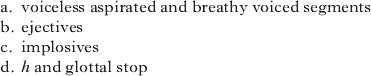
To these examples we could add the classic case of Grassmann's Law, which arguably marked the beginning of linguistic interest in dissimilation, various proposals over the past several decades that cite phenomena similar to Grassmann's LawFootnote 1 and the survey data in MacEachern (Reference MacEachern1999), which in her interpretation support the view that ‘laryngeally active’ segments are avoided in successive syllables, where ‘laryngeally active’ segments are defined as in (2).
(2)
The generalisation that appears to unite all of these examples is that two marked elements are disfavoured within the same phonological domain. In the following sections I will present data from several Austronesian and Australian languages that supports the same inference. But first I will briefly review the conclusions of MacEachern (Reference MacEachern1999), since these contain a significant restriction on dissimilation as a repair strategy in eliminating multiple markedness, and it will be profitable to compare this with other types of sometimes quite puzzling restrictions in the new cases that I cite.
4 Generalising Grassmann's Law: MacEachern (Reference MacEachern1999)
Following up the observations of earlier researchers who described phenomena similar to Grassmann's Law, MacEachern (Reference MacEachern1999, Reference MacEachern2002) conducted a survey of dissimilation which led her to challenge earlier conceptions of Grassmann's Law in two important respects. First, she observed that although Grassmann's Law is usually discussed in terms of alternations, it actually describes a constraint that can be realised either dynamically (through alternations) or statically (through phonotactics). Her survey therefore included both phonological processes and the more abundant data on co-occurrence restrictions in morpheme structure. Second, she found that the class of segments subject to significant cross-linguistic co-occurrence restrictions is wider than that of aspirated stops, including all laryngeally active segments, as defined above.
In other words, very few languages allow aspirated or breathy voiced stops, ejectives, implosives, h or the glottal stop to appear twice within the same morpheme/word, or permit any two of these to co-occur. Where laryngeally active segments are found within the same phonological domain, this relaxation of the restriction usually is confined to segments that are identical or at least homorganic, as in Peruvian Aymara, which allows only one ejective or aspirated stop per morpheme unless these segments are identical, or in the Rajasthani language Gojri, which allows only one aspirated stop per word – again, unless the segments are identical (MacEachern Reference MacEachern1999: 35, 44). These languages, and others with similar restrictions, are marked ‘ ± ’ in the leftmost column of (3), which summarises the main points in MacEachern (Reference MacEachern1999), ignoring irrelevant differences of detail. MacEachern notes that none of these language has what she calls ‘a general identity constraint’, and this feature therefore need not be considered further.
(3)
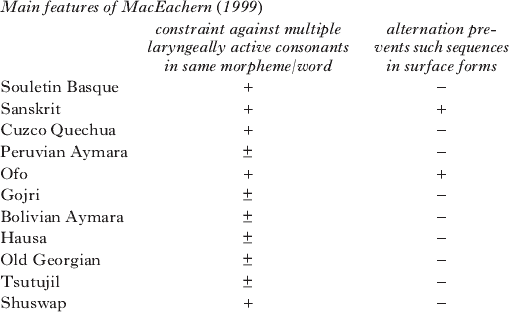
According to MacEachern (Reference MacEachern2002: 367), languages such as Souletin Basque, Sanskrit and Cuzco Quechua ‘prohibit the co-occurrence of two aspirated consonants … [as well as] the co-occurrence of /h/ with aspirated consonants, and of two /h/'s’. Other languages, such as Gojri and Aymara, prohibit non-identical aspirated consonants, but allow identical aspirated consonants, [h] and an aspirated consonant, or two instances of [h] to co-occur in the same morpheme. Finally, she says it is unclear whether Ofo patterns like Gojri and Aymara, but based on an account of laryngeal co-occurrence restrictions within Optimality Theory she notes (2002: 370) that ‘the only constraint ranking that will generate the observed forms of Ofo, while prohibiting forms containing nonidentical aspirated consonants, will also prohibit forms containing identical aspirated consonants’.
Like Alderete's data, a notable aspect of MacEachern's survey results is that they are difficult to reconcile with the traditional interpretation of the OCP, namely that languages tend strongly to avoid consecutive occurrences of identical feature values.Footnote 2 First, in many languages consonants that are not laryngeally active are exempt from the dissimilation pattern found with aspirates, implosives, ejectives and the like, as noted above. Second, as just seen, there is a counterpattern that MacEachern calls the ‘identity effect’: where some laryngeally active consonants do co-occur within the same phonological domain this is usually restricted those that are identical. To reconcile the OCP with her data, then, MacEachern (Reference MacEachern1999: 80) concluded that the theory must be restated in terms of featural similarity rather than identity, since ‘traditional OCP-based analyses do not account for all of the data’.Footnote 3
Gallagher (Reference Gallagher2010a, b) extends the work of MacEachern (Reference MacEachern1999) by testing the perception of contrast with regard to laryngeal features that surface in a non-laryngeal environment, but are suppressed in a laryngeal environment, thus proposing to explain dissimilations of the type seen in Grassmann's Law as products of perceptual limitations in the listener. Her analysis appeals throughout to marked structures, and so suggests a kind of ‘masking’ effect, in that the appearance of a marked structure makes the perception of a following marked structure more difficult to recognise.
In the following sections I will show that a different set of languages provides evidence for a pattern of dissimilation that targets underlying geminates and nasal clusters. Given the potentially controversial nature of the claim that these phenomena are divergent expressions of a single underlying process, it will be well to begin by considering geminate dissimilation, since the conditions on this process involve both geminates and nasal clusters, thus indicating a common property that cannot be stated in terms of phonetic similarity.
5 Dissimilation of geminates: Talaud
Sneddon (Reference Sneddon1984) presents a reconstruction of Proto-Sangiric, the ancestor of a low-level subgroup of Austronesian languages that forms part of the larger Philippine group. The Sangiric languages are Sangir, spoken in the Sangihe islands, situated between the northern peninsula of Sulawesi and Mindanao in the southern Philippines, Sangil, a dialect of the same language spoken on Mindanao which is often treated as a separate language, Talaud, spoken in the Talaud islands north-east of the Sangihe islands, and Bantik and Ratahan, both spoken in the northern peninsula of Sulawesi. Most of these languages have undergone fairly extensive sound change, and this appears to be particularly true of Talaud.
Talaud has 17 consonants /p t k ʔ b d g β r h m n ŋ s ʐ l ɭ/ and six vowels /i u e ə o a/. /ɭ/ is a retroflex lateral flap. Symbols in attested languages have their IPA values in this and subsequent phonological descriptions, unless otherwise noted. Sneddon (Reference Sneddon1984: 22) notes that most consonants may occur doubled, and that ‘geminate stops are sometimes realised as preglottalised single consonants, in free variation with long consonants’. The only consonant clusters are nasal–obstruent sequences in medial position.
According to Sneddon, Talaud geminates arose in three environments.
(4)

The last of these is most relevant to the discussion, and is illustrated in (5) with reconstructions from Proto-Malayo-Polynesian (PMP), the ancestor of the non-Formosan Austronesian languages (*R was probably an alveolar trill; note that the reconstructed schwa in the specialist Austronesian literature is conventionally written *e).
(5)
Footnote 4
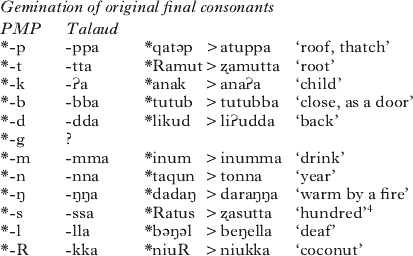
These examples show that PMP final consonants usually became Talaud geminates plus a supporting vowel -a. Reflexes of *-g are uncertain, *-k became glottal stop, which never geminated, and final *y and *w monophthongised with the preceding vowel, and were then not available for gemination (PMP *quay > Talaud ue ‘rattan’, *takaw > Talaud taʔo ‘steal’, etc.). The conditions for gemination in Talaud are of interest in themselves. In Sneddon's view (1984: 48), ‘it is unlikely that gemination occurred word-finally so it may be assumed that it developed after addition of the paragoge’. However, as seen in (6), words that ended in *-Ca did not geminate the onset of the final syllable.
(6)
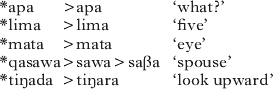
It therefore appears that final geminates either existed before -a was added, or that gemination and paragoge were a single change. Whichever interpretation is adopted, the conditions on this change turn out to be of direct interest to theories of dissimilation.
Sneddon notes that when a geminate follows the first vowel in Talaud the original final consonant did not geminate, as seen in (7), where unmarked reconstructions are PMP, and PS = Proto-Sangiric.
(7)
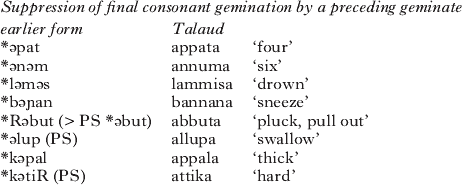
The gemination of original final syllable onsets is most common where the penultimate vowel was schwa, and it suggests that gemination after schwa preceded gemination of word-final consonants. What makes this case particularly interesting is that there is a second condition under which the expected doubling of a final stop is also suppressed.
PMP permitted two types of medial consonant clusters: (i) homorganically prenasalised stops (*mp, *mb, *nt, *nd, etc.), and (ii) clusters in reduplicated monosyllables that were already monomorphemic in Proto-Austronesian, as in *bəjbəj ‘bind by wrapping’, *dəmdəm ‘dark’ and *tuktuk ‘knock, pound, beat’. Most heterorganic clusters reduced in Proto-Sangiric, but homorganic nasal–obstruent sequences were retained. Final consonants in Talaud failed to geminate if the last-syllable vowel was preceded by a consonant cluster, which thus had the same inhibiting effect as a geminate consonant. Examples of this condition, which are less common than those of degeminate dissimilation, are shown in (8). There is one known exception: PS *undam > Talaud undamma ‘medicine’.Footnote 5
(8)
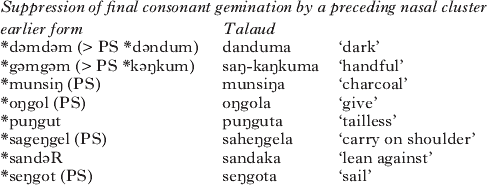
It is clear that Talaud degemination is not part of a general OCP constraint. This is shown in the first place because degemination is triggered either by a preceding geminate consonant or by nasal cluster, but it is also confirmed by the occurrence of identical onsets in successive syllables, as seen in (9).
(9)
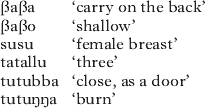
Importantly, there are also no alternations in Talaud that serve to avoid the occurrence of identical consonants in adjacent syllables unless these identical consonants are either geminates or a nasal cluster followed in the next syllable by a geminate consonant.
5.1 Summary
In Talaud the usual change C > CiCia/̲# is blocked under either of two conditions: (i) if there is a geminate earlier in the word, or (ii) if there is a nasal cluster earlier in the word. Rather than the traditional OCP account (avoid adjacent segments that share featural identity), this limitation on the gemination of original final consonants is most simply explained as a constraint against multiple occurrences of marked elements within the same phonological domain.Footnote 6
6 Dissimilation of prenasalised stops
6.1 Timugon Murut
Since nasal clusters act like geminates in suppressing final consonant doubling in Talaud, it should not be surprising to find that in other languages nasal clusters also reduce to simple segments if a nasal cluster occurs in an adjacent syllable. This type of change has previously been noted in passing for Timugon Murut of Sabah, Mori Bawah of southeast Sulawesi, and Ngaju Dayak of southeast Borneo (Blust Reference Blust2004: 110ff).
Probably the most widely shared phonological processes in the Austronesian languages of island Southeast Asia are what in the specialist literature are called ‘nasal substitution’ and ‘nasal accretion’.Footnote 7 While the first of these names is appropriate, what ‘nasal accretion’ actually describes is nasal place assimilation, and that is how it will be designated here. These processes, which accompany prefixation mostly with reflexes of PMP *maŋ- (active verb) and *paŋ- (actor, instrument), are almost universal in the Philippines and western Indonesia, but also occur in Malagasy, and in Chamorro and Palauan of western Micronesia. Examples from Bahasa Indonesia are given in (10).
(10)
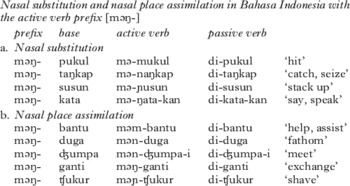
Indonesian (and Malay, from which it derives) generally shows nasal place assimilation (NPA) with base-initial voiced obstruents, and nasal substitution (NS) with base-initial voiceless obstruents. NPA involves only place assimilation of the prefixal nasal, while NS involves replacing the NC sequence with a nasal consonant having the place features of the oral segment.
There are additional complications, such as why the nasal substitution for s is palatal, and why ʧ shows NPA even though it is a voiceless obstruent, but these need not concern us here. Before bases that begin with sonorant consonants the prefixal coda generally drops, and before vowel-initial bases the active verb prefix is realised as məŋ-, providing an insight into its underlying form.
Austronesian NS shows a generic similarity cross-linguistically, but details differ from one language to the next. In Javanese, for example, this process affects all obstruents, and the prefix involves NS without a reflex of *ma-, as in (11).
(11)
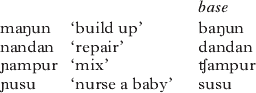
In other languages some (but not all) voiced obstruents undergo NS along with the voiceless obstruents.Footnote 8
Timugon Murut has 15 consonants /p t k ʔ b d g m n ŋ s ʤ l j w/ and four vowels /i u o a/. It allows no consonant clusters except homorganic nasal–obstruent sequences in medial position.
In describing the allomorphy of the Timugon Murut ‘subject focus’ prefix /maN-/, Prentice (Reference Prentice1971: 112ff) lists three allomorphs with a nasal coda: mam- before bases beginning with p or b, man- before bases beginning with t, d, s or ʤ, and maŋ- before bases beginning with k or g. In this language many bases allow both NPA and NS, with syntactic differences that are irrelevant to the present discussion, such as mam-buli vs. ma-muli ‘keep’, or man-tutu vs. ma-nutu ‘pound’. However, as seen in (12), nasal deletion rather than NPA occurs in bases with nasal clusters, hence ma-tumbuk (**man-tumbuk) ‘topic/subject will thump each other’ vs. ma-numbuk ‘topic/subject will thump object’.Footnote 9
(12)

Although the prefixal nasal coda also drops in some other environments, the coda is invariably lost where regular morphology would produce two nasal clusters in the same word. In short, multiple nasal clusters are disallowed within a word in Timugon Murut, and where they arise from affixation the first is eliminated by nasal deletion, giving rise to prefixal allomorphs with and without the final nasal.
Comparison with Talaud shows both similarities and differences. While Talaud geminate dissimilation is progressive, nasal cluster dissimilation in Timugon Murut is regressive, and while degemination in Talaud is conditioned by both geminates and nasal clusters, cluster reduction in Timugon Murut occurs under a single condition. However, this variability of form is no greater than that in Grassmann's Law, in the dissimilations of Ofo or Meithei or in the constraints that MacEachern (Reference MacEachern1999) finds for laryngeally active consonants in a range of languages.
Summary
In Timugon Murut the prefixes that Prentice (Reference Prentice1971) writes /maN/, /ŋaN-/, /saN-/ and /taN-/ lose the nasal coda under what appears to be a heterogeneous collection of conditions. However, the dominant pattern in his data is one in which multiple instances of nasal clusters are disallowed within the same phonological domain. This is reminiscent of Meinhof's Ganda Law, cited by Alderete (Reference Alderete and McCarthy1997), although Luganda solves the problem by dropping the plosive member of a nasal cluster, while Timugon Murut solves the problem by dropping the nasal member.
6.2 Mori Bawah
Mead (Reference Mead1998: 100) reports a more complicated case of multiple nasal cluster avoidance in Mori Bawah of southeast Sulawesi. This language has a CV(N)CV morpheme structure, 15 consonants /p t k ʔ b d g β s h m n ŋ l r/ and five vowels /i u e o a/. The only consonant clusters in the language are [mb nd ŋg] within a morpheme, and [mp nt ŋk ns] both morpheme-internally and at a morpheme boundary. Mead (Reference Mead1998: 17) treats all of these as unit phonemes, but notes that Barsel (Reference Barsel1994) analyses [mb nd ŋg] as phonemic units (/mb nd ŋg/) and [mp nt ŋk ns] as clusters.
The morphophonemic behaviour of prefixal nasal codas in Mori Bawah and some other languages of Sulawesi differs strikingly from that of other Austronesian languages in insular Southeast Asia. In CVCV bases moN- ‘active verb’ shows NPA with voiceless base-initial obstruents, nasal deletion with other base-initial consonants and nasal deletion plus glottal stop insertion with vowel-initial bases, as seen in (13).
(13)
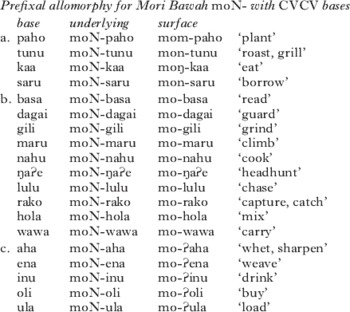
Prefixal allomorphy for CVNCV bases shows another surprising pattern. According to the Indonesian source on which Mead draws (Tapehe Reference Tapehe1984), moN- varies in shape with the voicing of the medial prenasalised consonant. If this obstruent is voiced it tolerates a prefixal nasal coda, but if it is voiceless the coda drops, as shown in (14).
(14)
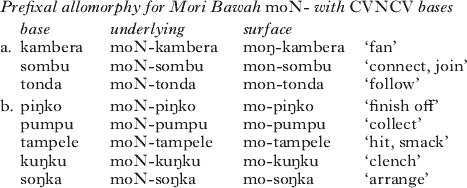
These observations are puzzling for several reasons. First, as just noted, in most languages reflexes of *maŋ- show NPA with base-initial voiced obstruents and NS with base-initial voiceless obstruents. By contrast, Mori Bawah moN- shows nasal deletion where most languages show NPA, and NPA where most languages show NS. Second, the NPA/NS distinction is normally insensitive to canonical shape, and if it does take account of medial nasal clusters, as in the languages discussed here, it makes no reference to voicing distinctions in the post-nasal medial obstruent. No obvious phonetic or phonological motivation for this development is apparent. Third, since CVCV bases that begin with a voiceless stop never drop the prefixal nasal coda (paho: mompaho, etc.), the loss of this segment in forms such as kuŋku: mo-kuŋku ‘clench’, piŋko: mo-piŋko ‘finish off’, pumpu: mo-pumpu ‘collect’, etc. appears to be motivated by avoidance of multiple nasal clusters within a word. In fact, without further information this constraint hardly differs from the similar constraint in Timugon Murut.
However, as seen in (14), complications arise in bases with a medial prenasalised voiced obstruent, like mon-sombu, since these allow multiple nasal clusters, and hence seem to defeat the purpose of nasal deletion in forms like mo-soŋka. What is especially odd is that this pattern is contrary to what might be expected from the morphophonemics of prefixal nasal codas, where e.g. *moN- + p>mom-p, but *moN- + b>mo-b. In other words, prenasalised voiced obstruents are not tolerated across a morpheme boundary, but morpheme-internally they not only occur, but they overrule the general constraint against multiple marked elements, and so permit a generally disfavoured situation to exist. This allomorphic pattern raises at least two distinct questions: (i) what motivates non-local conditioning?; and (ii) what general linguistic principle could be invoked to explain why voiced medial stops tolerate multiple marked elements in a word, while voiceless ones do not? Or, stated differently, why it is that two nasal clusters may occur in Mori Bawah surface forms provided that the obstruent member differs in voicing?Footnote 10
The search for cases parallel to Mori Bawah has so far proved frustrating. Thurneysen's Law in Gothic, for example, shows voicing dissimilation at a distance, but cannot be compared directly with the facts in Mori Bawah, where the voicing value of a medial stop triggers the retention or loss of a prefixal nasal coda rather than a switch in the value for voicing, and it does so only if the medial stop is prenasalised.Footnote 11
6.2.1 Summary
Mori Bawah, like a number of other languages of Sulawesi, differs from the usual pattern of nasal place assimilation and nasal substitution in requiring NPA before base-initial voiceless obstruents rather than voiced obstruents. This pattern is consistent in CVCV bases. However, in CVNCV bases that begin with a voiceless obstruent, prefixal nasal coda deletion occurs if the medial prenasalised obstruent is voiceless, but not if it is voiced. In effect, voiced medial obstruents have the same effect in conditioning prefixal allomorphy as voiced base-initial obstruents in most of the Austronesian languages of insular Southeast Asia.
6.3 Ngaju Dayak
Ngaju Dayak, spoken in the Barito river basin of southeast Borneo, is best known from the early work of the Swiss missionary August Hardeland (Reference Hardeland1858, Reference Hardeland1859), whose grammar and dictionary, although written more than 150 years ago, remain among the most detailed for any language of Indonesia.
Hardeland (Reference Hardeland1858) lists 18 consonants /p t ʧ k b d ʤ g m n ɲ ŋ s h l r w j/ and six vowels /i u e o æ a/. Although a small number of dictionary entries are given with an initial cluster of stop + liquid (blaŋa ‘highly prized porcelain jar’, brita ‘news’, grinaŋ ‘cockroach’, klambi ‘man's open jacket’, prontok ‘nod the head’, trima∼tarima ‘receive’, etc.) most of these appear to result from late vowel deletion, and many are Malay loans that contain an antepenultimate schwa between a stop and a liquid. Other clusters are limited to homorganically prenasalised medial obstruents. Base forms are thus CVCVC and CVNCVC, where C is optional.
Ngaju Dayak maŋ- has three classes of allomorphs in consonant-initial bases: one formed by NS before base-initial voiceless obstruents p, t, ʧ, s, k, another formed by NPA before base-initial voiced obstruents b, d, ʤ, g, and ma-, formed by nasal deletion before base-initial nasals, h, l, r or w.Footnote 12
(15)

The division of labour between these processes thus shows a superficial resemblance to that in Malay/Indonesian. However, Dempwolff (Reference Dempwolff1922–23: 195ff), who used Hardeland as his source, stated that bases with initial voiced obstruents also show NS if a nasal or prenasalised stop occurs in the next syllable: ‘Der größte Teil dieser Fälle … zeigt bei näherer Prüfung des Lautbestandes, daß in der nächste Silbe des Wortes ein Nasal oder einer Nasalverbindung folgt’. In fact, despite this statement, all examples that he cites have a medial nasal cluster, as shown in (16).
(16)

Again, as with Timugon Murut, and – in a more complex way – with Mori Bawah, Ngaju Dayak shows an exception to a general pattern of allomorphy that appears to be motivated by avoidance of multiple nasal clusters within a word. However, as with Mori Bawah, even this generalisation is difficult to state without puzzling qualifications.
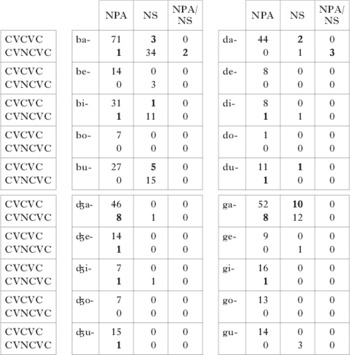
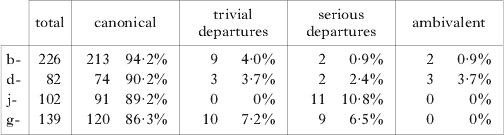
Hardeland (Reference Hardeland1859) is a Ngaju Dayak–German dictionary of 638 pages in double columns and eight-point type, containing about 8000 base entries. An exceptional feature of this work, particularly for its time, is that extensive information on affix potential is given for several thousand verb bases. Table I gives known patterns of allomorphy in connection with the active verb prefix maŋ- and its less frequent counterpart paŋ- for 549 bases that begin with a voiced obstruent. To help identify possible conditioning each category of base-initial voiced obstruent is further subdivided by first vowel, hence ba-, be-, bi-, bo-, bu-, etc. Table II summarises the patterns in Table I.
Frequency of nasal place assimilation and nasal substitution with voiced obstruent initials in Ngaju Dayak. NPA = nasal place assimilation, NS = nasal substitution, NPA/NS = variant forms given, one with nasal place assimilation, the other with nasal substitution. Canonical patterns are in plain type: divergent patterns in bold.

Summary of occurrences of maŋ- in Table I.
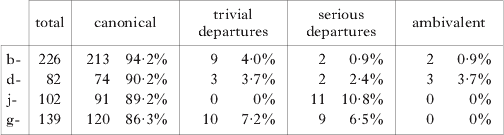
This material shows that bases with a voiced obstruent initial undergo NPA if they are CVCVC, but generally undergo NS if they are CVNCVC. It is clear, then, that Ngaju Dayak exhibits a strong tendency to undergo non-canonical NS just where failure to do so would result in two nasal clusters within a word.
The other interesting detail that emerges from this data is a substantial difference in the tolerance of multiple occurrences of nasal clusters that is correlated with place features: labial-initial and dental-initial bases allow very few multiple nasal clusters, while bases that begin with a palatal or velar obstruent are far more tolerant of this marked feature. This can be seen most clearly by considering the CVNCVC lines in Table I, which show that in the sample tested two b-initial bases permit the formation of verbs with multiple nasal clusters, while 63 do not, for d-initial bases the numbers are 2 and 2, for ʤ-initial bases 11 and 2 and for g-initial bases 9 and 16.Footnote 13 Ngaju Dayak thus disfavours multiple instances of nasal clusters within a word, but this constraint is much more strictly observed in b-initial bases and d-initial bases than it is in ʤ-initial bases or g-initial bases, as shown by the sample data in (17), where non-canonical allomorphs are given in bold.
(17)
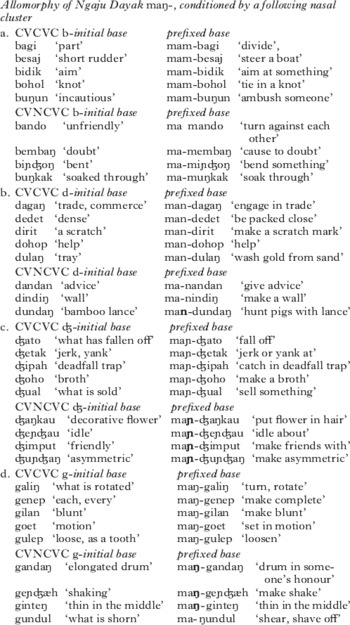
Nine of the 13 exceptions for b-initial bases are trivial in that they do not lead to multiple nasal clusters within a word, but simply overextend the pattern of nasal substitution for bVNCVC bases to some bVCVC bases, as with bili ‘buying’: ma-mili ‘buy’, or buat ‘load, cargo’: muat/mamuat ‘load cargo’. The only serious counterevidence to the claim that maŋ- shows NPA with bases of the shape bVCVC, but NS with bases of the shape bVNCVC, comes from two bVNCVC bases that show NPA, and two that show both patterns, as seen in (18).
(18)
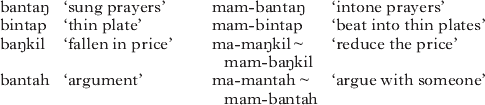
The first two examples are unexplained, but the last two could be from Banjarese Malay mam-baŋkil and mam-bantah, as it is well known that Ngaju Dayak has a significant Banjarese lexical stratum (Dyen Reference Dyen1956).
6.3.1 Summary
Like the other languages examined previously, Ngaju Dayak disfavours the presence of surface forms that contain more than one nasal cluster. However this constraint appears to be gradient rather than absolute, since serious departures from the canonical pattern of prefixal allomorphy increase sharply in moving from labial and dental initials (b = 0·8%, d = 2·4%) to palatal and velar initials (ʤ = 10·8%, g = 6·4%). Even if ambivalent (NPA/NS) cases are averaged by halving, this pattern is unaffected (b = 1·2%, d = 4·2%, ʤ = 10·8%, g = 6·4%). For reasons that remain unclear, this increase in the likelihood of NPA for voiced obstruent-initial CVNCVC bases parallels the cross-linguistic tendency for base-initial voiceless obstruents to resist NS, since this is rare for labials and dentals, but increasingly more common for palatals and velars (Blust Reference Blust2004: 94–95). Ngaju Dayak, then, presents a challenging case of multiple cluster avoidance that decreases in strength as the voiced initial moves further back in the vocal tract.
6.4 Nhanda
Blevins (Reference Blevins2001: 32–34) describes a rule of nasal dissimilation in Nhanda, a Pama-Nyungan language of Western Australia, which ‘typically involves sequential nasal-stop clusters across a vowel, where the second cluster loses its nasal component’, hence: … NCVNC … > … NCVC …. According to Blevins, in Nhanda this change produces allomorphy of the ergative and homophonous locative suffixes -ŋgu∼-gu, the locative path suffix -ŋgalu∼-galu, and the ambulative suffix -ŋgula∼-gula, as shown in (19).
(19)
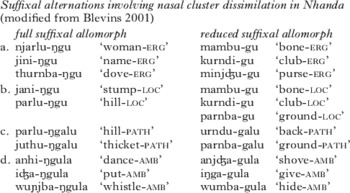
However, as in Mori Bawah and Ngaju Dayak, there are complications. The last example shows that nasal cluster dissimilation occurs if the first nasal cluster is a homorganic sequence (mb), but not if it is a heterorganic sequence (ɲb). Blevins states that this is generally true, the only known exception being parnba-gu. Moreover, nasal dissimilation is limited to the four morphemes illustrated here; the allative suffix -ŋgu, which is homophonous with the ergative and locative, is exempt. Blevins (Reference Blevins2001: 32) suggests that ‘nasal dissimilation had its origin in a single morpheme *-nggu which served as ergative, instrumental and locative’, but the historical factors which gave rise to a dissimilatory response in this morpheme and not in the currently homophonous allative suffix are not elucidated.
Although her discussion of this phenomenon in Nhanda covers less than three pages, it is extremely valuable, not least because she concludes by noting (2001: 34) that ‘nasal-cluster dissimilation rules are found in Aboriginal languages across Australia, and do not appear to be confined to any particular genetic grouping or geographic region’. In support of this statement she cites eight references to earlier discussions of nasal cluster dissimilation, and it will be worthwhile to refer to one or two of these here.
6.5 Other Australian cases
Blake (Reference Blake1979: 18) notes that in Kalkatungu, a Pama-Nyungan language spoken in western Queensland, ‘there is a rule that deletes the nasal from a nasal plus stop sequence in a suffix when that suffix is added to a stem already containing a nasal plus stop sequence. The rule is not a general phonetic one, but is particular to certain suffixes’. Among the suffixes that are subject to this process are the ergative -ŋku, the habitual -ʧaŋu, the continuative -ɲʧaani, the purposive -ɲʧaaʤa and the verb pluraliser -ntiti.
Dixon (Reference Dixon1980: 199, 216–218) notes a historical change in Linngithigh, one of the ‘initial dropping’ languages of the Cape York Peninsula. In this language, as in others of the same region, initial consonants, and sometimes C1V1-, have dropped. However, before an initial nasal disappeared it triggered dissimilatory deletion of a medial preconsonantal nasal, as shown by the following forms (Dixon Reference Dixon1980: 317).
(20)
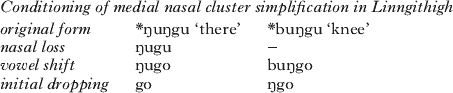
This example is especially interesting, because it parallels the Ganda Law of Meinhof (Reference Meinhof1932) in showing that nasal cluster dissimilation can be triggered in some languages by a simple nasal within the same word. Other examples of nasal cluster dissimilation in various parts of the Australian continent are discussed by McConvell (Reference McConvell1988), but will not be considered further, since they add little to the material already considered here.
7 Summary of the data
Dissimilation patterns that affect either geminates or nasal clusters have been described for seven languages: Talaud, Timugon Murut, Mori Bawah, Ngaju Dayak, Nhanda, Kalkatungu and Linngithigh. In each of these there appears to be a dispreference for more than one marked element (geminate, nasal cluster), and where two marked elements would be expected on the basis of regular synchronic processes or historical change, one is eliminated. However, the method of elimination, the conditions for its occurrence, and – most significantly – the sub-conditions that permit consecutive marked elements vary in interesting ways cross-linguistically.
Since the central claim of this paper essentially supports Alderete (Reference Alderete and McCarthy1997), its principal contributions are: (i) to make new data available showing that, whatever the role of the traditional OCP, in a number of languages dissimilation appears to be motivated by avoidance of consecutive marked elements, (ii) to draw attention to the types of constraints on markedness-driven dissimilation that are attested in different languages and (iii) to offer some preliminary indications that markedness-driven dissimilation is motivated by cognitive rather than phonetic principles. The first of these contributions forms the main body of this paper. The second is found scattered throughout the paper, and it will be helpful to bring all relevant examples together in one place here. The evidence for a possible cognitive motivation will be discussed last.
The recognition that a number of languages exhibit dissimilation patterns that are best explained in terms of avoidance of multiple marked elements within the same phonological domain is an insight that serves to unite a wide array of phenomena, including the following.
(21)
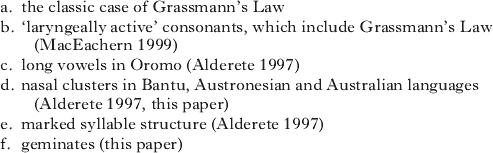
In all of these cases, the pattern of avoidance that triggers dissimilation seems to involve multiple marked elements rather than a constraint against consecutive identical features, and it therefore seems safe to conclude that, whatever role the traditional OCP may play in some languages, it is distinct from the principle that languages be limited to ‘one mark per word.’Footnote 14
From the standpoint of phonological theory, the major challenge presented by this data is not so much how to justify the claim that ‘one mark per word’ is a valid principle, but rather how to explain exceptions to this principle. In the ideal situation, what one would hope for is a pattern in the exceptions that would allow for cross-linguistic generalisation. While this is the case for one pattern (MacEachern's ‘identity effect’), it does not appear to be the case for others. The constraints found so far that allow ‘one mark per word’ to be violated are:
(i) The ‘identity effect’ (MacEachern Reference MacEachern1999): two ‘laryngeally active’ consonants may appear within the same phonological domain if and only if they are identical.
(ii) The ‘non-local voicing effect’: in Mori Bawah two marked elements may appear within a prefixed word if and only if the prenasalised stop in a CVNCV base is voiced.
(iii) The ‘backness effect’: in Ngaju Dayak two marked elements are more likely to appear within the same word if the base-initial consonant is palatal or velar.
(iv) The ‘homorganicity effect’: in Nhanda two marked elements may appear within the same word if and only if the first nasal cluster is a heterorganic sequence (this is distinct from identity/non-identity of the two nasal clusters).
Although it may be possible to model these effects in terms of constraint ranking, to do so in a way that produces plausible explanations requires that the proposed constraints be justified as language universals, or as principles operative elsewhere in the language in question. MacEachern (Reference MacEachern1999) found cross-linguistic support for the ‘identity effect’, and the claim that this is a language universal can therefore be justified. However, why multiple marked elements should be permitted only if they are identical remains elusive. In the cases at hand we must ask what constraint could seriously be invoked to explain why Mori Bawah allows double nasal clusters in a prefixed word if the prenasalised medial obstruent of the base is voiced, but not if it is voiceless, why Ngaju Dayak shows a lower tolerance for double nasal clusters in a prefixed word if the base-initial obstruent is labial or alveolar than if it is palatal or velar and why Nhanda allows double nasal clusters in a suffixed word if the nasal and obstruent of the base are homorganic, but not if they are heterorganic. I do not wish to predict outcomes, but accounting for these structural properties will undoubtedly be challenging, since none of these conditions appears to involve a plausible language universal, and one of them (‘the backness effect’) is gradient rather than absolute.Footnote 15