Background
The need to integrate services and reduce costs has been a political drive to the National Health Service (NHS) in the United Kingdom in recent years. The 12-bed Greenview Intermediate Care Unit (GICU) in North West London opened in 2008 aiming to relieve pressure on overcrowded and high-cost beds in the local general hospital (GH). Its goal was to provide rehabilitation for people recovering from physical illness in the general hospital (GH) who had coexisting psychiatric disorders, e.g., delirium, dementia, and depression, but for whom assessment while in the general hospital suggested that discharge home (i.e., their own home, not institutional accommodation) might be achieved. Although delirium may be considered to be part of physical illness rather than an independently occurring psychiatric disorder, because of its behavioral manifestations, when the physical trigger for it had been treated, it was included as “psychiatric” in the context of rehabilitation.
The unit is located in one wing of a nursing home in the community, a lower cost environment compared with the general hospital. Its philosophy is compatible with the objectives of the National Service Framework for Older People (Department of Health, 2001) and the National Dementia Strategy (Department of Health, 2009).
Recovery from delirium may take many months and may significantly impede functional recovery following acute physical illness. Delirium, often including symptoms of poor judgment and psychotic symptoms running a fluctuating course and worse at night, may make discharge home temporarily unsafe when the person is otherwise deemed “medically fit for discharge.” Clinical experience suggests that general hospitals often do not take into account the frequently long duration of recovery. These patients, and others with various inter-current psychiatric illnesses, e.g., depression, are consequently at high risk of discharge to institutional care, in the expectation that recovery will never be sufficient for independent living. Hence, the need to provide combined physical and psychiatric intermediate care.
Referral to the service was associated with the general hospital clinical team regarding the patient as “medically fit for discharge.” Initial assessment, usually in the general hospital, was carried out in a standardized fashion by one of the three assessors: an intermediate care nurse, a consultant old age psychiatrist, or a staff grade psychiatrist. Assessment included psychiatric history and mental state examination and a detailed review of the current clinical situation, including results of investigations, diagnosis, treatment, and course of illness. Discussion with therapy staff identified potential for rehabilitation. For most patients a collateral history was obtained from family or friends to determine level of mental and physical function before the existing acute episode and their willingness to support discharge home after rehabilitation. A similar process was followed for a few patients admitted directly from home, including obtaining results of clinical investigations. This was to ensure that a patient was not disadvantaged due to failure to identify treatable causes of delirium, which might have been better managed in the general hospital.
Greenview Intermediate Care Unit was nurse-led. Rehabilitation staff included physiotherapist, occupational therapist, staff grade psychiatrist, and psychologist. Visiting senior medical support included a general practitioner, a psychiatrist, and a geriatrician. GICU therefore had elements of a joint geriatric and psychiatric unit in which there has been a recent revival of interest (George et al., Reference George, Adamson and Woodford2011).
The unit was established to provide clinical service, and not for research. However, the staff realized that working within a relatively new service model, they had a responsibility to analyze its clinical outcomes. Two qualitative reports give more details of the origins and the nature of the unit (Madaras and Hilton, Reference Madaras and Hilton2010; Department of Health, 2011). The present study aimed to give an overview of the clinical characteristics of the patients admitted and the outcome of their rehabilitation with a view to improving the services provided by us.
In the course of clinical work, it appeared that longer length of stay within the GICU was associated with discharge to institutional care. Also, despite thorough initial pre-admission assessment based on clinical skills and experience, it was difficult to predict who might benefit most from rehabilitation and achieve discharge home.
We could not identify any directly comparable studies because of differences in health care settings and selection of subjects. Some studies defined “home” as place where the patient was living prior to admission, whether institution or otherwise. Other studies investigated dementia only (Alzheimer's Society, 2009).
Methods
We set up a naturalistic retrospective cohort study using data collected in the course of daily work for 100 consecutive admissions to GICU between March 2009 and October 2010. Assessment tools were readily available and some were mandatory as performance indicators. The design of the study, as a service evaluation, meant that it did not require research ethics approval (National Research Ethics Service, 2009).
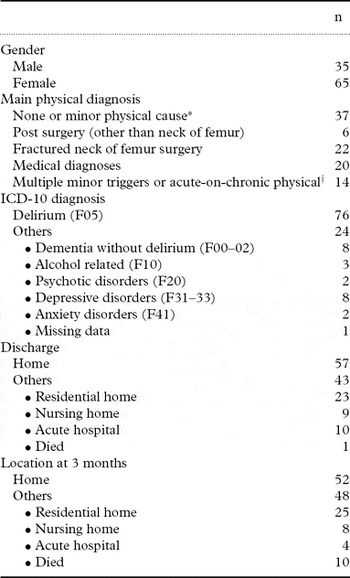
Data at the time of assessment and admission – usually within 24 hours of each other – were recorded (Table 1): demographic data, physical diagnoses, Abbreviated Mental Test Score (AMTS) (Hodkinson, Reference Hodkinson1972), Barthel Index for Activities of Daily Living (Barthel and Mahoney, Reference Barthel and Mahoney1965), and Health of the Nation Outcome Score for Elderly People (HoNOS 65+). The HoNOS 65+ is a widely used scale within NHS mental health services to measure the health and social functioning of people with severe mental illness (Burns et al., Reference Burns1999). The International Classification of Disease (ICD 10) (World Health Organisation, 2010) category for psychiatric disorder was confirmed during admission to GICU.
Demographic and assessment data (n = 100)

*For example, may be a fall reported, or urinary tract infection (UTI), fractured upper limb, urinary retention secondary to prostatic hypertrophy.
†On pre-existing chronic physical disorder, e.g., Parkinson's disease or diabetes mellitus.
Data were analyzed using binary logistic regression, since the dependent variable was dichotomous: discharge home or not home. Since our main interest was in patients returning to their own home, the other outcomes – residential home, nursing home, return to hospital, or death – were grouped together. A backward entry model was used for the analysis as the study was exploratory in nature and no prior statistical assumptions were made about the data. All analyses were performed using SPSS software. Logistic regression analysis requires complete data; however, there were 47 items of data missing at random from 20 participants within the dataset (overall, 4% of total items). Listwise deletion was employed to exclude data from these 20 participants, resulting in a final analysis based on complete data from 80 participants.
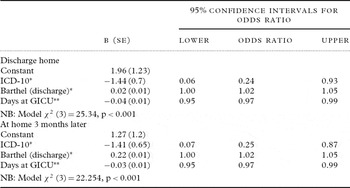
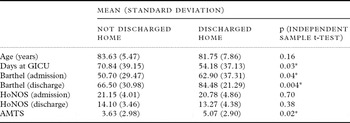
Two logistic regression analyses were conducted (Table 2) with place of initial discharge and location three months later as the respective dependent variables. In both analyses the independent variables were gender, age, physical diagnosis, ICD-10 diagnosis, AMTS on admission, days at GICU, and Barthel and HoNOS scores on admission and discharge. A paired samples t-test was also conducted to compare the change in Barthel and HoNOS scores between time of admission to GICU and discharge. Independent sample t-test was used to compare some variables in the discharge home and the not discharge home groups (Table 3).
Logistic regression analysis (n = 80)

*p < 0.05, **p < 0.01.
Comparisons between patients discharged home and not discharged home (n = 100)

*Statistically significant.
Statistical methodology required grouping of data, and this was done in a way that had good face validity for types of condition and clinical interventions. Similar groupings for physical disorders have been used by other researchers (George et al., Reference George, Bleasdale and Singleton1997). ICD-10 psychiatric diagnoses were also grouped. In this analysis, delirium included both that occurring independent of dementia (F05.0) and superimposed on it (F05.1).
Results
Logistic regression analysis (Table 2) found that better Barthel scores at discharge, shorter duration in GICU, and a diagnosis other than delirium were associated with being discharged to their own home and being there three months later. Age, underlying physical illness, AMTS, and HoNOS and Barthel scores on admission were not significant predictors of discharge home.
Results in Table 3 indicated significant differences in mean number of days at GICU between those discharged to their own home and those who were not. Interestingly, the discharge outcome groups did not differ according to age or HoNOS scores.
Whether or not the patient went home, there was a significant improvement in Barthel scores between admission (X = 61.64, SD = 28.01) and discharge (X = 79.43, SD = 25.47) (t = –8.85, df = 79, p = 0.00). There was also a significant improvement in HoNOS scores over the same period. (X = 20.45, SD = 4.50; X = 13.51, SD = 4.06) (t = 12.19, df = 79, p = 0.00).
As an exploratory measure, missing data analysis using multiple imputation was conducted on the dataset to examine whether imputing data for the 20 participants would have made any difference to the final logistic regression model. Twenty data sets were imputed as recommended by Enders (Reference Enders2010) for continuous variables. Logistic regression analyses were conducted on all 20 data sets, each yielding the same model resulting in the Barthel score at discharge, days at GICU, and the ICD-10 diagnosis as predictors of place of discharge. This indicates that the exclusion of the missing data made little difference to the outcome of the variables predicting discharge destination.
Discussion
Our study had clear limitations such as a retrospective design and lack of randomized control groups and should be considered a pilot study. The findings are relevant in the context of the Department of Health's recommendations for intermediate care to allow recovery from physical illness, and to ensure that older people with coexisting mental illness are not excluded from these services (Department of Health, 2001; 2009). They are also relevant to the Royal College of Physicians (2012) report on hospitals struggling to cope with their allocation of beds.
This study indicates that older people with physical plus psychiatric diagnoses can improve sufficiently over a number of weeks to return home (57%). Both the HoNOS and Barthel scores of patients improved significantly during their time at GICU. However, we do not know how much improvement was due to the natural resolution of the psychiatric and physical disorders over time in a safe and supported environment and how much due to the therapeutic interventions.
Delirium is known to have poor long-term prognosis. One earlier study indicated that delirium predicted discharge to a nursing home (Adamis et al., Reference Adamis, Treloar, Martin and Macdonald2006). An American study of discharge from acute medical wards, of patients who had not been delirious at the time of admission but had persisting delirium at the time of discharge, found an 80% nursing home placement rate (McAvary et al., Reference McAvary2006). Although it has been shown that any mental disorder complicating physical illness is an independent predictor of poor outcome (Holmes and House, Reference Holmes and House2000), it was not surprising that rates of discharge home for people without delirium were better than those with it. Notably, in our study, the non-delirium group included those with reversible functional disorders or dementia without superimposed delirium, suggesting no acute behavioral disturbances, and therefore discharge was associated with the level of mental function with which the families were coping prior to the acute episode. A further question which arose was whether the patient's change in behavior in delirium provoked a “never again” or “can't cope” family reaction, and whether this could be overcome by adequate psycho-education and specialist support in the management of pre-existing dementia.
Our study has implications for estimating potential for rehabilitation within the general hospital. Patients returning home and those who did not were of similar age and had similar HoNOS scores at the time of admission to GICU, suggesting that these variables were of little significance in the outcome of rehabilitation. Barthel scores and AMTS on admission were better in the group which ultimately returned home, but the standard deviation was too wide to be helpful in clinical practice. Type of physical disorder was also not associated with place of discharge.
Our findings emphasize the difficulties of identifying people likely to benefit from intermediate care targeted at those with physical plus mental disorders. Often at the time of general hospital discharge, decisions are made rapidly but the individual may lack capacity to make that decision and the family does not understand the potentially slowly reversible nature of delirium. The lack of understanding was apparent from discussions with relatives of GICU patients. Decisions on discharge made precipitately may have huge financial and social implications. Notably, for those discharged home, over 90% were there three months later, stressing the importance of not rushing to place people in institutional care on the basis of an acute admission. A long-term follow-up study might be useful in this context.
The association between prolonged length of stay and discharge to institutional care was also observed in a study by the Alzheimer's Society (George et al., Reference George, Bleasdale and Singleton1997). This was apparent in our study although where the threshold lies was unclear. In a prospective study, it would be possible to identify the point at which delayed discharges were related to administrative difficulties. However, we did not have this data. Rather, length of admission was affected by multiple factors, administrative being only one. Some patients deteriorated rapidly in GICU and required readmission to hospital so had only short GICU admissions, partially redressing the assumption of administrative factors contributing to duration of admission. Discharge planning began shortly after admission, thus also avoiding some of the administrative blocks. Another potential cause for delay was the observation of a “saw-tooth” clinical pattern of delirium. This was associated with repeatedly beginning to recover physically and mentally but then worsening again with minor physical disorders such as constipation, urinary infection, or upper respiratory infection. Each time progress in rehabilitation began, but goals were never achieved. This pattern would be unlikely to be observed in a general hospital with short duration of admission, but suggests the need for monitoring the pattern of delirium to plan future care needs.
More investigation of factors – social, psychological, physical, and mental – is warranted to better predict who is likely to return home. Also, clearer understanding of the relative values of providing safe convalescence, with and without active therapeutic interventions, would be useful. The model of GICU warrants further investigation, for example, clinical, social, and financial comparisons with other forms of intermediate care such as domiciliary therapy plus personal and social support, or with a matched group of general hospital in-patients for whom no dedicated psychiatric–geriatric intermediate care is available.
Conflict of interest
None.
Description of authors' roles
Claire Hilton, suggested the study, did the literature review, oversaw the project, and wrote it up. Andrew Madaras collated the data. Maria Qureshi did the statistics. We all commented on various drafts of the manuscript.
Acknowledgments
Our thanks to Natascha Basedau, Carl Money, and David Lubel for their comments.