I. INTRODUCTION
Carbon fiber, a high performance material, is considered to be an ideal reinforcing material for advanced composite materials, and it has attracted great attention because of its super high strength-to-weight ratio and superior stiffness. Carbon fiber has been extensively applied in high-tech aerospace, defense areas, and civil engineering (e.g., transportation industry, architecture industry, medical industry, and sports equipment).Reference Shokuhfarl, Sedghi and Farsani1–Reference Ji, Wang, Bai, Yu and Wang3 Carbon fiber is predominantly manufactured from rayon, polyacrylonitrile (PAN), and pitch precursor fibers.Reference Zhang, Liu and Wu4 Among all the available precursors, PAN fiber is one of the best materials for preparing high performance carbon fiber.Reference Gupta, Paliwal and Bajaj5 However, PAN homopolymer has hardly been used as a carbon fiber precursor because of its poor stabilization and processability such as high stabilization temperature and centralized heat release, which results from the strong interaction and closed packing between PAN molecules. Therefore, a small amount of comonomer is generally incorporated into PAN chains during polymerization for enhancing solubility, spinnability, hydrophilicity, and drawability, and especially for improving the stabilization of PAN, which plays an important role in preparation of high performance carbon fiber.Reference Bahrami, Bajaj and Sen6–Reference Devasia, Reghunadhan Nair, Sadhana, Babu and Ninan9 It is well known that the conversion of precursor into carbon fiber includes three stages: stabilization, carbonization, and graphitization. In the stabilization stage, precursor fiber is heat treated in an oxidizing atmosphere, normally air, at a temperature range of 200–300 °C. A variety of exothermic chemical reactions, such as cyclization, dehydrogenation, and oxygen uptake reactions, occur during this process. Among all these reactions, the cyclization reactions, which convert PAN into an infusible stable ladder polymer, are the key step owing to the significant effect of cyclization extent on the performance of resulting carbon fiber.Reference Rahaman, Ismail and Mustafa10–Reference Fitzer, Frohs and Heine14 It is well knownReference Watt15, Reference Bahl and Manocha16 that the ideal carbon fiber performance requires the cyclization reactions to proceed as fully as possible, preferably to 100%, and the initial cyclization temperature should be as low as possible, otherwise, the heat released from stabilization reactions will lead to breakage of the molecular chain and fragile carbon fiber. The influence of various comonomers, such as acrylic acid (AA),Reference Ferguson and Debanath17 methacrylic acid (MAA),Reference Kakida and Tashiro18, Reference Kakida and Tashiro19 itaconic acid (IA),Reference Devasia, Reghunadhan, Sivadasan, Katherine and Ninan20 and acrylamide,Reference Wang, Wang, Wu and Jing21 on the stabilization of PAN has been reported. It is also found that many terpolymers of acrylonitrile (AN), such as P(AN-MA-IA), P(AN-MMA-IA), and P(AN-MA-AA), are used as carbon fiber precursor for improving the stabilization and spinnability,Reference Catta, Sakata, Garcia, Zimmermann, Galembeck, Galembeck and Giovedi22, Reference Sen, Bajaj and Sreekumar23 in which acidic comonomers such as AA, MAA, and IA mainly play a role to reduce the cyclization temperature, and neutral comonomers like methyl acrylate (MA) and MMA are used to improve the solubility, drawability, and spinnability of PAN.Reference Bajaj, Sreekumar and Sen13
However, it is very difficult to improve the stabilization and spinnability at the same time in PAN terpolymers due to the different reactivity of acidic comonomer and neutral comonomer.Reference Catta, Sakata, Garcia, Zimmermann, Galembeck, Galembeck and Giovedi22, Reference Sen, Bajaj and Sreekumar23 Generally, the reactivity of acidic comonomers is lower than that of neutral comonomers, which results in less acidic comonomers incorporated into the polymer chains, so the initiation temperature of stabilization in the terpolymers is almost as high as in PAN homopolymer. If the amount of acidic comonomers in the feed during polymerization increased, the molecular weight of polymers will significantly decrease, which is not beneficial for preparation of high performance carbon fiber. The similar results have also been found in our previous work.Reference Chen, Ju, Xu and Pan24 In addition, the sequence of each component in the terpolymers is very difficult to be controlled. For these reasons, the terpolymers are not the best materials for making high performance carbon fiber. Thus, many binary polymers, such as P(AN-co-IA), poly(acrylonitrile-co-ammonium itaconate [P(AN-co-AIA)], and P(AN-co-MMA), are also used as precursor to make carbon fiber. The binary polymers can reduce the initiation temperature of stabilization from approximately 210 to 180 °C; however, the spinnability of the binary polymers is poor because of no neutral comonomers incorporated into the polymer chains.Reference Devasia, Reghunadhan Nair, Sadhana, Babu and Ninan9, Reference Bajaj, Sreekumar and Sen13, Reference Ouyang, Cheng, Wang and Li25, Reference Cui, Yu and Wang26 How to effectively improve the stabilization and spinnability of PAN at same time for preparation of high performance carbon fibers is still a challenge. Thus, in this work, a bifunctional comonomer β-methylhydrogen itaconate (MHI) containing both carboxyl group and ester group was synthesized. It is expected that the stabilization and spinnability of poly(acrylonitrile-co-β-methylhydrogen itaconate) [P(AN-co-MHI)] can be improved at the same time. The structural evolution and stabilization mechanism of P(AN-co-MHI) during stabilization were investigated in detail. The spinnability has great effect on the properties of precursor fiber such as fineness, density crystallinity, and drawability, which ultimately affects the mechanical properties of resultant carbon fiber. So the spinnability of P(AN-co-MHI) was also investigated by rheological analysis in this article.
II. EXPERIMENTAL
A. Materials
AN (analytical grade) was purchased from Shanghai Boer Chemical Reagent Co., Ltd., Shanghai, China, and distilled twice before polymerization. Azodiisobutyronitrile (AIBN, analytical grade) was purchased from Sinopharm Chemical Reagent Co., Ltd., Shanghai, China, and recrystallized from methanol. Dimethyl sulfoxide (DMSO, analytical grade) was purchased from Shanghai Huadong Reagent Company, Shanghai, China, and distilled by reduced pressure before use. IA, petroleum ether, methanol, benzene, and benzoyl chloride (analytical grade) were purchased from Sinopharm Chemical Reagent Co., Ltd., Shanghai, China, and used as received.
B. Synthesis of comonomer MHI
In a 100-mL round-bottomed flask, IA (13 g, 100 mmol), methanol (14.2 mL, 350 mmol), and benzoyl chloride (0.5 mL, 4.3 mmol) were added. The mixture was refluxed at 65 °C for 0.5 h and then cooled to room temperature. The reaction mixture was distilled under reduced pressure to remove excess methanol and then followed by standing to get precipitation. The precipitation was recrystallized from benzene–petroleum ether (v/v = 1:1).
The resulting MHI is a white crystal at room temperature, and the yield of MHI is 84.52%. Fourier transform infrared (FTIR) spectroscopy (KBr) υmax cm-1: 3004, 2955 (C–H), 1726, 1691 (C=O), 1636 (C=C), 1237, 1170 (C–O). The proton nuclear magnetic resonance (1H NMR) spectra (400 Hz, DMSO-d6, room temperature, tetramethylsilane) δ ppm: 12.616 (s, 1 H, COOH), 6.149 (d, J =1.20 Hz, 1 H, CH2=), 5.763 (d, J =1.20 Hz, 1 H, CH2=), 3.580 (s, 3 H, OCH3), 3.336 (s, 2 H, CH2).
C. Preparation of polymers
PAN and P(AN-co-MHI) containing approximately 2.0 mol% MHI were prepared under nitrogen atmosphere. A typical polymerization is given below: 13.2 mL (200 mmol) of AN, 0.5940 g (4.08 mmol) of MHI, 0.0896 g (0.54 mmol) of AIBN, and 31.4 mL (441.98 mmol) of DMSO were added into a 250-mL three-necked flask fitted with a condenser tube and stirrer. The polymerization was carried out at 60 °C for 24 h under nitrogen and terminated by methanol. Then, the reaction mixture was added to excessive methanol with vigorous agitation to precipitate the polymer. The isolated polymer was washed with methanol for several times and then dried at 60 °C under vacuum to a constant weight. The viscosity average molecular weights of PAN and P(AN-co-MHI) are about 8.79 × 10⁴ and 8.75 × 10⁴g/mol, respectively. The viscosity average molecular weights of the PAN polymers were measured by Ubbelohde viscometer method.
D. Characterization
The proton nuclear magnetic resonance 1H NMR (400 MHz) spectrum was recorded on a Bruker DMX-400 NMR spectrometer (Bruker Corporation, Fällanden, Switzerland) using DMSO-d6 as a solvent at room temperature. Fourier transform infrared spectroscopy (FTIR) of KBr disks were measured on a Thermo Nicolet 8700 FTIR spectrophotometer (Thermo Nicolet Corporation, Madison, WI) at room temperature; 32 scans were collected at a resolution of 1 cm−1. The differential scanning calorimetry (DSC) and thermogravimetry (TG) curves of powered samples were carried out on a TA instrument Modulated DSC 2910 (TA Instruments, Wilmington, DE) and Netzsch TG 209 F1 thermal analyzer (Netzsch Group, Bavaria, Germany), respectively. The sample weights used for DSC and TG experiments were about 3–4 mg. X-ray diffraction (XRD) patterns of powered samples were measured on a Rigaku D/max-2550 diffractometer (Rigaku Corporation, Tokyo, Japan) between 0 and 50° at the rate of 3°/ min. All the XRD measurements were carried out under the same conditions. Rheological measurements were recorded on a Haake RS150L Rotational rheometer (Haake, Bremen, Germany) at 70 °C from 0 to 1000 s−1, and the concentration of PAN/DMSO and P(AN-co-MHI)/DMSO solutions was 18 wt%.
For stabilization, the powder samples were heated at constant temperature in an air oven with a temperature accuracy of 1 °C. One milligram stabilized sample was mixed thoroughly with 200 mg KBr and pelletized for FTIR characterization.
III. RESULTS AND DISCUSSION
A. FTIR studies of PAN and P(AN-co-MHI) stabilized at different temperatures for 30 min
In our previous work, the comonomer MHI was designed and synthesized, and the controllable preparation of P(AN-co-MHI) was investigated in detail.Reference Chen, Ju, Xu and Pan24 It was found that the molecular weight and conversion of polymerization decreased significantly at high MHI content. The P(AN-co-MHI) with high molecular weight 8.75 × 10⁴g/mol could be obtained under approximately 2.0 mol% MHI.
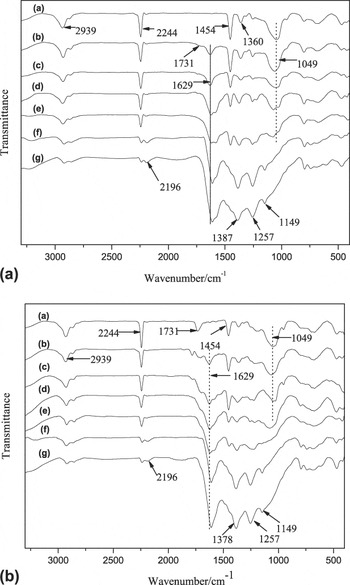
Figure 1 shows the FTIR spectra of PAN and P(AN-co-MHI) stabilized at different temperatures in air for 30 min. Of particular interest are the bands at 2244 cm−1 assigned to stretching vibration of C ≡ N and the bands at 1629 cm−1 assigned to stretching vibration of C = N conjugated with C = C.Reference Bajaj, Sreekumar and Sen27, Reference Shimada and Takahagi28 As it is well known, the cyclization reactions turn –C ≡ N groups into –C = N– structure, and the dehydrogenation reactions cause the conversion of the –CH2–CH2– structure to –CH = CH– structure, so the intensity change of bands at 2244 and 1629 cm−1 can be used to evaluate the extent of stabilization. As shown in Fig. 1, the intensity of band at 2244 cm−1 decreases gradually with increase of stabilization temperature for both PAN and P(AN-co-MHI), while the intensity of band at 1629 cm−1 increases significantly, indicating the extent of stabilization increases with the increase of stabilization temperature. That is, increasing temperature is beneficial for stabilization. It is well known that high temperature can cause breakage of the molecular chain, so lowering stabilization temperature is an effective measure for improvement of performance of carbon fiber. As shown in Fig. 1(a), d, and Fig. 1(b), c, the stabilization temperature for the band intensity of C = N and C = C groups (1629 cm−1) overtaking the band intensity of C ≡ N group (2244 cm−1) is approximately 200 °C for PAN homopolymer, while it is only 180 °C for P(AN-co-MHI), indicating the stabilization of P(AN-co-MHI) has been promoted by the comonomer MHI with lower stabilization temperature. It is widely accepted that the cyclization of nitrile groups in PAN can only be initiated through a free radical mechanism, while the cyclization in P(AN-co-MHI) can be initiated through both a free radical mechanism and an ionic mechanism.Reference Bajaj, Sreekumar and Sen13 The hydroxyl of carboxyl group (–COOH) in MHI can make a nucleophilic attack on the carbon atom of adjacent nitrile groups and then induces molecules to cyclize, which makes the stabilization reactions of P(AN-co-MHI) occur at a lower temperature.
FTIR spectra of PAN (a) and P(AN-co-MHI) (b) stabilized at different temperatures in air for 30 min: a, room temperature; b, 160 °C; c, 180 °C; d, 200 °C; e, 220 °C; f, 240 °C; and g, 260 °C.

From in Fig. 1, it is also found that the intensity of bands at 2939 cm−1 (stretching vibration of CH2 in open chain), 1454 cm−1 (bending vibration of CH2 in open chain), and 1360 cm−1 (bending vibration of C–H) decrease gradually with the increase of stabilization temperature.Reference Zhu and Wilding29, Reference Ouyang, Cheng, Wang and Li30 The band at 2196 cm−1 assigned to α, β-unsaturated nitrile groups appears and its intensity increases with the increase of stabilization temperature, hinting that the dehydrogenation reactions, which convert –CH2–CH– structure into –CH = C– structure, have occurred.Reference Jing, Wang, Wang, Bai and Zhu31 However, the sequence of cyclization and dehydrogenation is still not clear.Reference Zhao, Wang, Bai, Chen, Jing and Zhu32
The bands at 1257 and 1149 cm−1 assigned to stretching vibration of different C–O appear after 240 °C for both PAN and P(AN-co-MHI) as shown in Fig. 1,Reference Yu, Wang, Bai, Wang, Wang and Liu33, Reference Jing, Wang, Bai, Zhu and Wang34 supporting that oxygen uptake reactions have occurred. Oxygen mainly plays two roles in the stabilization of PAN polymers. One acts as a dehydrogenation agent in the conversion of –CH2–CH– structure to –CH = C– structure, which results in the formation of conjugated ladder structure combining with cyclization. The other role is to generate oxygen containing groups in the polymer backbone such as –OH and C = O, etc., which promotes intermolecular cross-linkage of polymer chains and provides PAN polymers better stability to sustain high temperature carbonization treatment.Reference Dalton, Heatley and Budd35, Reference Xue, Mckinney and Wilkie36
B. XRD studies of PAN and P(AN-co-MHI) stabilized at different temperatures for 30 min
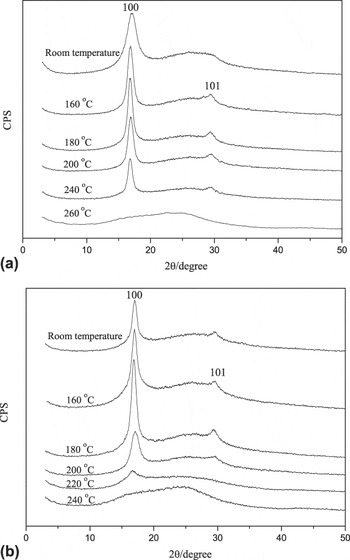
XRD patterns of PAN and P(AN-co-MHI) stabilized at different temperature in air for 30 min are shown in Fig. 2, respectively. The strongest diffraction peak at about 2θ = 17° is attributed to the (100) crystalline plane of the pseudohexagonal cell.Reference Yu, Bai, Wang, Xu and Guo37 At the same time, a weak diffraction peak at about 2θ = 29° is attributed to the (101) crystalline plane of the pseudohexagonal cell.Reference Xue, Mckinney and Wilkie36 The stabilization is a process of converting linear structure into ladder structure, and the structural change during the stabilization agrees well with the intensity change of diffraction peak around 2θ = 17°.Reference Bell and Dumbleton38 So the intensity changes around 2θ = 17° can be used to evaluate the extent of stabilization, and the equation is expressed as followsReference Yu, Bai, Wang, Xu and Guo37:
 $${\rm{SI}} = (I_0 - I_{\rm{s}} )/I_0 ,$$
XRD curves of PAN (a) and P(AN-co-MHI) (b) stabilized at different temperatures for 30 min.

where I 0 is the intensity of the peak around 2θ = 17° from the original polymer at room temperature, and I s is the intensity of peak around 2θ = 17° from the polymer stabilized at different temperature for 30 min. SI values determined by the equation are listed in Table I. For both PAN and P(AN-co-MHI) stabilized at 160 and 180 °C, the intensity of peak around 2θ = 17° is higher than that of original polymers and the SI values are negative, which can be accounted for by further crystallization in the polymer. From the following DSC data, it is known that the stabilization reactions of PAN and P(AN-co-MHI) have not yet started significantly at temperatures less than 180 °C. However, the energy provided by heating is enough to break the boundaries between crystalline zones and amorphous zones,Reference Yu, Bai, Wang, Xu and Guo37 which results in the increase of peak intensity, so the SI values are negative. When the PAN polymers were stabilized at temperatures higher than 180 °C, the peak intensity of (100) crystalline plane at 2θ = 17° becomes weak gradually with the increase of stabilization temperature for both PAN and P(AN-co-MHI), indicating that the stabilization reactions occurred and the linear structures of PAN polymers gradually died away. A new wide and flat peak at 2θ = 25.5° assigned to ladder structureReference Bell and Dumbleton38 appears at 260 °C for PAN and at 240 °C for P(AN-co-MHI) as shown in Fig. 2, indicating that the linear structure of polymers has been translated to ladder structure. The structural conversion of P(AN-co-MHI) happens at lower temperature than that of PAN, further confirming the cyclization of P(AN-co-MHI) has been successfully initiated by the comonomer MHI through an ionic mechanism at a lower temperature. The larger SI values of P(AN-co-MHI) in Table I indicate that the extent of stabilization has been significantly improved by the incorporation of MHI. These results are consistent with FTIR analysis. It is worth to point out that the peak intensity of PAN at (100) crystalline plane is larger than that of P(AN-co-MHI) at room temperature. It is attributed to the hindrance of interactions between intermolecular C ≡ N groups by the incorporation of comonomer MHI, which enhances the activity of chain segments and reduces the crystallinity of P(AN-co-MHI).
XRD data related to PAN and P(AN-co-MHI) stabilized at different temperatures for 30 min.

C. DSC and TG analyses of PAN and P(AN-co-MHI)
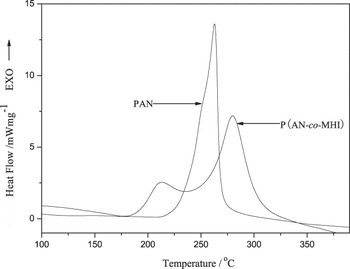
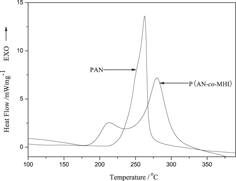
Figure 3 shows the DSC curves of PAN and P(AN-co-MHI) heated from ambient temperature to 400 °C at a rate of 10 °C/min under N2 (40 mL/min). The DSC measurement was carried out under N2, so only cyclization reactions occurred during this process and the exothermic peaks of DSC curves mainly resulted from cyclization reactions. PAN exhibits a sharp single exothermic peak initiated at about 220 °C and centered at 263 °C, whereas P(AN-co-MHI) shows a doublet exothermic peak initiated at about 179 °C and centered at 213 and 279 °C, respectively. It is found that the cyclization reactions of PAN can only be initiated through a free radical mechanism at a relative high temperature evidenced from only one exothermic peak in DSC curve of PAN,Reference Bajaj, Sreekumar and Sen13 which causes a large amount of heat to be released at the same time. While in P(AN-co-MHI), the appearance of two exothermic peaks in DSC curve confirms that the cyclization reactions can be initiated through both an ionic mechanism at a lower temperature and a radical mechanism at a higher temperature, which results in the broadening of exothermic peak. The broadening of exothermic peak avoids the centralized heat release and it is beneficial for preparation of high performance carbon fiber. The similar results were also found by Catta et al.Reference Catta, Sakata, Garcia, Zimmermann, Galembeck, Galembeck and Giovedi22 in terpolymers such as P(AN-MA-AA), P(AN-MA-IA), and P(AN-MMA-IA). All these terpolymers contain both acidic comonomer and neutral comonomer, which are similar to the binary polymer P(AN-co-MHI) prepared in this work. However, it is found that the initiation temperature of all the terpolymers is about 225 °C, which is much higher than that of P(AN-co-MHI) copolymer (approximately 179 °C), hinting that P(AN-co-MHI) copolymer showed better stabilization than terpolymers containing similar chemistry component.Reference Catta, Sakata, Garcia, Zimmermann, Galembeck, Galembeck and Giovedi22 Even the content of carboxyl group in the P(AN-MMA-IA) is 3 times of P(AN-co-MHI) prepared in this work, the initiation temperature is only 215 °C, still higher than that of P(AN-co-MHI). This phenomenon was also observed in Devasia’s work.Reference Devasia, Reghunadhan Nair, Sivadasan and Ninan39 It is found that only the content of carboxyl group in the P(AN-MA-IA) is 2.2 times larger than that of P(AN-co-MHI) prepared in this work; the initiation temperature can lower to 180 °C. Thus, it can be concluded that the binary P(AN-co-MHI) is a more significant advantage than terpolymers in the improvement of stabilization of PAN.
DSC curves of PAN and P(AN-co-MHI) heated at 10 °C/min.

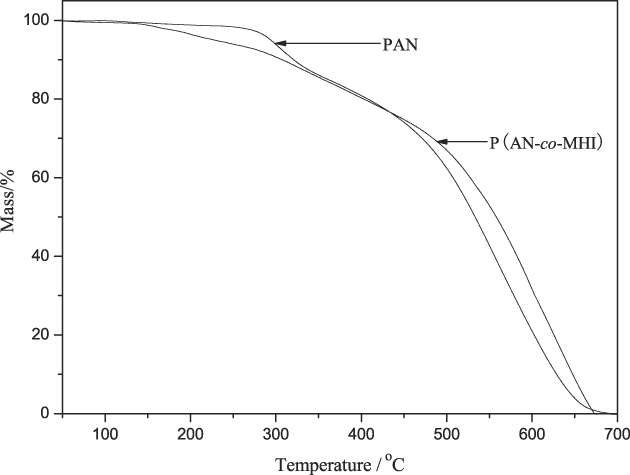
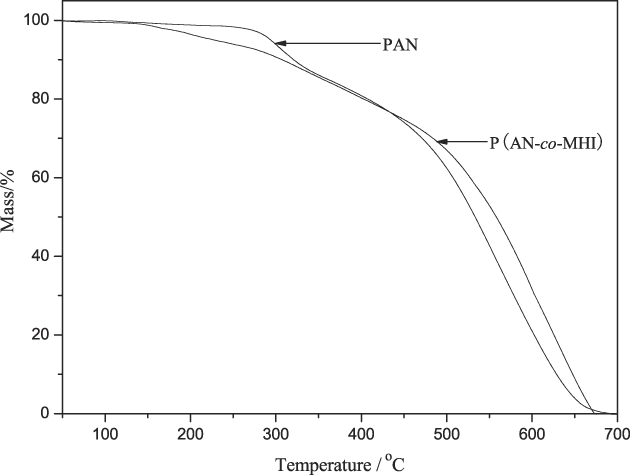
Figure 4 shows the thermogravimetry analysis (TGA) thermogram of PAN and P(AN-co-MHI) heated from ambient temperature at 5 °C/min to 700 °C under air atmosphere (40 mL/min). The TGA thermogram can be roughly divided into three steps according to the rate of weight loss. The first step is up to 250 °C with a slow rate of weight loss. From FTIR and DSC data, it is known that both cyclization and dehydrogenation reactions occur in this step. However, the cyclization reactions do not cause any weight loss theoreticallyReference Bajaj, Sreekumar and Sen13; the weight loss of PAN and P(AN-co-MHI) at 260 °C are 2 and 6.5 wt%, respectively. The difference between these two weight losses is 4.5%, which is closed to the theoretical value of weigh loss (3.8 wt%) from dehydrogenation reactions. So we conclude that the weight loss in this step is mainly caused by the dehydrogenation reactions. As shown in Fig. 4, the weight loss of P(AN-co-MHI) is larger than that of PAN, implying that the dehydrogenation of P(AN-co-MHI) has been promoted by the incorporation of comonomer MHI, which is similar to the incorporation of hydroxylethylacrylonitril into PAN.Reference Shimada and Takahagi28 The second step is up to 450 °C and the rate of weight loss becomes rapid during this step, which is mainly due to release of volatile particles formed by random degradation of polymer chains. Oxygen uptake reactions also take place in this step, and it has been confirmed by the results of FTIR spectra. However, the generation of oxygen containing groups, such as –OH and C = O, causes weight gain. Thus, the net weight loss in this step is the summation of weight loss and weight gain. The last step is above 450 °C with the fastest rate of weight loss among the three steps. In this step, the weight loss of P(AN-co-MHI) is smaller than that of PAN at the same temperature. The possible reason is that the structure change from linear to ladder induced by cyclization and dehydrogenation can be promoted by comonomer MHI, which makes P(AN-co-MHI) more stable than PAN.
TGA thermogram of PAN and P(AN-co-MHI) heated at 5 °C/min.
D. Evaluation of the kinetic parameters of stabilization reactions
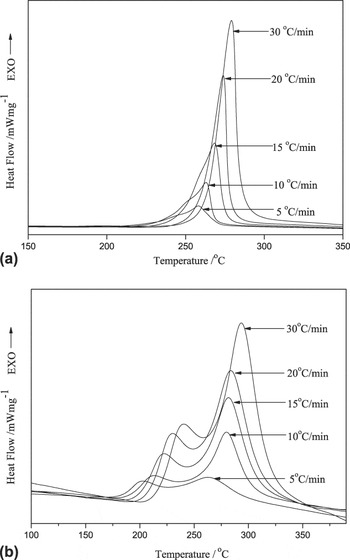
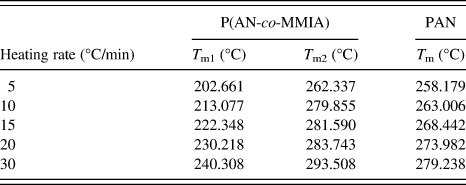
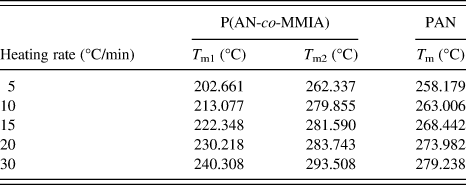
Figure 5 shows DSC curves of PAN and P(AN-co-MHI) heated from ambient temperature to 400 °C at different rates (5, 10, 15, 20, 30 °C/min) under N2 (40 mL/min). As heating rate increases, the exotherms wholly shift to higher temperature and the exothermic peaks become stronger for both PAN and P(AN-co-MHI). The apparent activation energy (E a) of the stabilization reactions was determined by Kissinger methodReference Kissinger40 and Ozawa method.Reference Ozawa41 The two methods are used to calculate E a based on DSC curves heated at different rates.Reference Tiptipakorn, Damrongsakkul, Ando, Hemvichian and Rimdusit42, Reference Reghunadhan, Krishnan and Ninan43 The parameters obtained from DSC curves are summarized in Table II. The peak temperature of DSC curve (T m) used to evaluate E aby Kissinger and Ozawa methods shows a regular increase with the increase of heating rate (ϕ).
DSC curves of PAN (a) and P(AN-co-MHI) (b) heated at different rates.

DSC peak maxima for PAN and P(AN-co-MHI) heated at different rates.
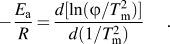
Kissinger’s method uses an equation as followsReference Kissinger40:
 $$ - {{E_{\rm{a}} } \over R} = {{d[\ln (\varphi /{ T}_{\rm{m}}^2 )]} \over {d(1/T_{\rm{m}}^2 )}}.$$
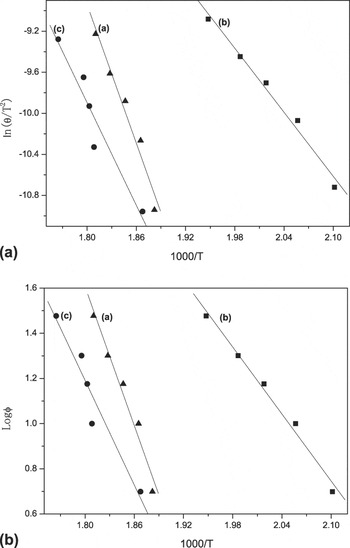
E a was calculated from the slope of the linear plot of ln(ϕ/ $T_{\rm{m}}^2 $) versus 1000/T m as shown in Fig. 6 (a).
Kissinger method (a) and Ozawa method (b) used to quantify E a: a, PAN; b, peak 1 of P(AN-co-MHI); c, peak 2 of P(AN-co-MHI).

Ozawa’s method makes use of the following equationReference Ozawa41:
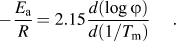 $$ - {{E_{\rm{a}} } \over R} = 2.15{{d(\log \varphi )} \over {d(1/T_{\rm{m}} )}}.$$
E a was calculated from the slope of the linear plot of log ϕ versus 1000/T m as shown in Fig. 6(b).
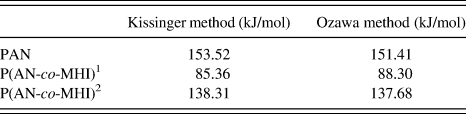
The calculated results of E a are listed in Table III. It is found that the values of E a calculated from Kissinger method and Ozawa method are almost the same. The DSC curves were obtained under N2 atmosphere, so only cyclization reactions occurred during this process. The E a of the cyclization reactions for PAN is about 153 kJ/mol, while for P(AN-co-MHI), the Ea has been splitted into two parts. The first part calculated from the first exothermic peak is about 85 kJ/mol, which is assigned to the ionic cyclization reactions. The second part calculated from the second exothermic peak is about 138 kJ/mol, which is assigned to the radical cyclization reactions. It is obvious that the E a of cyclization reactions has been reduced by the incorporation of MHI into PAN chains, which is mainly attributed to the change of cyclization mechanism caused by MHI.Reference Shimada and Takahagi28 This further confirms that the cyclization of nitrile groups has been promoted by comonomer MHI.
E adetermined by Kissinger and Ozawa methods.
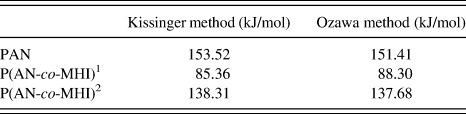
1 Represents the Ea calculated from the first exothermic peak of P(AN-co-MHI).
2 Represents the Ea calculated from the second exothermic peak of P(AN-co-MHI).
E. Rheological analysis of PAN/DMSO and P(AN-co-MHI)/DMSO solutions
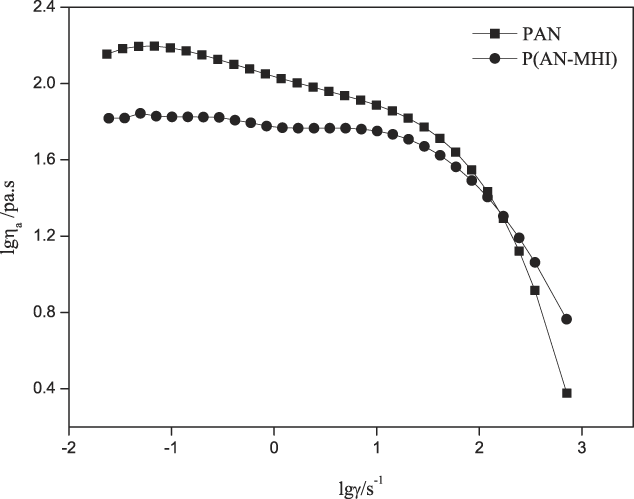
The flow curves of PAN/DMSO and P(AN-co-MHI)/DMSO solutions at 70 °C are shown in Fig. 7. Both PAN/DMSO and P(AN-co-MHI)/DMSO solutions show shear thinning at high shear rates, which is explained by breakage of the entangled networks and shear alignment of the molecules.Reference Jain and Abhiraman44 Entanglement points exist between molecules because of the intermolecular van der Waals forces; it can be destroyed in one place and rebuilt in another place because of the random thermal motion of polymer chains. The density of entanglement points is depended on the external conditions such as temperature, shear rate, etc. At the low sheer rate, the destroyed entanglement points have enough time to rebuild and the density of entanglement points is unchanged, so the apparent viscosity keeps unchanged. With the increase of shear rate, the rebuild rate of entanglement points is lower than the destroy rate, so the density of entanglement points decreases, which results in the decrease of apparent viscosity. On the other hand, the molecule chains of polymer are aligned in the direction of flow, which also cause the decrease of apparent viscosity.Reference Chiu and Wang45 In addition, the value of ηa for P(AN-co-MHI) is smaller than that of PAN as shown in Fig. 7, which is due to the decrease of intermolecular forces caused by the incorporation of MHI into PAN chains.
Plots of lg ηa versus lg $\dot \gamma $ for PAN/DMSO and P(AN-co-MHI)/DSMO solutions at 70 °C.
The structural viscosity index ( $\Delta {\rm{\eta }}$) represents the degree of structuration of polymer solution and can be calculated by the following equationReference Wang and Wu46:
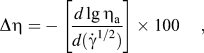 $$\Delta {\rm{\eta = }} - \left[ {{{d\lg {\rm{\eta }}_{\rm{a}} } \over {d({{\dot \gamma }}^{1/2} )}}} \right] \times {\rm{100,}}$$
where  ${\rm{\eta }}_{\rm{a}} $ is the apparent viscosity of polymer solution and
 ${{\dot \gamma }}$ is the shear rate. It has been reported that the
 $\Delta {\rm{\eta }}$ can be used as an indication of spinnability.Reference Wang and Wu46, Reference Zhou, Wu and Wang47 The smaller the value is, the better the spinnability is. The calculated
 $\Delta {\rm{\eta }}$ of PAN/DMSO and P(AN-co-MHI)/DMSO solution system are 6.61 and 4.05, respectively, indicating that P(AN-co-MHI) possesses better spinnability than PAN, which is beneficial in making high performance carbon fiber.
IV. CONCLUSIONS
The P(AN-co-MHI) used as precursor for carbon fiber was prepared, and the mechanism of stabilization reactions was investigated in detail. It is found that the cyclization of nitrile groups is successfully initiated at a lower temperature through an ionic mechanism when the comonomer MHI is incorporated into PAN. The dehydrogenation of P(AN-co-MHI) is promoted by the incorporation of comonomer MHI into PAN chains, which is confirmed by increased weight loss in the first step of TGA thermogram compared with PAN. P(AN-co-MHI) shows better stabilization than PAN such as lower initiation temperature and larger extent of stabilization under the same condition, which is mainly attributed to the ionic cyclization reactions induced by the incorporation of comonomer MHI. This is further confirmed by the calculation of E a based on Kissinger method and Ozawa method. In addition, P(AN-co-MHI) exhibits lower stabilization temperature than terpolymer containing similar chemistry component, confirming that the binary P(AN-co-MHI) is more significant advantage than terpolymers in the improvement of stabilization of PAN. Simultaneously, it is found that P(AN-co-MHI) possesses better spinnability than PAN, which is beneficial in making high performance carbon fiber.
ACKNOWLEDGMENTS
The authors gratefully acknowledge financial support from the China “973 project,” National Natural Science Fund of China (Grant Nos. 20974018, 20971021, 21171034, and 51073031), and Doctoral Dissertation Innovation Project (No. BC200902).