


INTRODUCTION
In 1991, the first congressional election in Taiwan was held for the National Assembly, which introduced party competitions between the Kuomintang (KMT) and the Democratic Progressive Party (DPP) and began Taiwan's transition from martial rule to a full-fledged democracy. However, since 2014, we have seen the rise of the Third Force, which has eroded traditional party allegiances.Footnote 1 The 2014 Taipei mayoral race became a flashpoint in Taiwan's local elections. Ko Wen-je won as an independent in a heated election, relegating the KMT to the position of opposition party. Taiwan's party system became more fragmented. In the 2016 legislative election, the DPP won 68 of 113 seats, making the KMT, with only 35 seats, the main opposition party. It is noteworthy that the New Power Party (NPP), founded by young civil activists associated with the 2014 Sunflower Movement, held five seats in the Legislative Yuan, giving it the third-largest bloc after the DPP and the KMT. The Green Party and the Social Democratic Party formed a political union, with five candidates obtaining more than 10 percent of votes in single-member districts. In 2020, the newly established Taiwan People's Party, led by Ko Wen-je, secured five legislative seats in the legislative election. The traditional parties now face a plethora of new competitors. The rise of the Third Force reveals the causal power of new social forces that do not fit easily within the classic Blue–Green cleavage.
According to Shively (Reference Shively1972, 1203), if party identification is an enduring psychological attachment, sudden bursts of votes for flash parties are less likely. The instability of Taiwan's party politics conflicts with the dominant view proposed by the authors of The American Voter, who asserted that most people continue to identify with the same party throughout their lives (Campbell et al. Reference Campbell, Converse, Miller and Stokes1960; Converse Reference Converse1969). Party loyalty is held to contribute to political stability with age. Starting in the 1960s, electoral volatility became prevalent in traditional and nascent democracies, and numerous scholars began to debate whether aging results in greater consistency in political identification (Abramson Reference Abramson1975; Glenn and Hefner Reference Glenn and Hefner1972; Shively Reference Shively1982). Many academic discussions have focused on generational replacement as an explanation for partisan dealignment—a trend of partisan decay among the electorate (Abramson Reference Abramson1976; Dalton Reference Dalton1984; Glenn Reference Glenn1974). This may explain the waning partisanship among Taiwan's post-1990 generation.
Taiwan's smaller parties, although they made a huge impact in elections, were doomed to decline (Fell Reference Fell2005; Reference Fell2018). Eventually, Taiwan's party system shifted back to a KMT–DPP competition. In 1992, a split began in the KMT with power struggles between its mainstream and non-mainstream factions, forcing the latter to break off and establish the New Party (NP) in 1993. That led to the KMT receiving only 25.9 percent of votes in the 1994 Taipei mayoral election, which the NP won by a landslide, with 30.2 percent of votes. Four years later, the NP's support plummeted, and the party won only 3 percent of votes in the Taipei mayoral election. Similarly, in 2000, power struggles arising from the KMT's presidential primary split the KMT. The newly established People First Party (PFP) gained 18.6 percent of seats in the 2001 legislative election. Support for the PFP then also declined considerably, with its share of seats falling to 2.7 percent in the 2008 legislative election. Likewise, in the 2020 legislative election, the NPP won only three seats, down from five in the last election. It is intriguing that the generational effect has led to the assumption that gradual and persistent forces drive identity change. Fluctuations in Taiwan's party identification provide a different example of this steady trend. Many analysts treated this partisan dealignment as a temporary phrase in the life cycle, interrupted by short-term period effects (Converse Reference Converse1969; Shively Reference Shively1979). The period effect, which has played out in economic crises and institutional transformations in recent decades, is believed to have more influence than generational replacement on cyclical and permanent changes in partisanship.
What are the main factors—aging, period, or cohort (APC) effects—driving changes in party identification in Taiwan? This is the question that we attempt to answer in this article. A close examination of APC effects on partisan stability has far-reaching implications for Taiwan's party politics. Such investigations also yield critical insights of theoretical significance. If life-cycle forces indeed lead to increases in partisan strength as people age, the recent decline in partisanship should be regarded as provisional. After short-term shocks, people may gradually find their way back to their original party identity. The aging–partisanship effect would ultimately foster stability in KMT and DPP identities. However, assuming that a decline in party identification is actually a result of generational replacement, it seems reasonable to speculate that the KMT and DPP can no longer dominate the political landscape. The causal power of new generational forces may restructure the Blue–Green cleavage and expand the ideological diversity among the parties with a share of the electorate. Accordingly, the political competition is more likely to open to the entry of independent candidates and Third Force parties.
A great deal of research has been conducted on Taiwan's party identification; however, analyses of APC effects on Taiwan's party identities are sparse. Despite the large body of studies correlating age and Taiwan's party identity (Chen and Chen Reference Chen and Chen2013; Rigger Reference Rigger2001; Wu Reference Wu1999), relatively little is known about whether aging leads to partisan stability. In addition, extensive research has already indicated that Taiwan's party identification varies from generation to generation (Chen Reference Chen1995; Chen Reference Chen2000; Liu Reference Liu1994). Studies disagree about whether the level of party identity is in decline among younger generations (Rigger Reference Rigger2006; Sheng Reference Sheng2010). The reasons for such divergence in opinions may be rooted in the methodological difficulty. Given that cross-sectional analysis may not actually track partisan changes over time, a generation is almost a synonym for an age group. Studies may interpret age-related differences in party identity as a generation effect, and vice versa. Period effects could be confounded by generation effects. More fundamentally, it is empirically difficult to discern the distinction between a generational effect and a life-cycle effect in cross-sectional studies (Jou and Chu Reference Jou and Chu2008; Lin Reference Lin2014). The APC model suffers from a non-identification problem involving the perfect linear relationship between these effects (period = age + year of birth); therefore, it cannot differentiate among period, age, and cohort effects. Scholars still question how these three time effects should be disentangled methodologically (Fu Reference Fu2000; O'Brien Reference O'Brien2000; Yang Reference Yang2006).
Our study is aimed at filling the gap and untangling these intertwined age, cohort, and period effects on partisan stability and volatility throughout Taiwan's democratization period. In the following sections, we explore the theoretical debate over life-cycle, cohort, and period effects on party identification. Then we discuss the use of two-level multinomial logit models that enabled us to disentangle the effects of the simultaneous operation of the three (APC) forces on changes in the KMT, DPP, and independent identities.Footnote 2 We used national survey data from personal interviews conducted by the Center of Political System Change and Electoral Behavior (PSCEB), the Asian Barometer Survey, and Taiwan's Election and Democratization Study (TEDS) to test for the postulated relationships. The study time frame is 1991 to 2020, which includes 18 waves of surveys. This time span highlights Taiwan's progression from democratic transition to globalization. In the conclusion, we summarize the separate effects of age, cohort, and period and the key implications of our findings for future partisan stability and changes in Taiwan.
LITERATURE REVIEW
This article revolves around the time mechanisms that have shaped the rise and fall of Taiwanese party identity. Period, cohort, life cycle, and their interactions have been topics of debate among scholars in the identity discipline since the 1960s.
Life-cycle theories generally assume that each life stage is characterized by different biological needs, cognitive abilities, and psychosocial traits (Braungart Reference Braungart1974; O'Rand and Krecker Reference O'Rand and Krecker1990).The life-cycle assumption also applies to the development of party identity. The authors of The American Voter empirically confirmed a positive relationship between age and strength of party identification (Campbell et al. Reference Campbell, Converse, Miller and Stokes1960). It is generally believed that partisanship is quite stable and strengthens with age, regardless of the initial direction of partisanship (Converse Reference Converse1969, 145; 1976, 162). According to Converse (Reference Converse1976), the older electorate is typically less likely to be politically independent. People in an established democracy tend to be independents in their twenties, weak partisans at age 40, and strong partisans at 70. Two avenues were proposed to explain the reinforcement process along the life cycle. The first attributed the effect of aging primarily to social learning. Party identification is formed early in life through intergenerational transmission. Initially, parents drive the learning process of political attitudes. Later on, the repeated use of party labels to realize the political world reinforces one's partisan ties (Campbell et al. Reference Campbell, Converse, Miller and Stokes1960; Converse Reference Converse1969). That being said, the strength of psychological attachment to a party increases as a function of how long a voter has been voting, not as a function of the voter's age (Butler and Stokes Reference Butler and Stokes1969, 40–43; Converse Reference Converse1969). This also explains why partisan intensity is relatively weak in new democracies (Markus Reference Markus1983, 721). The other group of studies pointed out that the life-cycle process by which older people become staunchly partisan is largely due to information costs investigating candidates in elections (Shively Reference Shively1979, 1040). As suggested by Downs (Reference Downs1957), party identity is a cost-saving way to gather political information to guide voting choices. For less-informed voters, existing party identification is a shortcut to knowing the candidates and a perceptual screen for voting decisions (Lewis-Beck et al. Reference Lewis-Beck, Jacoby, Norpoth and Weisberg2009, 288).
In the 1960s, the United States (US) and European democracies witnessed declining partisanship, which called into question the hypothesis of a stable age–partisanship relationship. This has led to a new emphasis on generational replacement (Abramson Reference Abramson1975, Reference Abramson1976, Reference Abramson1979; Glenn and Hefner Reference Glenn and Hefner1972). Using panel data, Abramson (Reference Abramson1975, Reference Abramson1976) argued that American partisan loyalties declined markedly after 1964. Unlike their parents, young cohorts lacked strong political socialization during their late adolescence, and this weak party attachment persisted as they aged. In contrast to the life-cycle effect, which highlights variations within age groups caused by socio-psychological mechanisms, proponents of generational effects argue that generational differences are derived from members of a cohort sharing common experiences at pivotal points during their formative years (late teens) (Mannheim Reference Mannheim and Kecskemeti1952). In their analysis, Glenn and Hefner (Reference Glenn and Hefner1972) concluded that the cohort that entered the electorate during the New Deal era maintained a Democratic Party identification throughout life. Inglehart (Reference Inglehart, Kent Jennings and van Deth1990) attributed generational differences to value changes from a materialistic to a post-materialistic orientation. In advanced industrialized countries, identification with class-based parties declined mainly because younger cohorts became more concerned about quality of life and human rights than about economic growth. Cognitive mobilization with increasing access to information is another factor in explaining the generational effect. In the 1970s, along with rising levels of mass education, costs of gathering information declined. Thus, there should be a reduced need for party identification among new generations (Dalton Reference Dalton1984, Reference Dalton2000; Shively Reference Shively1979). Similarly, as globalization progresses, the internet facilitates the circulation of information, which obviates young people engaging in formal political processes such as elections and parties (Grasso Reference Grasso2014, 66; Norris Reference Norris2002, 221–222).
Despite the importance of generation effects, Shively (Reference Shively1979, 1050) stressed that the large drop in partisan propensities among American voters from 1966 on was too sudden and may not have been produced simply by gradual processes of generational replacement. There is growing academic attention on relating oscillations of party identification with period effects, which represent variations over time periods that influence all ages and cohorts (Glenn Reference Glenn, Mortimer and Shanahan2003, 465–476; Leithner Reference Leithner1997). It appears that crises can sharply depress party loyalties among cohorts and prevent life-cycle processes from emerging temporarily or permanently. Converse (Reference Converse1969, 150–152; 1976) asserted that the age gains in partisan strength in the US can only be sustained in a “steady-state” period between 1952 and 1964. Severe shocks to the political system, such as the Fascist era in Italy or the Nazi era in Germany, might impede the aging–partisanship relationship. Moreover, Abramson (Reference Abramson1992, 393) discovered that generational replacement has not been the only force eroding British party identification. In the 1970s, the inflation crisis saddled the United Kingdom with long-term economic recession. Both the Conservative and Labour parties failed to prevent further deterioration, resulting in partisan decline among all birth cohorts. Variations in partisanship could result from short-term forces generated by wars, recessions, and dramatic changes in social, political, and economic institutions (Markus Reference Markus1983, 731). The enforcement of the national prohibition law in the US was closely correlated with party realignment in the 1928 presidential election, leading to durable changes in partisan allegiance (Key Reference Key1955, 8). The passage of the Voting Rights Act in 1965 was regarded as a prime cause of disruption in the stability of party identification in the US as it led Whites in the South to switch to identification with the Republican Party (Green and Schickler Reference Green and Schickler1996).
RESEARCH DESIGN
Drawing on the previously discussed theories, our objective is to investigate and separate the simultaneous operation of the APC forces on partisan stability and changes in Taiwan, and identify which APC is the most important factor in influencing party identification.
HYPOTHESES
As noted, party affiliation stems from intergenerational transmission and strengthens through repeated use of a party label in elections. In view of this, the aging–partisanship relationship is dependent on the history of suffrage in a country. New democracies are more volatile than established ones. For countries that held popular elections over a period of 10 to 15 years, the aging effect would be nonlinear (Converse Reference Converse1969; Reference Converse1976). The age gains in partisan strength may work poorly in political systems in which parties and the democratic process have just begun (Markus Reference Markus1983, 721). In Taiwan, as early as 1950, the majority of Taiwanese were allowed to select representatives and leaders at the local level. The KMT, which was formed in 1919, was the only party to run in elections in Taiwan from the 1950s through the mid-1980s. Then, in 1987, a year after the DPP was informally established, Taiwan lifted its ban on the formation of new political parties, which enabled competition between the KMT and the newly formed DPP in the 1990s. Hence, the extent to which life-cycle effects explain party identification in Taiwan may differ between these two major parties. We follow the life-cycle theory and developed the following hypothesis:
H1: The older one grows, the more likely that he or she will identify with the KMT than self-claim as politically independent; however, this aging–partisanship proposition does not apply to the DPP identity.
As noted, Taiwan's party identification varies from generation to generation. This process of generational replacement could be the main factor in explaining partisan changes. Common experiences with the progress of democratization, the evolution of nationalist discourses, and critical moments of cross-strait relations at pivotal points during the late teenage years can lead to a distinctive cohort and produce generational effects on party identity in Taiwan (Chen Reference Chen1995; Chen Reference Chen2000; Liu Reference Liu1994; Rigger Reference Rigger2006; Sheng Reference Sheng2010). As Taiwan's economic development proceeds, value changes from a materialistic to a post-materialistic orientation among new generations may be accompanied by a breakdown in traditional party preference and a new method of political participation. These factors led us to hypothesize the curvilinear effect of generational replacement:
H2: Older cohorts, who lived through the periods when the KMT employed a full range of political control, tend to have a strong KMT identity. Younger cohorts, who grew up with democratization and the rise of Taiwanese nationalism, are more likely to form a stronger DPP identity.
H3: The youngest cohorts, who experienced a turning point in anti-establishment views, are inclined toward weakening KMT and DPP identities.
The period from 1991 to 2020 was by no means a “steady state” for Taiwan that might truncate life-cycle or generation effects. Taiwan's party politics during this period have been particularly susceptible to an irredentist China. Cross-strait crises, which tended to trigger anti-Chinese sentiments, may have played a role in swaying party identification among all age groups and generations. As a new democracy, Taiwan has undergone several stages of constitutional amendments since 1991. At the heart of the 2005 constitutional reform was a fundamental transformation of Taiwan's legislative election system, changing from a single non-transferable vote (SNTV) system to a double-ballot system, which combines 73 seats of the single-member district (SMD) plural system and 34 seats of the party-list proportional representation (PR) system. Period effects underlying constitutional transformations could generate critical shocks to party politics. Hence, Taiwan's party identities are also liable to period effects that could disrupt the life-cycle or generational effects of party identification. To summarize, we assumed the following:
H4: In the acute phase of a cross-strait crisis, it is more likely that partisan allegiance will be eroded for parties that are soft on China and that an appreciable amount of support will be driven for parties embracing Taiwanese nationalism.
H5: The 2005 electoral reform was a critical moment, which generated unfavorable conditions for independents, possibly contributing to the enhancement of KMT and DPP identities.
DEBATES AND MODEL SPECIFICATION
As mentioned before, the APC models suffer from the problem of the perfect linear relationship between three time effects. Over the past four decades, researchers have proposed multiple approaches to resolve such an identification problem, which has fueled a heated methodological debate (Bell and Jones Reference Bell and Jones2014; Reither et al. Reference Reither, Land, Jeon, Powers, Masters, Zheng, Hardy, Keyes, Fu, Hanson, Smith, Utz and Yang2015). An easy way to resolve the problem is to include cohort characteristics as proxies for cohort effects in a modeling framework (O'Brien Reference O'Brien2000). Another solution is to leave one of the effects out of the analysis or to impose functional restrictions on the models to make the model just-identify or over-identify (Kupper et al. Reference Kupper, Janis, Karmous and Greenberg1985). One other way is to conduct nonlinear parametric transformation to avoid collinearity of APC effects. These solutions require a clear theoretical justification. To rule out methodological skepticism, the hierarchical age–period–cohort (HAPC) model developed by Yang and Land (Reference Yang and Land2013) has become one of the more frequently used methods to simultaneously estimate APC effects. Yang and Land use a cross-classified random-effects model (CCREM) in which individuals are nested within cells created by the cross-classification of two types of social context: birth cohorts and survey years. These two time effects can, therefore, be treated as random in multilevel modeling.
Many scholars, however, believe that CCREM cannot solve the identification problem, and they are concerned with its violation of the independence assumption. Random-effects models can be biased when covariates are correlated with higher-level residuals (Wooldridge Reference Wooldridge2002, 257). The variance left unaccounted for will be absorbed into the error terms at different levels, which will consequently be correlated with the covariate (Bell and Jones Reference Bell and Jones2015a, 137). Moreover, the cross-classified APC strategy implicitly uses multiple constraints to choose one set of estimates from among an infinite number of possible estimates that can be highly biased (Liu and Hodges 2020). With regard to data structure, grouping age and cohort differently may produce different results and affect the estimates of random-effect APC models (Bell and Jones Reference Bell and Jones2018; Luo and Hodges Reference Luo and Hodges2016).
Nevertheless, as Bell and Jones (Reference Bell and Jones2015b, 5) also point out, the CCREM model can function relatively well as long as there are no trends in the periods or cohorts. Considering that cohorts often have a linear trend, it might be biased to estimate cohort random fluctuations. With respect to period effects, it makes theoretical sense that it is unlikely that there would be any linear period trends in Taiwan's party identity. Taiwan's party politics is in a nascent stage, and its party identification easily oscillates with time (Sheng Reference Sheng2010). Fluctuations in Taiwan's party identification provide a contrast to a steady trend of party identity. Hence, in this study, we used the random intercept model, adding a random intercept for assessment of the period effect with robust standard errors and modeling age and cohort trends at the first level.Footnote 3
Since party identity in Taiwan is a nominal variable with three main categories (KMT, DPP, and independent identities),Footnote 4 we conducted two-level multinomial logit random-effect models estimated by quasi-maximum likelihood. We used survey data collected from personal interviews conducted by the PSCEB, the Asian Barometer Survey, and TEDS. The time span of the survey data is from 1991 to 2020, with 18 waves of cross-sectional surveys and a total sample size of 27,738 respondents drawn from the population based on the probability proportional to size (PPS) sampling method.Footnote 5 Since these surveys cover the same topics of relevant variables in similar wordings and scales, they can be pooled together as repeated cross-sectional data. To better employ the multilevel analyses, this study is complemented by electoral statistics, which represent the effective number of parties and their relative strength.Footnote 6
The relationships between time variables and party identity are estimated by a logit transformation. Since party identity has three categories, this model requires two equations, one for each category relative to the reference category. The proposed model is described as follows:
Level-l fixed effects
The respondents are nested within survey years.
-
log[
 ${{_{DPP_{it}} } \over {_{KMT_{it}} }}$]=β0t+β1Ageit+β2Ageit2+β3Educationit+β4Educationit2+β5Ethnicityit+ β6National identityit+ β7Taiwan's future national statusit +β8Genderit +β9Areait+β10Occupationit+β11Economic evaluationit +β12Cohortit +β13Cohortit2+εit
-
log[
${{_{IND_{it}} } \over {_{KMT_{it}} }}$]=β0t+β1Ageit+β2Ageit2+β3Educationit+β4Educationit2+β5Ethnicityit+ β6National identityit+ β7Taiwan's future national statusit +β8Genderit +β9Areait+β10Occupationit+β11Economic evaluationit +β12Cohortit +β13Cohortit2+εit$\pi_{DPP_{it}} $ -
π KMT it = predicted probability for KMT identity; πDPP it = predicted probability for DPP identity, and πIND it = predicted probability for the independent identity;
-
i = 1, 2, ⋯, nt = 27,738 respondents within cell t;
-
t = 1, 2, ⋯, 16 = 18 years; and
-
εit = a within-cell residual, which is assumed to be normally distributed.


Level-2 random effect of intercept
This random-intercept model specification allows only the level-1 intercept to vary randomly from period to period:
-
β0t=γ 0 + μ 0t
where γ 0 denotes the mean proportions of KMT, DPP, and independent identities averaged over all years. The μ 0t represents the period effect of KMT, DPP, and independent identities for all respondents.
Level-2 fixed effects of intercept
-
β0t=γ 0 + γ 1 Party fragmentationt +γ 2Incumbentit+μ 0t
This fixed-effects model specification allows the addition of exogenous variables to estimate their influence on a party identity that varies from period to period. We assumed that the mean party identity (β0t) is influenced by period effects, which are presumably correlated with party system fragmentation and the incumbent party. Hence, we included these two variables in the model to control for their confounding effects.
VARIABLE SPECIFICATIONS
As Taiwan is an emerging democracy, party identification might not accord with what Campbell et al. (Reference Campbell, Converse, Miller and Stokes1960) termed a long-term psychological attachment to a certain party. To formulate the indicator of party identity, we adopted an assessment of closeness to a specific party.Footnote 7 It includes three categories of party identity: KMT identity, DPP identity, and independent identity. Three time factors were predicted to influence the evolution of party identity. Age refers to the age of the respondent when participating in the survey, and age2 was designed to examine if there exists a curvilinear relationship between age and party identity. For cohorts, the respondents were coded based on their year of birth at 10-year intervals with a total of 11 cohorts.Footnote 8 We included cohort2 to test if the youngest cohorts are inclined toward weakening party identities. The period is the year in which the survey was conducted.
Ten principal variables that reflect personal characteristics were included in the models as controls. Education was measured on a continuous scale ranging from 1 to 7. Education2 was added to provide a better fit for the non-linear relationship between education and party identity. Ethnicity is based on the father's ethnicity and is classified as benshengren (coded 1) and waishengren (coded 0).Footnote 9 National identity is limited to a subjective criterion and coded as 1 for self-reported Taiwanese. We generated two dummy variables for Taiwan's future national status, one for unification with China (coded 0) and the other for Taiwanese independence (coded 1). There are a set of dummy variables: occupation coded 1 for government employees, gender coded 1 for male, and area of residence coded 1 for southern regions. The evaluation of the state of the economy was computed in a dummy variable, one for worsening. Incumbent is coded 1 for the KMT and 0 for the DPP. Effective number of parties (ENP) was devised to measure party fragmentation and was used to control for the effect of party split that sways party identity over time and to confound the period effect.Footnote 10
EMPIRICAL FINDINGS AND IMPLICATIONS
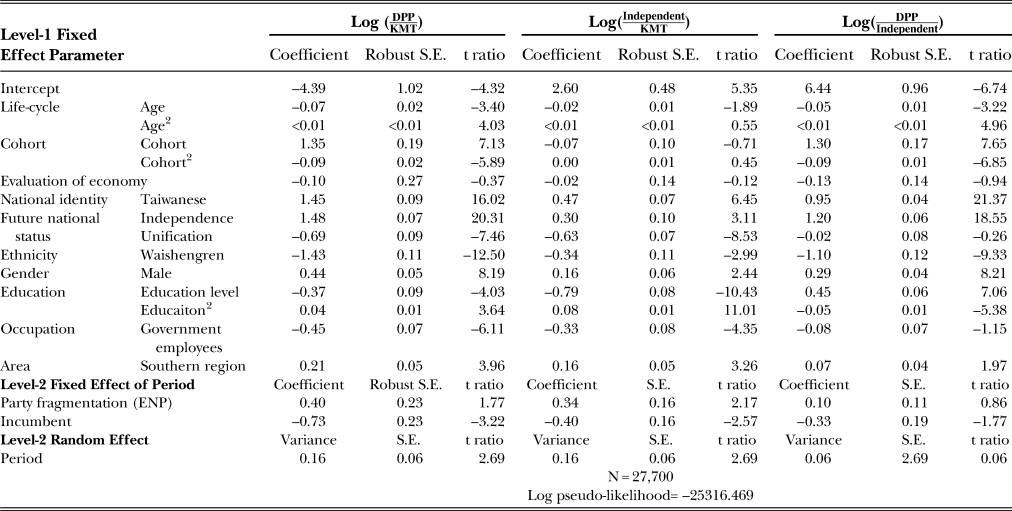
As shown in Table 1, the two-level multinomial logit model estimates separate a binary logit for each pair of outcome categories. These findings challenge the core assumption that partisanship strengthens with age. Party affiliation remains fluid with respect to mass loyalties in Taiwan. As a new democracy, Taiwan's party identities fluctuated due to short-term period effects triggered by cross-strait crises and a radical reform of the electoral rule. However, among three time effects, generational replacement is the most significant factor driving party identity changes in Taiwan. In general, the youngest generation increasingly refuses to associate with the traditional political parties.
Two-level Multinomial Logit Model

LIFE CYCLE AND PARTY IDENTIFICATION
Our findings confirm that party attachment remains unstable in Taiwan. As illustrated in Table 1, the association between age and the binary log of the ratio of independent to KMT identity is not statistically significant. The estimated result verifies that age is not significant in determining a respondent's affiliation with the KMT over the independent identity, while controlling for cohort, period, and all other variables. Unlike Converse's (Reference Converse1969) assumption, KMT partisanship was not reinforced along the life cycle. As shown in Table 1, a negative coefficient is indicated for the log odds of the DPP versus independent identities significantly correlating with age. With a one-year increase in an individual's age, DPP identity decreases by 4.8 percent ([1-EXP(-0.05)]×100%) compared with the independent identity. Aging effect, instead of reinforcing DPP partisanship, generated gradual forces to undermine DPP identity.
Why did the life-cycle proposition fail to explain the development of partisanship in Taiwan? Converse (Reference Converse1969) claimed that the aging–partisanship relation is a function of the length of suffrage in an established democracy characterized by a competitive party system. In 1948, at the climax of the Chinese Civil War between the KMT and the Communists, the “Temporary Provisions Effective during the Period of Communist Rebellion” were implemented, which forbade the forming of new political parties and froze elections of national assemblies. After the KMT retreated to Taiwan, elections were allowed to take place at the local level. However, during the martial law period (1949–1987), election contests were limited to competitions within factional rivalries of the KMT. Even if a handful of independent candidates “outside the KMT (Dangwai)” formed an alliance to challenge the KMT in the late 1960s, they barely succeeded. As the KMT was the only legal party campaigning in elections, there was no need to use the KMT identity as a perceptual screen for voting choices. Consequently, the repeated use of KMT in each election worked less efficiently to reinforce its partisan ties among the electorate.
The DPP, which was informally founded in 1986, was the first opposition party in Taiwan. In 1987 Taiwan began the process of democratization by lifting the ban on the formation of political parties, which was expanded to include general elections in 1991. It was still not long ago that DPP identity was transmitted from parents to children. Hence, the age gains in partisan strength worked weakly for a newly established DPP. More importantly, during the authoritarian era, the KMT regime strictly limited the number of newspapers, and most media and education were part of the state apparatus for political propaganda. Taiwan's media and education, once tightly controlled, have been liberalized since the early 1990s, expanding the range of information available to the public. Hence, DPP's partisanship serves less as an information shortcut in elections.
To summarize, in Taiwan, as a new democracy, age gains in partisan strength were not reinforced along the life cycle. The balance of power between political parties and independents in elections changes greatly, which implies that generational or period effects might be the driving forces of partisan instability.
GENERATION AND PARTY IDENTITY
The generational effect shifting patterns of Taiwan's party identification was empirically proved to be the most important factor. As can be seen in Table 1, the logit coefficient of cohort for the DPP and KMT identities is significant, which indicates that the perceptions of DPP identity and KMT identity fundamentally differed according to cohorts. The significantly positive coefficient confirms our hypothesis that younger cohorts are more likely to form a stronger DPP identity than a KMT identity, controlling for age, period, and all other variables. For one younger cohort, the odds to have DPP identity as 3.85 times (EXP(1.35)) that of having KMT identity. A significantly negative coefficient (-0.09) indicates that the cohort effect of DPP identity versus KMT identity forms a reversed U shape, with the oldest and youngest cohorts inclined toward weakening DPP identity. The comparison between DPP identity and the independent is the same. The middle cohorts tended to show relatively higher proportions of DPP identification than older cohorts and millennials.
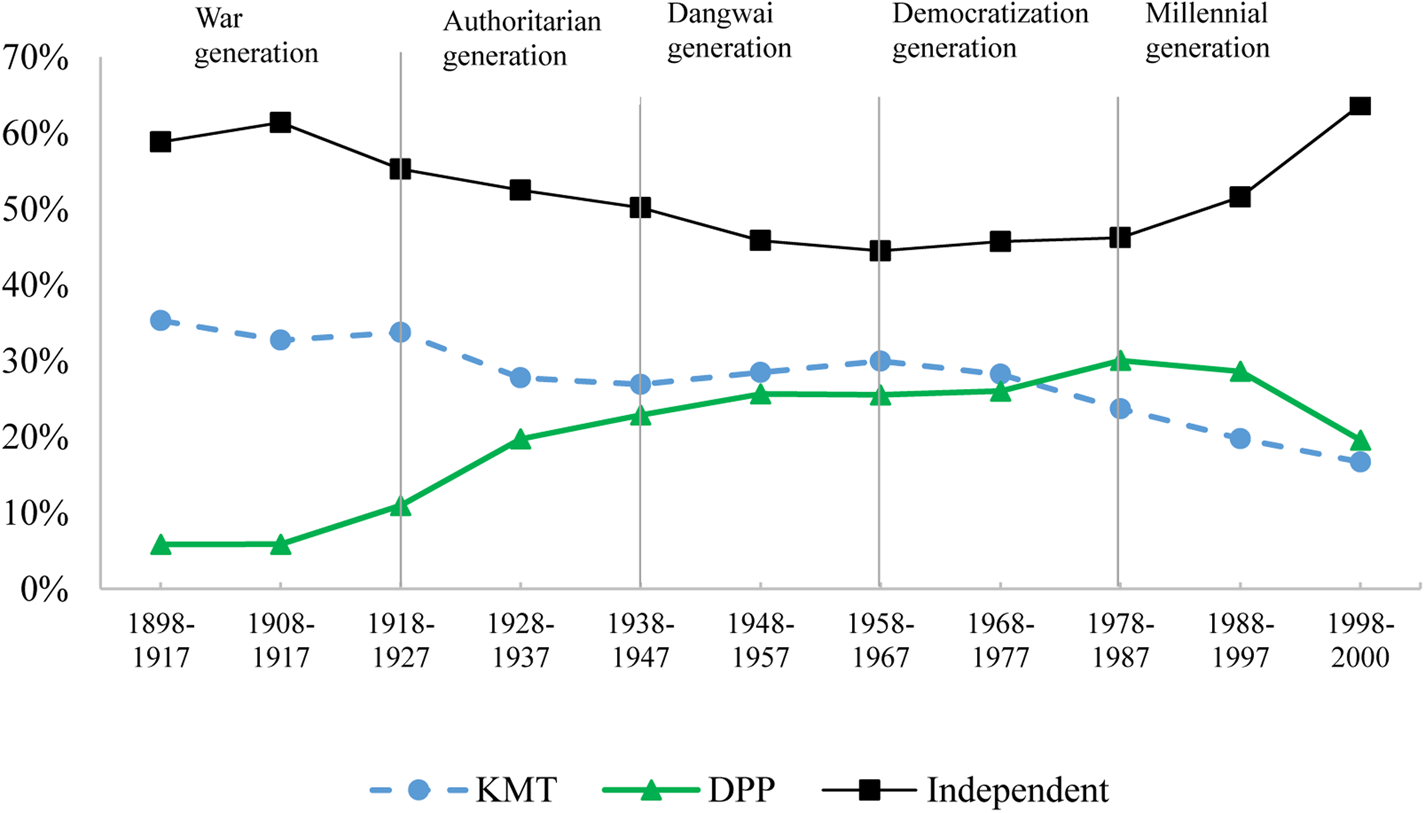
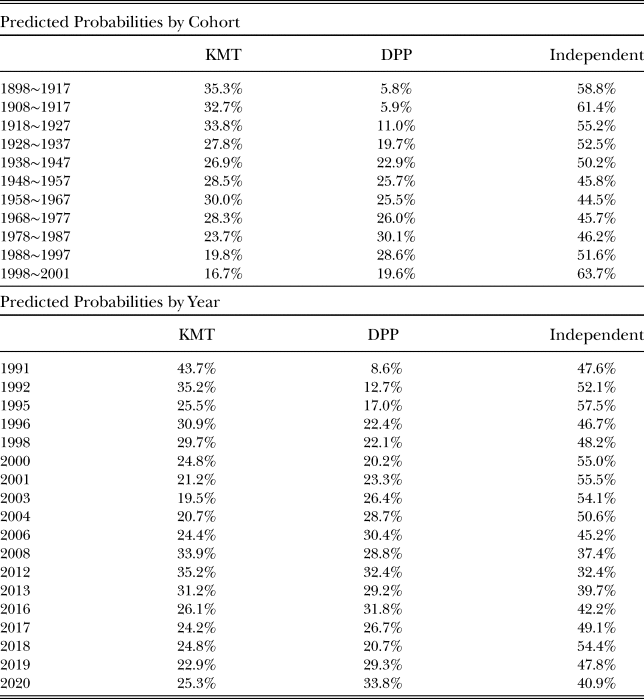
Since the coefficients in the two-level multinomial logit model are not directly understandable, we alternatively expressed them in the form of response probabilities. Specifically, we calculated the predicted probabilities of each category of party identity for age, cohort, and period by controlling for all other variables, which are not interpreted at their sample means, and by the empirical Bayesian mean predictions of the latent period effect. We juxtapose predicted probabilities of the KMT, DPP, and independent identities (including the minor parties) and show their relative strengths by cohorts in Table 2 and Figure 1. We also present each generation in the context of the critical events that shaped its party preferences.
Predicted Probabilities of Party Identities by Cohort

Predicted Probabilities for KMT, DPP Identities, and the Independent

Critical events forming particular partisan preferences among generations occur largely during their late teenage years. In Taiwan, generation replacements of party identification are rooted in different common experiences about Chinese-oriented ideology, Taiwan's economic development, and its progress toward democratization in their adolescence. On the basis of that, we can divide Taiwanese into five distinct political generations: the war generation (1898–1927), the authoritarian generation (1928–1947), the Dangwai generation (1948–1967), the democratization generation (1968–1987), and the millennial generation (1988–2001). In general, since the KMT has cornered itself with an image of a century's standing, with generational replacement, it lost its appeal to younger generations.
As shown in Figure 1, the war generation (1898–1927) generally lived through multiple transformative eras and were exposed to diverse nationalist discourses in their early adulthood. For local Taiwanese, their political apathy is glaringly obvious, originating from political oppression under Japanese colonial rule. Hence, this generation has a large proportion of independents (around 60 percent). For mainlanders, the common experiences and shared values within this generation resulted from fighting the Sino-Japanese War on the mainland, and they are filled with nostalgia for the Chinese motherland. Consequently, they developed an affinity for the KMT, which played a key role in defeating Japan, with predicted probabilities of more than 30 percent. They also developed an adverse DPP identity. The cohorts born between 1928 and 1947 are best described as the authoritarian generation (1928–1947). During their formative years, the KMT's legitimacy, which served to maintain identification with the KMT, was not merely based on seamless social control but was coupled with rapid economic growth and facilitated by an ideological system to foster Chinese identity among the local Taiwanese (Haggard Reference Haggard and Hughes1988). Yet standing on different sides of the Sino-Japanese War, with the KMT fighting Japan and with colonial Taiwan fighting for Japan, left the ruling KMT government with a distrust of Taiwanese elites. This distrust culminated in the February 28 Incident in 1947 in which the KMT regime purged potential threats to its survival. After the February 28 crackdown, the White Terror followed, inaugurating two decades of suppression of political dissidents. The political apathy developed into political sentiments originating from oppression under KMT rule. DPP identity, as a resistance to the KMT, increased greatly among this generation (more than 20 percent of that generation have DPP identity).
The 1960s, a decade filled with dramatic political events, gave birth to a Dangwai generation (1948–1967). After 1967, the KMT government used the compulsory education system as a pivotal instrument for identity construction and as a method of KMT legitimization. Hence, the predicted probabilities of KMT identity among this generation could be maintained at approximately 30 percent (Table 2). Paradoxically, this generation lived through the first anti-authoritarianism movements in the middle 1960s. Political mobilization in Taiwan took off with the 1979 Formosa Incident, which marked a transition to opposition politics and the road to Taiwan independence (Wu Reference Wu2004). This generation also witnessed Taiwan's international status being in limbo in the 1970s and felt confused about their national identity (Hsiau Reference Hsiau2005, 17–18). These experiences contributed to a steady increase in DPP partisan preference. In the 1980s the democratization generation (1968–1987) slowly became detached from Chinese-based ideology and KMT identity. The diminishing legitimacy of the Republic of China to represent “China” in international society has prevented the new generation from clinging to an “imagined Chinese community.” Moreover, they witnessed the formation of the DPP in 1986 as the first opposition party in Taiwan and the first presidential election in 1996 to achieve democratization. Taken together, these circumstances resulted in the KMT regime losing legitimacy stemming from Chinese ideology. Among the cohort from 1978 to 1987, the likelihood of claiming DPP identity (30.1 percent) eventually becomes greater than that of holding KMT identity (23.7 percent).
As demonstrated in Figure 1, the predicted probabilities of independent identity were in a downward trend but are obviously increasing among the millennial generation (1988–2001). This generation, the most targeted generation for state-sponsored Taiwanization through education and language policies, turns out to identify more weakly with the DPP than other cohorts. For these millennials, resentment over the difficulty in moving up the economic ladder and government failure to improve economic justice can escalate into widespread frustration with traditional party politics. Hence, the anti-establishment sentiment has made it particularly popular with the young cohorts, which may reduce their support for the DPP (19.6 percent) and the KMT (16.7 percent). Particularly the DPP—the party in office and no longer an opposition party expressing the grievances of the youth—risks losing its traditional young constituency to newly risen Third Force parties that pay more attention to social justice and post-materialist values. Taiwan's Sunflower Movement in 2014 essentially resulted from resentment over cross-strait integration, which magnified anxieties about increasing economic inequality (Tsai and Chen Reference Tsai and Chen2015). Consequently, the KMT became the target of blame for the harsh economic integration it promoted. As globalization progresses, young people are mobilized through the internet around personal lifestyle values, which obviates young people engaging in formal organizations. Altogether, these changes may reshape individuals’ party attachments. Hence, the new generation surpasses all other cohorts in their level of independent identity (64 percent).
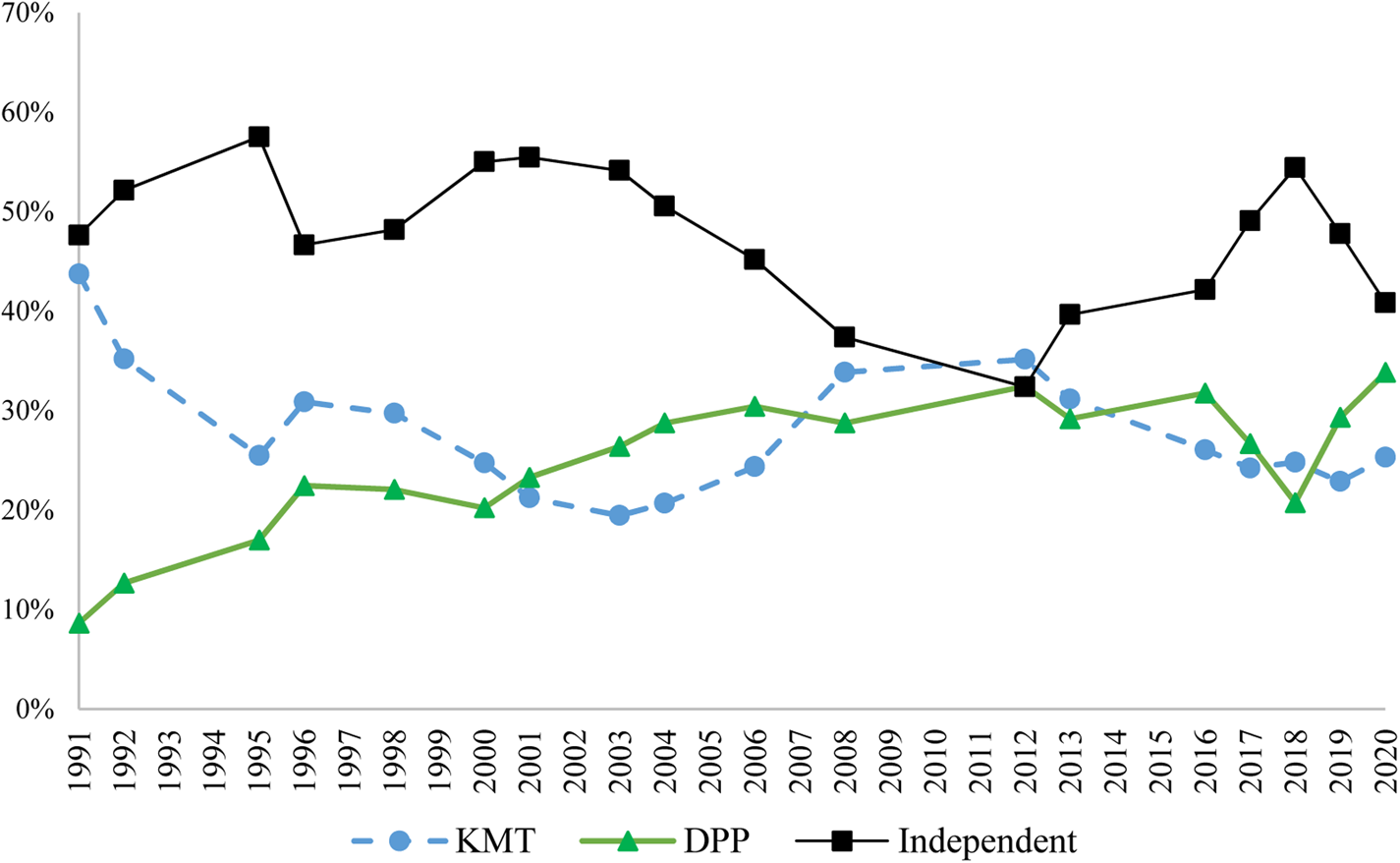
To summarize, political generations significantly affect the ways in which individuals realigned and dealigned their party identities in Taiwan. If generational replacement does subsequently lead to a consistent decrease in partisan strength, why has DPP identity bounced back since 2019 (see Figure 2)? It seems reasonable to assume that the generational effect, important though it was, could be temporarily suspended by period effects.
Predicted probabilities of Party Identities by Year

PERIOD EFFECT AND PARTY IDENTIFICATION
As a new democracy, Taiwan was in a transition period between 1991 and 2020. Therefore, partisan intensity in Taiwan has been vulnerable to short-term shocks from cross-strait relations and constitutional designs that could divert the steady generation effect. Based on the level-2 random-effects analysis (Table 1), period effects significantly influence Taiwan's party identity after controlling for age, cohort, and all other variables. The estimated variance of the random period effect is 0.16, implying a standard deviation of 0.4. Thus, a one-standard-deviation change in the random effect amounts to an EXP(0.4) = 1.5 change in the relative-risk ratio of different party identities. The fluctuations in party identities oscillate with time, suggesting that Taiwan's party identities are less fixed, being contingent on circumstances and critical events. From Figure 2, we can more clearly see that the period effect, which has played out in institutional transformation and cross-strait crises in recent decades, has significant influence on cyclical changes in party identity.
Taiwan's party politics has been particularly susceptible to an irredentist China. Political shocks caused by cross-strait crises have resulted in fluctuations of party identity and derailed the generational effect on party identification. In the early 1990s, with the Dangwai and democratization generations entering the political arena, KMT identity has been decreasing (Figure 2). However, as shown in Figure 2, KMT identity was on the rebound in 1996. The predicted probability of KMT identity rose from 25.5 percent to 30.9 percent amid China's missile tests near Taiwan ahead of Taiwan's first direct presidential election in 1996 (Table 2). As Gold (Reference Gold and Liu2000) stated, a unique Taiwanese identity tapped into the psychology of many people, both as a sense of self-esteem and pride. China's incessant threats to Taiwan's survival and democratic values led people to stiffen their resistance to China. As the first native Taiwanese president, then-KMT leader Lee Teng-hui won by a landslide and became the major symbol of a new Taiwanese identity. This so-called Lee Teng-hui Complex dominated the political arena of the mid-1990s in Taiwan and apparently contributed to an upsurge in KMT identity as a defense against mainland China among all age groups and generations (Chen Reference Chen2012, 868).
The period effect equally helps to explain the unexpected surge in DPP identity in 2019, when a growing number of millennials became eligible to vote. A new crisis across the Taiwan Strait was escalated by China's reaffirmation of the 1992 Consensus in 2019.Footnote 11 While the impasse between the two regimes worsened as a result of the unwillingness of President Tsai Ing-wen to embrace the 1992 Consensus, the 2019 demonstrations in Hong Kong, in opposition to the amendment of the extradition law, rekindled fear among Taiwanese about the reality of “one country, two systems.” During the 2019 presidential election, a new phrase, “the sense of national doom” (wangguogan), circulated in Taiwan's media. Subsequently, the DPP's tough stance on rejecting the 1992 Consensus provided an opportunity for it to regain momentum (Figure 2). Conversely, the KMT's presidential candidate, Han Kuo-yu, who explicitly supported the 1992 Consensus, lost the election in a shocking landslide and brought KMT identification to a new low of 22.9 percent in 2019 (Table 2).
In addition to short-term crises, period effects underlying radical institutional transformations might generate long-lasting shocks to party politics and obstruct the impact of generational replacement. We witnessed the rise of DPP and the fall of KMT at the beginning of the twenty-first century, as the democratization generation became the backbone of society. But the predicted probabilities of the KMT identity had been increasing since 2004 (Figure 2), which coincided with the critical juncture of the major constitutional changes initiated in 2004 and enacted in 2005. In those reforms, Taiwan adopted a double-ballot system for the legislative election in which 73 district-level legislators are elected from the single-member districts and 34 from proportional representation (PR) party lists. With a large proportion of seats from the SMD and a 5 percent electoral threshold for the PR allocation of seats, in tandem with Duverger's law, plurality within single-member districts tends to encourage the emergence of a two-party system (Duverger Reference Duverger1954). Under the “first past the post” mechanism, voters who are considered rational actors will avoid wasting their votes on independent or third-party candidates with a slim chance of winning. Hence, the new voting system has in turn encouraged elites from the NP and PFP to merge into the KMT (Hsieh Reference Hsieh2010, 36–68; Huang Reference Huang, Achen and Wang2017, 239–240; Sheng Reference Sheng2010, 11). Taiwan's party system swung back to KMT–DPP competitions, contributing to enhancements of the KMT and DPP identities in 2005. For more than 30 years, the share of independents excelled the percentages of either KMT identity or DPP identity; yet its proportion fell to less than 40 percent in 2008 and reached its nadir (32.4 percent) in 2012. In summary, the epoch-making institutional reform in 2005, which lifted the ban on direct legislative elections in Taiwan, marks the return to KMT–DPP competitions. As Duverger also pointed out, proportional representation tends to favor multipartism. Taiwan's electoral system mixed with the PR system still leaves room for the emergence of independents and Third Force parties.
To summarize, despite short-term shocks deviating party identities, the generation effect was the foremost factor among the three time factors in guiding the direction of identity change. As shown, starting in 2013, the independent identity rose from its nadir (32.4 percent) and climbed all the way to a peak of 54 percent in 2018. Primarily, the entrance of the millennial generation has cancelled out the effects of the institutional reform. Generational replacement once again offers favorable conditions for party dealignment.
CONCLUSION
Since 2014, the rise of Third Force parties and an independent candidate winning the Taipei mayoral elections and overcoming rivals of the KMT and the DPP highlights a turning point in Taiwan's party politics. Party identification is the enduring attachment to a certain party that disposes voters to support that party in elections. Fluctuations in Taiwan's party identification provide a different example of this steady trend. This leads us to some questions in examining what forces drove a cyclic change in party identities in Taiwan throughout its democratization.
This study built on the theoretical debate over age, period, and cohort effects (APC) and explored how these factors have reshaped Taiwan's party identities in particular ways. We designed a two-level multinomial logit model, adding a random intercept for assessment period effect. We used 18 waves of surveys conducted between 1991 and 2020 to delineate the effects of the three time factors on Taiwan's party identity (KMT, DPP, and independent identities). The study produced three main findings.
First, as one gets older, the probability of strengthening the KMT identity or DPP identity do not increase. The life-cycle effect does not explain the age gains in partisanship in Taiwan. The aging–partisanship relationship works poorly in Taiwan, where the party system and the democratic process have just begun. Despite the fact that Taiwan's election history began in 1950, with limited party competition from the 1950s to the mid-1980s, the repeated use of KMT was not an information shortcut in elections, and accordingly could not reinforce its partisan ties as life-cycles proceeded. In 1987, Taiwan began the process of democratization by lifting the ban on the formation of political parties. The intergenerational transmission of DPP identity is still at an early stage. Hence, the age gains in partisan strength work weakly for a newly established DPP.
Second, among all the time effects, the generation effect is the most critical factor affecting changes in party identification. Taiwan's generation replacement of party identity resulted from various common experiences with Chinese-oriented ideology, Taiwan's economic development, and its progress toward democratization. Established with an image of the old party, the KMT steadily lost its appeal to young generations. The older generations identify with the KMT for legitimacy in governing the Chinese nation through their war experience or the Chinese identity construction of compulsory education. However, the progress of democratization and globalization led to generational replacement, which has worked against the KMT identity. Dangwai and democratization generations, having grown up in resistance to a KMT authoritarian regime and experiencing Taiwan's emergent democracy in their late adolescence, have gradually developed a greater identification with the DPP. As globalization proceeds, anti-establishment sentiment has influenced millennials in Taiwan. Concern over social mobility has spurred suspicion of the representativeness of traditional parties. With generational replacement, the DPP, which previously fared better among young cohorts, may gradually lose its support from millennials.
Finally, as a new democracy, party attachment remains unstable in Taiwan. Taiwan's party identities easily oscillate, with short-term and long-term period effects. There is evidence of significant period effects on partisan volatility deviating generational effects. The mechanisms underlying period effects primarily arise from sudden shocks from institutional reform and cross-strait crises. Cross-strait crises in 1996 and 2019 acted as catalysts of the period effect on party identity. Once cross-strait crises began to threaten Taiwan's democracy, it became beneficial for the party in power that served as an agent to stiffen its resistance against China. In instances such as the 1996 missile crisis, the KMT whipped up support from Taiwanese nationalism. In the same vein, during the 2019 demonstrations in Hong Kong, the DPP gained support amid a general fear of national doom. The above findings suggest that cross-strait tensions, which have escalated in recent years, will continue to have a positive effect on popular support for the DPP. Period effects underlying constitutional transformations also generated critical shocks to party politics. In the 2005 constitutional reform, Taiwan adopted a new mixed-member system that places more weight on the SMD than on the PR tier. The SMD tends to consolidate a two-party system; accordingly, the reform contributed to a decline in the independent identity.
Overall, the generation effect is the dominant factor affecting Taiwan's party identification. Once the millennial generation entered the political arena in 2013, the period effect of the electoral reform was cut short. Given the generational replacement and a likelihood of low levels of partisanship among the youngest generation, it is logical to infer that the KMT and DPP are not as central as they were in determining voters’ choices. The new generational forces will have a causal power to restructure the Blue–Green cleavage and expand the ideological diversity along Taiwan's party identity spectrum. In the end, it is likely that political competition will open for the entry of independent candidates and Third Force parties.
ACKNOWLEDGMENTS
We thank anonymous reviewers for their insightful suggestions, and the support of the Ministry of Science and Technology (MOST), Taiwan, R.O.C. This research is funded by the MOST (MOST 107-2410-H-110-047).
CONFLICTS OF INTEREST
The author declares that no support, financial or otherwise, has been received from any organization that may have an interest in the submitted work; and there are no other relationships or activities that could appear to have influenced the submitted work.
Appendix