The birth of an infant sibling is a normative developmental milestone for many families. Parents are often concerned about how best to prepare their firstborn children for their new sibling, and whether children will be jealous and have emotional setbacks (Gullicks & Crase, Reference Gullicks and Crase1993; Wilford & Andrews, Reference Wilford and Andrews1986). Although most children seem to manage the transition to siblinghood with little difficulty, other children do have more emotional and behavioral problems (e.g., aggression, sleep problems, anxiety, and withdrawal), even before the birth of their infant sibling (Volling, Gonzalez et al., Reference Volling, Gonzalez, Oh, Song, Yu, Rosenberg and Stevenson2017). Individual differences in children's adjustment difficulties even before the birth indicate that family processes, rather than the infant's birth, are likely responsible for children's adjustment. Dunn and Kendrick (Reference Dunn and Kendrick1982) were one of the first to examine how children adjusted to the birth of a sibling and noted several child and maternal risk factors that increased the likelihood that children would have difficulties adjusting to their new sibling. Maternal depressed mood was one of these risks that increased children's withdrawal and fretting after the birth, and as such, opens the door for further investigations examining the role of parental depression as a possible risk factor that increases children's emotional and behavioral problems over the transition to siblinghood. Therefore, the main goal of the current study was to examine developmental trajectories of parental depression in explaining children's emotional and behavioral difficulties after the birth of their infant sibling.
The possibility that parental depression may increase children's adjustment problems during the transition is not surprising given the decades of research demonstrating a link between maternal depression and children's maladaptive developmental outcomes in general and, specifically, over the postpartum period (Giallo, Woolhouse, Gartland, Hiscock, & Brown, Reference Giallo, Woolhouse, Gartland, Hiscock and Brown2015; Goodman & Gotlib, Reference Goodman and Gotlib1999; Goodman et al., Reference Goodman, Rouse, Connell, Broth, Hall and Heyward2011; Guyon-Harris, Huth-Bocks, Lauterbach, & Janisse, Reference Guyon-Harris, Huth-Bocks, Lauterbach and Janisse2016; Kvalevaag et al., Reference Kvalevaag, Ramchandani, Hove, Eberhard-Gran, Assmus, Havik and Biringer2015; Reuben & Shaw, Reference Reuben and Shaw2015; Thomason et al., Reference Thomason, Volling, Flynn, McDonough, Marcus, Lopez and Vazquez2014). Postpartum depression affects approximately 20% of women (Gavin et al., Reference Gavin, Gaynes, Lohr, Meltzer-Brody, Gartlehner and Swinson2005). When elevated depressive symptoms are considered, a much larger percentage of women are affected. For instance, in a survey of 1,573 women in the perinatal period, 63% reported elevated depressive symptoms in the year following birth (Beck, Gable, Sakala, & Declercq, Reference Beck, Gable, Sakala and Declercq2011). Researchers and clinicians have recognized that even minor depressive episodes or clusters of depressive symptoms can still affect an individual's quality of life (Gavin et al., Reference Gavin, Gaynes, Lohr, Meltzer-Brody, Gartlehner and Swinson2005) and adversely affect children and mother–child interaction (Ashman, Dawson, & Panagiotides, Reference Ashman, Dawson and Panagiotides2008; Tietz, Zietlow, & Reck, Reference Tietz, Zietlow and Reck2014).
Children with depressed mothers are more likely to experience behavior problems and developmental difficulties during childhood (Apter-Levi et al., Reference Apter-Levi, Pratt, Vakart, Feldman, Zagoory-Sharon and Feldman2016; Dietz, Jennings, Kelley, & Marshal, Reference Dietz, Jennings, Kelley and Marshal2009; Goodman & Gotlib, Reference Goodman and Gotlib1999; Goodman et al., Reference Goodman, Rouse, Connell, Broth, Hall and Heyward2011). Although the effects of maternal postpartum depression have now been investigated extensively, recent studies have uncovered significant rates of paternal depression in the postnatal period as well. An estimated 8%–10% of fathers experience depression in the postnatal period (Cameron, Sedov, & Tomfohr-Madsen, Reference Cameron, Sedov and Tomfohr-Madsen2016; Paulson & Bazemore, Reference Paulson and Bazemore2010). Further, paternal depression in the perinatal period predicted children's emotional and behavioral problems as far out as preschool and school age, even after controlling for the effects of maternal postpartum depression (Gutierrez-Galve, Stein, Hanington, Heron, & Ramchandani, Reference Gutierrez-Galve, Stein, Hanington, Heron and Ramchandani2015; Kvalevaag et al., Reference Kvalevaag, Ramchandani, Hove, Eberhard-Gran, Assmus, Havik and Biringer2015; Ramchandani, Stein, Evans, & O'Connor, Reference Ramchandani, Stein, Evans and O'Connor2005; Ramchandani et al., Reference Ramchandani, Stein, O'Connor, Heron, Murray and Evans2008). Considering paternal depression after the birth of a second child is incredibly important to understanding how children will adjust to the birth of their sibling because fathers may be the essential supports for their children during the early months when mothers are deeply involved in the care of a newborn infant (Kreppner, Reference Kreppner1988; Stewart, Reference Stewart1990). There are significant changes in the relationship between children and their mothers after the birth of a sibling, with decreases in attachment security (Feiring, Lewis, & Jaskir, Reference Feiring, Lewis and Jaskir1983; Teti, Sakin, Kucera, Corns, & Eiden, Reference Teti, Sakin, Kucera, Corns and Eiden1996) and joint play (Dunn & Kendrick, Reference Dunn and Kendrick1982), and increases in physical punishment and mother–child confrontations (Baydar, Greek, & Brooks-Gunn, Reference Baydar, Greek and Brooks-Gunn1997; Dunn & Kendrick, Reference Dunn and Kendrick1982). Children with depressed fathers during the transition may be at risk for developing behavioral and emotional difficulties because they are experiencing significant changes in the mother–child relationship without the protection of the father–child relationship, making them particularly vulnerable for adjustment problems. The first aim of this research was to identify different trajectories of paternal and maternal depression over the year following the birth of an infant sibling to determine whether we could identify different families in which mothers and fathers differed in depressive symptoms (e.g., both high, mother high–father low). We hypothesized that different family groupings (i.e., classes) would be apparent given the range of depressive symptoms often reported in the perinatal period for mothers and fathers (Giallo et al., Reference Giallo, Woolhouse, Gartland, Hiscock and Brown2015).
Depression in the Family: One or Both Parents?
The current study was guided by a family-level perspective, which acknowledges the interrelations of various individuals and subsystems (e.g., parent–child and mother–father) in the family (Cox & Paley, Reference Cox and Paley2003; Minuchin, Reference Minuchin1985) and the different relationships children have with multiple members of the family. Because mothers and fathers often reside in the same family and parent their children together, examining the effects of one parent independently from the effects of the other on children's development does not represent the interdependent nature of family relationships and the additive effects of parenting on children's development. Further, a family-level perspective allows the testing of specific hypotheses surrounding family processes that may be informative in understanding the effects of parental depression for the development of childhood psychopathology, such as the spillover hypothesis (paternal depression is positively related to maternal depression), the additive risk hypothesis (maternal depression and paternal depression combined increase risk), or the buffering hypothesis (paternal depression compensates for the effects of maternal depression). Only when mothers and fathers in the same family are examined together (family-level) can one understand the full extent of how parental depression predicts children's emotional and behavioral difficulties after the birth of a sibling.
Parental depression can influence children's mental health through several critical mechanisms, including genetic heritability of psychopathology, neuroregulatory dysfunction, social modeling of behavior, affect and coping styles, and providing a stressful environment, often via parenting practices (Goodman & Gotlib, Reference Goodman and Gotlib1999). The negative impact of maternal postpartum depression on parenting and children's outcomes has been well documented (Goodman et al., Reference Goodman, Rouse, Connell, Broth, Hall and Heyward2011; Grace, Evindar, & Stewart, Reference Grace, Evindar and Stewart2003), and similar negative effects have now been reported for paternal depression (Connell & Goodman, Reference Connell and Goodman2002; Wilson & Durbin, Reference Wilson and Durbin2010), Yet, few studies have adopted a broader family-level approach when studying depression in parents of young children. Understanding the role of each parent's depression on children during the transition to siblinghood is particularly salient for understanding children's adjustment across this period. Are there additive risk effects for children when both parents exhibit symptoms of postnatal depression compared to children with only one parent, and does it matter if the parent with depressive symptoms is the mother versus the father? For instance, Kvalevaag et al. (Reference Kvalevaag, Ramchandani, Hove, Eberhard-Gran, Assmus, Havik and Biringer2015) in a sample of 31,663 children from the Norwegian Mother and Child Cohort Study found more externalizing and internalizing problems for children when both parents were depressed during pregnancy, and a higher risk for emotional difficulties when the mother had been depressed than when the father had been depressed. If mothers are on leave and home with children in the early postnatal months more than fathers, then perhaps maternal depression would be a greater risk for children's problematic adjustment after the birth of a sibling than paternal depression. However, if fathers’ support of children is critical once the infant is born and the mother–firstborn relationship is in flux, then having a depressed father may be more detrimental for children's adjustment outcomes after the infant sibling's birth than having a depressed mother.
Consistent with a spillover hypothesis, paternal postnatal depression appears to be exacerbated in the presence of maternal postnatal depression (Edward, Castle, Mills, Davis, & Casey, Reference Edward, Castle, Mills, Davis and Casey2015; Paulson, Bazemore, Goodman, & Leiferman, Reference Paulson, Bazemore, Goodman and Leiferman2016; Roberts, Bushnell, Collings, & Purdie, Reference Roberts, Bushnell, Collings and Purdie2006; Zelkowitz & Milet, Reference Zelkowitz and Milet2001). Thus, one parent with depression may increase the likelihood of depression in the other parent, increasing children's exposure to depression in the family and associated negative parenting. Some have suggested that fathers can buffer the negative impact of maternal depression on children (Edhborg, Matthiesen, Lundh, & Widström, Reference Edhborg, Matthiesen, Lundh and Widström2005; Hossain et al., Reference Hossain, Field, Gonzalez, Malphurs, Del Valle and Pickens1994), but the results are inconsistent in this regard. Although some have found support for a compensatory model (Goodman, Lusby, Thompson, Newport, & Stowe, Reference Goodman, Lusby, Thompson, Newport and Stowe2014; Nelson, O'Brien, Blankson, Calkins, & Keane, Reference Nelson, O'Brien, Blankson, Calkins and Keane2009), others have found no evidence that fathers are able to compensate in the face of maternal depression (Carro, Grant, Gotlib, & Compas, Reference Carro, Grant, Gotlib and Compas1993; Mezulis, Hyde, & Clark, Reference Mezulis, Hyde and Clark2004). The second aim of this study was to examine the additive and compensatory effects of parental depression on children's adjustment after the birth of a sibling. We hypothesized that children would have higher internalizing and externalizing behavior problems after the sibling's birth when both parents were high on depressive symptoms compared to children with one parent high on depressive symptoms and to children with no parent high on depressive symptoms. Further, we also considered whether there was evidence of compensation or an interactive effect by examining whether children whose mothers were high on depressive symptoms had fewer behavior problems if their fathers were low compared to children in families in which neither parent was high on depressive symptoms. Given the circumstances surrounding the birth of a second child and the call for fathers to be attentive to their firstborn to ease adjustment difficulties, mothers without depressive symptoms may compensate and decrease the effects of a depressed father on children's emotional and behavioral difficulties. In other words, the nondepressed parent, either mother or father, may buffer or protect the child from the effects of living with one depressed parent.
Does Maternal and Paternal Depression Increase Family Risk Factors?
Once family-level trajectories of paternal and maternal depression and their relations with children's adjustment were examined, the final aim of this study was to address the family risks that coincided with these trajectory patterns, hypothesizing that more risks would be apparent in those families in which one or both parents displayed elevated depressive symptoms than in those families in which both parents did not. We were particularly interested in family risks noted in prior research, both on parental postpartum depression, and the transition after the birth of a sibling, including parenting stress, parental self-efficacy, and marital relationship quality (Coyne, Thompson, & Palmer, Reference Coyne, Thompson and Palmer2002; Davis, Davis, Freed, & Clark, Reference Davis, Davis, Freed and Clark2011; deMontigny, Girard, Lacharité, Dubeau, & Devault, Reference deMontigny, Girard, Lacharité, Dubeau and Devault2013; Don & Mickelson, Reference Don and Mickelson2012; Matthey, Barnett, Ungerer, & Waters, Reference Matthey, Barnett, Ungerer and Waters2000; Oh, Volling, & Gonzalez, Reference Oh, Volling and Gonzalez2015; Thomason et al., Reference Thomason, Volling, Flynn, McDonough, Marcus, Lopez and Vazquez2014; Thorp, Krause, Cukrowicz, & Lynch, Reference Thorp, Krause, Cukrowicz and Lynch2004; Vismara et al., Reference Vismara, Rollè, Agostini, Sechi, Fenaroli, Molgora and Tambelli2016; Volling, Oh, Gonzalez, Kuo, & Yu, Reference Volling, Oh, Gonzalez, Kuo and Yu2015).
Mothers and fathers are parents, but they are also partners, and depression affects not only parenting but also marital relations (Coyne et al., Reference Coyne, Thompson and Palmer2002; Don & Mickelson, Reference Don and Mickelson2012; Fisher, Brock, O'Hara, Kopelman, & Stuart, Reference Fisher, Brock, O'Hara, Kopelman and Stuart2015; Johnson & Jacob, Reference Johnson and Jacob1997). Family process models of parental depression stipulate that both interparental conflict and parenting difficulties are pathways between parental depression and children's mental health problems (Cummings, Keller, & Davies, Reference Cummings, Keller and Davies2005), so we also considered parent–child conflict, parenting stress, and feelings of parental efficacy as potential mediators between parental depression and children's problem behaviors for both mothers and fathers (Giallo, Cooklin, Wade, D'Esposito, & Nicholson, Reference Giallo, Cooklin, Wade, D'Esposito and Nicholson2013; Jacob & Johnson, Reference Jacob and Johnson1997; Kane & Garber, Reference Kane and Garber2009; Parfitt, Pike, & Ayers, Reference Parfitt, Pike and Ayers2013; Wilson & Durbin, Reference Wilson and Durbin2010). In the present investigation, trajectories of maternal and paternal depression across the transition after the birth of a second child were related to these parenting and family risk factors, and then were examined to determine whether these risk factors would increase the likelihood of children's internalizing and externalizing behavior problems after their infant sibling's birth. We expected that couples in which both parents were high in depressive symptoms would report more marital conflict and less harmonious marital relations than couples with one or no parent high on depressive symptoms, as well as more parenting stress and lower parental efficacy. We also hypothesized that positive and negative marital relations would mirror the trajectories of paternal and maternal depressive symptoms, consistent with prior studies finding links between marital functioning and parental depression (deMontigny et al., Reference deMontigny, Girard, Lacharité, Dubeau and Devault2013; Don & Mickelson, Reference Don and Mickelson2012; Matthey et al., Reference Matthey, Barnett, Ungerer and Waters2000).
The Current Study
The current study was based on a family-level conceptual framework and a person-centered statistical approach, in which trajectories of maternal and paternal depression were modeled simultaneously in the months and year following the birth of a second child to (a) identify different classes of family-level depression trajectories using latent class growth analyses; (b) examine the additive and compensatory effects of parental depression on children's externalizing and internalizing behavior problems; and (c) determine whether family risks such as parenting stress, parental self-efficacy, and marital relationship functioning covaried with maternal and paternal depressive trajectories over the year following the birth.
Method
Participants
Participants included 241 two-parent families consisting of fathers, mothers, and firstborn children (mean age = 31.12 months, SD = 10.12 at time of infant's birth) recruited for a longitudinal study examining change in children's adjustment and family relationships following the birth of a second child. Parents were eligible to participate if they met the following criteria: (a) mothers were expecting their second child, (b) biological fathers of the infant were resident and living with the mother, (c) firstborn children were between the ages of 1 and 5 by the expected birth date of the infant, and (d) both children were free of physical or developmental disabilities, and infants were born full-term (>37 weeks gestation). Families were recruited through obstetric clinics, childbirth classes, and advertisements in local media. The sample was primarily European American (86.3% of fathers, 85.9% of mothers) with 13.7% of fathers and 14.1% of mothers representing other racial and ethnic groups. The length of marriage ranged from 0.58 years to 20 years (M = 5.77, SD = 2.74). The majority of fathers (79.2%) and mothers (83.9%) earned a bachelor's degree or higher, and the mode for annual household income was $60,000–$99,999 (37.8%). The firstborn children (131 girls) were 31 months of age, on average, (range: 12–69 months) at the time of the infant sibling's birth. See Volling et al. (Reference Volling, Gonzalez, Oh, Song, Yu, Rosenberg and Stevenson2017) for further information on recruitment and sample characteristics.
The study consisted of five longitudinal time points, starting in the last trimester of the women's pregnancy with the second child and 1, 4, 8, and 12 months after the infant's birth. Information on child and family functioning was obtained through multiple methods, including couple interviews, questionnaires, home- and lab-based observations of family interaction, and child assessments of social–cognitive understanding. Data for the present report included self-reports of depressive symptoms, marital relationship functioning, parenting daily hassles, parental efficacy, and firstborn children's internalizing and externalizing behavior problems obtained from both husbands and wives at each of the five time points.
Of the initial 241 families recruited, 203 families remained in the study and participated at the 12-month time point. Thirty-eight families had missing data at 12 months. One family had missing data because they could not schedule the 12-month home visit within the required time period, and the other 37 families dropped for a variety of reasons (e.g., no longer interested, moving from the area, or not enough time). The 203 remaining families were not significantly different from the recruited sample on years of marriage, wives’ or husbands’ ages, and wives’ or husbands’ race/ethnicity. Remaining families had significantly higher incomes, χ2 (3) = 13.94, p < .01, and were higher on wives’ education, χ2 (2) = 7.90, p < .05, and husbands’ education, χ2 (3) = 10.82, p < .05. Mothers and fathers remaining in the study at 12 months did not differ significantly from the recruited sample on any of the depressive symptoms and family risk measures. The firstborn children remaining in the study at 12 months did not differ significantly from the recruited sample on their internalizing and externalizing adjustment measures. Latent class growth analyses (LCGA) using full information likelihood estimation allowed us to retain families with missing data, resulting in 231 families for analyses (10 excluded due to missing data across all time points).
Previous published reports from this longitudinal investigation have focused on the trajectories of children's behavior problems in the year following the birth, and the prebirth predictors of adjustment trajectories (Volling et al., Reference Volling, Gonzalez, Oh, Song, Yu, Rosenberg and Stevenson2017), individual differences in marital change patterns in the year following the birth (Volling et al., Reference Volling, Oh, Gonzalez, Kuo and Yu2015), the role of coparenting in predicting children's behavior problems and cooperation in caring for the infant 1 month after the birth (Kolak & Volling, Reference Kolak and Volling2013; Song & Volling, Reference Song and Volling2015), and how parental efficacy and punitive parenting predicted antagonistic, avoidant, and positive sibling relationships in the year after the birth (Oh et al., Reference Oh, Volling and Gonzalez2015). The current report adds to this knowledge base by focusing specifically on the trajectories of maternal and paternal depression after the birth of the infant sibling using a person-centered, family-level analytic approach.
Measures
Depressive symptoms
Husbands and wives completed the Beck Depression Inventory— Second Edition (BDI-II; Beck, Steer, & Brown, Reference Beck, Steer and Brown1997), which measures cognitive, affective, and somatic symptoms of depression. Both spouses reported on the frequency of 21 items, using a 0 to 3 scale, with 0 = no depressive symptom to 3 = severe depressive symptoms, which were then summed to create a total score. The BDI-II has well-documented reliability and internal consistency in both clinical and nonclinical samples (Steer, Ball, Ranieri, & Beck, Reference Steer, Ball, Ranieri and Beck1997), and has also been used as a screening tool during pregnancy and the postpartum period (Ji et al., Reference Ji, Long, Newport, Na, Knight, Zach and Stowe2011; Steer, Scholl, & Beck, Reference Steer, Scholl and Beck1990; Su et al., Reference Su, Chiu, Huang, Ho, Lee, Wu and Pariante2007). Internal consistency across the five time points in the current study ranged from 0.81 to 0.85 for wives (M = 0.82), and from 0.79 to 0.85 for husbands (M = 0.83). BDI scores of 0–13 are in the minimal range for depression, 14–19 is mild, 20–28 is moderate, and 29–63 is severe. Most parents in the current study (81% of mothers, 93% of fathers) were in the minimal range at the prenatal time point, as might be expected with a community-based sample. Only 2 mothers and none of the fathers fell in the severe range of depressive symptoms. Most parents with depressive symptoms were in the mild (12.2% of mothers, 5.3% of fathers) or moderate range (5.7% of mothers, 1.3% of fathers). Therefore, the 14 or greater cutoff was used to interpret the depressive symptom levels for mothers and fathers in each of the resulting classes from the LCGA.
Children's emotional and behavioral adjustment
Both mothers and fathers completed the Child Behavior Checklist for children ages 1.5 to 5 (CBCL 1½–5; Achenbach & Rescorla, Reference Achenbach and Rescorla2000) for their firstborn children at each of the five time points. The CBCL 1½–5 is one of the most widely used standardized measures in child psychology for evaluating maladaptive behavioral and emotional problems in preschool children between the ages of 1½ and 5. Parents rated 99 problem items about their children on 3-point Likert scale from 0 (not true) to 2 (very true). The CBCL yields two broadband scores: internalizing problems included emotionally reactive, anxious/depressed, somatic complaints, and withdrawn; and externalizing problems included attention problems and aggressive behavior. Cronbach's α ranged from 0.78 to 0.90 (M = 0.85) for mothers and α ranged from 0.77 to 0.90 (M = 0.84) for fathers across five time points. Correlations between mothers’ and fathers’ reports of the CBCL revealed significant associations across the five time points (rs = .26 to .50, all ps < .001). Therefore, mothers’ and fathers’ scores were averaged to create one composite score in order to increase construct validity and reduce single-reporter bias (Rushton, Brainerd, & Pressley, Reference Rushton, Brainerd and Pressley1983).
Marital relationship quality
At each of the five time points, husbands and wives completed the 25-item Intimate Relations Questionnaire (Braiker & Kelley, Reference Braiker, Kelley, Burgess and Huston1979), which assesses four dimensions: love (“To what extent do you have a sense of belonging to your spouse/partner?”), ambivalence (“How confused are you about your feelings toward your spouse/partner?”), maintenance (“How much do you and your spouse/partner talk about the quality of your relationship”), and conflict (“How often do you feel angry or resentful toward your partner?”), and is rated on a 9-point scale ranging from 1 = not at all/never to 9 = very much/extremely. Internal consistency across the five time points ranged from 0.64 to 0.89 for wives (M = 0.76), and from 0.63 to 0.88 for husbands (M = 0.75). The sum of the maintenance and love subscales, rs = .48 to .58 for wives, .40 to .53 for husbands; all ps < .001, comprised the positive marital relations composite, whereas the sum of the conflict and ambivalence subscales, rs = .46 to .56 for wives, .54 to .60 for husbands; all ps < .001, comprised the negative marital relations composite. Correlations between mothers’ and fathers’ reports of marital positivity and negativity revealed moderate to high associations across the five time points (rs = .35 to .53, all ps < .001). Therefore, mothers’ and fathers’ scores were averaged to create composite scores of marital positivity and marital negativity for each time point to create more reliable constructs of dyadic relationship functioning.
Daily hassles
Both mothers and fathers completed the 14-item Daily Hassles Scale (Crnic & Greenberg, Reference Crnic and Greenberg1990) at each of the five time points. Mothers and fathers reported the extent to which they felt hassled while completing daily tasks of parenting, using a 5-point Likert scale (1 = no hassle to 5 = huge hassle). Example items included “You continually have to clean up after your child's messes,” “your child is constantly under foot or in the way,” and “having to run extra errands just for your child.” A composite score was created by averaging the 14 items for mothers (α = 0.84 to 0.88; M = 0.87) and for fathers (α = 0.83 to 0.88; M = 0.87).
Parental efficacy
At each time point, mothers and fathers also completed the 10-item parental efficacy subscale of the Parental Locus of Control Scale (Campis, Lyman, & Prentice-Dunn, Reference Campis, Lyman and Prentice-Dunn1986) as it pertained to their feelings of competence in managing their firstborn child's behavior, using a 5-point Likert scale (1 = strongly disagree, 5 = strongly agree). Example items included “What I do has little effect on my child's behavior” and “My child usually ends up getting his/her way, so why try.” Items were averaged, and scales were reversed coded so that high scores reflected higher feelings of parental efficacy for both mothers (α = 0.74 to 0.77, M = 0.75) and fathers (α = 0.67 to 0.74, M = 0.71).
Data analysis plan
The primary aims of this study focused on using a family system's perspective to address different patterns of postpartum depression for mothers and fathers in the year following the birth of the second child. A person-oriented approach to data analysis was used to examine individual differences as well as heterogeneity in the trajectories of maternal and paternal depression over time. A LCGA with two-parallel processes (maternal and paternal depression) was employed to model developmental trajectories for mothers and fathers simultaneously at the family level in an effort to identify families with parents high or low on depressive symptoms. LCGA in the current report modeled paternal and maternal depression simultaneously as two parallel growth processes to fit with our family systems’ framework. LCGA allows for heterogeneity in the form of modeling distinct subgroups that follow similar patterns of longitudinal trajectories, but does not allow within class variability.Footnote 1 Data analyses were conducted using Mplus Version 7.2 (Muthen & Muthen, Reference Muthen and Muthen1998–2012).
Different depression trajectories were tested in our statistical models based on prior theoretical formulations of maladaptive and adaptive change patterns after a significant life event such as the birth of a sibling (see Volling et al., Reference Volling, Gonzalez, Oh, Song, Yu, Rosenberg and Stevenson2017). Our strategy involved testing three statistical models of change. The first model, the linear growth curve model, served as our unconditional baseline model (intercept and linear slope) and modeled linear change patterns (increases or decreases) over time. Two additional models were tested that each added one more growth parameter to the baseline model. One model, the sudden persistent change model (quadratic model), added a fixed-effect quadratic term across all five time points, and assessed (quadratic) curvature across the first year after the birth of the second child. The quadratic effect would test whether there was a change pattern reflecting a sudden increase in depression from prenatal to 1 month that persisted over the year following the birth. The other model, the adjustment and adaptation response (AAR) model, added a fixed-effect polynomial contrast over the first three time points (prenatal, 1 month, and 4 months) that tested an increase in depression from prenatal to 1 month after the birth that subsided and returned to prebirth levels by 4 months, a pattern we found in our earlier work examining children's behavior problems across the transition (see Volling et al., Reference Volling, Gonzalez, Oh, Song, Yu, Rosenberg and Stevenson2017). Across all models, time was centered at the prenatal time point, and paths from the latent intercept to the observed items were constrained to be 1 for each time point. The paths from the latent linear slope to the observed items were constrained to be 0, 1, 2.5, 4.5, and 6.5, which corresponded to the prenatal, 1-month, 4-month, 8-month, and 12-month time points, respectively; the paths from the latent AAR to the observed items were constrained to be –1, 2.5, –1, 0, and 0; and the paths from the latent quadratic slope to the observed items were constrained to be the square of the linear contrast paths as is typically done in latent growth curve modeling. The numerical contrasts of the different paths insured that the AAR was independent of the linear and quadratic effects. Models were compared using the difference in chi-square test to identify the best fitting unconditional model (see Volling et al., Reference Volling, Gonzalez, Oh, Song, Yu, Rosenberg and Stevenson2017 for a detailed theoretical and statistical justification for testing a quadratic and AAR effect for assessing trajectory patterns of maladaptive and adaptive change).
Once the best fitting unconditional model was chosen from the three possible models, the LCGA was then built to identify subgroups with distinct trajectories of maternal and paternal depression from prenatal throughout the first year after the infant's birth. The fixed effects of the growth model (i.e., the intercept, linear slope, and nonlinear effects) were freely estimated for each class, and the random variance of growth parameters was constrained to be zero. The residual variance was estimated freely for each time point, but was constrained to be equal across classes. Models with different numbers of latent classes were evaluated to determine which model provided the best fit to the data. Because models with different numbers of classes are not nested, a model comparison was conducted using a set of fit indices, including the Bayesian information criterion (BIC; Schwarz, Reference Schwarz1978), the sample size adjusted BIC (Sclove, Reference Sclove1987), and the Akaike information criterion (AIC; Akaike, Reference Akaike1987); lower scores represent better fitting models. The parametric bootstrapped likelihood ratio test (BLRT), which compares the estimated model with a model having one class less than the estimated model, was also examined for model fit. The BLRT likelihood ratio test produces a p value that indicates the better fitting model. A p value less than .05 indicates that the model with one fewer class should be rejected in favor of the estimated model. We also assessed entropy, which refers to the average accuracy in assigning individuals to classes. Entropy values range from 0 to1, with higher scores reflecting greater accuracy in classification. The optimal models were chosen based on goodness-of-fit and parsimony.
After the trajectory classes of maternal and paternal depression were identified, the final analyses included multigroup growth models to address whether the family-level classes of parental depression differed with respect to the growth trajectories of children's internalizing and externalizing (Aim 2), as well as the family risks of marital relationship quality, parents’ reported daily hassles, and parental self-efficacy over time (Aim 3).
Results
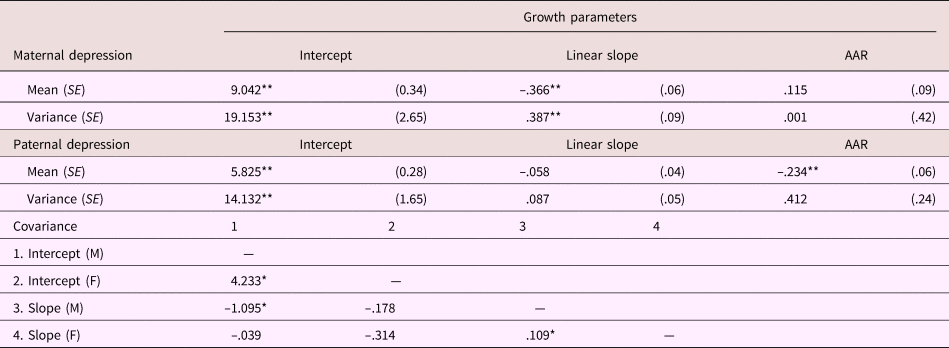
Three unconditional latent growth models of parallel growth processes of maternal and paternal depression in the year following the birth of the second child were fit, the linear growth model, the sudden persistent change model (quadratic), and the adjustment and adaptation response (AAR) model. A delta chi-square test indicated that adding the quadratic slope to the linear growth model did not improve model fit, Δχ2 (4) = 3.80, p = ns, but adding the AAR effect improved the model fit significantly, Δχ2 (4) = 21.28, p < .001. Based on AIC and other fit indices, we concluded the unconditional AAR model, AIC = 11,808.717, root mean square error of approximation (RMSEA) = .048, χ2 = 56.75, df = 37, comparative fit index (CFI) = .970, Tucker–Lewis index (TLI) = .975, was a better fitting model than the unconditional quadratic model, AIC = 11,826.197, RMSEA = .066, χ2 = 74.23, df = 37, CFI = .961, TLI = .953, and the unconditional linear growth curve model, AIC = 11,821.997, RMSEA = .063, χ2 = 78.03, df = 41, CFI = .961, TLI = .958. Thus, the unconditional growth model chosen to use in the LCGA to identify family groupings (classes) of maternal and paternal depression trajectories in the year following the birth of the second child included three individual growth parameters: (a) an intercept parameter with time centered at the prenatal time point, which represents maternal and paternal depressive symptoms during the last trimester of pregnancy; (b) a linear slope parameter, which represents the linear change in maternal and paternal depression over time; and (c) an AAR parameter that reflected an initial increase in depression 1 month after the birth with subsequent decline by 4 months (see Table 1 for growth parameters for the unconditional model). The average intercept of both maternal and paternal depression, the average linear slope of maternal depression, and the average AAR for paternal depression were significantly different from zero. In general, mothers had higher depressive symptoms during the last trimester of pregnancy than during the postpartum period, and their depressive symptoms decreased over the year after the infant's birth. Fathers, on average, had lower depressive symptoms than mothers, and their depressive symptoms decreased shortly after the infant's birth (between prenatal and 1-month time points), but increased again from 1 month to 4 months, reflecting the AAR effect. After 4 months, fathers’ depressive symptoms were fairly flat and stable over time. Significant variance existed in both intercepts of maternal and paternal depression and the linear slope of maternal depression underscoring the individual differences within the sample with respect to depression trajectories for both mothers and fathers (see Table 1). Table 1 also reveals that the intercepts of maternal depression and paternal depression were positively correlated, as were the linear slopes, indicating that mothers’ and fathers’ depressive symptoms during the last trimester of pregnancy, and change in depression over time, were correlated; decline in mothers’ depressive symptoms was associated with a decline in fathers’ depressive symptoms. For mothers, the intercept and the linear slope were negatively correlated, indicating that mothers with higher depressive symptoms during the last trimester of pregnancy decreased more in their depressive symptoms over time. Because the variance of the AAR contrasts for both maternal and paternal depression were nonsignificant, the covariance between AAR for both maternal and paternal depression and other growth parameters (intercept and linear slope) was fixed to 0 in the LCGA.
Unconditional latent growth curve model with linear slope and AAR for parallel growth parameters of maternal and paternal depression

Note: AAR, adjustment and adaptation response, which examines change (e.g., increase) from prenatal to 1 month and then change (e.g., decrease) from 1 month to 4 months. *p < .05. **p < .01. ***p < .001.
LCGA to identify family-level depression trajectories
LCGA was used to model simultaneously growth trajectories of maternal and paternal depression over time with the goal of identifying subgroups or classes of family-level patterns of depression. Fit indices were obtained for unconditional models with two, three, four, and five classes. The AIC and BIC values decreased as the number of classes increased. The BLRT likelihood ratio test indicated that the four-class model, AIC = 11,970.90, BIC = 12,098.26, Entropy = .84, BLRT (p) < .001, was more favorable than the three-class model, AIC = 12,090.94, BIC = 12,194.22, Entropy = .89, BLRT (p) < .001, and the five-class model, AIC = 11,900.36, BIC = 12,051.82, Entropy = .84, BLRT (p) = .67, was not a better fit in comparison to the four-class model. Thus, we chose the four-class model as the best fitting model.
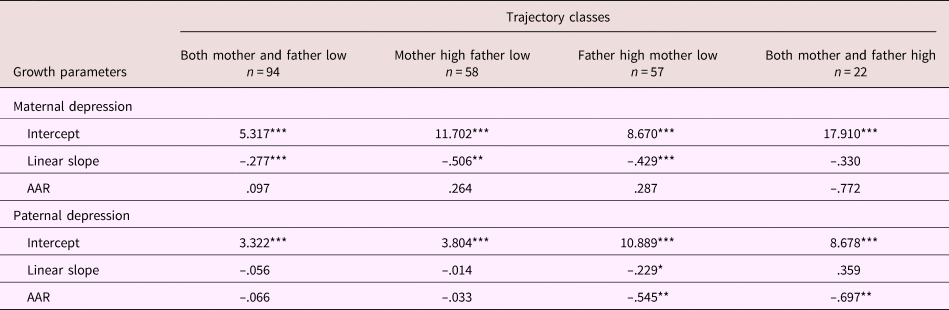
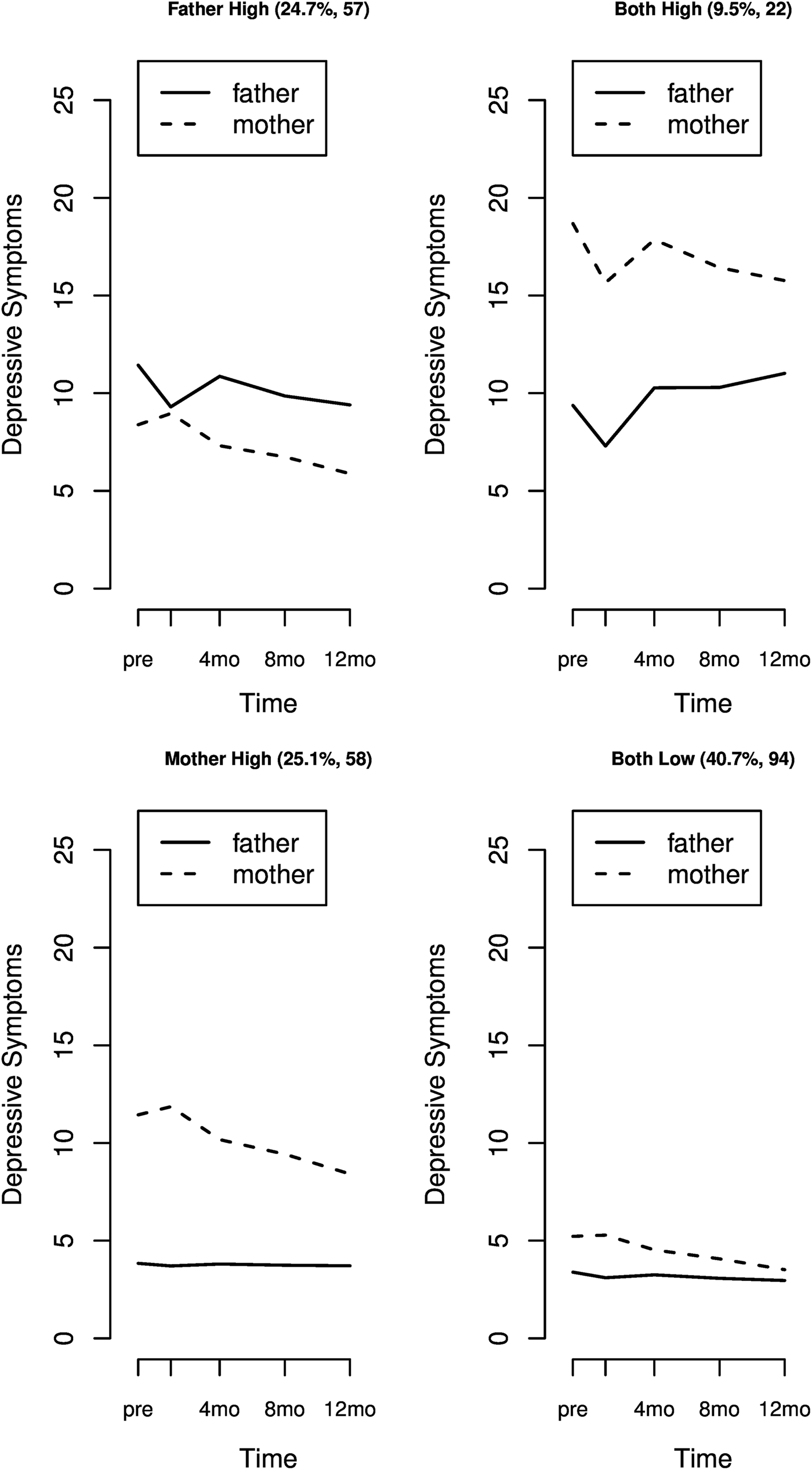
The four classes showing the trajectories for maternal and paternal depression are shown in Figure 1, and the unstandardized intercepts, linear slopes, and AAR effects are shown in Table 2, which allow for the interpretation of the classes that emerged. Mothers’ and fathers’ BDI scores were also examined to determine whether parents were within the minimal (0–13) or mild to severe (14 or greater) range for depressive symptoms. The largest class, both mother and father low in depressive symptoms (n = 94), accounted for 40.7% of the sample, and included both mothers and fathers reporting low depressive symptoms over the year after the infant's birth, with mothers’ depressive symptoms decreasing significantly over time and fathers’ depressive symptoms remaining stable. At the prenatal time point, all (100%) of the mothers and fathers in this class had BDI scores in the minimal range (<14). The second class of parents (n = 58, 25.1%), was labeled mother high–father low because mothers had higher depressive symptoms than fathers, and fathers’ scores were relatively low (see Table 2). Mothers in this class also significantly declined in depressive symptoms over time (see linear slope in Table 2), whereas there was no change in fathers’ depressive symptoms. In this class, 34.5% of mothers had BDI scores of 14 or above and all of the fathers were in the minimal range at the prenatal time point. The third class (n = 57, 24.7%), father high–mother low, consisted of families in which fathers actually had higher depressive symptoms than mothers. Further, Table 2 shows that fathers’ trajectories were characterized by an AAR with an initial decline in depressive symptoms from prenatal to 1 month, and an increase again by 4 months with a subsequent decline in depressive symptoms from 4 to 12 months. Mothers in this class had lower depressive symptoms than fathers and their depressive symptoms decreased over time. Here, 23% of fathers had BDI scores of 14 or greater, and 94.6% of mothers had BDI scores in the minimal range. The final and smallest class (n = 22) consisted of 9.5% of the sample. This class included mothers and fathers with relatively high depressive symptoms (compared to other mothers and fathers in the sample) and was labeled both mother and father high. Mothers’ depressive symptoms were high and stable over time, and fathers experienced an AAR, in which their depressive symptoms dropped right after the birth of the infant from prenatal to 1 month, but then increased to the initial level by 4 months and remained stable throughout the rest of the year. At the prenatal time point, 91% of mothers in this class and 10% of the fathers had BDI scores of 14 or higher.
Estimated mean trajectories of latent class growth analysis 4-class solution for maternal depression and paternal depression.
Unstandardized growth parameter estimates of trajectory classes for maternal and paternal depressive symptoms from latent class growth analysis

Note: AAR, adjustment and adaptation response, indicating an increase (or decrease) in depressive symptoms from prenatal to 1 month with a subsequent decrease (or increase) to initial prebirth levels from 1 month to 4 months. *p < .05. **p < .01. ***p < .001.
Descriptive statistics examining demographics such as household income, mothers’ and fathers’ ages, mothers’ and fathers’ education, firstborn children's age, and the length of marriage revealed only one significant difference for maternal education by class; mothers in the mother high–father low class and in the both mother and father high classes had lower education levels than did mothers in the other two classes. We controlled for mothers’ education in the multigroup latent growth models that follow. Chi-square analyses revealed no significant class differences for the gender of either the firstborn or the infant sibling.
Multigroup latent growth models to uncover child and family risks
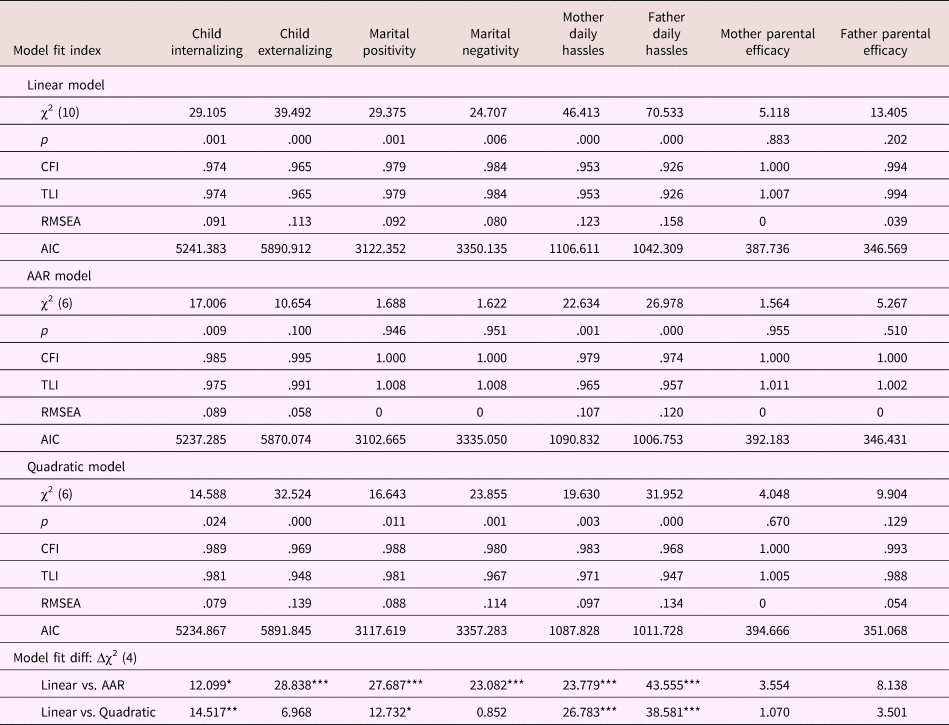
In an effort to determine whether children's internalizing and externalizing behavior problems differed across the latent classes, and whether there was evidence of risky family dynamics covarying with parental depression, we conducted multigroup latent growth models (Duncan, Duncan, Strycker, Li, & Alpert, Reference Duncan, Duncan, Strycker, Li and Alpert1999) to examine how the groups differed on the growth parameters of children's internalizing and externalizing problems, as well as marital positivity and negativity, mothers’ and fathers’ reports of daily parenting hassles, and parental self-efficacy. All models controlled for mothers’ education. We employed the same analytic strategy here to fit the unconditional latent growth curve models for each outcome variable as we did in our initial models testing for the hypothesized linear and nonlinear growth trajectories (the linear change model, sudden persistent change, and adjustment and adaptation) using orthogonal polynomial contrasts to determine the overall general pattern of change for the entire sample and then applied this best fitting model to test for class differences. Results of the model fit comparisons are shown in Table 3. Four out of six models supported the AAR model as the best fit to the longitudinal patterns in the sample; children's externalizing problems, marital negativity, and fathers’ daily hassles indicated an increase from prenatal to 1 month after the infant's birth (i.e., a period of adjustment), with an eventual decrease by 4 months to prebirth levels (i.e., adaptation). The AAR model was also the better fitting model for marital positivity, with a sudden decline from prenatal to 1 month with a subsequent increase by 4 months (see Table 3). The quadratic model reflecting sudden, persistent change or a maladaptive pattern of adjustment fit the trajectory patterns for mothers’ daily hassles and children's internalizing problems better than either the linear or AAR models. The linear growth model was the best fitting model for maternal and paternal parental efficacy. Based on this information, we conducted multigroup latent growth models using the trajectory classes of maternal and paternal depressive symptoms to examine class differences on the growth trajectories for each child and family variable.
Unconditional model comparisons of growth processes of children's internalizing and externalizing problems, marital positivity and negativity, and mothers’ and fathers’ daily hassles and parental efficacy

Note: AAR, adjustment and adaptation response. *p < .05. **p < .01. ***p < .001.
Additive or interactive models of family risk for children's internalizing and externalizing?
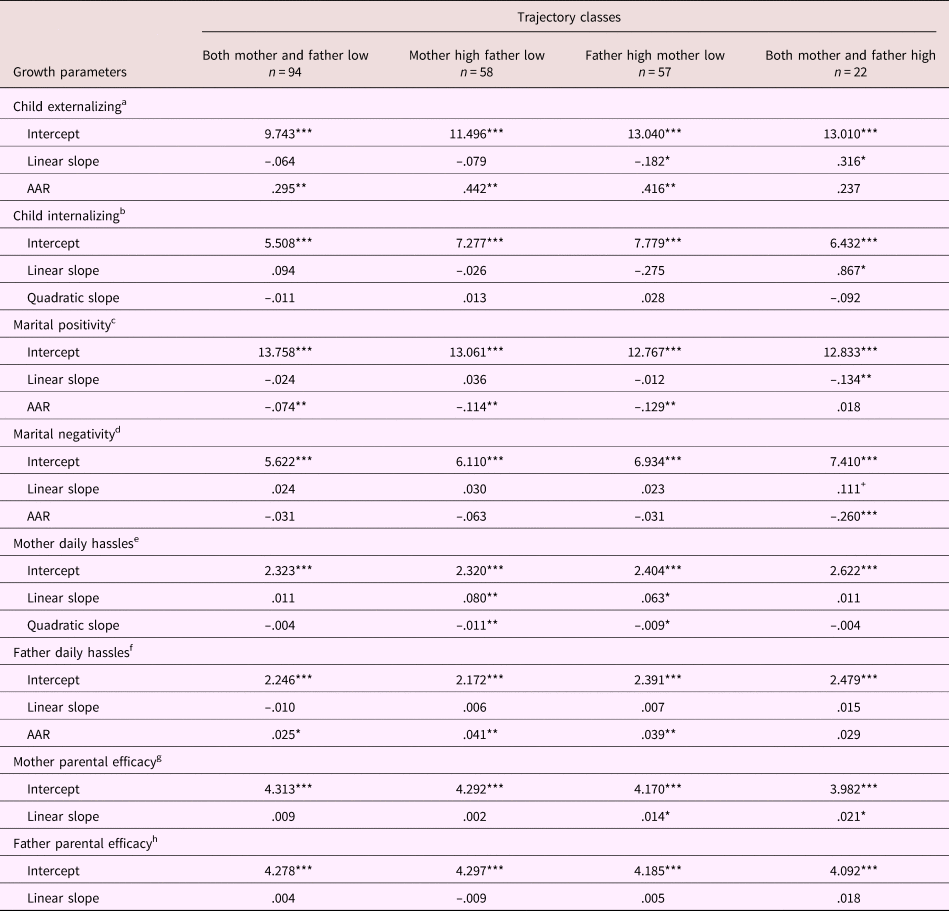
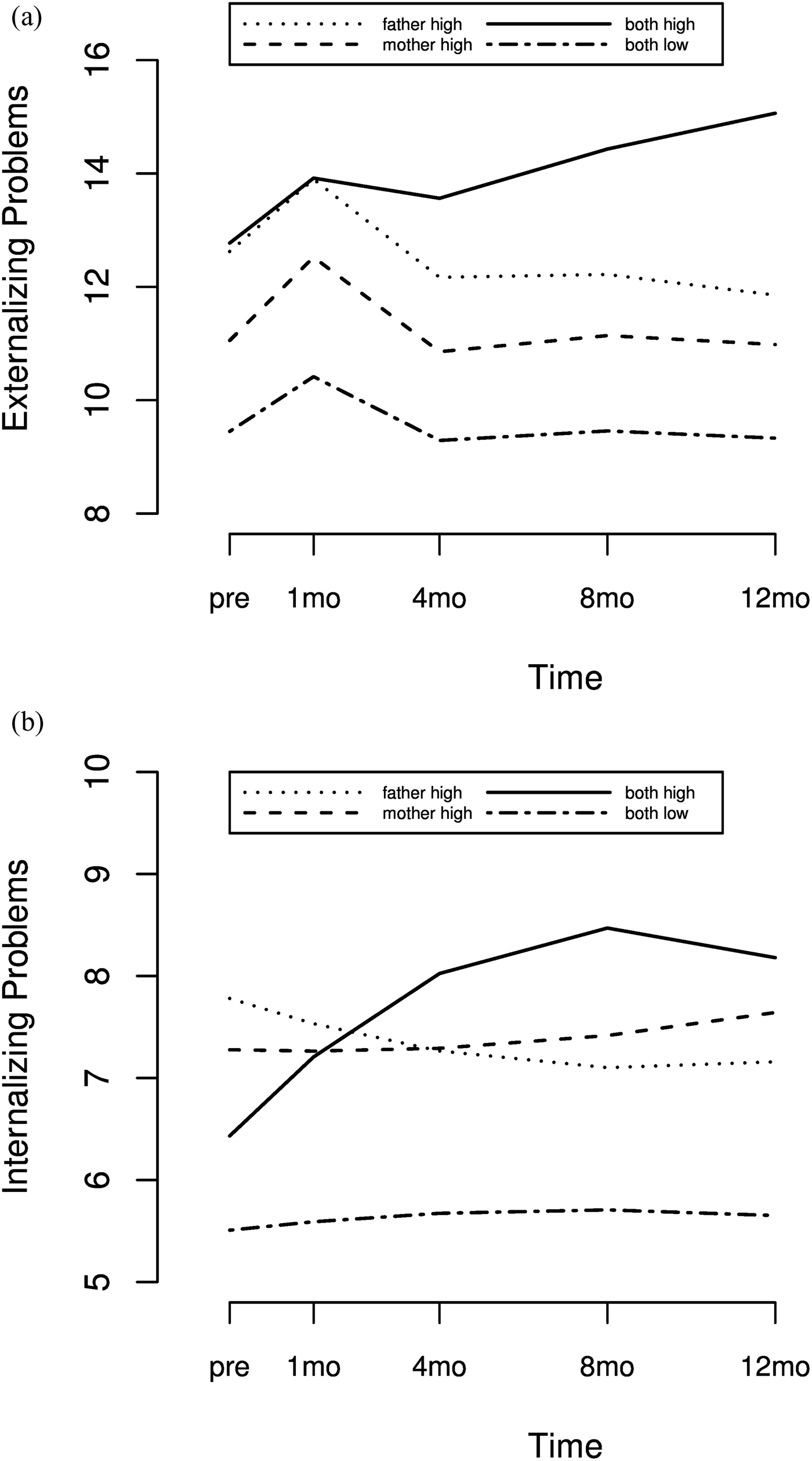
Table 4 presents the unstandardized intercepts, linear slopes, and nonlinear effects (quadratic or AAR) for the longitudinal growth trajectories of children's adjustment for each of the four depression classes. Figure 2 displays the estimated trajectories of children's internalizing and externalizing problems over time for each of the four classes.
Estimated mean trajectories of children's (a) externalizing and (b) internalizing problems for each depression trajectory class.
Unstandardized growth parameter estimates of depressive trajectory classes on firstborn children's internalizing and externalizing behavior problems, marital positivity and negativity, and parental daily hassles and parental self-efficacy

Note: All models controlled for mothers’ education. AAR, adjustment and adaptation response.
aModel fit: χ2 (43) = 54.935, p =.105; CFI = .986, TLI = .980, RMSEA = .069; 90% CI [0, .119].
bModel fit: χ2 (45) = 70.319, p =.009; CFI = .967, TLI = .956, RMSEA = .099; 90% CI [.050, .142].
cModel fit: χ2 (37) = 33.985, p =.611; CFI = 1.00, TLI = 1.01, RMSEA = 0; 90% CI [0, .082].
dModel fit: χ 2 (42) = 42.073, p =.468; CFI = 1.00, TLI = 1.00, RMSEA = .006; 90% CI [0, .090].
eModel fit: χ2 (42) = 75.789, p =.001; CFI = .957, TLI = .938, RMSEA = .118; 90% CI [.074, .160].
fModel fit: χ2 (44) = 92.712, p <.001; CFI = .940, TLI = .918, RMSEA = .138; 90% CI [.099, .178].
gModel fit: χ2 (52) = 59.955, p =.210; CFI = .988, TLI = .986, RMSEA = .052; 90% CI [0, .102].
hModel fit: χ2 (54) = 70.430, p =.066; CFI = .971, TLI = .967, RMSEA = .073; 90% CI [0, .118].
*p < .05. **p < .01. ***p < .001. +p < .10.
Externalizing behavior problems
At the prenatal time point (i.e., intercept), children in the both mother and father low class had lower externalizing problems than children in the mother high–father low class, Wald test = 3.940, df = 1, p = .047. Children in the father high–mother low class and the both mother and father high class had similar levels of externalizing problems at the prenatal time point, and children in both classes had higher externalizing problems than did children in the both mother and father low (Wald test = 16.614, df = 1, p < .001 for father high–mother low class; Wald test = 8.524, df = 1, p = .004 for the both mother and father high class), but not the mother high–father low class. Unlike the three classes in which neither or one parent had depressive symptoms, children in the class with both mother and father high on depressive symptoms showed a significant linear increase over the year following the birth of a sibling. For the three other classes, children showed a similar pattern of growth trajectories on their externalizing problems over time with an immediate increase in externalizing problems from prenatal to 1 month that eventually subsided by 4 months (AAR) and remained stable over the rest of the year to 12 months, even though each class differed in their intercepts (i.e., where they started at the prenatal time point). The father high–mother low and both mother and father high classes had distinct patterns of growth trajectories on children's externalizing problems over time, even though both had similar intercepts and increases from prenatal to 1 month. Children in the both mother and father high class were not able to return to prebirth levels of adjustment, and the accelerating trajectory for externalizing problems over the year indicated a clear pattern of maladjustment for these children, in contrast to patterns of resilience (i.e., AAR) seen for families with only one parent or no parent with depressive symptoms. Whereas children in the both mother and father high class continued to show significant increases in their externalizing over the year, children in the father high–mother low class showed a continuous decline in externalizing from 1 month to 12 months, after the initial increase (i.e., AAR).
Internalizing behavior problems
As Figure 2 shows, children in the both mother and father low class had the lowest levels of internalizing problems at the prenatal time point and remained low over time. Children in the both mother and father high class showed moderate levels of internalizing problems at the prenatal time point but also a significant increase over time that began to subside from 8 to 12 months (significant quadratic), but was still relatively high by the end of the year. Children in the mother high–father low, Wald test = 6.877, df = 1, p = .009, and father high–mother low classes, Wald test = 14.126, df = 1, p < .001, also had significantly higher internalizing problems at the prenatal time point than children in the both mother and father low class, and their scores remained stable over time.
Longitudinal patterns of family risks
To address our final aim examining risky family dynamics, we estimated trajectories of marital positivity and negativity, parental daily hassles, and feelings of parental efficacy over time for each class; the growth parameters for each class are summarized in Table 4. Figure 3 also shows the relationship trajectories for martial positivity and marital negativity for each of the four classes. In the both mother and father low class, the couple reported very high levels of marital positivity at the prenatal time point that followed an AAR pattern, with an immediate decline in marital positivity after the infant's birth that returned to prebirth levels by 4 months and remained positive over the year after the birth. These couples reported more marital positivity than couples in the other three classes. For mother high–father low families, Wald test = 7.004, df = 1, p = .008, and father high–mother low families, Wald test = 19.310, df = 1, p < .001, couples reported lower marital positivity in comparison to the both mother and father low class. Marital positivity also showed an AAR effect for these couples with an initial decrease from the prenatal to 1-month time points, followed by an increase from 1 to 4 months and then no change throughout the last half of the year. For both mother and father high families, couples reported similar levels of marital positivity as the father high–mother low families at the prenatal time point, and significantly lower than couples in the both mother and father low class, Wald test = 6.547, df = 1, p = .011, but their marital positivity progressively declined over time (see Figure 3).
Estimated mean trajectories of (a) marital positivity and (b) marital negativity for each depression trajectory class.

Regarding marital negativity, parents in the both mother and father low, mother high–father low, and father high–mother low groups reported no changes in their marital negativity over time. They did, however, differ on their marital negativity at the prenatal time point (i.e., intercept differences). The both mother and father low class reported the lowest levels of marital negativity at the prenatal time point in comparison to the other three classes, Wald test = 3.820, df = 1, p = .050 for the mother high–father low class; Wald test = 22.401, df = 1, p < .001 for the father high–mother low class; and Wald test = 16.372, df = 1, p < .001 for the both mother and father high class. Couples in the mother high–father low class reported higher levels of marital negativity than did parents in the both mother and father low class, and their marital negativity was lower than those couples in the father high–mother low class. Couples in the both mother and father high class had the highest scores on marital negativity at the prenatal time point and showed a distinct pattern of marital negativity reflecting an AAR effect with a significant decline from prenatal to 1 month but a return to prebirth levels by 4 months that remained stably high throughout the year.
Table 4 and Figure 4 display the estimated trajectories of mothers’ and fathers’ reports of parenting daily hassles over time for each group. Mothers in the both mother and father low group reported the lowest levels of daily parenting hassles at the prenatal time point, and remained low over the year after the birth. In contrast, mothers in the both mother and father high class reported the highest levels of parenting hassles at the prenatal time point that remained high throughout the year, and were significantly different from levels of parenting hassles for mothers in the both mother and father low, Wald test = 6.186, df = 1, p = .013, and mother high–father low classes, Wald test = 5.218, df = 1, p = .022. Mothers in the mother high–father low and father high–mother low classes reported similar levels of parenting hassles to the both mother and father low class at the prenatal time point; however, their parenting stress continued to increase over time with a gradual decline by the end of the year (i.e., significant quadratic effects; see Table 4). With respect to fathers’ parenting hassles, fathers in the both mother and father low and mother high–father low classes reported the lowest levels of parenting stress at the prenatal time point, and their trajectories followed an AAR pattern with an immediate increase from prenatal to 1 month followed by a decrease in parenting hassles from 1 to 4 months and no change throughout the last half of the year. Fathers in the father high–mother low class also evinced an AAR effect with the increase from prenatal to 1 month and decline by 4 months, but they reported higher parenting stress levels at the prenatal time point than mother high–father low fathers, which continued to be higher over time, Wald test = 5.809, df = 1, p = .016, Fathers in the both mother and father high class reported the highest levels of parenting hassles compared to the both mother and father low, Wald test = 4.970, df = 1, p = .026, and mother high–father low classes, Wald test = 7.579, df = 1, p = .016, which remained stable over time.
Estimated mean trajectories of (a) mothers’ daily hassles and (b) fathers’ daily hassles for each depression trajectory class.

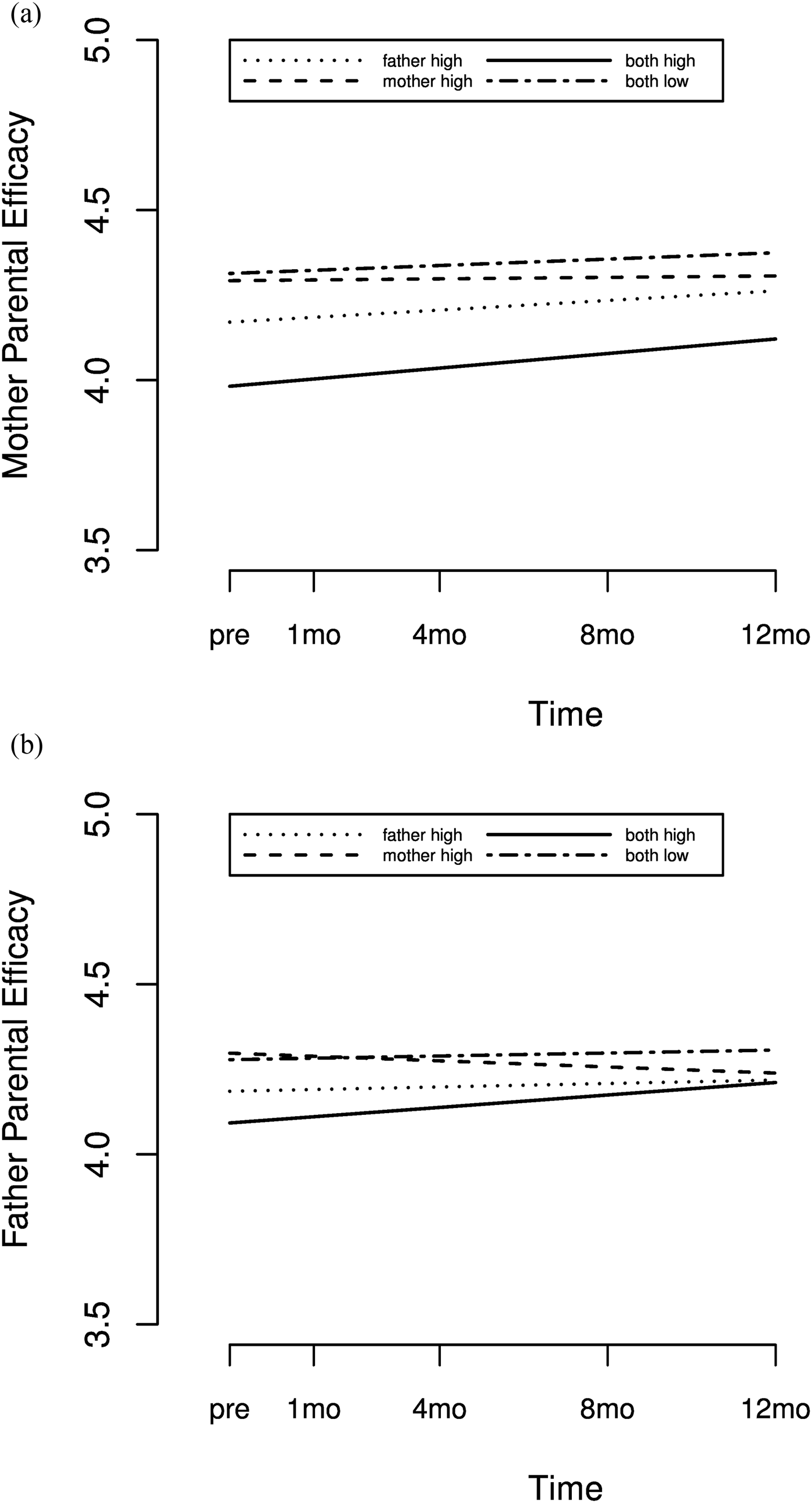
Finally, results for parental efficacy can be found in Table 4 and Figure 5. Here, we see that mothers’ efficacy was lower in families in the both mother and father high class compared to the mother high–father low, Wald test = 7.253 df = 1, p = .007, and both mother and father low classes, Wald test = 8.986, df = 1, p = .003, but not the father high–mother low class. Further, maternal efficacy was lower in the father high–mother low class than the both mother and father low class, Wald test = 5.636, df = 1, p = .018. Mothers in the father high–mother low and both mother and father high actually showed increases in their parental efficacy over the year following the birth. Paternal efficacy revealed fewer differences across classes and no change over time for any of the four classes of families. Fathers in the both mother and father high had lower parental efficacy at the prenatal time point (intercept differences, Wald test = 4.014, df = 1, p = .045), than fathers in the mother high–father low class.
Estimated mean trajectories of (a) mothers’ and (b) fathers’ parental efficacy for each depression trajectory class.
Discussion
The transition to siblinghood is characterized by individual variation in children's adjustment to the birth of an infant sibling (Volling, Reference Volling2012). As such, uncovering the risk and protective factors that predict individual differences in children's emotional and behavioral problems after the birth is important for targeting parent education and intervention efforts. The main goal of the current investigation was to focus on parental depression as a predictor of children's externalizing and internalizing behavior problems after the sibling's birth, given the significance of both maternal and paternal depression in predicting both infant and child outcomes (Edhborg et al., Reference Edhborg, Matthiesen, Lundh and Widström2005; Fisher et al., Reference Fisher, Brock, O'Hara, Kopelman and Stuart2015; Guyon-Harris et al., Reference Guyon-Harris, Huth-Bocks, Lauterbach and Janisse2016; Kane & Garber, Reference Kane and Garber2009). To this end, we took a family-level perspective and a person-centered statistical approach to identify classes or groups of families based on the depression trajectories for both mothers and fathers, starting in the last trimester of pregnancy and traversing the first year after the infant sibling's birth. We were interested in whether different trajectory classes would emerge that would allow us to examine both the additive and the interactive effects of maternal and paternal depression on firstborn children's problem behaviors. We were also interested in whether parenting and marital trajectories covaried with the depression trajectory classes that would demonstrate the complex interplay between child and parenting dynamics, as well as the accumulation of risks that exacerbate adjustment problems for children after the birth of a sibling.
Maternal and paternal trajectories of depression
As hypothesized, the LCGA with two parallel processes (maternal and paternal depression) identified four classes of families based on whether mothers and fathers were higher or lower on depressive symptoms relative to other parents in the sample. As part of our delineation of trajectory patterns, we relied on our prior conceptual model of maladjustment (i.e., sudden persistent change) and resilience (i.e., AAR), which was based on tenets of family stress theory and developmental psychopathology (see Volling et al., Reference Volling, Gonzalez, Oh, Song, Yu, Rosenberg and Stevenson2017). The first class included the largest group of couples in which both mothers and fathers were low on depressive symptoms. A second class included a smaller percentage of couples (9.5%) in which both mothers and fathers had higher depressive symptoms relative to other parents in the sample. As might be expected in a community-based sample, few parents had high depressive symptoms that met a clinical diagnosis. However, children in the smaller group of families with both parents high on depressive symptoms appeared to be at greater risk for developing both internalizing and externalizing problem behaviors because of the dual risk of two parents with depressive symptoms in the household. The last two classes included nearly equal numbers of families (25%) in which mothers were high on depressive symptoms and fathers were low, and fathers were high on depressive symptoms and mothers were low.
One of the unique strengths of this study was the simultaneous modeling of both maternal and paternal depression, and the inclusion of the AAR to test for family and child resilience. No prior study to our knowledge has used group-based trajectory analyses to model trajectories of maternal and paternal depression simultaneously. Recent findings analyzing either mothers’ (e.g., Guyon-Harris et al., Reference Guyon-Harris, Huth-Bocks, Lauterbach and Janisse2016) or fathers’ depression trajectories (e.g., Vänskä et al., Reference Vänskä, Punamäki, Tolvanen, Lindblom, Flykt, Unkila-Kallio and Tiitinen2017) independently have also uncovered four to five classes of trajectory patterns across the perinatal period, often with a low-stable group, a moderate-increasing or decreasing group, and other heterogeneous patterns of symptom severity. In general, the low-stable groups often have the most positive family and parenting experiences and the lowest incidence of children's social and emotional difficulties, similar to the both mother and father low class in the current study. However, in these prior studies, it was not known if some mothers in a low-stable group may be partnered with fathers in the moderate-increasing group, and whether this combined knowledge would improve prediction of both parenting and child outcomes. In the current study, it did, as children had more internalizing and externalizing problems in the father high–mother low class than the both low class. Only further investigations that consider both parents’ mental health trajectories together rather than separately can determine whether the findings reported here will replicate across other samples.
Although we are aware of no study that has intentionally modeled an AAR, an initial period of disruption shortly after the birth that was resolved months later, Vänskä et al. (Reference Vänskä, Punamäki, Tolvanen, Lindblom, Flykt, Unkila-Kallio and Tiitinen2017) did find support for a similar pattern in their study of 773 Finnish fathers queried about their psychological distress during pregnancy, and 2 months and 12 months after an infant's birth. Their early fatherhood class evinced a pattern of increased psychological distress at 2 months, with lower scores at both pregnancy and 12 months. These men reported negative fathering experiences but only at 2 months, suggesting that the initial period shortly after the birth was difficult for these fathers, yet they were able to adapt and manage the demands of raising an infant by the end of the first year. In the current investigation, the AAR effect was found across multiple aspects of family life (marital dynamics, externalizing behavior problems, and daily hassles), not just a single dimension, which suggests that the entire family system may undergo a period of disruption after the birth of the sibling. It also indicates, however, that most parents and children will eventually learn to manage these changes and adapt to the addition of a new family member. Interventions may help some families (i.e., both parents high in depressive symptoms) manage the transition period surrounding the birth of an infant sibling.
Children's adjustment and adaptation in families with and without depressive parents
The benefits of having information on both maternal and paternal depressive symptoms over the year following the birth allowed us to examine the adjustment of children exposed to none, one, or two parents with depressive symptoms (additive risk), as well as address the interaction and moderation of one parent's depressive symptoms in protecting children against the effect of depressive symptoms in the other parent (buffering). Further, with two seemingly equal classes with one parent (either mother or father) high and the other low, we could test directly if it mattered whether the depressed parent was the mother or the father. A number of scholars have proposed that fathers’ support during the transition to siblinghood is especially critical for the firstborn's adjustment given the significant changes occurring in the mother–firstborn relationship (e.g., increased confrontations and harsh discipline) and the time mothers must spend caring for a newborn infant (Gottlieb & Mendelson, Reference Gottlieb and Mendelson1990; Kreppner, Reference Kreppner1988; Stewart, Reference Stewart1990). As such, paternal depression during this transition may be particularly problematic for the development of children's externalizing and internalizing behavior should fathers be unable to support children during this time. Children in families with both mothers and fathers high on depressive symptoms fared the worst after the transition with respect to both internalizing and externalizing behavior problems. These children showed a steady increase in both their externalizing and internalizing behaviors over the year following the sibling's birth. In contrast, children in the other three classes demonstrated patterns of externalizing wherein they each showed a sudden increase from prenatal to 1 month, but then a decrease to prebirth levels by 4 months; the AAR pattern we believe reflects resilience in the face of stressful life circumstances given children are able to return to their prebirth “baseline” levels. In the case of internalizing, children in these three classes remained stable over time and showed no noticeable change. Thus, having two parents with depressive symptoms over the transition to siblinghood increased the likelihood of children showing maladjustment in that both externalizing and internalizing steadily increased over time and did not return to earlier, lower prebirth levels.
In addition to the maladjustment and resilience patterns uncovered, we also found evidence of an additive or “exposure-response” effect in that children in families with two parents with depressive symptoms had worse outcomes than children in families with only one parent with depressive symptoms, who, in turn, had worse outcomes than children with both parents low in depressive symptoms. These findings also suggested that children differed in their levels of externalizing and internalizing behavior problems before the birth of their sibling (i.e., intercept differences) and that exposure to one or two parents with depressive symptoms even before the birth played some role in these initial differences. However, as anticipated, children in families in which fathers were high on depressive symptoms and mothers low fared worse than children in families where mothers were high on depressive symptoms and fathers were low. Thus, fathers appeared to be a support for their firstborn children during this life transition. Should fathers be struggling with their own emotional problems, they may simply be unable to provide enough emotional sustenance for their children to assist them through the stresses following the birth of their infant sibling. Mothers often spend the majority of time with the infants and are most likely on maternal leave in the early months, so mothers may protect children in families with a father high in depressive symptoms. Yet, children with a mother high on depressive symptoms did not fare as well as children in families with neither parent having depressive symptoms because these children were higher in both externalizing and internalizing behaviors before and after the birth than children with two parents low on depressive symptoms. However, the AAR effect that emerged for these families suggested that children, even though initially reacting to the birth in the first month with increases in internalizing and externalizing, were resilient and able to return to prebirth levels, in contrast to the steady increases in problem behavior for children with two depressed parents.
Do parental and marital problems heighten risky family dynamics?
Due to the strong associations found in prior research between parental depression, marital conflict, and parental stress, and the suggestion that both marital conflict and parental distress are mediators between parental depression and children's maladjustment (Cummings et al., Reference Cummings, Keller and Davies2005; Goodman & Gotlib, Reference Goodman and Gotlib1999), our final aim focused on whether we could demonstrate covariation between trajectories of parental depression, marital relationship functioning, and parenting for mothers and fathers. We were working from the hypothesis that family risks are often correlated and there is spillover across family relationships. These correlated risks create family environments that make it difficult for both children and parents to function effectively, and in the end, increase the psychological and relationship difficulties for all family members. As hypothesized, there were differences in parenting hassles, parental self-efficacy, and marital relationship quality across the depressive trajectory classes in line with the exposure-response effect, and these differences were similar to the intercept differences found with children's behavior problems. Specifically, in families with both mothers and fathers high on depressive symptoms, couples had lower scores on marital positivity even before the birth and experienced a precipitous decline in marital positivity over the year. They also experienced a honeymoon effect for marital relationship change (i.e., a decline in marital negativity soon after the birth that returns to prebirth levels by 4 months), suggesting that these couples have problems maintaining positive and supportive relationships with one another devoid of conflict. Further, mothers in families with elevated maternal and paternal depressive symptoms reported more hassles and parenting stress with the firstborn during pregnancy and a steady increase over the year following the birth. Fathers’ parenting stress reflected an AAR effect with a sudden increase that eventually declined. These fathers, however, reported more parenting hassles than fathers in the other three depressive trajectory classes. Finally, both mothers and fathers in these families reported feeling less efficacious in their parenting of the firstborn compared to other parents, and this continued to be the case throughout the year following the birth of the sibling.
These results also highlight the significant risk of having a father with depressive symptoms over this transition period and the accompanying family dynamics that can contribute to children's adjustment difficulties. Marital positivity and parental efficacy were lower, marital negativity higher, and parenting hassles for mothers and fathers higher in the father high–mother low depressive class than the mother high–father low depressive class. Families, in which neither mother nor father was high in depressive symptoms reported little change over time in all areas of family life and experienced the highest levels of marital positivity, the lowest levels of marital negativity, feelings of parental efficacy, decreases in mothers’ parenting hassles over the year, and low levels of paternal hassles compared to families with one or both parents with depressive symptoms. It is important to note here that this class of parents who were both low in depressive symptoms was by far the largest group of families in this community-based sample (40.7%). This point should be underscored to demonstrate that most families can and do make it through the transition to a second child with little or no difficulties. In contrast to popular belief that children experience a developmental crisis upon the arrival of a sibling rival, our findings suggest that the majority of families manage the transition with little to no disruption in family life.
Having made that point, we must also acknowledge that some families do struggle with the transition, and children in these families do appear to experience significant adjustment problems that are deserving of attention. The results clearly indicated that children and parents struggle when both mothers and fathers are high on depressive symptoms during the transition. Many studies examining depression during the perinatal period focus on the mother–infant relationship and infant emotional outcomes. The current study is unique in that the focus was on the adjustment of firstborn children after the birth of an infant sibling, and consistent with a family-level perspective, included fathers. Significant numbers of children experience the transition to siblinghood, and yet research has almost completely neglected the topic, which has resulted in a limited understanding of how best to assist families struggling with the transition from one child to two (Volling, Reference Volling2012). The current research suggests that interventions may need to reach out to fathers, particularly those high in depressive symptoms, because such efforts will help these men in their family roles and allow them to care for themselves, engage with their children, and support their partners to create family environments conducive to children's adjustment and adaptation (i.e., resilience). Because problematic child behavior, marital issues, and parenting stress were prevalent in families when both parents were high on depressive symptoms, we would recommend family-centered interventions that focus on mothers and fathers as coparents. In the end, coparenting interventions may be more beneficial for children and their parents across the transition than any intervention focused on only one parent (Pruett, Pruett, Cowan, & Cowan, Reference Pruett, Pruett, Cowan and Cowan2017).
Limitations and directions for future research
Despite the many strengths of this investigation, there are also limitations. The sample consisted of a community-based sample of mostly White, middle-class families undergoing a normative life transition. We did not screen parents for depressive symptoms or recruit mothers or fathers with known psychiatric histories for inclusion in the study. Moreover, few parents scored in the range of severe or even moderate levels of depression. Still, we were able to uncover different trajectory patterns based on maternal and paternal depressive symptoms and demonstrate how marital relationship functioning, parenting efficacy, daily hassles, and children's behavior problems followed an exposure-response effect and covaried to create interrelated family system dynamics that either supported or undermined children's adjustment to the transition to siblinghood. We suspect these dynamics would only be intensified and lead to more distress for children and their parents in families with more severe parental psychopathology, greater financial stress, and more familial risk factors.
Further, LCGA, as an exploratory statistical tool, searches for patterns within a sample, and the investigators must provide meaning and interpretation of the resulting classes. Labels of both high or mother high–father low were based on parents’ BDI scores in relation to other parents in the sample, not clinically significant cutoffs on the BDI, and this is an important point to emphasize. Although 91% of mothers in the both high class were above the cutoff for mild depression, only 10% of fathers were, yet fathers in this class had higher depression scores, on average, than most other fathers in the sample. Even though both parents had higher scores than other parents, is it possible that the greater percentage of mothers with mild to moderate depressive symptoms in this class was what was responsible for these children's poorer outcomes and the associated family risks? Perhaps it was the severity of maternal depression in these families, and not necessarily having one or both parents with depressive symptoms, that accounted for the differences. Future investigations are certainly needed that examine the questions posed here using groups of mothers and fathers with known clinical diagnoses or who have reached clinical cutoffs when defining a both high group to know how the severity and duration of parental depression may play a role in explaining the current results. Further, we also need to acknowledge the bidirectional relations between family subsystems and the fact that even though parental depression may adversely affect children's behavior and create martial difficulties, dealing with difficult child behavior, marital duress, and the new demands of parenting two young children during this transition may also contribute to depressive symptoms, and create reciprocated, transactional processes that unfold over time.
Given our interest in the role of fathers for children's adjustment across the transition, families consisted of two-parent, heterosexual couples giving birth to their second child, and all fathers were resident. We cannot claim our results will generalize to other family constellations with nonresident fathers, same-sex parents, low-income families, or racial and ethnic minority families, and strongly advise that these families be included in future investigations. Finally, we focused on the firstborn children's adjustment in this paper, although many might argue that the infant is also at risk in families with one or more parents with depressive symptoms. We would certainly agree, but given the overwhelming focus on the effects of parental depression on infants in the postnatal period, even when an older sibling is present in the home, we chose to look at the firstborn children, believing that a focus on both children was beyond the scope of the current paper. Bringing a newborn infant into the family also brings sleepless nights, potentially lengthy bouts of fussing and crying, and frequent feedings at all hours of the day and night. In keeping with a family-level perspective, the sleeping, feeding, and crying habits of the newborn most certainly contribute to family dynamics and may even be responsible for the depressive symptoms, parenting stress, and marital difficulties reported by some of our parents, which then indirectly affected the older siblings. This is certainly a possibility worth pursuing. Future analyses are planned that will take advantage of the family perspective advanced here and focus on infant outcomes, but will also remain sensitive to the developmental transition in which these families find themselves (i.e., all infants have an older sibling).
In conclusion, the current study considered whether family-level patterns of depressive trajectories for mothers and fathers after the birth of a second child could be identified and what the effects were for firstborn children in families with two, one, or no parents with depressive symptoms. Different trajectory classes based on maternal and paternal depressive symptoms were uncovered that supported, in part, an additive model of risk in that children in families with one parent high on depressive symptoms fared worse than children with neither parent high on depressive symptoms, but better than children with both parents high on depressive symptoms. Children and parents in the father high–mother low families appeared to struggle across the transition more than children and parents in the mother high–father low families, which may be due to the particular developmental transition under investigation and the importance of fathers in supporting firstborn children when mothers are caring for a newborn. Future research may want to consider whether the effects of maternal and paternal depression may differ across the different stages of the family life cycle, rather than assuming the effects of maternal and paternal depression are similar across different developmental periods or even for all children in the family. Both mothers and fathers without depressive symptoms may protect children from developing adjustment difficulties after the birth of an infant sibling, and both mothers and fathers with depressive symptoms may increase the risk of difficulties. Children and parents in families with one or more parents high on depressive symptoms differed in levels of parenting hassles, feelings of parental efficacy, children's behavior problems, and marital difficulties even before the birth, indicating that parental depression, along with other family risk factors, and not necessarily the birth of an infant, may better explain children's adjustment before and after the birth. The birth of the infant sibling may exacerbate stresses in the family, but surely, the arrival of an infant cannot be blamed for children's behavioral difficulties, as is so often assumed in the popular and psychoanalytic literature on the birth of an infant sibling (Hindle & Sherwin-White, Reference Hindle and Sherwin-White2014; Mitchell, Reference Mitchell2013). It is time to stop blaming the baby for children's emotional and behavioral difficulties after the birth of a sibling, and start focusing on family dynamics. Only then can we support parents and their children undergoing the transition from one child to two.
Acknowledgments
We are grateful to the parents and children of the Family Transitions Study for the time and commitment they devoted to this research program, and to the many research staff who assisted with data collection.
Financial support
This research was supported by Eunice Kennedy Shriver National Institute of Child Health and Human Development Grants R01HD042607 and K02HD047423 (to B.L.V.).