Introduction
The family Hymenolepididae is the richest in number of recorded species of all families within Eucestoda, with about 850 species: 230 in mammals, the rest in birds (Czaplinski & Vaucher, Reference Czaplinski, Vaucher, Khalil, Jones and Bray1994). Czaplinski & Vaucher (Reference Czaplinski, Vaucher, Khalil, Jones and Bray1994) listed 34 valid genera of mammalian hymenolepidids, with eight of them primarily or exclusively from rodents. Of these, Hymenolepis (sensu stricto) and Rodentolepis Spasskii, 1954 are the most species-rich genera found in rodents.
There has been much controversy and confusion with regard to Rodentolepis straminea since it was first (inadequately) described by Goeze in 1782 and named as Taenia straminea (summarized by Baer & Tenora, Reference Baer and Tenora1970). Currently there is still some disagreement over whether this species should be assigned to Hymenolepis or Rodentolepis. It was originally assigned to the genus Rodentolepis Spasskii, 1954, which was erected for hymenolepidids with numerous hooks from mammals, and R. straminea was designated a type species of the group (Czaplinski & Vaucher, Reference Czaplinski, Vaucher, Khalil, Jones and Bray1994). However, Cunningham & Olson (Reference Cunningham and Olson2010) argued that the more common usage of Hymenolepis should be adopted, but stated that more defined molecular analyses would be required to fully interpret the systematics. Subsequently, a study by Haukisalmi et al. (Reference Haukisalmi, Hardman, Foronda, Feliu, Laakkonen, Niemimaa, Lehtonen and Henttonen2010) on the systematic relationships of hymenolepidid cestodes of rodents and shrews, using partial sequences of 28S ribosomal RNA, placed R. straminea in the ‘Rodentolepis’ clade. Recent papers refer to R. straminea, and in the Fauna Europaea (www.faunaeur.org) this is listed as the accepted name (updated in 2013). The genus Rodentolepis includes armed cestodes with a single row of numerous hooks and testes in a row or elongated triangle, separated into two groups by the female gonads; whereas the genus Hymenolepis includes only species with a rudimentary rostellar apparatus and no rostellar hooks, such as Hymenolepis diminuta. Therefore, in this paper R. straminea will be used.
Rodentolepis straminea was also originally thought to be synonymous with Rodentolepis microstoma; however, morphological examination and protein electrophoresis have now shown these to be separate species (Casanova et al., Reference Casanova, Santalla, Durand, Vaucher, Feliu and Renaud2001). Morphologically, R. straminea and R. microstoma are very similar and difficult to differentiate. The main method of distinguishing between the two species is based on identification of polar filaments in the eggs of R. microstoma and the absence of polar filaments in the eggs of R. straminea (Casanova et al., Reference Casanova, Santalla, Durand, Vaucher, Feliu and Renaud2001). Rodentolepis microstoma is commonly known as the ‘bile duct tapeworm’ of rodents, due to its predilection for the bile duct where it attaches by the scolex with the strobila extending into the duodenum. In contrast, R. straminea is usually found in the ileum.
Rodentolepis straminea is a generalist cestode for which murid rodents and cricetids are the definitive host. The intermediate hosts of R. straminea are thought to be beetles, and Tribolium confusum has been used in experimental infections (Walkey et al., Reference Walkey, Simmons and Nasher1980). In addition, cystercercoids of R. straminea were found to occur naturally in the oribatid mite Archipteria coleopterata (Prokopic, 1962). This is noteworthy as mites are usually associated with the intermediate stages of anoplocephalid cestodes rather than hymenolepidids (Prokopic, 1962).
In an experimental study on the specificity of R. straminea, it was shown that the preferred hosts were Apodemus flavicollis, Apodemus sylvaticus and Mesocricetus auratus (Walkey et al., Reference Walkey, Simmons and Nasher1980). Only individuals of Mus musculus with reduced immunological competence could be experimentally infected (Walkey et al., Reference Walkey, Simmons and Nasher1980). The preferred hosts of R. microstoma were M. musculus along with the golden hamster (M. auratus) (Dvorak et al., Reference Dvorak, Jones and Kuhlman1961). The morphological similarity between these two hymenolepidid species could have led to erroneous identification, particularly in earlier reports before the advent of molecular techniques.
Other hosts of R. straminea include Cricetus cricetus in Hungary (Tenora & Murai, Reference Tenora and Murai1970); Apodemus agrarius in Serbia and Slovakia (Ondrikova et al., Reference Ondrikova, Miklisova, Ribas and Stanko2010, Debenedetti et al., Reference Debenedetti, Sainz-Elipe, Sáez-Durán, Galicia, Imaz, Galán-Pulchades and Fuentes2014); A. flavicollis in Slovakia (Ondrikova et al., Reference Ondrikova, Miklisova, Ribas and Stanko2010); A. sylvaticus in Spain (Fuentes et al., Reference Fuentes, Saez, Trelis, Galan-Puchades and Esteban2004); Rattus norvegicus and Rattus rattus in the islands of the southern Indian Ocean (Pisanu et al., Reference Pisanu, Chapuis and Durette-Desset2001) and in Rhabdomys pumilia (four-striped grass mouse) and Mastomys natalensis (African soft-furred rat) in South Africa (Collins, Reference Collins1972). Rodentolepis straminea has also been recorded from Mus spretus, R. rattus and A. sylvaticus in the Iberian penisula (Feliu et al., Reference Feliu, Renaud, Catzeflis, Hugot, Durand and Morand1997).
Rodentolepis straminea has apparently been recorded from M. musculus and R. norvegicus in the UK (Corbett & Harris, Reference Corbet and Harris1991). In a study carried out in Essex (UK), R. straminea was recorded from Clethrionomys glareolus and Microtus agrestis (Nasher, Reference Nasher1976). It would appear that the only published record of R. straminea in A. sylvaticus in the British Isles is that from Ross Island, Kilarney, south-west Ireland, where R. straminea was found to infect 24% of the wood mice examined (O'Sullivan et al., 1984). The current study represents the first molecular confirmation of R. straminea in the British Isles and the first report of R. straminea infection of A. sylvaticus on the mainland of Great Britain.
Materials and methods
Collection and examination of helminths
Wood mice (A. sylvaticus) were trapped using Longworth and Ugglan traps over the period from October to December 2012, June and July 2013, October to December 2013 and January to March 2014, at Castle Irwell in Salford, Greater Manchester. Castle Irwell is a large area comprising student accommodation for the University of Salford, university sports pitches and an area of woodland within a dense urban area. It is bounded by the River Irwell on three sides and by a 2-m high brick wall, with a road and housing estate beyond on the other. Trapped wood mice were taken back to the laboratory, euthanized with isofluorane followed by cervical dislocation. Each mouse was sexed, weighed and its dimensions measured, then either dissected immediately following a standard dissection procedure or frozen at − 20°C for later examination. The intestinal tract and the liver were examined under a dissecting microscope for the presence of helminth parasites. Retrieved tapeworms were relaxed in water before being counted and fixed in 70% ethanol.
Wood mice were grouped on the basis of their weight into rough age groups: adults ( ≥ 20 g), young adults (13–19 g) and juveniles ( < 13 g) (Behnke et al., Reference Behnke, Lewis, Mohd Zain and Gilbert1999). Seasonality was assessed by grouping the sampling times into seasons: spring (March–May), summer (June–August), autumn (September–November) and winter (December–February).
Morphological identification of Rodentolepis and Hymenolepis species is difficult because they are very similar; they also have a wide geographical distribution and often low host specificity. Furthermore, after freezing or fixation R. straminea would appear to lose some or all of its scolex hooks readily, especially if its rostellum is everted, making identification more difficult (O'Sullivan et al., 1984; R. Rushworth, pers. obs.).
Morphological identification of cestodes was determined using keys (Khalil et al., Reference Khalil, Jones and Bray1994) and drawings from Haukisalmi et al. (Reference Haukisalmi, Hardman, Foronda, Feliu, Laakkonen, Niemimaa, Lehtonen and Henttonen2010). Nematodes were identified using keys (Anderson, Reference Anderson1974). The only trematode found was identified by the position of the testes. Tapeworms were stained with Mayer's paracarmine, using a protocol from the Natural History Museum, London (E. Harris, pers. comm.). The hooks on the scolex were cleared with a drop of lactic acid.
DNA amplification and sequence analysis
Ten specimens of putative R. straminea retrieved from the ileum of A. sylvaticus were included in this study. Tapeworms were fixed in 70% ethanol and genomic DNA was extracted using a Bioline Isolate II genomic DNA kit according to the manufacturer's instructions (Bioline, London, UK). A fragment within the internal transcribed sequence (ITS) 1 and 5.8S ribosomal RNA gene was amplified using the hymenolepid primers F3 (5′-GCGGAAGGATCATTACACGTTC-3′) and R3 (5′-GCTCGACTCTTCATCGATCCACG-3′) (Foronda et al., Reference Foronda, Lopez-Gonzalez, Hernandez, Haulisalmi and Feliu2011). Polymerase chain reaction (PCR) was carried out in 50 μl containing 10 × NH4 buffer (Bioline), 0. 5 μm of each primer, 200 μm of each deoxynucleoside triphosphate (dNTPs; Bioline), 2 mm MgCl2, 2.5 U of BioTaq DNA polymerase (Bioline) and 5 μl of template DNA. A Stratagene (La Jolla, California, USA) Robocycler was used, with a cycling profile of 5 min at 94°C for one cycle; followed by 30 s at 94°C, 30 s at 56°C and 30 s at 72°C for 35 cycles; and a final extension of 5 min at 72°C for one cycle.
PCR products were resolved electrophoretically on a 1.5% Tris–borate–EDTA (TBE) agarose gel, stained using gel red DNA dye and visualized using ultraviolet illumination (Syngene G:Box gel documentation and analysis system, Cambridge, UK). The amplified products were sequenced commercially (Beckman Coulter, Essex, UK) using the reverse PCR primer. Nucleotide sequences were analysed using FinchTV software package (Geospiza, Seattle, Washington, USA) and compared with those deposited in the National Center for Biotechnology Information (NCBI) database using BLAST (Basic Local Alignment Search Tool) (http://www.ncbi.nlm.nih.gov/BLAST/).
Data analysis
Data analysis was conducted using R statistical software version 3.1.1 (R core team, 2014). The sampled mouse population was described briefly and the prevalence, mean intensity (average worm burden amongst infected individuals), mean abundance (average worm burden throughout the whole population) and burden distribution of R. straminea were described (Bush et al., Reference Bush, Lafferty, Lotz and Shostak1997). Basic univariable assessments of differences in prevalence were conducted, using hypothesis testing as appropriate (Fisher's exact test for categorical variables; Cochran–Armitage trend test for ordered categorical variables; Mann–Whitney U test for continuous variables). A logistic regression model was developed in order to identify possible risk factors for infection with R. straminea. Due to the lack of R. straminea tapeworms during the spring sampling period, the ‘bayesglm’ procedure in the ‘arm’ package was used to stabilize the model regression coefficients. Although this procedure uses elements of Bayesian methodology (incorporation of prior distributions of the model coefficients), the model output was interpreted in a frequentist fashion. The model was first parameterized using all variables of interest (mouse weight, sex, sampling season, sampling year) and a manual stepwise process was used to remove those variables not contributing to the model (as assessed using a Likelihood ratio test, with a P value of 0.05 or less to suggest model contribution). Possible confounding was assessed by comparing model coefficients, with any change greater than 20% suggestive of confounding. Differences in mean intensity were largely assessed using bootstrapped t-tests and analyses of variance (ANOVAs) (Efron & Tibshirani, Reference Efron and Tibshirani1993), using tailored code written in R and 1000 iterations. For comparison of the burden and mouse weight, the Spearman rank correlation test was used (Best & Roberts, Reference Best and Roberts1975).
Results
Sequencing
PCR products were successfully obtained from all ten putative R. straminea tapeworms tested. Unambiguous sequence data were obtained for all PCR products. A BLAST search of these data (a 513 bp ITS1 and 5.8S ribosomal RNA fragment) indicated that all were indistinguishable from one another and shared 100% sequence identity to R. straminea (GenBank accession number JN258054).
Morphology and distribution of adult R. straminea tapeworms
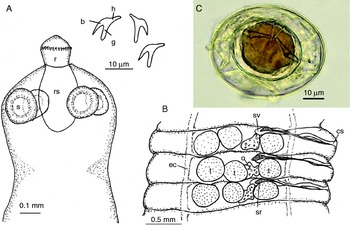
The tapeworms were relatively long and thin, ranging from 60 mm to 165 mm (mean length = 112 mm), with a body width of up to 2 mm. The proglottids were wider than long, craspedote, with maturation progressing down the strobila. The scolex is small with four suckers and a retractable rostellum armed with single crown of small hooks. There are 21–26 cricetoid hooks (short handle and pronounced guard) which are approximately 14 μm long (fig. 1A). Each proglottid contained three testes arranged in a row with a single lobed ovary and vitellarium in the centre (fig. 1B). The eggs were slightly oval with no polar filaments and measured approximately 62–66 μm × 36–50 μm (fig. 1C). The oncosphere hooklets were longer than those on the scolex.
Rodentolepis straminea to show: (A) the scolex, (B) a mature segment and (C) an egg containing a hexacanth embryo. h, Handle; b, blade; g, guard; r, rostellum (everted); rs, rostellar sac; s, sucker; cs, cirrus sac; sv, seminal vesicle; sr, seminal receptacle; t, testes; o, ovary; ec, excretory canal.

The distribution of R. straminea burden within wood mice showed a clear right skew (moment coefficient of skewness 3.7), suggesting an overdispersed distribution, as is commonly seen in macroparasitic infections (Crofton, Reference Crofton1971). The mean intensity of infection was 7.8 worms per mouse, and the mean abundance was 2.2 worms per mouse.
Seasonality, age and sex of A. sylvaticus
A total of 79 wood mice were captured over the study period, of which 47 (59%) were female (χ2(1)=2.85; P= 0.1). Most of the mice captured (53 mice; 67%) were young adults, and 20 (25%) were adults. Although all six juvenile mice (8% of the total) were trapped during 2013, there was no evidence of any significant temporal trends in age (Fisher's exact test P value = 0.2) or weight (Kruskal–Wallis test χ2(5) = 5.72; P= 0.3) distribution over the sampling period. Only one sampling collection was conducted in the spring and summer months (2014 and 2013, respectively), and two were conducted in autumn and winter. The number of mice collected per season ranged from eight (spring 2014) to 22 (autumn 2013).
Helminth species and levels of infection
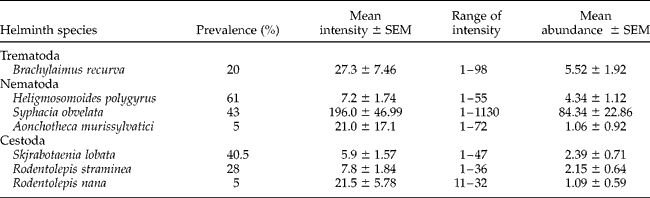
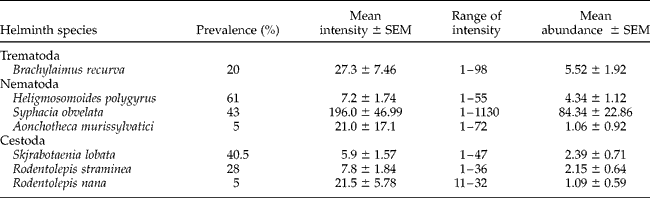
Seven species of intestinal helminths were recorded in A. sylvaticus from Castle Irwell, including three nematode species (Heligmosomoides polygyrus, Syphacia obvelata and Aonchotheca murissylvatici), one trematode species (Brachylaimus recurva) and three cestode species (Skjrabotaenia lobata, R. straminea and Rodentolepis nana) (table 1). Overall, 90% of the wood mice were infected with one or more helminth species. Intestinal cestodes were identified in 47 (59.5%) of the wood mice trapped in Castle Irwell, Salford. Cestodes now identified as R. straminea were found in 22 wood mice (27.8%) and could be seen through the intestinal wall of the posterior part (ileum) of the intestine prior to dissection. The most commonly identified cestode was S. lobata which was found in 32 (41%) of the wood mice. The presence of this worm often caused an enlargement of the anterior part of the intestine. Of the 22 wood mice infected with R. straminea, 10 (45%) were also infected with S. lobata, which suggested there was no interaction between infection with the two worms (χ2(1) = 0.09; P= 0.8).
Intestinal helminths infecting 79 Apodemus sylvaticus from Castle Irwell, Salford.
The only other hymenolepidid species found in four wood mice (5.1%) from Castle Irwell was R. nana. Rodentolepis nana is considerably smaller than R. straminea, measuring up to 35 mm in length and 0.6–1 mm in width, and it is often firmly attached to the gut wall. It has a retractable rostellum with a single crown of approximately 23 fraternoid (Baer & Tenora, Reference Baer and Tenora1970) hooks (long, curved handle and a short blade and guard) measuring approximately 16 μm.
There was no evidence of any difference in prevalence of R. straminea between male and female mice (χ2(1) = 0.66; P= 0.4). The Cochran–Armitage test for trend identified evidence of a borderline linear increase in prevalence as age increased (χ2(1) = 3.51; P= 0.06), with the prevalence in juveniles, young adults and adults estimated as 17, 23 and 45%, respectively. Similarly, a Mann–Whitney U test showed evidence that mice infected with R. straminea had a higher median weight than those not infected (18.7 g vs. 15.9 g; P= 0.01).
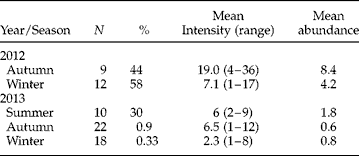
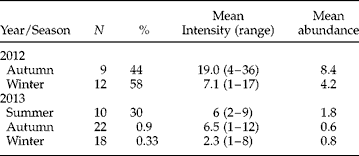
There was evidence of temporal variation in the prevalence of infection with R. straminea over the sampling period (Fisher's exact test P= 0.01). This effect remained apparent when the year alone was assessed (Fisher's exact test P= 0.02), with a higher prevalence in 2012 compared to subsequent years (table 2). There was weak evidence of variation in prevalence according to season (Fisher's exact test P= 0.05), which remained when only autumn and winter (the only seasons for which two samplings were available) were compared (Fisher's exact test P= 0.06). This suggested that the prevalence in winter was higher than that in autumn.
Prevalence (%), mean intensity and mean abundance of Rodentolepis straminea from Castle Irwell, Salford. N, number of wood mice examined. The eight mice examined in 2014 were not infected.
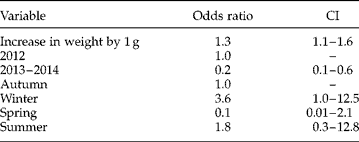
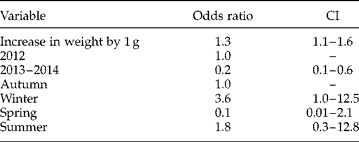
In order to account for possible confounding, a multivariable logistic regression model was developed – the results of which are shown in table 3. Due to possible collinearity between the spring season and the year 2014, the year of sampling was condensed into two categories: period 1 (autumn/winter 2012) and period 2 (summer 2013–spring 2014). As expected from univariable analysis, there was a significant effect of weight, sampling period and season. The model fit, as assessed by the Hosmer–Lemeshow goodness of fit test with 10 groups, was good (χ2(8) = 6.05; P= 0.6).
Rodentolepis straminea final logistic regression model; CI, 95% confidence interval; dates and seasons relate to the timing of sampling.
There was no evidence of any difference in the mean abundance of infection between mice of different sexes (t(76) = 0.28; bootstrapped P= 0.4), or of different estimated ages (F(2) = 0.65; bootstrapped P= 0.4). However, there was evidence of a positive correlation between mouse weight and burden (Spearman's rho = 0.3; P= 0.01). There was also evidence of variation in mean intensity of infection during different years, with a mean burden of 6 worms per mouse in 2012, 0.8 in 2013 and 0.7 in 2014 (F(2) = 7.58; bootstrapped P= 0.01). There was no evidence of any difference in mean worm burden in different seasons (F(3) = 0.55; bootstrapped P= 0.5).
Discussion
Morphological and molecular methods have confirmed the presence of the hymenolepidid tapeworm R. straminea in A. sylvaticus with a prevalence of 27.8% from an urban area in Salford, Greater Manchester (UK). As far as can be ascertained, this would appear to be the first record of this species in A. sylvaticus in mainland Britain. Rodentolepis straminea has, however, been recorded from Apodemus spp. in continental Europe (Gouy de Bellocq et al., Reference Gouy de Bellocq, Sara, Casanova, Feliu and Morand2003; Fuentes et al., Reference Fuentes, Saez, Trelis, Galan-Puchades and Esteban2004).
There would appear to be no published surveys of the helminth parasites of A. sylvaticus in urban areas in the UK or Europe. However, there have been many published surveys of the helminth parasites of A. sylvaticus in the British Isles (Elton et al., Reference Elton, Ford and Baker1931, Sharpe, Reference Sharpe1964; Lewis, Reference Lewis1968; Lewis & Twigg, Reference Lewis and Twigg1972; Murua, Reference Murua1978; Langley & Fairley, Reference Langley and Fairley1982; Montgomery & Montgomery, Reference Montgomery and Montgomery1990; Behnke et al., Reference Behnke, Lewis, Mohd Zain and Gilbert1999; Abu-Madi et al., Reference Abu-Madi, Behnke, Lewis and Gilbert2000; Rogan et al., Reference Rogan, Craig, Hide, Heath, Pickles and Storey2007). Rodentolepis straminea was not reported from any of these studies, the majority of which were from rural areas and only one of the areas studied (in Bristol) could be considered to be peri-urban (Murua, Reference Murua1978).
The results reported in this study suggest that the prevalence of R. straminea infection in A. sylvaticus increases with age and weight. This is not surprising as, generally, older animals have a higher level of infection (Behnke et al., Reference Behnke, Gilbert, Abu-Madi and Lewis2005). There was no significant difference of infection rate between male and female mice. The mean intensity of infection was higher in 2012 than in a similar period in 2013. This could be due to the bumper seed harvest in 2013, leading to fewer arthropods being eaten.
Populations of wild vertebrates inhabiting urban environments often show several significant ecological and behavioural differences compared with populations of the same species living in their natural, non-urban habitat. These include higher density, reduced territories, prolonged breeding season, reduced losses from predators, shift in diet composition, nesting in or on man-made constructions and reduced fear of man (Gliwicz et al., Reference Gliwicz, Goszczynski and Luniak1994). Dickman & Doncaster (Reference Dickman and Doncaster1987) found that A. sylvaticus in urban areas of Oxford had a higher population density than their rural counterparts. Urban areas tend to have a slightly higher temperature than rural areas (Bradley & Altizer, Reference Bradley and Altizer2007), and this could lead to an increase in the population of the potential arthropod intermediate hosts. The (experimental) intermediate host for R. straminea is T. confusum (Walkey et al., Reference Walkey, Simmons and Nasher1980), a beetle commonly found in stored grains. However, the oribatid mite A. coleopterata was shown to be a naturally infected intermediate host in the Czech Republic by Prokopic (1962).
Commensal rodents such as R. rattus, R. norvegicus and M. musculus may be relatively common in urban areas, and Walkey et al. (Reference Walkey, Simmons and Nasher1980) showed that only immunocomprised M. musculus could be infected with R. straminea. In contrast, R. straminea has been recorded in R. rattus in continental Europe (Feliu et al., Reference Feliu, Renaud, Catzeflis, Hugot, Durand and Morand1997); thus, this could be a reservoir for cross-infection to Apodemus in urban sites. Apodemus sylvaticus has also been considered a species well adapted to urban ecosystems (Dickman & Doncaster, Reference Dickman and Doncaster1987).
In conclusion, this study represents the first molecular confirmation of R. straminea in the British Isles and a new host record for this species in A. sylvaticus on the mainland of Great Britain. Further work could include studies on the parasites found in A. sylvaticus in other urban sites throughout the UK and the potential role of oribatid mites in the transmission of R. straminea.
Acknowledgements
The authors would like to thank the University of Salford for providing the opportunity to carry out this study. We would also like to thank Alex MacIvor for his assistance with the sampling, and Dr R.A. Bray from the Natural History Museum, London, Professor B.B. Georgiev from the Institute of Biodiversity and Ecosystem Research, Bulgaria and Dr S. Foster from Beckman Coulter Genomics for their invaluable help and advice.
Financial support
This research received no specific grant from any funding agency, commercial or not-for-profit sectors.
Conflict of interest
None.
Ethical standards
Wood mice were euthanized humanely according to UK Home Office guidelines.